Recognition: unknown
Engineering molecular potential energy surfaces using magnetic cavity quantum electrodynamics
Pith reviewed 2026-05-09 22:34 UTC · model grok-4.3
The pith
Magnetic cavity coupling renders H2 ground states metastable, inverts singlet-triplet gaps, and stabilizes exotic antiaromatic states in rings like H4 and C4H4 by preventing Jahn-Teller distortions.
A machine-rendered reading of the paper's core claim, the machinery that carries it, and where it could break.
Core claim
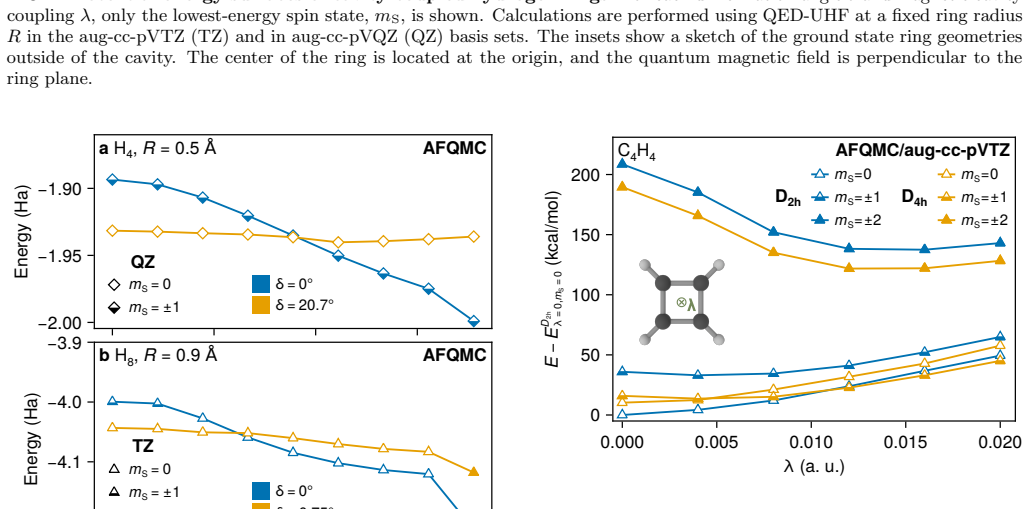
In H2, we find that a strong enough cavity coupling makes the original bound ground state metastable, along with inverting the singlet-triplet gap. In ring molecules (e.g., Hn), the magnetic cavity coupling stabilizes symmetric geometries. As a consequence, open-shell rings such as H4, H8, or C4H4, which would undergo Jahn-Teller distortions outside of the cavity, obtain exotic spin or ring-current polarized, antiaromatic ground states.
Load-bearing premise
The cavity-molecule interaction is modeled as a quantum-magnetic field that couples directly to molecular electrons beyond the long-wavelength approximation, and that auxiliary-field quantum Monte Carlo accurately captures the resulting interplay with electron correlations without significant uncontrolled errors.
Figures



read the original abstract
We investigate the effects of coupling a quantum-magnetic cavity field to molecules. Our high-precision auxiliary-field quantum Monte Carlo calculations capture the effect of the cavity field in the presence of electron correlations, and their interplay and competition. In H$_2$, we find that a strong enough cavity coupling makes the original bound ground state metastable, along with inverting the singlet-triplet gap. In ring molecules (e.g., H$_n$), the magnetic cavity coupling stabilizes symmetric geometries. As a consequence, open-shell rings such as H$_4$, H$_8$, or C$_4$H$_4$, which would undergo Jahn-Teller distortions outside of the cavity, obtain exotic spin or ring-current polarized, antiaromatic ground states. These effects are enhanced by increasing the molecule concentration inside the cavity. Our results suggest cavity quantum electrodynamics beyond the long-wavelength approximation as a promising avenue for cavity-altered chemistry.
Editorial analysis
A structured set of objections, weighed in public.
Referee Report
Summary. The manuscript investigates the coupling of molecules to a quantum-magnetic cavity field beyond the long-wavelength approximation. Using auxiliary-field quantum Monte Carlo (AFQMC) to incorporate electron correlations, it reports that sufficiently strong cavity coupling renders the H2 ground state metastable while inverting the singlet-triplet gap; for ring molecules (Hn, C4H4), the coupling stabilizes symmetric geometries, yielding exotic spin- or ring-current-polarized antiaromatic ground states in open-shell systems that otherwise undergo Jahn-Teller distortion. Effects are stated to strengthen with increasing molecular concentration inside the cavity.
Significance. If the numerical results hold, the work demonstrates a concrete route to engineering molecular potential energy surfaces and electronic states via magnetic cQED, with potential implications for controlling stability, spin gaps, and aromaticity. The explicit use of AFQMC to treat the interplay between the cavity-induced vector-potential terms and electron correlation constitutes a methodological strength, providing quantitative predictions rather than perturbative estimates.
major comments (2)
- [Methods] § Methods (AFQMC implementation for cavity-augmented Hamiltonian): No benchmarks against exact diagonalization are reported for the modified Hamiltonian that includes direct magnetic vector-potential coupling to electrons. This is load-bearing for the central claims, as the metastability threshold in H2 and the stabilization of symmetric ring geometries rest on AFQMC energies whose accuracy for the non-local phase factors and altered kinetic terms has not been validated even in minimal bases.
- [Results for H2] Results for H2 (metastability and singlet-triplet inversion): The reported energy differences and critical coupling strengths lack explicit convergence data with respect to walker population, imaginary-time step, or basis-set size, and no error bars are provided for the key energy crossings. Without these, the quantitative location of the metastability point remains sensitive to possible uncontrolled stochastic or Trotter errors specific to the cavity-modified Hamiltonian.
minor comments (2)
- [Theory/Methods] The definition of the cavity-molecule Hamiltonian (likely Eq. in §2) should explicitly state the gauge choice and the truncation of the vector-potential expansion to clarify how the beyond-long-wavelength terms are implemented.
- [Results for rings] Figure captions for the ring-molecule potential energy surfaces should include the precise definition of the distortion coordinate and the cavity coupling value used for each curve.
Simulated Author's Rebuttal
We thank the referee for the careful and constructive review, as well as for recognizing the potential significance of magnetic cQED for engineering molecular states. We address the two major comments point by point below. Both can be resolved by additions to the manuscript, which we will incorporate in the revised version.
read point-by-point responses
-
Referee: [Methods] § Methods (AFQMC implementation for cavity-augmented Hamiltonian): No benchmarks against exact diagonalization are reported for the modified Hamiltonian that includes direct magnetic vector-potential coupling to electrons. This is load-bearing for the central claims, as the metastability threshold in H2 and the stabilization of symmetric ring geometries rest on AFQMC energies whose accuracy for the non-local phase factors and altered kinetic terms has not been validated even in minimal bases.
Authors: We thank the referee for highlighting this point. Our AFQMC implementation augments the standard auxiliary-field formalism with the cavity vector-potential terms in the kinetic operator, preserving the structure of the Hubbard-Stratonovich transformation. To directly address the concern, we have performed additional benchmark calculations for H2 in a minimal basis, comparing AFQMC energies against exact diagonalization across a range of cavity coupling strengths. These tests confirm that the implementation accurately captures the modified kinetic terms and associated phase factors. We will add a dedicated subsection (or supplementary figure) in the Methods section of the revised manuscript presenting these benchmarks. revision: yes
-
Referee: [Results for H2] Results for H2 (metastability and singlet-triplet inversion): The reported energy differences and critical coupling strengths lack explicit convergence data with respect to walker population, imaginary-time step, or basis-set size, and no error bars are provided for the key energy crossings. Without these, the quantitative location of the metastability point remains sensitive to possible uncontrolled stochastic or Trotter errors specific to the cavity-modified Hamiltonian.
Authors: We agree that explicit convergence data and statistical error bars are necessary to support the quantitative claims. Although internal convergence tests were performed during the study, they were not reported in detail. In the revised manuscript we will add figures or tables that demonstrate the stability of the reported energy differences and critical coupling strengths with respect to walker population, imaginary-time step, and basis-set size. Statistical error bars (from the AFQMC stochastic sampling) will be included on all key quantities, including the metastability threshold and singlet-triplet crossing points. revision: yes
Circularity Check
No circularity: results are direct AFQMC outputs on explicit Hamiltonian
full rationale
The paper's central claims (metastable H2 ground state, singlet-triplet inversion, Jahn-Teller suppression in rings) are obtained as numerical outputs from auxiliary-field quantum Monte Carlo applied to an explicitly constructed Hamiltonian that augments the molecular electronic Hamiltonian with direct magnetic vector-potential coupling. No step in the reported derivation chain reduces by the paper's own equations to a fitted parameter, self-definition, or self-citation chain; the outcomes are not predictions forced by construction but computed observables for the stated model. The methodology relies on standard AFQMC techniques without introducing tautological redefinitions or ansatzes smuggled via prior self-citations. This is the most common honest finding for a computational study whose results are benchmarked against the input Hamiltonian rather than derived analytically from it.
Axiom & Free-Parameter Ledger
free parameters (2)
- cavity coupling strength
- molecule concentration inside the cavity
axioms (2)
- domain assumption The magnetic cavity field couples to molecular electrons in a manner that can be treated beyond the long-wavelength approximation
- domain assumption Auxiliary-field quantum Monte Carlo provides a sufficiently accurate description of electron correlations in the presence of the cavity field
Reference graph
Works this paper leans on
-
[1]
Ruggenthaler, J
M. Ruggenthaler, J. Flick, C. Pellegrini, H. Appel, I. V. Tokatly, and A. Rubio, Quantum-electrodynamical density-functional theory: Bridging quantum optics and electronic-structure theory, Phys. Rev. A90, 012508 (2014)
2014
-
[2]
H¨ ubener, U
H. H¨ ubener, U. De Giovannini, C. Sch¨ afer, J. Andberger, M. Ruggenthaler, J. Faist, and A. Rubio, Engineering quantum materials with chiral optical cavities, Nature Materials20, 438 (2021)
2021
-
[3]
Schlawin, D
F. Schlawin, D. M. Kennes, and M. A. Sentef, Cavity quantum materials, Applied Physics Reviews9, 011312 (2022)
2022
-
[4]
H¨ ubener, E
H. H¨ ubener, E. V. Bostr¨ om, M. Claassen, S. Latini, and A. Rubio, Quantum materials engineering by structured cavity vacuum fluctuations, Materials for Quantum Tech- nology4, 023002 (2024)
2024
-
[5]
Appugliese, J
F. Appugliese, J. Enkner, G. L. Paravicini-Bagliani, M. Beck, C. Reichl, W. Wegscheider, G. Scalari, C. Ciuti, and J. Faist, Breakdown of topological protection by cav- ity vacuum fields in the integer quantum Hall effect, Sci- ence375, 1030 (2022)
2022
-
[6]
G. Jarc, S. Y. Mathengattil, A. Montanaro, F. Giusti, E. M. Rigoni, R. Sergo, F. Fassioli, S. Winnerl, S. Dal Zilio, D. Mihailovic, P. Prelovˇ sek, M. Eckstein, and D. Fausti, Cavity-mediated thermal control of metal-to- insulator transition in 1T-TaS2, Nature622, 487 (2023)
2023
-
[7]
Enkner, L
J. Enkner, L. Graziotto, D. Bori¸ ci, F. Appugliese, C. Re- ichl, G. Scalari, N. Regnault, W. Wegscheider, C. Ciuti, and J. Faist, Tunable vacuum-field control of fractional and integer quantum Hall phases, Nature641, 884 (2025)
2025
-
[8]
Keren, T
I. Keren, T. A. Webb, S. Zhang, J. Xu, D. Sun, B. S. Y. Kim, D. Shin, S. S. Zhang, J. Zhang, G. Pereira, J. Yao, T. Okugawa, M. H. Michael, E. Vi˜ nas Bostr¨ om, J. H. Edgar, S. Wolf, M. Julian, R. P. Prasankumar, K. Miya- gawa, K. Kanoda, G. Gu, M. Cothrine, D. Mandrus, M. Buzzi, A. Cavalleri, C. R. Dean, D. M. Kennes, A. J. Millis, Q. Li, M. A. Sentef, ...
2026
-
[9]
Thomas, J
A. Thomas, J. George, A. Shalabney, M. Dryzhakov, S. J. Varma, J. Moran, T. Chervy, X. Zhong, E. Devaux, C. Genet, J. A. Hutchison, and T. W. Ebbesen, Ground- State Chemical Reactivity under Vibrational Coupling to the Vacuum Electromagnetic Field, Angewandte Chemie International Edition55, 11462 (2016)
2016
-
[10]
Thomas, L
A. Thomas, L. Lethuillier-Karl, K. Nagarajan, R. M. A. Vergauwe, J. George, T. Chervy, A. Shalabney, E. De- vaux, C. Genet, J. Moran, and T. W. Ebbesen, Tilting a ground-state reactivity landscape by vibrational strong coupling, Science363, 615 (2019)
2019
-
[11]
R. M. A. Vergauwe, A. Thomas, K. Nagarajan, A. Sha- labney, J. George, T. Chervy, M. Seidel, E. Devaux, V. Torbeev, and T. W. Ebbesen, Modification of Enzyme Activity by Vibrational Strong Coupling of Water, Ange- wandte Chemie International Edition58, 15324 (2019)
2019
-
[12]
Hirai, R
K. Hirai, R. Takeda, J. A. Hutchison, and H. Uji-i, Modulation of Prins Cyclization by Vibrational Strong Coupling, Angewandte Chemie International Edition59, 5332 (2020)
2020
-
[13]
Thomas, A
A. Thomas, A. Jayachandran, L. Lethuillier-Karl, R. M. A. Vergauwe, K. Nagarajan, E. Devaux, C. Genet, J. Moran, and T. W. Ebbesen, Ground state chemistry under vibrational strong coupling: Dependence of ther- modynamic parameters on the Rabi splitting energy, Nanophotonics9, 249 (2020)
2020
-
[14]
Lather, A
J. Lather, A. N. K. Thabassum, J. Singh, and J. George, Cavity catalysis: Modifying linear free-energy rela- tionship under cooperative vibrational strong coupling, Chemical Science13, 195 (2021)
2021
-
[15]
Lather and J
J. Lather and J. George, Improving Enzyme Catalytic Efficiency by Co-operative Vibrational Strong Coupling of Water, The Journal of Physical Chemistry Letters12, 379 (2021)
2021
-
[16]
A. Sau, K. Nagarajan, B. Patrahau, L. Lethuillier-Karl, R. M. A. Vergauwe, A. Thomas, J. Moran, C. Genet, and T. W. Ebbesen, Modifying Woodward–Hoffmann Stere- oselectivity Under Vibrational Strong Coupling, Ange- wandte Chemie International Edition60, 5712 (2021)
2021
-
[17]
W. Ahn, J. F. Triana, F. Recabal, F. Herrera, and B. S. Simpkins, Modification of ground-state chemical reactiv- ity via light–matter coherence in infrared cavities, Science 380, 1165 (2023)
2023
-
[18]
X. Li, A. Mandal, and P. Huo, Cavity frequency- dependent theory for vibrational polariton chemistry, Na- ture Communications12, 1315 (2021)
2021
-
[19]
C. Sch¨ afer, J. Flick, E. Ronca, P. Narang, and A. Ru- bio, Shining light on the microscopic resonant mecha- nism responsible for cavity-mediated chemical reactivity, Nature Communications13, 10.1038/s41467-022-35363- 6 (2022)
-
[20]
L. P. Lindoy, A. Mandal, and D. R. Reichman, Quantum dynamical effects of vibrational strong coupling in chem- ical reactivity, Nature Communications14, 2733 (2023)
2023
-
[21]
M. Du, Y. R. Poh, and J. Yuen-Zhou, Vibropolari- tonic Reaction Rates in the Collective Strong Coupling Regime: Pollak–Grabert–H¨ anggi Theory, The Journal of Physical Chemistry C127, 5230 (2023)
2023
-
[22]
S. M. Vega, W. Ying, and P. Huo, Theoretical Insights into the Resonant Suppression Effect in Vibrational Po- 8 lariton Chemistry, Journal of the American Chemical So- ciety147, 19727 (2025)
2025
-
[23]
Sidler, M
D. Sidler, M. Ruggenthaler, C. Sch¨ afer, E. Ronca, and A. Rubio, A perspective on ab initio modeling of polari- tonic chemistry: The role of non-equilibrium effects and quantum collectivity, The Journal of Chemical Physics 156, 230901 (2022)
2022
-
[24]
Sidler, T
D. Sidler, T. Schnappinger, A. Obzhirov, M. Ruggen- thaler, M. Kowalewski, and A. Rubio, Unraveling a Cavity-Induced Molecular Polarization Mechanism from Collective Vibrational Strong Coupling, The Journal of Physical Chemistry Letters15, 5208 (2024)
2024
-
[25]
Sidler, M
D. Sidler, M. Ruggenthaler, and A. Rubio, Collectively- Modified Intermolecular Electron Correlations: The Connection of Polaritonic Chemistry and Spin Glass Physics, Chemical Reviews126, 4 (2026)
2026
-
[26]
Rza˙ zewski, K
K. Rza˙ zewski, K. W´ odkiewicz, and W.˙Zakowicz, Phase Transitions, Two-Level Atoms, and the${A}ˆ{2}$ Term, Physical Review Letters35, 432 (1975)
1975
-
[27]
Bialynicki-Birula and K
I. Bialynicki-Birula and K. Rz¸ a˙ zewski, No-go theorem concerning the superradiant phase transition in atomic systems, Physical Review A19, 301 (1979)
1979
-
[28]
Gaw¸ edzki and K
K. Gaw¸ edzki and K. Rz¸ a´ zewski, No-go theorem for the superradiant phase transition without dipole approxima- tion, Physical Review A23, 2134 (1981)
1981
-
[29]
G. M. Andolina, F. M. D. Pellegrino, V. Giovannetti, A. H. MacDonald, and M. Polini, Cavity quantum elec- trodynamics of strongly correlated electron systems: A no-go theorem for photon condensation, Phys. Rev. B 100, 121109 (2019)
2019
-
[30]
Hepp and E
K. Hepp and E. H. Lieb, On the superradiant phase tran- sition for molecules in a quantized radiation field: The dicke maser model, Annals of Physics76, 360 (1973)
1973
-
[31]
Tasci, L
C. Tasci, L. A. Cunha, and J. Flick, Photon many-body dispersion: Exchange-correlation functional for strongly coupled light-matter systems, Physical Review Letters 134, 073002 (2025)
2025
-
[32]
Tasci, M
C. Tasci, M. Hassan, L. Orlov-Sullivan, L. A. Cunha, and J. Flick, Super-poissonian squeezed light in the ground state of strongly coupled light-matter systems (2025)
2025
-
[33]
G. M. Andolina, F. M. D. Pellegrino, V. Giovannetti, A. H. MacDonald, and M. Polini, Theory of photon con- densation in a spatially varying electromagnetic field, Phys. Rev. B102, 125137 (2020)
2020
-
[34]
Guerci, P
D. Guerci, P. Simon, and C. Mora, Superradiant Phase Transition in Electronic Systems and Emergent Topolog- ical Phases, Physical Review Letters125, 257604 (2020)
2020
-
[35]
Rom´ an-Roche, F
J. Rom´ an-Roche, F. Luis, and D. Zueco, Photon Con- densation and Enhanced Magnetism in Cavity QED , Physical Review Letters127, 167201 (2021)
2021
-
[36]
G. M. Andolina, A. De Pasquale, F. M. D. Pellegrino, I. Torre, F. H. L. Koppens, and M. Polini, Can deep sub- wavelength cavities induce Amperean superconductivity in a 2D material? (2022)
2022
-
[37]
Bacciconi, G
Z. Bacciconi, G. M. Andolina, T. Chanda, G. Chiriac` o, M. Schir` o, and M. Dalmonte, First-order photon conden- sation in magnetic cavities: A two-leg ladder model, Sci- Post Physics15, 113 (2023)
2023
-
[38]
E. W. Fischer and M. Roemelt, Cavity-modified Zeeman effect via spin-polariton formation, The Journal of Chem- ical Physics163, 174307 (2025)
2025
-
[39]
E. W. Fischer and M. Roemelt, Spin-cavity interactions in relativistic Jahn-Teller systems under strong light- matter coupling (2026)
2026
-
[40]
Goryachev, W
M. Goryachev, W. G. Farr, D. L. Creedon, Y. Fan, M. Kostylev, and M. E. Tobar, High-Cooperativity Cav- ity QED with Magnons at Microwave Frequencies, Phys- ical Review Applied2, 054002 (2014)
2014
-
[41]
Zhang, Y
C. Zhang, Y. Shi, W. Zhang, C. Jiang, and G. Chai, Ultra-strong magnon-photon coupling induced in the photonic crystals with an YGaGeIG defect, Applied Physics Letters115, 022407 (2019)
2019
-
[42]
Golovchanskiy, N
I. Golovchanskiy, N. Abramov, V. Stolyarov, A. Gol- ubov, M. Yu. Kupriyanov, V. Ryazanov, and A. Ustinov, Approaching Deep-Strong On-Chip Photon-To-Magnon Coupling, Physical Review Applied16, 034029 (2021)
2021
-
[43]
Macˆ edo, M
R. Macˆ edo, M. A. Smith, A. Joseph, R. D. McKenzie, and R. L. Stamps, A map of cavity magnonics: Concepts, developments, and recent advances, Journal of Physics: Condensed Matter37, 493003 (2025)
2025
-
[44]
Zhang, Z
C. Zhang, Z. Hao, Y. Shi, X. Li, C. Jiang, C. K. Ong, D. Gao, and G. Chai, Simultaneous realization of nonre- ciprocal and ultra-strong coupling in cavity magnonics, npj Spintronics3, 45 (2025)
2025
-
[45]
Weber, L
L. Weber, L. dos Anjos Cunha, M. A. Morales, A. Rubio, and S. Zhang, Phaseless Auxiliary-Field Quantum Monte Carlo Method for Cavity-QED Matter Systems, Journal of Chemical Theory and Computation21, 2909 (2025)
2025
-
[46]
Weber, M
L. Weber, M. A. Morales, J. Flick, S. Zhang, and A. Rubio, Light-Matter Correlation Energy Functional of the Cavity-Coupled Two-Dimensional Electron Gas via Quantum Monte Carlo Simulations, Physical Review Letters135, 126901 (2025)
2025
-
[47]
B. P. Pritchard, D. Altarawy, B. Didier, T. D. Gibson, and T. L. Windus, New Basis Set Exchange: An Open, Up-to-Date Resource for the Molecular Sciences Commu- nity, Journal of Chemical Information and Modeling59, 4814 (2019)
2019
-
[48]
T. S. Haugland, E. Ronca, E. F. Kjønstad, A. Rubio, and H. Koch, Coupled Cluster Theory for Molecular Polari- tons: Changing Ground and Excited States, Phys. Rev. X10, 041043 (2020)
2020
-
[49]
R. A. Kendall, T. H. Dunning, Jr., and R. J. Harrison, Electron affinities of the first-row atoms revisited. Sys- tematic basis sets and wave functions, The Journal of Chemical Physics96, 6796 (1992)
1992
-
[50]
K. A. Peterson, D. E. Woon, and T. H. Dunning, Jr., Benchmark calculations with correlated molecular wave functions. IV. The classical barrier height of the H+H2→H2+H reaction, The Journal of Chemical Physics100, 7410 (1994)
1994
-
[51]
R. E. Peierls,Quantum Theory of Solids(Oxford Univer- sity Press, 2001)
2001
-
[52]
Fr¨ ohlich, On the theory of superconductivity: The one-dimensional case, Proceedings of the Royal Society of London
H. Fr¨ ohlich, On the theory of superconductivity: The one-dimensional case, Proceedings of the Royal Society of London. A. Mathematical and Physical Sciences223, 296 (1954)
1954
-
[53]
H. C. Longuet-Higgins and L. Salem, The Alternation of Bond Lengths in Long Conjugated Chain Molecules, Proceedings of the Royal Society of London. Series A, Mathematical and Physical Sciences251, 172 (1959)
1959
-
[54]
For the sake of studying a model system, we focus on the Peierls distortion as a representative example
We note that, besides the Peierls distortion, the H rings could also display other highly asymmetric distortions, as has been shown for 4n-site Hubbard rings [74]. For the sake of studying a model system, we focus on the Peierls distortion as a representative example. 9
-
[55]
Monino, M
E. Monino, M. Boggio-Pasqua, A. Scemama, D. Jacquemin, and P.-F. Loos, Reference Energies for Cyclobutadiene: Automerization and Excited States, The Journal of Physical Chemistry A126, 4664 (2022)
2022
-
[56]
P. K. Mogensen and A. N. Riseth, Optim: A mathe- matical optimization package for Julia, Journal of Open Source Software3, 615 (2018)
2018
-
[57]
Don’t unroll adjoint: Dif- ferentiating SSA-Form programs
M. Innes, Don’t unroll adjoint: Differentiating SSA-form programs, CoRRabs/1810.07951(2018)
-
[58]
Zhang, J
S. Zhang, J. Carlson, and J. E. Gubernatis, Constrained path Monte Carlo method for fermion ground states, Phys. Rev. B55, 7464 (1997)
1997
-
[59]
Zhang and H
S. Zhang and H. Krakauer, Quantum Monte Carlo Method using Phase-Free Random Walks with Slater De- terminants, Phys. Rev. Lett.90, 136401 (2003)
2003
-
[60]
Simons Collaboration on the Many-Electron Problem, K. T. Williams, Y. Yao, J. Li, L. Chen, H. Shi, M. Motta, C. Niu, U. Ray, S. Guo, R. J. Anderson, J. Li, L. N. Tran, C.-N. Yeh, B. Mussard, S. Sharma, F. Bruneval, M. van Schilfgaarde, G. H. Booth, G. K.-L. Chan, S. Zhang, E. Gull, D. Zgid, A. Millis, C. J. Umrigar, and L. K. Wag- ner, Direct Comparison o...
2020
-
[61]
J. Shee, J. L. Weber, D. R. Reichman, R. A. Fries- ner, and S. Zhang, On the potentially transforma- tive role of auxiliary-field quantum Monte Carlo in quantum chemistry: A highly accurate method for transition metals and beyond, J. Chem. Phys.158, 140901 (2023), https://pubs.aip.org/aip/jcp/article- pdf/doi/10.1063/5.0134009/20004431/140901 1 5.0134009.pdf
-
[62]
Motta and S
M. Motta and S. Zhang, Ab initio computations of molec- ular systems by the auxiliary-field quantum Monte Carlo method, Wiley Interdiscip. Rev. Comput. Mol. Sci.8, e1364 (2018)
2018
-
[63]
J. Lee, H. Q. Pham, and D. R. Reichman, Twenty Years of Auxiliary-Field Quantum Monte Carlo in Quantum Chemistry: An Overview and Assessment on Main Group Chemistry and Bond-Breaking, J. Chem. Theory Com- put.18, 7024 (2022)
2022
-
[64]
Purwanto, H
W. Purwanto, H. Krakauer, and S. Zhang, Pressure- induced diamond toβ-tin transition in bulk silicon: A quantum Monte Carlo study, Phys. Rev. B80, 214116 (2009)
2009
-
[65]
F. Ma, W. Purwanto, S. Zhang, and H. Krakauer, Quan- tum Monte Carlo Calculations in Solids with Down- folded Hamiltonians, Phys. Rev. Lett.114, 226401 (2015)
2015
-
[66]
S. Chen, M. Motta, F. Ma, and S. Zhang, Ab initio electronic density in solids by many-body plane-wave auxiliary-field quantum Monte Carlo calculations, Phys. Rev. B103, 075138 (2021)
2021
-
[67]
Simons Collaboration on the Many-Electron Problem, J. P. F. LeBlanc, A. E. Antipov, F. Becca, I. W. Bu- lik, G. K.-L. Chan, C.-M. Chung, Y. Deng, M. Ferrero, T. M. Henderson, C. A. Jim´ e nez-Hoyos, E. Kozik, X.- W. Liu, A. J. Millis, N. V. Prokof’ev, M. Qin, G. E. Scuseria, H. Shi, B. V. Svistunov, L. F. Tocchio, I. S. Tupitsyn, S. R. White, S. Zhang, B....
2015
-
[68]
Qin, C.-M
Simons Collaboration on the Many-Electron Problem, M. Qin, C.-M. Chung, H. Shi, E. Vitali, C. Hubig, U. Schollw¨ ock, S. R. White, and S. Zhang, Absence of Su- perconductivity in the Pure Two-Dimensional Hubbard Model, Phys. Rev. X10, 031016 (2020)
2020
-
[69]
Xiao, Y.-Y
B. Xiao, Y.-Y. He, A. Georges, and S. Zhang, Tem- perature Dependence of Spin and Charge Orders in the Doped Two-Dimensional Hubbard Model, Phys. Rev. X 13, 011007 (2023)
2023
-
[70]
Xu, C.-M
H. Xu, C.-M. Chung, M. Qin, U. Schollw¨ ock, S. R. White, and S. Zhang, Coexistence of superconductivity with par- tially filled stripes in the Hubbard model, Science384, eadh7691 (2024)
2024
-
[71]
Weber, Carlo.jl: A general framework for Monte Carlo simulations in Julia, SciPost Physics Codebases , 049 (2025)
L. Weber, Carlo.jl: A general framework for Monte Carlo simulations in Julia, SciPost Physics Codebases , 049 (2025)
2025
-
[72]
Haegeman, KrylovKit (2024)
J. Haegeman, KrylovKit (2024)
2024
-
[73]
L. Weber, L. dos Anjos Cunha, J. Flick, and S. Zhang, lukas-weber/qed-cyclobutadiene-data: v1.0.0, 10.5281/zenodo.19698917 (2026)
-
[74]
E. H. Lieb and B. Nachtergaele, Stability of the Peierls instability for ring-shaped molecules, Physical Review B 51, 4777 (1995)
1995
-
[75]
London, Th´ eorie quantique des courants inter- atomiques dans les combinaisons aromatiques, Journal de Physique et le Radium8, 397 (1937)
F. London, Th´ eorie quantique des courants inter- atomiques dans les combinaisons aromatiques, Journal de Physique et le Radium8, 397 (1937)
1937
-
[76]
Ditchfield, Self-consistent perturbation theory of dia- magnetism: I
R. Ditchfield, Self-consistent perturbation theory of dia- magnetism: I. A gauge-invariant LCAO method for N.M.R. chemical shifts, Molecular Physics27, 789 (1974)
1974
-
[77]
Sugimoto and H
M. Sugimoto and H. Nakatsuji, Gauge-invariant basis sets for magnetic property calculations, The Journal of Chemical Physics102, 285 (1995). ACKNOWLEDGEMENTS We thank Florian Kluibenschedl for inspiring discus- sions about electronic cavities coupled to quantum ro- tors. The Flatiron Institute is a division of the Simons Foundation. COMPETING INTERESTS Th...
1995
discussion (0)
Sign in with ORCID, Apple, or X to comment. Anyone can read and Pith papers without signing in.