Recognition: unknown
Impact of different neutrino decoherence formalisms at the future long-baseline Experiments
Pith reviewed 2026-05-09 23:25 UTC · model grok-4.3
The pith
Two ways of placing the neutrino decoherence matrix produce the same oscillation probabilities only when decoherence is weak; they diverge once the parameter grows large or matter effects strengthen.
A machine-rendered reading of the paper's core claim, the machinery that carries it, and where it could break.
Core claim
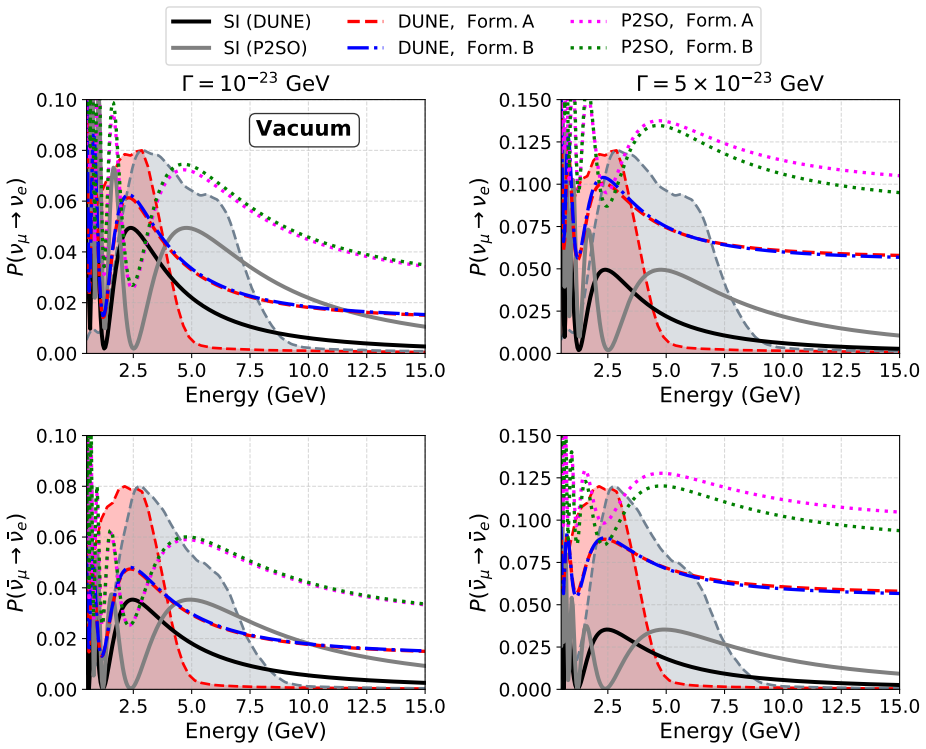
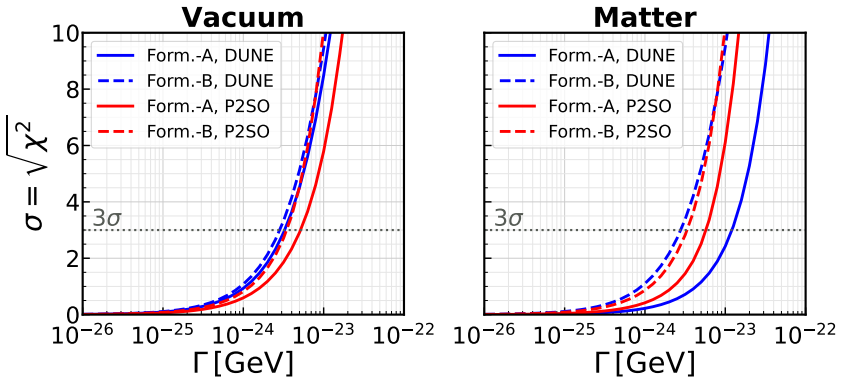
Formalism-A places the decoherence matrix in the matter mass eigenstate basis while Formalism-B places it in the vacuum mass eigenstate basis and rotates it unitarily into the matter basis; the two formalisms yield identical vacuum oscillation probabilities for small decoherence parameter Γ yet produce distinctly different probabilities when Γ is large or when matter density effects are significant, thereby altering the chi-squared reach of DUNE and P2SO for the decoherence parameter.
What carries the argument
the decoherence matrix defined either directly in the matter mass eigenstate basis (Formalism-A) or in the vacuum mass eigenstate basis followed by unitary rotation to the matter basis (Formalism-B)
If this is right
- Oscillation probabilities at DUNE and P2SO become dependent on the chosen formalism once the decoherence parameter reaches large values.
- The chi-squared sensitivity to the decoherence parameter therefore differs between the two formalisms.
- Strong matter effects increase the numerical difference between the two formalisms.
- For small decoherence the basis choice remains irrelevant in vacuum.
- Any future bound or discovery claim on the decoherence parameter must specify which basis definition was used.
Where Pith is reading between the lines
- Analyses of data from baselines where matter density varies strongly may require a single agreed convention for the decoherence matrix to avoid artificial signals.
- Cross-checks with atmospheric or solar neutrino samples could reveal which formalism better describes real data.
- Extending both formalisms to non-constant density profiles would test whether the unitary rotation remains a valid approximation.
- The observed divergence implies that decoherence may interact with the matter potential in a way not fully captured by a simple basis rotation.
Load-bearing premise
Placing the decoherence matrix in the matter basis or in the vacuum basis and rotating it introduces no extra physical effects beyond the unitary transformation itself.
What would settle it
A long-baseline measurement of appearance or disappearance probabilities at DUNE for a large value of the decoherence parameter that matches the predictions of one formalism but deviates from the other.
Figures


read the original abstract
In this paper, we have studied the impact of two different formalisms of quantum decoherence in determining the sensitivities of the two future long-baseline experiments DUNE and P2SO. In Formalism-A, we will assume that the decoherence matrix is defined in a matter mass eigenstate basis which is the basis that diagonalizes the Hamiltonian for neutrinos in matter, with a constant matter density. In Formalism-B, we will define the decoherence matrix in the vacuum mass eigenstate basis and then rotate it to matter mass basis via an unitary transformation. By using different values of the decoherence parameter $\Gamma$, we will show how these two formalisms differ at the probability level and then we will demonstrate how the sensitivities can differ at the $\chi^2$ level. Our results show that if the values of $\Gamma$ is small, then these two formalisms yield same probability in vacuum. However, if the values of $\Gamma$ is large or if there is strong matter effect, then these two formalisms yield very different results.
Editorial analysis
A structured set of objections, weighed in public.
Referee Report
Summary. The paper compares two formalisms for incorporating quantum decoherence into neutrino oscillation probabilities in matter for the DUNE and P2SO experiments. Formalism-A defines the decoherence matrix directly in the matter mass eigenstate basis (which diagonalizes the Hamiltonian under constant matter density). Formalism-B defines it in the vacuum mass eigenstate basis and applies a unitary rotation to obtain the matter-basis version. Using varying values of the decoherence parameter Γ, the authors show that the two formalisms produce identical vacuum probabilities for small Γ but yield different results at the probability level (and subsequently at the χ² sensitivity level) for large Γ or under strong matter effects.
Significance. If the differences are shown to be physically robust rather than implementation artifacts, the result would be moderately significant for neutrino phenomenology, as it demonstrates that the basis choice for the decoherence matrix can affect projected sensitivities of next-generation long-baseline experiments. The work supplies a direct numerical comparison at both probability and fit levels, which is of practical use. However, the absence of explicit derivations, error propagation details, and validation against known limits (e.g., vacuum or small-Γ regimes) limits the strength of the claim.
major comments (2)
- [Formalism definitions] In the definitions of Formalism-A and Formalism-B (as summarized in the abstract and the formalism section): the unitary rotation applied in Formalism-B to move the decoherence matrix from the vacuum mass basis to the matter mass basis does not automatically preserve the structure of the Lindblad dissipator when the matter Hamiltonian is present. Because the matter potential is diagonal only in the matter basis, the rotated dissipator can generate additional cross terms absent in Formalism-A. Please provide the explicit Lindblad master equation for both formalisms, the resulting density-matrix evolution, and a demonstration that Formalism-B remains completely positive and trace-preserving without extra commutator contributions.
- [Probability calculations] Abstract and probability-level results: the claim that the formalisms agree for small Γ in vacuum but diverge for large Γ or strong matter effects is presented without the explicit oscillation probability expressions or the numerical method used to solve the evolution. Include the master equation, any constant-density approximation, and a check that both formalisms recover the standard oscillation probability when Γ → 0.
minor comments (2)
- The abstract contains a minor grammatical issue: 'if the values of Γ is small' should read 'are small'.
- Add a brief discussion of how the χ² is constructed (including systematic uncertainties and the treatment of the decoherence parameter as a nuisance or fixed input) to allow readers to reproduce the sensitivity differences.
Simulated Author's Rebuttal
We thank the referee for the careful reading of our manuscript and the constructive comments on the formalism definitions and probability calculations. We address each major comment below and indicate the revisions we will make to strengthen the presentation.
read point-by-point responses
-
Referee: [Formalism definitions] In the definitions of Formalism-A and Formalism-B (as summarized in the abstract and the formalism section): the unitary rotation applied in Formalism-B to move the decoherence matrix from the vacuum mass basis to the matter mass basis does not automatically preserve the structure of the Lindblad dissipator when the matter Hamiltonian is present. Because the matter potential is diagonal only in the matter basis, the rotated dissipator can generate additional cross terms absent in Formalism-A. Please provide the explicit Lindblad master equation for both formalisms, the resulting density-matrix evolution, and a demonstration that Formalism-B remains completely positive and trace-preserving without extra commutator contributions.
Authors: We agree that the manuscript would benefit from a more explicit derivation of the Lindblad equations. In the revised version we will present the full master equation for Formalism-A, with the decoherence matrix defined directly in the matter eigenbasis that diagonalizes the constant-density Hamiltonian. For Formalism-B we will write the rotated dissipator obtained by the unitary transformation from the vacuum mass basis and derive the resulting density-matrix evolution, explicitly showing any cross terms generated by the matter potential. We will also demonstrate that Formalism-B remains completely positive and trace-preserving because the unitary rotation preserves these properties of the original Lindblad operator; the additional cross terms are simply part of the consistent evolution under the rotated dissipator and do not violate the required conditions. revision: yes
-
Referee: [Probability calculations] Abstract and probability-level results: the claim that the formalisms agree for small Γ in vacuum but diverge for large Γ or strong matter effects is presented without the explicit oscillation probability expressions or the numerical method used to solve the evolution. Include the master equation, any constant-density approximation, and a check that both formalisms recover the standard oscillation probability when Γ → 0.
Authors: We acknowledge that the explicit expressions and validation steps were not sufficiently detailed. In the revised manuscript we will provide the master equation under the constant-density approximation used for both DUNE and P2SO baselines, together with the numerical procedure (matrix-exponential integration of the Liouvillian) employed to obtain the probabilities. We will also show analytically that, for small Γ in vacuum, both formalisms reduce to the same standard oscillation probabilities, and we will verify numerically that the Γ → 0 limit recovers the usual three-flavor vacuum and matter oscillation probabilities for each formalism. revision: yes
Circularity Check
No circularity detected in the definition or comparison of the two decoherence formalisms
full rationale
The paper explicitly defines Formalism-A (decoherence matrix in the matter mass eigenstate basis) and Formalism-B (defined in vacuum mass eigenstate basis then rotated via unitary transformation) as independent phenomenological choices. It then computes oscillation probabilities and chi-squared sensitivities for DUNE and P2SO using standard Lindblad evolution under each choice, showing agreement for small Gamma in vacuum and divergence for large Gamma or strong matter effects. No equation reduces a prediction to a fitted input by construction, no self-citation is invoked as load-bearing justification, and the central claim follows directly from the basis-dependent implementations without renaming or smuggling ansatze. The derivation chain remains self-contained and externally falsifiable via explicit probability formulas.
Axiom & Free-Parameter Ledger
free parameters (1)
- decoherence parameter Γ
axioms (2)
- domain assumption Neutrino propagation Hamiltonian in matter with constant density
- standard math Unitary transformation rotates the decoherence matrix from vacuum to matter basis
Reference graph
Works this paper leans on
-
[1]
norm”, signal as “Sg
HereG F,n e andEare the Fermi coupling constant, electron number density and neutrino energy. The oscillation probabilities for antineutrinos can be obtained by performing the replacementsA→ −Aandδ CP → −δCP. At this stage, in order to make a comparison between these two formalisms, if we put Γ31 = Γ32 = Γ4 andΓ 21 = Γ2 in Eq. 9, we obtainΓ2 = 4Γ4. After ...
2024
-
[2]
Current unknowns in the three neutrino framework
F. Capozzi, E. Lisi, A. Marrone, and A. Palazzo, Prog. Part. Nucl. Phys.102, 48 (2018), arXiv:1804.09678 [hep-ph]. 13
work page Pith review arXiv 2018
-
[3]
F. Benatti and R. Floreanini, JHEP02, 032 (2000), arXiv:hep-ph/0002221
- [4]
-
[5]
Ohlsson, Equivalence between neutrino oscillations and neutrino decoherence, Phys
T. Ohlsson, Phys. Lett. B502, 159 (2001), arXiv:hep-ph/0012272
-
[6]
M. Blennow, T. Ohlsson, and W. Winter, JHEP06, 049 (2005), arXiv:hep-ph/0502147
-
[7]
M. Blennow, T. Ohlsson, and W. Winter, Eur. Phys. J. C49, 1023 (2007), arXiv:hep- ph/0508175
- [8]
-
[9]
S. B. Giddings and A. Strominger, Nucl. Phys. B307, 854 (1988)
1988
-
[10]
G. Amelino-Camelia, J. R. Ellis, N. E. Mavromatos, and D. V. Nanopoulos, Int. J. Mod. Phys. A12, 607 (1997), arXiv:hep-th/9605211
- [11]
-
[12]
J. R. Ellis, J. S. Hagelin, D. V. Nanopoulos, and M. Srednicki, Nucl. Phys. B241, 381 (1984)
1984
- [13]
- [14]
-
[15]
Neutrino decoherence from quantum gravitational stochastic perturbations,
T. Stuttard and M. Jensen, Phys. Rev. D102, 115003 (2020), arXiv:2007.00068 [hep-ph]
-
[16]
E. Akhmedov and A. Y. Smirnov, JHEP11, 082 (2022), arXiv:2208.03736 [hep-ph]
-
[17]
Lindblad, Commun
G. Lindblad, Commun. Math. Phys.48, 119 (1976)
1976
-
[18]
J. A. Wheeler, Phys. Rev.97, 511 (1955)
1955
-
[19]
Aielloet al.(KM3NeT), JCAP03, 039 (2025), arXiv:2410.01388 [hep-ex]
S. Aielloet al.(KM3NeT), JCAP03, 039 (2025), arXiv:2410.01388 [hep-ex]
-
[20]
V. De Romeri, C. Giunti, T. Stuttard, and C. A. Ternes, JHEP09, 097 (2023), arXiv:2306.14699 [hep-ph]
- [21]
- [22]
- [23]
- [24]
- [25]
-
[26]
G. Barenboim, A. M. Calatayud-Cadenillas, A. M. Gago, and C. A. Ternes, Phys. Lett. B 852, 138626 (2024), arXiv:2402.16395 [hep-ph]
-
[27]
Aguilaret al.(ESSnuSB), JHEP08, 063 (2024), arXiv:2404.17559 [hep-ex]
J. Aguilaret al.(ESSnuSB), JHEP08, 063 (2024), arXiv:2404.17559 [hep-ex]
-
[28]
C. Bera and K. N. Deepthi, Phys. Rev. D110, 035035 (2024), arXiv:2405.03286 [hep-ph]. 14
- [29]
-
[30]
G. Balieiro Gomes, D. V. Forero, M. M. Guzzo, P. C. De Holanda, and R. L. N. Oliveira, Phys. Rev. D100, 055023 (2019), arXiv:1805.09818 [hep-ph]
- [31]
- [32]
- [33]
-
[34]
A. de Gouvea, V. de Romeri, and C. A. Ternes, JHEP08, 018 (2020), arXiv:2005.03022 [hep-ph]
-
[35]
A. de Gouvêa, V. De Romeri, and C. A. Ternes, JHEP06, 042 (2021), arXiv:2104.05806 [hep-ph]
-
[36]
R. Krueger and T. Schwetz, Eur. Phys. J. C83, 578 (2023), arXiv:2303.15524 [hep-ph]
- [37]
- [38]
- [39]
-
[40]
Gorini, A
V. Gorini, A. Kossakowski, and E. C. G. Sudarshan, J. Math. Phys.17, 821 (1976)
1976
-
[41]
R. L. N. Oliveira and M. M. Guzzo, Eur. Phys. J. C73, 2434 (2013)
2013
-
[42]
G. Balieiro Gomes, M. M. Guzzo, P. C. de Holanda, and R. L. N. Oliveira, Phys. Rev. D95, 113005 (2017), arXiv:1603.04126 [hep-ph]
- [43]
- [44]
- [45]
- [46]
- [47]
-
[48]
Experiment Simulation Con- figurations Approximating DUNE TDR,
B. Abiet al.(DUNE), (2021), arXiv:2103.04797 [hep-ex]
-
[49]
Abiet al.(DUNE Collaboration), Eur
B. Abiet al.(DUNE), Eur. Phys. J. C80, 978 (2020), arXiv:2006.16043 [hep-ex]
- [50]
-
[51]
New features in the simulation of neutrino oscillation experiments with GLoBES 3.0
P. Huber, J. Kopp, M. Lindner, M. Rolinec, and W. Winter, Comput. Phys. Commun.177, 432 (2007), arXiv:hep-ph/0701187. 15
work page Pith review arXiv 2007
- [52]
- [53]
-
[54]
NuFit-6.0: Updated global analysis of three-flavor neutrino oscillations
I. Esteban, M. C. Gonzalez-Garcia, M. Maltoni, I. Martinez-Soler, J. P. Pinheiro, and T. Schwetz, JHEP12, 216 (2024), arXiv:2410.05380 [hep-ph]. 16
work page internal anchor Pith review arXiv 2024
discussion (0)
Sign in with ORCID, Apple, or X to comment. Anyone can read and Pith papers without signing in.