Recognition: unknown
Light-induced Self-Organization in Cooperative Free Space Atomic Arrays
Pith reviewed 2026-05-10 00:00 UTC · model grok-4.3
The pith
Laser-driven atoms in free space spontaneously rearrange into dimerized chains and contracted or expanded rings even from initial separations larger than the wavelength.
A machine-rendered reading of the paper's core claim, the machinery that carries it, and where it could break.
Core claim
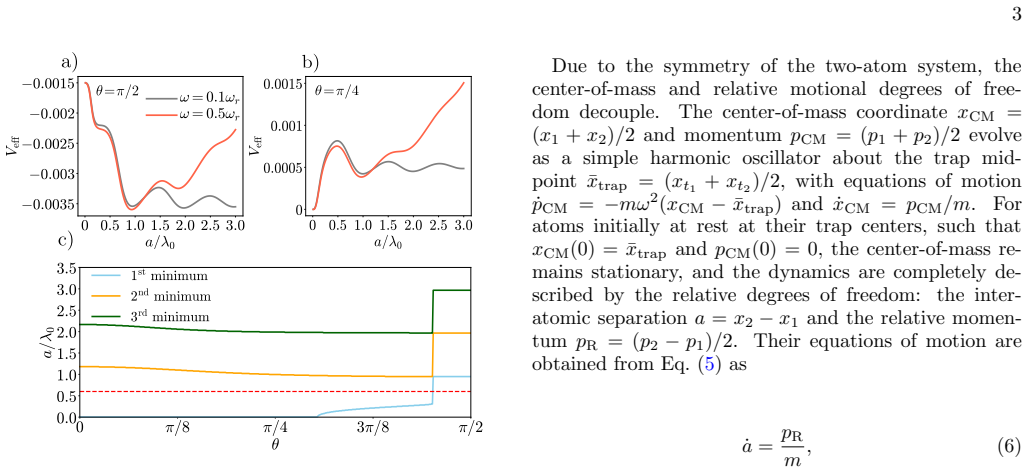
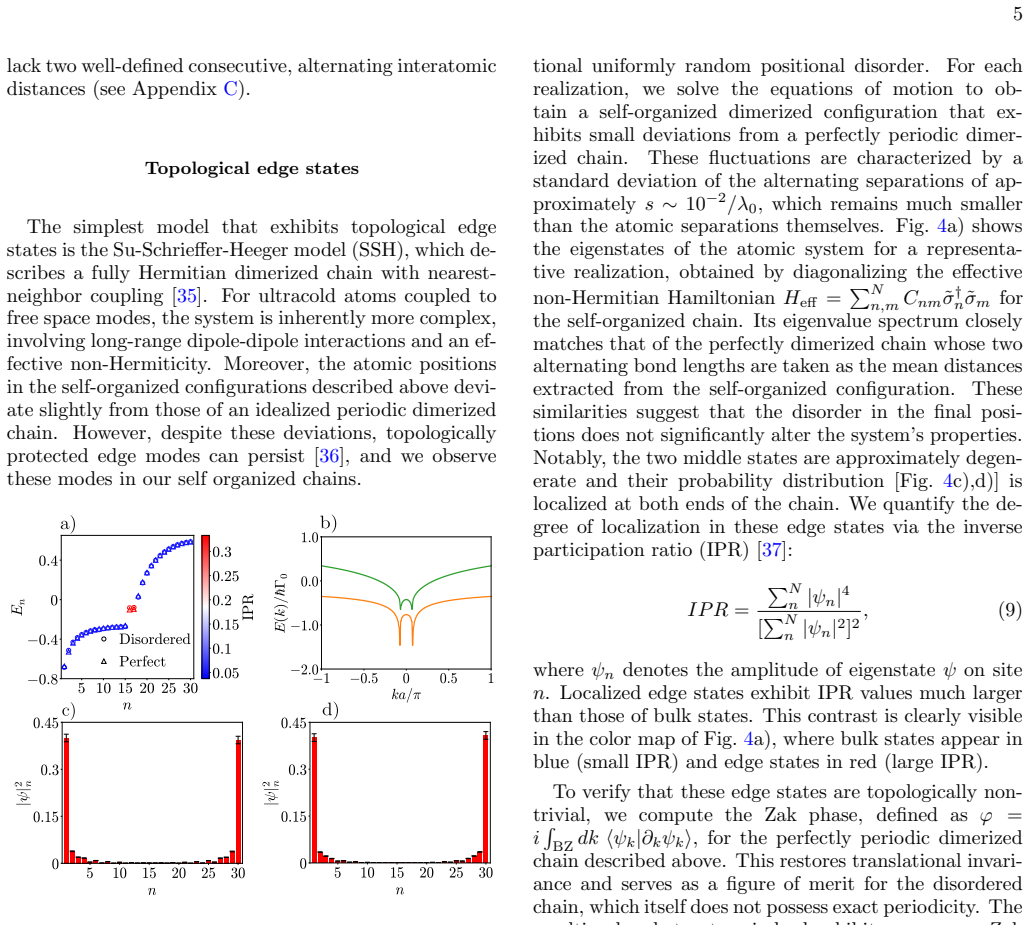
We demonstrate that laser-driven cooperative dipole-dipole interactions in weakly trapped atomic arrays give rise to self-organized configurations. Starting from an analytically tractable two-emitter system, we identify the possible steady-state spatial arrangements. In linear chains the atoms form topologically nontrivial dimerized structures across a range of initial interatomic spacings. In ring geometries the ensemble undergoes self-organized contraction and expansion, enabling access to length scales below those set by the trapping lattice. These results show that collective light-matter interactions in free space can spontaneously generate modified ordered geometries even when emitters
What carries the argument
The steady-state spatial arrangements selected by the balance of cooperative dipole-dipole interactions in the driven multi-emitter master equation.
If this is right
- Linear chains develop dimerized configurations with topological character for a wide range of initial lattice spacings.
- Ring geometries reach steady-state radii smaller or larger than the original trap period through collective contraction or expansion.
- Self-organization occurs in free space without requiring tight external confinement once the laser drive is applied.
- The same mechanism applies to larger ensembles and suggests geometry-dependent ordering in both open and closed atomic arrays.
Where Pith is reading between the lines
- The approach could be extended to three-dimensional lattices to test whether light-induced ordering produces crystals with new symmetries.
- Similar collective forces might be engineered in molecular or ion arrays to achieve sub-wavelength positioning without additional traps.
- Detection of these states could rely on changes in collective fluorescence spectra rather than direct position imaging.
Load-bearing premise
The atoms remain in weakly trapped conditions where dipole-dipole interactions dominate the dynamics without significant atomic motion, recoil, or higher-order effects.
What would settle it
Time-resolved imaging of a driven linear chain that shows the final positions remain uniformly spaced rather than clustering into preferred dimer separations would falsify the predicted self-organization.
Figures



read the original abstract
We investigate how laser-driven, cooperative dipole-dipole interactions in weakly trapped atomic arrays give rise to self-organized configurations. Starting from an analytically tractable two-emitter system, we identify the possible steady-state spatial arrangements accessible to the atoms. We then extend this analysis to larger ensembles in both linear and ring geometries. In linear chains, we demonstrate the emergence of topologically nontrivial dimerized configurations across a range of initial interatomic spacings. In ring geometries, we find that the system undergoes self-organized contraction and expansion, enabling access to length scales below those set by the trapping lattice. Our results demonstrate that collective light-matter interactions in free space can spontaneously generate modified ordered geometries, even when the emitters are initially separated by distances larger than their transition wavelength.
Editorial analysis
A structured set of objections, weighed in public.
Referee Report
Summary. The manuscript investigates light-induced self-organization in cooperative free-space atomic arrays driven by dipole-dipole interactions. It begins with an analytically tractable two-emitter system to identify accessible steady-state spatial arrangements, then extends the analysis to larger ensembles in linear chains (showing emergence of dimerized configurations) and ring geometries (showing self-organized contraction and expansion). The central claim is that collective light-matter interactions can spontaneously generate modified ordered geometries even when initial interatomic separations exceed the transition wavelength.
Significance. If the central results hold, the work would be significant for quantum optics and collective atomic physics, as it identifies a pathway for spontaneous ordering in free space that bypasses some constraints of optical lattices and enables access to sub-wavelength scales. The analytical tractability of the two-emitter case and the parameter-free identification of topologically nontrivial steady states in larger systems constitute clear strengths that ground the extensions.
major comments (2)
- [Section 3] The extension from the two-emitter steady-state analysis to linear chains (Section 3) identifies dimerized configurations by solving the force-balance equations, but no time-dependent trajectories or master-equation simulations that incorporate recoil and photon momentum kicks are presented to establish dynamical reachability from initial conditions with r > λ. This is load-bearing for the claim that the states are spontaneously generated.
- [Section 4] In the ring-geometry analysis (Section 4), the contraction to length scales below the trapping lattice is derived under the weakly-trapped approximation where DD forces dominate; however, no quantitative comparison of the DD force strength (∼1/r^3 for r > λ) against recoil energy or residual trap depth is provided, leaving open whether the identified equilibria remain stable against heating.
minor comments (2)
- [Section 2] Notation for the collective decay rates and the effective potential in the two-emitter case could be cross-referenced more explicitly when the same quantities are used for N>2.
- Figure captions for the linear-chain results should specify the range of initial spacings and the numerical method used to locate the steady states.
Simulated Author's Rebuttal
We thank the referee for their careful reading of the manuscript and their constructive comments. We address the major comments point by point below.
read point-by-point responses
-
Referee: [Section 3] The extension from the two-emitter steady-state analysis to linear chains (Section 3) identifies dimerized configurations by solving the force-balance equations, but no time-dependent trajectories or master-equation simulations that incorporate recoil and photon momentum kicks are presented to establish dynamical reachability from initial conditions with r > λ. This is load-bearing for the claim that the states are spontaneously generated.
Authors: We agree that demonstrating dynamical reachability from initial separations larger than the transition wavelength is important for the spontaneous self-organization claim. The original manuscript identifies the steady-state dimerized configurations through force-balance equations derived from the cooperative dipole-dipole interactions. To address this point directly, the revised manuscript will include time-dependent master-equation simulations that incorporate recoil and photon momentum kicks. These will illustrate the evolution toward the dimerized states from initial conditions with r > λ, under the relevant parameter regimes. revision: yes
-
Referee: [Section 4] In the ring-geometry analysis (Section 4), the contraction to length scales below the trapping lattice is derived under the weakly-trapped approximation where DD forces dominate; however, no quantitative comparison of the DD force strength (∼1/r^3 for r > λ) against recoil energy or residual trap depth is provided, leaving open whether the identified equilibria remain stable against heating.
Authors: We thank the referee for noting the importance of validating the weakly-trapped approximation. The manuscript derives the self-contracted and expanded ring equilibria under the assumption that dipole-dipole forces dominate over the trapping potential. In the revision, we will add a quantitative comparison of the DD force magnitude (scaling as 1/r^3) against recoil energy and residual trap depth for the considered parameters and distances r > λ. This will confirm that the identified equilibria remain stable against recoil-induced heating. revision: yes
Circularity Check
No circularity: derivation extends analytically from two-body steady states without reduction to inputs
full rationale
The paper derives steady-state spatial arrangements first from an analytically tractable two-emitter system and then extends the same dipole-dipole interaction framework to N-body linear chains and rings. This produces independent results on dimerization and contraction/expansion, including for initial separations > λ, without any step that renames a fit as a prediction, imports uniqueness via self-citation, or defines the output in terms of itself. The weakly-trapped assumption is stated explicitly as a modeling choice rather than a hidden definitional loop, and no load-bearing claim collapses to a prior self-citation or ansatz smuggling.
Axiom & Free-Parameter Ledger
axioms (2)
- domain assumption The validity of the Markovian approximation for the collective decay and coherent interactions in the dipole-dipole regime
- domain assumption Atoms are treated as two-level systems with weak trapping potentials
Reference graph
Works this paper leans on
-
[1]
Wallis, Quantum theory of atomic motion in laser light, Physics Reports255, 203 (1995)
H. Wallis, Quantum theory of atomic motion in laser light, Physics Reports255, 203 (1995)
1995
-
[2]
Dalibard and C
J. Dalibard and C. Cohen-Tannoudji, Atomic motion in laser light: connection between semiclassical and quan- tum descriptions, Journal of Physics B: Atomic and Molecular Physics18, 1661 (1985)
1985
-
[3]
S. Chu, L. Hollberg, J. E. Bjorkholm, A. Cable, and A. Ashkin, Three-dimensional viscous confinement and cooling of atoms by resonance radiation pressure, Phys. Rev. Lett.55, 48 (1985)
1985
-
[4]
Dalibard and C
J. Dalibard and C. Cohen-Tannoudji, Laser cooling be- low the doppler limit by polarization gradients: simple theoretical models, J. Opt. Soc. Am. B6, 2023 (1989)
2023
-
[5]
Domokos and H
P. Domokos and H. Ritsch, Collective cooling and self- organization of atoms in a cavity, Physical Review Letters 89, 253003 (2002)
2002
-
[7]
Baumann, C
K. Baumann, C. Guerlin, F. Brennecke, and T. Esslinger, Dicke quantum phase transition with a superfluid gas in an optical cavity, Nature464, 1301 (2010)
2010
-
[8]
Domokos and H
P. Domokos and H. Ritsch, Mechanical effects of light in optical resonators, Journal of the Optical Society of America B20, 1098 (2003)
2003
-
[9]
J. K. Asb´ oth, P. Domokos, H. Ritsch, and A. Vukics, Self-organization of atoms in a cavity field: Threshold, bistability, and scaling laws, Phys. Rev. A72, 053417 (2005)
2005
-
[10]
A. T. Black, H. W. Chan, and V. Vuleti´ c, Observation of collective friction forces due to spatial self-organization of atoms: From rayleigh to bragg scattering, Phys. Rev. Lett.91, 203001 (2003)
2003
-
[11]
Sch¨ utz, S
S. Sch¨ utz, S. B. J¨ ager, and G. Morigi, Thermodynamics and dynamics of atomic self-organization in an optical cavity, Phys. Rev. A92, 063808 (2015)
2015
-
[12]
D. E. Chang, J. I. Cirac, and H. J. Kimble, Self- organization of atoms along a nanophotonic waveguide, Phys. Rev. Lett.110, 113606 (2013)
2013
-
[13]
Eldredge, P
Z. Eldredge, P. Solano, D. Chang, and A. V. Gorshkov, Self-organization of atoms coupled to a chiral reservoir, Physical Review A94, 053855 (2016)
2016
-
[14]
R. H. Dicke, Coherence in Spontaneous Radiation Pro- cesses, Physical Review93, 99 (1954)
1954
-
[15]
Bonifacio, P
R. Bonifacio, P. Schwendimann, and F. Haake, Quantum Statistical Theory of Superradiance. I, Physical Review A4, 302 (1971)
1971
-
[16]
Bonifacio and L
R. Bonifacio and L. A. Lugiato, Cooperative radiation processes in two-level systems: Superfluorescence, Phys- ical Review A11, 1507 (1975)
1975
-
[17]
Gross and S
M. Gross and S. Haroche, Superradiance: An essay on the theory of collective spontaneous emission, Physics Reports93, 301 – 396 (1982)
1982
-
[18]
selective radiance
A. Asenjo-Garcia, M. Moreno-Cardoner, A. Albrecht, H. J. Kimble, and D. E. Chang, Exponential improve- ment in photon storage fidelities using subradiance and “selective radiance” in atomic arrays, Phys. Rev. X7, 031024 (2017)
2017
-
[19]
Perczel, J
J. Perczel, J. Borregaard, D. E. Chang, H. Pichler, S. F. Yelin, P. Zoller, and M. D. Lukin, Topological quantum optics in two-dimensional atomic arrays, Phys. Rev. Lett. 119, 023603 (2017)
2017
-
[20]
J. S. Peter, S. Ostermann, and S. F. Yelin, Chirality dependent photon transport and helical superradiance, Physical Review Research6, 023200 (2024)
2024
-
[21]
J. S. Peter, S. Ostermann, and S. F. Yelin, Chirality- induced emergent spin-orbit coupling in topological atomic lattices, Physical Review A109, 043525 (2024)
2024
-
[22]
Holzinger, J
R. Holzinger, J. S. Peter, S. Ostermann, H. Ritsch, and S. Yelin, Harnessing quantum emitter rings for efficient energy transport and trapping, Optica Quantum2, 57 (2024)
2024
-
[23]
Shahmoon, M
E. Shahmoon, M. D. Lukin, and S. F. Yelin, Chapter one - collective motion of an atom array under laser illumi- nation (Academic Press, 2019) pp. 1–38. 8
2019
-
[24]
Shahmoon, M
E. Shahmoon, M. D. Lukin, and S. F. Yelin, Quantum optomechanics of a two-dimensional atomic array, Phys. Rev. A101, 063833 (2020)
2020
-
[25]
S. Buckley-Bonanno, S. Ostermann, Y. Wang, and S. F. Yelin, Two-dimensional motion of an impurity under dy- namic light-induced dipole forces in an atomic subwave- length array, arXiv preprint arXiv:2407.11113 (2024), 11 pages, 7 figures, arXiv:2407.11113 [quant-ph]
-
[26]
C. E. M´ aximo, R. Bachelard, and R. Kaiser, Optical binding with cold atoms, Phys. Rev. A97, 043845 (2018)
2018
-
[27]
Rubies-Bigorda, R
O. Rubies-Bigorda, R. Holzinger, A. Asenjo-Garcia, O. Romero-Isart, H. Ritsch, S. Ostermann, C. Gonzalez- Ballestero, S. F. Yelin, and C. C. Rusconi, Collectively enhanced ground-state cooling in subwavelength atomic arrays, Phys. Rev. A112, 023714 (2025)
2025
-
[28]
J. Ho, Y.-H. Lu, T. Xiang, C. C. Rusconi, S. J. Masson, A. Asenjo-Garcia, Z. Yan, and D. M. Stamper-Kurn, Op- tomechanical self-organization in a mesoscopic atom ar- ray, Nature Physics 10.1038/s41567-025-02916-7 (2025)
-
[29]
J. Rui, D. Wei, A. Rubio-Abadal, S. Hollerith, J. Zeiher, D. M. Stamper-Kurn, C. Gross, and I. Bloch, A subradi- ant optical mirror formed by a single structured atomic layer, Nature583, 369 (2020)
2020
-
[30]
Many-Body Super- and Subradiance in Ordered Atomic Arrays
A. Douglas, L. Su, M. Szurek, R. Groth, S. Brandstetter, O. Markovic, O. Rubies-Bigorda, S. Ostermann, S. F. Yelin, and M. Greiner, Many-body super- and subradi- ance in ordered atomic arrays (2026), arXiv:2604.11795 [quant-ph]
work page internal anchor Pith review Pith/arXiv arXiv 2026
-
[31]
Huang, W
X. Huang, W. Yuan, A. Holman, M. Kwon, S. J. Masson, R. Gutierrez-Jauregui, A. Asenjo-Garcia, S. Will, and N. Yu, Metasurface holographic optical traps for ultra- cold atoms, Progress in Quantum Electronics89, 100470 (2023)
2023
-
[32]
Barredo, S
D. Barredo, S. de L´ es´ eleuc, V. Lienhard, T. Lahaye, and A. Browaeys, An atom-by-atom assembler of defect-free arbitrary 2d atomic arrays, Science354, 1021 (2016)
2016
-
[33]
Endres, H
M. Endres, H. Bernien, A. Keesling, H. Levine, E. R. Anschuetz, A. Krajenbrink, C. Senko, V. Vuleti´ c, M. Greiner, and M. D. Lukin, Atom-by-atom assembly of defect-free one-dimensional cold atom arrays, Science 354, 1024 (2016)
2016
-
[34]
R. H. Lehmberg, Radiation from ann-atom system. i. general formalism, Phys. Rev. A2, 883 (1970)
1970
-
[35]
W. P. Su, J. R. Schrieffer, and A. J. Heeger, Solitons in polyacetylene, Phys. Rev. Lett.42, 1698 (1979)
1979
-
[36]
B. X. Wang and C. Y. Zhao, Topological photonic states in one-dimensional dimerized ultracold atomic chains, Phys. Rev. A98, 023808 (2018)
2018
-
[37]
Goetschy and S
A. Goetschy and S. E. Skipetrov, Non-hermitian eu- clidean random matrix theory, Phys. Rev. E84, 011150 (2011)
2011
-
[38]
Koepke, X
J. Koepke, X. Hu, C. Muenke, K. Schulten, and H. Michel, The crystal structure of the light-harvesting complex ii (b800–850) from rhodospirillum molischi- anum, Structure4, 581 (1996)
1996
-
[39]
Moreno-Cardoner, R
M. Moreno-Cardoner, R. Holzinger, and H. Ritsch, Ef- ficient nano-photonic antennas based on dark states in quantum emitter rings, Opt. Express30, 10779 (2022)
2022
-
[40]
St-Jean, V
P. St-Jean, V. Goblot, E. Galopin, A. Lemaˆ ıtre, T. Ozawa, L. Le Gratiet, I. Sagnes, J. Bloch, and A. Amo, Lasing in topological edge states of a one-dimensional lat- tice, Nature Photonics11, 651 (2017)
2017
-
[41]
Pause, L
L. Pause, L. Sturm, M. Mittenb¨ uhler, S. Amann, T. Preuschoff, D. Sch¨ affner, M. Schlosser, and G. Birkl, Supercharged two-dimensional tweezer array with more than 1000 atomic qubits, Optica11, 222 (2024)
2024
- [42]
-
[43]
Baier, M
S. Baier, M. J. Mark, D. Petter, K. Aikawa, L. Chomaz, Z. Cai, M. A. Baranov, P. Zoller, and F. Ferlaino, Ex- tended bose-hubbard models with ultracold magnetic atoms, Science352, 201 (2016)
2016
-
[44]
L. Du, P. Barral, M. Cantara, J. de Hond, Y. Lu, and W. Ketterle, Atomic physics on a 50-nm scale: Realiza- tion of a bilayer system of dipolar atoms, Science384, 546 (2024)
2024
-
[45]
de L´ es´ eleuc, D
S. de L´ es´ eleuc, D. Barredo, V. Lienhard, A. Browaeys, and T. Lahaye, Optical control of the resonant dipole- dipole interaction between rydberg atoms, Phys. Rev. Lett.119, 053202 (2017)
2017
-
[46]
Glicenstein, G
A. Glicenstein, G. Ferioli, N. ˇSibali´ c, L. Brossard, I. Ferrier-Barbut, and A. Browaeys, Collective shift in resonant light scattering by a one-dimensional atomic chain, Phys. Rev. Lett.124, 253602 (2020)
2020
-
[47]
Rubies-Bigorda,Light-Induced Collective Interac- tions in Arrays of Quantum Emitters, Phd thesis, Mas- sachusetts Institute of Technology, Cambridge, MA (2025)
O. Rubies-Bigorda,Light-Induced Collective Interac- tions in Arrays of Quantum Emitters, Phd thesis, Mas- sachusetts Institute of Technology, Cambridge, MA (2025)
2025
-
[48]
Seubert, L
M. Seubert, L. Hartung, S. Welte, G. Rempe, and E. Distante, Tweezer-assisted subwavelength positioning of atomic arrays in an optical cavity, PRX Quantum6, 010322 (2025)
2025
-
[49]
M. A. Norcia, A. W. Young, and A. M. Kaufman, Mi- croscopic control and detection of ultracold strontium in optical-tweezer arrays, Physical Review X8, 041054 (2018)
2018
-
[50]
D. A. Steck, Rubidium 87 D Line Data,http:// steck.us/alkalidata/rubidium87numbers.pdf(2019), revision 2.1.6
2019
-
[51]
Blush and M
K. Blush and M. Auzinsh, Calculation of level-crossing signals for spin-1 and spin-2 systems using irreducible tensor operators, Journal of the Optical Society of Amer- ica B20, 103 (2003)
2003
-
[52]
Santra, E
R. Santra, E. Arimondo, T. Ido, C. H. Greene, and J. Ye, High-accuracy optical clock via three-level co- herence in neutral bosonic 88sr, Physical Review A69, 042510 (2004)
2004
-
[53]
Takasu, K
Y. Takasu, K. Maki, K. Komori, T. Takano, K. Honda, M. Kumakura, T. Yabuzaki, and Y. Takahashi, Spin- singlet bose-einstein condensate of two-electron atoms, Physical Review Letters91, 040404 (2003)
2003
-
[54]
S. G. Porsev and A. Derevianko, Multipolar theory of blackbody radiation shift of atomic energy levels and its implications for optical lattice clocks, Physical Review A 69, 021403 (2004). 9 Appendix A: Electromagnetic Green’s Tensor in Free Space The coherent and dissipative dipole-dipole couplings between emittersnandmread Jnm − iΓnm 2 =− 3πΓ0 ω0 d† ·G(...
2004
discussion (0)
Sign in with ORCID, Apple, or X to comment. Anyone can read and Pith papers without signing in.