Recognition: unknown
Many-Body Super- and Subradiance in Ordered Atomic Arrays
Pith reviewed 2026-05-10 16:15 UTC · model grok-4.3
The pith
Ordered 2D atom arrays with subwavelength spacing produce strong super- and subradiance as a many-body process
A machine-rendered reading of the paper's core claim, the machinery that carries it, and where it could break.
Core claim
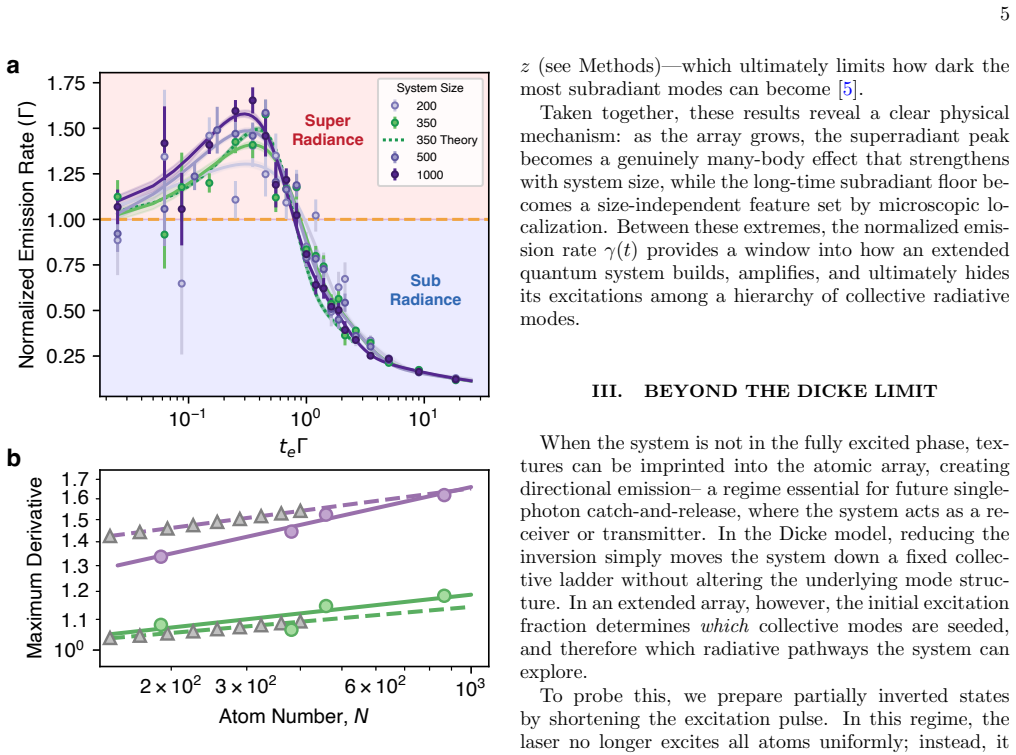
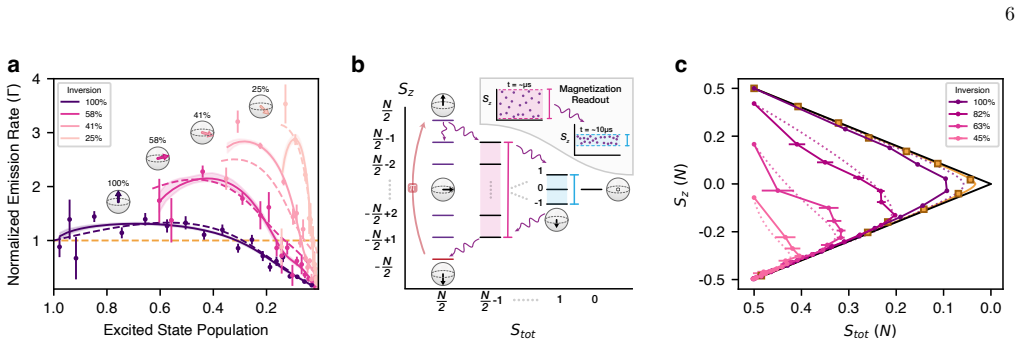
Geometrically ordered 2D atom arrays with subwavelength spacing undergo strong super- and subradiant emission. Despite the close spacing, site-resolved imaging reveals the buildup of spatial correlations, showing how cooperative decay transforms into a strongly correlated many-body process. Superradiance exhibits extensive scaling and revivals, with ferromagnetic character, while subradiance is antiferromagnetic.
What carries the argument
The ordered network of photon-mediated interactions in the subwavelength 2D array, which allows collective emission to emerge from multiple modes rather than a single Dicke state.
If this is right
- Superradiance scales extensively with the size of the ordered array.
- Superradiant revivals appear in the time evolution of the emission.
- Superradiance displays ferromagnetic character and subradiance antiferromagnetic character.
- The arrays function as a programmable platform for photon capture, storage, and atom-photon entanglement.
Where Pith is reading between the lines
- The platform could be used to engineer targeted correlation patterns for tasks in quantum information processing.
- Similar ordering in three-dimensional arrays might produce additional collective phases not accessible in two dimensions.
- The direct visibility of correlations suggests routes to improved light-matter interfaces for quantum technologies.
Load-bearing premise
The fabricated atom arrays maintain sufficient geometric order and subwavelength spacing with low enough disorder or defects that the observed collective effects and spatial correlations arise from photon-mediated many-body interactions.
What would settle it
Site-resolved images showing no buildup of spatial correlations during decay, or superradiance intensity failing to scale extensively with array size, would falsify the transformation into a many-body process.
Figures



read the original abstract
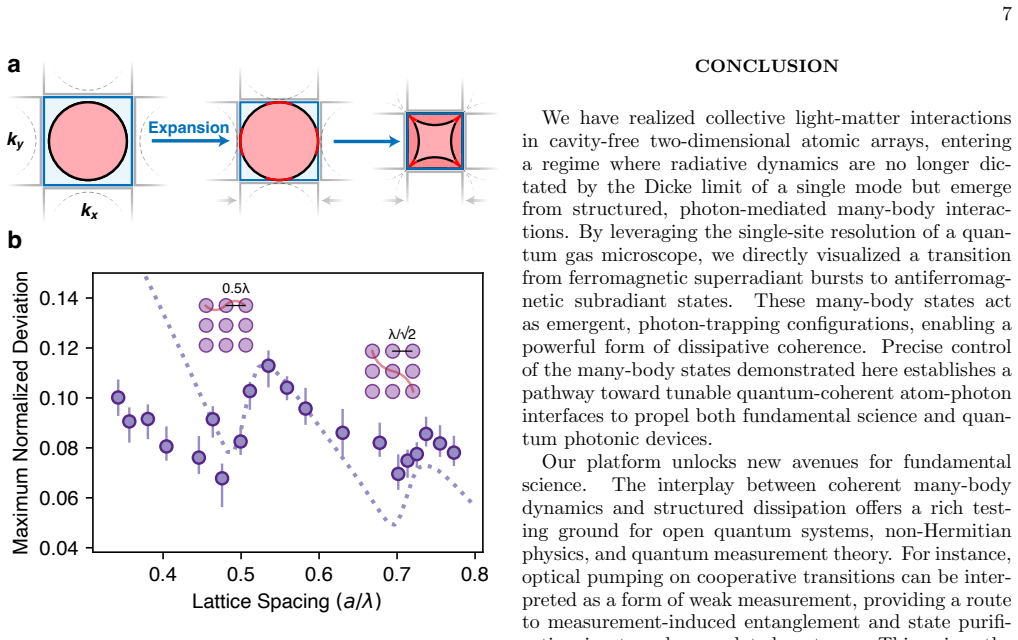
When quantum emitters couple indistinguishably to light, they can synchronize into a collective light matter system with radiative properties profoundly different from those of independent particles. To date, the resulting collective effects have largely been confined to point like or homogeneous ensembles. Here, we open access to a qualitatively new collective regime by realizing geometrically ordered, spatially extended atom arrays with subwavelength spacing. This establishes a fundamentally new platform in which collective emission is no longer confined to a single Dicke mode but instead emerges from an ordered network of photon mediated interactions. We find that 2D atom arrays undergo strong super and subradiant emission. Despite subwavelength spacing, we achieve site resolved imaging and directly observe the buildup of spatial correlations, demonstrating the transformation of cooperative decay into a strongly correlated many-body process. We observe extensive scaling of superradiance, uncover superradiant revivals, and reveal the ferromagnetic nature of superradiance and the antiferromagnetic nature of subradiance. Our results realize a novel programmable platform for exploring and utilizing dissipative many-body quantum physics, opening new possibilities for photon capture, storage, and atom photon entanglement.
Editorial analysis
A structured set of objections, weighed in public.
Referee Report
Summary. The manuscript reports the experimental realization of geometrically ordered 2D atomic arrays with subwavelength spacing. Using site-resolved imaging, the authors observe strong super- and subradiant collective emission, the buildup of spatial correlations that transform cooperative decay into a many-body process, extensive scaling of superradiance, superradiant revivals, and the ferromagnetic character of superradiance contrasted with the antiferromagnetic character of subradiance. The work positions these arrays as a programmable platform for dissipative many-body quantum physics.
Significance. If the central observations hold, the results establish a new experimental platform that extends collective radiative effects beyond point-like or homogeneous ensembles to spatially extended, ordered networks of photon-mediated interactions. The direct imaging of spatial correlations and the reported scaling/revival phenomena would provide concrete evidence for many-body dissipative dynamics with potential implications for photon storage, capture, and atom-photon entanglement protocols.
major comments (2)
- [§4.3, Fig. 5] §4.3, Fig. 5: The quantitative extraction of superradiant decay rates and the claim of 'extensive scaling' with array size are presented without reported uncertainties, fit residuals, or details on how background subtraction and finite-size effects were handled; this directly affects the strength of the scaling conclusion.
- [§5.1, Eq. (7)] §5.1, Eq. (7): The spatial correlation function used to infer ferromagnetic vs. antiferromagnetic character does not include an explicit correction or bound for residual lattice disorder or position jitter; given the subwavelength spacing, even small inhomogeneities could contribute to the observed sign of the correlations.
minor comments (3)
- [Methods] The manuscript would benefit from a brief methods subsection clarifying the lattice loading fidelity and measured position disorder (e.g., via a supplementary figure or table of rms deviations).
- [Fig. 2] Figure 2 caption and main text use 'site-resolved imaging' without stating the achieved optical resolution relative to the lattice constant; adding this number would aid reproducibility.
- [Discussion] A short paragraph comparing the observed revival times to the expected single-atom lifetime and collective decay rates would help readers connect the data to the underlying master-equation description.
Simulated Author's Rebuttal
We thank the referee for the positive assessment of our work and the constructive comments, which help clarify the presentation of our results. We address each major comment below and will incorporate the suggested revisions.
read point-by-point responses
-
Referee: [§4.3, Fig. 5] The quantitative extraction of superradiant decay rates and the claim of 'extensive scaling' with array size are presented without reported uncertainties, fit residuals, or details on how background subtraction and finite-size effects were handled; this directly affects the strength of the scaling conclusion.
Authors: We agree that the manuscript would benefit from additional quantitative details on the analysis. In the revised version, we will add error bars derived from the fitting procedure to the decay rates in Fig. 5, report the fit residuals explicitly, and expand §4.3 to describe the background subtraction method and the approach used to assess finite-size effects in the scaling analysis. These additions will make the extensive scaling claim more robust without altering the underlying data or conclusions. revision: yes
-
Referee: [§5.1, Eq. (7)] The spatial correlation function used to infer ferromagnetic vs. antiferromagnetic character does not include an explicit correction or bound for residual lattice disorder or position jitter; given the subwavelength spacing, even small inhomogeneities could contribute to the observed sign of the correlations.
Authors: We thank the referee for highlighting this potential systematic effect. In the revised manuscript, we will add a paragraph in §5.1 that provides an explicit bound on the contribution of measured lattice disorder and position jitter to the correlation function in Eq. (7). Using our independently characterized lattice stability, we will show that the observed sign of the correlations (ferromagnetic for superradiance, antiferromagnetic for subradiance) remains robust and is not an artifact of inhomogeneities. This discussion will be added without changing the reported results. revision: yes
Circularity Check
No significant circularity in experimental observations
full rationale
The paper is an experimental report on realizing ordered 2D atom arrays and directly observing super/subradiant emission and spatial correlations via site-resolved imaging. No derivation chain, predictive modeling, or fitted parameters are presented that could reduce to self-definition or self-citation. All claims rest on measured data rather than any theoretical construction that loops back to its inputs.
Axiom & Free-Parameter Ledger
axioms (1)
- domain assumption Atoms couple indistinguishably to the electromagnetic field when their separation is subwavelength
Forward citations
Cited by 2 Pith papers
-
Light-induced Self-Organization in Cooperative Free Space Atomic Arrays
Laser-driven cooperative dipole-dipole interactions cause free-space atomic arrays to spontaneously form topologically nontrivial dimerized linear chains and self-contracted or expanded ring geometries even from initi...
-
One knob to tune them all: Phase-controlled photon statistics and linewidth in partially pumped atomic ensembles
In partially pumped atomic ensembles, a tunable relative phase between pumped and unpumped emission contributions allows control of linewidth scaling and photon statistics from antibunched to bunched.
Reference graph
Works this paper leans on
-
[1]
la Caixa
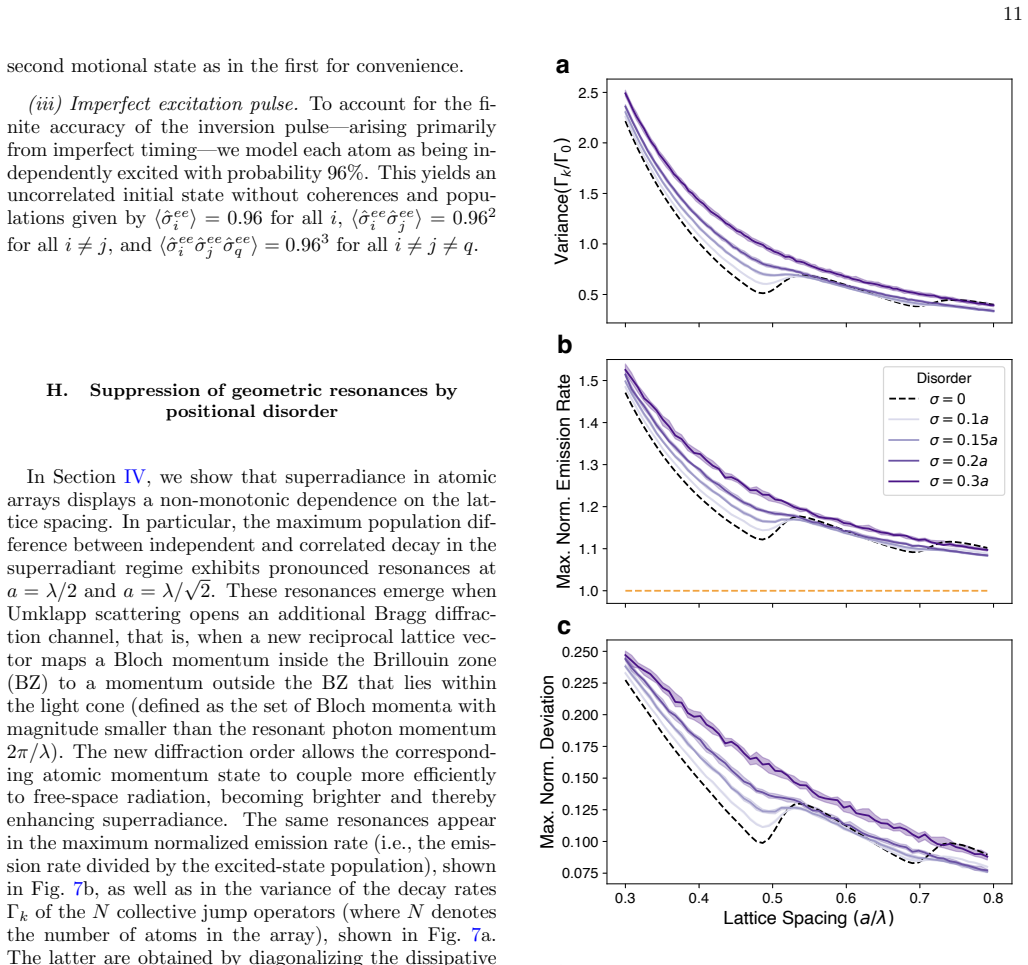
These resonances provide clear evidence that new radiative pathways open discretely as the spac- ing increases. At these special geometries, the maximum allowed in-plane photonic momentum reaches the edge of the Brillouin zone defined by the array. Spin waves that previously lay outside the light cone are folded back into it through Bragg scattering enabl...
2000
-
[2]
To simulate the dynamics of ensembles of up to 450 emitters, we instead employ an approximate method based on a cumulant expansion [5, 51, 52]
Numerical simulation via a cumulant expansion A direct numerical solution of the master equation be- comes intractable for systems with more than about 16 emitters due to the exponential growth of the Hilbert space dimension—the density matrix ˆρhas dimension 2N ×2 N [28, 42]. To simulate the dynamics of ensembles of up to 450 emitters, we instead employ ...
-
[3]
These dis- tributions are experimentally characterised by imaging the lattice immediately after loading
Incorporating experimental factors To accurately model the experiment, we take into ac- count the following factors: (i) Distribution of atomic positions.Although the ex- periment targets a specific number of atoms, the stochas- tic loading of the optical lattice leads to fluctuations both in the total atom number and in the site occupancy, re- sulting in...
-
[4]
The new diffraction order allows the correspond- ing atomic momentum state to couple more efficiently to free-space radiation, becoming brighter and thereby enhancing superradiance
These resonances emerge when Umklapp scattering opens an additional Bragg diffrac- tion channel, that is, when a new reciprocal lattice vec- tor maps a Bloch momentum inside the Brillouin zone (BZ) to a momentum outside the BZ that lies within the light cone (defined as the set of Bloch momenta with magnitude smaller than the resonant photon momentum 2π/λ...
-
[5]
R. H. Dicke, Coherence in Spontaneous Radiation Pro- cesses, Physical Review93, 99 (1954)
1954
-
[6]
Gross and S
M. Gross and S. Haroche, Superradiance: An essay on the theory of collective spontaneous emission, Physics Reports93, 301 (1982)
1982
-
[7]
Chang, J
D. Chang, J. Douglas, A. Gonz´ alez-Tudela, C.-L. Hung, and H. Kimble, Colloquium: Quantum matter built from nanoscopic lattices of atoms and photons, Reviews of Modern Physics90, 031002 (2018), publisher: American Physical Society. 14
2018
-
[8]
S. J. Masson and A. Asenjo-Garcia, Universality of Dicke superradiance in arrays of quantum emitters, Nature Communications13, 2285 (2022)
2022
-
[9]
Rubies-Bigorda, S
O. Rubies-Bigorda, S. Ostermann, and S. F. Yelin, Char- acterizing superradiant dynamics in atomic arrays via a cumulant expansion approach, Physical Review Research 5, 013091 (2023)
2023
-
[10]
Sierra, S
E. Sierra, S. J. Masson, and A. Asenjo-Garcia, Dicke Su- perradiance in Ordered Lattices: Dimensionality Mat- ters, Physical Review Research4, 023207 (2022), pub- lisher: American Physical Society
2022
-
[11]
R. J. Bettles, S. A. Gardiner, and C. S. Adams, En- hanced Optical Cross Section via Collective Coupling of Atomic Dipoles in a 2D Array, Physical Review Letters 116, 103602 (2016), publisher: American Physical Soci- ety
2016
-
[12]
Shahmoon, D
E. Shahmoon, D. S. Wild, M. D. Lukin, and S. F. Yelin, Cooperative Resonances in Light Scattering from Two-Dimensional Atomic Arrays, Physical Review Let- ters118, 113601 (2017), publisher: American Physical Society
2017
-
[13]
Noh and D
C. Noh and D. G. Angelakis, Quantum simulations and many-body physics with light, Reports on Progress in Physics80, 016401 (2016), publisher: IOP Publishing
2016
-
[14]
D. E. Chang, V. Vuleti´ c, and M. D. Lukin, Quantum nonlinear optics — photon by photon, Nature Photonics 8, 685 (2014), publisher: Nature Publishing Group
2014
-
[15]
Facchinetti, S
G. Facchinetti, S. D. Jenkins, and J. Ruostekoski, Storing Light with Subradiant Correlations in Arrays of Atoms, Physical Review Letters117, 243601 (2016), publisher: American Physical Society
2016
-
[16]
Selec- tive Radiance
A. Asenjo-Garcia, M. Moreno-Cardoner, A. Albrecht, H. Kimble, and D. Chang, Exponential Improvement in Photon Storage Fidelities Using Subradiance and “Selec- tive Radiance” in Atomic Arrays, Physical Review X7, 031024 (2017), publisher: American Physical Society
2017
-
[17]
Rubies-Bigorda, V
O. Rubies-Bigorda, V. Walther, T. L. Patti, and S. F. Yelin, Photon control and coherent interactions via lat- tice dark states in atomic arrays, Physical Review Re- search4, 013110 (2022)
2022
-
[18]
Bekenstein, I
R. Bekenstein, I. Pikovski, H. Pichler, E. Shahmoon, S. F. Yelin, and M. D. Lukin, Quantum metasurfaces with atom arrays, Nature Physics16, 676 (2020), pub- lisher: Nature Publishing Group
2020
-
[19]
N. E. Rehler and J. H. Eberly, Superradiance, Physical Review A3, 1735 (1971)
1971
-
[20]
R. H. Lehmberg, Radiation from an N -Atom System. I. General Formalism, Physical Review A2, 883 (1970)
1970
-
[21]
Bonifacio, P
R. Bonifacio, P. Schwendimann, and F. Haake, Quantum Statistical Theory of Superradiance. I, Physical Review A4, 302 (1971)
1971
-
[22]
V. I. Yukalov and E. P. Yukalova, Cooperative Electro- magnetic Effects (2000)
2000
-
[23]
J. M. Raimond, P. Goy, M. Gross, C. Fabre, and S. Haroche, Collective Absorption of Blackbody Radi- ation by Rydberg Atoms in a Cavity: An Experiment on Bose Statistics and Brownian Motion, Physical Review Letters49, 117 (1982)
1982
-
[24]
Inouye, A
S. Inouye, A. P. Chikkatur, D. M. Stamper-Kurn, J. Stenger, D. E. Pritchard, and W. Ketterle, Superra- diant Rayleigh Scattering from a Bose-Einstein Conden- sate, Science285, 571 (1999)
1999
-
[25]
Guerin, M
W. Guerin, M. O. Ara´ ujo, and R. Kaiser, Subradiance in a Large Cloud of Cold Atoms, Physical Review Letters 116, 083601 (2016)
2016
-
[26]
Slama, S
S. Slama, S. Bux, G. Krenz, C. Zimmermann, and P. W. Courteille, Superradiant Rayleigh Scattering and Collec- tive Atomic Recoil Lasing in a Ring Cavity, Physical Re- view Letters98, 053603 (2007)
2007
-
[27]
Baumann, C
K. Baumann, C. Guerlin, F. Brennecke, and T. Esslinger, Dicke quantum phase transition with a superfluid gas in an optical cavity, Nature464, 1301 (2010)
2010
-
[28]
J. G. Bohnet, Z. Chen, J. M. Weiner, D. Meiser, M. J. Holland, and J. K. Thompson, A steady-state superradi- ant laser with less than one intracavity photon, Nature 484, 78 (2012), publisher: Nature Publishing Group
2012
-
[29]
J. Rui, D. Wei, A. Rubio-Abadal, S. Hollerith, J. Zeiher, D. M. Stamper-Kurn, C. Gross, and I. Bloch, A subradi- ant optical mirror formed by a single structured atomic layer, Nature583, 369 (2020), publisher: Nature Pub- lishing Group
2020
-
[30]
M. T. Manzoni, M. Moreno-Cardoner, A. Asenjo-Garcia, J. V. Porto, A. V. Gorshkov, and D. E. Chang, Opti- mization of photon storage fidelity in ordered atomic ar- rays, New Journal of Physics20, 083048 (2018), pub- lisher: IOP Publishing
2018
-
[31]
K. E. Ballantine and J. Ruostekoski, Quantum Single- Photon Control, Storage, and Entanglement Generation with Planar Atomic Arrays, PRX Quantum2, 040362 (2021)
2021
-
[32]
S. J. Masson, I. Ferrier-Barbut, L. A. Orozco, A. Browaeys, and A. Asenjo-Garcia, Many-Body Signa- tures of Collective Decay in Atomic Chains, Physical Re- view Letters125, 263601 (2020)
2020
- [33]
-
[34]
A. Glicenstein, D. B. Orenes, A. Apoorva, R. Saint- Jalm, and R. Kaiser, Probing subradiant dynamics in cold atomic ensembles via population and emitted light measurements (2025), arXiv:2507.16549 [physics]
-
[35]
Rubies-Bigorda, S
O. Rubies-Bigorda, S. Ostermann, and S. F. Yelin, Dy- namic population of multiexcitation subradiant states in incoherently excited atomic arrays, Physical Review A 107, L051701 (2023), publisher: American Physical So- ciety
2023
-
[36]
Henriet, J
L. Henriet, J. S. Douglas, D. E. Chang, and A. Albrecht, Critical open-system dynamics in a one-dimensional optical-lattice clock, Physical Review A99, 023802 (2019)
2019
-
[37]
W.-K. Mok, A. Poddar, E. Sierra, C. C. Rusconi, J. Preskill, and A. Asenjo-Garcia, Universal scaling laws for correlated decay of many-body quantum systems (2024), version Number: 3
2024
-
[38]
M. J. Kastoryano, F. Reiter, and A. S. Sørensen, Dissi- pative Preparation of Entanglement in Optical Cavities, Physical Review Letters106, 090502 (2011)
2011
-
[39]
Reiter, D
F. Reiter, D. Reeb, and A. S. Sørensen, Scalable Dissipa- tive Preparation of Many-Body Entanglement, Physical Review Letters117, 040501 (2016)
2016
-
[40]
Wetter, M
H. Wetter, M. Fleischhauer, S. Linden, and J. Schmitt, Observation of a Topological Edge State Stabilized by Dissipation, Physical Review Letters131, 083801 (2023)
2023
- [41]
-
[42]
L. Lin, Dissipative Preparation of Many-Body Quantum States: Towards Practical Quantum Advantage (2025), arXiv:2505.21308 [quant-ph]
- [43]
-
[44]
Perczel, J
J. Perczel, J. Borregaard, D. Chang, H. Pichler, S. Yelin, P. Zoller, and M. Lukin, Topological Quantum Optics in Two-Dimensional Atomic Arrays, Physical Review Let- ters119, 023603 (2017), publisher: American Physical Society
2017
-
[45]
R. B. Hutson, W. R. Milner, L. Yan, J. Ye, and C. Sanner, Observation of millihertz-level cooperative Lamb shifts in an optical atomic clock, Science383, 384 (2024)
2024
-
[46]
J. P. Clemens, L. Horvath, B. C. Sanders, and H. J. Carmichael, Collective spontaneous emission from a line of atoms, Physical Review A68, 023809 (2003)
2003
-
[47]
Ferioli, A
G. Ferioli, A. Glicenstein, L. Henriet, I. Ferrier-Barbut, and A. Browaeys, Storage and Release of Subradiant Ex- citations in a Dense Atomic Cloud, Physical Review X 11, 021031 (2021)
2021
-
[48]
M. Cech, I. Lesanovsky, and B. Olmos, Dispersionless subradiant photon storage in one-dimensional emitter chains, Physical Review A108, L051702 (2023), pub- lisher: American Physical Society
2023
-
[49]
A. C. Santos, A. Cidrim, C. J. Villas-Boas, R. Kaiser, and R. Bachelard, Generating long-lived entangled states with free-space collective spontaneous emission, Physi- cal Review A105, 053715 (2022), publisher: American Physical Society
2022
-
[50]
Srakaew, P
K. Srakaew, P. Weckesser, S. Hollerith, D. Wei, D. Adler, I. Bloch, and J. Zeiher, A subwavelength atomic array switched by a single Rydberg atom, Nature Physics19, 714 (2023), publisher: Nature Publishing Group
2023
-
[51]
Rubies-Bigorda, S
O. Rubies-Bigorda, S. J. Masson, S. F. Yelin, and A. Asenjo-Garcia, Deterministic Generation of Photonic Entangled States Using Decoherence-Free Subspaces, Physical Review Letters134, 213603 (2025)
2025
- [52]
-
[53]
L. Su, A. Douglas, M. Szurek, R. Groth, S. F. Ozturk, A. Krahn, A. H. H´ ebert, G. A. Phelps, S. Ebadi, S. Dick- erson, F. Ferlaino, O. Markovi´ c, and M. Greiner, Dipolar quantum solids emerging in a Hubbard quantum simula- tor, Nature622, 724 (2023)
2023
-
[54]
H. Y. Ban, M. Jacka, J. L. Hanssen, J. Reader, and J. J. McClelland, Laser cooling transitions in atomic erbium, Optics Express13, 3185 (2005), publisher: Optica Pub- lishing Group
2005
-
[55]
Plankensteiner, C
D. Plankensteiner, C. Hotter, and H. Ritsch, Quantum- Cumulants.jl: A Julia framework for generalized mean- field equations in open quantum systems, Quantum6, 617 (2022)
2022
-
[56]
Robicheaux and D
F. Robicheaux and D. A. Suresh, Beyond lowest order mean-field theory for light interacting with atom arrays, Physical Review A104, 023702 (2021)
2021
discussion (0)
Sign in with ORCID, Apple, or X to comment. Anyone can read and Pith papers without signing in.