Recognition: unknown
A Complexity Dichotomy for Generalized Rainbow Matchings Based on Color Classes
Pith reviewed 2026-05-09 22:23 UTC · model grok-4.3
The pith
Maximum Rainbow Matching is polynomial-time solvable when almost every color class is a complete multipartite graph, and NP-hard otherwise.
A machine-rendered reading of the paper's core claim, the machinery that carries it, and where it could break.
Core claim
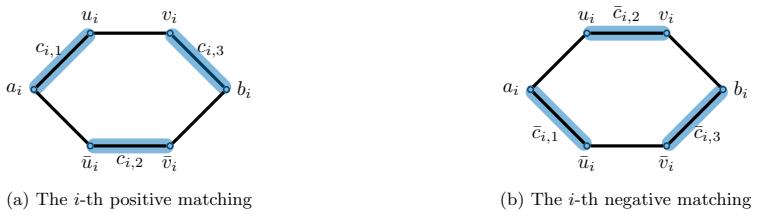
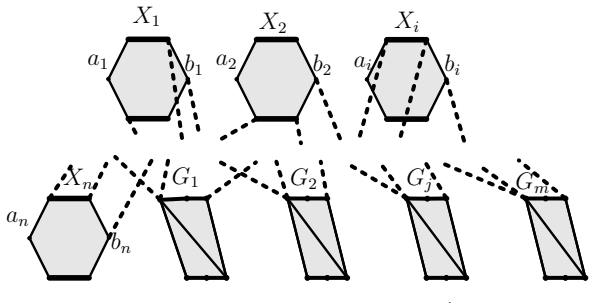
We provide the following complexity dichotomy for this problem based on the structure of the color classes: Maximum Rainbow Matching admits a polynomial-time algorithm if almost every color class is a complete multipartite graph and it is NP-hard otherwise. To prove the NP-hardness-part of the dichotomy, we first show that the problem remains NP-hard even if every color class is a subgraph on four vertices that is either a matching of size two, a path on four vertices or a paw. We then leverage this result to all color classes that are not complete multipartite graphs. For this purpose, we introduce color-closed graph classes, which seem to be an appropriate notion for obtaining complexity 1
What carries the argument
Color-closed graph classes that propagate hardness from three specific four-vertex graphs to all non-complete-multipartite color classes, paired with a reduction to maximum (l,u)-matching when almost all color classes are complete multipartite.
Load-bearing premise
That hardness for the three small forbidden color-class graphs extends to every non-complete-multipartite class via the color-closed property without further restrictions.
What would settle it
A polynomial-time algorithm for the problem on an instance where at least one color class is a non-complete-multipartite graph such as a triangle, or a reduction proving NP-hardness when all color classes are complete multipartite graphs.
Figures




read the original abstract
Given an edge-colored graph, the Maximum Rainbow Matching problem asks for a maximum-cardinality matching of the graph that contains at most one edge from each color. We provide the following complexity dichotomy for this problem based on the structure of the color classes: Maximum Rainbow Matching admits a polynomial-time algorithm if almost every color class is a complete multipartite graph and it is NP-hard otherwise. To prove the NP-hardness-part of the dichotomy, we first show that the problem remains NP-hard even if every color class is a subgraph on four vertices that is either a matching of size two, a path on four vertices or a paw. We then leverage this result to all color classes that are not complete multipartite graphs. For this purpose, we introduce color-closed graph classes, which seem to be an appropriate notion for obtaining complexity classifications for rainbow problems and may be of independent interest. To prove the positive part of the dichotomy, we show that the problem essentially reduces to computing a maximum $(l, u)$-matching, where we heavily exploit that almost all color classes are complete multipartite graphs. In the case where all color classes are complete multipartite, we provide a polynomial-time algorithm that computes a maximum matching containing at most $m_i$ edges from each color class $i$.
Editorial analysis
A structured set of objections, weighed in public.
Referee Report
Summary. The manuscript presents a complexity dichotomy for the Maximum Rainbow Matching problem in edge-colored graphs. The central claim is that the problem is polynomial-time solvable when almost every color class is a complete multipartite graph, and NP-hard otherwise. Hardness is first shown for the case where every color class is one of three specific 4-vertex graphs (matching of size two, P4, or paw), then extended to arbitrary non-complete-multipartite color classes using the new notion of color-closed graph classes. The positive direction reduces the problem to computing a maximum (l, u)-matching and gives an explicit polynomial-time algorithm when all color classes are complete multipartite.
Significance. If correct, the dichotomy provides a clean structural classification for the tractability of rainbow matching, a natural generalization of matching problems. The reduction to (l, u)-matching and the explicit algorithm for the complete-multipartite case are strengths. The introduction of color-closed graph classes is a potentially reusable tool for complexity results on rainbow or colored-graph problems and is credited as such.
major comments (1)
- [Section introducing and applying color-closed graph classes] The extension step (following the hardness result for the three 4-vertex color classes): the argument that color-closed classes lift the NP-hardness to every non-complete-multipartite color class must explicitly verify that the closure operation does not introduce auxiliary colors or structures to which the (l, u)-matching reduction from the positive side could be applied, thereby creating a loophole. A concrete reduction or invariant showing that hardness is preserved under closure without violating the non-multipartite condition is required.
minor comments (2)
- [Abstract and Introduction] The phrase 'almost every color class' in the dichotomy statement should be given a precise formal definition (e.g., all but a constant number, or all but o(n)) already in the introduction or abstract.
- [Positive-result section] Notation for the (l, u)-matching parameters and the precise bound on the number of non-multipartite classes should be introduced consistently before the algorithmic section.
Simulated Author's Rebuttal
We thank the referee for the careful and constructive review. The single major comment identifies a point where the argument for lifting hardness via color-closed classes can be made more explicit, and we will strengthen the manuscript accordingly.
read point-by-point responses
-
Referee: [Section introducing and applying color-closed graph classes] The extension step (following the hardness result for the three 4-vertex color classes): the argument that color-closed classes lift the NP-hardness to every non-complete-multipartite color class must explicitly verify that the closure operation does not introduce auxiliary colors or structures to which the (l, u)-matching reduction from the positive side could be applied, thereby creating a loophole. A concrete reduction or invariant showing that hardness is preserved under closure without violating the non-multipartite condition is required.
Authors: We agree that an explicit invariant is needed to rule out any interaction with the positive-side reduction. In the revised version we will insert a new lemma immediately after the definition of color-closed classes. The lemma states that if C is the color-closed class generated by a non-complete-multipartite graph H, then every member of C contains at least one color class that is not complete multipartite, and moreover the closure operation never produces an instance in which all but a bounded number of color classes become complete multipartite. The proof proceeds by observing that the only auxiliary colors added by the closure are subgraphs of the original non-multipartite color classes (matchings of size two, P4s, or paws) or disjoint unions thereof; none of these auxiliary colors are complete multipartite, so the resulting instance always retains a positive number of non-multipartite color classes. Consequently the (l,u)-matching algorithm, which requires that almost every color class be complete multipartite, cannot be invoked. We also verify that the concrete hardness reduction from the three 4-vertex graphs stays inside this invariant. This addition closes the potential loophole while leaving the rest of the proof unchanged. revision: yes
Circularity Check
No circularity in the dichotomy derivation chain
full rationale
The paper first proves NP-hardness directly for the three base 4-vertex color classes (matching of size 2, P4, paw) via explicit reductions. It then defines color-closed classes as a technical device to lift the hardness result to arbitrary non-complete-multipartite color classes while preserving the relevant structural restrictions. The algorithmic direction reduces the problem to maximum (l,u)-matching by exploiting the complete-multipartite structure of almost all color classes, using standard matching algorithms. No step equates a claimed prediction or theorem to its own inputs by construction, no parameters are fitted and then renamed as predictions, and no load-bearing premise rests on a self-citation chain. The derivation is self-contained against external benchmarks.
Axiom & Free-Parameter Ledger
axioms (1)
- standard math Standard definitions and properties of matchings, edge colorings, complete multipartite graphs, and NP-hardness reductions hold.
invented entities (1)
-
color-closed graph classes
no independent evidence
Reference graph
Works this paper leans on
-
[1]
Rainbow matchings inr-partiter-graphs.Electronic Journal of Combinatorics, 16(1), 2009
Ron Aharoni and Eli Berger. Rainbow matchings inr-partiter-graphs.Electronic Journal of Combinatorics, 16(1), 2009
2009
-
[2]
Howard, and Paul D
Ron Aharoni, Eli Berger, Maria Chudnovsky, David M. Howard, and Paul D. Seymour. Large rainbow matchings in general graphs.European Journal of Combinatorics, 79:222–227, 2019
2019
-
[3]
On a generalization of the Ryser-Brualdi-Stein conjecture.Journal of Graph Theory, 78(2):143–156, 2015
Ron Aharoni, Pierre Charbit, and David Howard. On a generalization of the Ryser-Brualdi-Stein conjecture.Journal of Graph Theory, 78(2):143–156, 2015
2015
-
[4]
Color-coding.Journal of the ACM, 42(4):844–856, 1995
Noga Alon, Raphael Yuster, and Uri Zwick. Color-coding.Journal of the ACM, 42(4):844–856, 1995
1995
-
[5]
More on the rainbow disconnection in graphs.Discuss
Xuqing Bai, Renying Chang, Zhong Huang, and Xueliang Li. More on the rainbow disconnection in graphs.Discuss. Math. Graph Theory, 42(4):1185–1204, 2022
2022
-
[6]
Fomin, Petr A
Aritra Banik, Fedor V. Fomin, Petr A. Golovach, Tanmay Inamdar, Satyabrata Jana, and Saket Saurabh. Cuts in graphs with matroid constraints. In Timothy M. Chan, Johannes Fischer, John Iacono, and Grzegorz Herman, editors,32nd Annual European Symposium on Algorithms, ESA 2024, September 2-4, 2024, Royal Holloway, London, United Kingdom, volume 308 ofLIPIcs...
2024
-
[7]
S´ ark¨ ozy
J´ anos Bar´ at, Andr´ as Gy´ arf´ as, and G´ abor N. S´ ark¨ ozy. Rainbow matchings in bipartite multigraphs. Periodica Mathematica Hungarica, 74(1):108–111, 2017
2017
-
[8]
Spanning trees with many or few colors in edge-colored graphs
Hajo Broersma and Xueliang Li. Spanning trees with many or few colors in edge-colored graphs. Discussiones mathematicae. Graph theory, 17(2):259–269, 1997. 14
1997
-
[9]
Springer, 1991
Richard A Brualdi, Herbert John Ryser, et al.Combinatorial matrix theory, volume 39. Springer, 1991
1991
-
[10]
On the complexity of rainbow spanning forest problem.Optimization Letters, 12(3):443–454, 2018
Francesco Carrabs, Carmine Cerrone, Raffaele Cerulli, and Selene Silvestri. On the complexity of rainbow spanning forest problem.Optimization Letters, 12(3):443–454, 2018
2018
-
[11]
The complexity of determining the rainbow vertex- connection of a graph.Theoretical Computer Science, 412(35):4531–4535, 2011
Lily Chen, Xueliang Li, and Yongtang Shi. The complexity of determining the rainbow vertex- connection of a graph.Theoretical Computer Science, 412(35):4531–4535, 2011
2011
-
[12]
An improved bound on the sizes of matchings guaranteeing a rainbow matching.The Electronic Journal of Combinatorics, 23(2):2, 2016
Dennis Clemens and Julia Ehrenm¨ uller. An improved bound on the sizes of matchings guaranteeing a rainbow matching.The Electronic Journal of Combinatorics, 23(2):2, 2016
2016
-
[13]
Short proofs of rainbow matchings results.International Mathematics Research Notices, 2023(14):12441–12476, 2023
David Munh Correia, Alexey Pokrovskiy, and Benny Sudakov. Short proofs of rainbow matchings results.International Mathematics Research Notices, 2023(14):12441–12476, 2023
2023
-
[14]
Solving the maximum popular matching problem with matroid constraints.SIAM Journal on Discrete Mathematics, 38(3):2226–2242, 2024
Gergely K´ al Cs´ aji, Tam´ as Kir´ aly, and Yu Yokoi. Solving the maximum popular matching problem with matroid constraints.SIAM Journal on Discrete Mathematics, 38(3):2226–2242, 2024
2024
-
[15]
Maximizing a submodu- lar set function subject to a matroid constraint (extended abstract)
Gruia Cualinescu, Chandra Chekuri, Martin P´ al, and Jan Vondr´ ak. Maximizing a submodu- lar set function subject to a matroid constraint (extended abstract). In Matteo Fischetti and David P. Williamson, editors,Integer Programming and Combinatorial Optimization, 12th Interna- tional IPCO Conference, Ithaca, NY, USA, June 25-27, 2007, Proceedings, volume...
2007
-
[16]
Arthur A. Drisko. Transversals in row-latin rectangles.Journal of Combinatorial Theory, Series A, 84(2):181–195, 1998
1998
-
[17]
A tight combinatorial algorithm for submodular maximization subject to a matroid constraint
Yuval Filmus and Justin Ward. A tight combinatorial algorithm for submodular maximization subject to a matroid constraint. In53rd Annual IEEE Symposium on Foundations of Computer Science, FOCS 2012, New Brunswick, NJ, USA, October 20-23, 2012, pages 659–668. IEEE Com- puter Society, 2012
2012
-
[18]
Harold N. Gabow. An efficient reduction technique for degree-constrained subgraph and bidirected network flow problems. In David S. Johnson, Ronald Fagin, Michael L. Fredman, David Harel, Richard M. Karp, Nancy A. Lynch, Christos H. Papadimitriou, Ronald L. Rivest, Walter L. Ruzzo, and Joel I. Seiferas, editors,Proceedings of the 15th Annual ACM Symposium...
1983
-
[19]
How many colors guarantee a rainbow matching? The Electronic Journal of Combinatorics, 21(1):1, 2014
Roman Glebov, Benny Sudakov, and Tibor Szab´ o. How many colors guarantee a rainbow matching? The Electronic Journal of Combinatorics, 21(1):1, 2014
2014
-
[20]
Mouawad, Vijayaragunathan Ramamoor- thi, Daniel Schmand, and Sebastian Siebertz
Mario Grobler, Stephanie Maaz, Nicole Megow, Amer E. Mouawad, Vijayaragunathan Ramamoor- thi, Daniel Schmand, and Sebastian Siebertz. Solution discovery via reconfiguration for problems in P. In Karl Bringmann, Martin Grohe, Gabriele Puppis, and Ola Svensson, editors,51st Inter- national Colloquium on Automata, Languages, and Programming, ICALP 2024, July...
2024
-
[21]
Parameterized algorithms and kernels for rainbow matching.Algorithmica, 81(4):1684–1698, 2019
Sushmita Gupta, Sanjukta Roy, Saket Saurabh, and Meirav Zehavi. Parameterized algorithms and kernels for rainbow matching.Algorithmica, 81(4):1684–1698, 2019
2019
-
[22]
Quadratic vertex kernel for rainbow matching.Algorithmica, 82(4):881–897, 2020
Sushmita Gupta, Sanjukta Roy, Saket Saurabh, and Meirav Zehavi. Quadratic vertex kernel for rainbow matching.Algorithmica, 82(4):881–897, 2020
2020
-
[23]
Approximation schemes for the restricted shortest path problem.Mathematics of Operations research, 17(1):36–42, 1992
Refael Hassin. Approximation schemes for the restricted shortest path problem.Mathematics of Operations research, 17(1):36–42, 1992
1992
-
[24]
Pooya Hatami and Peter W. Shor. A lower bound for the length of a partial transversal in a latin square.Journal of Combinatorial Theory, Series A, 115(7):1103–1113, 2008. 15
2008
-
[25]
Cor A. J. Hurkens and Alexander Schrijver. On the size of systems of sets every t of which have an sdr, with an application to the worst-case ratio of heuristics for packing problems.SIAM J. Discret. Math., 2(1):68–72, 1989
1989
-
[26]
Matching problems with delta-matroid constraints
Naonori Kakimura and Mizuyo Takamatsu. Matching problems with delta-matroid constraints. SIAM Journal on Discrete Mathematics, 28(2):942–961, 2014
2014
-
[27]
The popular matching and condensation problems under matroid constraints
Naoyuki Kamiyama. The popular matching and condensation problems under matroid constraints. Journal of Combinatorial Optimization, 32(4):1305–1326, 2016
2016
-
[28]
Popular matchings with ties and matroid constraints.SIAM Journal on Discrete Mathematics, 31(3):1801–1819, 2017
Naoyuki Kamiyama. Popular matchings with ties and matroid constraints.SIAM Journal on Discrete Mathematics, 31(3):1801–1819, 2017
2017
-
[29]
On stable matchings with pairwise preferences and matroid constraints
Naoyuki Kamiyama. On stable matchings with pairwise preferences and matroid constraints. In Amal El Fallah Seghrouchni, Gita Sukthankar, Bo An, and Neil Yorke-Smith, editors,Proceedings of the 19th International Conference on Autonomous Agents and Multiagent Systems, AAMAS ’20, Auckland, New Zealand, May 9-13, 2020, pages 584–592. International Foundation...
2020
-
[30]
Monochromatic and heterochromatic subgraphs in edge-colored graphs - A survey.Graphs Comb., 24(4):237–263, 2008
Mikio Kano and Xueliang Li. Monochromatic and heterochromatic subgraphs in edge-colored graphs - A survey.Graphs Comb., 24(4):237–263, 2008
2008
-
[31]
Large matchings in bipartite graphs have a rainbow matching.European Journal of Combinatorics, 38:97–101, 2014
Daniel Kotlar and Ran Ziv. Large matchings in bipartite graphs have a rainbow matching.European Journal of Combinatorics, 38:97–101, 2014
2014
-
[32]
Complexity results for rainbow matchings.Theoretical Computer Science, 524:27–33, 2014
Van Bang Le and Florian Pfender. Complexity results for rainbow matchings.Theoretical Computer Science, 524:27–33, 2014
2014
-
[33]
Restricted t-Matchings via Half-Edges
Katarzyna Paluch and Mateusz Wasylkiewicz. Restricted t-Matchings via Half-Edges. In Petra Mutzel, Rasmus Pagh, and Grzegorz Herman, editors,29th Annual European Symposium on Al- gorithms, ESA 2021, September 6-8, 2021, Lisbon, Portugal (Virtual Conference), volume 204 of LIPIcs, pages 73:1–73:17. Schloss Dagstuhl - Leibniz-Zentrum f¨ ur Informatik, 2021
2021
-
[34]
Springer Berlin, Heidelberg, 1 edition, 2003
Alexander Schrijver.Combinatorial Optimization: Polyhedra and Efficiency, volume 24 ofAlgo- rithms and Combinatorics. Springer Berlin, Heidelberg, 1 edition, 2003
2003
-
[35]
Another look at the degree constrained subgraph problem.Information Processing Letters, 12(2):89–92, 1981
Yossi Shiloach. Another look at the degree constrained subgraph problem.Information Processing Letters, 12(2):89–92, 1981
1981
-
[36]
Transversals of latin squares and their generalizations.Pacific Journal of Math- ematics, 59(2):567–575, 1975
Sherman K Stein. Transversals of latin squares and their generalizations.Pacific Journal of Math- ematics, 59(2):567–575, 1975
1975
-
[37]
On the rainbow connec- tivity of graphs: Complexity and FPT algorithms.Algorithmica, 67(2):161–179, 2013
Kei Uchizawa, Takanori Aoki, Takehiro Ito, Akira Suzuki, and Xiao Zhou. On the rainbow connec- tivity of graphs: Complexity and FPT algorithms.Algorithmica, 67(2):161–179, 2013. 16
2013
discussion (0)
Sign in with ORCID, Apple, or X to comment. Anyone can read and Pith papers without signing in.