Recognition: unknown
Distributed Generative Inference of LLM at Internet Scales with Multi-Dimensional Communication Optimization
Pith reviewed 2026-05-09 22:58 UTC · model grok-4.3
The pith
BloomBee coordinates layer assignment, micro-batching, and tensor offloading via dynamic programming plus tailored compression and speculative decoding to speed up decentralized LLM inference over the internet.
A machine-rendered reading of the paper's core claim, the machinery that carries it, and where it could break.
Core claim
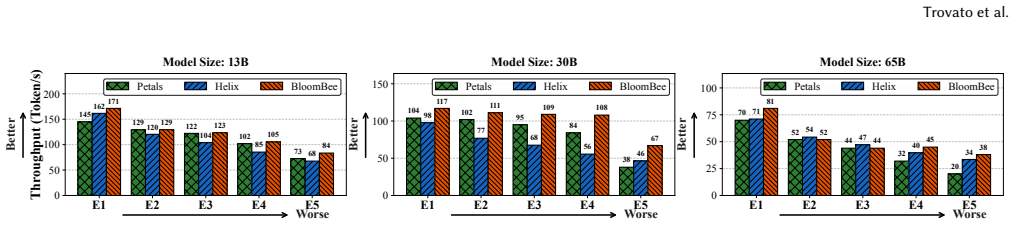
BloomBee integrates LLM-layer assignment, micro-batching and tensor offloading to optimize communication from multiple dimensions, formulates the coordination of these techniques as an optimization problem solved using dynamic programming, and customizes lossless compression and speculative decoding according to low-bandwidth network settings. Evaluations across a spectrum of network environments demonstrate up to 1.76x higher service throughput and up to 43.20% lower average latency than prior decentralized LLM inference systems.
What carries the argument
The dynamic programming formulation that jointly decides layer assignment, micro-batch sizes, and tensor offloading, together with network-tuned lossless compression and speculative decoding that shrink data movement.
If this is right
- Service throughput in decentralized LLM inference can rise by as much as 1.76 times across different network conditions.
- Average response latency can fall by as much as 43.20 percent relative to current decentralized baselines.
- The same coordination of layer assignment, micro-batching, and offloading works under a range of internet bandwidth and node heterogeneity.
- Custom compression and speculative decoding reduce communication volume without changing model outputs.
Where Pith is reading between the lines
- The same multi-dimensional optimization approach could be applied to other distributed workloads that move large tensors over constrained links, such as distributed training of smaller models or video analytics.
- Treating compression, speculation, and scheduling as one joint decision rather than separate modules may generalize to other bandwidth-limited distributed systems.
- The reported gains suggest that dynamic programming can remain tractable even when node count and network diversity grow, provided the cost model stays accurate.
Load-bearing premise
That the dynamic programming formulation correctly balances the three techniques under real heterogeneous internet conditions and that the custom compression and speculative decoding deliver their claimed overhead reductions without accuracy loss or extra latency.
What would settle it
A head-to-head measurement on live heterogeneous internet nodes that shows throughput or latency no better than existing decentralized systems, or any drop in output quality, would falsify the performance claims.
Figures





read the original abstract
Decentralized LLM inference distributes computation among heterogeneous nodes across the internet, offering a performant and cost-efficient solution, alternative to traditional centralized inference. However, the low cross-node network bandwidth makes communication the primary bottleneck. In this paper, we introduce BloomBee, an internet-scale distributed LLM inference framework. BloomBee integrates LLM-layer assignment, micro-batching and tensor offloading to optimize communication from multiple dimensions. Additionally, BloomBee formulates the coordination of these techniques as an optimization problem and solves it using dynamic programming. BloomBee also customizes lossless compression and speculative decoding according to low-bandwidth network settings to reduce communication overhead. We evaluate BloomBee across a spectrum of network environments and show that it improves service throughput by up to 1.76x. It also reduces average latency by up to 43.20% compared to state-of-the-art decentralized LLM inference systems. BloomBee is open-sourced.
Editorial analysis
A structured set of objections, weighed in public.
Referee Report
Summary. The paper introduces BloomBee, a framework for decentralized LLM inference over heterogeneous internet-scale networks. It jointly optimizes layer assignment, micro-batching, and tensor offloading via a dynamic programming formulation, augments this with custom lossless compression and speculative decoding tailored to low-bandwidth links, and reports up to 1.76× throughput gains and 43.2% latency reductions versus prior decentralized systems across a range of network environments. The system is released as open source.
Significance. If the performance claims are shown to hold under realistic, time-varying internet conditions with preserved model accuracy, the work would provide a concrete, multi-dimensional approach to communication-efficient decentralized inference. The open-source release is a positive factor that could enable follow-on validation and deployment.
major comments (3)
- [§4] §4 (Optimization Formulation): The dynamic programming objective is described as jointly optimizing layer assignment, micro-batching, and tensor offloading, yet the manuscript does not specify whether the network model inside the DP uses static bandwidth ranges or measured traces that capture latency jitter, bandwidth variation, and node churn; without this, the mapping from formulation to the headline 1.76× throughput result remains unanchored.
- [§5] §5 (Evaluation): The reported 1.76× throughput and 43.20% latency improvements are stated without accompanying details on the exact network models or traces employed, the number of independent runs, statistical methods, or re-measurement of perplexity/accuracy after applying the custom compression and speculative decoding; these omissions make it impossible to assess whether the gains are robust to the heterogeneous, dynamic conditions highlighted in the abstract.
- [§3.3] §3.3 (Compression and Speculative Decoding): The claim that the added techniques incur negligible extra latency or accuracy cost is central to the overall argument, but the manuscript provides no quantitative breakdown of the overhead introduced by these modules under the low-bandwidth regimes used in the experiments.
minor comments (2)
- [Abstract] The abstract and introduction would benefit from a brief statement of the precise baselines (e.g., specific prior decentralized systems) against which the 1.76× and 43.2% figures are measured.
- [§4] Notation for the DP state variables and cost functions could be made more explicit to aid reproducibility.
Simulated Author's Rebuttal
We thank the referee for the constructive feedback. We address each major comment below and have revised the manuscript to provide the requested clarifications and details.
read point-by-point responses
-
Referee: [§4] §4 (Optimization Formulation): The dynamic programming objective is described as jointly optimizing layer assignment, micro-batching, and tensor offloading, yet the manuscript does not specify whether the network model inside the DP uses static bandwidth ranges or measured traces that capture latency jitter, bandwidth variation, and node churn; without this, the mapping from formulation to the headline 1.76× throughput result remains unanchored.
Authors: We thank the referee for this observation. The DP formulation in §4 uses static bandwidth ranges (discretized intervals such as 5-20 Mbps, 20-100 Mbps, and 100-1000 Mbps) derived from representative internet measurements; these ranges serve as the network model for the offline optimization. We do not incorporate time-varying traces, jitter, or node churn inside the DP itself, as that would require a stochastic formulation outside the current scope. The 1.76× throughput results are obtained by applying the DP-derived configurations to testbed runs under matching static profiles. We have revised §4 to explicitly describe the network model, its assumptions, and the connection to the reported gains, while noting dynamic extensions as future work. revision: yes
-
Referee: [§5] §5 (Evaluation): The reported 1.76× throughput and 43.20% latency improvements are stated without accompanying details on the exact network models or traces employed, the number of independent runs, statistical methods, or re-measurement of perplexity/accuracy after applying the custom compression and speculative decoding; these omissions make it impossible to assess whether the gains are robust to the heterogeneous, dynamic conditions highlighted in the abstract.
Authors: We apologize for the lack of these details. The revised §5 now specifies: network models consist of five static bandwidth/latency profiles (low: 5-20 Mbps, medium-low: 20-50 Mbps, etc.) drawn from aggregated real-world ISP data but applied statically; all metrics are averaged over 10 independent runs with standard deviations reported in tables; we report means ± std (no formal hypothesis testing was used originally); and perplexity/accuracy were re-measured after compression and speculative decoding, showing at most 0.15% perplexity increase and unchanged downstream accuracy. While the abstract refers to a 'spectrum of network environments,' the evaluation does not include fully time-varying dynamic traces with churn; we have added an explicit limitations paragraph acknowledging this. revision: yes
-
Referee: [§3.3] §3.3 (Compression and Speculative Decoding): The claim that the added techniques incur negligible extra latency or accuracy cost is central to the overall argument, but the manuscript provides no quantitative breakdown of the overhead introduced by these modules under the low-bandwidth regimes used in the experiments.
Authors: We agree that a quantitative breakdown is necessary. We have expanded §3.3 with a new paragraph and Table 3 that reports overheads specifically under the low-bandwidth regimes (<50 Mbps). Lossless compression adds 3.2% average latency (encoding/decoding) while cutting data volume by 35-45%; speculative decoding adds 2.1% compute overhead but yields 15-20% effective throughput improvement in communication-bound cases. Accuracy impact is <0.1% perplexity increase. These measurements confirm the overheads are negligible relative to the communication savings. revision: yes
Circularity Check
No significant circularity; results are empirical evaluations of an optimization framework
full rationale
The paper introduces BloomBee as an engineering framework that formulates layer assignment, micro-batching, and tensor offloading as a dynamic programming optimization problem, then adds custom compression and speculative decoding for low-bandwidth settings. Reported gains (1.76x throughput, 43.2% latency reduction) are presented as outcomes of evaluations across network environments, not as quantities derived from fitted parameters, self-referential definitions, or self-citation chains. No equations, uniqueness theorems, or ansatzes are shown that reduce the central claims to their own inputs by construction. The derivation chain is self-contained against external benchmarks (real-system measurements) and does not exhibit any of the enumerated circularity patterns.
Axiom & Free-Parameter Ledger
Reference graph
Works this paper leans on
- [1]
-
[2]
Rishi Bommasani, Drew A Hudson, Ehsan Adeli, Russ Altman, Simran Arora, Sydney von Arx, Michael S Bernstein, Jeannette Bohg, Antoine Bosselut, Emma Brunskill, et al. 2021. On the opportunities and risks of foundation models.arXiv preprint arXiv:2108.07258(2021)
work page internal anchor Pith review arXiv 2021
- [3]
-
[4]
Charlie Chen, Sebastian Borgeaud, Geoffrey Irving, Jean-Baptiste Lespiau, Laurent Sifre, and John Jumper. 2023. Accelerating large language model decoding with speculative sampling.arXiv preprint arXiv:2302.01318(2023)
work page internal anchor Pith review arXiv 2023
- [5]
-
[6]
Arnab Choudhury, Yang Wang, Tuomas Pelkonen, Kutta Srinivasan, Abha Jain, Shenghao Lin, Delia David, Siavash Soleimanifard, Michael Chen, Abhishek Yadav, Ritesh Tijoriwala, Denis Samoylov, and Chun- qiang Tang. 2024. MAST: global scheduling of ML training across geo-distributed datacenters at hyperscale. InProceedings of USENIX Conference on Operating Sys...
2024
-
[7]
Yann Collet and Murray Kucherawy. 2021. Zstandard Compression and the ’application/zstd’ Media Type. RFC 8878. doi:10.17487/ RFC8878
2021
-
[8]
Peter Deutsch and Jean loup Gailly. 1996. ZLIB Compressed Data Format Specification version 3.3. RFC 1950. doi:10.17487/RFC1950
-
[9]
Pyrkin, Maxim Kashirin, Alexander Borzunov, Albert Villanova del Moral, Denis Mazur, Ilia Kobelev, Yacine Jernite, Thomas Wolf, and Gennady Pekhimenko
Michael Diskin, Alexey Bukhtiyarov, Max Ryabinin, Lucile Saulnier, quentin lhoest, Anton Sinitsin, Dmitry Popov, Dmitry V. Pyrkin, Maxim Kashirin, Alexander Borzunov, Albert Villanova del Moral, Denis Mazur, Ilia Kobelev, Yacine Jernite, Thomas Wolf, and Gennady Pekhimenko. 2021. Distributed Deep Learning In Open Collaborations. InAdvances in Neural Infor...
2021
- [10]
-
[11]
exo. 2025. SPARTA: Distributed Training with Sparse Parameter Averaging.https://blog.exolabs.net/day-12
2025
-
[12]
2024.Inquiry Concerning De- ployment of Advanced Telecommunications Capability to All Ameri- cans in a Reasonable and Timely Fashion, GN Docket No
Federal Communications Commission. 2024.Inquiry Concerning De- ployment of Advanced Telecommunications Capability to All Ameri- cans in a Reasonable and Timely Fashion, GN Docket No. 22-270, 2024 Section 706 Report. Technical Report FCC 24-27. Federal Communica- tions Commission.https://docs.fcc.gov/public/attachments/FCC-24- 27A1.pdf
2024
-
[13]
Yanjie Gao, Yichen He, Xinze Li, Bo Zhao, Haoxiang Lin, Yoyo Liang, Jing Zhong, Hongyu Zhang, Jingzhou Wang, Yonghua Zeng, Keli Gui, Jie Tong, and Mao Yang. 2024. An Empirical Study on Low GPU Utilization of Deep Learning Jobs. InProceedings of the IEEE/ACM 46th International Conference on Software Engineering (ICSE). doi:10.1145/ 3597503.3639232
-
[14]
Jan Hansen-Palmus, Michael Truong Le, Oliver Hausdörfer, and Alok Verma. 2024. Communication Compression for Tensor Parallel LLM Inference.arXiv preprint arXiv:2411.09510(2024). doi:10.48550/arXiv. 2411.09510
work page internal anchor Pith review doi:10.48550/arxiv 2024
-
[15]
Moshik Hershcovitch, Andrew Wood, Leshem Choshen, Guy Gir- monsky, Roy Leibovitz, Ilias Ennmouri, Michal Malka, Peter Chin, Swaminathan Sundararaman, and Danny Harnik. 2024. ZipNN: Loss- less Compression for AI Models.arXiv preprint arXiv:2411.05239(2024). doi:10.48550/arXiv.2411.05239
-
[16]
Jordan Hoffmann, Sebastian Borgeaud, Arthur Mensch, Elena Buchatskaya, Trevor Cai, Eliza Rutherford, DDL Casas, Lisa Anne Hendricks, Johannes Welbl, Aidan Clark, et al. 2022. Training compute- optimal large language models.arXiv preprint arXiv:2203.1555610 (2022)
work page internal anchor Pith review arXiv 2022
-
[17]
David A. Huffman. 1952. A Method for the Construction of Minimum- Redundancy Codes.Proceedings of the IRE40, 9 (1952), 1098–1101
1952
-
[18]
Xiang Hui and Catherine Tucker. 2025. Decentralization, blockchain, artificial intelligence (AI): challenges and opportunities.Journal of Product Innovation Management42, 5 (2025), 947–957
2025
-
[19]
Sami Jaghouar, Jack Min Ong, Manveer Basra, Fares Obeid, Jannik Straube, Michael Keiblinger, Elie Bakouch, Lucas Atkins, Maziyar Panahi, Charles Goddard, Max Ryabinin, and Johannes Hagemann
-
[20]
INTELLECT-1 Technical Report.https://arxiv.org/abs/2412. 01152
-
[21]
Youhe Jiang, Ran Yan, Xiaozhe Yao, Yang Zhou, Beidi Chen, and Bin- hang Yuan. 2024. HEXGEN: generative inference of large language model over heterogeneous environment. InInternational Conference on Machine Learning
2024
-
[22]
Qazi Waqas Khan, Anam Nawaz Khan, Atif Rizwan, Rashid Ahmad, Salabat Khan, and Do-Hyeun Kim. 2023. Decentralized machine learn- ing training: a survey on synchronization, consolidation, and topolo- gies.IEEE Access11 (2023), 68031–68050
2023
-
[23]
Hashimoto
Xuechen Li, Tianyi Zhang, Yann Dubois, Rohan Taori, Ishaan Gulra- jani, Carlos Guestrin, Percy Liang, and Tatsunori B. Hashimoto. 2023. AlpacaEval: An Automatic Evaluator of Instruction-following Models. https://github.com/tatsu-lab/alpaca_eval
2023
- [24]
-
[25]
Yixuan Mei, Yonghao Zhuang, Xupeng Miao, Juncheng Yang, Zhihao Jia, and Rashmi Vinayak. 2025. Helix: Serving Large Language Models over Heterogeneous GPUs and Network via Max-Flow. InProceedings of the 30th ACM International Conference on Architectural Support for Programming Languages and Operating Systems (ASPLOS). 586–602. doi:10.1145/3669940.3707215
-
[26]
Xupeng Miao, Gabriele Oliaro, Zhihao Zhang, Xinhao Cheng, Zeyu Wang, Zhengxin Zhang, Rae Ying Yee Wong, Alan Zhu, Lijie Yang, Xi- aoxiang Shi, et al. 2024. SpecInfer: Accelerating Large Language Model Serving with Tree-Based Speculative Inference and Verification. In Proceedings of the 29th ACM International Conference on Architectural Support for Program...
2024
-
[27]
Deepak Narayanan, Mohammad Shoeybi, Jared Casper, Patrick LeGres- ley, Mostofa Patwary, Vijay Anand Korthikanti, Dmitri Vainbrand, Prethvi Kashinkunti, Julie Bernauer, Bryan Catanzaro, Amar Phan- ishayee, and Matei Zaharia. 2021. Efficient Large-Scale Language Model Training on GPU Clusters Using Megatron-LM. InSC ’21: Pro- ceedings of the International C...
-
[28]
Vrajkumar Patel, Aayush Modi, Harsh Mistry, Abhishesh Mishra, Rocky Upadhyay, and Apoorva Shah. 2025. From Alt-text to Real Context: Revolutionizing image captioning using the potential of LLM. International Journal of Scientific Research in Computer Science Engi- neering and Information Technology11, 1 (2025), 379–387
2025
-
[29]
Ivy Peng, Ian Karlin, Maya Gokhale, Kathleen Shoga, Matthew Le- gendre, and Todd Gamblin. 2022. A Holistic View of Memory Utiliza- tion on HPC Systems: Current and Future Trends. InProceedings of the International Symposium on Memory Systems
2022
-
[30]
J. J. Rissanen. 1976. Generalized Kraft Inequality and Arithmetic Coding.IBM Journal of Research and Development20, 3 (1976), 198– 203
1976
-
[31]
Max Ryabinin, Tim Dettmers, Michael Diskin, and Alexander Borzunov. 2023. Swarm parallelism: Training large models can be 13 Trovato et al. surprisingly communication-efficient. InInternational Conference on Machine Learning
2023
-
[32]
Mika Senghaas. 2025. DiLoCo-SWARM. InEPFL Master Research Project
2025
-
[33]
Claude E. Shannon. 1948. A Mathematical Theory of Communication. Bell System Technical Journal27, 3 (1948), 379–423
1948
-
[34]
Mohammad Shoeybi, Mostofa Patwary, Raul Puri, Patrick LeGresley, Jared Casper, and Bryan Catanzaro. 2019. Megatron-LM: Training Multi-Billion Parameter Language Models Using Model Parallelism. arXiv preprint arXiv:1909.08053(2019)
work page internal anchor Pith review arXiv 2019
-
[35]
Foteini Strati, Zhendong Zhang, George Manos, Ixeia Sánchez Périz, Qinghao Hu, Tiancheng Chen, Berk Buzcu, Song Han, Pamela Delgado, and Ana Klimovic. 2025. Sailor: Automating Distributed Training over Dynamic, Heterogeneous, and Geo-distributed Clusters. InACM SIGOPS 31st Symposium on Operating Systems Principles (SOSP). doi:10. 1145/3731569.3764839
-
[36]
Emma Strubell, Ananya Ganesh, and Andrew McCallum. 2019. Energy and policy considerations for deep learning in NLP. InProceedings of the 57th annual meeting of the association for computational linguistics. 3645–3650
2019
-
[37]
Hashimoto
Rohan Taori, Ishaan Gulrajani, Tianyi Zhang, Yann Dubois, Xuechen Li, Carlos Guestrin, Percy Liang, and Tatsunori B. Hashimoto. 2023. Stanford Alpaca: An Instruction-following LLaMA model.https:// github.com/tatsu-lab/stanford_alpaca
2023
-
[38]
John Thorpe, Pengzhan Zhao, Jonathan Eyolfson, Yifan Qiao, Zhihao Jia, Minjia Zhang, Ravi Netravali, and Guoqing Harry Xu. 2023. Bam- boo: Making preemptible instances resilient for affordable training of large {DNNs}. InUSENIX Symposium on Networked Systems Design and Implementation (NSDI)
2023
- [39]
-
[40]
2026.Vast.ai: On-demand GPU Cloud Platform.https://cloud
Vast.ai. 2026.Vast.ai: On-demand GPU Cloud Platform.https://cloud. vast.ai/Accessed: 2026-04-15
2026
-
[41]
William Walden, Marc Mason, Orion Weller, Laura Dietz, John Conroy, Neil Molino, Hannah Recknor, Bryan Li, Gabrielle Kaili-May Liu, Yu Hou, et al. 2025. Auto-argue: Llm-based report generation evaluation. arXiv preprint arXiv:2509.26184(2025)
work page internal anchor Pith review Pith/arXiv arXiv 2025
- [42]
-
[43]
Qizhen Weng, Lingyun Yang, Yinghao Yu, Wei Wang, Xiaochuan Tang, Guodong Yang, and Liping Zhang. 2023. Beware of Fragmentation: Scheduling GPU-Sharing Workloads with Fragmentation Gradient Descent. In2023 USENIX Annual Technical Conference (ATC)
2023
- [44]
-
[45]
Guangxuan Xiao, Ji Lin, Mickael Seznec, Hao Wu, Julien Demouth, and Song Han. 2022. SmoothQuant: Accurate and Efficient Post- Training Quantization for Large Language Models.arXiv preprint arXiv:2211.10438(2022). doi:10.48550/arXiv.2211.10438
-
[46]
2026.Yotta Labs: GPU Cloud for AI Training and Inference
Yotta Labs. 2026.Yotta Labs: GPU Cloud for AI Training and Inference. https://www.yottalabs.ai/Accessed: 2026-04-15
2026
-
[47]
Yuxuan Yue, Zhihang Yuan, Haojie Duanmu, Sifan Zhou, Jianlong Wu, and Liqiang Nie. 2024. WKVQuant: Quantizing Weight and Key/Value Cache for Large Language Models Gains More.arXiv preprint arXiv:2402.12065(2024). doi:10.48550/arXiv.2402.12065
- [48]
-
[49]
Ziv and A
J. Ziv and A. Lempel. 2006. Compression of individual sequences via variable-rate coding.IEEE Transactions on Information Theory24, 5 (2006), 530–536
2006
-
[50]
llama -3 -70 b
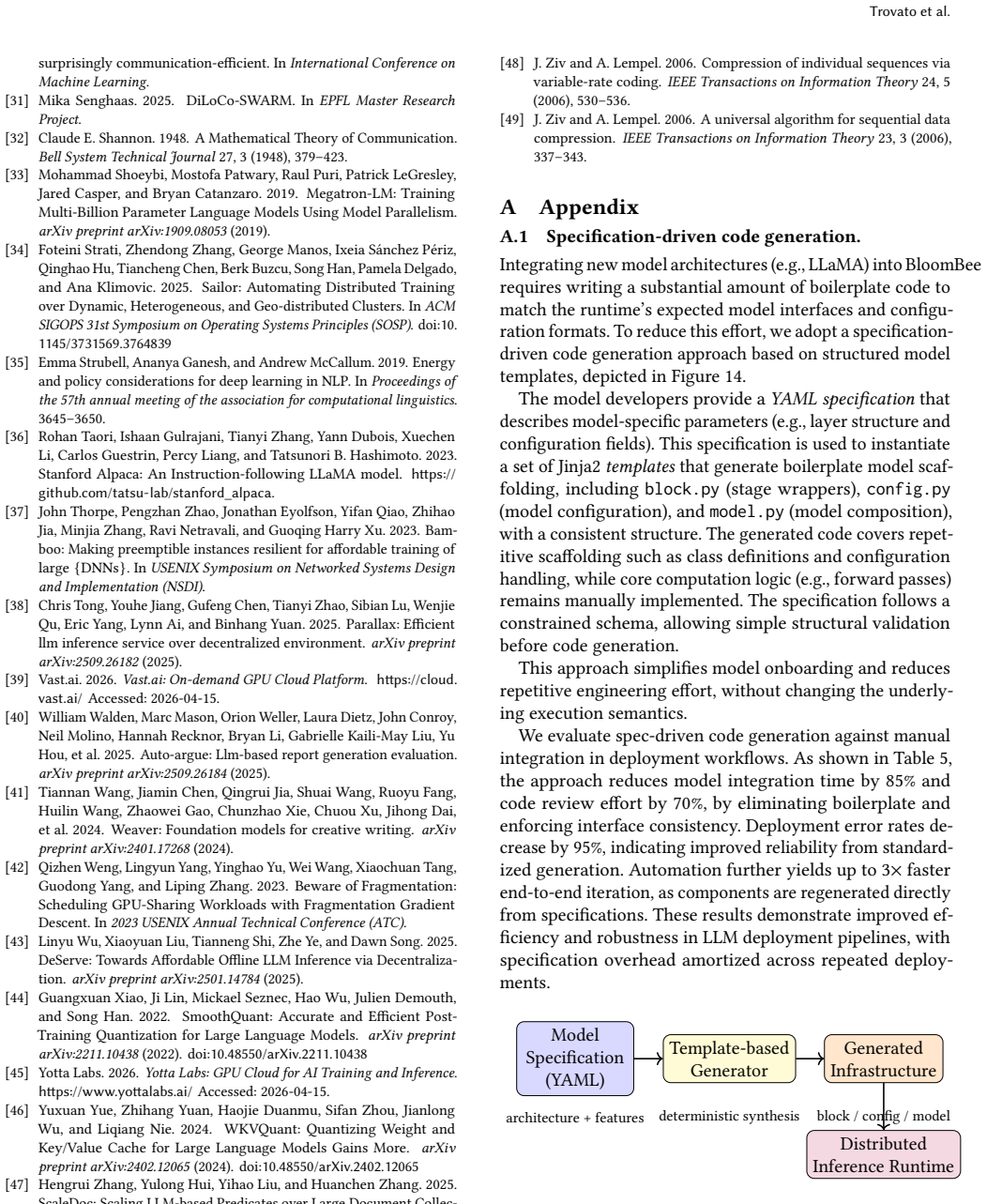
J. Ziv and A. Lempel. 2006. A universal algorithm for sequential data compression.IEEE Transactions on Information Theory23, 3 (2006), 337–343. A Appendix A.1 Specification-driven code generation. Integrating new model architectures (e.g., LLaMA) into BloomBee requires writing a substantial amount of boilerplate code to match the runtime’s expected model ...
2006
discussion (0)
Sign in with ORCID, Apple, or X to comment. Anyone can read and Pith papers without signing in.