Generative Discovery of Magnetic Insulators under Competing Physical Constraints
Pith reviewed 2026-05-09 23:23 UTC · model grok-4.3
The pith
A constraint-guided generative framework discovers twelve new magnetic insulator candidates by steering searches toward regions where stability, magnetism, and insulation must hold simultaneously.
A machine-rendered reading of the paper's core claim, the machinery that carries it, and where it could break.
Core claim
The central claim is that MagMatLLM integrates language-model-based crystal generation with evolutionary selection, surrogate screening, and first-principles validation to target materials that must be simultaneously stable, magnetic, and insulating, thereby identifying twelve previously unreported candidate magnetic insulators of which ten satisfy dynamical stability, finite band gaps, and nonzero magnetic moments in DFT calculations.
What carries the argument
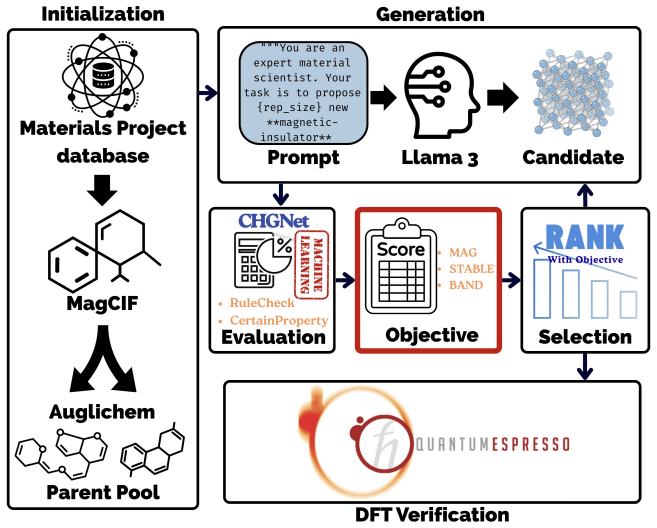
MagMatLLM, the constraint-guided generative discovery framework that enforces functional requirements of stability, magnetism, and insulation during structure generation and selection instead of applying them only afterward.
If this is right
- Twelve previously unreported compounds become concrete targets for experimental synthesis and characterization.
- Ten candidates pass phonon-based dynamical stability checks and display both finite band gaps and nonzero magnetic moments.
- The workflow provides a transferable strategy for discovering other quantum materials that must satisfy multiple competing physical constraints.
- Generation and selection steps can be adapted to different sets of functional requirements beyond magnetism and insulation.
Where Pith is reading between the lines
- The same constraint-enforcement approach could be applied to other sparse material classes such as high-temperature superconductors or topological insulators.
- Integrating the workflow with higher-accuracy methods beyond standard DFT could further reduce the rate of false positives before experiments.
- The identified candidates may serve as starting points for doping or strain studies aimed at tuning magnetic transition temperatures.
Load-bearing premise
That LLM-driven generation combined with evolutionary and surrogate filtering can locate physically viable structures in the sparse magnetic-insulator space and that spin-polarized DFT predictions of stability, gaps, and moments are accurate enough to identify experimentally relevant candidates.
What would settle it
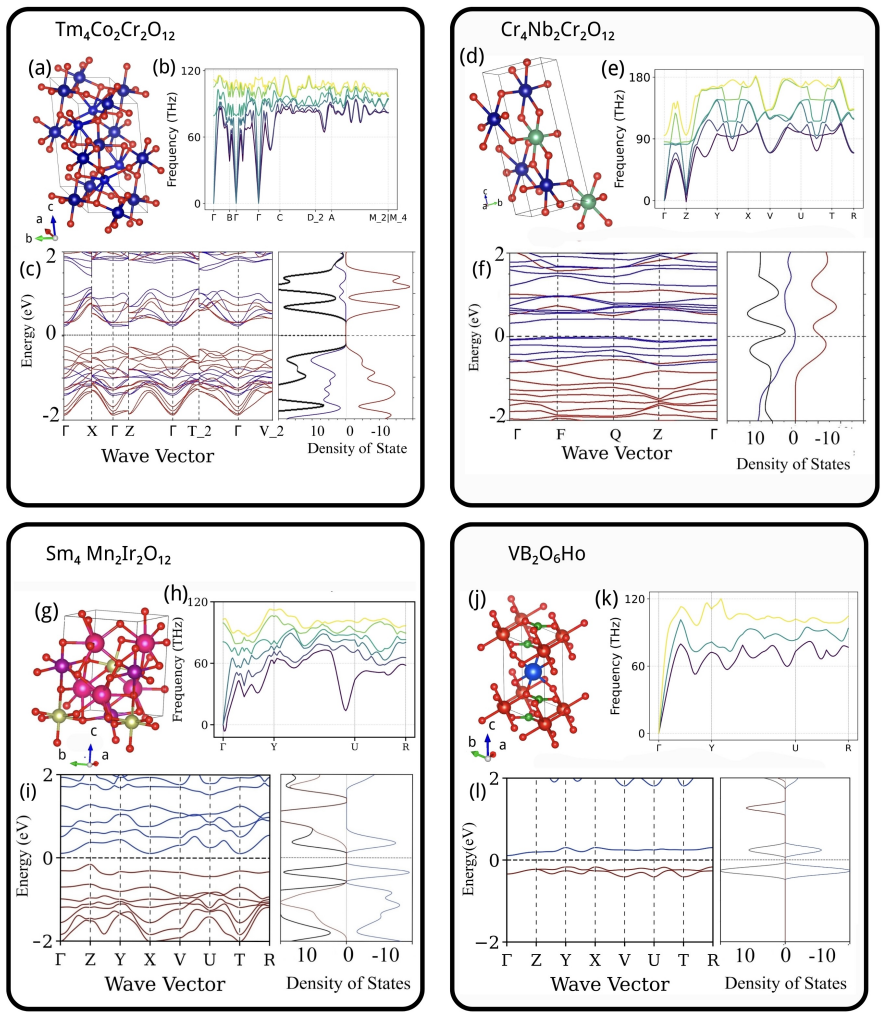
Experimental synthesis and measurement of the magnetic ordering temperature, band gap, and resistivity of one candidate such as Cr₄Nb₂O₁₂ or Tm₄Co₂Cr₂O₁₂ to test whether it is indeed a magnetic insulator.
Figures
read the original abstract
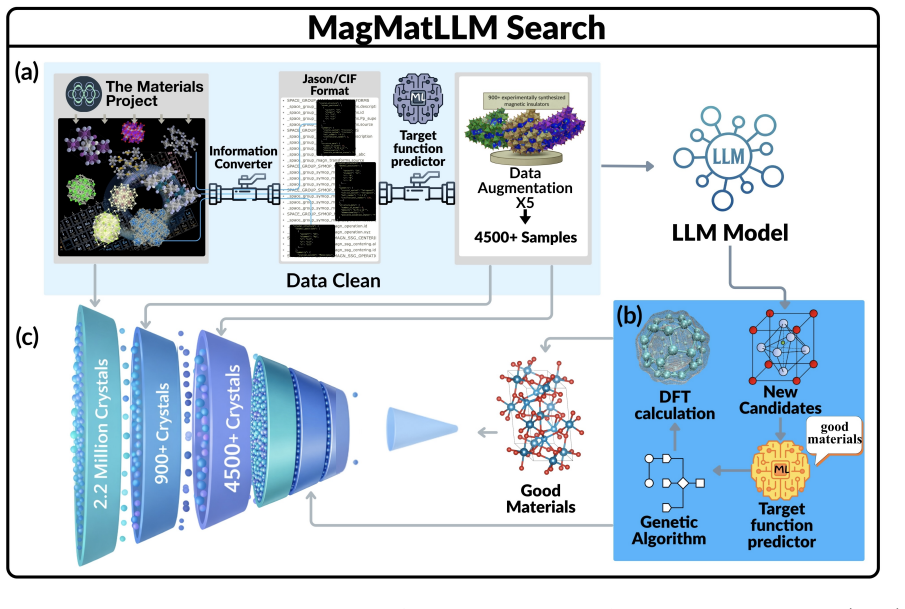
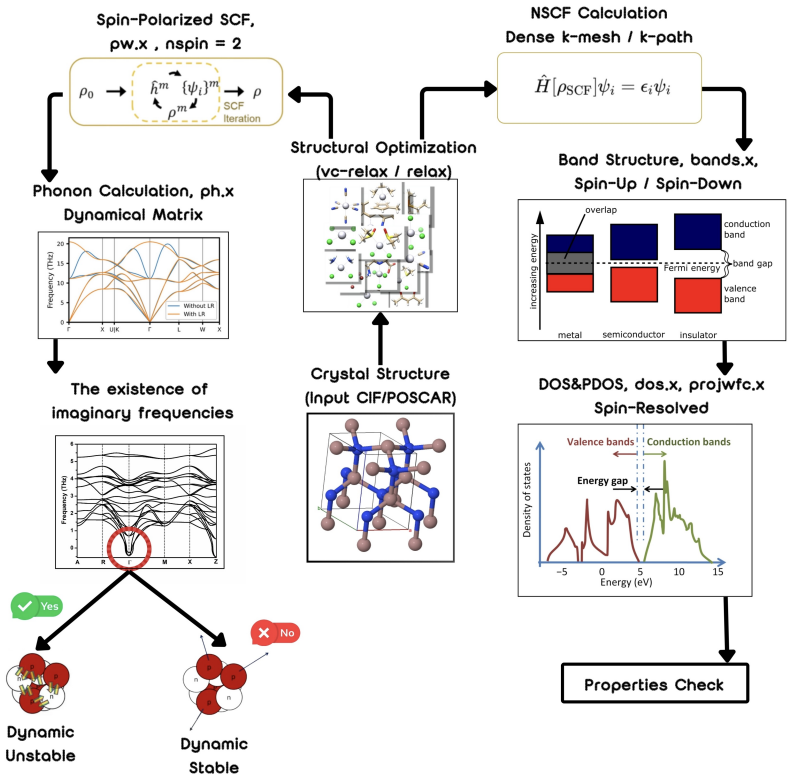
Discovering materials that must simultaneously satisfy multiple competing constraints remains a central challenge in computational materials design, particularly in data-scarce regimes where conventional data-driven approaches are least effective. Magnetic insulators represent a stringent example: the electronic conditions that favor magnetic order often also promote metallicity, while insulating behavior suppresses the interactions that stabilize magnetism. As a result, experimentally viable magnetic insulators are rare and difficult to identify through conventional screening. Here, we introduce MagMatLLM, a constraint-guided generative discovery framework that integrates language-model-based crystal generation with evolutionary selection, surrogate screening, and first-principles validation to target simultaneous stability, magnetism, and insulating behavior. Unlike stability-first approaches, the framework enforces functional constraints during generation and selection, steering the search toward sparsely populated regions of materials space defined by competing physical requirements. Using this workflow, we identify twelve previously unreported candidate magnetic insulators, including Tm$_4$Co$_2$Cr$_2$O$_{12}$ and Cr$_4$Nb$_2$O$_{12}$. Of these, ten are dynamically stable by phonon analysis and exhibit finite band gaps and nonzero magnetic moments in spin-polarized density functional theory calculations. Beyond the specific compounds identified here, this work establishes a general constraint-guided paradigm for multi-objective materials discovery in sparse chemical spaces and provides a transferable strategy for the design of quantum materials under competing physical constraints.
Editorial analysis
A structured set of objections, weighed in public.
Referee Report
Summary. The manuscript introduces the MagMatLLM framework, which integrates LLM-based crystal generation, evolutionary selection, surrogate screening, and first-principles validation to discover magnetic insulators satisfying the competing constraints of dynamical stability, nonzero magnetic moments, and finite electronic band gaps. The central result is the identification of twelve previously unreported candidate compounds (including Tm₄Co₂Cr₂O₁₂ and Cr₄Nb₂O₁₂), of which ten are reported as dynamically stable by phonon analysis and to exhibit finite gaps plus nonzero moments in spin-polarized DFT calculations. The work positions this as a general constraint-guided paradigm for multi-objective discovery in sparse chemical spaces.
Significance. If the DFT-validated candidates hold under more rigorous electronic-structure treatments, the paper would advance generative materials discovery by showing how functional constraints can be enforced during generation and selection rather than applied post hoc. This is valuable for data-scarce regimes such as magnetic insulators. Credit is due for the explicit reporting of specific new compounds, the avoidance of circularity via external DFT validation, and the articulation of a transferable strategy for quantum materials design under competing physical requirements.
major comments (2)
- [Results section on candidate validation] The identification of ten magnetic insulators rests on spin-polarized DFT results for finite band gaps and nonzero moments (abstract and the validation paragraph following the workflow description). For the reported compounds containing open d- and f-shell ions (Tm, Cr, Co, Nb), standard DFT functionals are known to underestimate gaps and can yield spurious metallic or magnetic states. This is load-bearing for the central claim: if gaps close or moments vanish under DFT+U or hybrid-functional treatments, the assertion that the framework successfully locates viable magnetic insulators does not hold.
- [Methods section describing surrogate and evolutionary components] The surrogate screening and evolutionary selection steps are described as enforcing the competing constraints, yet no quantitative metrics (e.g., precision-recall against a held-out DFT set, or enrichment factor relative to random sampling) are provided for how reliably these steps steer toward the sparse magnetic-insulator region. Without such evidence, the claim that the workflow reliably locates viable structures in data-scarce space remains difficult to evaluate.
minor comments (2)
- [Abstract] The abstract states that ten compounds are 'dynamically stable by phonon analysis' but does not report the specific imaginary-frequency thresholds or supercell sizes used; adding these details would strengthen reproducibility.
- [Results tables] Tables or supplementary lists of the twelve candidates should include the computed band-gap values, total magnetic moments, and formation energies to allow direct assessment of the DFT results.
Simulated Author's Rebuttal
We thank the referee for the constructive comments and positive assessment of the work's potential impact. We address each major comment point by point below and will revise the manuscript accordingly to strengthen the validation and evaluation sections.
read point-by-point responses
-
Referee: [Results section on candidate validation] The identification of ten magnetic insulators rests on spin-polarized DFT results for finite band gaps and nonzero moments (abstract and the validation paragraph following the workflow description). For the reported compounds containing open d- and f-shell ions (Tm, Cr, Co, Nb), standard DFT functionals are known to underestimate gaps and can yield spurious metallic or magnetic states. This is load-bearing for the central claim: if gaps close or moments vanish under DFT+U or hybrid-functional treatments, the assertion that the framework successfully locates viable magnetic insulators does not hold.
Authors: We acknowledge the well-known limitations of standard spin-polarized DFT (PBE) for open-shell systems, where gap underestimation and potential spurious magnetism can occur. Our current results establish that the generated candidates satisfy the target constraints at the DFT level, which is a standard first-principles filter in generative discovery workflows. To directly address the concern, we will add DFT+U calculations (with element-specific U values for Cr, Co, Nb, and Tm) and hybrid-functional (HSE06) results for the ten dynamically stable candidates in the revised manuscript. These additional data will clarify whether the finite gaps and nonzero moments persist under improved treatments, thereby reinforcing the framework's utility for proposing candidates that warrant further study. revision: yes
-
Referee: [Methods section describing surrogate and evolutionary components] The surrogate screening and evolutionary selection steps are described as enforcing the competing constraints, yet no quantitative metrics (e.g., precision-recall against a held-out DFT set, or enrichment factor relative to random sampling) are provided for how reliably these steps steer toward the sparse magnetic-insulator region. Without such evidence, the claim that the workflow reliably locates viable structures in data-scarce space remains difficult to evaluate.
Authors: We agree that quantitative performance metrics for the surrogate and evolutionary components are necessary to substantiate the workflow's effectiveness in sparse regions. The surrogate was trained on available DFT data for magnetic materials and combined with evolutionary selection to enforce the multi-objective constraints, but we did not include held-out evaluations or baseline comparisons in the original submission. In the revision, we will incorporate a dedicated evaluation subsection reporting: precision-recall metrics on a held-out DFT test set, an ablation study isolating each component's contribution, and an enrichment factor relative to random sampling within the same compositional space. This will provide concrete evidence for the steering capability. revision: yes
Circularity Check
No circularity: generative workflow validated by independent DFT on new compounds
full rationale
The paper's core workflow (LLM generation + evolutionary/surrogate screening) produces candidate structures that are then validated externally via phonon analysis and spin-polarized DFT for stability, gaps, and moments. No derivation step reduces to a fitted parameter, self-definition, or self-citation chain; the reported compounds are previously unreported and the validation uses standard first-principles methods outside the generative loop. This matches the default expectation of a non-circular materials discovery paper.
Axiom & Free-Parameter Ledger
axioms (2)
- domain assumption Spin-polarized DFT reliably predicts dynamic stability, band gaps, and magnetic moments for the generated candidates.
- ad hoc to paper LLM crystal generation combined with evolutionary selection can steer toward sparsely populated regions satisfying competing constraints.
invented entities (1)
-
MagMatLLM framework
no independent evidence
Reference graph
Works this paper leans on
-
[1]
Sanchez-Lengeling, B. & Aspuru-Guzik, A. Inverse molecular design using machine learning: Generative models for matter engineering.Science361, 360–365 (2018)
work page 2018
-
[2]
Chumak, A. V., Vasyuchka, V. I., Serga, A. A. & Hillebrands, B. Magnon spintronics.Nature Physics 11, 453–461 (2015)
work page 2015
-
[3]
Uchida, K.et al.Spin seebeck insulator.Rev. Mod. Phys.9, 894–897 (2010)
work page 2010
-
[4]
Tokura, Y., Yasuda, K. & Tsukazaki, A. Magnetic topological insulators.Nature Reviews Physics1, 126–143 (2019)
work page 2019
-
[5]
Magnetic topological materials.Matter4, 362–370 (2021)
Wang, Z. Magnetic topological materials.Matter4, 362–370 (2021)
work page 2021
-
[6]
Emori, S. Ferrimagnetic insulators for spintronics: Beyond garnets.Journal of Applied Physics129, 020901 (2021)
work page 2021
-
[7]
Huang, B.et al.Layer-dependent ferromagnetism in a van der waals crystal down to the monolayer limit.Nature546, 270–273 (2017)
work page 2017
-
[8]
Choudhary, K., Garrity, K. F., Jiang, J. & Pachter, R. High-throughput identification of magnetic topological materials.Physical Review B103, 155131 (2021)
work page 2021
-
[9]
Butler, K., Davies, D., Cartwright, H., Isayev, O. & Walsh, A. Machine learning for molecular and materials science.Nature559(2018)
work page 2018
-
[10]
Gan, J.et al.Large language models are innate crystal structure generators (2025)
work page 2025
-
[11]
Tshitoyan, V.et al.Unsupervised word embeddings capture latent knowledge from materials science literature571(2019)
work page 2019
-
[12]
Jain, A.et al.Commentary: The materials project: A materials genome approach to accelerating materials innovation.APL Materials1, 011002 (2013)
work page 2013
-
[13]
Ward, L., Agrawal, A., Choudhary, A. & Wolverton, C. A general-purpose machine learning framework for predicting properties of inorganic materials.npj Computational Materials2(2016)
work page 2016
-
[14]
Bradlyn, B.et al.Topological quantum chemistry.Nature547, 298–305 (2017)
work page 2017
-
[15]
G.et al.A complete catalogue of high-quality topological materials.Nature566, 480–485 (2019)
Vergniory, M. G.et al.A complete catalogue of high-quality topological materials.Nature566, 480–485 (2019). 14
work page 2019
-
[16]
Vergniory, M. G.et al.All topological bands of all nonmagnetic stoichiometric materials.Science376, eabg9094 (2022)
work page 2022
-
[17]
Deng, B.et al.Chgnet as a pretrained universal neural network potential for charge-informed atomistic modelling.Nature Machine Intelligence1–11 (2023)
work page 2023
-
[18]
Xie, T. & Grossman, J. C. Crystal graph convolutional neural networks for an accurate and interpretable prediction of material properties.Physical Review Letters120(2018)
work page 2018
-
[19]
Deng, B.et al.Chgnet: Pretrained universal neural network potential for charge-informed atomistic modeling (2023)
work page 2023
-
[20]
Kusaba, M., Liu, C. & Yoshida, R. Crystal structure prediction with machine learning-based element substitution.Computational Materials Science211, 111496 (2022)
work page 2022
-
[21]
Noh, J.et al.Inverse design of solid-state materials via a continuous representation.Matter1, 1370–1384 (2019)
work page 2019
-
[22]
Glass, C. W., Oganov, A. R. & Hansen, N. Uspex—evolutionary crystal structure prediction.Computer Physics Communications175, 713–720 (2006)
work page 2006
-
[23]
Wang, Y., Lv, J., Zhu, L. & Ma, Y. Calypso: A method for crystal structure prediction.Computer Physics Communications183, 2063–2070 (2012)
work page 2063
-
[24]
Ye, C.-Y., Weng, H.-M. & Wu, Q.-S. Con-cdvae: A method for the conditional generation of crystal structures.Computational Materials Today1, 100003 (2024)
work page 2024
-
[25]
Zhu, R., Nong, W., Yamazaki, S. & Hippalgaonkar, K. Wycryst: Wyckoff inorganic crystal generator framework (2024)
work page 2024
-
[26]
Ishii, T., Hisama, K. & Shinohara, K. Symmetry-aware conditional generation of crystal structures using diffusion models (2026)
work page 2026
- [27]
-
[28]
Perdew, J. P., Burke, K. & Ernzerhof, M. Generalized gradient approximation made simple.Physical Review Letters77, 3865–3868 (1996)
work page 1996
-
[29]
Dixon, W. J. & Yuen, K. K. Trimming and winsorization: A review.Statistische Hefte15, 157–170 (1974)
work page 1974
-
[30]
Gruver, N.et al.Fine-tuned language models generate stable inorganic materials as text (2025). 15
work page 2025
discussion (0)
Sign in with ORCID, Apple, or X to comment. Anyone can read and Pith papers without signing in.