The Method of Ellipcenters for Strongly Convex Functions
Pith reviewed 2026-05-12 01:08 UTC · model grok-4.3
The pith
The Method of Ellipcenters matches the convergence rate of gradient descent with exact line search for strongly convex functions with Lipschitz gradients.
A machine-rendered reading of the paper's core claim, the machinery that carries it, and where it could break.
Core claim
The Method of Ellipcenters evaluates the gradient once at the current iterate and once at a companion point chosen on the same level set. For any strongly convex function with Lipschitz gradient, this pair of directions produces a reduction in the objective that is at least as large as the reduction obtained by gradient descent with an optimally chosen step length. When the two gradients are linearly independent, the midpoint of the two points lies strictly inside the level set and therefore gives a further decrease; if the angle between the gradients is bounded away from zero, the extra decrease is uniform. In two dimensions the procedure terminates after at most two iterations.
What carries the argument
Method of Ellipcenters (ME), which performs two gradient evaluations per iteration at points sharing the same level-set value and uses their linear independence together with level-set symmetry to obtain a midpoint improvement.
If this is right
- ME supplies an implementable surrogate for exact line search that never requires a one-dimensional minimization.
- In two-dimensional problems the method reaches the solution after a fixed number of steps independent of starting point.
- Whenever the angle between successive gradient pairs stays bounded away from zero, the extra midpoint reduction accumulates into a strictly better global rate.
- The same two-gradient construction applies directly to regularized logistic regression and other smooth strongly convex models.
Where Pith is reading between the lines
- The level-set midpoint argument could be reused inside other first-order methods that already compute two gradients per step.
- The uniform-angle condition might be replaced by a weaker average-angle condition that still guarantees a positive fraction of the extra decrease.
- In high dimensions the probability that two random gradients are nearly collinear may be small, suggesting that the midpoint improvement occurs most of the time in practice.
Load-bearing premise
The objective functions are strongly convex and have Lipschitz continuous gradients.
What would settle it
A concrete strongly convex function with Lipschitz gradient on which the Method of Ellipcenters either fails to match the per-step contraction of exact-line-search gradient descent or requires more than two iterations in two dimensions.
Figures
read the original abstract
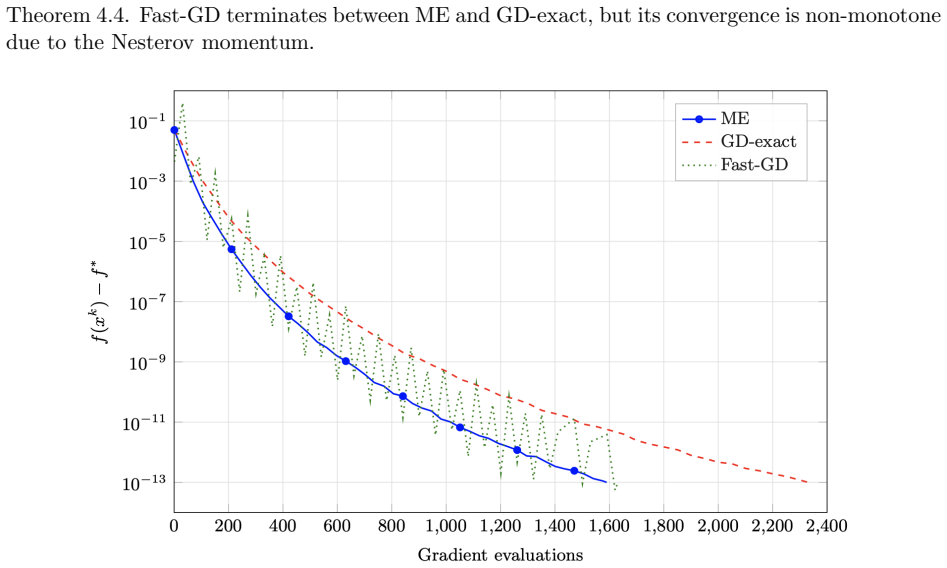
The Method of Ellipcenters (ME), introduced in~\cite{ME2025} for strongly convex quadratic minimization, uses two gradient evaluations per iteration: one at the current iterate and one at a companion point on the same level set. We extend ME to the broader class of strongly convex functions with Lipschitz continuous gradient, and prove that ME matches the convergence rate of gradient descent with exact line search on this class. When the two gradient directions are linearly independent, a midpoint argument exploiting the level-set symmetry yields a further per-step improvement, which is global when the angle between the two gradients is uniformly bounded away from zero. ME also converges in at most two steps in dimension two. Numerical experiments on regularized logistic regression confirm the theoretical predictions.
Editorial analysis
A structured set of objections, weighed in public.
Referee Report
Summary. The manuscript extends the Method of Ellipcenters (ME), previously introduced for quadratic objectives, to the class of strongly convex functions with Lipschitz continuous gradients. It proves that ME achieves the same linear convergence rate as gradient descent with exact line search. When the two gradient directions are linearly independent, a midpoint argument based on level-set symmetry yields an additional per-step improvement that is global under a uniform lower bound on the angle between gradients. The method is also shown to terminate in at most two steps in dimension two. These theoretical claims are illustrated by numerical experiments on regularized logistic regression.
Significance. If the proofs are correct, the work supplies a first-order method whose convergence rate matches a standard benchmark while incorporating a symmetry-based refinement that can accelerate progress when gradients are independent. The finite-termination result in two dimensions and the global improvement under an angle condition are attractive features. The numerical validation on logistic regression provides concrete support for the analysis. The extension from the quadratic case in the cited ME2025 work is a direct and useful generalization.
minor comments (2)
- Abstract: the claim that ME 'matches the convergence rate' would be clearer if it briefly recalled the explicit rate (in terms of the condition number) or cited the standard result for exact-line-search gradient descent on this function class.
- The manuscript should include a short remark on how the Lipschitz-gradient assumption is used in the level-set symmetry argument, to make the midpoint improvement transparent to readers familiar with standard analyses.
Simulated Author's Rebuttal
We thank the referee for the careful reading and the positive assessment of our manuscript. We appreciate the recommendation for minor revision. The referee summary and significance section accurately describe the contributions, including the extension of the Method of Ellipcenters, the convergence rate matching gradient descent with exact line search, the additional improvement when gradients are independent, the finite termination in 2D, and the numerical experiments. As no specific major comments were raised, we do not have any points requiring response or revision at this stage. Should the referee have any minor suggestions or clarifications, we are happy to incorporate them in a revised version.
Circularity Check
Minor self-citation to prior work on quadratics; central extension and rate proof remain independently derived
full rationale
The paper cites ME2025 solely for the original definition of the ellipcenter method on quadratics. The extension to strongly convex functions with Lipschitz gradients, the proof that ME matches the linear convergence rate of exact-line-search gradient descent, the midpoint improvement when gradients are linearly independent, and the two-step termination in dimension two are all obtained directly from the level-set symmetry and standard properties of the function class under the paper's maintained assumptions. No self-definitional reduction, fitted input renamed as prediction, or load-bearing self-citation chain appears in the derivation; the central claims retain independent content.
Axiom & Free-Parameter Ledger
axioms (2)
- domain assumption The objective function is strongly convex
- domain assumption The gradient is Lipschitz continuous
Lean theorems connected to this paper
-
IndisputableMonolith/Cost/FunctionalEquation.leanwashburn_uniqueness_aczel unclear?
unclearRelation between the paper passage and the cited Recognition theorem.
midpoint argument exploiting the level-set symmetry yields a further per-step improvement... f(y_k)=f(x_k)
-
IndisputableMonolith/Foundation/AlphaCoordinateFixation.leanJ_uniquely_calibrated_via_higher_derivative unclear?
unclearRelation between the paper passage and the cited Recognition theorem.
Baillon–Haddad descent... orthogonality of ∇f(x_{k+1}) to the step
What do these tags mean?
- matches
- The paper's claim is directly supported by a theorem in the formal canon.
- supports
- The theorem supports part of the paper's argument, but the paper may add assumptions or extra steps.
- extends
- The paper goes beyond the formal theorem; the theorem is a base layer rather than the whole result.
- uses
- The paper appears to rely on the theorem as machinery.
- contradicts
- The paper's claim conflicts with a theorem or certificate in the canon.
- unclear
- Pith found a possible connection, but the passage is too broad, indirect, or ambiguous to say the theorem truly supports the claim.
Reference graph
Works this paper leans on
-
[1]
Barzilai, J. and Borwein, J. M. Two-point step size gradient methods.IMA Journal of Numerical Analysis, 8(1):141–148, 1988
work page 1988
-
[2]
Behling, R., Corrˆ ea Aquines, R., Zanatta, E. F., and Guigues, V. Introducing the method of ellipcenters, a new first-order technique for unconstrained optimization.Preprint, arXiv, 2025
work page 2025
-
[3]
Nesterov, Y. A method of solving a convex programming problem with convergence rate O(1/k2).Soviet Mathematics Doklady, 27(2):372–376, 1983
work page 1983
-
[4]
Kluwer Aca- demic Publishers, Dordrecht, 2004
Nesterov, Y.Introductory Lectures on Convex Optimization: A Basic Course. Kluwer Aca- demic Publishers, Dordrecht, 2004
work page 2004
-
[5]
Polyak, B. T. Gradient methods for the minimisation of functionals.USSR Computational Mathematics and Mathematical Physics, 3(4):864–878, 1963. 11
work page 1963
discussion (0)
Sign in with ORCID, Apple, or X to comment. Anyone can read and Pith papers without signing in.