Recognition: unknown
Orbital evolution of highly eccentric bodies embedded in a ringed accretion disc
Pith reviewed 2026-05-09 23:02 UTC · model grok-4.3
The pith
A ring in an accretion disc traps prograde eccentric bodies by circularizing their orbits and drawing semi-major axes to the ring radius.
A machine-rendered reading of the paper's core claim, the machinery that carries it, and where it could break.
Core claim
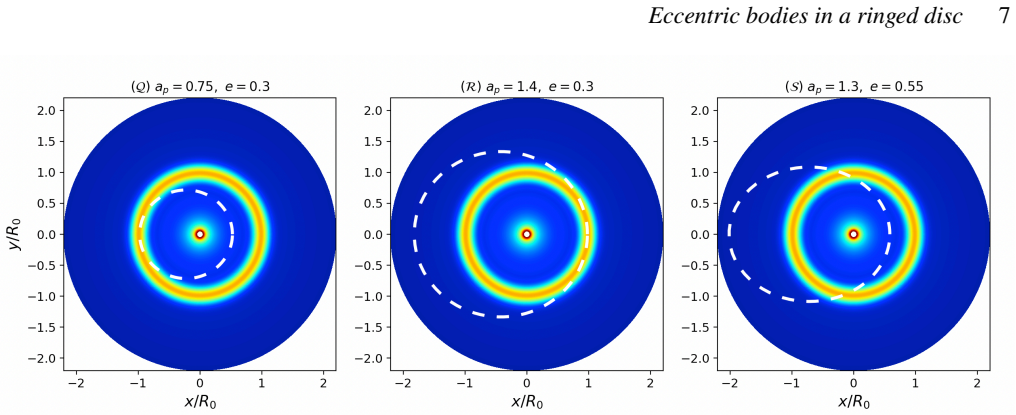
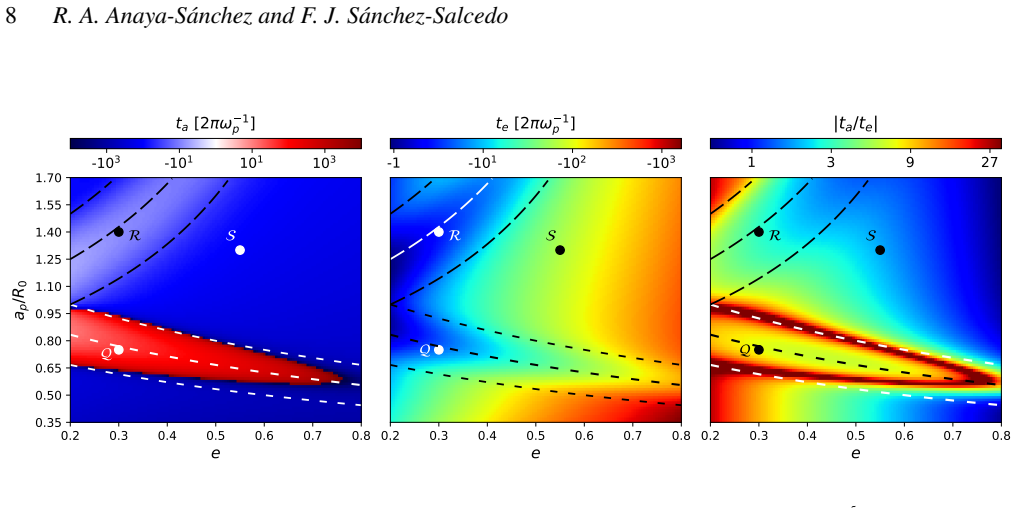
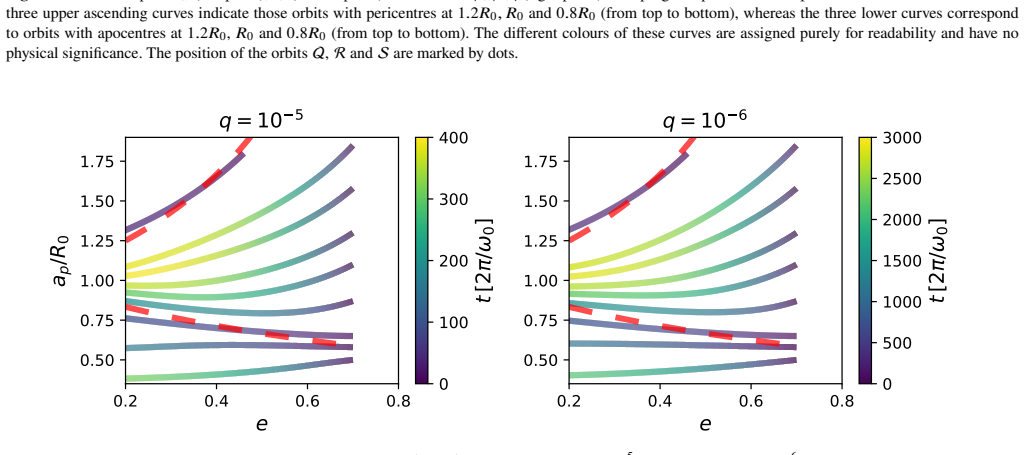
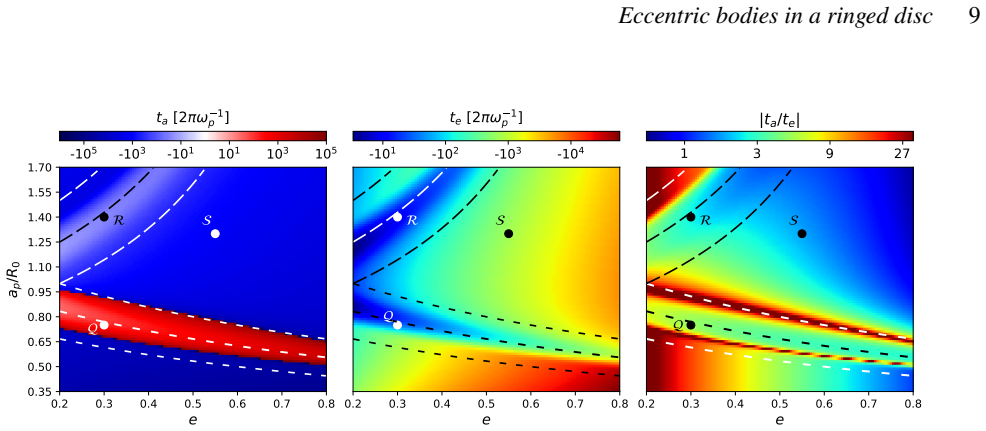
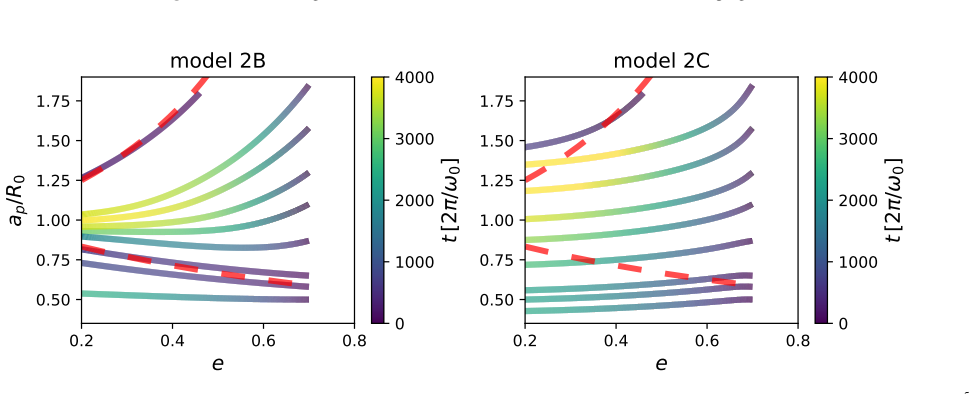
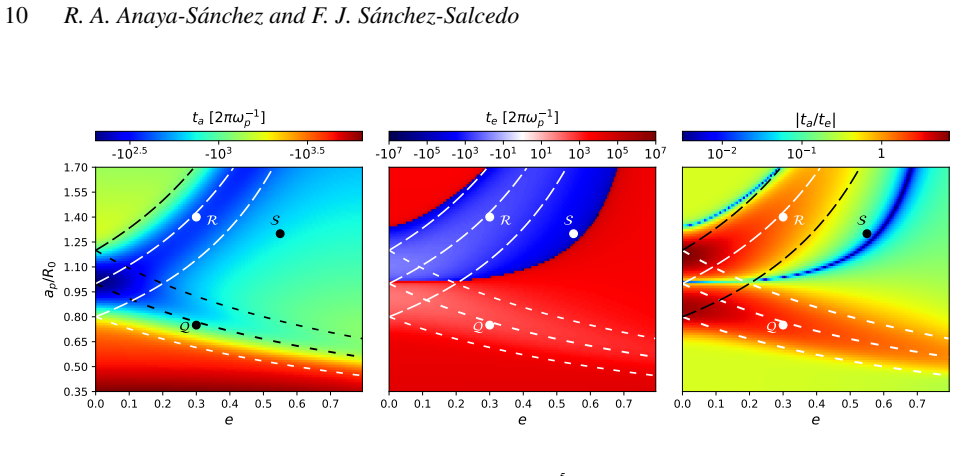
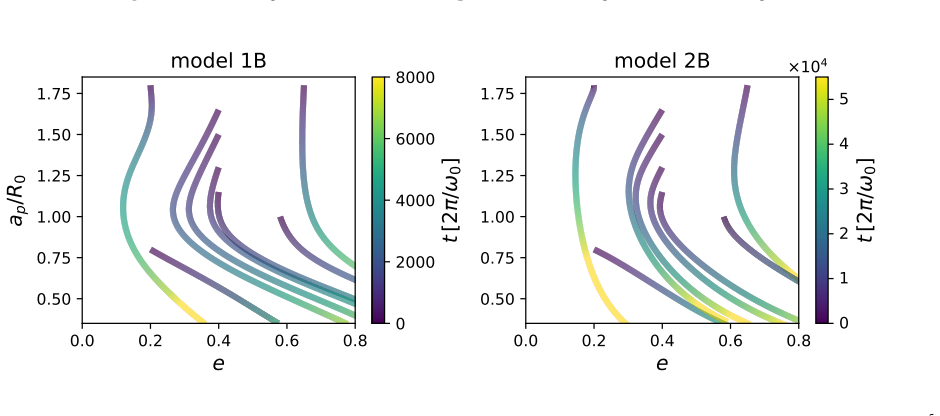
For prograde perturbers whose orbits cross the density ring, the eccentricity decreases over time while the semi-major axis converges to the ring radius, resulting in accumulation and the formation of a population ring superimposed on the gaseous ring. This demonstrates that the ring functions as a migration trap for these eccentric orbits. Prograde orbits that are tangent to the ring at apocentre or pericentre remain tangential, experiencing the highest accretion rates. Retrograde perturbers migrate inward, and after their semi-major axis becomes smaller than the ring radius, eccentricity grows but insufficiently for the orbit to intersect the ring again.
What carries the argument
Local approximation of dynamical friction in an isothermal disc for highly eccentric orbits (e > 4 times aspect ratio), which produces torques that circularize prograde crossing orbits and converge their semi-major axes to the ring.
If this is right
- Prograde crossing orbits accumulate into a population ring at the gaseous ring's radius.
- Tangent prograde orbits persist and exhibit peak accretion rates.
- Retrograde perturbers migrate inward without re-intersecting the ring after passing it.
- Feedback effects like jet launching could change the effective forces on the perturbers.
- The ring serves as an effective migration trap specifically for prograde eccentric bodies.
Where Pith is reading between the lines
- This mechanism may help explain the presence of clustered eccentric objects in ringed discs observed in protoplanetary systems.
- Simulations incorporating thermal torques and jets could test how feedback modifies the trapping efficiency.
- Similar trapping might occur in other disc structures like spiral arms or gaps if they produce comparable density enhancements.
- Extending to massive perturbers could reveal whether self-gravity or back-reaction on the disc alters the accumulation.
Load-bearing premise
The assumption that the local dynamical friction approximation holds for orbits with eccentricity larger than four times the disc's aspect ratio in an isothermal disc, without including feedback.
What would settle it
Numerical N-body or hydrodynamical simulations of eccentric bodies in a ringed disc showing whether their semi-major axes converge to the ring radius and eccentricity damps for prograde cases, or if they instead get scattered or ejected.
Figures





read the original abstract
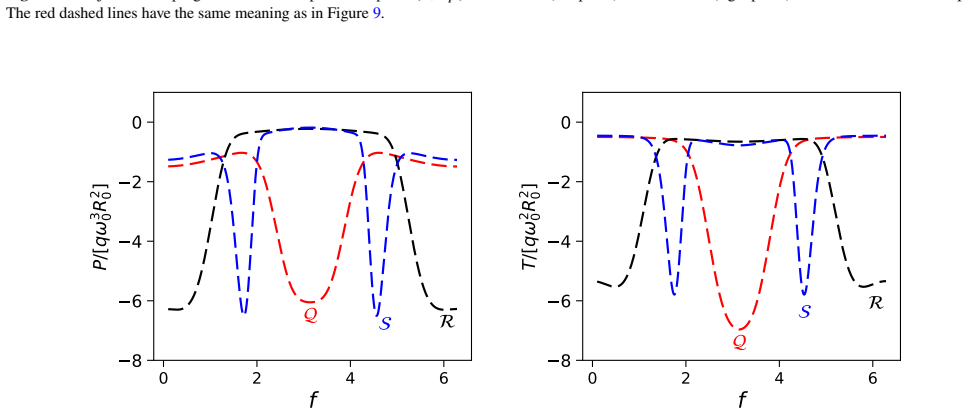
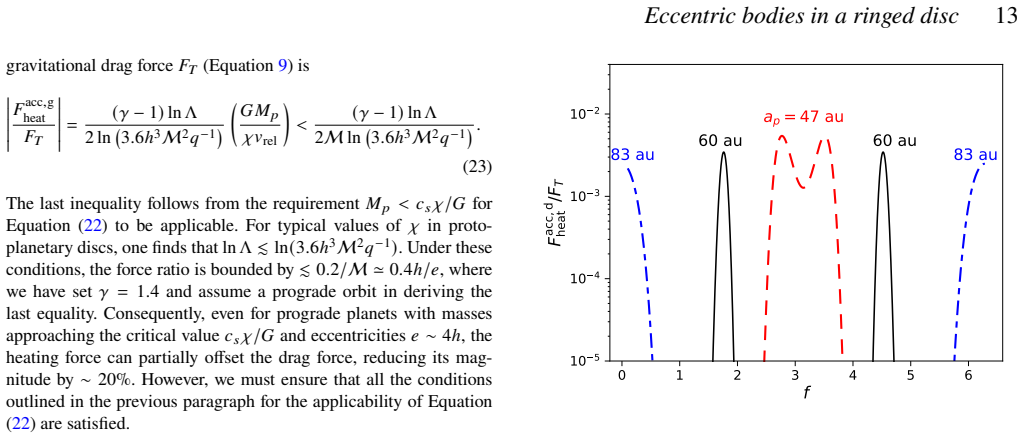
Various processes can induce long-lived overdense rings and arcs in protoplanetary and AGN accretion discs, such as the accumulation of gas at the outer edge of the dead zone, or the infall of material. Using the local approximation of dynamical friction, we investigate the orbital evolution of a low-mass highly-eccentric point-mass accretor (perturber) embedded in an isothermal disc hosting a density ring. We specifically consider the regime in which the eccentricity exceeds four times the disc aspect ratio. For prograde perturbers, orbits that cross the ring progressively circularize while their semi-major axes converge toward the ring radius. As a result, perturbers accumulate, forming a population ring superimposed on the gaseous ring. The ring therefore acts as a migration trap for these eccentric orbits. We also find that prograde orbits tangent to the ring, either at apocentre or pericentre, remain tangential throughout their evolution; perturbers confined to these trajectories experience the highest accretion rates. In contrast, retrograde perturbers always migrate inward. Once the semi-major axis becomes smaller than the ring radius, the eccentricity grows, but not enough for the orbit to intersect the ring again. We also discuss how feedback effects, such as jet launching and thermal torques, could modify the effective forces acting on the perturbers.
Editorial analysis
A structured set of objections, weighed in public.
Referee Report
Summary. The paper applies the local dynamical friction approximation to study the orbital evolution of low-mass, highly eccentric (e > 4H) point-mass perturbers in an isothermal accretion disc containing a localized density ring. For prograde orbits that cross the ring, the model predicts progressive circularization accompanied by convergence of the semi-major axis toward the ring radius, resulting in accumulation of perturbers into a superimposed population ring that functions as a migration trap. Tangent prograde orbits remain tangential with elevated accretion rates, while retrograde perturbers migrate inward, with eccentricity growth insufficient to re-intersect the ring once a drops below the ring radius. Feedback effects such as jets and thermal torques are discussed qualitatively as potential modifiers.
Significance. If the local approximation remains valid in the stated regime, the work identifies a concrete dynamical mechanism by which rings can trap and concentrate eccentric bodies, with direct relevance to migration traps, planetesimal accumulation, and observed ring/arc structures in protoplanetary and AGN discs. The approach re-uses the standard Chandrasekhar-type local friction force without introducing new free parameters or ad-hoc entities, which is a methodological strength; the resulting predictions (circularization + a-convergence for prograde crossers, inward migration for retrograde) are falsifiable via targeted hydrodynamical simulations.
major comments (2)
- [results and discussion sections (application of local DF across ring crossings)] The central claim of accumulation into a superimposed population ring (abstract and results sections) rests on the local dynamical friction force producing net circularization and a-convergence when orbit-averaged across sharp ring crossings. Standard derivations of this force assume density variations slow compared to the wake scale, yet the ring is a localized overdensity crossed at v >> c_s (e > 4H). The manuscript applies the local formula instantaneously at each crossing without an explicit check (e.g., comparison to non-local wake solutions or hydrodynamical validation) that non-local effects such as bow shocks or asymmetric density responses do not alter the integrated torque and energy loss. This is load-bearing for the migration-trap conclusion.
- [method section (local approximation justification)] The regime statement e > 4H is used to justify the local approximation, but the manuscript provides no quantitative estimate of the wake scale relative to the ring width or the time spent inside the density jump. Without this, it is unclear whether the instantaneous local-density evaluation remains accurate for the orbit-averaged evolution that drives the reported a-convergence.
minor comments (2)
- [abstract and introduction] The abstract and introduction would benefit from a brief statement of the disc model (surface density profile of the ring, aspect ratio H/r, sound speed) to allow immediate assessment of the e > 4H regime.
- [throughout] Notation for the ring radius and perturber semi-major axis should be defined consistently (e.g., a single symbol for ring location) to avoid ambiguity when discussing convergence.
Simulated Author's Rebuttal
We thank the referee for their careful reading and insightful comments on the applicability of the local dynamical friction approximation. These points help clarify the scope and limitations of our analysis. We address each major comment below and indicate the revisions we will make.
read point-by-point responses
-
Referee: [results and discussion sections (application of local DF across ring crossings)] The central claim of accumulation into a superimposed population ring (abstract and results sections) rests on the local dynamical friction force producing net circularization and a-convergence when orbit-averaged across sharp ring crossings. Standard derivations of this force assume density variations slow compared to the wake scale, yet the ring is a localized overdensity crossed at v >> c_s (e > 4H). The manuscript applies the local formula instantaneously at each crossing without an explicit check (e.g., comparison to non-local wake solutions or hydrodynamical validation) that non-local effects such as bow shocks or asymmetric density responses do not alter the integrated torque and energy loss. This is load-bearing for the migration-trap conclusion.
Authors: We agree that the standard local dynamical friction derivation assumes density gradients slow relative to the wake scale, and that a sharp ring crossed at high relative velocity (v >> c_s) could in principle introduce non-local contributions such as bow shocks or asymmetric wake responses. The manuscript does not contain an explicit comparison to non-local wake solutions or hydrodynamical validation of the integrated torque across the ring. In the revised manuscript we will add a paragraph in the discussion section that (i) estimates the relevant scales, (ii) notes the possible influence of bow shocks on the instantaneous force, and (iii) states that the reported circularization and a-convergence should be regarded as predictions within the local approximation. We will also emphasize that targeted hydrodynamical simulations are the natural next step to test the robustness of the migration-trap mechanism. revision: partial
-
Referee: [method section (local approximation justification)] The regime statement e > 4H is used to justify the local approximation, but the manuscript provides no quantitative estimate of the wake scale relative to the ring width or the time spent inside the density jump. Without this, it is unclear whether the instantaneous local-density evaluation remains accurate for the orbit-averaged evolution that drives the reported a-convergence.
Authors: We accept that a quantitative estimate is needed to support the regime choice. The e > 4H threshold is motivated by ensuring supersonic vertical motion and a short interaction time with the ring, but the manuscript indeed lacks an explicit comparison of wake length (∼GM_p/v_rel²) to ring width or of crossing time to wake-formation time. In the revised methods section we will insert a short calculation that (i) adopts a representative ring width, (ii) computes the time the perturber spends inside the density jump, and (iii) contrasts this timescale with the sound-crossing time across the expected wake. This addition will make the justification for applying the local formula instantaneously more transparent. revision: yes
Circularity Check
No circularity: standard force law integrated over given density profile
full rationale
The central result follows from applying the local dynamical-friction force (an external, standard approximation) to the prescribed ring density profile and integrating the resulting orbital equations. No fitted parameters are renamed as predictions, no self-citation supplies a uniqueness theorem or ansatz that forces the accumulation outcome, and the ring-trap behavior is an output of the integration rather than an input by definition. The derivation remains self-contained against external benchmarks once the local-force assumption is granted.
Axiom & Free-Parameter Ledger
axioms (2)
- domain assumption The disc is isothermal
- domain assumption Local approximation of dynamical friction is valid when eccentricity exceeds four times the disc aspect ratio
Reference graph
Works this paper leans on
-
[1]
The Disk Substructures at High Angular Resolution Project (DSHARP). I. Motivation, Sample, Calibration, and Overview. , keywords =. doi:10.3847/2041-8213/aaf741 , archivePrefix =. 1812.04040 , primaryClass =
-
[2]
2015, ApJ, 805, 15, doi: 10.1088/0004-637X/805/1/15
Are Protoplanetary Disks Born with Vortices? Rossby Wave Instability Driven by Protostellar Infall. , keywords =. doi:10.1088/0004-637X/805/1/15 , archivePrefix =. 1503.02694 , primaryClass =
-
[3]
Using FU Orionis Outbursts to Constrain Self-regulated Protostellar Disk Models. , keywords =. doi:10.1086/174206 , archivePrefix =. astro-ph/9312015 , primaryClass =
-
[4]
M., Mac Low, M.-M., McKernan, B., & Ford, K
Migration Traps in Disks around Supermassive Black Holes. , keywords =. doi:10.3847/2041-8205/819/2/L17 , archivePrefix =. 1511.00005 , primaryClass =
-
[5]
doi:10.1038/nature14277 , eprint =
Planet heating prevents inward migration of planetary cores. , keywords =. doi:10.1038/nature14277 , archivePrefix =. 1510.01778 , primaryClass =
-
[6]
, year = 1944, month = jan, volume =
On the mechanism of accretion by stars. , year = 1944, month = jan, volume =. doi:10.1093/mnras/104.5.273 , adsurl =
-
[7]
Star Formation Around Supermassive Black Holes. Science , keywords =. doi:10.1126/science.1160653 , archivePrefix =. 0810.2723 , primaryClass =
-
[8]
ALMA dual-band constraints on grain properties and the mass-infall rate
A dusty streamer infalling onto the disk of a class I protostar. ALMA dual-band constraints on grain properties and the mass-infall rate. , keywords =. doi:10.1051/0004-6361/202347486 , archivePrefix =. 2311.13723 , primaryClass =
-
[9]
, archivePrefix = "arXiv", eprint =
Gravitational drag on a point mass in hypersonic motion through a gaseous medium. , keywords =. doi:10.1111/j.1365-2966.2011.19574.x , archivePrefix =. 1108.3032 , primaryClass =
-
[10]
Low-mass planets falling into gaps with cyclonic vortices. , keywords =. doi:10.1093/mnras/stae1548 , archivePrefix =. 2406.12813 , primaryClass =
-
[11]
Gravitational Drag on a Point Mass in Hypersonic Motion within a Gaussian Disk. , keywords =. doi:10.1088/0004-637X/762/1/21 , archivePrefix =. 1211.3988 , primaryClass =
-
[12]
The role of wind asphericity in dynamical friction. , keywords =. doi:10.1093/mnras/staf905 , archivePrefix =. 2504.08884 , primaryClass =
-
[13]
Hydrodynamics of galaxy mergers with supermassive black holes: is there a last parsec problem?. , keywords =. doi:10.1093/mnras/sts568 , archivePrefix =. 1110.6086 , primaryClass =
-
[14]
Eccentricity excitation and merging of planetary embryos heated by pebble accretion. , keywords =. doi:10.1051/0004-6361/201731033 , archivePrefix =. 1706.06329 , primaryClass =
-
[15]
Accreting luminous low-mass planets escape from migration traps at pressure bumps. , keywords =. doi:10.1093/mnras/stad2059 , archivePrefix =. 2307.05230 , primaryClass =
-
[16]
The evolution of substructures in massive discs at 3-5 au resolution
The Ophiuchus DIsc Survey Employing ALMA (ODISEA) - III. The evolution of substructures in massive discs at 3-5 au resolution. , keywords =. doi:10.1093/mnras/staa3787 , archivePrefix =. 2012.00189 , primaryClass =
-
[17]
On the interaction of pebble accreting embryos with the gaseous disc: importance of thermal forces. , keywords =. doi:10.1093/mnras/stad1476 , archivePrefix =. 2305.09093 , primaryClass =
-
[18]
A Simple Analytical Model for Gaps in Protoplanetary Disks. , keywords =. doi:10.1088/2041-8205/807/1/L11 , archivePrefix =. 1505.03514 , primaryClass =
-
[19]
The Disk Substructures at High Angular Resolution Project (DSHARP). VI. Dust Trapping in Thin-ringed Protoplanetary Disks. , keywords =. doi:10.3847/2041-8213/aaf742 , archivePrefix =. 1812.04044 , primaryClass =
-
[20]
Cloudlet capture by transitional disk and FU Orionis stars. , keywords =. doi:10.1051/0004-6361/201832632 , archivePrefix =. 1911.05158 , primaryClass =
-
[21]
Misaligned accretion on to supermassive black hole binaries. , keywords =. doi:10.1093/mnras/stu1914 , archivePrefix =. 1409.3842 , primaryClass =
-
[22]
2025a, PhRvD, 111, 084006, doi: 10.1103/PhysRevD.111.084006
Constraining accretion physics with gravitational waves from eccentric extreme-mass-ratio inspirals. , keywords =. doi:10.1103/PhysRevD.111.084006 , archivePrefix =. 2411.03436 , primaryClass =
-
[23]
Evolution of eccentricity and inclination of hot protoplanets embedded in radiative discs. , keywords =. doi:10.1093/mnras/stx856 , archivePrefix =. 1704.01931 , primaryClass =
-
[24]
ALMA chemical survey of disk-outflow sources in Taurus (ALMA-DOT). VI. Accretion shocks in the disk of DG Tau and HL Tau. , keywords =. doi:10.1051/0004-6361/202141264 , archivePrefix =. 2110.13820 , primaryClass =
-
[25]
Binary evolution and the final parsec problem
Infalling clouds on to supermassive black hole binaries - II. Binary evolution and the final parsec problem. , keywords =. doi:10.1093/mnras/stx1996 , archivePrefix =. 1602.01966 , primaryClass =
-
[26]
Formation of discs, accretion and gas dynamics
Infalling clouds on to supermassive black hole binaries - I. Formation of discs, accretion and gas dynamics. , keywords =. doi:10.1093/mnras/stv2470 , archivePrefix =. 1507.05596 , primaryClass =
-
[27]
The effect of thermal torques on AGN disc migration traps and gravitational wave populations. , keywords =. doi:10.1093/mnras/stae828 , archivePrefix =. 2307.07546 , primaryClass =
-
[28]
Negative dynamical friction on compact objects moving through dense gas. , keywords =. doi:10.1093/mnras/staa013 , archivePrefix =. 1906.01186 , primaryClass =
-
[29]
Spiral-driven accretion in protoplanetary discs . III. Tridimensional simulations. , keywords =. doi:10.1051/0004-6361/201629779 , archivePrefix =. 1611.07376 , primaryClass =
-
[30]
Proceedings of the Cambridge Philosophical Society , year = 1939, month = jan, volume =
The effect of interstellar matter on climatic variation. Proceedings of the Cambridge Philosophical Society , year = 1939, month = jan, volume =. doi:10.1017/S0305004100021150 , adsurl =
-
[31]
The evolution of a binary in a retrograde circular orbit embedded in an accretion disk. , keywords =. doi:10.1051/0004-6361/201424359 , archivePrefix =. 1410.3250 , primaryClass =
-
[32]
Accretion rates of stellar-mass compact objects embedded in AGN discs. , keywords =. doi:10.1093/mnras/staf1899 , archivePrefix =. 2510.26111 , primaryClass =
-
[33]
Improved torque formula for low- and intermediate-mass planetary migration. , keywords =. doi:10.1093/mnras/stx1946 , archivePrefix =. 1707.08988 , primaryClass =
-
[34]
The viscously spreading ring revisited
Measuring the numerical viscosity in simulations of protoplanetary disks in Cartesian grids. The viscously spreading ring revisited. , keywords =. doi:10.1051/0004-6361/202245601 , archivePrefix =. 2308.03881 , primaryClass =
-
[35]
Jet Formation in 3D GRMHD Simulations of Bondi-Hoyle-Lyttleton Accretion. , keywords =. doi:10.3847/1538-4357/acc7a1 , archivePrefix =. 2201.11753 , primaryClass =
-
[36]
Dynamical Gaseous Rings in Global Simulations of Protoplanetary Disk Formation. , keywords =. doi:10.3847/1538-4357/ab378a , archivePrefix =. 1908.02515 , primaryClass =
-
[37]
2011, PhRvD, 84, 024032, doi: 10.1103/PhysRevD.84.024032
Observable signatures of extreme mass-ratio inspiral black hole binaries embedded in thin accretion disks. , keywords =. doi:10.1103/PhysRevD.84.024032 , archivePrefix =. 1104.2322 , primaryClass =
-
[38]
Grain Retention and Formation of Planetesimals near the Snow Line in MRI-driven Turbulent Protoplanetary Disks. , keywords =. doi:10.1086/520718 , archivePrefix =. 0706.1272 , primaryClass =
-
[39]
Bondi-Hoyle Accretion in a Turbulent Medium. , keywords =. doi:10.1086/498844 , archivePrefix =. astro-ph/0510410 , primaryClass =
-
[40]
Forming second generation disks
Late encounter events as source of disks and spiral structures. Forming second generation disks. , keywords =. doi:10.1051/0004-6361/201936820 , archivePrefix =. 1911.04833 , primaryClass =
-
[41]
Anisotropic Infall and Substructure Formation in Embedded Disks. , keywords =. doi:10.3847/1538-4357/ac54a8 , archivePrefix =. 2202.05301 , primaryClass =
-
[42]
Migration of Earth-sized planets in 3D radiative discs. , keywords =. doi:10.1093/mnras/stu304 , archivePrefix =. 1402.2834 , primaryClass =
-
[43]
Simulation of a compact object with outflows moving through a gaseous background. , keywords =. doi:10.1093/mnras/staa900 , archivePrefix =. 1912.06864 , primaryClass =
-
[44]
Gaps and Rings in an ALMA Survey of Disks in the Taurus Star-forming Region. , keywords =. doi:10.3847/1538-4357/aae8e1 , archivePrefix =. 1810.06044 , primaryClass =
-
[45]
The evolution of viscous discs and the origin of the nebular variables. , year = 1974, month = sep, volume =. doi:10.1093/mnras/168.3.603 , adsurl =
-
[46]
Constraining Stellar-mass Black Hole Mergers in AGN Disks Detectable with LIGO. , keywords =. doi:10.3847/1538-4357/aadae5 , archivePrefix =. 1702.07818 , primaryClass =
-
[47]
Disk Surface Density Transitions as Protoplanet Traps. , keywords =. doi:10.1086/500967 , archivePrefix =. astro-ph/0601222 , primaryClass =
-
[48]
Dynamical friction on hot bodies in opaque, gaseous media. , keywords =. doi:10.1093/mnras/stw3008 , archivePrefix =. 1611.05684 , primaryClass =
-
[49]
Coorbital thermal torques on low-mass protoplanets. , keywords =. doi:10.1093/mnras/stx2271 , archivePrefix =. 1708.09807 , primaryClass =
-
[50]
Accretion of clumpy cold gas on to massive black hole binaries: the challenging formation of extended circumbinary structures. , keywords =. doi:10.1093/mnras/sty1105 , archivePrefix =. 1801.06179 , primaryClass =
-
[51]
Bondi-Hoyle-Lyttleton Accretion Onto a Protoplanetary Disk. , keywords =. doi:10.1088/0004-637X/707/1/268 , archivePrefix =. 0910.3539 , primaryClass =
-
[52]
On the Interaction between a Protoplanetary Disk and a Planet in an Eccentric Orbit: Application of Dynamical Friction. , keywords =. doi:10.1088/0004-637X/737/1/37 , archivePrefix =. 1106.0417 , primaryClass =
-
[53]
Three-dimensional radiation hydrodynamics simulations of wandering intermediate-mass black holes considering the anisotropic radiation and dust sublimation. , keywords =. doi:10.1093/mnras/stae195 , archivePrefix =. 2402.00369 , primaryClass =
-
[54]
Eccentricity Trap: Trapping of Resonantly Interacting Planets Near the Disk Inner Edge. , keywords =. doi:10.1088/0004-637X/721/2/1184 , archivePrefix =. 1008.0461 , primaryClass =
-
[55]
and Ogilvie, Gordon and Tanaka, Hidekazu , month = mar, year =
Planet-Disk Interactions and Orbital Evolution. Protostars and Planets VII , year = 2023, editor =. doi:10.48550/arXiv.2203.09595 , archivePrefix =. 2203.09595 , primaryClass =
-
[56]
Gaseous Dynamical Friction in Presence of Black Hole Radiative Feedback. , keywords =. doi:10.3847/1538-4357/aa65ce , archivePrefix =. 1701.00526 , primaryClass =
-
[57]
On the evolution of pebble-accreting planets in evolving protoplanetary discs. , keywords =. doi:10.1093/mnras/stac2958 , archivePrefix =. 2210.00932 , primaryClass =
-
[58]
Growth and evolution of low-mass planets in pressure bumps. , keywords =. doi:10.1051/0004-6361/202348923 , archivePrefix =. 2402.05760 , primaryClass =
-
[59]
Can dead zones create structures like a transition disk?. , keywords =. doi:10.1051/0004-6361/201628441 , archivePrefix =. 1610.02044 , primaryClass =
-
[60]
Annual Review of Astronomy and Astrophysics , author =
Accretion discs in astrophysics. , keywords =. doi:10.1146/annurev.aa.19.090181.001033 , adsurl =
-
[61]
Flow morphology of a supersonic gravitating sphere. , keywords =. doi:10.1093/mnras/stad3405 , archivePrefix =. 2310.20315 , primaryClass =
-
[62]
Planet-disc interaction in highly inclined systems. , keywords =. doi:10.1111/j.1365-2966.2012.20869.x , archivePrefix =. 1106.1869 , primaryClass =
-
[63]
3D simulations of planet trapping at disc-cavity boundaries. , keywords =. doi:10.1093/mnras/stz535 , archivePrefix =. 1809.04013 , primaryClass =
-
[64]
Torques on Low-mass Bodies in Retrograde Orbit in Gaseous Disks. , keywords =. doi:10.3847/1538-4357/aac494 , archivePrefix =. 1805.08852 , primaryClass =
-
[65]
Structure of gaps induced by retrograde satellites embedded in accretion discs. , keywords =. doi:10.1093/mnras/staf221 , archivePrefix =. 2502.09876 , primaryClass =
-
[66]
Monthly Notices of the Royal Astronomical Society , author =
Estimating the depth of gaps opened by planets in eccentric orbit. , keywords =. doi:10.1093/mnras/stac2856 , archivePrefix =. 2210.09008 , primaryClass =
-
[67]
Orbital Evolution of Gas-driven Inspirals with Extreme Mass Ratios: Retrograde Eccentric Orbits. , keywords =. doi:10.3847/1538-4357/ab9b2d , archivePrefix =. 2006.10206 , primaryClass =
-
[68]
Orbital Evolution of Eccentric Low-mass Companions Embedded in Gaseous Disks: Testing the Local Approximation. , keywords =. doi:10.3847/1538-4357/ab46ae , archivePrefix =. 1910.03024 , primaryClass =
-
[69]
Orbital Migration of Interacting Stellar Mass Black Holes in Disks around Supermassive Black Holes. , keywords =. doi:10.3847/1538-4357/ab20ca , archivePrefix =. 1807.02859 , primaryClass =
-
[70]
The Pairing of Accreting Massive Black Holes in Multiphase Circumnuclear Disks: the Interplay Between Radiative Cooling, Star Formation, and Feedback Processes. , keywords =. doi:10.3847/1538-4357/aa5d19 , archivePrefix =. 1610.01600 , primaryClass =
-
[71]
The Erratic Path to Coalescence of LISA Massive Black Hole Binaries in Subparsec-resolution Simulations of Smooth Circumnuclear Gas Disks. , keywords =. doi:10.3847/1538-4357/aba624 , archivePrefix =. 2003.13789 , primaryClass =
-
[72]
Stability of the viscously spreading ring. , keywords =. doi:10.1051/0004-6361:20021783 , archivePrefix =. astro-ph/0212139 , primaryClass =
-
[73]
Orbital evolution of a planet on an inclined orbit interacting with a disc. , keywords =. doi:10.1093/mnras/sts064 , archivePrefix =. 1209.4843 , primaryClass =
-
[74]
, archivePrefix = "arXiv", eprint =
A natural formation scenario for misaligned and short-period eccentric extrasolar planets. , keywords =. doi:10.1111/j.1365-2966.2011.19390.x , archivePrefix =. 1107.2113 , primaryClass =
-
[75]
Gaseous dynamical friction under radiative feedback: do intermediate-mass black holes speed up or down?. , keywords =. doi:10.1093/mnras/staa1338 , archivePrefix =. 2002.08017 , primaryClass =
-
[76]
Reviving Dead Zones in accretion disks by Rossby vortices at their boundaries. , keywords =. doi:10.1051/0004-6361:200500226 , archivePrefix =. astro-ph/0511684 , primaryClass =
-
[77]
Numerical study of dynamical friction with thermal effects - I. Comparison to linear theory. , keywords =. doi:10.1093/mnras/sty3382 , archivePrefix =. 1812.03191 , primaryClass =
-
[78]
High-resolution study of the subsonic regime
Dynamical friction with radiative feedback - II. High-resolution study of the subsonic regime. , keywords =. doi:10.1093/mnras/staa1215 , archivePrefix =. 2004.13422 , primaryClass =
-
[79]
Dust rings trap protoplanets on eccentric orbits and get consumed by them. , keywords =. doi:10.1093/mnras/stae1835 , archivePrefix =. 2407.16546 , primaryClass =
-
[80]
An alternative model for the origin of gaps in circumstellar disks. , keywords =. doi:10.1051/0004-6361/201527701 , archivePrefix =. 1601.08089 , primaryClass =
discussion (0)
Sign in with ORCID, Apple, or X to comment. Anyone can read and Pith papers without signing in.