Recognition: unknown
Properties and Radial Evolution of Solar Wind Turbulence Near Mercury's Orbit
Pith reviewed 2026-05-08 12:56 UTC · model grok-4.3
The pith
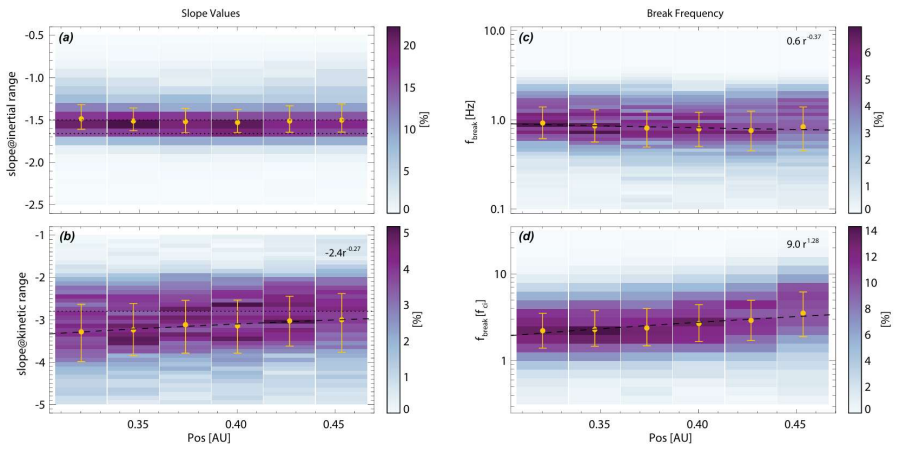
Solar wind turbulence maintains a stable Alfvenic inertial range with slopes near -3/2 from 0.31 to 0.47 AU.
A machine-rendered reading of the paper's core claim, the machinery that carries it, and where it could break.
Core claim
Using long-term magnetic field measurements from the MESSENGER mission, the study shows that inertial-range spectral slopes remain close to -3/2 throughout Mercury's orbit, showing no significant radial evolution. Combined with low magnetic compressibility, this result indicates a stable, predominantly Alfvenic inertial-range cascade already established here. In contrast, kinetic-range spectral slopes exhibit clear radial evolution, becoming progressively shallower with increasing heliocentric distance. The ion-scale spectral break frequency decreases with distance in the spacecraft frame, while its normalized form increases relative to the local proton cyclotron frequency.
What carries the argument
Fourier spectral analysis of magnetic field fluctuations that separates inertial-range and kinetic-range power laws, together with measures of magnetic compressibility and autocorrelation times.
If this is right
- Inertial-range turbulence is already established and Alfvenic by 0.3 AU.
- Kinetic-scale turbulence remains sensitive to local plasma conditions and distance.
- The ion-scale spectral break reflects evolving local conditions rather than a fixed scale.
- Field-aligned magnetic fluctuations become less correlated at greater distances while perpendicular ones stay short.
- These patterns constrain how kinetic processes develop in the inner heliosphere.
Where Pith is reading between the lines
- The fixed inertial-range properties may be set by conditions closer to the Sun or by the solar source itself.
- Future closer-in observations could test whether the inertial range remains unchanged even nearer the corona.
- Scale-dependent radial changes could influence models of how energy is transferred to particles at kinetic scales.
Load-bearing premise
The selected long-term intervals represent stationary homogeneous turbulence free of contamination from Mercury's bow shock, orbital effects, or instrumental artifacts, and standard Fourier methods cleanly separate inertial and kinetic ranges at every distance.
What would settle it
Observation of inertial-range spectral slopes that deviate markedly from -3/2 or display clear radial evolution in intervals confirmed free of bow-shock or orbital contamination would falsify the claim of stability.
Figures



read the original abstract
We present a comprehensive statistical study of the radial evolution of solar wind turbulence near Mercury's orbit using long-term magnetic field measurements from the MESSENGER mission. Owing to Mercury's highly elliptical orbit and the spacecraft's repeated, extended residence in the upstream solar wind, the data set provides more than 17,000 hours of observations, enabling robust statistics across well-defined heliocentric distance intervals (0.31-0.47 au). We find that inertial-range spectral slopes remain close to -3/2 throughout Mercury's orbit, showing no significant radial evolution. Combined with low magnetic compressibility, this result indicates a stable, predominantly Alfvenic inertial-range cascade already established here. In contrast, kinetic-range spectral slopes exhibit clear radial evolution, becoming progressively shallower with increasing heliocentric distance, highlighting the greater sensitivity of kinetic-scale turbulence to heliocentric conditions. The ion-scale spectral break frequency decreases with distance in the spacecraft frame, while its normalized form increases relative to the local proton cyclotron frequency, demonstrating that the break is not tied to a single ion scale but reflects evolving local plasma conditions. Magnetic compressibility shows a similar frequency dependence at all distances, with a subtle radial enhancement of compressive fluctuations at kinetic scales. Autocorrelation analysis reveals strong anisotropy, with the correlation times of field-aligned magnetic fluctuations increasing with heliocentric distance, while those of perpendicular fluctuations remain shorter and nearly invariant. Together, these results demonstrate a clear scale-dependent radial evolution of solar wind turbulence near Mercury's orbit, providing new constraints on the development of kinetic processes in the inner heliosphere.
Editorial analysis
A structured set of objections, weighed in public.
Referee Report
Summary. The manuscript presents a statistical study of solar wind magnetic turbulence using >17,000 hours of MESSENGER magnetic field data across 0.31–0.47 au. It reports that inertial-range spectral slopes remain near −3/2 with no significant radial evolution (indicating a stable, predominantly Alfvénic cascade), while kinetic-range slopes become shallower with distance; the ion-scale break frequency decreases in the spacecraft frame but increases when normalized to the local proton cyclotron frequency; magnetic compressibility shows mild radial enhancement at kinetic scales; and autocorrelation times reveal strong anisotropy with field-aligned times increasing with distance.
Significance. If the central claims hold after methodological clarification, the work supplies new empirical constraints on the early establishment of inertial-range turbulence in the inner heliosphere and the greater radial sensitivity of kinetic-scale processes. The large, well-binned dataset from Mercury’s orbit is a clear strength and complements existing 1 au and outer-heliosphere studies.
major comments (2)
- [§3 and §4.1] §3 (Spectral Analysis) and §4.1 (Inertial-range results): The headline finding that inertial-range slopes show no radial evolution assumes that the fitted frequency intervals remain strictly inside the inertial range at every heliocentric distance. Because the ion-scale break frequency decreases in the spacecraft frame (abstract and §4.2), any fixed-frequency fitting window will progressively encroach on the kinetic range at larger distances. The manuscript must demonstrate that fitting bands were either rescaled to the locally determined break or that an automated, uniform break-finding procedure was applied; otherwise the apparent constancy of the −3/2 slope is at risk of being an artifact of inconsistent scale separation.
- [§2] §2 (Data selection): The criteria used to select the long-term intervals, including explicit stationarity tests, homogeneity checks, and exclusion of intervals contaminated by Mercury’s bow shock or orbital effects, are not described in sufficient detail. These choices are load-bearing for all reported radial trends; without them the robustness of the statistical sample cannot be verified.
minor comments (3)
- [Figures 2–5 and §4] Figures 2–5 and §4: Spectral slopes, break frequencies, and compressibility values are plotted without error bars or uncertainty estimates, making it difficult to judge whether the reported “no significant evolution” in the inertial range is statistically supported.
- [§4.3] §4.3 (Autocorrelation): The radial trends in correlation times would be strengthened by a direct quantitative comparison with existing 1 au results using the same analysis pipeline.
- [§3.2] Notation: The normalized break frequency is introduced without a clear equation defining the normalization (proton cyclotron frequency in the spacecraft frame?); a short equation or footnote would remove ambiguity.
Simulated Author's Rebuttal
We thank the referee for the constructive and detailed review. The comments identify important points that require clarification to ensure the robustness of our analysis. We address each major comment below and will revise the manuscript to incorporate the necessary improvements.
read point-by-point responses
-
Referee: [§3 and §4.1] §3 (Spectral Analysis) and §4.1 (Inertial-range results): The headline finding that inertial-range slopes show no radial evolution assumes that the fitted frequency intervals remain strictly inside the inertial range at every heliocentric distance. Because the ion-scale break frequency decreases in the spacecraft frame (abstract and §4.2), any fixed-frequency fitting window will progressively encroach on the kinetic range at larger distances. The manuscript must demonstrate that fitting bands were either rescaled to the locally determined break or that an automated, uniform break-finding procedure was applied; otherwise the apparent constancy of the −3/2 slope is at risk of being an artifact of inconsistent scale separation.
Authors: We agree that the referee has identified a critical methodological point. The original manuscript did not explicitly describe how the inertial-range fitting intervals were chosen relative to the ion-scale break frequency, leaving open the possibility that fixed bands could encroach on the kinetic range at larger distances. To resolve this, we will revise §3 to include a detailed description of an automated break-finding procedure (based on identifying the frequency where the local spectral slope steepens beyond a threshold) and will rescale all inertial-range fits to a consistent normalized interval relative to the local break (e.g., 0.05–0.5 times the break frequency). We will also add a supplementary figure showing the break locations and fitting windows across radial bins to demonstrate that the reported −3/2 slopes remain within the inertial range at all distances. This will confirm that the lack of radial evolution is not an artifact. revision: yes
-
Referee: [§2] §2 (Data selection): The criteria used to select the long-term intervals, including explicit stationarity tests, homogeneity checks, and exclusion of intervals contaminated by Mercury’s bow shock or orbital effects, are not described in sufficient detail. These choices are load-bearing for all reported radial trends; without them the robustness of the statistical sample cannot be verified.
Authors: We acknowledge that §2 does not provide sufficient detail on the data selection criteria. We will expand this section to include explicit descriptions of the stationarity tests (e.g., variance thresholds on magnetic field components over sub-intervals and checks for consistent mean values), homogeneity requirements (e.g., limits on variations in plasma beta or density within each interval), and the quantitative criteria used to exclude intervals affected by Mercury’s bow shock or orbital effects. We will also add a summary of the data rejection statistics (e.g., fraction of intervals removed at each step) and, if space permits, a brief flowchart of the selection pipeline. These revisions will allow independent verification of the sample robustness. revision: yes
Circularity Check
No circularity: purely empirical statistical summaries of observed spectra
full rationale
The paper performs a statistical analysis of MESSENGER magnetic field data across heliocentric distances, reporting measured spectral slopes, break frequencies, compressibility, and correlation times. No derivations, predictions, or fitted parameters are claimed to follow from first-principles equations within the paper; all results are direct data products. The skeptic concern about fixed fitting bands potentially mixing inertial and kinetic ranges is a methodological question of scale separation, not a reduction of any claimed result to its own inputs by construction. No self-citations, ansatzes, or uniqueness theorems appear in the provided text as load-bearing steps. The analysis is therefore self-contained against external benchmarks.
Axiom & Free-Parameter Ledger
axioms (2)
- domain assumption Magnetic field fluctuations can be decomposed into inertial and kinetic ranges using power spectral density in the spacecraft frame.
- domain assumption Selected intervals represent undisturbed solar wind turbulence without significant planetary or instrumental contamination.
Reference graph
Works this paper leans on
-
[1]
2012, The Astrophysical Journal, 760, 121
Alexandrova, O., Lacombe, C., Mangeney, A., Grappin, R., & Maksimovic, M. 2012, The Astrophysical Journal, 760, 121
2012
-
[2]
J., & Robert, P
Alexandrova, O., Saur, J., Lacombe, C., Mangeney, A., Mitchell, J., Schwartz, S. J., & Robert, P. 2009, Phys Rev Lett, 103, 165003
2009
-
[3]
J., Acuña, M
Anderson, B. J., Acuña, M. H., Lohr, D. A., Scheifele, J., Raval, A., Korth, H., & Slavin, J. A. 2007, in The MESSENGER mission to Mercury (Springer), 417
2007
-
[4]
2005, The Astrophysical Journal Letters, 626, L37 ---
Boldyrev, S. 2005, The Astrophysical Journal Letters, 626, L37 ---. 2006, Phys Rev Lett, 96, 115002
2005
-
[5]
2012, The Astrophysical Journal, 749, 102
Bourouaine, S., Alexandrova, O., Marsch, E., & Maksimovic, M. 2012, The Astrophysical Journal, 749, 102
2012
-
[6]
2013, Living Reviews in Solar Physics, 10, 2
Bruno, R., & Carbone, V . 2013, Living Reviews in Solar Physics, 10, 2
2013
-
[7]
2014, The Astrophysical Journal Letters, 787, L24
Bruno, R., & Trenchi, L. 2014, The Astrophysical Journal Letters, 787, L24
2014
-
[8]
2020, The Astrophysical Journal Supplement Series, 246, 53
Chen, C., et al. 2020, The Astrophysical Journal Supplement Series, 246, 53
2020
-
[9]
2013, The Astrophysical Journal, 770, 125
Chen, C., Bale, S., Salem, C., & Maruca, B. 2013, The Astrophysical Journal, 770, 125
2013
-
[10]
2011, The Astrophysical Journal Letters, 737, L41
Chen, C., Bale, S., Salem, C., & Mozer, F. 2011, The Astrophysical Journal Letters, 737, L41
2011
-
[11]
2010, arXiv preprint arXiv:10022539
Chen, C., Horbury, T., Schekochihin, A., Wicks, R., Alexandrova, O., & Mitchell, J. 2010, arXiv preprint arXiv:10022539
2010
-
[12]
2014, Geophys Res Lett, 41, 8081
Chen, C., Leung, L., Boldyrev, S., Maruca, B., & Bale, S. 2014, Geophys Res Lett, 41, 8081
2014
-
[13]
2005, The Astrophysical Journal, 635, L181
Dasso, S., Milano, L., Matthaeus, W., & Smith, C. 2005, The Astrophysical Journal, 635, L181
2005
-
[14]
2019, Geophys Res Lett, 46, 11584
Germaschewski, K. 2019, Geophys Res Lett, 46, 11584
2019
-
[15]
2018, Phys Rev Lett, 121, 165101
Dong, C., Wang, L., Huang, Y .-M., Comisso, L., & Bhattacharjee, A. 2018, Phys Rev Lett, 121, 165101
2018
-
[16]
A., & Bhattacharjee, A
Dong, C., Wang, L., Huang, Y .-M., Comisso, L., Sandstrom, T. A., & Bhattacharjee, A. 2022, Science Advances, 8, eabn7627
2022
-
[17]
2020, The Astrophysical Journal Supplement Series, 246, 55
Duan, D., et al. 2020, The Astrophysical Journal Supplement Series, 246, 55
2020
-
[18]
P., & Smith, C
Gary, S. P., & Smith, C. W. 2009, Journal of Geophysical Research: Space Physics, 114
2009
-
[19]
2015, Philosophical Transactions of the Royal Society A: Mathematical, Physical and Engineering Sciences, 373, 20140147
Goldstein, M., Wicks, R., Perri, S., & Sahraoui, F. 2015, Philosophical Transactions of the Royal Society A: Mathematical, Physical and Engineering Sciences, 373, 20140147
2015
-
[20]
L., Roberts, D
Goldstein, M. L., Roberts, D. A., & Matthaeus, W. 1995, Annu Rev Astron Astr, 33, 283
1995
-
[21]
2015, The Astrophysical journal letters, 813, L29
Hadid, L., et al. 2015, The Astrophysical journal letters, 813, L29
2015
-
[22]
Z., Sahraoui, F., Galtier, S., & Huang, S
Hadid, L. Z., Sahraoui, F., Galtier, S., & Huang, S. 2018, Phys Rev Lett, 120, 055102
2018
-
[23]
2013, The Astrophysical Journal, 773, 72
He, J., Tu, C., Marsch, E., Bourouaine, S., & Pei, Z. 2013, The Astrophysical Journal, 773, 72
2013
-
[24]
2020, The Astrophysical Journal, 891, 159
Huang, S., et al. 2020, The Astrophysical Journal, 891, 159
2020
-
[25]
1963, Astronomicheskii Zhurnal, 40, 742
Iroshnikov, P. 1963, Astronomicheskii Zhurnal, 40, 742
1963
-
[26]
H., Chapman, S
Kiyani, K. H., Chapman, S. C., Sahraoui, F., Hnat, B., Fauvarque, O., & Khotyaintsev, Y . V . 2013, The Astrophysical Journal, 763, 10
2013
-
[27]
H., Osman, K
Kiyani, K. H., Osman, K. T., & Chapman, S. C. 2015, in (The Royal Society Publishing), 20140155
2015
-
[28]
1941, Cr Acad Sci Urss, 30, 301
Kolmogoroff, A. 1941, Cr Acad Sci Urss, 30, 301
1941
-
[29]
Kraichnan, R. H. 1965, Phys Fluids, 8, 1385
1965
-
[30]
2025, arXiv preprint arXiv:260102393
Li, X., et al. 2025, arXiv preprint arXiv:260102393
2025
-
[31]
2023, The Astrophysical Journal, 942, 93
Lotz, S., et al. 2023, The Astrophysical Journal, 942, 93
2023
-
[32]
H., Goldstein, M
Matthaeus, W. H., Goldstein, M. L., & Roberts, D. A. 1990, Journal of Geophysical Research: Space Physics, 95, 20673
1990
-
[33]
McGregor, S., Hughes, W., Arge, C., Odstrcil, D., & Schwadron, N. A. 2011, Journal of Geophysical Research: Space Physics, 116
2011
-
[34]
2007, The Astrophysical Journal Letters, 654, L103
Osman, K., & Horbury, T. 2007, The Astrophysical Journal Letters, 654, L103
2007
-
[35]
2010, The Astrophysical Journal Letters, 725, L52
Perri, S., Carbone, V ., & Veltri, P. 2010, The Astrophysical Journal Letters, 725, L52
2010
-
[36]
E., Dasso, S., Matthaeus, W., & Weygand, J
Ruiz, M. E., Dasso, S., Matthaeus, W., & Weygand, J. 2014, Sol Phys, 289, 3917
2014
-
[37]
2013, The Astrophysical Journal, 777, 15
Sahraoui, F., Huang, S., Belmont, G., Goldstein, M., Retinò, A., Robert, P., & De Patoul, J. 2013, The Astrophysical Journal, 777, 15
2013
-
[38]
S., Howes, G., Sundkvist, D., Bale, S., Chaston, C., Chen, C., & Mozer, F
Salem, C. S., Howes, G., Sundkvist, D., Bale, S., Chaston, C., Chen, C., & Mozer, F. 2012, The Astrophysical Journal Letters, 745, L9
2012
-
[39]
Schekochihin, A. A. 2022, J Plasma Phys, 88, 155880501
2022
-
[40]
2021, Astron Astrophys, 650, A21
Shi, C., et al. 2021, Astron Astrophys, 650, A21
2021
-
[41]
A., et al
Slavin, J. A., et al. 2008, Science, 321, 85
2008
-
[42]
W., Hamilton, K., Vasquez, B
Smith, C. W., Hamilton, K., Vasquez, B. J., & Leamon, R. J. 2006, The Astrophysical Journal, 645, L85
2006
-
[43]
2022, The Astrophysical Journal, 924, 53
Terres, M., & Li, G. 2022, The Astrophysical Journal, 924, 53
2022
-
[44]
1995, Space Sci Rev, 73, 1
Tu, C.-Y ., & Marsch, E. 1995, Space Sci Rev, 73, 1
1995
-
[45]
G., & Kasper, J
Vech, D., Mallet, A., Klein, K. G., & Kasper, J. C. 2018, The Astrophysical Journal Letters, 855, L27
2018
-
[46]
2019, The Astrophysical Journal, 871, 93
Wang, X., Tu, C., & He, J. 2019, The Astrophysical Journal, 871, 93
2019
-
[47]
1967, IEEE Transactions on audio and electroacoustics, 15, 70
Welch, P. 1967, IEEE Transactions on audio and electroacoustics, 15, 70
1967
-
[48]
T., Forman, M
Wicks, R. T., Forman, M. A., Horbury, T. S., & Oughton, S. 2012, The Astrophysical Journal, 746, 103
2012
-
[49]
M., et al
Winslow, R. M., et al. 2013, Journal of Geophysical Research: Space Physics, 118, 2213
2013
-
[50]
D., Wicks, R
Woodham, L. D., Wicks, R. T., V erscharen, D., & Owen, C. J. 2018, The Astrophysical Journal, 856, 49
2018
-
[51]
2021, Phys Plasmas, 28
Zank, G., Zhao, L.-L., Adhikari, L., Telloni, D., Kasper, J., & Bale, S. 2021, Phys Plasmas, 28
2021
-
[52]
2022, The Astrophysical Journal Letters, 924, L5
Zhao, L.-L., Zank, G., Adhikari, L., & Nakanotani, M. 2022, The Astrophysical Journal Letters, 924, L5
2022
-
[53]
P., Zhao, L., & Silwal, A
Zhu, X., Zank, G. P., Zhao, L., & Silwal, A. 2025, The Astrophysical Journal Letters, 978, L34
2025
discussion (0)
Sign in with ORCID, Apple, or X to comment. Anyone can read and Pith papers without signing in.