Recognition: unknown
When Constraints Limit and Inspire: Characterizing Presentation Authoring Practices for Evolving Narratives
Pith reviewed 2026-05-09 21:32 UTC · model grok-4.3
The pith
Presenters treat time, audience, and intent constraints as guides for building evolving slide narratives.
A machine-rendered reading of the paper's core claim, the machinery that carries it, and where it could break.
Core claim
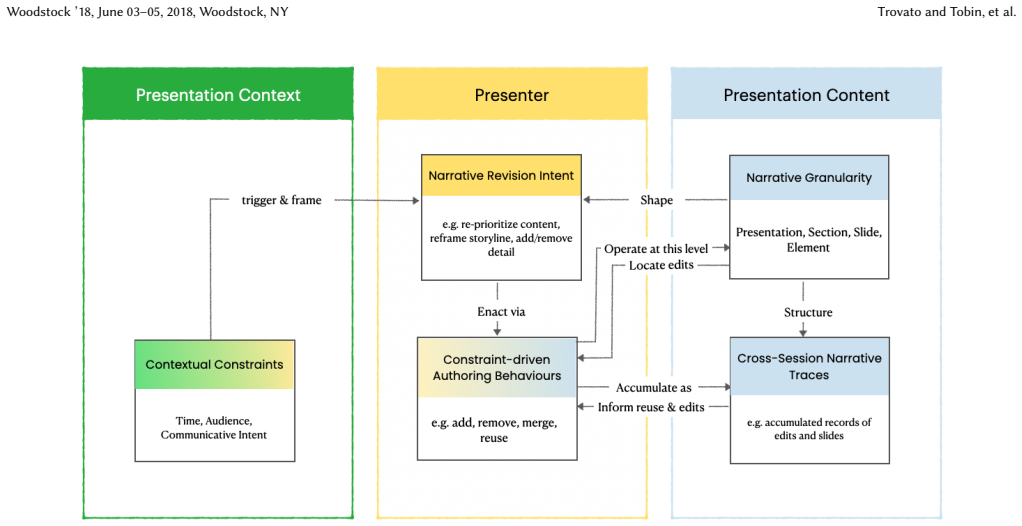
The central discovery is that a constraint-aware tool helps presenters treat constraints as active design drivers that guide narrative construction, and that presenters can flexibly reuse and adapt content across authoring cycles as constraints evolve, based on the CMPA framework derived from formative observations of how constraints emerge and influence decisions.
What carries the argument
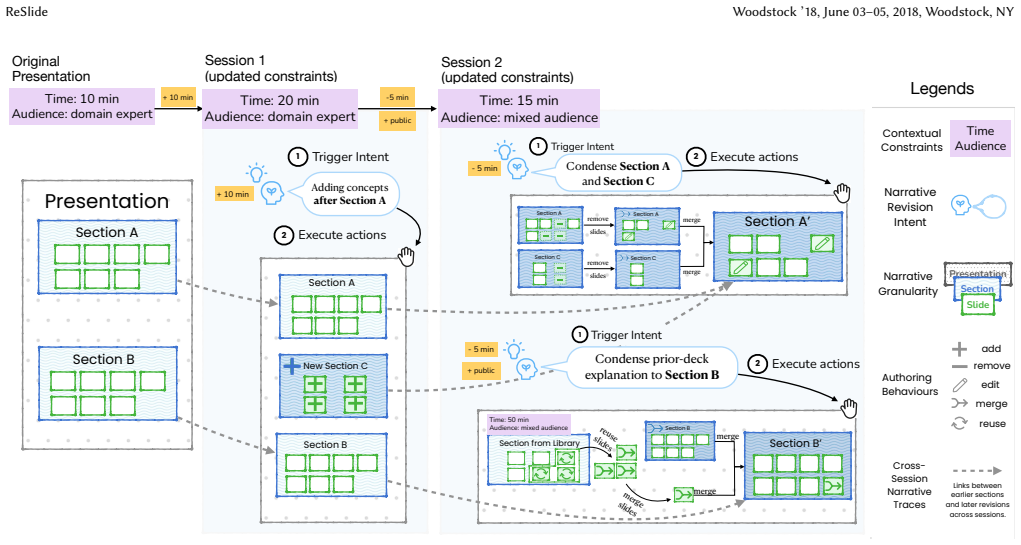
The CMPA framework, which models presentation authoring as a multi-session process driven by evolving constraints of time, audience, and communicative intent, instantiated in a research prototype for constraint-aware slide creation and reuse.
If this is right
- Presenters using constraint-aware tools construct narratives more effectively by treating limitations as design opportunities.
- Content can be reused and adapted more flexibly when tools account for changing constraints over sessions.
- Future presentation software should incorporate mechanisms to track and respond to evolving constraints like time and audience.
- Designers of authoring tools can draw implications for supporting multi-session workflows beyond single-session editing.
Where Pith is reading between the lines
- Similar constraint-based approaches could benefit other evolving creative tasks such as report writing or video scripting.
- Automatic detection of constraints in tools might further reduce manual adaptation effort in professional settings.
- Long-term studies in real professional environments could reveal how these practices scale to team-based or collaborative presentations.
Load-bearing premise
The authoring practices observed in the formative study of ten presenters and the prototype evaluations in user studies generalize to broader presentation authoring contexts and real-world multi-session workflows.
What would settle it
A larger study with diverse presenters working on their own ongoing projects over multiple sessions that finds no difference in narrative construction quality or content reuse between the constraint-aware prototype and a standard baseline tool.
Figures



read the original abstract
Authoring presentation slides involves navigating contextual constraints that shape how content is structured, adapted, and reused. While prior work frames constraints as limitations, little is known about how presenters actively reason about them. We conducted a formative study with ten presenters to examine how constraints emerge, are interpreted, and influence authoring decisions, leading to the Constraint-based Multi-session Presentation Authoring (CMPA) framework. CMPA treats time, audience, and communicative intent as key constraints shaping authoring. We instantiated CMPA in ReSlide, a research prototype for constraint-aware slide creation and reuse, and conducted two user studies on (1) single-session behaviors and (2) multi-session workflows. Compared to a baseline tool, ReSlide helped presenters treat constraints as active design drivers that guide narrative construction. The second study further shows how presenters flexibly reuse and adapt content across authoring cycles as constraints evolve. We then propose design implications for future constraint-aware presentation tools.
Editorial analysis
A structured set of objections, weighed in public.
Referee Report
Summary. The paper reports a formative study with ten presenters that derives the Constraint-based Multi-session Presentation Authoring (CMPA) framework, identifying time, audience, and communicative intent as key constraints. CMPA is instantiated in the ReSlide prototype for constraint-aware slide creation and reuse. Two user studies evaluate ReSlide: the first compares single-session authoring behaviors against a baseline tool, and the second examines multi-session workflows. Findings indicate that ReSlide encourages treating constraints as active design drivers guiding narrative construction and supports flexible content reuse and adaptation as constraints evolve, followed by design implications for future tools.
Significance. If the qualitative observations hold, the work advances HCI understanding of presentation authoring by reframing constraints as generative rather than purely limiting factors. The CMPA framework and ReSlide prototype offer a concrete, empirically grounded approach to supporting iterative, multi-session workflows, which are prevalent in professional practice. This could inform the design of adaptive authoring tools and stimulate further research on constraint-aware interfaces.
minor comments (3)
- [§3.2] §3.2 (formative study procedure): provide more detail on the interview protocol and coding process to strengthen replicability of the CMPA derivation.
- [Table 2] Table 2 (participant demographics): clarify the distribution of presentation experience levels and how they map to the observed behaviors.
- [§5.1] §5.1 (single-session study): the baseline tool description should explicitly list its constraint-handling features (or lack thereof) to make the comparison more precise.
Simulated Author's Rebuttal
We thank the referee for their positive summary of our work on the CMPA framework and ReSlide prototype, as well as for recognizing its significance in reframing constraints as generative factors in presentation authoring. The recommendation for minor revision is appreciated. No specific major comments were provided in the report, so we have no points to address point-by-point. We will incorporate any minor editorial suggestions in the revised version.
Circularity Check
Empirical derivation from user data is self-contained with no circular reductions
full rationale
The paper derives the CMPA framework directly from a formative study of ten presenters' observed practices around constraints, then instantiates it in the ReSlide prototype and evaluates via two standard user studies reporting behaviors through interviews and comparisons. All central claims (treating constraints as design drivers, flexible reuse across sessions) are grounded in collected qualitative data rather than self-definitions, fitted parameters renamed as predictions, or load-bearing self-citations. No equations, uniqueness theorems, or ansatzes appear; the derivation chain remains independent of its inputs by construction.
Axiom & Free-Parameter Ledger
axioms (1)
- domain assumption Findings from interviews with ten presenters can reveal general patterns in how constraints shape authoring decisions across users
Reference graph
Works this paper leans on
-
[1]
[n. d.]. Towards Dialogic and On-Demand Metaphors for Interdisciplinary Read- ing | Proceedings of the 2025 CHI Conference on Human Factors in Computing Systems. https://dl.acm.org/doi/10.1145/3706598.3713698
-
[2]
2006.Dazzle ’em with style: the art of oral scientific presentation(2nd ed ed.)
Robert Rene Henri Anholt. 2006.Dazzle ’em with style: the art of oral scientific presentation(2nd ed ed.). Elsevier Academic Press, Philadelphia
2006
-
[3]
Sumit Asthana, Hannah Rashkin, Elizabeth Clark, Fantine Huot, and Mirella Lapata. 2024. Evaluating LLMs for Targeted Concept Simplification for Domain- Specific Texts. InProceedings of the 2024 Conference on Empirical Methods in Natural Language Processing. Association for Computational Linguistics, Miami, Florida, USA, 6208–6226. https://doi.org/10.18653...
-
[4]
Alex Baker and André Van Der Hoek. 2010. Ideas, subjects, and cycles as lenses for understanding the software design process.Design Studies31, 6 (Nov. 2010), 590–613. https://doi.org/10.1016/j.destud.2010.09.008
-
[5]
Sambaran Bandyopadhyay, Himanshu Maheshwari, Anandhavelu Natarajan, and Apoorv Saxena. 2024. Enhancing Presentation Slide Generation by LLMs with a Multi-Staged End-to-End Approach. https://doi.org/10.48550/arXiv.2406.06556 arXiv:2406.06556
-
[6]
Michel Beaudouin-Lafon. 2004. Designing interaction, not interfaces. InProceed- ings of the working conference on Advanced visual interfaces. ACM, Gallipoli Italy, 15–22. https://doi.org/10.1145/989863.989865
-
[7]
Michel Beaudouin-Lafon and Wendy Mackay. 2002. Prototyping tools and tech- niques. InThe human-computer interaction handbook: fundamentals, evolving technologies and emerging applications. L. Erlbaum Associates Inc., USA, 1006– 1031
2002
-
[8]
Canós, María Isabel Marante, and Manuel Llavador
José H. Canós, María Isabel Marante, and Manuel Llavador. 2010. SliDL: A Slide Digital Library Supporting Content Reuse in Presentations. InResearch and Advanced Technology for Digital Libraries, Mounia Lalmas, Joemon Jose, Andreas Rauber, Fabrizio Sebastiani, and Ingo Frommholz (Eds.). Springer, Berlin, Heidelberg, 453–456. https://doi.org/10.1007/978-3-...
-
[9]
Yining Cao, Jane L E, Chen Zhu-Tian, and Haijun Xia. 2023. DataParticles: Block- based and Language-oriented Authoring of Animated Unit Visualizations. In Proceedings of the 2023 CHI Conference on Human Factors in Computing Systems (CHI ’23). Association for Computing Machinery, New York, NY, USA, 1–15. https://doi.org/10.1145/3544548.3581472
-
[10]
Yining Cao, Rubaiat Habib Kazi, Li-Yi Wei, Deepali Aneja, and Haijun Xia. 2024. Elastica: Adaptive Live Augmented Presentations with Elastic Mappings Across Modalities. InProceedings of the CHI Conference on Human Factors in Computing Systems. ACM, Honolulu HI USA, 1–19. https://doi.org/10.1145/3613904.3642725
-
[11]
Shirley Carter-Thomas and Elizabeth Rowley-Jolivet. 2003. Analysing the scien- tific conference presentation (CP), a methodological overview of a multimodal genre.ASp - La revue du GERAS39-40 (2003), 59–72. https://doi.org/10.4000/asp. Woodstock ’18, June 03–05, 2018, Woodstock, NY Trovato and Tobin, et al. 1295 Publisher: revue.org (en ligne) / Bordeaux ...
work page doi:10.4000/asp 2003
-
[12]
Zhang, Jonathan Bragg, Andrew Head, Kyle Lo, Doug Downey, and Daniel S
Joseph Chee Chang, Amy X. Zhang, Jonathan Bragg, Andrew Head, Kyle Lo, Doug Downey, and Daniel S. Weld. 2023. CiteSee: Augmenting Citations in Scientific Papers with Persistent and Personalized Historical Context. InPro- ceedings of the 2023 CHI Conference on Human Factors in Computing Systems (CHI ’23). Association for Computing Machinery, New York, NY, ...
-
[13]
Valerie Chen, Alan Zhu, Sebastian Zhao, Hussein Mozannar, David Sontag, and Ameet Talwalkar. 2024. Need Help? Designing Proactive AI Assistants for Pro- gramming. https://doi.org/10.48550/ARXIV.2410.04596 Version Number: 2
-
[14]
Leonardo Christino, Taylor Hill, and Fernando Paulovich. 2022. Knowledge- Decks: Automatically Generating Presentation Slide Decks of Visual Analytics Knowledge Discovery Applications. https://doi.org/10.48550/ARXIV.2212.01469 Version Number: 1
-
[15]
Maria João Costa, Hugo Amaro, and Hugo Gonçalo Oliveira. 2023. Smart- EDU: Accelerating Slide Deck Production with Natural Language Process- ing. InNatural Language Processing and Information Systems, Elisabeth Mé- tais, Farid Meziane, Vijayan Sugumaran, Warren Manning, and Stephan Reiff- Marganiec (Eds.). Vol. 13913. Springer Nature Switzerland, Cham, 10...
-
[16]
Thi Ngoc Yen Dang. 2022. A corpus-based study of vocabulary in conference presentations.Journal of English for Academic Purposes59 (Sept. 2022), 101144. https://doi.org/10.1016/j.jeap.2022.101144
-
[17]
Laurent Denoue, Scott Carter, and Matthew Cooper. 2018. SlideDiff: Animating Textual and Media Changes in Slides. InProceedings of the ACM Symposium on Document Engineering 2018 (DocEng ’18). Association for Computing Machinery, New York, NY, USA, 1–4. https://doi.org/10.1145/3209280.3229107
-
[18]
Kees Dorst and Nigel Cross. 2001. Creativity in the design process: co-evolution of problem–solution.Design Studies22, 5 (Sept. 2001), 425–437. https://doi.org/ 10.1016/S0142-694X(01)00009-6
-
[19]
Christian Bastien
Tomás Dorta, Annemarie Lesage, Edgar Pérez, and J.M. Christian Bastien. 2011. Signs of Collaborative Ideation and the Hybrid Ideation Space. InDesign Creativity 2010, Toshiharu Taura and Yukari Nagai (Eds.). Springer London, London, 199–
2011
-
[20]
https://doi.org/10.1007/978-0-85729-224-7_26
-
[21]
Drucker, Georg Petschnigg, and Maneesh Agrawala
Steven M. Drucker, Georg Petschnigg, and Maneesh Agrawala. 2006. Comparing and managing multiple versions of slide presentations. InProceedings of the 19th annual ACM symposium on User interface software and technology (UIST ’06). Association for Computing Machinery, New York, NY, USA, 47–56. https: //doi.org/10.1145/1166253.1166263
-
[22]
Betty Lou Dubais. [n. d.]. The Use of Slidesin BiomedicalSpeeches.The ESP Journal([n. d.])
-
[23]
Mateusz Dubiel, Bereket Abera Yilma, Kayhan Latifzadeh, and Luis A. Leiva. 2022. A Contextual Framework for Adaptive User Interfaces: Modelling the Interaction Environment. https://doi.org/10.48550/arXiv.2203.16882 arXiv:2203.16882 [cs]
-
[24]
Darren Edge, Xi Yang, Yasmine Kotturi, Shuoping Wang, Dan Feng, Bongshin Lee, and Steven Drucker. 2016. SlideSpace: Heuristic Design of a Hybrid Presentation Medium.ACM Trans. Comput.-Hum. Interact.23, 3 (June 2016), 16:1–16:30. https: //doi.org/10.1145/2898970
-
[25]
K. Falkovych, F. Nack, J. van Ossenbruggen, and L. Rutledge. 2004. Sam- pLe: towards a framework for system-supported multimedia authoring. In 10th International Multimedia Modelling Conference, 2004. Proceedings.362–. https://doi.org/10.1109/MULMM.2004.1265009
-
[26]
Raymond Fok, Joseph Chee Chang, Tal August, Amy X. Zhang, and Daniel S. Weld. 2024. Qlarify: Recursively Expandable Abstracts for Dynamic Information Retrieval over Scientific Papers. InProceedings of the 37th Annual ACM Symposium on User Interface Software and Technology (UIST ’24). Association for Computing Machinery, New York, NY, USA, 1–21. https://do...
-
[27]
Tsu-Jui Fu, William Yang Wang, Daniel McDuff, and Yale Song. 2022. DOC2PPT: Automatic Presentation Slides Generation from Scientific Documents.Proceedings of the AAAI Conference on Artificial Intelligence36, 1 (June 2022), 634–642. https: //doi.org/10.1609/aaai.v36i1.19943 Number: 1
-
[28]
Verena Fuchsberger, Martin Murer, Ilhan Aslan, Alexander Meschtscherjakov, Manfred Tscheligi, Petra Sundström, and Daniela Petrelli. 2014. Contextual constraints: consequences for interaction design. InProceedings of the 2014 companion publication on Designing interactive systems (DIS Companion ’14). Association for Computing Machinery, New York, NY, USA,...
-
[29]
Jacqueline Gartner-Schmidt. 2022. The New Normal – Virtual and Hybrid Pre- sentations: Developing Content, Designing Slides, and Delivery Guidelines.Ear, Nose & Throat Journal101, 9_suppl (Nov. 2022), 20S–28S. https://doi.org/10. 1177/01455613231158799
2022
-
[30]
Yue Guo, Joseph Chee Chang, Maria Antoniak, Erin Bransom, Trevor Cohen, Lucy Lu Wang, and Tal August. 2023. Personalized Jargon Identification for Enhanced Interdisciplinary Communication. https://doi.org/10.48550/arXiv. 2311.09481 arXiv:2311.09481 [cs]
work page internal anchor Pith review doi:10.48550/arxiv 2023
-
[31]
2007.The design space: the design process as the construction, exploration and expansion of a conceptual space : PhD disserta- tion
Christopher Robert Ashton Heape. 2007.The design space: the design process as the construction, exploration and expansion of a conceptual space : PhD disserta- tion. Designarena.dk : [Bestilles via e-mail: chris @designarena.dk], S.l. OCLC: 962336272
2007
-
[32]
Jeffrey Heer. 2019. Agency plus automation: Designing artificial intelligence into interactive systems.Proceedings of the National Academy of Sciences of the United States of America116, 6 (Feb. 2019), 1844–1850. https://doi.org/10.1073/pnas. 1807184115
-
[33]
Shelton, Fanny Chevalier, Kari Kraus, and Niklas Elmqvist
Md Naimul Hoque, Tasfia Mashiat, Bhavya Ghai, Cecilia D. Shelton, Fanny Chevalier, Kari Kraus, and Niklas Elmqvist. 2024. The HaLLMark Effect: Sup- porting Provenance and Transparent Use of Large Language Models in Writ- ing with Interactive Visualization. InProceedings of the CHI Conference on Hu- man Factors in Computing Systems. ACM, Honolulu HI USA, 1...
-
[34]
James Hutson. 2025. Human-AI Collaboration in Writing: A Multidimensional Framework for Creative and Intellectual Authorship.International Journal of Changes in Education(Feb. 2025). https://doi.org/10.47852/bonviewIJCE52024908
-
[35]
Hyeonsu B Kang, Tongshuang Wu, Joseph Chee Chang, and Aniket Kittur. 2023. Synergi: A Mixed-Initiative System for Scholarly Synthesis and Sensemaking. InProceedings of the 36th Annual ACM Symposium on User Interface Software and Technology (UIST ’23). Association for Computing Machinery, New York, NY, USA, 1–19. https://doi.org/10.1145/3586183.3606759
-
[36]
Yudai Kato, Shun Shiramatsu, Tadachika Ozono, and Toramatsu Shintani. 2014. Slide Repository: A Repository for Slide Reuse Using Research Episode Network. In2014 IIAI 3rd International Conference on Advanced Applied Informatics. 198–203. https://doi.org/10.1109/IIAI-AAI.2014.50
-
[37]
G. Klein, B. Moon, and R.R. Hoffman. 2006. Making Sense of Sensemaking 1: Alternative Perspectives.IEEE Intelligent Systems21, 4 (July 2006), 70–73. https://doi.org/10.1109/MIS.2006.75
-
[38]
Jon Kolko. 2010. Sensemaking and Framing: A Theoretical Reflection on Perspec- tive in Design Synthesis. https://doi.org/10.21606/drs.2010.67
-
[39]
Leonhard Lichtschlag, Thorsten Karrer, and Jan Borchers. 2009. Fly: a tool to author planar presentations. InProceedings of the SIGCHI Conference on Human Factors in Computing Systems (CHI ’09). Association for Computing Machinery, New York, NY, USA, 547–556. https://doi.org/10.1145/1518701.1518786
-
[40]
Zhiyu Lin, Upol Ehsan, Rohan Agarwal, Samihan Dani, Vidushi Vashishth, and Mark Riedl. 2023. Beyond Prompts: Exploring the Design Space of Mixed- Initiative Co-Creativity Systems. https://doi.org/10.48550/arXiv.2305.07465 arXiv:2305.07465 [cs]
-
[41]
Kyle Lo, Joseph Chee Chang, Andrew Head, Jonathan Bragg, Amy X. Zhang, Cas- sidy Trier, Chloe Anastasiades, Tal August, Russell Authur, Danielle Bragg, Erin Bransom, Isabel Cachola, Stefan Candra, Yoganand Chandrasekhar, Yen-Sung Chen, Evie Yu-Yen Cheng, Yvonne Chou, Doug Downey, Rob Evans, Raymond Fok, Fangzhou Hu, Regan Huff, Dongyeop Kang, Tae Soo Kim,...
-
[42]
Young, Victoria Bellotti, and Thomas P
Allan MacLean, Richard M. Young, Victoria M.E. Bellotti, and Thomas P. Moran. 1991. Questions, options, and criteria: Elements of de- sign space analysis.Human–Computer Interaction6, 3-4 (1991), 201–250. https://doi.org/10.1080/07370024.1991.9667168 tex.eprint: https://www.tandfonline.com/doi/pdf/10.1080/07370024.1991.9667168
-
[43]
Himanshu Maheshwari, Sambaran Bandyopadhyay, Aparna Garimella, and Anandhavelu Natarajan. 2024. Presentations are not always linear! GNN meets LLM for Text Document-to-Presentation Transformation with Attribution. In Findings of the Association for Computational Linguistics: EMNLP 2024, Yaser Al-Onaizan, Mohit Bansal, and Yun-Nung Chen (Eds.). Association...
2024
-
[44]
Caterina Moruzzi and Solange Margarido. 2024. A User-centered Framework for Human-AI Co-creativity. InExtended Abstracts of the CHI Conference on Human Factors in Computing Systems (CHI EA ’24). Association for Computing Machinery, New York, NY, USA, 1–9. https://doi.org/10.1145/3613905.3650929
-
[45]
Prasanth Murali, Javier Hernandez, Daniel McDuff, Kael Rowan, Jina Suh, and Mary Czerwinski. 2021. AffectiveSpotlight: Facilitating the Communication of Affective Responses from Audience Members during Online Presentations. In Proceedings of the 2021 CHI Conference on Human Factors in Computing Systems. ACM, Yokohama Japan, 1–13. https://doi.org/10.1145/3...
-
[46]
Kristen M. Naegle. 2021. Ten simple rules for effective presentation slides.PLOS Computational Biology17, 12 (Dec. 2021), e1009554. https://doi.org/10.1371/ journal.pcbi.1009554 ReSlide Woodstock ’18, June 03–05, 2018, Woodstock, NY
2021
-
[47]
Sachita Nishal, Eric Lee, and Nicholas Diakopoulos. 2024. De-jargonizing Science for Journalists with GPT-4: A Pilot Study. https://doi.org/10.48550/arXiv.2410. 12069 arXiv:2410.12069 [cs]
-
[48]
Norman (Ed.)
Donald A. Norman (Ed.). 1986.User centered system design: new perspectives on human-computer interaction(9. [print.] ed.). Erlbaum, Hillsdale, NJ
1986
-
[49]
Yoshiaki Oida, Kazuo Hiekata, Taiga Mitsuyuki, Hiroki Kamba, and Isaac Okada
-
[50]
Development of presentation slide retrieval system based on visual in- formation.Journal of Industrial Information Integration12 (Dec. 2018), 3–12. https://doi.org/10.1016/j.jii.2018.01.001
-
[51]
Yi-Hao Peng, Peggy Chi, Anjuli Kannan, Meredith Ringel Morris, and Irfan Essa
-
[52]
InProceedings of the 2023 CHI Conference on Human Factors in Computing Systems (CHI ’23)
Slide Gestalt: Automatic Structure Extraction in Slide Decks for Non-Visual Access. InProceedings of the 2023 CHI Conference on Human Factors in Computing Systems (CHI ’23). Association for Computing Machinery, New York, NY, USA, 1–14. https://doi.org/10.1145/3544548.3580921
-
[53]
Peter Pirolli and Stuart Card. [n. d.]. The Sensemaking Process and Leverage Points for Analyst Technology as Identified Through Cognitive Task Analysis. ([n. d.])
-
[54]
Walter Ralph Reitman. 1965. Cognition and thought : an information-processing approach. InCognition and thought : an information-processing approach. Wiley, New York. tex.lccn: 65025856
1965
-
[55]
2012.Presentation zen: simple ideas on presentation design and delivery(2nd ed., rev
Garr Reynolds. 2012.Presentation zen: simple ideas on presentation design and delivery(2nd ed., rev. & updated ed.). New Riders, Berkeley, CA
2012
-
[56]
Mohi Reza, Jeb Thomas-Mitchell, Peter Dushniku, Nathan Laundry, Joseph Jay Williams, and Anastasia Kuzminykh. 2025. Co-Writing with AI, on Human Terms: Aligning Research with User Demands Across the Writing Process. https: //doi.org/10.1145/3757566 arXiv:2504.12488 [cs]
-
[57]
Jeba Rezwana and Mary Lou Maher. 2023. Designing Creative AI Partners with COFI: A Framework for Modeling Interaction in Human-AI Co-Creative Systems.ACM Trans. Comput.-Hum. Interact.30, 5 (Sept. 2023), 67:1–67:28. https://doi.org/10.1145/3519026
-
[58]
Reinout Roels and Beat Signer. 2019. A Conceptual Framework and Content Model for Next Generation Presentation Solutions.Proc. ACM Hum.-Comput. Interact.3, EICS (June 2019), 7:1–7:22. https://doi.org/10.1145/3331149
-
[59]
Quentin Roy, Futian Zhang, and Daniel Vogel. 2019. Automation Accuracy Is Good, but High Controllability May Be Better. InProceedings of the 2019 CHI Conference on Human Factors in Computing Systems. ACM, Glasgow Scotland Uk, 1–8. https://doi.org/10.1145/3290605.3300750
-
[60]
Bahador Saket, Sijie Yang, Hong Tan, Koji Yatani, and Darren Edge. 2014. Talk- Zones: section-based time support for presentations. InProceedings of the 16th international conference on Human-computer interaction with mobile devices & services (MobileHCI ’14). Association for Computing Machinery, New York, NY, USA, 263–272. https://doi.org/10.1145/2628363.2628399
-
[61]
Schwabish
Jonathan A. Schwabish. 2017.Better presentations: a guide for scholars, researchers, and wonks. Columbia University Press, New York City
2017
-
[62]
Donald A. Schön. 1983.The reflective practitioner: how professionals think in action. Basic Books, New York
1983
-
[63]
Edward Segel and Jeffrey Heer. 2010. Narrative Visualization: Telling Stories with Data.IEEE Transactions on Visualization and Computer Graphics16, 6 (Nov. 2010), 1139–1148. https://doi.org/10.1109/TVCG.2010.179 Conference Name: IEEE Transactions on Visualization and Computer Graphics
-
[64]
Moushumi Sharmin, Lawrence Bergman, Jie Lu, and Ravi Konuru. 2012. On slide-based contextual cues for presentation reuse. InProceedings of the 2012 ACM international conference on Intelligent User Interfaces (IUI ’12). Association for Computing Machinery, New York, NY, USA, 129–138. https://doi.org/10. 1145/2166966.2166992
-
[65]
Bailey, and Tal August
Yifan Song, Wing Yee Au, Hon Yung Wong, Brian P. Bailey, and Tal August
-
[66]
https: //doi.org/10.48550/arXiv.2508.10239 arXiv:2508.10239 [cs]
Personalized Real-time Jargon Support for Online Meetings. https: //doi.org/10.48550/arXiv.2508.10239 arXiv:2508.10239 [cs]
-
[67]
Ryan Spicer, Yu-Ru Lin, Aisling Kelliher, and Hari Sundaram. 2012. NextSlide- Please: Authoring and delivering agile multimedia presentations.ACM Trans. Mul- timedia Comput. Commun. Appl.8, 4 (Nov. 2012), 53:1–53:20. https://doi.org/out
2012
-
[68]
Ryan P. Spicer and Aisling Kelliher. 2009. NextSlidePlease: navigation and time management for hyperpresentations. InCHI ’09 Extended Abstracts on Human Factors in Computing Systems (CHI EA ’09). Association for Computing Machinery, New York, NY, USA, 3883–3888. https://doi.org/10.1145/1520340.1520588
-
[69]
Patricia D. Stokes. 2008. Creativity from Constraints: What can we learn from Motherwell? from Modrian? from Klee?The Journal of Creative Behavior42, 4 (Dec. 2008), 223–236. https://doi.org/10.1002/j.2162-6057.2008.tb01297.x
-
[70]
Kazuma Takahashi, Wen Gu, Koichi Ota, and Shinobu Hasegawa. 2024. An Academic Presentation Support System Utilizing Structural Elements.IEICE Transactions on Information and SystemsE107.D, 4 (April 2024), 486–494. https: //doi.org/10.1587/transinf.2023IHP0006
-
[71]
Fengjie Wang, Yanna Lin, Leni Yang, Haotian Li, Mingyang Gu, Min Zhu, and Huamin Qu. 2024. OutlineSpark: Igniting AI-powered Presentation Slides Cre- ation from Computational Notebooks through Outlines. InProceedings of the CHI Conference on Human Factors in Computing Systems. ACM, Honolulu HI USA, 1–16. https://doi.org/10.1145/3613904.3642865
-
[72]
Fengjie Wang, Xuye Liu, Oujing Liu, Ali Neshati, Tengfei Ma, Min Zhu, and Jian Zhao. 2023. Slide4N: Creating Presentation Slides from Computational Notebooks with Human-AI Collaboration. InProceedings of the 2023 CHI Conference on Human Factors in Computing Systems. ACM, Hamburg Germany, 1–18. https: //doi.org/10.1145/3544548.3580753
-
[73]
Ruotong Wang, Ruijia Cheng, Denae Ford, and Thomas Zimmermann. 2024. Investigating and Designing for Trust in AI-powered Code Generation Tools. In The 2024 ACM Conference on Fairness, Accountability, and Transparency. ACM, Rio de Janeiro Brazil, 1475–1493. https://doi.org/10.1145/3630106.3658984
-
[74]
Thomas Winters and Kory W. Mathewson. 2019. Automatically Generating Engaging Presentation Slide Decks. InComputational Intelligence in Music, Sound, Art and Design, Anikó Ekárt, Antonios Liapis, and María Luz Castro Pena (Eds.). Vol. 11453. Springer International Publishing, Cham, 127–141. https://doi.org/ 10.1007/978-3-030-16667-0_9 Series Title: Lectur...
-
[75]
Jiaje Zhang and Donald A. Norman. 1994. Representations in distributed cognitive tasks.Cognitive Science18, 1 (Jan. 1994), 87–122. https://doi.org/10.1016/0364- 0213(94)90021-3
-
[76]
$ { o r i g i n a l D e s c r i p t i o n }
Jie Zhang, Chuan Xiao, Toyohide Watanabe, and Yoshiharu Ishikawa. 2014. Content-Based Element Search for Presentation Slide Reuse.IEICE Transac- tions on Information and SystemsE97.D, 10 (2014), 2685–2696. https://doi.org/10. 1587/transinf.2014EDP7023 Woodstock ’18, June 03–05, 2018, Woodstock, NY Trovato and Tobin, et al. A Formative Study Details A.1 De...
2014
-
[77]
Use the detailed audience profile to determine what would be jargon
-
[78]
WHAT THIS AUDIENCE KNOWS
If a term is in the " WHAT THIS AUDIENCE KNOWS " list , it's NOT jargon
-
[79]
LIKELY JARGON
If a term is similar to items in " LIKELY JARGON " list , it probably IS jargon
-
[80]
i n f e r r e d E x p e r t i s e L e v e l }/5) carefully
Consider the expertise level ( $ { expandedContext . i n f e r r e d E x p e r t i s e L e v e l }/5) carefully
discussion (0)
Sign in with ORCID, Apple, or X to comment. Anyone can read and Pith papers without signing in.