Recognition: no theorem link
Legal Infrastructure Organizes Eviction: Evidence from Philadelphia
Pith reviewed 2026-05-12 01:46 UTC · model grok-4.3
The pith
Eviction in Philadelphia is organized upstream by a concentrated plaintiff-side legal infrastructure of dominant attorneys and repeat property filings.
A machine-rendered reading of the paper's core claim, the machinery that carries it, and where it could break.
Core claim
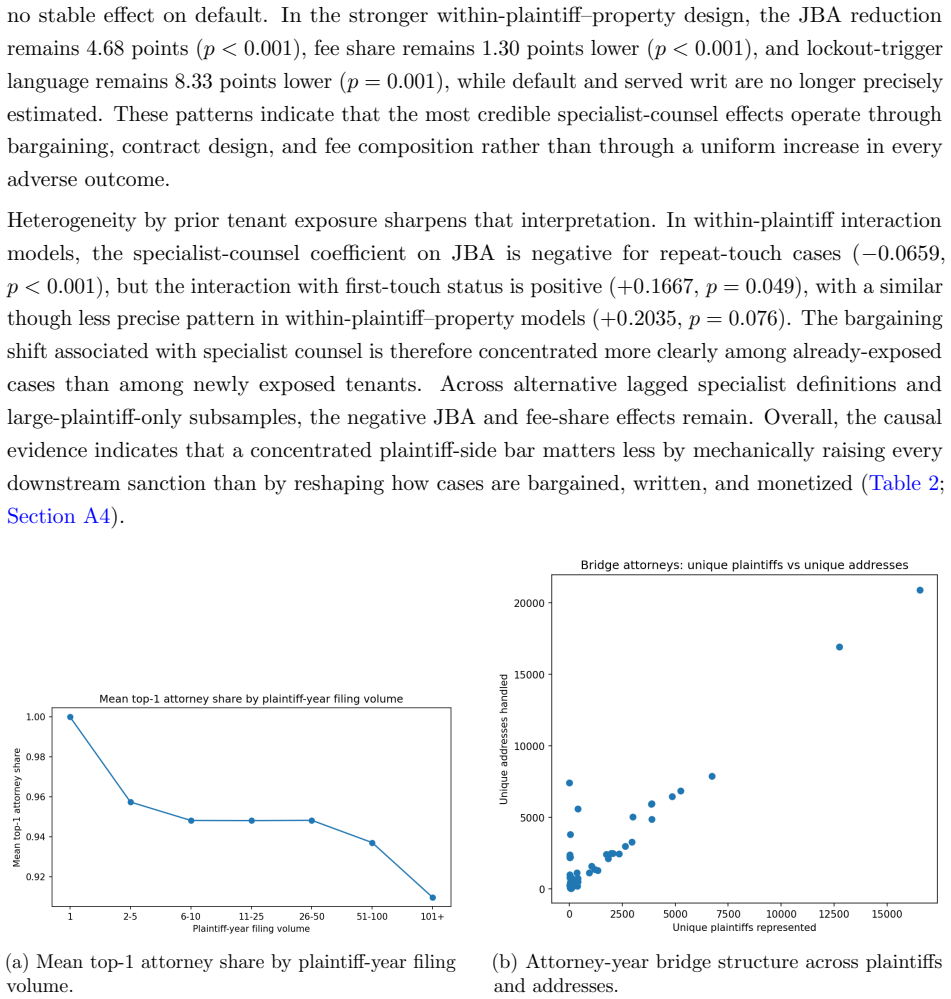
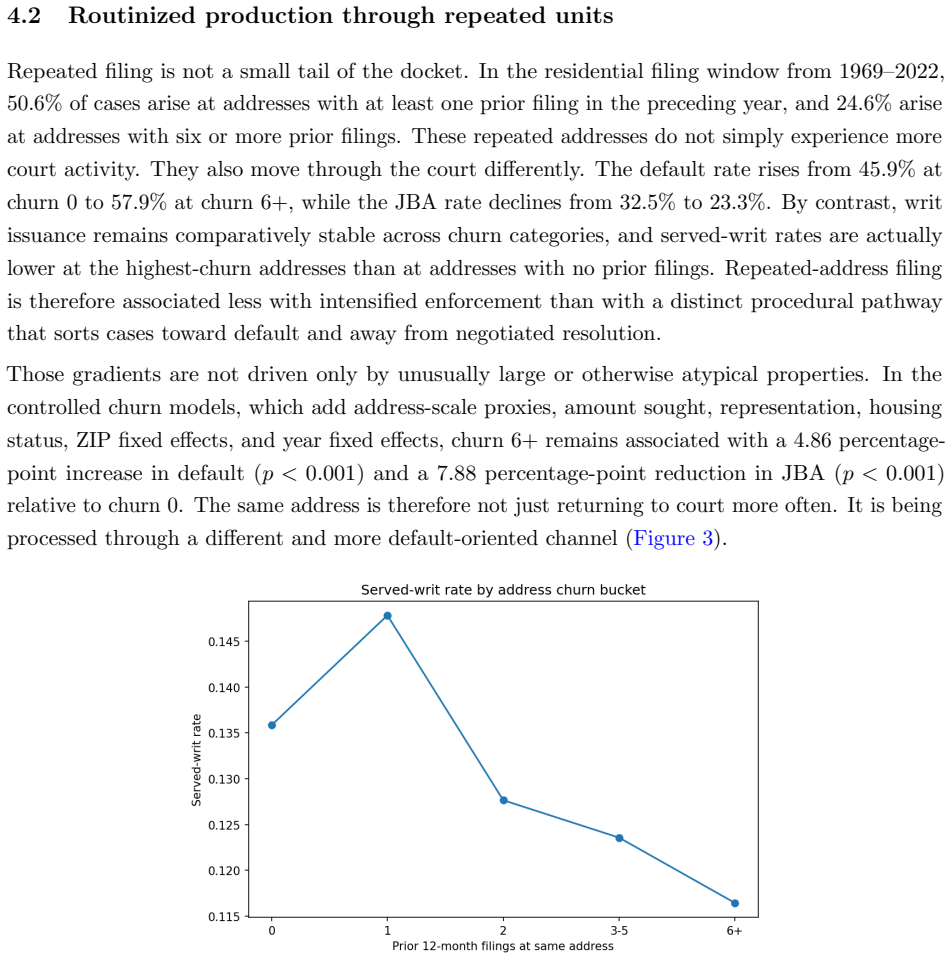
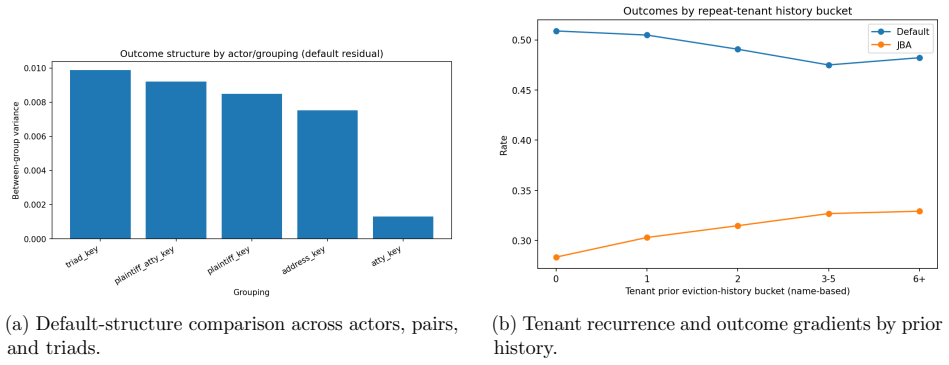
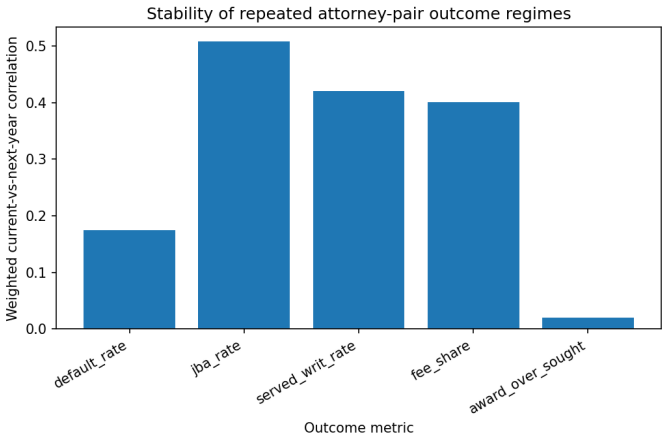
Eviction is organized by plaintiff-side legal infrastructure: a concentrated bar where ten attorneys average 82.0 percent of represented cases, durable plaintiff-attorney dependence where large filers route most work to one specialist, and repeated use of the same properties with 50.6 percent of cases at addresses filed the previous year. Adoption of specialist counsel by plaintiffs produces reorganization in judgment types, fee shares, and lockout language rather than uniform throughput gains, while repeated addresses route through default-heavy processes.
What carries the argument
Plaintiff-side legal infrastructure: the layer of concentrated counsel, plaintiff-attorney dependence, and repeat filings at specific addresses that generates eviction cases before court bargaining.
If this is right
- Filings are produced through this infrastructure before any courtroom bargaining occurs.
- Repeated addresses are processed through more default judgments and fewer agreements.
- Plaintiff adoption of specialist counsel reorganizes case features such as judgment by agreement and fee shares.
- Tenants experience recurring exposure to the court system at the same properties.
Where Pith is reading between the lines
- Interventions aimed at a small number of dominant attorneys could reach a large share of total filings.
- Focusing on repeat properties might interrupt cycles that generate repeated cases through the same plaintiffs.
- Support for tenants could target repeat exposure rather than isolated filings.
Load-bearing premise
The docket patterns of attorney concentration and repeated addresses reflect organized upstream infrastructure rather than recording artifacts, selection into the system, or simple correlation.
What would settle it
A finding that the top ten attorneys handle shares close to the 14.7 percent seen for top plaintiffs, or that most addresses show no prior filings within a year, would undermine the claim that eviction is structured by this concentrated infrastructure.
Figures



read the original abstract
The filing-side legal infrastructure of eviction is studied using the Philadelphia Municipal Court docket. Using 755.004 landlord--tenant records filed from 1969 to 2022, with 747.125 residential filings, it shows that eviction is organized upstream by a concentrated plaintiff-side bar, durable plaintiff--attorney dependence, repeated use of the same properties, and repeat exposure of tenants to the court system. In 1983--2022, the ten most active plaintiff attorneys handled an average of 82.0% of represented plaintiff-side cases, compared with 14.7% for the ten most active plaintiffs. Large plaintiffs are also highly dependent on dominant counsel: among plaintiffs with at least 101 cases, the mean top-1 attorney share is 78.3%. Repeated filing is likewise central. Across the residential docket, 50.6% of cases occur at addresses with a prior filing in the preceding year, and 24.6% occur at addresses with six or more prior filings. Those repeated addresses are usually same-plaintiff repeats and are processed through a more default-heavy, agreement-light pathway. A narrower mechanism is also examined: plaintiff adoption of specialist plaintiff-side counsel. Filing-margin event studies show adoption-linked reorganization rather than clean throughput effects, while within-plaintiff and within-plaintiff--property comparisons show the most stable changes in judgment by agreement, fee share, and lockout-trigger language. The contribution is an upstream account of eviction as plaintiff-side legal infrastructure: a layer of concentrated counsel, repeated places, and recurring tenants through which filings are produced before any courtroom bargaining occurs.
Editorial analysis
A structured set of objections, weighed in public.
Referee Report
Summary. The manuscript analyzes 755,004 landlord-tenant records from the Philadelphia Municipal Court (1969-2022), focusing on 747,125 residential filings. It documents that eviction is organized upstream by a concentrated plaintiff-side bar (top-10 attorneys handling an average of 82.0% of represented cases from 1983-2022 vs. 14.7% for top plaintiffs), durable plaintiff-attorney dependence (mean top-1 attorney share of 78.3% among plaintiffs with at least 101 cases), repeated property use (50.6% of cases at addresses with a prior filing in the preceding year; 24.6% at addresses with six or more prior filings), and repeat tenant exposure. It examines plaintiff adoption of specialist counsel via filing-margin event studies and within-plaintiff/property comparisons, showing reorganization effects on outcomes such as judgment by agreement, fee share, and lockout language.
Significance. If the entity-identification procedures prove reliable, this provides a valuable upstream descriptive account of eviction as structured through plaintiff-side legal infrastructure rather than isolated bilateral disputes. The large dataset spanning decades, clear descriptive statistics, and event-study framing are strengths that enable observation of concentration, repetition, and adoption dynamics not feasible in smaller studies. This could inform policy discussions on repeat-player effects in housing courts.
major comments (3)
- [Data and sample construction] Data and sample construction section: The manuscript does not report the procedure used to identify unique plaintiffs and attorneys from raw docket name strings. Court records routinely contain abbreviations, corporate suffixes, typos, and variant spellings. Without fuzzy matching, manual review, or external validation, the headline concentration gap (82.0% for attorneys vs. 14.7% for plaintiffs) may be mechanically inflated because plaintiff names are more prone to variation than attorney names. This is load-bearing for the central claim of organized legal infrastructure and requires explicit documentation plus sensitivity checks.
- [Repeated filing statistics] Repeated filing statistics (around the 50.6% and 24.6% figures): The repeated-property claims depend on reliable address normalization. The paper should specify the address-matching algorithm and report robustness to alternative normalizations or exclusion of ambiguous addresses, as these statistics underpin the repeated-use component of the infrastructure narrative.
- [Event-study analysis of counsel adoption] Event-study analysis of counsel adoption: The identification of 'adoption' events, the definition of the filing margin, and the construction of within-plaintiff and within-plaintiff-property comparisons need additional detail to rule out selection effects. It is unclear how the paper isolates reorganization effects on judgment by agreement and fee share from other changes in filing behavior.
minor comments (2)
- [Abstract] Abstract: The abstract is information-dense; separating the core descriptive patterns from the mechanism examination would improve readability.
- [Tables and figures] Tables and figures: All reported shares (e.g., 82.0%, 14.7%, 78.3%) should be accompanied by underlying sample sizes, time periods, and any standard errors in the main displays.
Simulated Author's Rebuttal
We thank the referee for their constructive comments, which highlight important areas for improving transparency and robustness. We address each major comment below and will revise the manuscript to incorporate additional documentation, sensitivity analyses, and clarifications as detailed in our responses.
read point-by-point responses
-
Referee: [Data and sample construction] Data and sample construction section: The manuscript does not report the procedure used to identify unique plaintiffs and attorneys from raw docket name strings. Court records routinely contain abbreviations, corporate suffixes, typos, and variant spellings. Without fuzzy matching, manual review, or external validation, the headline concentration gap (82.0% for attorneys vs. 14.7% for plaintiffs) may be mechanically inflated because plaintiff names are more prone to variation than attorney names. This is load-bearing for the central claim of organized legal infrastructure and requires explicit documentation plus sensitivity checks.
Authors: We agree that the current manuscript lacks sufficient detail on entity identification, which is a valid concern given the potential for name variation in court records. In the revised version, we will expand the Data and Sample Construction section with a dedicated subsection describing our full procedure: name standardization steps (e.g., removal of suffixes, abbreviation handling), the fuzzy matching algorithm employed (including distance metrics and thresholds), any manual review protocols, and attempts at external validation against public bar records where feasible. We will also add sensitivity checks that vary matching strictness, exclude ambiguous cases, and report how the top-10 concentration shares (82.0% attorneys vs. 14.7% plaintiffs) and durable dependence statistics change under these alternatives. revision: yes
-
Referee: [Repeated filing statistics] Repeated filing statistics (around the 50.6% and 24.6% figures): The repeated-property claims depend on reliable address normalization. The paper should specify the address-matching algorithm and report robustness to alternative normalizations or exclusion of ambiguous addresses, as these statistics underpin the repeated-use component of the infrastructure narrative.
Authors: We concur that reliable address normalization is critical for the repeated-filing statistics and the broader infrastructure narrative. The revised manuscript will specify the address-matching algorithm in detail (including parsing rules, standardization of street names/numbers, and handling of multi-unit buildings). We will also report robustness checks using alternative normalizations (e.g., stricter vs. looser matching thresholds) and results after excluding addresses with high ambiguity, confirming that the 50.6% prior-year repeat rate and 24.6% six-or-more prior filings rate remain substantively unchanged. revision: yes
-
Referee: [Event-study analysis of counsel adoption] Event-study analysis of counsel adoption: The identification of 'adoption' events, the definition of the filing margin, and the construction of within-plaintiff and within-plaintiff-property comparisons need additional detail to rule out selection effects. It is unclear how the paper isolates reorganization effects on judgment by agreement and fee share from other changes in filing behavior.
Authors: We will add substantial detail to the Event-Study Analysis section to clarify these elements. Specifically, we will define the adoption event as the first filing by a plaintiff using a new specialist counsel after a period of non-use, with the filing margin constructed as the window around this switch. We will elaborate on the within-plaintiff and within-plaintiff-property fixed-effects comparisons, including how they control for time-invariant plaintiff or property characteristics. Additional text will explain the identification assumptions and report supplementary checks (e.g., pre-trend tests and placebo switches) to better isolate reorganization effects on outcomes like judgment by agreement, fee share, and lockout language from selection or concurrent behavioral changes. revision: yes
Circularity Check
No circularity: purely descriptive docket statistics
full rationale
The paper reports direct computations from raw court records (shares of cases by top attorneys/plaintiffs, repeat-address rates, within-plaintiff comparisons, and event-study differences). No equations, fitted parameters, predictions, or self-citations are invoked as load-bearing steps in any derivation chain. All figures are simple aggregations of observed docket strings and dates; they do not reduce to definitional tautologies or imported uniqueness results. The analysis is therefore self-contained against external benchmarks.
Axiom & Free-Parameter Ledger
axioms (1)
- domain assumption Philadelphia Municipal Court docket records are complete and accurately represent all filed landlord-tenant cases from 1969 to 2022.
Reference graph
Works this paper leans on
-
[1]
[A. Hoffman and Strezhnev, 2023] A. Hoffman, D. and Strezhnev, A. (2023). Longer trips to court cause evictions.Proceedings of the National Academy of Sciences, 120(2):e2210467120. [Aizman and Huntley, 2025] Aizman, A. and Huntley, E. R. (2025). Shadow players of the eviction crisis: identifying and characterizing professional evicting attorneys in massac...
work page 2023
-
[2]
[Sudeall and Pasciuti, 2021] Sudeall, L. and Pasciuti, D. (2021). Praxis and paradox: Inside the black box of eviction court.Vand. L. Rev., 74:1365. [Summers, 2022] Summers, N. (2022). Eviction court displacement rates.Nw. UL REv., 117:287. [Summers, 2023] Summers, N. (2023). Civil probation.Stan. L. Rev., 75:847. [Summers, 2026] Summers, N. (2026). Settl...
work page 2021
-
[3]
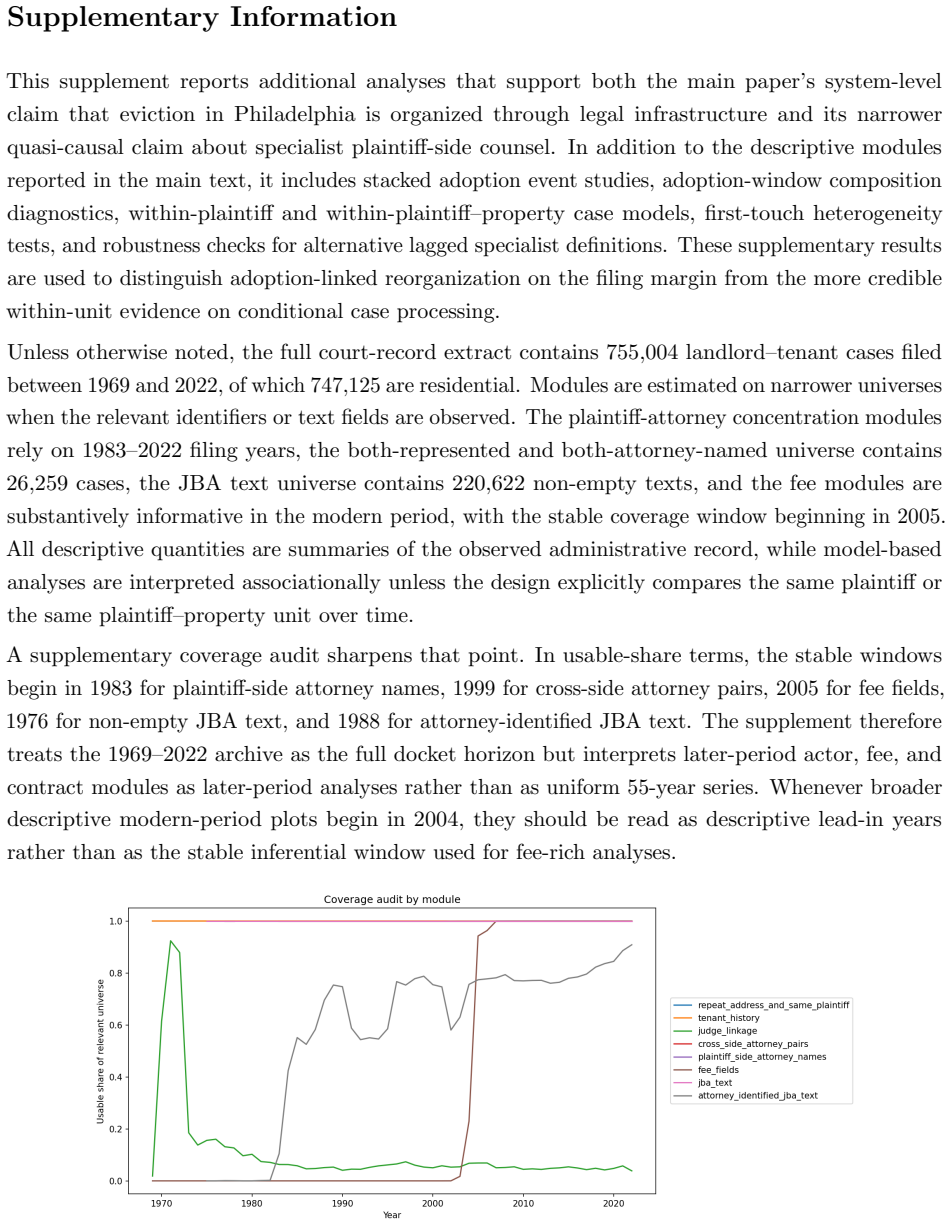
A supplementary coverage audit sharpens that point
All descriptive quantities are summaries of the observed administrative record, while model-based analyses are interpreted associationally unless the design explicitly compares the same plaintiff or the same plaintiff–property unit over time. A supplementary coverage audit sharpens that point. In usable-share terms, the stable windows begin in 1983 for pl...
work page 1983
-
[4]
The point is not a simple upward trend
Award-to-request ratios exceed unity in every modern year shown, indicating that court-imposed debt frequently exceeds the amount originally sought. The point is not a simple upward trend. It is that fee-augmented debt remains a material component of court processing across the modern period (Table D3; Figure D1). Table D3: Selected fee-extraction statist...
work page 2004
discussion (0)
Sign in with ORCID, Apple, or X to comment. Anyone can read and Pith papers without signing in.