Recognition: unknown
Relativistic frequency shifts in gravitational waves from axion clouds
Pith reviewed 2026-05-09 21:40 UTC · model grok-4.3
The pith
A bilinear-form relativistic perturbation theory unifies calculations of frequency shifts in gravitational waves from axion clouds around black holes, including cases with multiple excited modes.
A machine-rendered reading of the paper's core claim, the machinery that carries it, and where it could break.
Core claim
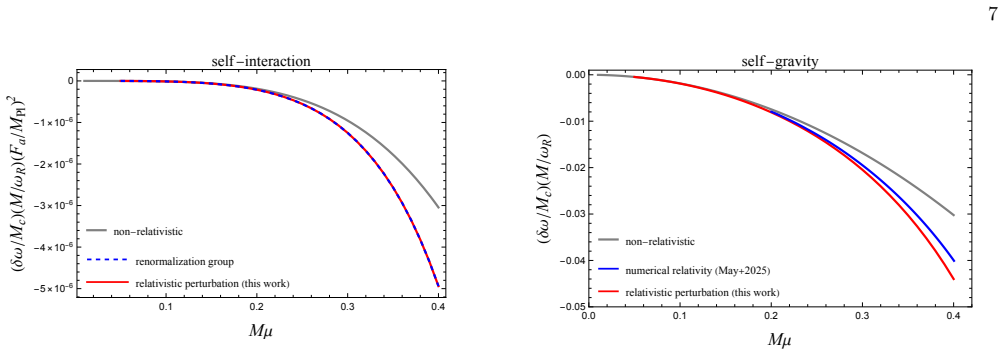
Relativistic perturbation theory based on a bilinear form calculates the frequency shifts of gravitational waves emitted by axion clouds, supplying a simple unified treatment that works for self-interaction-driven multiple modes and that revisits the self-gravity contribution.
What carries the argument
Relativistic perturbation theory based on a bilinear form, which computes frequency shifts by treating the interactions among superradiant modes and the cloud's gravitational field.
If this is right
- Frequency shifts can be computed uniformly for gravitational-wave emission channels that arise when several superradiant modes are populated.
- The same framework incorporates the cloud's self-gravity without separate ad-hoc adjustments.
- Predictions become available for the long-term frequency evolution of signals that future detectors must match.
- The method extends directly to any situation in which multiple bosonic modes interact inside a black-hole cloud.
Where Pith is reading between the lines
- The framework could be reused for other ultralight scalar or vector fields that form clouds around black holes.
- Accurate frequency templates derived this way would allow continuous-wave searches to place tighter bounds on boson masses and couplings.
- If the bilinear approach holds, it offers a computationally lighter alternative to full nonlinear simulations for initial signal modeling.
Load-bearing premise
The bilinear-form perturbation theory remains valid and accurate when self-interactions excite multiple modes and the cloud's self-gravity is included, without higher-order nonlinear effects becoming dominant.
What would settle it
A high-resolution numerical evolution of an axion cloud with self-interactions that tracks the actual gravitational-wave frequencies and checks whether they match the shifts predicted by the bilinear theory or deviate once multiple modes and self-gravity are fully nonlinear.
Figures

read the original abstract
Superradiant instability of ultralight bosons can produce clouds around rotating black holes, whose continuous gravitational wave (GW) emission is a promising observational target. Precise predictions of the signal frequency and its evolution are essential for detecting such continuous GWs. For axions, self-interactions can populate multiple superradiant modes via nonlinear couplings, and GW emission can occur through various channels. To calculate the frequency shifts of GWs emitted through these channels, we employ relativistic perturbation theory based on a bilinear form. We apply this framework to self-interaction effects for the first time, and also revisit the treatment of the self-gravity contribution. Our results provide a simple and unified framework for calculating frequency shifts, including cases in which multiple modes are excited, and are relevant for next-generation GW observations.
Editorial analysis
A structured set of objections, weighed in public.
Referee Report
Summary. The manuscript develops a relativistic perturbation theory framework based on a bilinear form to compute frequency shifts in gravitational waves emitted by axion clouds around Kerr black holes. It applies the method to self-interaction effects (claimed for the first time) that can excite multiple superradiant modes via nonlinear couplings, revisits the self-gravity contribution, and asserts that the approach supplies a simple unified framework for frequency-shift calculations even in multi-mode cases, with relevance to next-generation GW observations.
Significance. If the bilinear-form truncation is shown to be consistent and higher-order nonlinear back-reaction remains negligible, the unified treatment would supply a practical tool for precise frequency predictions needed to search for continuous GW signals from superradiant axion clouds. The absence of free parameters in the core derivation and the explicit inclusion of multi-mode self-interactions would strengthen its utility for observational modeling.
major comments (2)
- [Abstract and multi-mode results] Abstract and the multi-mode application section: the central claim that the bilinear-form relativistic perturbation theory supplies an accurate unified framework when self-interactions populate multiple superradiant modes rests on the assertion that all relevant frequency-shift contributions are captured at linear order. No explicit error bounds, convergence tests, or demonstration that quadratic and higher nonlinear terms remain negligible at the retained order are provided for the multi-mode case, leaving the truncation unverified.
- [Self-gravity treatment] Self-gravity revisit section: the paper states that self-gravity is revisited within the same bilinear structure, yet no direct comparison is shown between the new bilinear treatment and prior calculations to confirm consistency of the frequency-shift correction at the order relevant for GW emission.
minor comments (2)
- [Method introduction] Notation for the bilinear form is introduced without an explicit definition of the inner product or the precise perturbation variable in the opening paragraphs of the method section; adding this would improve readability.
- [Derivation of frequency shift] The abstract claims the framework is 'simple,' but several intermediate steps in the derivation of the frequency-shift formula are only sketched; expanding one or two key algebraic steps would aid verification.
Simulated Author's Rebuttal
We thank the referee for the careful reading of our manuscript and the constructive comments. We address each major comment below and have revised the manuscript to incorporate additional discussion and comparisons where the points identify gaps in the original presentation.
read point-by-point responses
-
Referee: [Abstract and multi-mode results] Abstract and the multi-mode application section: the central claim that the bilinear-form relativistic perturbation theory supplies an accurate unified framework when self-interactions populate multiple superradiant modes rests on the assertion that all relevant frequency-shift contributions are captured at linear order. No explicit error bounds, convergence tests, or demonstration that quadratic and higher nonlinear terms remain negligible at the retained order are provided for the multi-mode case, leaving the truncation unverified.
Authors: We agree that the original manuscript lacks explicit error bounds or convergence tests for the multi-mode truncation. The bilinear framework is constructed so that frequency shifts arise at linear order in the metric and axion perturbations, with self-interactions entering through the quadratic source terms in the mode equations. Higher-order contributions are parametrically suppressed by the smallness of the cloud amplitude relative to the black-hole mass and by the slow secular evolution. In the revised manuscript we have added a dedicated paragraph in the multi-mode section that supplies order-of-magnitude estimates for the size of the neglected quadratic and cubic terms under typical superradiant-cloud parameters, together with a brief consistency argument showing that these terms remain below the precision required for next-generation continuous-wave searches. revision: yes
-
Referee: [Self-gravity treatment] Self-gravity revisit section: the paper states that self-gravity is revisited within the same bilinear structure, yet no direct comparison is shown between the new bilinear treatment and prior calculations to confirm consistency of the frequency-shift correction at the order relevant for GW emission.
Authors: The referee is correct that no side-by-side comparison was presented. The bilinear derivation recovers the standard self-gravity frequency shift in the single-mode limit by construction. To make the agreement explicit, the revised manuscript now includes a short subsection that analytically reduces the bilinear result to the known expression from earlier literature and tabulates numerical values of the frequency correction for representative cloud parameters, confirming agreement at the order relevant for gravitational-wave emission. revision: yes
Circularity Check
No significant circularity; derivation from established perturbation theory is self-contained
full rationale
The paper derives GW frequency shifts via relativistic perturbation theory based on a bilinear form, applying the framework to self-interactions for the first time while revisiting self-gravity. No quoted equations or steps reduce by construction to fitted inputs, self-definitions, or load-bearing self-citations whose validity depends on the present work. The central claim of a unified framework for multi-mode cases rests on the bilinear perturbation structure rather than renaming or reparameterizing known results. The approach is presented as an application of prior theory with novel extensions, consistent with an independent derivation chain.
Axiom & Free-Parameter Ledger
axioms (1)
- domain assumption Relativistic perturbation theory based on a bilinear form accurately captures frequency shifts from self-interactions and self-gravity in axion clouds.
Reference graph
Works this paper leans on
-
[1]
(4), which we write asOϕ= 0
Bilinear product As the nonperturbative background, we begin with the Lagrangian density for the scalar field, L=− 1 2 √−g gµν∇µϕ∇νϕ+µ 2ϕ2 .(19) The equation of motion is given by Eq. (4), which we write asOϕ= 0. In what follows, we work with the constant-thypersurface in Boyer–Lindquist coordinates. Here, following Ref. [56], we define a bilinear product...
-
[2]
Perturbation theory For the development of perturbation theory, it is con- venient to move to the Hamiltonian formulation. Here, we introduce the canonical momentum conjugate to the scalar fieldϕ, π= ∂L ∂ ˙ϕ = √−g n µ∇µϕ ,(24) the Hamiltonian density is given by H=π ˙ϕ− L =− 1 2√−gg tt π2 − gti gtt π∂iϕ + 1 2 √−g Aij∂iϕ∂jϕ+µ 2ϕ2 .(25) whereA ij =g ij −g t...
2025
-
[3]
R. D. Peccei and H. R. Quinn,Phys. Rev. Lett.38, 1440 (1977), [,328(1977)]
1977
-
[4]
Weinberg,Phys
S. Weinberg,Phys. Rev. Lett.40, 223 (1978)
1978
-
[5]
Wilczek,Phys
F. Wilczek,Phys. Rev. Lett.40, 279 (1978)
1978
- [6]
-
[7]
Dine and W
M. Dine and W. Fischler,Phys. Lett.120B, 137 (1983)
1983
-
[8]
Preskill, M
J. Preskill, M. B. Wise, and F. Wilczek,Phys. Lett. 120B, 127 (1983)
1983
-
[9]
L. F. Abbott and P. Sikivie,Phys. Lett.120B, 133 (1983)
1983
-
[10]
L. Hui, J. P. Ostriker, S. Tremaine, and E. Witten, Phys. Rev. D95, 043541 (2017), arXiv:1610.08297 [astro- ph.CO]
work page Pith review arXiv 2017
-
[11]
A. Arvanitaki, S. Dimopoulos, S. Dubovsky, N. Kaloper, and J. March-Russell,Phys. Rev.D81, 123530 (2010), arXiv:0905.4720 [hep-th]
work page internal anchor Pith review arXiv 2010
-
[12]
P. Svrcek and E. Witten,JHEP06, 051 (2006), arXiv:hep-th/0605206 [hep-th]
work page Pith review arXiv 2006
- [13]
-
[14]
W. H. Press and S. A. Teukolsky,Nature238, 211 (1972)
1972
-
[15]
T. J. M. Zouros and D. M. Eardley,Annals Phys.118, 139 (1979)
1979
-
[16]
S. L. Detweiler,Phys. Rev.D22, 2323 (1980)
1980
-
[17]
S. R. Dolan,Phys. Rev.D76, 084001 (2007), arXiv:0705.2880 [gr-qc]
work page Pith review arXiv 2007
- [18]
-
[19]
Exploring the String Axiverse with Precision Black Hole Physics
A. Arvanitaki and S. Dubovsky,Phys. Rev.D83, 044026 (2011), arXiv:1004.3558 [hep-th]
work page Pith review arXiv 2011
- [20]
- [21]
-
[22]
D. Baumann, H. S. Chia, and R. A. Porto,Phys. Rev. D 99, 044001 (2019), arXiv:1804.03208 [gr-qc]
-
[23]
D. Baumann, H. S. Chia, R. A. Porto, and J. Stout,Phys. Rev. D101, 083019 (2020), arXiv:1912.04932 [gr-qc]
-
[24]
Baryakhtaret al., in2022 Snowmass Summer Study (2022) arXiv:2203.07984 [hep-ph]
M. Baryakhtaret al., in2022 Snowmass Summer Study (2022) arXiv:2203.07984 [hep-ph]
- [25]
- [26]
- [27]
- [28]
- [29]
-
[30]
L. Tsukada, T. Callister, A. Matas, and P. Meyers, Phys. Rev. D99, 103015 (2019), arXiv:1812.09622 [astro- ph.HE]
-
[31]
D. Gavilan-Martin, O. Simon, D. Krishna, D. F. J. Kim- ball, D. Budker, and A. Wickenbrock, arXiv:2602.23415 [hep-ph]
-
[32]
Abbottet al.(LIGO Scientific, Virgo, KAGRA),Phys
R. Abbottet al.(LIGO Scientific, Virgo, KAGRA),Phys. Rev. D105, 102001 (2022), arXiv:2111.15507 [astro- ph.HE]
-
[33]
Abbottet al.(KAGRA, LIGO Scientific, VIRGO), Phys
R. Abbottet al.(KAGRA, LIGO Scientific, VIRGO), Phys. Rev. D106, 042003 (2022), arXiv:2204.04523 [astro-ph.HE]
- [34]
-
[35]
H. Yoshino and H. Kodama,PTEP2014, 043E02 (2014), arXiv:1312.2326 [gr-qc]
-
[36]
H. Yoshino and H. Kodama,PTEP2015, 061E01 (2015), arXiv:1407.2030 [gr-qc]
- [37]
-
[38]
C. Palombaet al.,Phys. Rev. Lett.123, 171101 (2019), arXiv:1909.08854 [astro-ph.HE]
- [39]
-
[40]
H. Yoshino and H. Kodama,Prog. Theor. Phys.128, 153 (2012), arXiv:1203.5070 [gr-qc]
-
[41]
H. Yoshino and H. Kodama,Class. Quant. Grav.32, 214001 (2015), arXiv:1505.00714 [gr-qc]
-
[42]
T. Takahashi, H. Omiya, and T. Tanaka,Phys. Rev. D 110, 104038 (2024), arXiv:2408.08349 [gr-qc]
-
[43]
S. Collaviti, L. Sun, M. Galanis, and M. Baryakhtar, Class. Quant. Grav.42, 025006 (2025), arXiv:2407.04304 11 [gr-qc]
- [44]
-
[45]
Gruzinov, arXiv:1604.06422 [astro-ph.HE]
A. Gruzinov, arXiv:1604.06422 [astro-ph.HE]
-
[46]
M. Baryakhtar, M. Galanis, R. Lasenby, and O. Simon, Phys. Rev. D103, 095019 (2021), arXiv:2011.11646 [hep- ph]
- [47]
- [48]
-
[49]
Punturoet al.,Class
M. Punturoet al.,Class. Quant. Grav.27, 194002 (2010)
2010
-
[50]
Cosmic Explorer: The U.S. Contribution to Gravitational-Wave Astronomy beyond LIGO
D. Reitzeet al.,Bull. Am. Astron. Soc.51, 035 (2019), arXiv:1907.04833 [astro-ph.IM]
work page internal anchor Pith review arXiv 2019
-
[51]
Kawamuraet al.,Class
S. Kawamuraet al.,Class. Quant. Grav.28, 094011 (2011)
2011
-
[52]
T. Takahashi, H. Omiya, and T. Tanaka,PTEP2022, 043E01 (2022), arXiv:2112.05774 [gr-qc]
- [53]
- [54]
- [55]
- [56]
- [57]
-
[58]
E. Cannizzaro, L. Sberna, S. R. Green, and S. Hollands, Phys. Rev. Lett.132, 051401 (2024), arXiv:2309.10021 [gr-qc]
-
[59]
E. Cannizzaro, M. Palleschi, L. Sberna, R. Brito, and S. Green, arXiv:2512.15878 [gr-qc]
-
[60]
Bilinear products and the orthogonality of quasinormal modes on hyperboloidal foliations
M. Minucci, R. Panosso Macedo, C. Pantelidou, and L. Sberna, arXiv:2604.13182 [gr-qc]
work page internal anchor Pith review Pith/arXiv arXiv
-
[61]
D. R. Brill, P. L. Chrzanowski, C. M. Pereira, E. D. Fack- erell, and J. R. Ipser,Phys. Rev.D5, 1913 (1972)
1913
-
[62]
D. Baumann, H. S. Chia, J. Stout, and L. ter Haar,JCAP 12, 006 (2019), arXiv:1908.10370 [gr-qc]
- [63]
-
[64]
E. W. Leaver,Journal of Mathematical Physics27, 1238 (1986), https://doi.org/10.1063/1.527130
-
[65]
S. Hollands and V. Toomani,Class. Quant. Grav.43, 055001 (2026), arXiv:2405.18604 [gr-qc]
-
[66]
B. Wardell, C. Kavanagh, and S. R. Dolan,Class. Quant. Grav.42, 205007 (2025), arXiv:2406.12510 [gr-qc]
discussion (0)
Sign in with ORCID, Apple, or X to comment. Anyone can read and Pith papers without signing in.