Recognition: unknown
Reasoning About Traversability: Language-Guided Off-Road 3D Trajectory Planning
Pith reviewed 2026-05-09 22:00 UTC · model grok-4.3
The pith
A language refinement framework and geometry-aware preference optimization improve VLM-based 3D trajectory planning for off-road environments.
A machine-rendered reading of the paper's core claim, the machinery that carries it, and where it could break.
Core claim
The central claim is that action-aligned supervision via language refinement and terrain-aware optimization via geometry hard negatives enable a VLM to produce 3D trajectories with lower error, higher traversability compliance, and better elevation consistency on the ORAD-3D benchmark.
What carries the argument
Language refinement framework restructuring annotations into action-aligned pairs, paired with preference optimization using geometry-aware hard negatives.
If this is right
- Average trajectory error drops from 1.01m to 0.97m.
- Traversability compliance rises from 0.621 to 0.644.
- Elevation inconsistency falls from 0.428 to 0.322.
- Off-road specific metrics better capture terrain compliance than conventional on-road measures.
Where Pith is reading between the lines
- The alignment technique could apply to other VLM tasks where annotations need grounding in physical actions.
- Testing the approach on varied real-world off-road sites would reveal if the gains persist beyond the benchmark.
- The hard negative construction might inspire similar penalty mechanisms in related planning problems like aerial or underwater navigation.
Load-bearing premise
The restructured annotations accurately reflect vehicle actions and local terrain geometry, and the preference optimization penalizes truly inconsistent trajectories without creating new biases or overfitting to the specific benchmark data.
What would settle it
If a follow-up study with human-verified action-terrain aligned annotations shows no improvement or degradation in the metrics, the central claim would be falsified.
Figures


read the original abstract
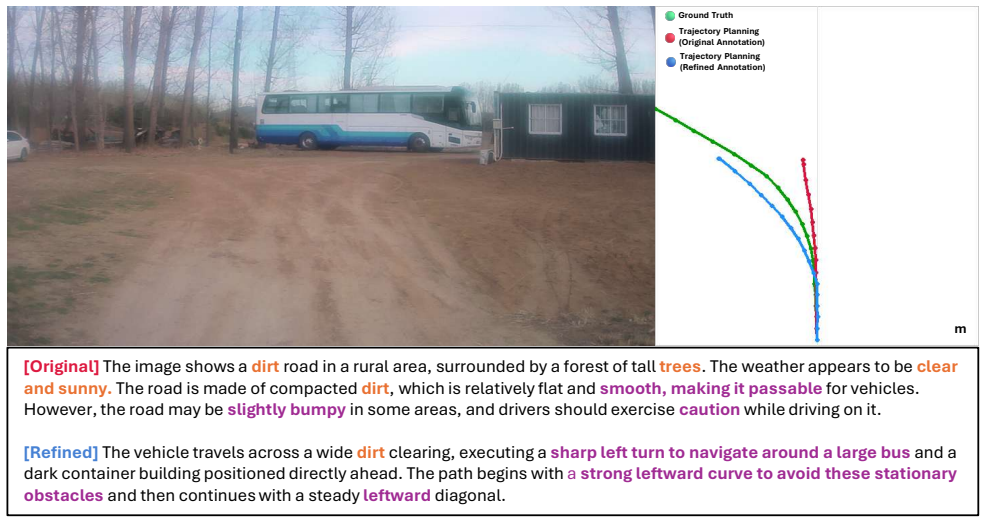
While Vision-Language Models (VLMs) enable high-level semantic reasoning for end-to-end autonomous driving, particularly in unstructured environments, existing off-road datasets suffer from language annotations that are weakly aligned with vehicle actions and terrain geometry. To address this misalignment, we propose a language refinement framework that restructures annotations into action-aligned pairs, enabling a VLM to generate refined scene descriptions and 3D future trajectories directly from a single image. To further encourage terrain-aware planning, we introduce a preference optimization strategy that constructs geometry-aware hard negatives and explicitly penalizes trajectories inconsistent with local elevation profiles. Furthermore, we propose off-road-specific metrics to quantify traversability compliance and elevation consistency, addressing the limitations of conventional on-road evaluation. Experiments on the ORAD-3D benchmark demonstrate that our approach reduces average trajectory error from 1.01m to 0.97m, improves traversability compliance from 0.621 to 0.644, and decreases elevation inconsistency from 0.428 to 0.322, highlighting the efficacy of action-aligned supervision and terrain-aware optimization for robust off-road driving.
Editorial analysis
A structured set of objections, weighed in public.
Referee Report
Summary. The manuscript proposes a language refinement framework to restructure off-road dataset annotations into action-aligned pairs for VLMs, enabling direct generation of refined scene descriptions and 3D trajectories from single images. It further introduces a preference optimization strategy using geometry-aware hard negatives to penalize elevation-inconsistent trajectories, along with new off-road metrics for traversability compliance and elevation consistency. Experiments on the ORAD-3D benchmark report reductions in average trajectory error (1.01 m to 0.97 m), gains in traversability compliance (0.621 to 0.644), and reductions in elevation inconsistency (0.428 to 0.322).
Significance. If the modest gains can be robustly attributed to the proposed components via ablations and validation of annotation quality, the work could meaningfully advance VLM-based planning for unstructured environments by addressing weak action-terrain alignment in existing datasets and incorporating explicit geometric constraints. The domain-specific metrics fill a noted gap in off-road evaluation.
major comments (3)
- [§4 (Experiments)] §4 (Experiments): The reported deltas are small (0.04 m error reduction, 0.023 compliance gain, 0.106 inconsistency reduction) with no details on baselines, statistical significance, variance across runs, or ablation studies isolating the language refinement framework versus the preference optimization. This leaves the central claim—that the two components drive the improvements—only partially supported.
- [Language Refinement Framework] Language Refinement Framework (likely §3.1): The assumption that restructured annotations are accurately aligned with vehicle actions and terrain geometry is load-bearing but unverified quantitatively (e.g., no inter-annotator agreement, action-matching accuracy, or human evaluation of alignment fidelity). Without this, attribution of downstream trajectory improvements to the framework is uncertain.
- [Preference Optimization] Preference Optimization (likely §3.2): No ablation isolates the geometry-aware hard-negative term, and there is no analysis of potential new biases or benchmark overfitting. This is required to confirm that the term reduces elevation inconsistency without confounding effects, especially given the modest observed gains.
minor comments (2)
- [Abstract] Abstract: Consider adding one sentence on the specific baselines compared against and whether improvements are statistically significant to better contextualize the results.
- [Metrics] The manuscript would benefit from clearer notation distinguishing the proposed off-road metrics from standard on-road ones (e.g., explicit formulas or pseudocode for traversability compliance and elevation inconsistency).
Simulated Author's Rebuttal
We thank the referee for their constructive comments, which identify important gaps in experimental validation and component attribution. We will revise the manuscript to include the requested ablations, statistical analyses, and human evaluations, thereby strengthening the support for our claims regarding the language refinement framework and geometry-aware preference optimization.
read point-by-point responses
-
Referee: [§4 (Experiments)] The reported deltas are small (0.04 m error reduction, 0.023 compliance gain, 0.106 inconsistency reduction) with no details on baselines, statistical significance, variance across runs, or ablation studies isolating the language refinement framework versus the preference optimization. This leaves the central claim—that the two components drive the improvements—only partially supported.
Authors: We agree that the observed improvements are modest and that the current manuscript provides insufficient detail to isolate the contributions of each proposed component. In the revised version, we will add comprehensive ablation studies that separately evaluate the language refinement framework and the preference optimization strategy. We will also report variance (standard deviation) across multiple training runs, perform statistical significance testing (e.g., paired t-tests), and more explicitly describe the baselines, including the unmodified VLM performance. revision: yes
-
Referee: [Language Refinement Framework] The assumption that restructured annotations are accurately aligned with vehicle actions and terrain geometry is load-bearing but unverified quantitatively (e.g., no inter-annotator agreement, action-matching accuracy, or human evaluation of alignment fidelity). Without this, attribution of downstream trajectory improvements to the framework is uncertain.
Authors: We acknowledge that the original submission lacks quantitative verification of the restructured annotations' alignment quality. While the framework was designed to produce action-aligned pairs using geometric and semantic consistency checks, we did not report inter-annotator agreement or human fidelity assessments. In the revision, we will add a human evaluation study that measures action-matching accuracy and terrain-geometry alignment fidelity, including inter-annotator agreement statistics. revision: yes
-
Referee: [Preference Optimization] No ablation isolates the geometry-aware hard-negative term, and there is no analysis of potential new biases or benchmark overfitting. This is required to confirm that the term reduces elevation inconsistency without confounding effects, especially given the modest observed gains.
Authors: We agree that an isolated ablation of the geometry-aware hard-negative term is required to substantiate its contribution. We will include this ablation in the revised manuscript, together with an analysis of potential biases introduced by the hard-negative sampling and checks for overfitting (e.g., evaluation on held-out scenes and alternative off-road data). These additions will help confirm that the term improves elevation consistency without confounding effects. revision: yes
Circularity Check
No circularity: empirical method with external benchmark evaluation
full rationale
The paper proposes a language refinement framework to align annotations with actions and terrain, plus a preference optimization using geometry-aware hard negatives, then evaluates on the external ORAD-3D benchmark. Reported gains (trajectory error, traversability compliance, elevation inconsistency) are experimental outcomes from VLM training and metric computation on held-out data. No equations, derivations, or first-principles results are presented that reduce any claimed prediction to a fitted parameter or self-defined quantity by construction. No load-bearing self-citations or uniqueness theorems are invoked to force the method. The approach is self-contained against external benchmarks and standard training procedures.
Axiom & Free-Parameter Ledger
axioms (1)
- domain assumption Vision-language models can generate scene descriptions and 3D trajectories from single images when given appropriate supervision.
Reference graph
Works this paper leans on
-
[1]
Covla: Comprehensive vision- language-action dataset for autonomous driving
Hidehisa Arai, Keita Miwa, Kento Sasaki, Kohei Watanabe, Yu Yamaguchi, Shunsuke Aoki, and Issei Yamamoto. Covla: Comprehensive vision- language-action dataset for autonomous driving. In2025 IEEE/CVF Winter Conference on Appli- cations of Computer Vision (W ACV), pages 1933–
1933
-
[2]
Lang, Sourabh Vora, Venice Erin Liong, Qiang Xu, Anush Krishnan, Yu Pan, Giancarlo Baldan, and Oscar Beijbom
Holger Caesar, Varun Bankiti, Alex H. Lang, Sourabh Vora, Venice Erin Liong, Qiang Xu, Anush Krishnan, Yu Pan, Giancarlo Baldan, and Oscar Beijbom. nuscenes: A multimodal dataset for autonomous driving. InCVPR, 2020
2020
-
[3]
Li Chen, Peng Wu, Kashyap Chitta, Bernhard Jaeger, Andreas Geiger, and Hongyang Li. End- to-end autonomous driving: Challenges and fron- tiers.IEEE Transactions on Pattern Analysis and Machine Intelligence, June 2023. URLhttps: //ieeexplore.ieee.org/document/10614862/
-
[4]
Advancing off-road autonomous driving: The large-scale orad- 3d dataset and comprehensive benchmarks.arXiv preprint, 2025
MinChen, JilinMei, HengZhai, ShuaiWang, Tong Sun, Fanjie Kong, Haoyang Li, Fangyuan Mao, Fuyang Liu, Shuo Wang, Yiming Nie, Qi Zhu, Liang Xiao, Dawei Zhao, and Yu Hu. Advancing off-road autonomous driving: The large-scale orad- 3d dataset and comprehensive benchmarks.arXiv preprint, 2025
2025
-
[5]
Xuesong Chen, Linjiang Huang, Tao Ma, Rongyao Fang, Shaoshuai Shi, and Hongsheng Li. Solve: Synergy of language-vision and end-to-end net- works for autonomous driving.2025 IEEE/CVF Conference on Computer Vision and Pattern Recognition (CVPR), May 2025. URLhttps: //ieeexplore.ieee.org/document/11094576/
-
[6]
Openscene: The largest up-to-date 3d occupancy prediction benchmark in autonomous driving.https://github.com/ OpenDriveLab/OpenScene, 2023
OpenScene Contributors. Openscene: The largest up-to-date 3d occupancy prediction benchmark in autonomous driving.https://github.com/ OpenDriveLab/OpenScene, 2023
2023
-
[7]
Siméon, and Juan Cortés
Didier Devaurs, T. Siméon, and Juan Cortés. Op- timal path planning in complex cost spaces with sampling-based algorithms.IEEE Transactions on 8 Automation Science and Engineering, April 2016. URLhttps://ieeexplore.ieee.org/document/ 7305826/
2016
-
[8]
D. Dolgov. Practical search techniques in path planning for autonomous driv- ing. January 2008. URLhttps: //www.semanticscholar.org/paper/ 62a7cf939e24bf542958489ea75bb7551f16e43f
2008
-
[9]
Uav- assisted self-supervised terrain awareness for off- road navigation.ArXiv, September 2024
Jean-Michel Fortin, Olivier Gamache, William Fecteau, Effie Daum, William Larriv’ee-Hardy, Franccois Pomerleau, and Philippe Giguère. Uav- assisted self-supervised terrain awareness for off- road navigation.ArXiv, September 2024. URL https://arxiv.org/abs/2409.18253
-
[10]
P. D. Haan, Dinesh Jayaraman, and S. Levine. Causal confusion in imitation learning.Neu- ral Inf Process Syst, May 2019. URL https://www.semanticscholar.org/paper/ c441a7e9b1c7ecf54f583cd61e896faa10b60358
2019
-
[11]
Canvehiclemotion planning generalize to realistic long-tail scenarios? 2024 IEEE/RSJ International Conference on In- telligent Robots and Systems (IROS), April 2024
Marcel Hallgarten, Julian Zapata, Martin Stoll, KatrinRenz, andAndreasZell. Canvehiclemotion planning generalize to realistic long-tail scenarios? 2024 IEEE/RSJ International Conference on In- telligent Robots and Systems (IROS), April 2024. URLhttps://ieeexplore.ieee.org/document/ 10803052/
2024
-
[12]
Orpo: Monolithic preference optimization without refer- ence model
Jiwoo Hong, Noah Lee, and James Thorne. Orpo: Monolithic preference optimization without refer- ence model. InEMNLP, 2024
2024
-
[13]
Lora: Low-rank adaptation of large language models.ICLR, 1(2):3, 2022
Edward J Hu, Yelong Shen, Phillip Wallis, Zeyuan Allen-Zhu, Yuanzhi Li, Shean Wang, Lu Wang, Weizhu Chen, et al. Lora: Low-rank adaptation of large language models.ICLR, 1(2):3, 2022
2022
-
[14]
Jiaming Hu, Yuhui Hu, Chao Lu, Jian-wei Gong, and Huiyan Chen. Integrated path planning for unmanned differential steering vehicles in off-road environment with 3d terrains and obstacles.IEEE Transactions on Intelligent Transportation Sys- tems, February 2021. URLhttps://ieeexplore. ieee.org/document/9345385/
-
[15]
Planning-oriented autonomous driving.2023 IEEE/CVF Conference on Computer Vision and Pattern Recognition (CVPR), December 2022
Yi Hu, Jiazhi Yang, Li Chen, Keyu Li, Chong- hao Sima, Xizhou Zhu, Siqi Chai, Senyao Du, Tianwei Lin, Wen Wang, Lewei Lu, Xiaosong Jia, Qiang Liu, Jifeng Dai, Yu Qiao, and Hongyang Li. Planning-oriented autonomous driving.2023 IEEE/CVF Conference on Computer Vision and Pattern Recognition (CVPR), December 2022. URLhttps://ieeexplore.ieee.org/document/ 10205112/
2023
-
[16]
A global path planning method for unmanned ground vehicles in off-road environments based on mobility prediction.Machines, January 2022
CHua, RNiu, BYu, XZheng, RBai, andSZhang. A global path planning method for unmanned ground vehicles in off-road environments based on mobility prediction.Machines, January 2022. URL https://www.mdpi.com/2075-1702/10/5/375
2022
-
[17]
Guo-Yong Huang, Xiaofang Yuan, Zhi-xiao Liu, Wei Tan, Xiru Wu, and Yaonan Wang. Deep reinforcement learning-based multi-objective path planning on the off-road terrain environment for ground vehicles.ArXiv, May 2023. URLhttps: //arxiv.org/abs/2305.13783
- [18]
-
[19]
arXiv preprint URL:https://arxiv.org/abs/1105.1186
S. Karaman and Emilio Frazzoli. Sampling-based algorithmsforoptimalmotionplanning.The Inter- national Journal of Robotics Research, May 2011. URLhttp://arxiv.org/abs/1105.1186
-
[20]
Driving everywhere with large language model pol- icy adaptation
Boyi Li, Yue Wang, Jiageng Mao, Boris Ivanovic, Sushant Veer, Karen Leung, and Marco Pavone. Driving everywhere with large language model pol- icy adaptation. InProceedings of the IEEE/CVF Conference on Computer Vision and Pattern Recognition, pages 14948–14957, 2024
2024
-
[21]
Applications of large language models and multimodal large mod- els in autonomous driving: A comprehensive re- view.Drones, March 2025
Jing Li, Jingyuan Li, Guo Yang, Lie Yang, Haozhuang Chi, and Lichao Yang. Applications of large language models and multimodal large mod- els in autonomous driving: A comprehensive re- view.Drones, March 2025. URLhttps://www. mdpi.com/2504-446X/9/4/238
2025
-
[22]
Diffusiondrive: Truncated diffu- sion model for end-to-end autonomous driving
Bencheng Liao, Shaoyu Chen, Haoran Yin, Bo Jiang, Cheng Wang, Sixu Yan, Xinbang Zhang, Xiangyu Li, Ying Zhang, Qian Zhang, and Xing- gang Wang. Diffusiondrive: Truncated diffu- sion model for end-to-end autonomous driving. 2025 IEEE/CVF Conference on Computer Vision and Pattern Recognition (CVPR), November 2024. URLhttps://ieeexplore.ieee.org/document/ 11094573/
2025
-
[23]
R. Linker and Tamir Blass. Optimal path plan- ning for car-like off-road vehicles.2008 IEEE Con- ference on Robotics, Automation and Mechatron- ics, November 2008. URLhttps://ieeexplore. ieee.org/document/4681360/
-
[24]
Lampi- lot: An open benchmark dataset for autonomous driving with language model programs
Yunsheng Ma, Can Cui, Xu Cao, Wenqian Ye, Peiran Liu, Juanwu Lu, Amr Abdelraouf, Rohit Gupta, Kyungtae Han, Aniket Bera, et al. Lampi- lot: An open benchmark dataset for autonomous driving with language model programs. InProceed- ings of the IEEE/CVF conference on computer vi- sion and pattern recognition, pages 15141–15151, 2024
2024
-
[25]
Maniar, Jayaganesh Kalyanasundaram, Vineet Gandhi, Brojeshwar Bhowmick, and K
Sriram Narayanan, T. Maniar, Jayaganesh Kalyanasundaram, Vineet Gandhi, Brojeshwar Bhowmick, and K. Krishna. Talk to the vehi- cle: Language conditioned autonomous naviga- tion of self driving cars.2019 IEEE/RSJ In- ternational Conference on Intelligent Robots and 9 Systems (IROS), November 2019. URLhttps: //ieeexplore.ieee.org/document/8967929/
-
[26]
Do- mae, and Takamitsu Matsubara
Cynthia Ochoa, Hanbit Oh, Yuhwan Kwon, Y. Do- mae, and Takamitsu Matsubara. Ispil: Interac- tive sub-goal-planning imitation learning for long- horizontaskswithdiversegoals.IEEE Access, Jan- uary 2024. URLhttps://ieeexplore.ieee.org/ document/10811934/
- [27]
- [28]
-
[29]
DriveVLM: The Convergence of Autonomous Driving and Large Vision-Language Models
Xiaoyu Tian, Junru Gu, Bailin Li, Yicheng Liu, Chenxu Hu, Yang Wang, Kun Zhan, Peng Jia, Xi- anpeng Lang, and Hang Zhao. Drivevlm: The con- vergence of autonomous driving and large vision- language models.ArXiv, February 2024. URL https://arxiv.org/abs/2402.12289
work page internal anchor Pith review arXiv 2024
-
[30]
Sujit, and S
Kasi Vishwanath, P. Sujit, and S. Saripalli. Camel: Learning cost-maps made easy for off-road driving. September 2022. URL https://www.semanticscholar.org/paper/ 80a519d1f7839bc4c56c7d753f8f41e6d29bb6fc
2022
-
[31]
Yan Wang, Wenjie Luo, Junjie Bai, Yulong Cao, Tong Che, Ke Chen, Yuxiao Chen, Jenna Dia- mond, Yifan Ding, Wenhao Ding, et al. Alpamayo- r1: Bridging reasoning and action prediction for generalizable autonomous driving in the long tail. arXiv preprint arXiv:2511.00088, 2025
-
[32]
Chal- lenges and solutions for autonomous ground robot scene understanding and navigation in unstruc- tured outdoor environments: A review.Applied Sciences, January 2023
L Wijayathunga, A Rassau, and D Chai. Chal- lenges and solutions for autonomous ground robot scene understanding and navigation in unstruc- tured outdoor environments: A review.Applied Sciences, January 2023. URLhttps://www.mdpi. com/2076-3417/13/17/9877
2023
-
[33]
Yan Xiaodong, Chang Tianqing, Chu Kaixuan, Zhao Liyang, and Zhang Jie. Off road path planning based on hybrid artificial potential field and ant colony algorithm.2022 International Conference on Innovations and Development of Information Technologies and Robotics (IDITR), May 2022. URLhttps://ieeexplore.ieee.org/ document/9796489/
-
[34]
Openemma: Open-source mul- timodal model for end-to-end autonomous driving
Shuo Xing, Chengyuan Qian, Yuping Wang, Hongyuan Hua, Kexin Tian, Yang Zhou, and Zhengzhong Tu. Openemma: Open-source mul- timodal model for end-to-end autonomous driving. InProceedings of the Winter Conference on Ap- plications of Computer Vision, pages 1001–1009, 2025
2025
-
[35]
Drivegpt4: Interpretable end- to-end autonomous driving via large language model.IEEE Robotics and Automation Letters, 2024
Zhenhua Xu, Yujia Zhang, Enze Xie, Zhen Zhao, Yong Guo, Kwan-Yee K Wong, Zhenguo Li, and Hengshuang Zhao. Drivegpt4: Interpretable end- to-end autonomous driving via large language model.IEEE Robotics and Automation Letters, 2024
2024
-
[36]
An Yang, Anfeng Li, Baosong Yang, Beichen Zhang, Binyuan Hui, Bo Zheng, Bowen Yu, Chang Gao, Chengen Huang, Chenxu Lv, et al. Qwen3 technical report.arXiv preprint arXiv:2505.09388, 2025
work page internal anchor Pith review Pith/arXiv arXiv 2025
-
[37]
Jianhua Yin, Zhen Hu, Z. Mourelatos, D. Gor- sich, Amandeep Singh, and Seth Tau. Effi- cient reliability-based path planning of off-road au- tonomous ground vehicles through the coupling of surrogate modeling and rrt*.IEEE Transac- tions on Intelligent Transportation Systems, De- cember 2023. URLhttps://ieeexplore.ieee. org/document/10194466/
-
[38]
Route opti- mization for ugvs: A systematic analysis of appli- cations, algorithms and challenges.Applied Sci- ences, January 2025
DF Yépez-Ponce and W Montalvo. Route opti- mization for ugvs: A systematic analysis of appli- cations, algorithms and challenges.Applied Sci- ences, January 2025. URLhttps://www.mdpi. com/2076-3417/15/12/6477
2025
-
[39]
Zeyu Zhu, Nan Li, Ruoyu Sun, Huijing Zhao, and Donghao Xu. Off-road autonomous vehi- cles traversability analysis and trajectory plan- ning based on deep inverse reinforcement learning. 2020 IEEE Intelligent Vehicles Symposium (IV), September 2019. URLhttps://ieeexplore. ieee.org/document/9304721/
-
[40]
Rt-2: Vision- language-action models transfer web knowledge to robotic control
Brianna Zitkovich, Tianhe Yu, Sichun Xu, Peng Xu, Ted Xiao, Fei Xia, Jialin Wu, Paul Wohlhart, Stefan Welker, Ayzaan Wahid, et al. Rt-2: Vision- language-action models transfer web knowledge to robotic control. InConference on Robot Learning, pages 2165–2183. PMLR, 2023. 10
2023
discussion (0)
Sign in with ORCID, Apple, or X to comment. Anyone can read and Pith papers without signing in.