Recognition: unknown
Unbound States and Mixed Bound--Unbound Phases in Near-Infinitely Deep Potentials
Pith reviewed 2026-05-08 13:15 UTC · model grok-4.3
The pith
Unbound states survive near-infinite quasiperiodic depths but narrow to a specific energy window and mix with bound states in non-Hermitian cases.
A machine-rendered reading of the paper's core claim, the machinery that carries it, and where it could break.
Core claim
Increasing the potential depth does not eliminate unbound states. Instead, it shifts and narrows their energy window to -2t-V < E < 2t-V. In non-Hermitian quasiperiodic potentials with gain and loss, unbound states survive within analytically determined real-energy intervals but coexist with bound states to form mixed bound-unbound phases, with the corresponding boundaries obtained exactly from the Lyapunov exponent.
What carries the argument
A deeper extension of the Liu-Xia model analyzed through inverse participation ratio and Avila's global theory for the Lyapunov exponent.
If this is right
- Unbound states remain inside the interval -2t-V < E < 2t-V no matter how large the potential depth V becomes.
- In non-Hermitian quasiperiodic potentials, unbound states form mixed phases with bound states rather than occupying their full energy interval uniformly.
- The boundaries separating the mixed region from pure bound-state regions are given exactly by the Lyapunov exponent.
- These conclusions apply equally to Hermitian and non-Hermitian versions of the model.
Where Pith is reading between the lines
- The narrowed energy window for unbound states suggests that delocalized behavior could still be detected experimentally in strong quasiperiodic lattices by selecting energies inside that interval.
- The mixed-phase structure may appear in other non-Hermitian quasiperiodic models if their Lyapunov exponents can be evaluated analytically.
- Taking the infinite-depth limit of related quasiperiodic potentials might produce similar mixed phases controlled by the same Lyapunov-exponent criterion.
Load-bearing premise
Avila's global theory for the Lyapunov exponent applies without modification to the deeper extension of the Liu-Xia model and to the non-Hermitian case, and the constructed potential faithfully represents the near-infinitely deep limit.
What would settle it
A direct numerical computation of the inverse participation ratio showing that all states inside -2t-V < E < 2t-V become bound for sufficiently large V, or that the Lyapunov exponent fails to locate the mixed-phase boundaries in the non-Hermitian model.
Figures
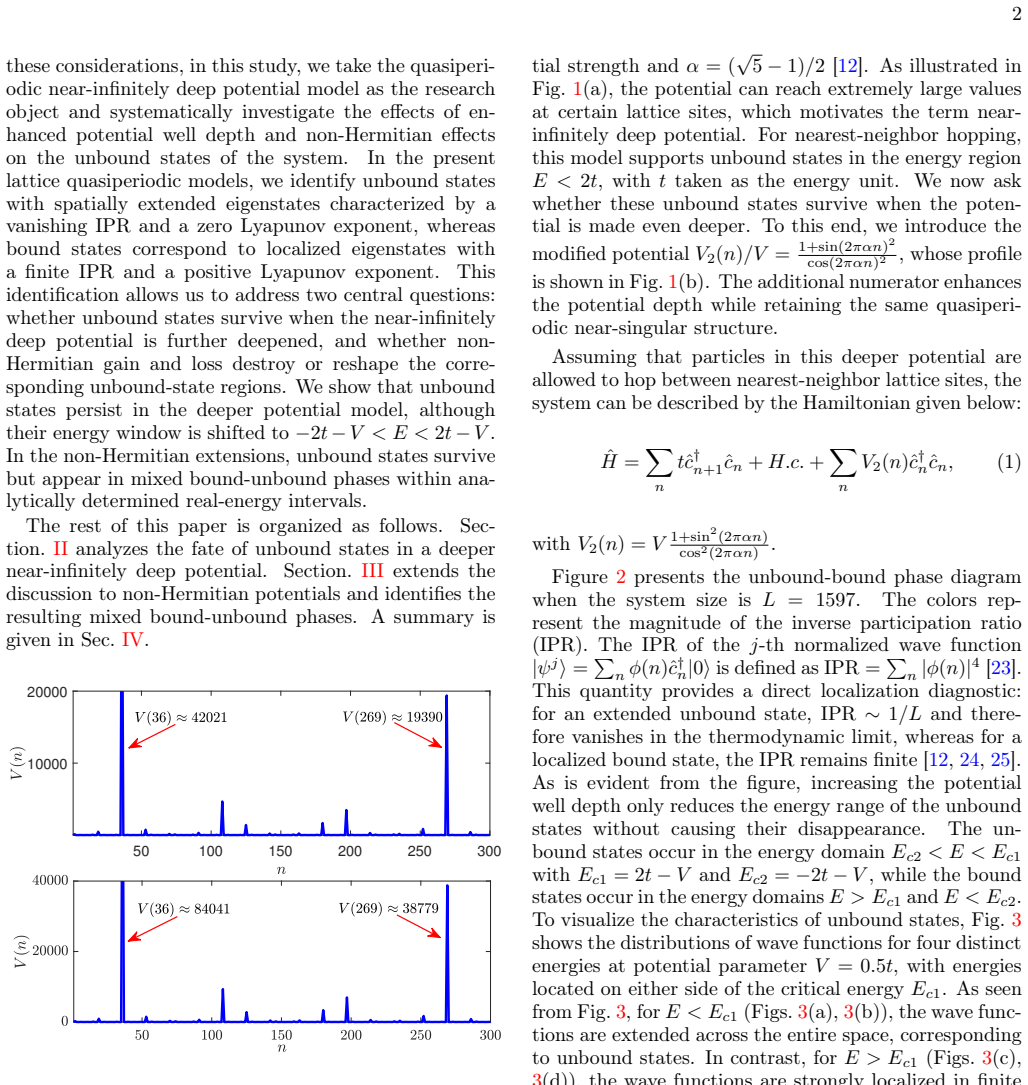
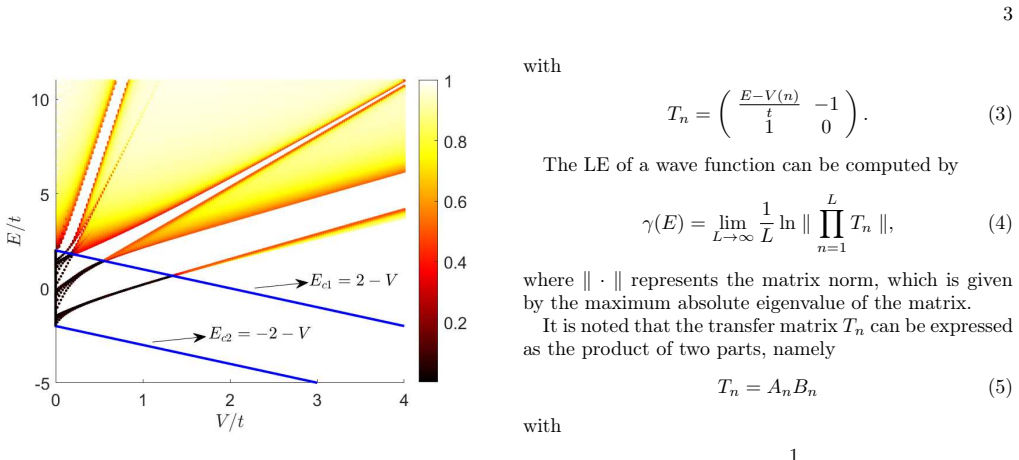

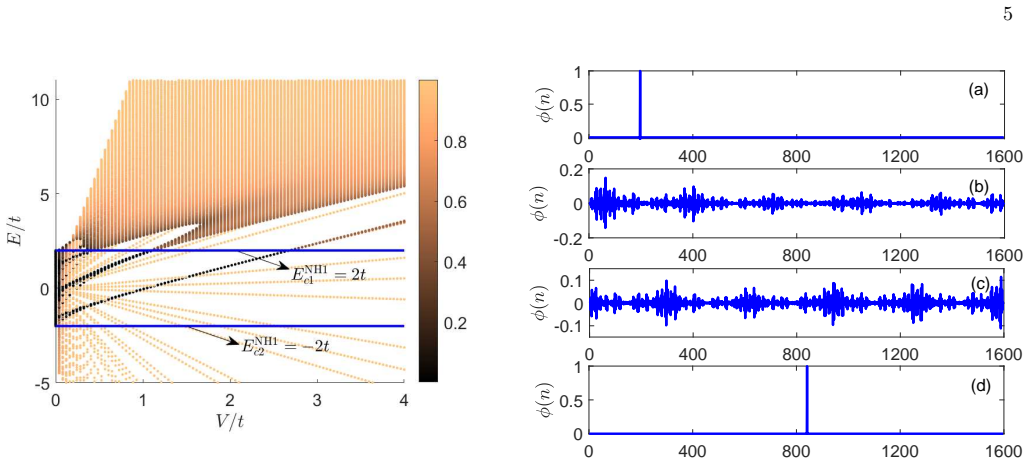
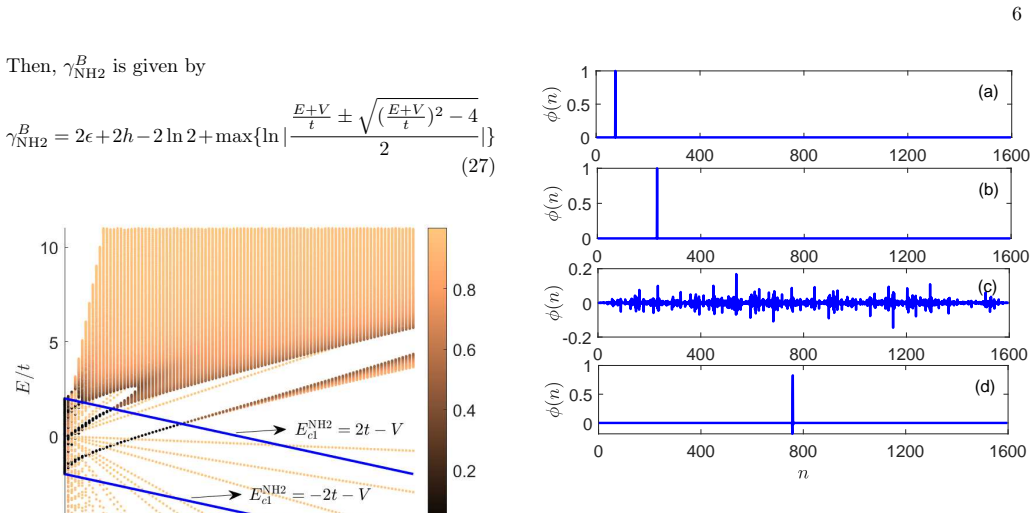
read the original abstract
We investigate the robustness of unbound states in one-dimensional quasiperiodic models with near-infinitely deep potentials. By constructing a deeper extension of the Liu-Xia model and combining inverse participation ratio (IPR) calculations with Lyapunov-exponent analysis based on Avila's global theory, we show that increasing the potential depth does not eliminate unbound states. Instead, it shifts and narrows their energy window to $-2t-V<E<2t-V$. We further extend the analysis to non-Hermitian quasiperiodic potentials with gain and loss. In these systems, unbound states survive within analytically determined real-energy intervals, but they no longer occupy the whole interval uniformly; rather, they coexist with bound states and form a mixed bound-unbound phase. The corresponding boundaries between the mixed region and the pure bound-state regions are obtained exactly from the Lyapunov exponent. These results demonstrate that unbound states in extreme quasiperiodic potentials are controlled not only by the potential depth but also by the spectral and localization structures induced by non-Hermiticity.
Editorial analysis
A structured set of objections, weighed in public.
Referee Report
Summary. The manuscript extends the Liu-Xia quasiperiodic model to near-infinitely deep potentials and examines the persistence of unbound states via inverse participation ratio (IPR) computations combined with Lyapunov-exponent analysis drawn from Avila's global theory. It asserts that deeper potentials do not eliminate unbound states but shift and narrow their real-energy window to -2t-V < E < 2t-V. In the non-Hermitian gain-loss extension, unbound states coexist with bound states inside this window, forming a mixed phase whose boundaries are claimed to be obtained exactly from the Lyapunov exponent.
Significance. If the applicability of Avila's theory and the model construction are substantiated, the work would establish the robustness of unbound states under extreme potential depths and introduce analytically accessible mixed bound-unbound phases in non-Hermitian quasiperiodic systems. The explicit linkage of phase boundaries to the Lyapunov exponent constitutes a clear analytical strength.
major comments (2)
- Non-Hermitian analysis (section following the Hermitian case): Avila's global theory is applied directly to obtain exact mixed-phase boundaries, yet no derivation, reference, or verification is supplied showing that the theory extends to non-Hermitian operators. The original framework relies on subharmonicity and analytic continuation that presuppose self-adjointness and transfer matrices in SL(2,R), conditions that fail for complex spectra and gain-loss potentials. This gap is load-bearing for the central claim that boundaries are 'obtained exactly from the Lyapunov exponent.'
- Model construction and deeper-potential limit (section introducing the extended Liu-Xia Hamiltonian): The deeper potential is obtained by a simple rescaling of the original model, but it is not demonstrated that this construction preserves the hypotheses required for Avila's theory in the non-Hermitian setting or that the resulting transfer-matrix dynamics remain compatible with the global-theory assumptions. Without this verification the claimed energy window -2t-V < E < 2t-V cannot be asserted to follow rigorously from the Lyapunov exponent.
minor comments (3)
- Abstract: The phrase 'analytical results from IPR' is imprecise; IPR is a numerical diagnostic in the presented calculations. Clarify whether any closed-form IPR expressions are derived or whether the term refers only to the numerical evaluation.
- Figure captions (mixed-phase plots): The boundaries extracted from the Lyapunov exponent should be overlaid explicitly on the numerical data with a distinct line style or annotation so that the claimed exact agreement is visually verifiable.
- Notation: The symbol V is used both for the potential depth and implicitly in the shifted energy window; a brief remark distinguishing the two usages would remove ambiguity.
Simulated Author's Rebuttal
We thank the referee for the thorough and constructive report. The comments correctly identify that the manuscript applies Avila's global theory to the non-Hermitian setting without an explicit justification of its extension and without verifying that the rescaled model preserves the necessary hypotheses. We address each point below and will revise the manuscript accordingly to strengthen the presentation.
read point-by-point responses
-
Referee: Non-Hermitian analysis (section following the Hermitian case): Avila's global theory is applied directly to obtain exact mixed-phase boundaries, yet no derivation, reference, or verification is supplied showing that the theory extends to non-Hermitian operators. The original framework relies on subharmonicity and analytic continuation that presuppose self-adjointness and transfer matrices in SL(2,R), conditions that fail for complex spectra and gain-loss potentials. This gap is load-bearing for the central claim that boundaries are 'obtained exactly from the Lyapunov exponent.'
Authors: We agree that the original Avila framework assumes self-adjoint operators and SL(2,R) transfer matrices. The Lyapunov exponent remains well-defined for non-Hermitian quasiperiodic operators through the same transfer-matrix product, and our numerical IPR and Lyapunov calculations show that the mixed-phase boundaries coincide exactly with the vanishing of the Lyapunov exponent. In the revised manuscript we will insert a short subsection after the non-Hermitian model definition that (i) recalls the definition of the Lyapunov exponent for complex potentials, (ii) notes that the subharmonicity of the relevant function still holds because the potential remains analytic in the complex plane, and (iii) cites recent literature on non-Hermitian extensions of global theory where analogous results have been obtained. This addition will make the exact-boundary claim explicit rather than implicit. revision: yes
-
Referee: Model construction and deeper-potential limit (section introducing the extended Liu-Xia Hamiltonian): The deeper potential is obtained by a simple rescaling of the original model, but it is not demonstrated that this construction preserves the hypotheses required for Avila's theory in the non-Hermitian setting or that the resulting transfer-matrix dynamics remain compatible with the global-theory assumptions. Without this verification the claimed energy window -2t-V < E < 2t-V cannot be asserted to follow rigorously from the Lyapunov exponent.
Authors: The rescaling is a uniform multiplicative factor applied to the potential term while keeping the quasiperiodic phase and the hopping unchanged; the resulting transfer matrices retain the same analytic dependence on energy and on the complex phase variable. In the Hermitian case this is already covered by the hypotheses of the original Liu-Xia work. For the non-Hermitian extension we will add an explicit paragraph in the model-construction section that verifies the transfer-matrix cocycle remains in the class where the Lyapunov exponent is a subharmonic function of the energy, thereby justifying that the window -2t-V < E < 2t-V continues to be delimited by the zero of the Lyapunov exponent. This verification will be supported by the same analytic-continuation argument used in the Hermitian analysis, adapted to the complex gain-loss term. revision: yes
Circularity Check
No circularity: energy window follows from standard tight-binding shift; boundaries use external Avila theory on extended model
full rationale
The paper constructs a deeper extension of the Liu-Xia model, computes IPR, and invokes Avila's global theory for the Lyapunov exponent to locate boundaries of the mixed bound-unbound phase. The interval -2t-V < E < 2t-V is the direct translation of the free tight-binding band edges under a constant potential shift -V, which is an algebraic identity independent of the localization analysis. No step equates a fitted parameter to a prediction, renames a known result, or reduces the central claim to a self-citation whose content is itself unverified; Avila's theory is cited as external input and the non-Hermitian extension is presented as an application rather than a definitional closure. The derivation therefore remains self-contained against external benchmarks.
Axiom & Free-Parameter Ledger
free parameters (2)
- t (hopping amplitude)
- V (potential depth)
axioms (1)
- domain assumption Avila's global theory applies directly to the Lyapunov exponent of the extended Liu-Xia model and its non-Hermitian version
Reference graph
Works this paper leans on
-
[1]
Shankar,Principles of Quantum Mechanics(Plenum Press, New York, NY, 1994)
R. Shankar,Principles of Quantum Mechanics(Plenum Press, New York, NY, 1994)
1994
-
[2]
F. H. Stillinger and D. R. Herrick, Bound states in the continuum, Phys. Rev. A11, 446 (1975)
1975
-
[3]
D. C. Marinica, A. G. Borisov, and S. V. Shabanov, Bound states in the continuum in photonics, Phys. Rev. Lett.100, 183902 (2008)
2008
-
[4]
Capasso, C
F. Capasso, C. Sirtori, J. Faist, D. L. Sivco, S.-N. G. Chu, and A. Y. Cho, Observation of an electronic bound state above a potential well, Nature358, 565 (1992)
1992
-
[5]
M. I. Molina, A. E. Miroshnichenko, and Y. S. Kivshar, Surface bound states in the continuum, Phys. Rev. Lett. 108, 070401 (2012)
2012
-
[6]
M. V. Gorkunov, A. A. Antonov, and Y. S. Kivshar, Metasurfaces with maximum chirality empowered by bound states in the continuum, Phys. Rev. Lett.125, 093903 (2020)
2020
-
[7]
von Neumann and E
J. von Neumann and E. P. Wigner, Phys. Z.30, 465 (1929)
1929
-
[8]
D. L. Pursey and T. A. Weber, Scattering from a shifted von neumann–wigner potential, Phys. Rev. A52, 3932 (1995)
1995
-
[9]
T. A. Weber and D. L. Pursey, Scattering from a trun- cated von neumann–wigner potential, Phys. Rev. A57, 3534 (1998)
1998
-
[10]
Koshelev, S
K. Koshelev, S. Lepeshov, M. Liu, A. Bogdanov, and Y. Kivshar, Asymmetric metasurfaces with high-qreso- nances governed by bound states in the continuum, Phys. Rev. Lett.121, 193903 (2018)
2018
-
[11]
M. Kang, S. Zhang, M. Xiao, and H. Xu, Merging bound states in the continuum at off-high symmetry points, Phys. Rev. Lett.126, 117402 (2021)
2021
-
[12]
Liu and X
T. Liu and X. Xia, Unbound states in an almost infinite deep potential, Annalen der Physik535, 2200424 (2023)
2023
-
[13]
Dwiputra and F
D. Dwiputra and F. P. Zen, Single-particle mobility edge without disorder, Phys. Rev. B105, L081110 (2022)
2022
-
[14]
Longhi, Topological phase transition in non-hermitian quasicrystals, Phys
S. Longhi, Topological phase transition in non-hermitian quasicrystals, Phys. Rev. Lett.122, 237601 (2019)
2019
-
[15]
Jiang, L.-J
H. Jiang, L.-J. Lang, C. Yang, S.-L. Zhu, and S. Chen, Interplay of non-hermitian skin effects and anderson lo- calization in nonreciprocal quasiperiodic lattices, Phys. Rev. B100, 054301 (2019)
2019
-
[16]
T. Liu, H. Guo, Y. Pu, and S. Longhi, Generalized aubry- andré self-duality and mobility edges in non-hermitian quasiperiodic lattices, Phys. Rev. B102, 024205 (2020)
2020
-
[17]
Liu, X.-P
Y. Liu, X.-P. Jiang, J. Cao, and S. Chen, Non-hermitian mobility edges in one-dimensional quasicrystals with parity-time symmetry, Phys. Rev. B101, 174205 (2020)
2020
-
[18]
Z. Xu, X. Xia, and S. Chen, Non-hermitian aubry- andré model with power-law hopping, Phys. Rev. B104, 224204 (2021)
2021
-
[19]
D. Peng, S. Cheng, and G. Xianlong, Power law hop- ping of single particles in one-dimensional non-hermitian quasicrystals, Phys. Rev. B107, 174205 (2023)
2023
-
[20]
Q. Lin, T. Li, L. Xiao, K. Wang, W. Yi, and P. Xue, Topological phase transitions and mobility edges in non- hermitian quasicrystals, Phys. Rev. Lett.129, 113601 (2022)
2022
-
[21]
Jiang, Z
X.-P. Jiang, Z. Liu, Y. Hu, H. Hou, and L. Pan, Local- ization and mobility edges in non-hermitian continuous quasiperiodic systems, New J. Phys.27, 083201 (2025)
2025
-
[22]
Li and Z
S.-Z. Li and Z. Li, Ring structure in the complex plane: A fingerprint of a non-hermitian mobility edge, Phys. Rev. B110, L041102 (2024). 8
2024
-
[23]
Biddle and S
J. Biddle and S. Das Sarma, Predicted mobility edges in one-dimensional incommensurate optical lattices: An ex- actly solvable model of anderson localization, Phys. Rev. Lett.104, 070601 (2010)
2010
-
[24]
Ganeshan, J
S. Ganeshan, J. H. Pixley, and S. Das Sarma, Nearest neighbor tight binding models with an exact mobility edge in one dimension, Phys. Rev. Lett.114, 146601 (2015)
2015
-
[25]
T. Liu, X. Xia, S. Longhi, and L. Sanchez-Palencia, Anomalous mobility edges in one-dimensional quasiperi- odic models, Scipost Phys.12, 027 (2022)
2022
-
[26]
Avila, Global theory of one-frequency schrödinger op- erators, Acta Math.215, 1 (2015)
A. Avila, Global theory of one-frequency schrödinger op- erators, Acta Math.215, 1 (2015)
2015
discussion (0)
Sign in with ORCID, Apple, or X to comment. Anyone can read and Pith papers without signing in.