Recognition: unknown
Disentangling new physics with quantum entanglement in tbar{t} production at future lepton colliders
Pith reviewed 2026-05-09 22:00 UTC · model grok-4.3
The pith
Quantum entanglement in top-antitop pairs at future lepton colliders can reveal new physics from scalars, Z' bosons, and extra dimensions.
A machine-rendered reading of the paper's core claim, the machinery that carries it, and where it could break.
Core claim
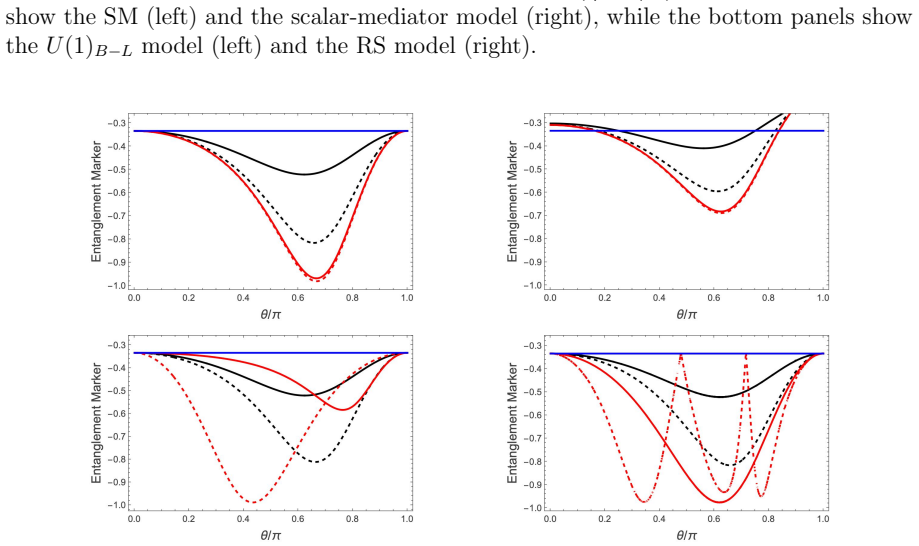
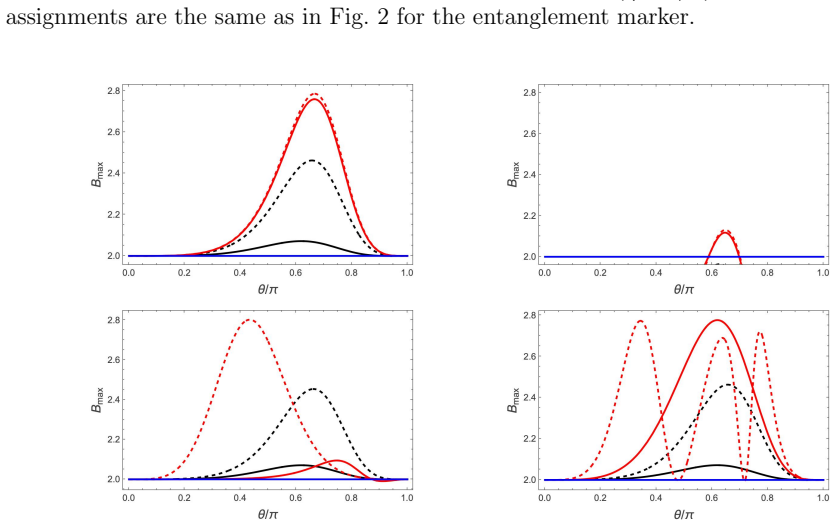
In the Standard Model, top-antitop production at lepton colliders proceeds through s-channel gamma and Z exchange and exhibits a non-trivial amount of entanglement. When a neutral scalar mediator is added, the entanglement marker, concurrence, and maximal CHSH parameter are typically reduced relative to the Standard Model. In the minimal U(1)_{B-L} model and in Randall-Sundrum scenarios with massive Kaluza-Klein gravitons, sizable deviations appear for phenomenologically viable values of the new parameters. The authors therefore conclude that quantum-information observables can act as sensitive probes of new neutral interactions and extra-dimensional dynamics.
What carries the argument
The spin-density-matrix observables of the top-antitop system, quantified by the entanglement marker, concurrence, and the maximal Clauser-Horne-Shimony-Holt parameter, which are altered by additional s-channel contributions from new particles.
If this is right
- Entanglement is reduced relative to the Standard Model expectation in the scalar-mediator scenario.
- Sizable deviations appear in the U(1)_{B-L} and Randall-Sundrum cases for relevant parameter space.
- The observables depend on center-of-mass energy, scattering angle, and model parameters and can be evaluated at future lepton colliders.
- Quantum-information quantities therefore complement traditional searches for new resonances.
Where Pith is reading between the lines
- Precise entanglement measurements could help distinguish which new-physics scenario is realized if a deviation is observed.
- The same spin-correlation technique might be applied to other heavy-fermion pairs produced at colliders.
- If the method works, it adds a quantum-information layer to beyond-Standard-Model searches that does not rely on resonance peaks.
Load-bearing premise
That the computed changes in entanglement and Bell parameters stay distinguishable from Standard Model backgrounds and from experimental uncertainties at the energies and luminosities of future lepton colliders.
What would settle it
A precision measurement of the concurrence or CHSH parameter in top-antitop events at the ILC that agrees with the Standard Model prediction within expected errors, even in the parameter regions where the new-physics models predict large deviations.
Figures


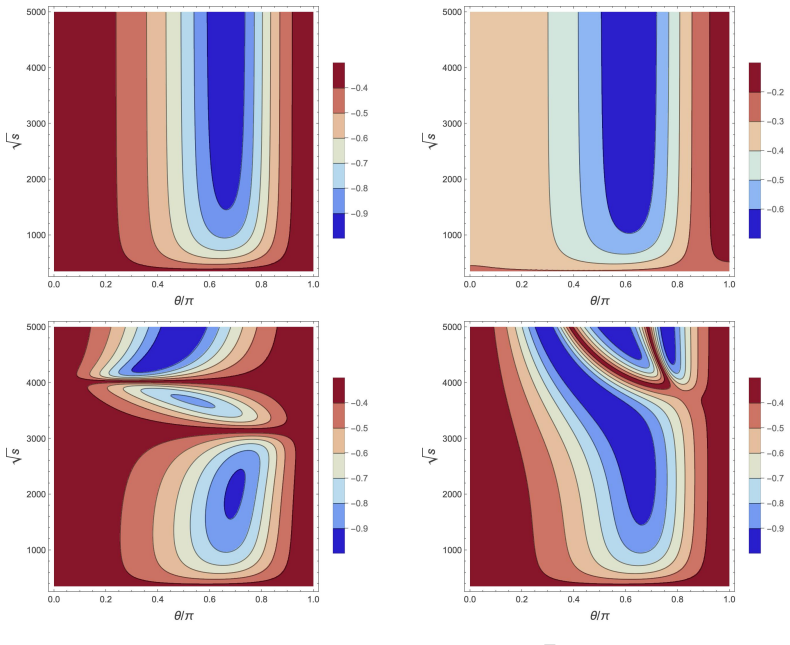


read the original abstract
We investigate quantum entanglement and Bell-inequality violation in top-antitop pair production at future lepton colliders such as the International Linear Collider (ILC) and multi-TeV muon colliders. Within the Standard Model (SM), the process proceeds through $s$-channel $\gamma$ and $Z$ exchange and exhibits characteristic spin-correlation patterns that encode a non-trivial amount of entanglement. We then examine how these features are modified in several well-motivated extensions of the SM:(i) a neutral scalar mediator that couples to charged leptons and top quarks via Yukawa interactions and contributes as an additional $s$-channel exchange; (ii) the minimal gauged $U(1)_{B-L}$ model, which introduces a new neutral gauge boson $Z'$ coupling vectorially to SM fermions; and (iii) a Randall-Sundrum scenario, in which the exchange of massive Kaluza-Klein gravitons arising from a warped extra dimension induces additional spin-dependent interactions. For all cases, we evaluate quantum-information observables, including the entanglement marker, the concurrence, and the maximal Clauser-Horne-Shimony-Holt parameter, and study their dependence on the center-of-mass energy, scattering angle, and model parameters. We find that, relative to the SM expectation, the entanglement is typically reduced in the scalar-mediator scenario, while sizable deviations can arise in the $U(1)_{B-L}$ and Randall-Sundrum cases for phenomenologically relevant regions of parameter space. These results demonstrate the potential of quantum-information observables as sensitive probes of new neutral interactions and extra-dimensional dynamics in future lepton colliders.
Editorial analysis
A structured set of objections, weighed in public.
Referee Report
Summary. The paper investigates quantum entanglement and Bell-inequality violation in top-antitop pair production at future lepton colliders (ILC and multi-TeV muon colliders). Within the SM, the process proceeds via s-channel γ/Z exchange; the authors then compute the entanglement marker, concurrence, and maximal CHSH parameter in three BSM extensions—a neutral scalar mediator with Yukawa couplings, the minimal U(1)_{B-L} model with a Z' boson, and a Randall-Sundrum scenario with Kaluza-Klein gravitons—and map their dependence on center-of-mass energy, scattering angle, and model parameters. They report that entanglement is typically reduced relative to the SM in the scalar case while sizable deviations appear in the U(1)_{B-L} and RS cases for phenomenologically relevant parameter regions, arguing that these quantum-information observables can serve as sensitive probes of new neutral interactions and extra-dimensional dynamics.
Significance. If the reported deviations survive experimental effects, the work demonstrates a concrete application of quantum-information observables to distinguish BSM scenarios at lepton colliders, complementing conventional cross-section and spin-correlation analyses. The explicit evaluation across three distinct model classes and the focus on collider-relevant energies constitute a useful contribution to the growing literature on quantum correlations in high-energy processes.
major comments (1)
- The central phenomenological claim—that the computed shifts in concurrence, entanglement marker, and CHSH remain 'sizable' and 'distinguishable' at ILC/muon-collider luminosities—rests on parton-level spin-density-matrix calculations. No full simulation chain (e.g., including top decays, acceptance cuts, combinatorial backgrounds, or detector smearing) or quantitative estimate of dilution factors is presented, which directly undermines the assertion that these observables constitute practical probes.
minor comments (2)
- The dependence of the quantum observables on the scattering angle is discussed but would benefit from explicit plots or tables showing the angular regions where deviations are maximal for each BSM scenario.
- A brief comparison of the computational method (helicity amplitudes or density-matrix formalism) with existing SM spin-correlation literature would help readers assess the novelty of the SM baseline.
Simulated Author's Rebuttal
We thank the referee for the positive summary and significance assessment of our manuscript. We address the single major comment below.
read point-by-point responses
-
Referee: The central phenomenological claim—that the computed shifts in concurrence, entanglement marker, and CHSH remain 'sizable' and 'distinguishable' at ILC/muon-collider luminosities—rests on parton-level spin-density-matrix calculations. No full simulation chain (e.g., including top decays, acceptance cuts, combinatorial backgrounds, or detector smearing) or quantitative estimate of dilution factors is presented, which directly undermines the assertion that these observables constitute practical probes.
Authors: We agree that the calculations are performed at the parton level and that a full experimental simulation chain is absent. The manuscript's goal is to isolate the theoretical impact of new physics on the quantum-information observables via the spin-density matrix, which is a standard first step for such studies. The abstract and conclusions frame the results as demonstrating the 'potential' of these observables rather than claiming immediate experimental readiness. In the revised manuscript we will add an explicit paragraph in the conclusions acknowledging that top decays, acceptance cuts, combinatorial backgrounds, and detector smearing will introduce dilution, and that quantitative dilution factors require a dedicated Monte Carlo study beyond the present scope. At the same time, the deviations we obtain in the U(1)_{B-L} and Randall-Sundrum scenarios reach 20-50% relative to the SM in phenomenologically allowed parameter regions; such magnitudes suggest that the effects could survive moderate dilution and therefore motivate the experimental work the referee correctly identifies as necessary. revision: partial
Circularity Check
No circularity in the computation of entanglement observables from production amplitudes
full rationale
The paper derives the quantum-information observables (entanglement marker, concurrence, CHSH parameter) by first computing the spin density matrix from the scattering amplitudes in the SM and the three BSM scenarios, then applying standard definitions of these measures to the resulting density matrix. This chain is self-contained and independent: the amplitudes follow from the Lagrangian terms of each model, and the entanglement quantities are fixed functions of the density matrix elements. No parameter is fitted to the target observables and then re-predicted, no self-citation provides a uniqueness theorem that forces the result, and no ansatz is smuggled in. The calculations are direct evaluations at parton level, making the derivation non-circular by construction.
Axiom & Free-Parameter Ledger
free parameters (3)
- scalar mediator mass and Yukawa couplings
- Z' mass and vector couplings
- Kaluza-Klein graviton masses and couplings
axioms (2)
- standard math Validity of perturbative quantum field theory calculations for the listed processes
- domain assumption Standard Model particle content and electroweak interactions as baseline
Reference graph
Works this paper leans on
-
[1]
J. S. Bell, Physics Physique Fizika1(1964), 195-200 doi:10.1103/PhysicsPhysiqueFizika.1.195
-
[2]
A. Aspect, P. Grangier and G. Roger, Phys. Rev. Lett.49(1982), 91-97 doi:10.1103/PhysRevLett.49.91
-
[3]
I. Bloch, J. Dalibard and S. Nascimb` ene, Nature Phys.8(2012), 267-276 doi:10.1038/nphys2259
-
[4]
G. L. Kane, G. A. Ladinsky and C. P. Yuan, Phys. Rev. D45(1992), 124-141 doi:10.1103/PhysRevD.45.124
-
[5]
W. Bernreuther and A. Brandenburg, Phys. Rev. D49(1994), 4481-4492 doi:10.1103/PhysRevD.49.4481 [arXiv:hep-ph/9312210 [hep-ph]]
-
[6]
S. J. Parke and Y. Shadmi, Phys. Lett. B387(1996), 199-206 doi:10.1016/0370- 2693(96)00998-7 [arXiv:hep-ph/9606419 [hep-ph]]. 20
-
[7]
W. Bernreuther, M. Flesch and P. Haberl, Phys. Rev. D58(1998), 114031 doi:10.1103/PhysRevD.58.114031 [arXiv:hep-ph/9709284 [hep-ph]]
-
[8]
W. Bernreuther, A. Brandenburg, Z. G. Si and P. Uwer, Nucl. Phys. B690(2004), 81-137 doi:10.1016/j.nuclphysb.2004.04.019 [arXiv:hep-ph/0403035 [hep-ph]]
-
[9]
P. Uwer, Phys. Lett. B609(2005), 271-276 doi:10.1016/j.physletb.2005.01.005 [arXiv:hep-ph/0412097 [hep-ph]]
-
[10]
M. Baumgart and B. Tweedie, JHEP03(2013), 117 doi:10.1007/JHEP03(2013)117 [arXiv:1212.4888 [hep-ph]]
-
[11]
W. Bernreuther, D. Heisler and Z. G. Si, JHEP12(2015), 026 doi:10.1007/JHEP12(2015)026 [arXiv:1508.05271 [hep-ph]]
-
[12]
T. Aaltonenet al.[CDF], Phys. Rev. D83(2011), 031104 doi:10.1103/PhysRevD.83.031104 [arXiv:1012.3093 [hep-ex]]
-
[13]
V. M. Abazovet al.[D0], Phys. Rev. Lett.107(2011), 032001 doi:10.1103/PhysRevLett.107.032001 [arXiv:1104.5194 [hep-ex]]
-
[14]
V. M. Abazovet al.[D0], Phys. Lett. B757(2016), 199-206 doi:10.1016/j.physletb.2016.03.053 [arXiv:1512.08818 [hep-ex]]
-
[15]
G. Aadet al.[ATLAS], Phys. Rev. Lett.108(2012), 212001 doi:10.1103/PhysRevLett.108.212001 [arXiv:1203.4081 [hep-ex]]
-
[16]
S. Chatrchyanet al.[CMS], Phys. Rev. Lett.112(2014) no.18, 182001 doi:10.1103/PhysRevLett.112.182001 [arXiv:1311.3924 [hep-ex]]
-
[17]
G. Aadet al.[ATLAS], Phys. Rev. Lett.114(2015) no.14, 142001 doi:10.1103/PhysRevLett.114.142001 [arXiv:1412.4742 [hep-ex]]
-
[18]
A. M. Sirunyanet al.[CMS], Phys. Rev. D100(2019) no.7, 072002 doi:10.1103/PhysRevD.100.072002 [arXiv:1907.03729 [hep-ex]]
-
[19]
M. Aaboudet al.[ATLAS], Eur. Phys. J. C80(2020) no.8, 754 doi:10.1140/epjc/s10052-020-8181-6 [arXiv:1903.07570 [hep-ex]]
-
[20]
Y. Afik and J. R. M. de Nova, Eur. Phys. J. Plus136(2021) no.9, 907 doi:10.1140/epjp/s13360-021-01902-1 [arXiv:2003.02280 [quant-ph]]
-
[21]
M. Fabbrichesi, R. Floreanini and G. Panizzo, Phys. Rev. Lett.127(2021) no.16, 16 doi:10.1103/PhysRevLett.127.161801 [arXiv:2102.11883 [hep-ph]]
-
[22]
C. Severi, C. D. Boschi, F. Maltoni and M. Sioli, Eur. Phys. J. C82(2022) no.4, 285 doi:10.1140/epjc/s10052-022-10245-9 [arXiv:2110.10112 [hep-ph]]
-
[23]
Y. Afik and J. R. M. de Nova, Quantum6(2022), 820 doi:10.22331/q-2022-09-29-820 [arXiv:2203.05582 [quant-ph]]
-
[24]
J. A. Aguilar-Saavedra and J. A. Casas, Eur. Phys. J. C82(2022) no.8, 666 doi:10.1140/epjc/s10052-022-10630-4 [arXiv:2205.00542 [hep-ph]]. 21
-
[25]
F. Maltoni, C. Severi, S. Tentori and E. Vryonidou, JHEP03(2024), 099 doi:10.1007/JHEP03(2024)099 [arXiv:2401.08751 [hep-ph]]
-
[26]
A. J. Barr, Phys. Lett. B825(2022), 136866 doi:10.1016/j.physletb.2021.136866 [arXiv:2106.01377 [hep-ph]]
-
[27]
M. Fabbrichesi, R. Floreanini, E. Gabrielli and L. Marzola, Eur. Phys. J. C83(2023) no.9, 823 doi:10.1140/epjc/s10052-023-11935-8 [arXiv:2302.00683 [hep-ph]]
-
[28]
G. Aadet al.[ATLAS], Nature633(2024) no.8030, 542-547 doi:10.1038/s41586-024- 07824-z [arXiv:2311.07288 [hep-ex]]
-
[29]
A. Hayrapetyanet al.[CMS], Phys. Rev. D110, no.11, 112016 (2024) doi:10.1103/PhysRevD.110.112016 [arXiv:2409.11067 [hep-ex]]
-
[30]
F. Maltoni, C. Severi, S. Tentori and E. Vryonidou, JHEP09(2024), 001 doi:10.1007/JHEP09(2024)001 [arXiv:2404.08049 [hep-ph]]
-
[31]
K. Ehat¨ aht, M. Fabbrichesi, L. Marzola and C. Veelken, Phys. Rev. D109(2024) no.3, 032005 doi:10.1103/PhysRevD.109.032005 [arXiv:2311.17555 [hep-ph]]
-
[32]
T. Han, M. Low and Y. Su, JHEP10(2025), 217 doi:10.1007/JHEP10(2025)217 [arXiv:2501.04801 [hep-ph]]
- [33]
-
[34]
K. Cheng, T. Han and M. Low, Phys. Lett. B868(2025), 139675 doi:10.1016/j.physletb.2025.139675 [arXiv:2410.08303 [hep-ph]]
-
[35]
Automated computation of spin-density matrices and quantum observables for collider physics
V. Durupt, F. Maltoni and O. Mattelaer, [arXiv:2510.17730 [hep-ph]]
work page internal anchor Pith review Pith/arXiv arXiv
- [36]
-
[37]
K. Cheng, T. Han and M. Low, Phys. Rev. D111(2025) no.3, 033004 doi:10.1103/PhysRevD.111.033004 [arXiv:2407.01672 [hep-ph]]
-
[38]
T. Han, M. Low, N. McGinnis and S. Su, JHEP05(2025), 081 doi:10.1007/JHEP05(2025)081 [arXiv:2412.21158 [hep-ph]]
- [39]
- [40]
-
[41]
R. N. Mohapatra and R. E. Marshak, Phys. Rev. Lett.44(1980), 1316-1319 [erratum: Phys. Rev. Lett.44(1980), 1643] doi:10.1103/PhysRevLett.44.1316
-
[42]
R. E. Marshak and R. N. Mohapatra, Phys. Lett. B91(1980), 222-224 doi:10.1016/0370-2693(80)90436-0
-
[43]
C. Wetterich, Nucl. Phys. B187(1981), 343-375 doi:10.1016/0550-3213(81)90279-0
-
[44]
A. Masiero, J. F. Nieves and T. Yanagida, Phys. Lett. B116(1982), 11-15 doi:10.1016/0370-2693(82)90024-7 22
-
[45]
R. N. Mohapatra and G. Senjanovic, Phys. Rev. D27(1983), 254 doi:10.1103/PhysRevD.27.254
-
[46]
W. Buchmuller, C. Greub and P. Minkowski, Phys. Lett. B267(1991), 395-399 doi:10.1016/0370-2693(91)90952-M
-
[47]
A Large Mass Hierarchy from a Small Extra Dimension
L. Randall and R. Sundrum, Phys. Rev. Lett.83(1999), 3370-3373 doi:10.1103/PhysRevLett.83.3370 [arXiv:hep-ph/9905221 [hep-ph]]
work page internal anchor Pith review doi:10.1103/physrevlett.83.3370 1999
-
[48]
W. K. Wootters, Phys. Rev. Lett.80(1998), 2245-2248 doi:10.1103/PhysRevLett.80.2245 [arXiv:quant-ph/9709029 [quant-ph]]
-
[49]
J. F. Clauser, M. A. Horne, A. Shimony and R. A. Holt, Phys. Rev. Lett.23(1969), 880-884 doi:10.1103/PhysRevLett.23.880
-
[50]
J. S. Bell, Rev. Mod. Phys.38(1966), 447-452 doi:10.1103/RevModPhys.38.447
-
[51]
B. S. Cirelson, Lett. Math. Phys.4(1980), 93-100 doi:10.1007/BF00417500
-
[52]
R. Horodecki, P. Horodecki and M. Horodecki, Phys. Lett. A200(1995) no.5, 340- 344 doi:10.1016/0375-9601(95)00214-N
-
[53]
H. Davoudiasl, J. L. Hewett and T. G. Rizzo, Phys. Rev. Lett.84(2000), 2080 doi:10.1103/PhysRevLett.84.2080 [arXiv:hep-ph/9909255 [hep-ph]]
-
[54]
H. Davoudiasl, J. L. Hewett and T. G. Rizzo, Phys. Rev. D63(2001), 075004 doi:10.1103/PhysRevD.63.075004 [arXiv:hep-ph/0006041 [hep-ph]]
-
[55]
Murayama, I
H. Murayama, I. Watanabe and K. Hagiwara, KEK-91-11
-
[56]
J. Alwall, R. Frederix, S. Frixione, V. Hirschi, F. Maltoni, O. Mattelaer, H. S. Shao, T. Stelzer, P. Torrielli and M. Zaro, JHEP07, 079 (2014) doi:10.1007/JHEP07(2014)079 [arXiv:1405.0301 [hep-ph]]
-
[57]
P. Artoisenet, P. de Aquino, F. Demartin, R. Frederix, S. Frixione, F. Maltoni, M. K. Mandal, P. Mathews, K. Mawatari and V. Ravindran,et al.JHEP11, 043 (2013) doi:10.1007/JHEP11(2013)043 [arXiv:1306.6464 [hep-ph]]
-
[58]
A. Das, P. S. B. Dev, Y. Hosotani and S. Mandal, Phys. Rev. D105, no.11, 115030 (2022) doi:10.1103/PhysRevD.105.115030 [arXiv:2104.10902 [hep-ph]]
-
[59]
Y. J. Fang, A. Bhoonah, K. Cheng, T. Han, Y. Liu and H. Zhang, [arXiv:2604.11887 [hep-ph]]. 23
work page internal anchor Pith review Pith/arXiv arXiv
discussion (0)
Sign in with ORCID, Apple, or X to comment. Anyone can read and Pith papers without signing in.