Recognition: unknown
Ghost Degrees of Freedom Without Quantum Runaway: Exact Moment Bounds from an Operator Conservation Law
Pith reviewed 2026-05-09 21:56 UTC · model grok-4.3
The pith
An exact quantum conservation law bounds the phase-space radius of a harmonic oscillator coupled to a ghost degree of freedom for all time and every state.
A machine-rendered reading of the paper's core claim, the machinery that carries it, and where it could break.
Core claim
We prove an exact quantum conservation law for a harmonic oscillator coupled to a ghost degree of freedom: a second classical conserved quantity lifts to a quantum operator that commutes with the Hamiltonian with no ħ corrections, yielding a rigorous, state-independent upper bound on the mean squared phase-space radius for all time and every quantum state with finite initial second moments. The proof uses only canonical commutation relations and the Leibniz rule; it requires no confining potential, no spectral assumptions, and no perturbative expansion.
What carries the argument
The quantum operator lifted from the classical second conserved quantity, which commutes exactly with the Hamiltonian and enforces the moment bound.
If this is right
- The mean squared phase-space radius remains bounded for all time.
- The bound holds for every quantum state with finite initial second moments and requires no approximations.
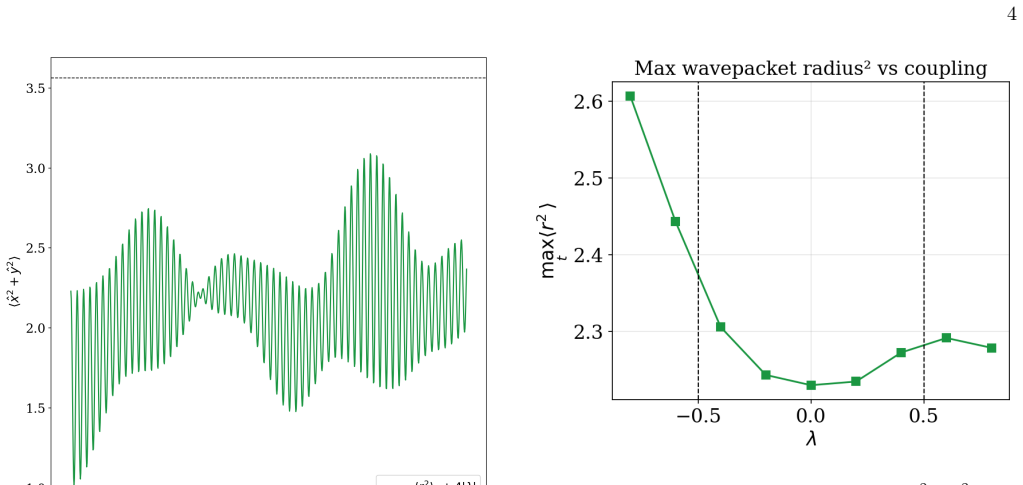
- Numerical evolution in the Heisenberg picture, Schrödinger picture, and Fock-space diagonalization all show wave-packet confinement below the analytic bound.
- The energy spectrum remains real and the level statistics are consistent with an integrable structure.
- Quantum stability of second moments is possible for ghost modes when the interaction is suitably restricted.
Where Pith is reading between the lines
- Similar bounded interactions in other effective theories could yield analogous operator conservation laws.
- The approach separates the sign of the kinetic term from the question of moment stability, suggesting stability criteria should target interaction decay.
- Whether the spectrum becomes discrete or a ground state exists remains open for this interaction class.
Load-bearing premise
The interaction must be bounded and vanish at large separations.
What would settle it
A quantum state with finite initial second moments whose mean squared phase-space radius grows without bound after finite time evolution.
Figures


read the original abstract
We prove an exact quantum conservation law for a harmonic oscillator coupled to a ghost degree of freedom: a second classical conserved quantity lifts to a quantum operator that commutes with the Hamiltonian with no hbar corrections, yielding a rigorous, state-independent upper bound on the mean squared phase-space radius for all time and every quantum state with finite initial second moments. The proof uses only canonical commutation relations and the Leibniz rule; it requires no confining potential, no spectral assumptions, and no perturbative expansion. The interaction studied here is bounded and vanishes at large separations, the generic situation in effective field theory, yet this suffices to guarantee quantum stability in the sense of bounded second moments. Three independent numerical frameworks (Heisenberg picture, Schrodinger picture, and Fock-space diagonalization) confirm wavepacket confinement below the analytic bound, a real energy spectrum, and Poisson level statistics numerically consistent with an integrable structure. The absence of a confining potential means the proof is silent on spectral discreteness and the existence of a ground state; those questions, addressed for polynomial confining interactions in concurrent work, remain open for the interaction class studied here and represent the sharpest targets for future work. Ghost quantum instability is therefore not an inevitable consequence of a wrong-sign kinetic term but depends critically on the interaction structure.
Editorial analysis
A structured set of objections, weighed in public.
Referee Report
Summary. The paper proves an exact quantum conservation law for a harmonic oscillator coupled to a ghost degree of freedom: a second classical conserved quantity lifts to a quantum operator that commutes with the Hamiltonian with no ħ corrections, yielding a rigorous, state-independent upper bound on the mean squared phase-space radius for all time and every quantum state with finite initial second moments. The proof uses only canonical commutation relations and the Leibniz rule; it requires no confining potential, no spectral assumptions, and no perturbative expansion. The interaction is bounded and vanishes at large separations. Three independent numerical frameworks (Heisenberg picture, Schrödinger picture, and Fock-space diagonalization) confirm wavepacket confinement below the analytic bound, a real energy spectrum, and Poisson level statistics. The absence of a confining potential means the proof is silent on spectral discreteness and the existence of a ground state.
Significance. If the result holds, it provides a non-perturbative demonstration that ghost instabilities are not inevitable but depend critically on interaction structure, with direct relevance to effective field theories containing wrong-sign kinetic terms. The exact operator conservation law (no ħ corrections, no fitted parameters), state-independence of the bound, and use of only CCR plus Leibniz rule are notable strengths, as is the cross-validation across three distinct numerical pictures. This advances understanding of stability in indefinite-metric or higher-derivative quantum systems without relying on ad-hoc exclusions or spectral assumptions.
minor comments (3)
- [Abstract] The abstract and introduction could explicitly state the precise form of the interaction potential (e.g., its functional dependence on separation) to make the boundedness and large-separation vanishing conditions immediately verifiable without reference to later sections.
- [Numerical results] In the numerical sections, the basis truncation or grid parameters for the Fock-space diagonalization and the initial wave-packet widths used in the Heisenberg/Schrödinger simulations should be reported with sufficient detail to permit independent reproduction of the Poisson statistics and bound saturation checks.
- [Discussion] The statement that the proof is 'silent on spectral discreteness' is correct but could be accompanied by a brief remark on what additional assumption (e.g., a confining term) would be needed to address the ground-state question, to guide readers toward the concurrent work mentioned.
Simulated Author's Rebuttal
We thank the referee for the positive assessment of our work and the recommendation for minor revision. The report accurately captures the central result—an exact, ħ-independent operator conservation law derived solely from the CCR and Leibniz rule—and correctly notes both the strengths of the cross-validation and the open questions regarding spectral discreteness in the absence of a confining potential. No specific major comments were raised that require point-by-point rebuttal.
Circularity Check
Derivation self-contained via CCR and Leibniz rule
full rationale
The central result is obtained by lifting a classical conserved quantity to an operator O and verifying [H, O] = 0 exactly using only the canonical commutation relations and the Leibniz rule for the given bounded interaction that vanishes at large separations. This directly implies conservation of expectation values and the state-independent bound on second moments without any fitted parameters, perturbative expansions, spectral assumptions, or self-referential definitions. The abstract and described proof structure contain no load-bearing self-citations, ansatz smuggling, or renaming of known results; numerical checks in three pictures are presented as independent corroboration rather than substitutes for the analytic argument. The derivation is therefore self-contained against external benchmarks.
Axiom & Free-Parameter Ledger
axioms (2)
- standard math Canonical commutation relations [x,p]=iħ hold for the oscillator and ghost degrees of freedom.
- standard math Leibniz rule for commutators: [AB,C]=A[B,C]+[A,C]B.
Reference graph
Works this paper leans on
-
[1]
Unitary Time Evolution and Vacuum for a Quantum Stable Ghost
C. Deffayet, A. F. Jalali, A. Held, S. Mukohyama, and A. Vikman, Unitary time evolution and vacuum for a quantum stable ghost (2026), arXiv:2604.21823 [hep-th]
work page internal anchor Pith review Pith/arXiv arXiv 2026
-
[2]
Quantum mechanics with a ghost: Counterexamples to spectral denseness
C. Deffayet, A. F. Jalali, A. Held, S. Muko- hyama, and A. Vikman, Quantum mechanics with a ghost: Counterexamples to spectral denseness (2026), arXiv:2604.21826 [hep-th]
work page internal anchor Pith review Pith/arXiv arXiv 2026
-
[3]
K. S. Stelle, Phys. Rev. D16, 953 (1977)
1977
-
[4]
L. D. Faddeev and V. N. Popov, Phys. Lett. B25, 29 (1967)
1967
-
[5]
S. M. Carroll, M. Hoffman, and M. Trodden, Phys. Rev. D68, 023509 (2003), arXiv:astro-ph/0301273
work page Pith review arXiv 2003
-
[6]
Pais and G
A. Pais and G. E. Uhlenbeck, Phys. Rev.79, 145 (1950)
1950
-
[7]
M. V. Ostrogradsky, M´ em. Acad. Imp. Sci. St.- P´ etersbourg6, 385 (1850)
-
[8]
J. M. Cline, S. Jeon, and G. D. Moore, Phys. Rev. D70, 043543 (2004), arXiv:hep-ph/0311312
work page Pith review arXiv 2004
-
[9]
A. G. Adameet al., Journal of Cosmology and Astropar- ticle Physics2025(02), 021
-
[10]
DESI Collaboration, arXiv (2025), arXiv:2503.14738 [astro-ph.CO]
work page internal anchor Pith review arXiv 2025
- [11]
-
[12]
Deffayet, O
C. Deffayet, O. Pujol` as, I. Sawicki, and A. Vikman, Jour- nal of Cosmology and Astroparticle Physics2010(10), 026
-
[13]
Mukohyama and K
S. Mukohyama and K. Noui, Journal of Cosmology and Astroparticle Physics2019(07), 049–049
-
[14]
C. Deffayet, S. Mukohyama, and A. Vikman, Phys. Rev. Lett.128, 041301 (2022), arXiv:2108.06294 [gr-qc]
-
[15]
C. Deffayet, A. Held, S. Mukohyama, and A. Vikman, J. Cosmol. Astropart. Phys.2023, 031 (2023), arXiv:2305.09631 [gr-qc]
-
[16]
(2026), see Supplemental Material at [URL inserted by publisher] for the explicit operator-ordered computation of [ ˆC, ˆH] = 0 and the accompanying SymPy verification of{C, H} PB = 0
2026
-
[17]
Crank and P
J. Crank and P. Nicolson, Proc. Camb. Phil. Soc.43, 50 (1947)
1947
- [18]
-
[19]
T. D. Lee and G. C. Wick, Nuclear Physics B9, 209 (1969)
1969
-
[20]
T. D. Lee and G. C. Wick, Physical Review D2, 1033 (1970)
1970
-
[21]
C. Deffayet, A. Held, S. Mukohyama, and A. Vikman, Phys. Rev. D112, 065011 (2025), arXiv:2504.11437 [hep- th]
-
[22]
Held, (2025), arXiv:2509.18049 [gr-qc]
A. Held, Global stability of ghostly field theories: Classical scattering in (N+ 1) dimensions (2025), arXiv:2509.18049 [gr-qc]
- [23]
-
[24]
T. Damour and A. V. Smilga, Phys. Rev. D105, 045018 (2022), arXiv:2110.11175 [hep-th]
-
[25]
Mostafazadeh,Pseudo-Hermitian Representation of Quantum Mechanics,Int
A. Mostafazadeh, Int. J. Geom. Methods Mod. Phys.7, 1191 (2010), arXiv:0810.5643 [quant-ph]. 8 SUPPLEMENT AL MA TERIAL: GHOST DEGREES OF FREEDOM WITHOUT QUANTUM RUNA W A Y — EXPLICIT OPERA TOR-ORDERED VERIFICA TION OF [ ˆC, ˆH] = 0 This Supplemental Material carries out the explicit operator-ordered verification that [ ˆC, ˆH] = 0 with noℏ remainder, wher...
discussion (0)
Sign in with ORCID, Apple, or X to comment. Anyone can read and Pith papers without signing in.