Recognition: unknown
Quantum mechanics with a ghost: Counterexamples to spectral denseness
Pith reviewed 2026-05-09 21:13 UTC · model grok-4.3
The pith
Certain ghostly quantum systems have discrete, non-dense energy spectra.
A machine-rendered reading of the paper's core claim, the machinery that carries it, and where it could break.
Core claim
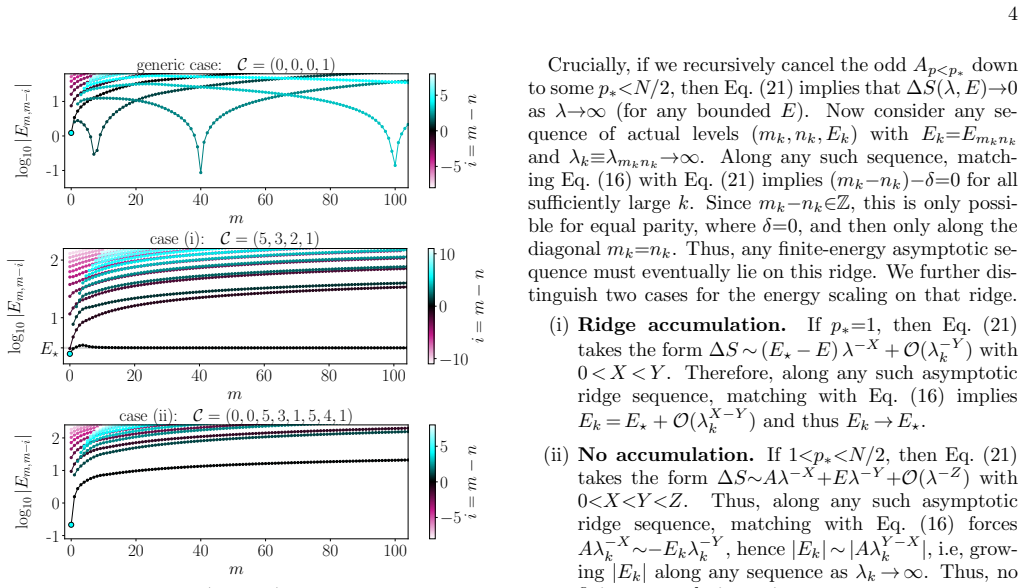
Integrable point-particle systems with opposite-sign kinetic terms and nontrivial interactions, when satisfying classical stability conditions, admit discrete separated eigenvalue spectra upon quantization. The energy spectrum is unbounded above and below but need not be dense, with sufficient conditions established for exactly one accumulation point or none at all.
What carries the argument
Separability theory, which allows the reduction of the quantum Hamiltonian to a set of one-dimensional problems whose spectra are discrete under the given conditions.
If this is right
- Ghostly systems do not necessarily possess continuous or dense spectra in the integrable case.
- Classical stability conditions imply quantum spectral discreteness for these models.
- The spectrum can be made non-dense with at most one accumulation point.
Where Pith is reading between the lines
- These counterexamples suggest that stability in ghostly theories may be more achievable than previously thought in restricted classes of models.
- Similar techniques could be explored in systems with more degrees of freedom if integrability holds.
Load-bearing premise
The systems are integrable, allowing the use of separability theory and the application of known classical stability conditions.
What would settle it
An explicit solution or numerical computation showing a dense spectrum in one of the classically stable integrable ghostly models considered would falsify the result.
Figures

read the original abstract
We quantise integrable point-particle systems with opposite-sign kinetic terms and nontrivial interactions. Using methods from separability theory, we show that previously determined classical stability conditions also imply discrete separated eigenvalue spectra. The resulting energy spectrum is unbounded above and below but not necessarily dense. We establish sufficient conditions for (i) exactly one accumulation point, or (ii) none at all. This dispels the widespread notion that ghostly quantum systems must have a continuous or dense energy spectrum.
Editorial analysis
A structured set of objections, weighed in public.
Referee Report
Summary. The paper quantizes integrable point-particle systems with opposite-sign kinetic terms and nontrivial interactions. Using separability theory, it shows that previously determined classical stability conditions imply discrete spectra for the separated one-dimensional eigenvalue problems. The resulting energy spectrum is unbounded above and below but not necessarily dense; sufficient conditions are given for exactly one accumulation point or none at all, providing counterexamples to the assumption that ghostly quantum systems must have continuous or dense spectra.
Significance. If the derivations hold, the result is significant as it supplies explicit sufficient conditions and concrete example systems where classically stable ghostly systems yield discrete (or at most singly accumulating) quantum spectra via reduction to standard ODE eigenvalue problems. This directly challenges a common expectation in indefinite-metric quantum mechanics and could inform work on PT-symmetric theories and higher-derivative models. The approach of invoking known discreteness results for the separated problems after applying separability is a clear strength.
minor comments (1)
- [Introduction] Introduction: the statement that there is a 'widespread notion' that ghostly quantum systems must have continuous or dense spectra would be strengthened by citing specific prior works that assert or assume this.
Simulated Author's Rebuttal
We thank the referee for the positive evaluation of the manuscript and for recommending minor revision. The provided summary accurately captures the central results on quantization of ghostly integrable systems and the counterexamples to spectral denseness under classical stability conditions. As the major comments section of the report is empty, we have no specific points requiring point-by-point response or revision at this time.
Circularity Check
No significant circularity; derivation is self-contained
full rationale
The paper reduces the quantization of classically stable integrable systems with opposite-sign kinetics to separated 1D eigenvalue problems via separability theory, then applies standard results on the discreteness of spectra for the resulting ODEs (with at most one finite accumulation point under the stated asymptotic conditions on effective potentials). The central claim follows from explicit sufficient conditions and example systems supplied in the manuscript. No step reduces by construction to a self-definition, a fitted parameter renamed as prediction, or a load-bearing self-citation chain; the classical stability conditions are external inputs, and the quantum spectral properties rest on independent mathematical theorems. The derivation is therefore self-contained against external benchmarks.
Axiom & Free-Parameter Ledger
axioms (2)
- standard math Standard axioms of quantum mechanics for point-particle systems
- domain assumption Integrability and separability of the classical point-particle systems
Forward citations
Cited by 1 Pith paper
-
Ghost Degrees of Freedom Without Quantum Runaway: Exact Moment Bounds from an Operator Conservation Law
An exact operator conservation law from canonical commutation relations bounds second moments of a ghost-coupled oscillator for all time and states, preventing quantum runaway.
Reference graph
Works this paper leans on
- [1]
-
[2]
E. J. Copeland, M. Sami, and S. Tsujikawa, Int. J. Mod. Phys. D15, 1753 (2006), arXiv:hep-th/0603057
work page Pith review arXiv 2006
-
[3]
T. P. Sotiriou and V. Faraoni, Rev. Mod. Phys.82, 451 (2010), arXiv:0805.1726 [gr-qc]
work page Pith review arXiv 2010
-
[4]
Modified Gravity and Cosmology
T. Clifton, P. G. Ferreira, A. Padilla, and C. Sko- rdis, Phys. Rept.513, 1 (2012), arXiv:1106.2476 [astro- ph.CO]
work page internal anchor Pith review arXiv 2012
-
[5]
C. de Rham, Living Rev. Rel.17, 7 (2014), arXiv:1401.4173 [hep-th]
-
[6]
Testing General Relativity with Present and Future Astrophysical Observations
E. Bertiet al., Class. Quant. Grav.32, 243001 (2015), arXiv:1501.07274 [gr-qc]
work page internal anchor Pith review arXiv 2015
-
[7]
C. Deffayet, S. Mukohyama, and A. Vikman, Phys. Rev. Lett.128, 041301 (2022), arXiv:2108.06294 [gr-qc]
-
[8]
C. Deffayet, A. Held, S. Mukohyama, and A. Vikman, JCAP11, 031 (2023), arXiv:2305.09631 [gr-qc]
-
[9]
C. Deffayet, A. Held, S. Mukohyama, and A. Vikman, Phys. Rev. D112, 065011 (2025), arXiv:2504.11437 [hep- th]
-
[10]
Held, (2025), arXiv:2509.18049 [gr-qc]
A. Held, (2025), arXiv:2509.18049 [gr-qc]
-
[11]
P. Figueras, A. D. Kov´ acs, and S. Yao, (2025), arXiv:2505.00082 [hep-th]
- [12]
-
[13]
A. Smilga, Int. J. Mod. Phys. A32, 1730025 (2017), arXiv:1710.11538 [hep-th]
-
[14]
T. Damour and A. Smilga, Phys. Rev. D105, 045018 (2022), arXiv:2110.11175 [hep-th]
-
[15]
Liouville, Journal de Math´ ematiques Pures et Ap- pliqu´ ees1e s´ erie, 11, 345 (1846)
J. Liouville, Journal de Math´ ematiques Pures et Ap- pliqu´ ees1e s´ erie, 11, 345 (1846)
-
[16]
St¨ ackel, Mathematische Annalen42, 537 (1893)
P. St¨ ackel, Mathematische Annalen42, 537 (1893)
-
[17]
Robertson, Mathematische Annalen98, 749 (1928)
H. Robertson, Mathematische Annalen98, 749 (1928)
1928
-
[18]
L. P. Eisenhart, Annals of Mathematics35, 284 (1934)
1934
-
[19]
Benenti, C
S. Benenti, C. Chanu, and G. Rastelli, Journal of Math- ematical Physics43, 5183 (2002)
2002
-
[20]
Podolsky, Phys
B. Podolsky, Phys. Rev.32, 812 (1928)
1928
-
[21]
B. S. DeWitt, Phys. Rev.85, 653 (1952)
1952
-
[22]
Carter, Phys
B. Carter, Phys. Rev. D16, 3395 (1977)
1977
-
[23]
Ess´ en, American Journal of Physics46, 983 (1978)
H. Ess´ en, American Journal of Physics46, 983 (1978)
1978
-
[24]
B laszak,Quantum versus Classical Mechanics and In- tegrability Problems(Springer, 2019)
M. B laszak,Quantum versus Classical Mechanics and In- tegrability Problems(Springer, 2019)
2019
-
[25]
Hellmann,Einf¨ uhrung in die Quantenchemie(Franz Deuticke, Leipzig und Wien, 1937) p
H. Hellmann,Einf¨ uhrung in die Quantenchemie(Franz Deuticke, Leipzig und Wien, 1937) p. 285
1937
-
[26]
R. P. Feynman, Phys. Rev.56, 340 (1939)
1939
-
[27]
E. C. Titchmarsh,Eigenfunction Expansions Associated with Second-order Differential Equations, Part 1, 2nd ed. (Clarendon Press, 1962)
1962
-
[28]
Deffayet, A
C. Deffayet, A. Held, A. Fathe Jalali, S. Mukohyama, and A. Vikman, to appear (2026)
2026
- [29]
- [30]
-
[31]
On the local ge- ometry of a bihamiltonian structure,
I. M. Gelfand and I. Zakharevich, “On the local ge- ometry of a bihamiltonian structure,” inThe Gelfand Mathematical Seminars, 1990–1992, edited by I. M. Gelfand, L. Corwin, and J. Lepowsky (Birkh¨ auser Boston, Boston, MA, 1993) pp. 51–112
1990
- [32]
-
[33]
V. Errasti D´ ıez, J. Gaset Rif` a, and G. Staudt, (2024), 10.1002/prop.202400268, arXiv:2408.16832 [hep-th]
-
[34]
Magri, J
F. Magri, J. Math. Phys.19, 1156 (1978)
1978
-
[35]
R. L. Fernandes, Journal of Dynamics and Differential Equations6, 53 (1994)
1994
-
[36]
Ewasiuk and S
C. Ewasiuk and S. Profumo, to appear (2026)
2026
discussion (0)
Sign in with ORCID, Apple, or X to comment. Anyone can read and Pith papers without signing in.