Recognition: unknown
Energy Loss of Newborn Magnetars by Schwinger Process
Pith reviewed 2026-05-09 21:22 UTC · model grok-4.3
The pith
Newborn magnetars with millisecond periods and strong fields lose most rotational energy through Schwinger pair creation within 30 milliseconds.
A machine-rendered reading of the paper's core claim, the machinery that carries it, and where it could break.
Core claim
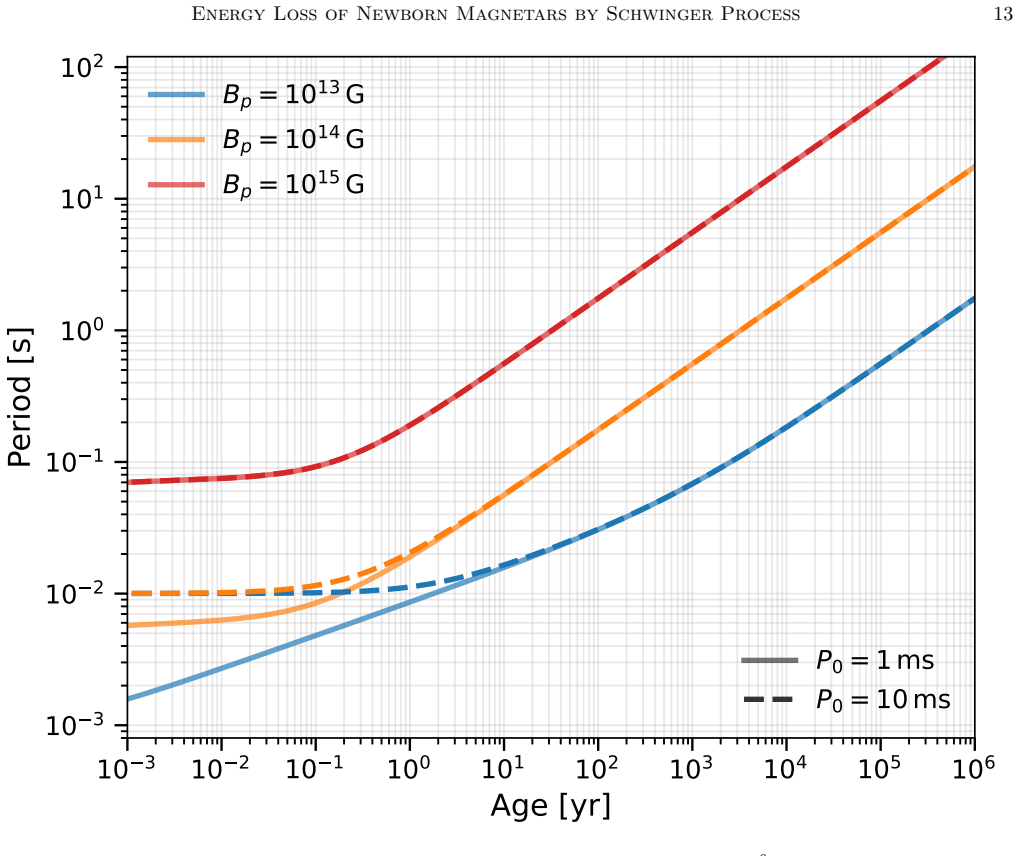
In the unscreened field scenario, the analytical global pair creation flux for the Schwinger process shows that for a magnetar with surface field 10^14 G and initial period 1 ms, the quantum pair production dominates charge supply, leading to a discharge that removes about 90% of the rotational energy within 30 ms, suppresses gravitational wave losses, and results in spin periods of order seconds after 10^4 years.
What carries the argument
The analytical global pair creation flux derived from the Schwinger process in the unscreened dipole magnetic field, which provides the charge supply rate and energy loss channel.
If this is right
- The Schwinger channel exceeds the Goldreich-Julian supply by many orders of magnitude at early times.
- About 90% of the initial rotational energy is removed within the first 30 ms.
- The gravitational-wave loss channel is suppressed during this phase.
- The observable millisecond spin phase becomes extremely short.
- Rapid energy release may serve as a power source for astrophysical transients and leads to spin periods of seconds after 10,000 years.
Where Pith is reading between the lines
- Early observations of magnetar births could test for this rapid energy drain through unusual light curves or spectra.
- Models of magnetar-driven transients may need to incorporate this initial discharge phase to match observed energetics.
- Numerical simulations of pair screening could reveal how the unscreened approximation breaks down and alter the predicted timescales.
Load-bearing premise
The created electron-positron pairs do not rapidly screen or modify the global magnetic field, so that the analytic flux formula remains valid throughout the discharge process.
What would settle it
Observation of a newborn magnetar retaining a spin period close to 1 ms beyond 30 ms after formation, or evidence of significant gravitational wave emission from such an object instead of rapid electromagnetic discharge.
Figures


read the original abstract
We investigate electron--positron pair creation through the Schwinger process in newborn magnetars with millisecond spin periods and surface dipole fields close to or above the QED critical field, $B_{\rm Q} = 4.414\times10^{13}\,\mathrm{G}$. In the unscreened field scenario, we derive the analytical global pair creation flux and recast it into a compact form with accurate analytic approximations. For a fiducial model with $B_{\rm p} = 10^{14}\,\mathrm{G}$ and $P_0 = 1\,\mathrm{ms}$, the Schwinger channel exceeds the classical Goldreich--Julian particle supply by many orders of magnitude and becomes the dominant source of charges at the earliest stage of the magnetar. The associated discharge removes about $90\%$ of the initial rotational energy within 30 ms, suppresses the gravitational-wave loss channel, and implies that the observable millisecond phase is extremely short in this unscreened scenario. The rapid energy release over such a short timescale may also provide a viable power source for astrophysical transients. Extending the same fiducial model to $10^4\,\mathrm{yr}$ gives spin periods of order seconds, linking newborn millisecond magnetars to the mature magnetar population.
Editorial analysis
A structured set of objections, weighed in public.
Referee Report
Summary. The paper derives an analytic expression for the global electron-positron pair-creation flux via the Schwinger process in the unscreened dipole field of a newborn magnetar. For the fiducial parameters B_p = 10^14 G and P_0 = 1 ms it shows that this channel supplies charges many orders of magnitude above the Goldreich-Julian rate, and that the resulting discharge removes ~90 % of the initial rotational energy in 30 ms, suppresses gravitational-wave losses, and leaves the star with a spin period of order seconds after 10^4 yr.
Significance. If the unscreened-field assumption remains valid over the discharge timescale, the result supplies a concrete, parameter-light mechanism that could dominate the earliest spin-down of millisecond magnetars and provide a transient power source. The compact analytic form of the flux and its accurate approximations constitute a useful technical contribution that can be checked independently.
major comments (2)
- [fiducial-model integration (abstract and §4)] The 90 % energy-loss figure is obtained by integrating the global Schwinger flux under the assumption that the magnetic-field geometry and strength remain fixed and unscreened for the entire 30 ms (fiducial-model calculation). No independent estimate of the pair-screening or current-induced restructuring timescale is supplied, even though the enormous multiplicity implied by the rate would be expected to modify E_∥ on a much shorter timescale, directly undermining the validity of the flux formula used.
- [§2 (analytic flux) and §4 (energy-loss integral)] The analytic global flux expression (derived in §2) is applied without demonstrating that the unscreened dipole geometry remains self-consistent once the created pairs begin to carry current; the central claim that Schwinger production dominates the earliest stage therefore rests on an untested extrapolation of the vacuum-field solution.
minor comments (2)
- [§4] The paper does not propagate uncertainties from the choice of fiducial B_p and P_0 into the quoted 90 % energy-loss fraction; a brief sensitivity plot or range would strengthen the quantitative statement.
- [§2] Notation for the local pair-creation rate and its global integral could be made more explicit (e.g., by labeling the integration limits over the polar cap) to facilitate reproduction.
Simulated Author's Rebuttal
We thank the referee for the careful and constructive review. The comments highlight important limitations in the assumptions of the unscreened-field scenario, which we address below. We will revise the manuscript to include additional estimates and discussion that qualify the results without altering the core analytic derivation.
read point-by-point responses
-
Referee: [fiducial-model integration (abstract and §4)] The 90 % energy-loss figure is obtained by integrating the global Schwinger flux under the assumption that the magnetic-field geometry and strength remain fixed and unscreened for the entire 30 ms (fiducial-model calculation). No independent estimate of the pair-screening or current-induced restructuring timescale is supplied, even though the enormous multiplicity implied by the rate would be expected to modify E_∥ on a much shorter timescale, directly undermining the validity of the flux formula used.
Authors: We agree that the 90% energy-loss result relies on holding the unscreened dipole fixed over 30 ms and that no explicit screening timescale is provided. The high multiplicity does imply that E_∥ will be modified rapidly. In the revised manuscript we will add an order-of-magnitude estimate of the screening time by computing the pair density from the integrated flux and comparing the time for the plasma to short out the parallel electric field against the 30 ms discharge interval. This will clarify the regime of validity of the calculation and qualify the fiducial energy-loss figure as an upper-bound estimate for the initial phase. revision: yes
-
Referee: [§2 (analytic flux) and §4 (energy-loss integral)] The analytic global flux expression (derived in §2) is applied without demonstrating that the unscreened dipole geometry remains self-consistent once the created pairs begin to carry current; the central claim that Schwinger production dominates the earliest stage therefore rests on an untested extrapolation of the vacuum-field solution.
Authors: The flux formula in §2 is derived under the explicit vacuum-dipole assumption stated in the text. We apply it only to characterize the earliest charge-supply rate before significant pair loading. In revision we will expand §4 with a qualitative discussion of the pair current and its potential effect on field restructuring, while noting that a fully self-consistent solution requires time-dependent numerical simulations (MHD or PIC) that lie outside the scope of the present analytic work. The central claim will be rephrased to emphasize that Schwinger production can dominate the initial stage under the unscreened assumption, with the rapid energy loss serving as a robust upper limit. revision: partial
Circularity Check
No circularity: derivation is a direct integration of the standard Schwinger rate under fixed-field assumption
full rationale
The paper starts from the established Schwinger pair-production formula (an external QED result) applied to a standard dipole field geometry. It derives an analytic global flux expression and integrates it forward in time to obtain the energy-loss fraction (90% in 30 ms for the fiducial model). This is a model prediction under the explicit unscreened-field assumption rather than a fit to data or a self-referential definition. No load-bearing self-citations, uniqueness theorems from the same authors, or ansatzes smuggled via prior work are required for the central chain; the Goldreich-Julian comparison is a separate benchmark. The result is therefore self-contained and not equivalent to its inputs by construction.
Axiom & Free-Parameter Ledger
free parameters (2)
- B_p =
10^14 G
- P_0 =
1 ms
axioms (2)
- domain assumption Magnetic field remains unscreened by created pairs during the discharge phase
- standard math Standard Schwinger pair-production rate in strong magnetic fields
Reference graph
Works this paper leans on
-
[1]
2019, Nature, 575, 464 —
Abdalla, H., et al. 2019, Nature, 575, 464 —. 2021, Science, 372, 1081
2019
-
[2]
Baring, M. G., & Harding, A. K. 2001, The Astrophysical Journal, 547, 929, doi: 10.1086/318390
-
[3]
Beloborodov, A. M., & Thompson, C. 2007, The Astrophysical Journal, 657, 967, doi: 10.1086/508917
-
[4]
Daugherty, J. K., & Harding, A. K. 1982, The Astrophysical Journal, 252, 337, doi: 10.1086/159561 —. 1983, The Astrophysical Journal, 273, 761, doi: 10.1086/161411
-
[5]
2020, The Astrophysical Journal Letters, 896, L30, doi: 10.3847/2041-8213/ab9742
Esposito, P., Rea, N., Borghese, A., et al. 2020, The Astrophysical Journal Letters, 896, L30, doi: 10.3847/2041-8213/ab9742
-
[6]
Farah, J. R., Prust, L. J., Howell, D. A., et al. 2026, Nature, 651, 321, doi: 10.1038/s41586-026-10151-0
-
[7]
R., Prust, L
Farah, J. R., Prust, L. J., Howell, D. A., et al. 2026, Nature, 651, 321
2026
-
[8]
Goldreich, P., & Julian, W. H. 1969, ApJ, 157, 869
1969
-
[9]
K., & Lai, D
Harding, A. K., & Lai, D. 2006, Reports on Progress in Physics, 69, 2631
2006
-
[10]
2025, The Astrophysical Journal, 986, 14, doi: 10.3847/1538-4357/adceb0
Hashemi, P., Shakeri, S., Wang, Y., Li, L., & Moradi, R. 2025, The Astrophysical Journal, 986, 14, doi: 10.3847/1538-4357/adceb0
-
[11]
1936, Zeitschrift fur Physik, 98, 714
Heisenberg, W., & Euler, H. 1936, Zeitschrift fur Physik, 98, 714
1936
-
[12]
S., & Shaviv, N
Heyl, J. S., & Shaviv, N. J. 2002, Physical Review D, 66, 023002
2002
-
[13]
M., & Beloborodov, A
Kaspi, V. M., & Beloborodov, A. M. 2017, ARA&A, 55, 261
2017
-
[14]
Kim, C. M., & Kim, S. P. 2023a, European Physical Journal C, 83, 104 —. 2023b, Astronomy Reports, 67, S122, doi: 10.1134/S1063772923070128
-
[15]
P., & Page, D
Kim, S. P., & Page, D. N. 2002, Physical Review D, 65, 105002 —. 2006, Physical Review D—Particles, Fields, Gravitation, and Cosmology, 73, 065020 —. 2007, Physical Review D—Particles, Fields, Gravitation, and Cosmology, 75, 045013
2002
-
[16]
1992, Physical Review D, 45, 4659
Mottola, E. 1992, Physical Review D, 45, 4659
1992
-
[17]
2015, Physics Reports, 561, 1 LHAASO Collaboration
Kumar, P., & Zhang, B. 2015, Physics Reports, 561, 1 LHAASO Collaboration. 2023, Science, 380, 1390
2015
-
[18]
2017, The Astrophysical Journal, 834, 199
Lieu, R. 2017, The Astrophysical Journal, 834, 199
2017
-
[19]
2022, A&A, 666, A138, doi: 10.1051/0004-6361/202244174 L¨ u, H.-J., Zou, L., Lan, L., & Liang, E.-W
Lin, T., Du, S., Wang, W., Hou, S., & Xu, R. 2022, A&A, 666, A138, doi: 10.1051/0004-6361/202244174 L¨ u, H.-J., Zou, L., Lan, L., & Liang, E.-W. 2018, Monthly Notices of the Royal Astronomical Society, 480, 4402 L¨ u, H.-J., Zou, L., Lan, L., & Liang, E.-W. 2018, Monthly Notices of the Royal Astronomical Society, 480, 4402, doi: 10.1093/mnras/sty2176
-
[20]
, archivePrefix = "arXiv", eprint =
Bucciantini, N., & Quataert, E. 2011, Monthly Notices of the Royal Astronomical Society, 413, 2031, doi: 10.1111/j.1365-2966.2011.18280.x
-
[21]
Metzger, B. D., Thompson, T. A., & Quataert, E. 2007, The Astrophysical Journal, 659, 561, doi: 10.1086/512059
-
[22]
1970, Nuclear Physics B, 21, 346
Nikishov, A. 1970, Nuclear Physics B, 21, 346
1970
-
[23]
A., & Kaspi, V
Olausen, S. A., & Kaspi, V. M. 2014, ApJS, 212, 6
2014
-
[24]
Olver, F. W. 2010, NIST handbook of mathematical functions hardback and CD-ROM (Cambridge university press)
2010
-
[25]
Ruderman, M. A., & Sutherland, P. G. 1975, The Astrophysical Journal, 196, 51, doi: 10.1086/153393
-
[26]
Rueda, J. A., Ruffini, R., & Wang, Y. 2026, Journal of High Energy Astrophysics, 50, 100464, doi: 10.1016/j.jheap.2025.100464
-
[27]
2010, Physics Reports, 487, 1
Ruffini, R., Vereshchagin, G., & Xue, S.-S. 2010, Physics Reports, 487, 1
2010
-
[28]
1951, Physical Review, 82, 664
Schwinger, J. 1951, Physical Review, 82, 664
1951
-
[29]
2022, Science, 378, 646
Taverna, R., Turolla, R., Muleri, F., et al. 2022, Science, 378, 646
2022
-
[30]
Thompson, C., & Duncan, R. C. 1993, ApJ, 408, 194
1993
-
[31]
Timokhin, A. N., & Arons, J. 2013, Monthly Notices of the Royal Astronomical Society, 429, 20, doi: 10.1093/mnras/sts298
-
[32]
Usov, V. V. 1992, Nature, 357, 472
1992
-
[33]
2024, The Astrophysical Journal, 974, 89, doi: 10.3847/1538-4357/ad6845
Wang, Y., Moradi, R., & Li, L. 2024, The Astrophysical Journal, 974, 89, doi: 10.3847/1538-4357/ad6845
discussion (0)
Sign in with ORCID, Apple, or X to comment. Anyone can read and Pith papers without signing in.