Recognition: unknown
Demand Curvature and Pass-Through in Differentiated Oligopoly
Pith reviewed 2026-05-08 13:24 UTC · model grok-4.3
The pith
A general representation of the pass-through matrix decomposes price responses into demand curvature, substitution, and multiproduct ownership in differentiated oligopoly.
A machine-rendered reading of the paper's core claim, the machinery that carries it, and where it could break.
Core claim
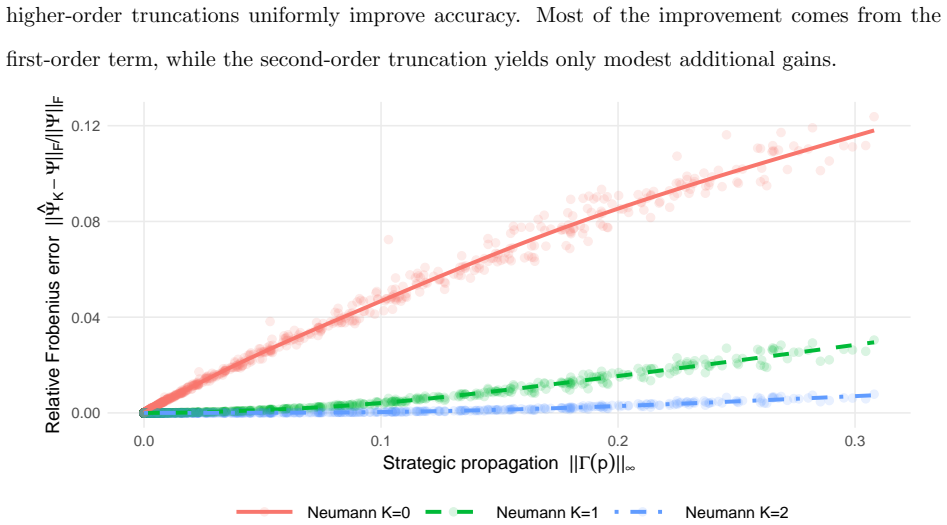
The paper derives a general representation of the pass-through matrix that decomposes equilibrium price responses into the roles of demand curvature, substitution, and multiproduct ownership. This extends the classic insight in single-product monopoly to multiproduct settings in which diversion and ownership also matter. A tractable first-order approximation is developed yielding a sufficient-statistics characterization for empirically relevant demand systems, and the small-share limit is characterized showing how common demand specifications impose tail restrictions that shape pass-through.
What carries the argument
The pass-through matrix decomposed by demand curvature, substitution patterns, and ownership structure.
If this is right
- Pass-through in single-product monopoly depends only on demand curvature.
- In multiproduct oligopoly, substitution and ownership additionally determine pass-through.
- The first-order approximation allows computation of pass-through from a few demand statistics.
- Common demand systems restrict pass-through in the small-share limit through their tail properties.
- The framework applies to tax incidence, cost shocks, and merger analysis.
Where Pith is reading between the lines
- If the decomposition is accurate, empirical work on pass-through can rely on local demand estimates rather than full market simulations.
- Merger simulations could incorporate this to predict changes in pass-through rates post-merger.
- Extensions to other competitive settings like quantity competition or dynamic models may be possible.
- The characterization suggests testing demand systems by their implied pass-through in small-share regimes.
Load-bearing premise
The derivations assume standard Nash price competition with twice-differentiable demand and that higher-order terms can be ignored in the approximation under common functional forms.
What would settle it
Numerically solving for equilibrium prices before and after a small cost shock in a specific oligopoly model with multiproduct firms and comparing the resulting pass-through matrix to the decomposed formula would test the claim.
Figures

read the original abstract
This paper studies cost pass-through in differentiated-product oligopoly. I derive a general representation of the pass-through matrix that decomposes equilibrium price responses into the roles of demand curvature, substitution, and multiproduct ownership. This extends the classic insight in single-product monopoly to multiproduct settings in which diversion and ownership also matter. I then develop a tractable first-order approximation that yields a sufficient-statistics characterization for empirically relevant demand systems. Finally, I characterize the small-share limit and show how common demand specifications impose tail restrictions that shape pass-through. The results provide a practical framework for applied work on tax incidence, merger analysis, and related questions in imperfect competition.
Editorial analysis
A structured set of objections, weighed in public.
Referee Report
Summary. The paper derives a general representation of the pass-through matrix for cost pass-through in differentiated-product oligopoly. This representation decomposes equilibrium price responses into the roles of demand curvature, substitution patterns, and multiproduct ownership. It extends the single-product monopoly insight to multiproduct settings. The paper also develops a tractable first-order approximation for sufficient-statistics characterization in empirically relevant demand systems and characterizes the small-share limit, showing how common demand specifications impose tail restrictions that shape pass-through.
Significance. If the derivations hold, this provides a practical framework for applied work on tax incidence, merger analysis, and imperfect competition. The decomposition isolates key economic forces and generalizes classic results. Strengths include the use of standard oligopoly primitives for the general representation and the separation of the exact decomposition from the approximation and limit cases. This could be useful for empirical researchers needing to understand pass-through determinants.
minor comments (2)
- [Abstract] The abstract is concise but could briefly mention the key assumptions underlying the general representation to set expectations for readers.
- The paper would benefit from a table summarizing the main results, such as the pass-through decomposition formula and the approximation, for quick reference.
Simulated Author's Rebuttal
We thank the referee for their positive assessment of the paper and for recommending minor revision. The referee's summary accurately reflects the manuscript's focus on the pass-through matrix decomposition, its extension of single-product results, and the development of approximations and limit characterizations for applied settings.
Circularity Check
No significant circularity; derivation self-contained from primitives
full rationale
The central result is a matrix decomposition of the pass-through operator obtained directly from the first-order conditions of Nash-Bertrand competition once the demand Jacobian and Hessian are defined. This follows from standard differentiated oligopoly primitives (twice-differentiable demand, interior equilibrium, invertible Jacobian) without fitting parameters to the target pass-through quantities or invoking self-citations as load-bearing support. The subsequent first-order approximation and small-share limit are explicitly optional characterizations that do not underpin the general representation. No step reduces by construction to its own inputs, and no uniqueness theorem or ansatz is smuggled via self-citation.
Axiom & Free-Parameter Ledger
axioms (2)
- domain assumption Firms play static Nash equilibrium in prices
- standard math Demand is twice continuously differentiable
Reference graph
Works this paper leans on
-
[1]
Pass-through, welfare, and incidence under imperfect competition,
Adachi, Takanori and Michal Fabinger (2022) “Pass-through, welfare, and incidence under imperfect competition,”Journal of Public Economics, 211, 104589
2022
-
[2]
Monopoly price discrimination and demand curvature,
Aguirre, Inaki, Simon Cowan, and John Vickers (2010) “Monopoly price discrimination and demand curvature,”American Economic Review, 100 (4), 1601–1615
2010
-
[3]
Tax incidence in differentiated product oligopoly,
Anderson, Simon P, Andre De Palma, and Brent Kreider (2001) “Tax incidence in differentiated product oligopoly,”Journal of Public Economics, 81 (2), 173–192
2001
-
[4]
Foundations of demand estimation,
Berry, Steven T and Philip A Haile (2021) “Foundations of demand estimation,” inHandbook of industrial organization, 4, 1–62: Elsevier
2021
-
[5]
Estimating substitution patterns and demand curvature in discrete-choice models of product differentiation,
Birchall, Cameron, Debashrita Mohapatra, and Frank Verboven (2024) “Estimating substitution patterns and demand curvature in discrete-choice models of product differentiation,”Review of Economics and Statistics, 1–40
2024
-
[6]
A note on the effect of cost changes on prices,
Bulow, Jeremy I and Paul Pfleiderer (1983) “A note on the effect of cost changes on prices,”Journal of political Economy, 91 (1), 182–185
1983
-
[7]
Antitrust Evaluation of Horizontal Mergers: An Economic Alternative to Market Definition,
Farrell, Joseph and Carl Shapiro (2010) “Antitrust Evaluation of Horizontal Mergers: An Economic Alternative to Market Definition,”The BE Journal of Theoretical Economics, 10 (1)
2010
-
[8]
Who Pays for Tariffs Along the Supply Chain? Evidence from European Wine Tariffs,
Flaaen, Aaron B, Ali Horta¸ csu, Felix Tintelnot, Nicol´ as Urdaneta, and Daniel Xu (2025) “Who Pays for Tariffs Along the Supply Chain? Evidence from European Wine Tariffs,”Technical report, National Bureau of Economic Research
2025
-
[9]
Pass-through rates and the price effects of mergers,
Froeb, Luke, Steven Tschantz, and Gregory J Werden (2005) “Pass-through rates and the price effects of mergers,”International Journal of Industrial Organization, 23 (9-10), 703–715
2005
-
[10]
The first-order approach to merger analysis,
Jaffe, Sonia and E Glen Weyl (2013) “The first-order approach to merger analysis,”American Economic Journal: Microeconomics, 5 (4), 188–218
2013
-
[11]
Robustness measures for welfare analysis,
Kang, Zi Yang and Shoshana Vasserman (2025) “Robustness measures for welfare analysis,”Amer- ican Economic Review, 115 (8), 2449–2487
2025
-
[12]
Cost pass-through in differentiated product mar- kets: The case of us processed cheese,
Kim, Donghun and Ronald W Cotterill (2008) “Cost pass-through in differentiated product mar- kets: The case of us processed cheese,”The Journal of Industrial Economics, 56 (1), 32–48
2008
-
[13]
Merger Analysis with Latent Price,
Koh, Paul S (2024) “Merger Analysis with Latent Price,”arXiv preprint arXiv:2404.07684
-
[14]
Bias in reduced-form estimates of pass-through,
MacKay, Alexander, Nathan H Miller, Marc Remer, and Gloria Sheu (2014) “Bias in reduced-form estimates of pass-through,”Economics Letters, 123 (2), 200–202
2014
-
[15]
Pass-through and the pre- diction of merger price effects,
Miller, Nathan H, Marc Remer, Conor Ryan, and Gloria Sheu (2016) “Pass-through and the pre- diction of merger price effects,”The Journal of Industrial Economics, 64 (4), 683–709. (2017b) “Upward pricing pressure as a predictor of merger price effects,”International Journal of Industrial Organization, 52, 216–247. 34
2016
-
[16]
Pass-through and tax incidence in differ- entiated product markets,
Miravete, Eugenio J, Katja Seim, and Jeff Thurk (2023) “Pass-through and tax incidence in differ- entiated product markets,”International Journal of Industrial Organization, 90, 102985. (2026) “Elasticity and curvature of discrete choice demand models,”https://www. eugeniomiravete.com/PDF/MST_Curvature.pdf. Mr´ azov´ a, Monika and J Peter Neary (2017) “No...
2023
-
[17]
Pass-through of own and rival cost shocks: Evidence from the US fracking boom,
Muehlegger, Erich and Richard L Sweeney (2022) “Pass-through of own and rival cost shocks: Evidence from the US fracking boom,”Review of Economics and Statistics, 104 (6), 1361–1369
2022
-
[18]
Does competition increase pass-through?
Ritz, Robert A (2024) “Does competition increase pass-through?”The RAND Journal of Eco- nomics, 55 (1), 140–165
2024
-
[19]
Pass-through as an economic tool: Principles of incidence under imperfect competition,
Weyl, E Glen and Michal Fabinger (2013) “Pass-through as an economic tool: Principles of incidence under imperfect competition,”Journal of political economy, 121 (3), 528–583. Appendix A Proofs A.1 Proof of Lemma 1 Fixv∈R Jf such thatϕ ′ j,v(0)̸= 0 for allj∈ J f. Since Φ f,v(t) = P j∈Jf (pj +tv j −c j)ϕj,v(t), differentiating twice att= 0 gives Φ′′ f,v(0)...
2013
discussion (0)
Sign in with ORCID, Apple, or X to comment. Anyone can read and Pith papers without signing in.