Recognition: unknown
JAX-BEM: Gradient-Based Acoustic Shape Optimisation via a Differentiable Boundary Element Method
Pith reviewed 2026-05-08 13:33 UTC · model grok-4.3
The pith
JAX-BEM provides a differentiable boundary element method that matches standard BEM accuracy while enabling gradient-based acoustic shape optimization.
A machine-rendered reading of the paper's core claim, the machinery that carries it, and where it could break.
Core claim
A boundary-element solver written in JAX produces acoustic fields whose accuracy matches that of existing non-differentiable BEM codes while automatically supplying gradients with respect to surface geometry, thereby permitting gradient-based shape optimization for acoustic objectives.
What carries the argument
Automatic differentiation applied to the boundary-integral discretization and the resulting dense linear system for time-harmonic acoustic scattering.
If this is right
- Acoustic geometries with dozens of free parameters can be refined by gradient descent instead of derivative-free search.
- Inverse problems that recover shape from measured acoustic data become directly solvable by the same code path.
- The same differentiable formulation can be reused for electromagnetic or other linear wave problems without new derivation.
- Optimization loops can be embedded inside larger machine-learning pipelines that treat geometry as trainable parameters.
Where Pith is reading between the lines
- The approach could be combined with neural-network surrogates to accelerate repeated forward solves inside long optimization trajectories.
- Extension to three-dimensional or topologically changing surfaces would test whether the current discretization remains stable under differentiation.
- Because JAX supports hardware acceleration, the method may lower the cost of high-frequency acoustic design studies relative to finite-element alternatives.
Load-bearing premise
Automatic differentiation through the BEM discretization and linear solve yields accurate, stable gradients for the acoustic boundary conditions.
What would settle it
On a simple scattering benchmark, finite-difference gradients and JAX-BEM gradients differ by more than a few percent, or an optimization run guided by JAX-BEM gradients fails to reduce the objective function.
Figures




read the original abstract
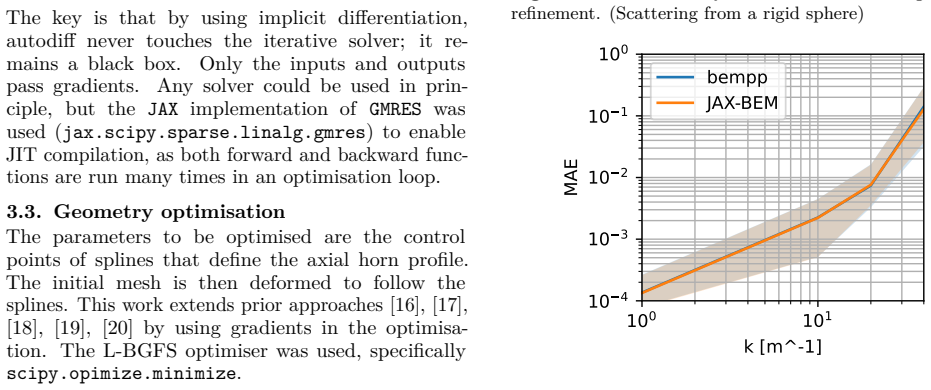
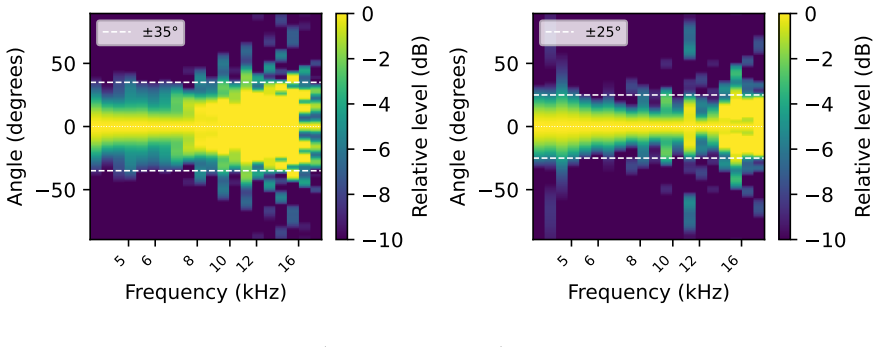
Engineering structures are increasingly designed using numerical optimisation. However, traditional optimisation methods can be challenging with multiple objectives and many parameters. In machine learning, stable training of artificial neural networks with millions or billions of parameters is achieved using automatic differentiation frameworks such as JAX and Pytorch. Because these frameworks provide accelerated numerical linear algebra with automatic gradient tracking, they also enable differentiable implementations of numerical methods to be built. This facilitates faster gradient-based optimisation of geometry and materials, as well as solution of inverse problems. We demonstrate JAX-BEM, a differentiable Boundary Element Method (BEM) solver, showing that it matches the error of existing BEM codes for a benchmark problem and enables gradient-based geometry optimisation. Although the demonstrated examples are for acoustic simulations, the concept could be readily extended to electromagnetic waves.
Editorial analysis
A structured set of objections, weighed in public.
Referee Report
Summary. The paper introduces JAX-BEM, a differentiable Boundary Element Method (BEM) solver implemented in the JAX framework for acoustic simulations. It claims that the implementation reproduces the forward-solution error of existing (non-differentiable) BEM codes on a benchmark problem and that the resulting gradients enable gradient-based shape optimization of acoustic geometries. The work is presented as a demonstration that automatic differentiation through BEM matrix assembly and linear solves can be used for engineering optimization, with a brief note on possible extension to electromagnetics.
Significance. If the gradients are shown to be accurate and stable, the approach would provide a practical route to gradient-based acoustic shape optimization without the need for adjoint derivations or finite-difference approximations. The use of an existing AD framework for a classical boundary-integral method is a useful engineering contribution, though the manuscript does not claim new theoretical results or parameter-free derivations.
major comments (2)
- [Abstract / Results] Abstract and results section: the statement that JAX-BEM 'matches the error of existing BEM codes for a benchmark problem' is not supported by any reported quantitative error values, mesh sizes, quadrature orders, or direct comparison tables. Without these data the forward-solver accuracy claim cannot be evaluated and the subsequent optimization results rest on an unquantified foundation.
- [Methods / Results] Methods / gradient verification: the central claim that automatic differentiation through the BEM discretization and linear solve produces usable gradients for shape optimization is not accompanied by any finite-difference gradient checks, manufactured-solution tests, or adjoint-consistency verification. Given the singular kernels and numerical quadrature required by BEM, the absence of such checks leaves open the possibility that reported optimization trajectories are driven by gradient artifacts rather than true sensitivities.
minor comments (2)
- [Abstract] The abstract mentions possible extension to electromagnetic waves, yet the manuscript contains no discussion, implementation notes, or caveats for that extension.
- [Methods] Notation for the acoustic boundary conditions and the differentiation of the single- and double-layer operators should be made explicit; current presentation leaves the precise form of the differentiated kernels unclear.
Simulated Author's Rebuttal
We thank the referee for their constructive comments, which highlight important aspects of how the accuracy and reliability of JAX-BEM should be presented. We agree that additional quantitative evidence is needed to support the claims and will revise the manuscript accordingly.
read point-by-point responses
-
Referee: [Abstract / Results] Abstract and results section: the statement that JAX-BEM 'matches the error of existing BEM codes for a benchmark problem' is not supported by any reported quantitative error values, mesh sizes, quadrature orders, or direct comparison tables. Without these data the forward-solver accuracy claim cannot be evaluated and the subsequent optimization results rest on an unquantified foundation.
Authors: We agree that the forward-solver accuracy claim requires explicit quantitative support. In the revised manuscript we will add a results subsection (or table) that reports concrete error metrics (e.g., L2-norm or pointwise errors) for the benchmark problem, together with the mesh sizes, quadrature orders, and direct numerical comparisons against a reference non-differentiable BEM code. This will allow readers to evaluate the accuracy claim directly and will provide a clearer foundation for the subsequent optimization examples. revision: yes
-
Referee: [Methods / Results] Methods / gradient verification: the central claim that automatic differentiation through the BEM discretization and linear solve produces usable gradients for shape optimization is not accompanied by any finite-difference gradient checks, manufactured-solution tests, or adjoint-consistency verification. Given the singular kernels and numerical quadrature required by BEM, the absence of such checks leaves open the possibility that reported optimization trajectories are driven by gradient artifacts rather than true sensitivities.
Authors: We acknowledge the referee's concern regarding the lack of explicit gradient verification, especially in the presence of singular kernels and quadrature. In the revised manuscript we will insert a dedicated verification subsection that (i) compares automatic-differentiation gradients against finite-difference approximations on a simple test geometry and (ii) presents a manufactured-solution test confirming consistency of the computed sensitivities. These checks will demonstrate that the reported optimization trajectories are driven by accurate gradients rather than numerical artifacts. revision: yes
Circularity Check
No circularity: implementation demonstration with independent validation
full rationale
The paper describes the implementation of a differentiable BEM solver in JAX and validates it by matching forward error on a benchmark problem before demonstrating gradient-based optimization. No derivation chain, uniqueness theorem, fitted parameter renamed as prediction, or self-citation load-bearing step is present in the provided text. The contribution is an engineering demonstration whose correctness can be checked externally against existing BEM codes and finite-difference gradients; it does not reduce to its own inputs by construction.
Axiom & Free-Parameter Ledger
axioms (2)
- domain assumption The acoustic problem is governed by the Helmholtz equation with standard boundary conditions.
- domain assumption JAX's automatic differentiation correctly propagates gradients through the BEM matrix assembly and linear solve.
Reference graph
Works this paper leans on
-
[1]
T. Sakuma, S. Sakamoto, and T. Otsuru, Eds., Computational Simulation in Architectural and Environmental Acoustics: Methods and Applica- tions of Wave-Based Computation, 1st ed. Tokyo: Springer, 2014,isbn: 978-4-431-54453-1.doi: 10.1007/978-4-431-54454-8
-
[2]
J. Cea, “Conception optimale ou identification de formes, calcul rapide de la d´ eriv´ ee direction- nelle de la fonction coˆ ut,” fr,ESAIM: Mathemat- ical Modelling and Numerical Analysis, vol. 20, no. 3, pp. 371–402, 1986.doi: 10.1051/m2an/ 1986200303711
-
[3]
T. Xue et al., “JAX-FEM: A differentiable GPU- accelerated 3D finite element solver for auto- matic inverse design and mechanistic data sci- ence,” en,Computer Physics Communications, vol. 291, p. 108 802, Oct. 2023.doi: 10.1016/j. cpc.2023.108802
work page doi:10.1016/j 2023
-
[4]
Borrel-Jensen and J
N. Borrel-Jensen and J. Bjorgaard,Differenti- ation Strategies for Acoustic Inverse Problems: Admittance Estimation and Shape Optimization, en, Nov. 2025.doi: 10 . 48550 / arXiv . 2511 . 11415
2025
-
[5]
A. J. Burton and G. F. Miller, “The application of integral equation methods to the numerical solution of some exterior boundary-value prob- lems,” en,Proc. Royal Society of London. A. Mathematical and Physical Sciences, vol. 323, no. 1553, pp. 201–210, Jun. 1971.doi: 10.1098/ rspa.1971.0097
-
[6]
Improved Integral Formulation for Acoustic Radiation Problems,
H. A. Schenck, “Improved Integral Formulation for Acoustic Radiation Problems,” en,The Jour- nal of the Acoustical Society of America, vol. 44, no. 1, pp. 41–58, Jul. 1968.doi: 10.1121/1. 1911085
work page doi:10.1121/1 1968
-
[7]
Learning representations by back- propagating errors,
D. E. Rumelhart, G. E. Hinton, and R. J. Williams, “Learning representations by back- propagating errors,” en,Nature, vol. 323, pp. 533–536, 1986
1986
-
[8]
Griewank and A
A. Griewank and A. Walther,Evaluating Deriva- tives, Second. Society for Industrial and Ap- plied Mathematics, 2008.doi: 10 . 1137 / 1 . 9780898717761
2008
-
[9]
T. B. Brown et al.,Language Models are Few- Shot Learners, en, Jul. 2020.doi: 10.48550/ arXiv.2005.14165
work page internal anchor Pith review arXiv 2020
-
[10]
Bradbury et al.,JAX: Composable trans- formations of Python+NumPy programs, ver- sion 0.3.13, 2018
J. Bradbury et al.,JAX: Composable trans- formations of Python+NumPy programs, ver- sion 0.3.13, 2018. [Online]. Available: http:// github.com/jax-ml/jax
2018
-
[11]
PyTorch: An Imperative Style, High-Performance Deep Learning Library
A. Paszke et al., “Pytorch: An imperative style, high-performance deep learning library,”CoRR, vol. abs/1912.01703, 2019. arXiv:1912.01703
work page internal anchor Pith review arXiv 1912
-
[12]
Bempp-cl: A fast Python based just-in-time compiling boundary element library.,
T. Betcke and M. Scroggs, “Bempp-cl: A fast Python based just-in-time compiling boundary element library.,” en,JoSS, vol. 6, no. 59, p. 2879, Mar. 2021.doi:10.21105/joss.02879
-
[13]
GMRES: A generalized minimal residual algorithm for solving nonsymmetric linear systems
Y. Saad and M. H. Schultz, “GMRES: A Gen- eralized Minimal Residual Algorithm for Solv- ing Nonsymmetric Linear Systems,” en,SIAM Journal on Scientific and Statistical Comput- ing, vol. 7, no. 3, pp. 856–869, Jul. 1986.doi: 10.1137/0907058
-
[14]
C. R. Harris et al., “Array programming with NumPy,”Nature, vol. 585, no. 7825, pp. 357–362, Sep. 2020.doi:10.1038/s41586-020-2649-2
-
[15]
On the limited memory BFGS method for large scale optimiza- tion,
D. C. Liu and J. Nocedal, “On the limited memory BFGS method for large scale optimiza- tion,” en,Mathematical Programming, vol. 45, no. 1-3, pp. 503–528, Aug. 1989.doi: 10.1007/ BF01589116
1989
-
[16]
Optimization of a variable mouth acoustic horn,
R. Udawalpola, E. Wadbro, and M. Berggren, “Optimization of a variable mouth acoustic horn,”International Journal for Numerical Methods in Engineering, vol. 85, no. 5, pp. 591– 606, Feb. 2011.doi:10.1002/nme.2982
-
[17]
3D numerical modelling of acoustic horns using the method of fundamental solutions,
L. Godinho, P. Amado-Mendes, J. Carbajo, and J. Ramis-Soriano, “3D numerical modelling of acoustic horns using the method of fundamental solutions,” en,Engineering Analysis with Bound- ary Elements, vol. 51, pp. 64–73, Feb. 2015.doi: 10.1016/j.enganabound.2014.09.013
-
[18]
Large-Scale Three-Dimensional Acoustic Horn Optimization,
S. Schmidt, E. Wadbro, and M. Berggren, “Large-Scale Three-Dimensional Acoustic Horn Optimization,” en,SIAM Journal on Scientific Computing, vol. 38, no. 6, B917–B940, Jan. 2016. doi:10.1137/15M1021131
-
[19]
3D shape optimization of loud- speaker cabinets for uniform directivity,
P. R. Andersen, V. Cutanda Henr´ ıquez, N. Aage, and J. Kook, “3D shape optimization of loud- speaker cabinets for uniform directivity,” en, Structural and Multidisciplinary Optimization, vol. 65, no. 12, p. 343, Dec. 2022.doi: 10.1007/ s00158-022-03451-2
2022
-
[20]
H. Dong, J. -B. Doc, and S. F´ elix, “Efficient multimodal-based shape optimization of acous- tic horns with application to subwavelength per- fect transmission,” en,Journal of Sound and Vibration, vol. 559, p. 117 746, Sep. 2023.doi: 10.1016/j.jsv.2023.117746
-
[21]
P. M. Morse and K. U. Ingard,Theoretical Acoustics. New York: McGraw-Hill, 1968
1968
-
[22]
UniformH-matrix compression with applications to boundary integral equations,
K. Bruyninckx, D. Huybrechs, and K. Meer- bergen, “UniformH-matrix compression with applications to boundary integral equations,” SIAM Journal on Scientific Computing, vol. 47, no. 3, B618–B644, May 2025.doi: 10.1137/ 24m1665209
2025
discussion (0)
Sign in with ORCID, Apple, or X to comment. Anyone can read and Pith papers without signing in.