Recognition: unknown
Investigation of White-light Emission in Compact Flares
Pith reviewed 2026-05-09 20:34 UTC · model grok-4.3
The pith
Compact solar flares produce white-light emissions in 61 percent of cases overall, with rates reaching 89 percent for C-class events and zero for B-class.
A machine-rendered reading of the paper's core claim, the machinery that carries it, and where it could break.
Core claim
Among the 28 compact flares examined, 17 produced white-light emission for an overall rate of approximately 60.7 percent. The rate reached 89.5 percent for the 19 C-class flares and remained at zero for the 9 B-class flares. When grouped by magnetic configuration, the three types showed occurrence rates of 77.8 percent, 11.1 percent, and 90 percent respectively, rising to 100 percent, 33.3 percent, and 100 percent when restricted to C-class members alone. These numbers lead to the conclusion that type-I and type-III compact flares are the configurations most likely to produce white-light emission.
What carries the argument
The three-type magnetic classification of compact flares (U-shaped loop loops, flux emergence near a sunspot, and fan-spine structures) together with direct counting of white-light detections across the 28-event sample.
Load-bearing premise
That the 28 chosen events are genuine compact flares driven by low-height reconnection, that the three-type magnetic scheme cleanly separates distinct physical regimes, and that white-light detection is applied uniformly.
What would settle it
A larger sample of B-class compact flares that still shows zero white-light detections, or a reclassification of the same events that moves several type-I and type-III cases into the low-rate group while preserving the original flare identifications.
Figures



read the original abstract
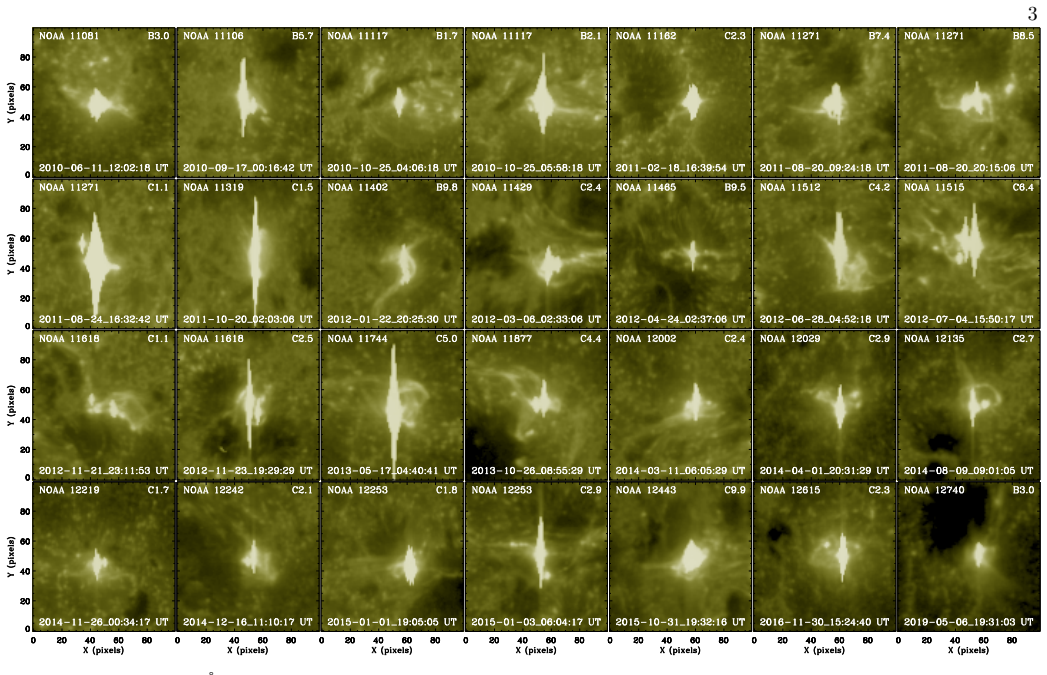
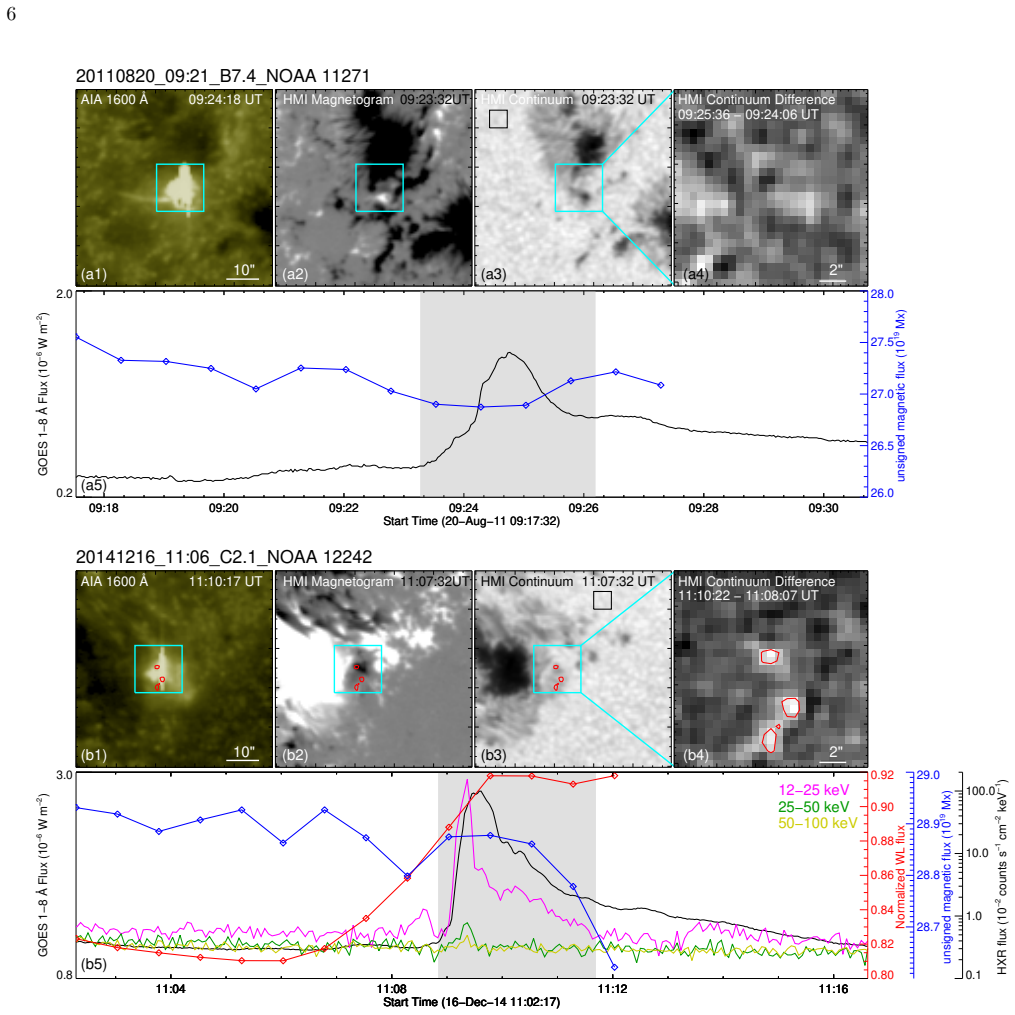
White-light flares (WLFs) are usually tend to be those very large flares. Nevertheless, several small and compact WLFs have been reported and thought to be produced by low-height magnetic reconnection. However, whether low-height magnetic reconnection can efficiently produce WLFs remains unclear. For the first time, we conduct a statistical study of the WL emission in compact flares to address this question. Using over a decade observations from the \textit{Solar Dynamics Observatory} (SDO), we identify 28 compact flares, including 19 C-class and 9 B-class flares. We find these compact flares can be classified into three types based on the magnetic configuration of the flare, corresponding to the U-shape loop (type I), the flux emergence near sunspot (type II), and the fan-spine like structure (type III). For each type, the flares numbers are 9 (7 C-calss and 2 B-class), 9 (3 C-calss and 6 B-calss) and 10 (9 C-calss and 1 B-calss), respectively. We find the occurrence rate of WLFs in compact flares is $\sim60.7\%$ (17/28), and for the C-class the rate can be up to $\sim89.5\%$ (17/19). No WLF was found in B-class compact flares. The occurrence rates for three types are $\sim77.8\%$ (7/9), $\sim11.1\%$ (1/9) and 90\% (9/10), respectively. And for the C-class flares, the occurrence rates for three types are 100\% (7/7), $\sim33.3\%$ (1/3) and 100\% (9/9), respectively. Our results suggest type-I and type-III compact flares are more likely to produce WL emissions.
Editorial analysis
A structured set of objections, weighed in public.
Referee Report
Summary. The paper reports a statistical study of white-light emission in 28 compact flares (19 C-class and 9 B-class) identified from over a decade of SDO observations. These events are classified into three magnetic types (U-loop/type I, flux emergence near sunspot/type II, fan-spine/type III) with counts 9, 9, and 10 respectively. It finds an overall WLF occurrence rate of ~60.7% (17/28), rising to ~89.5% (17/19) for C-class flares and 0% for B-class, with type-specific rates of ~77.8%, ~11.1%, and 90%. The authors conclude that type-I and type-III compact flares are more likely to produce WL emission due to low-height reconnection.
Significance. If the sample selection, detection criteria, and low-height inference are robustly validated, the result would be significant for solar flare physics: it provides the first quantitative occurrence rates showing that compact flares can produce white-light emission at high efficiency (especially C-class), challenging the view that WLFs are restricted to large events and supporting low-height reconnection as a key mechanism. The magnetic-type dependence offers a potential classification diagnostic if biases are ruled out.
major comments (3)
- [Abstract and sample identification] Abstract and sample identification: The criteria used to select the 28 compact flares, define 'compactness', set white-light detection thresholds, estimate errors, and control for observational biases (e.g., projection effects, sensitivity limits) are not provided. These details are load-bearing for the central occurrence rates (17/28 overall, 17/19 for C-class) and the claim that low-height reconnection efficiently produces WLFs.
- [Magnetic classification and results sections] Magnetic classification and results sections: The assignment of the three types to low-height reconnection rests on qualitative 2D HMI magnetogram morphology without quantitative height estimates (e.g., NLFFF extrapolations, potential-field source-surface modeling, or multi-viewpoint triangulation). This is load-bearing for the type-dependent rates (77.8%, 11.1%, 90%) and the overall conclusion, as projection effects could produce the observed morphological differences without a true height dependence; no non-compact flare comparison sample is mentioned to isolate the effect.
- [B-class results] B-class results: The reported zero WLF rate in B-class compact flares (0/9) is presented as supporting the height claim, but without discussion of detection sensitivity thresholds or energy dependence it is equally consistent with a simple energy threshold; this weakens the attribution to low-height reconnection specifically.
minor comments (3)
- [Abstract] Abstract contains repeated typos: 'C-calss' and 'calss' should read 'C-class'.
- [Abstract] Abstract opening sentence has a grammatical error ('are usually tend to be') that should be rephrased for clarity.
- [Abstract] Clarify whether the type-specific rates in the final paragraph refer to the full sample or only C-class events, as the preceding sentences mix both.
Simulated Author's Rebuttal
We thank the referee for the constructive comments, which have prompted us to improve the clarity and robustness of the manuscript. We have revised the text to explicitly summarize selection criteria, expand the justification and limitations of the magnetic classification, and add caveats to the B-class interpretation. Point-by-point responses follow.
read point-by-point responses
-
Referee: [Abstract and sample identification] The criteria used to select the 28 compact flares, define 'compactness', set white-light detection thresholds, estimate errors, and control for observational biases (e.g., projection effects, sensitivity limits) are not provided. These details are load-bearing for the central occurrence rates (17/28 overall, 17/19 for C-class) and the claim that low-height reconnection efficiently produces WLFs.
Authors: We agree these details merit more prominent presentation. In the revised manuscript we have added an explicit summary to the abstract and a dedicated methods paragraph listing: compactness defined by ribbon extent <100 arcsec and duration <30 min from AIA/GOES data; WL detection via >5% contrast threshold in HMI continuum with background-subtracted errors; and bias controls including disk-center distance <60° to limit projection effects. The reported occurrence rates are unchanged as they derive from the same sample. revision: yes
-
Referee: [Magnetic classification and results sections] The assignment of the three types to low-height reconnection rests on qualitative 2D HMI magnetogram morphology without quantitative height estimates (e.g., NLFFF extrapolations, potential-field source-surface modeling, or multi-viewpoint triangulation). This is load-bearing for the type-dependent rates (77.8%, 11.1%, 90%) and the overall conclusion, as projection effects could produce the observed morphological differences without a true height dependence; no non-compact flare comparison sample is mentioned to isolate the effect.
Authors: The three-type classification follows standard morphological signatures in HMI magnetograms previously linked in the literature to low-height reconnection. We have expanded the results section with additional references and a new paragraph discussing projection effects, noting that morphological distinctions remain consistent across the limited range of viewing angles in the sample. Quantitative height modeling (NLFFF or triangulation) for all events is not feasible within this revision. We have also added the absence of a non-compact comparison sample as an explicit limitation, while underscoring that the study is scoped to compact flares. revision: partial
-
Referee: [B-class results] The reported zero WLF rate in B-class compact flares (0/9) is presented as supporting the height claim, but without discussion of detection sensitivity thresholds or energy dependence it is equally consistent with a simple energy threshold; this weakens the attribution to low-height reconnection specifically.
Authors: We have inserted a new discussion paragraph noting that the identical WL contrast threshold was applied to all events and that the B-class non-detections occur predominantly in type-II configurations (already shown to have low WL rates even among C-class). We acknowledge that a pure energy threshold remains a viable alternative interpretation and have revised the conclusions to state that low-height reconnection appears particularly efficient for C-class compact flares of types I and III, while calling for larger samples to separate energy and height contributions. revision: yes
- Quantitative height estimates of reconnection sites via NLFFF extrapolations or multi-viewpoint triangulation for the full sample.
- A dedicated statistical comparison sample of non-compact flares to isolate compactness effects.
Circularity Check
Purely observational statistical reporting with no derivations or self-referential reductions
full rationale
The paper identifies 28 compact flares from SDO/HMI magnetograms, classifies them into three morphological types based on observed magnetic configurations, and directly computes occurrence rates of white-light emission as simple fractions of the sample (e.g., 17/28, 7/9). No equations, fitted parameters, predictions, or ansatzes appear in the text; rates are empirical counts without any reduction to prior results or self-citations. The analysis is self-contained, with all claims resting on the external observational dataset rather than internal definitions or chains.
Axiom & Free-Parameter Ledger
axioms (1)
- domain assumption Standard criteria for identifying compact flares and white-light signatures from SDO/AIA and HMI data are reliable and unbiased.
Reference graph
Works this paper leans on
-
[1]
Aboudarham, J., & Henoux, J. C. 1986, A&A, 156, 73
1986
-
[2]
Aboudarham, J., & Henoux, J. C. 1989, SoPh, 121, 19, doi: 10.1007/BF00161685
-
[3]
Allred, J. C., Hawley, S. L., Abbett, W. P., & Carlsson, M. 2005, ApJ, 630, 573, doi: 10.1086/431751
-
[4]
Allred, J. C., Kowalski, A. F., & Carlsson, M. 2015, ApJ, 809, 104, doi: 10.1088/0004-637X/809/1/104
-
[5]
2024, ApJ, 975, 69, doi: 10.3847/1538-4357/ad793b Castellanos Dur´ an, J
Cai, Y., Hou, Y., Li, T., & Liu, J. 2024, ApJ, 975, 69, doi: 10.3847/1538-4357/ad793b
-
[6]
Carlsson, M., & Stein, R. F. 1992, ApJL, 397, L59, doi: 10.1086/186544
-
[7]
Carlsson, M., & Stein, R. F. 1995, ApJL, 440, L29, doi: 10.1086/187753
-
[8]
Carlsson, M., & Stein, R. F. 1997, ApJ, 481, 500, doi: 10.1086/304043
-
[9]
Carlsson, M., & Stein, R. F. 2002, ApJ, 572, 626, doi: 10.1086/340293
-
[10]
Carrington, R. C. 1859, MNRAS, 20, 13, doi: 10.1093/mnras/20.1.13 Castellanos Durán, J. S., & Kleint, L. 2020, ApJ, 904, 96, doi: 10.3847/1538-4357/ab9c1e
-
[11]
Chen, P.-F., Fang, C., & Ding, M.-D. D. 2001, ChJA&A, 1, 176, doi: 10.1088/1009-9271/1/2/176
-
[12]
Chen, Q. R., & Ding, M. D. 2005, ApJ, 618, 537, doi: 10.1086/425856
-
[13]
Chen, Q. R., & Ding, M. D. 2006, ApJ, 641, 1217, doi: 10.1086/500635
-
[14]
Cheng, X., Hao, Q., Ding, M. D., et al. 2015, ApJ, 809, 46, doi: 10.1088/0004-637X/809/1/46
-
[15]
Chitta, L. P., Peter, H., Young, P. R., & Huang, Y. M. 2017, A&A, 605, A49, doi: 10.1051/0004-6361/201730830
-
[16]
Couvidat, S., Rajaguru, S. P., Wachter, R., et al. 2012, SoPh, 278, 217, doi: 10.1007/s11207-011-9927-y
-
[17]
Ding, M. D., Fang, C., Gan, W. Q., & Okamoto, T. 1994, ApJ, 429, 890, doi: 10.1086/174373
-
[18]
Ding, M. D., Fang, C., & Yun, H. S. 1999b, ApJ, 512, 454 ⚶ 457, doi: 10.1086/306776
-
[19]
Fang, C., & Ding, M. D. 1995, A&AS, 110, 99
1995
-
[20]
2013, Research in Astronomy and Astrophysics, 13, 1509, doi: 10.1088/1674-4527/13/12/011
Fang, C., Chen, P.-F., Li, Z., et al. 2013, Research in Astronomy and Astrophysics, 13, 1509, doi: 10.1088/1674-4527/13/12/011
-
[21]
Fletcher, L., & Hudson, H. S. 2008, ApJ, 675, 1645, doi: 10.1086/527044
-
[22]
Gan, W. Q., & Mauas, P. J. D. 1994, ApJ, 430, 891, doi: 10.1086/174459
-
[23]
Granovsky, S., Kosovichev, A. G., Sadykov, V. M., Kerr, G. S., & Allred, J. C. 2025, ApJ, 988, 74, doi: 10.3847/1538-4357/addd1e
-
[24]
Hanser, F. A., & Sellers, F. B. 1996, in Society of Photo-Optical Instrumentation Engineers (SPIE) Conference Series, Vol. 2812, GOES-8 and Beyond, ed. E. R. Washwell, 344–352, doi: 10.1117/12.254082 14
-
[25]
2012, A&A, 544, L17, doi: 10.1051/0004-6361/201219941
Hao, Q., Guo, Y., Dai, Y., et al. 2012, A&A, 544, L17, doi: 10.1051/0004-6361/201219941
-
[26]
2014, ApJL, 794, L23, doi: 10.1088/2041-8205/794/2/L23
Heinzel, P., & Kleint, L. 2014, ApJL, 794, L23, doi: 10.1088/2041-8205/794/2/L23
-
[27]
1859, MNRAS, 20, 15, doi: 10.1093/mnras/20.1.15a
Hodgson, R. 1859, MNRAS, 20, 15, doi: 10.1093/mnras/20.1.15a
-
[28]
, archivePrefix = "arXiv", eprint =
Holman, G. D., Aschwanden, M. J., Aurass, H., et al. 2011, SSRv, 159, 107, doi: 10.1007/s11214-010-9680-9
-
[29]
Hong, J., Ding, M. D., Li, Y., & Carlsson, M. 2018, ApJL, 857, L2, doi: 10.3847/2041-8213/aab9aa
-
[30]
2016, Research in Astronomy and Astrophysics, 16, 177, doi: 10.1088/1674-4527/16/11/177
Huang, N.-Y., Xu, Y., & Wang, H. 2016, Research in Astronomy and Astrophysics, 16, 177, doi: 10.1088/1674-4527/16/11/177
-
[31]
Hudson, H. S. 2016, SoPh, 291, 1273, doi: 10.1007/s11207-016-0904-3
-
[32]
Hudson, H. S., & Ohki, K. 1972, SoPh, 23, 155, doi: 10.1007/BF00153899
-
[33]
Hudson, H. S., Wolfson, C. J., & Metcalf, T. R. 2006, SoPh, 234, 79, doi: 10.1007/s11207-006-0056-y
-
[34]
Inglis, A. R., & Christe, S. 2014, ApJ, 789, 116, doi: 10.1088/0004-637X/789/2/116
-
[35]
B., Mathioudakis, M., Crockett, P
Jess, D. B., Mathioudakis, M., Crockett, P. J., & Keenan, F. P. 2008, ApJ, 688, L119 ⚶L122, doi: 10.1086/595588
-
[36]
2024, SoPh, 299, doi: 10.1007/s11207-024-02251-9
Jing, Z., Li, Y., Feng, L., et al. 2024, SoPh, 299, doi: 10.1007/s11207-024-02251-9
-
[37]
2007, SoPh, 243, 3, doi: 10.1007/s11207-007-9014-6
Kosugi, T., Matsuzaki, K., Sakao, T., et al. 2007, SoPh, 243, 3, doi: 10.1007/s11207-007-9014-6
-
[38]
2017, ApJ, 836, 12, doi: 10.3847/1538-4357/836/1/12
Carlsson, M. 2017, ApJ, 836, 12, doi: 10.3847/1538-4357/836/1/12
-
[39]
Kuhar, M., Krucker, S., Martínez Oliveros, J. C., et al. 2016, ApJ, 816, 6, doi: 10.3847/0004-637X/816/1/6
-
[40]
Lemen, J. R., Title, A. M., Akin, D. J., et al. 2012, SoPh, 275, 17, doi: 10.1007/s11207-011-9776-8
-
[41]
2024, SoPh, 299, 73, doi: 10.1007/s11207-024-02313-y
Li, Q., Li, Y., Su, Y., et al. 2024, SoPh, 299, 73, doi: 10.1007/s11207-024-02313-y
-
[42]
2024c, ApJL, 972, L1, doi: 10.3847/2041-8213/ad6d6c
Li, Y., Liu, X., Jing, Z., et al. 2024, ApJL, 972, L1, doi: 10.3847/2041-8213/ad6d6c
-
[43]
2024, ApJL, 963, L3, doi: 10.3847/2041-8213/ad27ca
Li, Y., Jing, Z., Song, D.-C., et al. 2024, ApJL, 963, L3, doi: 10.3847/2041-8213/ad27ca
-
[44]
Lin, R. P., Dennis, B. R., Hurford, G. J., et al. 2002, SoPh, 210, 3, doi: 10.1023/A:1022428818870
-
[45]
Liu, S., & Su, J. T. 2014, Ap&SS, 351, 417, doi: 10.1007/s10509-014-1853-7
-
[46]
Machado, M. E., Emslie, A. G., & A vrett, E. H. 1989, SoPh, 124, 303, doi: 10.1007/BF00156272
-
[47]
McIntosh, P. S., & Donnelly, R. F. 1972, SoPh, 23, 444, doi: 10.1007/BF00148107
-
[48]
Meegan, C., Lichti, G., Bhat, P. N., et al. 2009, ApJ, 702, 791, doi: 10.1088/0004-637X/702/1/791
-
[49]
Metcalf, T. R., Alexander, D., Hudson, H. S., & Longcope, D. W. 2003, ApJ, 595, 483, doi: 10.1086/377217
-
[50]
Metcalf, T. R., Canfield, R. C., A vrett, E. H., & Metcalf, F. T. 1990, ApJ, 350, 463, doi: 10.1086/168400
-
[51]
1989, SoPh, 121, doi: 10.1007/bf00161699
Neidig, D. 1989, SoPh, 121, doi: 10.1007/bf00161699
-
[52]
1983, SoPh, 88, doi: 10.1007/bf00196192
Neidig, D., & Cliver, E. 1983, SoPh, 88, doi: 10.1007/bf00196192
-
[53]
Neidig, D. F., & Wiborg, Jr., P. H. 1984, SoPh, 92, 217, doi: 10.1007/BF00157247
-
[54]
Qiu, J., & Gary, D. E. 2003, ApJ, 599, 615, doi: 10.1086/379146
-
[55]
Ryan, J. M., Chupp, E. L., Forrest, D. J., et al. 1983, ApJL, 272, L61, doi: 10.1086/184117
-
[56]
Scherrer, P. H., Schou, J., Bush, R. I., et al. 2012, SoPh, 275, 207, doi: 10.1007/s11207-011-9834-2
-
[57]
Schwartz, R. A., Csillaghy, A., Tolbert, A. K., et al. 2002, SoPh, 210, 165, doi: 10.1023/A:1022444531435
-
[58]
2018, ApJ, 867, 159, doi: 10.3847/1538-4357/aae5d1
Song, Y., & Tian, H. 2018, ApJ, 867, 159, doi: 10.3847/1538-4357/aae5d1
-
[59]
2020, ApJL, 893, L13, doi: 10.3847/2041-8213/ab83fa
Song, Y., Tian, H., Zhu, X., et al. 2020, ApJL, 893, L13, doi: 10.3847/2041-8213/ab83fa
-
[60]
Song, Y. L., Guo, Y., Tian, H., et al. 2018, ApJ, 854, 64, doi: 10.3847/1538-4357/aaa7f1
-
[61]
L., Tian, H., Zhang, M., & Ding, M
Song, Y. L., Tian, H., Zhang, M., & Ding, M. D. 2018, A&A, 613, A69, doi: 10.1051/0004-6361/201731817
-
[62]
2000, SoPh, 194, 305, doi: 10.1023/A:1005255532540
Sylwester, B., & Sylwester, J. 2000, SoPh, 194, 305, doi: 10.1023/A:1005255532540
-
[63]
Tsuneta, S., Ichimoto, K., Katsukawa, Y., et al. 2008, SoPh, 249, 167, doi: 10.1007/s11207-008-9174-z Švanda, M., Jurčák, J., Kašparová, J., & Kleint, L. 2018, ApJ, 860, 144, doi: 10.3847/1538-4357/aac3e4
-
[64]
2014, ApJL, 781, L23, doi: 10.1088/2041-8205/781/1/L23
Wang, H., Liu, C., Deng, N., et al. 2014, ApJL, 781, L23, doi: 10.1088/2041-8205/781/1/L23
-
[65]
2010, ApJ, 715, 651, doi: 10.1088/0004-637X/715/1/651
Watanabe, K., Krucker, S., Hudson, H., et al. 2010, ApJ, 715, 651, doi: 10.1088/0004-637X/715/1/651
-
[66]
2024, Reviews of Modern Plasma Physics, 8, 7, doi: 10.1007/s41614-024-00144-9
Zhang, Q. 2024, Reviews of Modern Plasma Physics, 8, 7, doi: 10.1007/s41614-024-00144-9
discussion (0)
Sign in with ORCID, Apple, or X to comment. Anyone can read and Pith papers without signing in.