Recognition: unknown
Linear Constraints
Pith reviewed 2026-05-08 12:54 UTC · model grok-4.3
The pith
Linear constraints act as implicit linear arguments in Haskell that the compiler fills automatically.
A machine-rendered reading of the paper's core claim, the machinery that carries it, and where it could break.
Core claim
Linear constraints are the linear counterpart of Haskell's class constraints. A linear constraint acts as an implicit linear argument that can be filled in automatically by the compiler. We present this new feature as a qualified type system, together with an inference algorithm which extends GHC's existing constraint solver algorithm. Soundness of linear constraints is ensured by the fact that they desugar into Linear Haskell. This paper is a revised and extended version that simplifies the formal system and solver while describing additional applications.
What carries the argument
The linear constraint, an implicit linear argument resolved automatically inside a qualified type system by an extended GHC constraint solver.
If this is right
- Programmers gain safer resource handling with far less explicit linear argument code.
- The inference algorithm integrates directly with GHC's current constraint solver.
- Soundness is preserved for all programs through the desugaring to Linear Haskell.
- Additional applications become feasible in areas such as memory management and file handling.
- The simplified formal system supports easier implementation and extension.
Where Pith is reading between the lines
- The same pattern of implicit linear arguments via qualified types could be ported to other languages with linear or affine type systems to lower annotation cost.
- It opens a route to treating other resource-like effects as implicit constraints rather than explicit parameters.
- Large-scale adoption would allow empirical measurement of how often linear constraints are inferred versus written out by hand.
- Combining linear constraints with dependent types could yield protocols that track resource state more precisely at the type level.
Load-bearing premise
The desugaring translation from linear constraints to Linear Haskell faithfully preserves linearity and typing, and the extended constraint solver correctly implements the qualified type system without introducing unsoundness or incompleteness.
What would settle it
A concrete program using a linear constraint that the solver accepts but whose desugaring to Linear Haskell is ill-typed, or a program the solver rejects that should be accepted under the qualified type rules.
Figures




read the original abstract
Linear constraints are the linear counterpart of Haskell's class constraints. Linearly typed parameters allow the programmer to control resources such as file handles and manually managed memory as linear arguments. Indeed, a linear type system can verify that these resources are used safely. However, writing code with explicit linear arguments requires bureaucracy. Linear constraints address this shortcoming: a linear constraint acts as an implicit linear argument that can be filled in automatically by the compiler. We present this new feature as a qualified type system, together with an inference algorithm which extends GHC's existing constraint solver algorithm. Soundness of linear constraints is ensured by the fact that they desugar into Linear Haskell. This paper is a revised and extended version of a previous paper by the same authors (arXiv:2103.06127). The formal system and the constraint solver have been significantly simplified and numerous additional applications are described.
Editorial analysis
A structured set of objections, weighed in public.
Referee Report
Summary. The paper introduces linear constraints as the linear counterpart to Haskell's class constraints, acting as implicit linear arguments that the compiler fills automatically. It presents the feature via a qualified type system and an inference algorithm extending GHC's existing constraint solver. Soundness is claimed to follow from desugaring into Linear Haskell. The work is a revised and extended version of an earlier paper (arXiv:2103.06127), with a simplified formal system and solver plus additional applications.
Significance. If the desugaring translation can be shown to be faithful (preserving well-typedness and linearity) and the extended solver proven to accept precisely the programs whose desugared forms are valid in Linear Haskell, the result would be significant for practical linear typing in Haskell. It reduces the explicit-argument bureaucracy that currently limits adoption of Linear Haskell for resource management (e.g., file handles, manual memory). The simplifications relative to the prior version are a clear improvement in presentation.
major comments (2)
- Abstract: the sole justification offered for soundness is that 'linear constraints desugar into Linear Haskell,' yet the manuscript supplies no formal desugaring translation, no statement of the translation's faithfulness properties, and no proof sketch or correspondence argument. This is load-bearing for the central soundness claim; without it, the qualified type system and solver extension cannot be verified to be sound.
- Qualified type system and inference algorithm sections: the paper describes the type system and the extension to GHC's constraint solver at a high level but provides neither the concrete typing rules for linear constraints nor the precise solver rules for how implicit linear arguments are generated and discharged. Without these, it is impossible to check whether the solver correctly implements the type system or whether it could accept programs that desugar to ill-typed Linear Haskell terms (e.g., in the presence of polymorphism or interaction with existing constraints).
Simulated Author's Rebuttal
We thank the referee for their thoughtful review and for identifying areas where the presentation of our soundness argument and formal details could be strengthened. We address each major comment below and will incorporate revisions to improve clarity and rigor.
read point-by-point responses
-
Referee: Abstract: the sole justification offered for soundness is that 'linear constraints desugar into Linear Haskell,' yet the manuscript supplies no formal desugaring translation, no statement of the translation's faithfulness properties, and no proof sketch or correspondence argument. This is load-bearing for the central soundness claim; without it, the qualified type system and solver extension cannot be verified to be sound.
Authors: We agree that the abstract's reference to desugaring would be more robust with an explicit pointer to the supporting argument. The body of the paper (Section 5) provides a high-level description of the desugaring from linear constraints to explicit linear arguments in Linear Haskell, together with an informal argument that well-typedness and linearity are preserved. To make this load-bearing claim fully verifiable, we will add a dedicated subsection that states the desugaring translation formally, lists the faithfulness properties (preservation of typing judgments and linearity), and includes a concise proof sketch of the correspondence between the qualified type system and Linear Haskell. This revision will directly address the referee's concern while preserving the paper's focus on the practical extension to GHC. revision: yes
-
Referee: Qualified type system and inference algorithm sections: the paper describes the type system and the extension to GHC's constraint solver at a high level but provides neither the concrete typing rules for linear constraints nor the precise solver rules for how implicit linear arguments are generated and discharged. Without these, it is impossible to check whether the solver correctly implements the type system or whether it could accept programs that desugar to ill-typed Linear Haskell terms (e.g., in the presence of polymorphism or interaction with existing constraints).
Authors: The manuscript presents the qualified type system in Section 3 and the solver extension in Section 4, including the mechanisms by which linear constraints are treated as implicit linear arguments and how they interact with GHC's existing constraint solver. We acknowledge, however, that the presentation remains somewhat high-level to keep the exposition accessible. In the revision we will insert the concrete typing rules (including the introduction and elimination rules for linear constraints) and the precise solver rules that govern the generation and discharge of implicit linear arguments. These additions will explicitly cover interactions with polymorphism and other constraints, enabling readers to verify that the solver accepts precisely the programs whose desugared forms are valid in Linear Haskell. revision: yes
Circularity Check
Soundness grounded externally via desugaring to Linear Haskell; only minor self-citation to prior version
full rationale
The paper's central soundness claim rests on the statement that linear constraints desugar into Linear Haskell, an independent prior system. The note that this is a revised version of arXiv:2103.06127 constitutes a self-citation, but it is not load-bearing for the soundness argument. No derivation step reduces by construction to its own inputs, no fitted parameter is relabeled as a prediction, and no uniqueness theorem or ansatz is imported solely via self-citation. The qualified type system and extended solver are presented with an external anchor, satisfying the criteria for a low circularity score.
Axiom & Free-Parameter Ledger
axioms (1)
- domain assumption Linear Haskell is a sound linear type system
Reference graph
Works this paper leans on
-
[1]
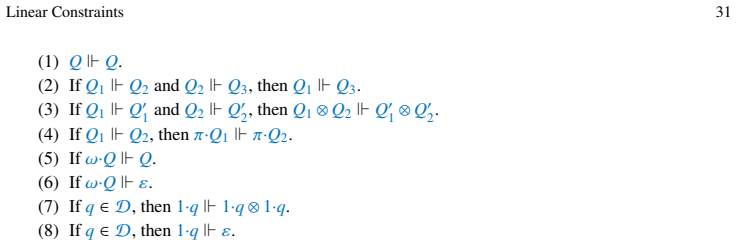
5) Q1 ⊗Q 2 ⊩𝜋·Q 1 ⊗𝜋·Q 2 as required
by C-Tensor Q′ 1 ⊗Q ′ 2 ⊢𝐶 1 ⊗𝐶 2 and by tensoring of the entailment relation (fig. 5) Q1 ⊗Q 2 ⊩𝜋·Q 1 ⊗𝜋·Q 2 as required. C-With We have that𝜋=1 since 𝐶1 &𝐶 2 is not in the image of scaling by𝜔. Therefore we can chooseQ ′ =Qand the result holds trivially. C-Impl In the conclusion of the rule,Qis already of the form 𝜋·Q′, so the result holds trivially □ Le...
-
[2]
⊗1·q By induction hypothesis, Q′ 1 ∧Q ′ 2 ⊩Q ′ 1 and Q′ 1 ∧Q ′ 2 ⊩Q ′
-
[3]
5, gives (Q′ 1 ∧Q ′
Which, tensoring with 1·q according to the rules of fig. 5, gives (Q′ 1 ∧Q ′
-
[4]
⊗1·q⊩Q ′ 1 ⊗1·q and (Q′ 1 ∧Q ′
-
[5]
We conclude by definition ofQ 1 ∧Q 2
⊗1·q⊩Q ′ 2 ⊗1·q. We conclude by definition ofQ 1 ∧Q 2. Inf-DiffLandInf-DiffR These two cases are symmetric, so we’ll prove the case of Inf-DiffL,Inf-DiffLis similar. That is we have •Q 1 =(U 1,L 1 ⊎q)=Q ′ 1 ⊗1·q •Q 1 ∧Q 2 =(Q ′ 1 ∧Q 2) ⊗𝜔·q By induction hypothesisQ′ 1 ∧Q 2 ⊩Q ′ 1 and Q′ 1 ∧Q 2 ⊩Q 2. Now (Q′ 1 ∧Q 2) ⊗𝜔·q⊩ Q2 by the weakening rule of fig. 5...
discussion (0)
Sign in with ORCID, Apple, or X to comment. Anyone can read and Pith papers without signing in.