Recognition: unknown
LightStim: A Framework for QEC Protocol Evaluation and Prototyping with Automated DEM Construction
Pith reviewed 2026-05-09 22:27 UTC · model grok-4.3
The pith
LightStim automates Detector Error Model construction for quantum error correction protocols by maintaining an augmented Pauli tableau during circuit compilation.
A machine-rendered reading of the paper's core claim, the machinery that carries it, and where it could break.
Core claim
By maintaining a Pauli tableau augmented with measurement records concurrently with circuit compilation, the framework constructs the complete set of detectors and observables required for the Detector Error Model of any quantum error correction protocol without protocol-specific input, as confirmed by exact matches in counts and logical error rates to public implementations across memory experiments, distillation circuits, and a novel heterogeneous cross-code lattice surgery design.
What carries the argument
A Pauli tableau augmented with measurement records that is updated in tandem with circuit compilation to automatically identify every detector and observable.
If this is right
- Exact detector and observable counts match those from public implementations for all tested protocols.
- Logical error rates remain consistent in simulations of memory experiments and end-to-end distillation circuits.
- New protocol designs can be prototyped and evaluated without manual DEM construction.
- A unified infrastructure supports systematic comparison across simple and complex quantum error correction schemes.
Where Pith is reading between the lines
- Researchers could test a much larger space of custom error correction schemes without the overhead of hand-crafted annotations.
- The approach may allow direct incorporation of device-specific noise models to produce more realistic performance predictions.
- Systematic sweeps over many protocol variants become practical, potentially revealing hybrid designs that outperform current standards.
Load-bearing premise
That the information captured in the augmented Pauli tableau during compilation is sufficient to identify every detector and observable for arbitrary quantum error correction protocols.
What would settle it
An independently verified manual Detector Error Model for any protocol that produces a different detector count or a different logical error rate when simulated with the framework's output.
Figures



read the original abstract
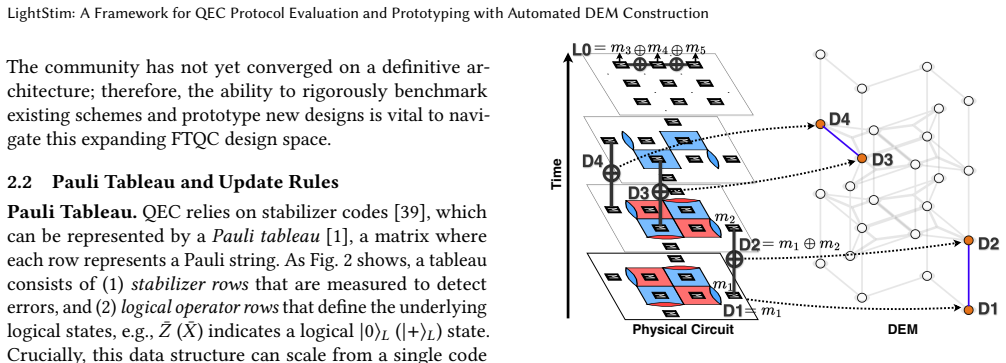
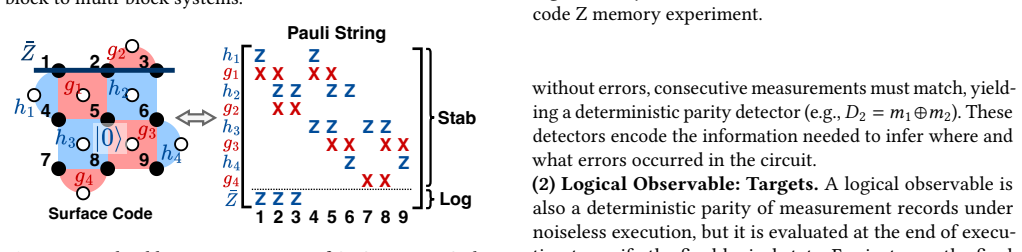
Fault-tolerant quantum computing increasingly demands rigorous, circuit-level evaluation of diverse quantum error correction (QEC) protocols and efficient prototyping of new ones. Such evaluation requires both the physical circuit and its Detector Error Model (DEM) to simulate end-to-end logical error rates. However, DEM construction today is performed by manual annotation, a tedious and error-prone process that effectively limits evaluation to simple memory experiments. We present LightStim, a framework that automates DEM construction concurrently with circuit compilation by maintaining a Pauli tableau augmented with measurement records, with no protocol-specific input required. We benchmark LightStim across protocols from memory experiments to end-to-end distillation circuits; cross-validation against public implementations confirms exact detector and observable counts and consistent logical error rates. LightStim additionally accelerates the exploration of new protocols, which we demonstrate through a novel heterogeneous cross-code lattice surgery design between surface and punctured quantum Reed-Muller codes. These capabilities together make LightStim a unified infrastructure for systematic QEC protocol evaluation and exploration.
Editorial analysis
A structured set of objections, weighed in public.
Referee Report
Summary. The manuscript presents LightStim, a framework that automates construction of Detector Error Models (DEMs) for quantum error correction protocols concurrently with circuit compilation. It maintains a Pauli tableau augmented with measurement records and requires no protocol-specific annotations or manual inputs. The approach is benchmarked on protocols ranging from memory experiments to distillation circuits, with cross-validation against public implementations confirming exact detector and observable counts plus consistent logical error rates. It is further used to prototype a novel heterogeneous cross-code lattice surgery between surface and punctured quantum Reed-Muller codes.
Significance. If the tableau-based construction fully captures all relevant error propagations without omissions, LightStim would substantially lower the barrier to rigorous circuit-level QEC evaluation and enable systematic exploration of complex protocols. The cross-validation on multiple protocols and the concrete demonstration of a new heterogeneous design provide reproducible evidence of utility for the tested cases and constitute a clear strength.
major comments (2)
- [Method section on Pauli tableau] Method section describing the Pauli tableau augmentation with measurement records: the central claim that this procedure yields a complete DEM for arbitrary QEC protocols (including those with mid-circuit measurements, resets, and feed-forward) rests on the assumption that all error propagations are tracked by the tableau updates. No explicit handling is shown for conditional branches or measurement-outcome-dependent logical observables, which could silently omit detectors even when counts match on the reported benchmarks.
- [Validation and cross-code lattice surgery section] Validation and cross-code lattice surgery section: while exact detector/observable counts and consistent logical error rates are reported against public implementations, the manuscript does not detail how the heterogeneous cross-code operations (surface to punctured Reed-Muller) propagate errors across code boundaries or whether additional measurement records are implicitly required. This is load-bearing for the claim of no protocol-specific input.
minor comments (2)
- [Figures and tables] Figure captions and table legends should explicitly state the error model parameters and number of shots used for the logical error rate comparisons to allow direct reproduction.
- [Abstract] The abstract states 'no protocol-specific input required' but the text should clarify whether this includes the absence of any hidden annotations for resets or classical feed-forward in the circuit description language.
Simulated Author's Rebuttal
We thank the referee for their thorough review and constructive feedback on our manuscript. We address each of the major comments below and will incorporate revisions to enhance the clarity and completeness of the presentation.
read point-by-point responses
-
Referee: [Method section on Pauli tableau] Method section describing the Pauli tableau augmentation with measurement records: the central claim that this procedure yields a complete DEM for arbitrary QEC protocols (including those with mid-circuit measurements, resets, and feed-forward) rests on the assumption that all error propagations are tracked by the tableau updates. No explicit handling is shown for conditional branches or measurement-outcome-dependent logical observables, which could silently omit detectors even when counts match on the reported benchmarks.
Authors: We thank the referee for highlighting this important aspect. The augmented Pauli tableau in LightStim is constructed to track error propagations through all operations, including mid-circuit measurements, resets, and feed-forward, by maintaining measurement records that capture outcome dependencies. However, we agree that the manuscript would benefit from more explicit description. In the revised version, we will add a new subsection in the Methods section explaining the handling of conditional branches and outcome-dependent observables. This will include pseudocode or a small example demonstrating that all relevant detectors are captured without omissions. We believe this will address the concern while maintaining the no-protocol-specific-input design. revision: yes
-
Referee: [Validation and cross-code lattice surgery section] Validation and cross-code lattice surgery section: while exact detector/observable counts and consistent logical error rates are reported against public implementations, the manuscript does not detail how the heterogeneous cross-code operations (surface to punctured Reed-Muller) propagate errors across code boundaries or whether additional measurement records are implicitly required. This is load-bearing for the claim of no protocol-specific input.
Authors: We appreciate the referee pointing out the need for greater detail in the cross-code lattice surgery demonstration. The LightStim framework handles cross-code operations by extending the measurement records across the boundary without requiring manual annotations, as the tableau augmentation is uniform. To strengthen this, we will revise the relevant section to provide a detailed breakdown of error propagation in the heterogeneous surgery, specifying the measurement records involved for interfacing the surface code with the punctured quantum Reed-Muller code. This will explicitly show that no additional protocol-specific inputs are needed beyond the circuit description. revision: yes
Circularity Check
No circularity: algorithmic DEM construction is a self-contained procedure validated against independent public implementations
full rationale
The paper describes LightStim as an algorithmic procedure that maintains a Pauli tableau augmented with measurement records during circuit compilation to automatically produce the DEM, requiring no protocol-specific input. This is presented as a direct implementation of standard Pauli tracking and measurement bookkeeping rather than a derivation that reduces to fitted parameters, self-definitions, or prior self-citations. Benchmarking relies on cross-validation against separate public implementations, which independently confirm detector/observable counts and logical error rates; this constitutes external evidence rather than self-referential support. No load-bearing steps invoke uniqueness theorems from the same authors, smuggle ansatzes via citation, or rename known results as new predictions. The skeptic concern about possible missed error propagations in complex protocols is a question of algorithmic completeness and correctness, not circularity in the reported construction.
Axiom & Free-Parameter Ledger
axioms (2)
- domain assumption Pauli errors dominate and can be tracked via tableau methods in quantum circuits
- domain assumption Measurement records suffice to identify all detectors without protocol-specific rules
invented entities (1)
-
LightStim framework
no independent evidence
Forward citations
Cited by 1 Pith paper
-
Analytical and Compressed Simulation of Noisy Stabilizer Circuits
Closed-form expressions and circuit compression enable efficient strong and weak simulation of noisy stabilizer circuits with non-deterministic measurements.
Reference graph
Works this paper leans on
-
[1]
Improved simulation of sta- bilizer circuits.Physical Review A—Atomic, Molecular, and Optical Physics, 70(5):052328, 2004
Scott Aaronson and Daniel Gottesman. Improved simulation of sta- bilizer circuits.Physical Review A—Atomic, Molecular, and Optical Physics, 70(5):052328, 2004
2004
-
[2]
Hastings, Vadym Kli- uchnikov, Juan M
David Aasen, Matthew B Hastings, Vadym Kliuchnikov, Juan M Bello- Rivas, Adam Paetznick, Rui Chao, Ben W Reichardt, Matt Zanner, Marcus P da Silva, Zhenghan Wang, et al. A topologically fault- tolerant quantum computer with four dimensional geometric codes. arXiv preprint arXiv:2506.15130, 2025
-
[3]
An- dersen, Markus Ansmann, Frank Arute, Kunal Arya, Abraham As- faw, Nikita Astrakhantsev, Juan Atalaya, Ryan Babbush, Dave Bacon, Brian Ballard, Joseph C
Rajeev Acharya, Laleh Aghababaie-Beni, Igor Aleiner, Trond I. An- dersen, Markus Ansmann, Frank Arute, Kunal Arya, Abraham As- faw, Nikita Astrakhantsev, Juan Atalaya, Ryan Babbush, Dave Bacon, Brian Ballard, Joseph C. Bardin, Johannes Bausch, Andreas Bengtsson, Alexander Bilmes, Sam Blackwell, Sergio Boixo, Gina Bortoli, Alexan- dre Bourassa, Jenna Bovai...
2024
-
[4]
A perspective on quantum com- puting applications in quantum chemistry using 25–100 logical qubits
Yuri Alexeev, Victor S Batista, Nicholas Bauman, Luke Bertels, Daniel Claudino, Rishab Dutta, Laura Gagliardi, Scott Godwin, Niranjan Govind, Martin Head-Gordon, et al. A perspective on quantum com- puting applications in quantum chemistry using 25–100 logical qubits. arXiv preprint arXiv:2506.19337, 2025
-
[5]
Quantum algorithms for quantum chemistry and quantum materials science.Chemical reviews, 120(22):12685–12717, 2020
Bela Bauer, Sergey Bravyi, Mario Motta, and Garnet Kin-Lic Chan. Quantum algorithms for quantum chemistry and quantum materials science.Chemical reviews, 120(22):12685–12717, 2020
2020
-
[6]
Automatic differentiation in machine learn- ing: a survey.Journal of machine learning research, 18(153):1–43, 2018
Atilim Gunes Baydin, Barak A Pearlmutter, Alexey Andreyevich Radul, and Jeffrey Mark Siskind. Automatic differentiation in machine learn- ing: a survey.Journal of machine learning research, 18(153):1–43, 2018
2018
-
[7]
Ilya Besedin, Michael Kerschbaum, Jonathan Knoll, Ian Hesner, Lukas Bödeker, Luis Colmenarez, Luca Hofele, Nathan Lacroix, Christoph Hellings, François Swiadek, et al. Realizing lattice surgery on two distance-three repetition codes with superconducting qubits.arXiv preprint arXiv:2501.04612, 2025
-
[8]
Logical quantum processor based on reconfigurable atom arrays.Nature, 626(7997):58–65, 2024
Dolev Bluvstein, Simon J Evered, Alexandra A Geim, Sophie H Li, Hengyun Zhou, Tom Manovitz, Sepehr Ebadi, Madelyn Cain, Marcin Kalinowski, Dominik Hangleiter, et al. Logical quantum processor based on reconfigurable atom arrays.Nature, 626(7997):58–65, 2024
2024
-
[9]
Dolev Bluvstein, Alexandra A Geim, Sophie H Li, Simon J Evered, J Ataides, Gefen Baranes, Andi Gu, Tom Manovitz, Muqing Xu, Marcin Kalinowski, et al. Architectural mechanisms of a universal fault- tolerant quantum computer.arXiv preprint arXiv:2506.20661, 2025
-
[10]
High-threshold and low-overhead fault-tolerant quantum memory.Nature, 627(8005):778–782, 2024
Sergey Bravyi, Andrew W Cross, Jay M Gambetta, Dmitri Maslov, Patrick Rall, and Theodore J Yoder. High-threshold and low-overhead fault-tolerant quantum memory.Nature, 627(8005):778–782, 2024
2024
-
[11]
Magic-state distillation with low overhead.Physical Review A—Atomic, Molecular, and Optical Physics, 86(5):052329, 2012
Sergey Bravyi and Jeongwan Haah. Magic-state distillation with low overhead.Physical Review A—Atomic, Molecular, and Optical Physics, 86(5):052329, 2012
2012
-
[12]
Universal quantum computation with ideal clifford gates and noisy ancillas.Physical Review A—Atomic, Molecular, and Optical Physics, 71(2):022316, 2005
Sergey Bravyi and Alexei Kitaev. Universal quantum computation with ideal clifford gates and noisy ancillas.Physical Review A—Atomic, Molecular, and Optical Physics, 71(2):022316, 2005. 12 LightStim: A Framework for QEC Protocol Evaluation and Prototyping with Automated DEM Construction
2005
-
[13]
Quantum codes on a lattice with boundary
Sergey B Bravyi and A Yu Kitaev. Quantum codes on a lattice with boundary.arXiv preprint quant-ph/9811052, 1998
work page Pith review arXiv 1998
-
[14]
Fold-transversal clifford gates for quantum codes.Quantum, 8:1372, 2024
Nikolas P Breuckmann and Simon Burton. Fold-transversal clifford gates for quantum codes.Quantum, 8:1372, 2024
2024
-
[15]
Fast correlated decoding of transversal logical algorithms,
Madelyn Cain, Dolev Bluvstein, Chen Zhao, Shouzhen Gu, Nishad Maskara, Marcin Kalinowski, Alexandra A Geim, Aleksander Kubica, Mikhail D Lukin, and Hengyun Zhou. Fast correlated decoding of transversal logical algorithms.arXiv preprint arXiv:2505.13587, 2025
-
[16]
Correlated decoding of logical algorithms with transversal gates.Physical Review Letters, 133(24):240602, 2024
Madelyn Cain, Chen Zhao, Hengyun Zhou, Nadine Meister, J Pablo Bonilla Ataides, Arthur Jaffe, Dolev Bluvstein, and Mikhail D Lukin. Correlated decoding of logical algorithms with transversal gates.Physical Review Letters, 133(24):240602, 2024
2024
-
[17]
Quantum chemistry in the age of quantum computing.Chemical reviews, 119(19):10856–10915, 2019
Yudong Cao, Jonathan Romero, Jonathan P Olson, Matthias Degroote, Peter D Johnson, Mária Kieferová, Ian D Kivlichan, Tim Menke, Borja Peropadre, Nicolas PD Sawaya, et al. Quantum chemistry in the age of quantum computing.Chemical reviews, 119(19):10856–10915, 2019
2019
-
[18]
Quantum error correction with only two extra qubits.Physical review letters, 121(5):050502, 2018
Rui Chao and Ben W Reichardt. Quantum error correction with only two extra qubits.Physical review letters, 121(5):050502, 2018
2018
-
[19]
Zi-Han Chen, Ming-Cheng Chen, Chao-Yang Lu, and Jian-Wei Pan. Transversal logical clifford gates on rotated surface codes with re- configurable neutral atom arrays.arXiv preprint arXiv:2412.01391, 2024
-
[20]
Cowtan, SSIP: automated surgery with quantum LDPC codes, arXiv preprint arXiv:2407.09423 (2024)
Alexander Cowtan. Ssip: automated surgery with quantum ldpc codes. arXiv preprint arXiv:2407.09423, 2024
-
[21]
Css code surgery as a universal construction.Quantum, 8:1344, 2024
Alexander Cowtan and Simon Burton. Css code surgery as a universal construction.Quantum, 8:1344, 2024
2024
-
[22]
Alexander Cowtan, Zhiyang He, Dominic J Williamson, and Theodore J Yoder. Parallel logical measurements via quantum code surgery.arXiv preprint arXiv:2503.05003, 2025
work page internal anchor Pith review arXiv 2025
-
[23]
Lucas Daguerre, Robin Blume-Kohout, Natalie C Brown, David Hayes, and Isaac H Kim. Experimental demonstration of high-fidelity logical magic states from code switching.arXiv preprint arXiv:2506.14169, 2025
-
[24]
Practical quantum advantage in quantum simulation.Nature, 607(7920):667–676, 2022
Andrew J Daley, Immanuel Bloch, Christian Kokail, Stuart Flannigan, Natalie Pearson, Matthias Troyer, and Peter Zoller. Practical quantum advantage in quantum simulation.Nature, 607(7920):667–676, 2022
2022
-
[25]
Break- ing even with magic: Demonstration of a high-fidelity logical non-Clifford gate
Shival Dasu, Simon Burton, Karl Mayer, David Amaro, Justin A Gerber, Kevin Gilmore, Dan Gresh, Davide DelVento, Andrew C Potter, and David Hayes. Breaking even with magic: demonstration of a high- fidelity logical non-clifford gate.arXiv preprint arXiv:2506.14688, 2025
-
[26]
Spacetime codes of clifford circuits, 2023
Nicolas Delfosse and Adam Paetznick. Spacetime codes of clifford circuits, 2023
2023
-
[27]
Topo- logical quantum memory.Journal of Mathematical Physics, 43(9):4452– 4505, 2002
Eric Dennis, Alexei Kitaev, Andrew Landahl, and John Preskill. Topo- logical quantum memory.Journal of Mathematical Physics, 43(9):4452– 4505, 2002
2002
-
[28]
arXiv preprint arXiv:1808.06709 , year=
Austin G Fowler and Craig Gidney. Low overhead quantum computa- tion using lattice surgery.arXiv preprint arXiv:1808.06709, 2018
-
[29]
Surface codes: Towards practical large-scale quantum com- putation.Physical Review A, 86(3):032324, 2012
Austin G Fowler, Matteo Mariantoni, John M Martinis, and Andrew N Cleland. Surface codes: Towards practical large-scale quantum com- putation.Physical Review A, 86(3):032324, 2012
2012
-
[30]
Stim: a fast stabilizer circuit simulator.Quantum, 5:497, 2021
Craig Gidney. Stim: a fast stabilizer circuit simulator.Quantum, 5:497, 2021
2021
-
[31]
How to factor 2048 bit RSA integers with less than a million noisy qubits
Craig Gidney. How to factor 2048 bit rsa integers with less than a million noisy qubits.arXiv preprint arXiv:2505.15917, 2025
work page internal anchor Pith review arXiv 2048
-
[32]
How to factor 2048 bit rsa integers in 8 hours using 20 million noisy qubits.Quantum, 5:433, 2021
Craig Gidney and Martin Ekerå. How to factor 2048 bit rsa integers in 8 hours using 20 million noisy qubits.Quantum, 5:433, 2021
2048
-
[33]
New circuits and an open source decoder for the color code , publisher =
Craig Gidney and Cody Jones. New circuits and an open source decoder for the color code.arXiv preprint arXiv:2312.08813, 2023
-
[34]
Magic state cultivation: growing T states as cheap as CNOT gates
Craig Gidney, Noah Shutty, and Cody Jones. Magic state cultivation: growing t states as cheap as cnot gates.arXiv preprint arXiv:2409.17595, 2024
work page internal anchor Pith review arXiv 2024
-
[35]
SlidingWindowDecoder: BB code circuit construction
Anqi Gong. SlidingWindowDecoder: BB code circuit construction. https://github.com/gongaa/SlidingWindowDecoder, 2023
2023
-
[36]
Toward Low-latency Iterative Decoding of QLDPC Codes Under Circuit-Level Noise,
Anqi Gong, Sebastian Cammerer, and Joseph M Renes. Toward low- latency iterative decoding of qldpc codes under circuit-level noise. arXiv preprint arXiv:2403.18901, 2024
-
[37]
Computation with quantum reed-muller codes and their mapping onto 2d atom arrays,
Anqi Gong and Joseph M Renes. Computation with quantum reed- muller codes and their mapping onto 2d atom arrays.arXiv preprint arXiv:2410.23263, 2024
-
[38]
Suppressing quantum errors by scaling a surface code logical qubit.Nature, 614(7949):676–681, 2023
Google Quantum AI. Suppressing quantum errors by scaling a surface code logical qubit.Nature, 614(7949):676–681, 2023
2023
-
[39]
Cali- fornia Institute of Technology, 1997
Daniel Gottesman.Stabilizer codes and quantum error correction. Cali- fornia Institute of Technology, 1997
1997
-
[40]
The Heisenberg representation of quantum com- puters
Daniel Gottesman. The Heisenberg representation of quantum com- puters. InProceedings of the XXII International Colloquium on Group Theoretical Methods in Physics, 1998
1998
-
[41]
An introduction to quantum error correction
Daniel Gottesman. An introduction to quantum error correction. In Proceedings of Symposia in Applied Mathematics, volume 58, pages 221–236, 2002
2002
-
[42]
Fault-tolerant quantum computa- tion with constant overhead,
Daniel Gottesman. Fault-tolerant quantum computation with constant overhead.arXiv preprint arXiv:1310.2984, 2013
-
[43]
Daniel Gottesman. Opportunities and challenges in fault-tolerant quantum computation.arXiv preprint arXiv:2210.15844, 2022
-
[44]
Demonstrating the viability of universal quantum computation using teleportation and single-qubit operations.Nature, 402(6760):390–393, 1999
Daniel Gottesman and Isaac L Chuang. Demonstrating the viability of universal quantum computation using teleportation and single-qubit operations.Nature, 402(6760):390–393, 1999
1999
-
[45]
Dynamically generated logical qubits.Quantum, 5:564, 2021
Matthew B Hastings and Jeongwan Haah. Dynamically generated logical qubits.Quantum, 5:564, 2021
2021
-
[46]
Pymatching: A python package for decoding quantum codes with minimum-weight perfect matching.ACM Transactions on Quantum Computing, 3(3):1–16, 2022
Oscar Higgott. Pymatching: A python package for decoding quantum codes with minimum-weight perfect matching.ACM Transactions on Quantum Computing, 3(3):1–16, 2022
2022
-
[47]
PhD thesis, UCL (University College London), 2024
Oscar Higgott.Practical and Efficient Quantum Error Correction. PhD thesis, UCL (University College London), 2024
2024
- [48]
-
[49]
Surface code quantum computing by lattice surgery.New Journal of Physics, 14(12):123011, 2012
Clare Horsman, Austin G Fowler, Simon Devitt, and Rodney Van Meter. Surface code quantum computing by lattice surgery.New Journal of Physics, 14(12):123011, 2012
2012
-
[50]
Quantum error correction with metastable states of trapped ions using erasure conversion.PRX Quantum, 4(2):020358, 2023
Mingyu Kang, Wesley C Campbell, and Kenneth R Brown. Quantum error correction with metastable states of trapped ions using erasure conversion.PRX Quantum, 4(2):020358, 2023
2023
-
[51]
Magic State Injection on IBM Quantum Processors Above the Distillation Threshold
Younghun Kim, Martin Sevior, and Muhammad Usman. Magic state injection on ibm quantum processors above the distillation threshold. arXiv preprint arXiv:2412.01446, 2024
work page internal anchor Pith review Pith/arXiv arXiv 2024
-
[52]
Fault-tolerant quantum computation by anyons.Annals of physics, 303(1):2–30, 2003
A Yu Kitaev. Fault-tolerant quantum computation by anyons.Annals of physics, 303(1):2–30, 2003
2003
-
[53]
Emanuel Knill, Raymond Laflamme, and Wojciech Zurek. Threshold accuracy for quantum computation.arXiv preprint quant-ph/9610011, 1996
-
[54]
Entangling logical qubits without physical op- erations,
Jin Ming Koh, Anqi Gong, Andrei C Diaconu, Daniel Bochen Tan, Alexandra A Geim, Michael J Gullans, Norman Y Yao, Mikhail D Lukin, and Shayan Majidy. Entangling logical qubits without physical operations.arXiv preprint arXiv:2601.20927, 2026
-
[55]
Scaling and logic in the colour code on a superconducting quantum processor.Nature, 645(8081):614–619, 2025
Nathan Lacroix, Alexandre Bourassa, Francisco JH Heras, Lei M Zhang, Johannes Bausch, Andrew W Senior, Thomas Edlich, Noah Shutty, Volodymyr Sivak, Andreas Bengtsson, et al. Scaling and logic in the colour code on a superconducting quantum processor.Nature, 645(8081):614–619, 2025
2025
-
[56]
Magic state injection on the rotated surface code
Lingling Lao and Ben Criger. Magic state injection on the rotated surface code. InProceedings of the 19th ACM International Conference on Computing Frontiers, pages 113–120, 2022
2022
-
[57]
A magic state’s fidelity can be superior to the operations that created it.New Journal of Physics, 17(2):023037, 2015
Ying Li. A magic state’s fidelity can be superior to the operations that created it.New Journal of Physics, 17(2):023037, 2015
2015
-
[58]
A game of surface codes: Large-scale quantum com- puting with lattice surgery.Quantum, 3:128, 2019
Daniel Litinski. A game of surface codes: Large-scale quantum com- puting with lattice surgery.Quantum, 3:128, 2019. 13 Xiang Fang1, Ming Wang2, Yue Wu3, Sharanya Prabhu1, Dean Tullsen1, Narasinga Rao Miniskar4, Frank Mueller2, Travis Humble4, Yufei Ding1
2019
-
[59]
Magic state distillation: Not as costly as you think
Daniel Litinski. Magic state distillation: Not as costly as you think. Quantum, 3:205, 2019
2019
-
[60]
Toward end-to-end quantum simulation for protein dynamics.arXiv preprint arXiv:2411.03972, 2024
Zhenning Liu, Xiantao Li, Chunhao Wang, and Jin-Peng Liu. Toward end-to-end quantum simulation for protein dynamics.arXiv preprint arXiv:2411.03972, 2024
-
[61]
Decoding correlated errors in quantum ldpc codes.Nature Communications, 2026
Arshpreet Singh Maan, Francisco Miguel Garcia Herrero, Alexandru Paler, and Valentin Savin. Decoding correlated errors in quantum ldpc codes.Nature Communications, 2026
2026
-
[62]
Computing ef- ficiently in qldpc codes,
Alexander J Malcolm, Andrew N Glaudell, Patricio Fuentes, Daryus Chandra, Alexis Schotte, Colby DeLisle, Rafael Haenel, Amir Ebrahimi, Joschka Roffe, Armanda O Quintavalle, et al. Computing efficiently in qldpc codes.arXiv preprint arXiv:2502.07150, 2025
-
[63]
Karl Mayer, Ciarán Ryan-Anderson, Natalie Brown, Elijah Durso- Sabina, Charles H Baldwin, David Hayes, Joan M Dreiling, Cameron Foltz, John P Gaebler, Thomas M Gatterman, et al. Benchmarking logi- cal three-qubit quantum fourier transform encoded in the steane code on a trapped-ion quantum computer.arXiv preprint arXiv:2404.08616, 2024
-
[64]
CUDA-Q — NVIDIA CUDA-Q documentation.https://nvidia
NVIDIA. CUDA-Q — NVIDIA CUDA-Q documentation.https://nvidia. github.io/cuda-quantum/latest/index.html, 2025. Accessed: 2025-08- 02
2025
-
[65]
Degenerate quantum ldpc codes with good finite length performance.Quantum, 5:585, 2021
Pavel Panteleev and Gleb Kalachev. Degenerate quantum ldpc codes with good finite length performance.Quantum, 5:585, 2021
2021
-
[66]
Pytorch: An imperative style, high- performance deep learning library.Advances in neural information processing systems, 32, 2019
Adam Paszke, Sam Gross, Francisco Massa, Adam Lerer, James Bradbury, Gregory Chanan, Trevor Killeen, Zeming Lin, Natalia Gimelshein, Luca Antiga, et al. Pytorch: An imperative style, high- performance deep learning library.Advances in neural information processing systems, 32, 2019
2019
-
[67]
PhD thesis, ETH Zurich, 2020
Natalie J Pearson.Simulating Many-Body Quantum Systems: Quantum Algorithms and Experimental Realisation. PhD thesis, ETH Zurich, 2020
2020
-
[68]
Demonstration of fault-tolerant steane quantum error correction.PRX Quantum, 5(3):030326, 2024
Lukas Postler, Friederike Butt, Ivan Pogorelov, Christian D Marciniak, Sascha Heußen, Rainer Blatt, Philipp Schindler, Manuel Rispler, Markus Müller, and Thomas Monz. Demonstration of fault-tolerant steane quantum error correction.PRX Quantum, 5(3):030326, 2024
2024
-
[69]
Marciniak, Roman Stricker, Martin Ringbauer, Rainer Blatt, Philipp Schindler, Markus Müller, and Thomas Monz
Lukas Postler, Sascha Heußen, Ivan Pogorelov, Manuel Rispler, Thomas Feldker, Michael Meth, Christian D. Marciniak, Roman Stricker, Martin Ringbauer, Rainer Blatt, Philipp Schindler, Markus Müller, and Thomas Monz. Demonstration of fault-tolerant universal quantum gate operations.Nature, 605(7911):675–680, 2022
2022
-
[70]
Beyond nisq: The megaquop machine, 2025
John Preskill. Beyond nisq: The megaquop machine, 2025
2025
-
[71]
Open-source code for Lat- tice Surgery in Stim.https://quantumcomputing.stackexchange.com/ questions/39276/open-source-code-for-lattice-surgery-in-stim, 2024
Quantum Computing Stack Exchange. Open-source code for Lat- tice Surgery in Stim.https://quantumcomputing.stackexchange.com/ questions/39276/open-source-code-for-lattice-surgery-in-stim, 2024. Accessed: 2026-04-04
2024
-
[72]
Reichardt, Adam Paetznick, David Aasen, Ivan Basov, Juan M
BW Reichardt, A Paetznick, D Aasen, I Basov, JM Bello-Rivas, P Bon- derson, R Chao, W van Dam, MB Hastings, A Paz, et al. Logical computation demonstrated with a neutral atom quantum processor. arXiv preprint arXiv:2411.11822, 2024
-
[73]
Pedro Sales Rodriguez, John M. Robinson, Paul Niklas Jepsen, Zhiyang He, Casey Duckering, Chen Zhao, Kai-Hsin Wu, Joseph Campo, Kevin Bagnall, Minho Kwon, Thomas Karolyshyn, Phillip Weinberg, Made- lyn Cain, Simon J. Evered, Alexandra A. Geim, Marcin Kalinowski, Sophie H. Li, Tom Manovitz, Jesse Amato-Grill, James I. Basham, Liane Bernstein, Boris Braverm...
-
[74]
De- coding across the quantum low-density parity-check code landscape
Joschka Roffe, David R White, Simon Burton, and Earl Campbell. De- coding across the quantum low-density parity-check code landscape. Physical Review Research, 2(4):043423, 2020
2020
-
[75]
Fault-tolerant quantum computation
Peter W Shor. Fault-tolerant quantum computation. InProceedings of 37th conference on foundations of computer science, pages 56–65. IEEE, 1996
1996
-
[76]
Transversal Fault Tolerant Distributed Quantum Computing Operations
John Stack, Ming Wang, and Frank Mueller. Assessing teleportation of logical qubits in a distributed quantum architecture under error correction.arXiv preprint arXiv:2504.05611, 2025
work page internal anchor Pith review Pith/arXiv arXiv 2025
-
[77]
Quantum reed-muller codes.IEEE Transactions on Information Theory, 45(5):1701–1703, 2002
Andrew M Steane. Quantum reed-muller codes.IEEE Transactions on Information Theory, 45(5):1701–1703, 2002
2002
-
[78]
tqec: A python package for topological quan- tum error correction.Journal of Open Source Software, 11(120):9142, 2026
Adrien Suau, Yiming Zhang, Purva Thakre, Yilun Zhao, Kabir Dubey, Jose A Bolanos, Arabella Schelpe, Tianyi Hao, Philip Seitz, Gian Gia- como Guerreschi, et al. tqec: A python package for topological quan- tum error correction.Journal of Open Source Software, 11(120):9142, 2026
2026
-
[79]
qLDPC: Tools for constructing and analyz- ing quantum low density parity check codes.https://github.com/ qLDPCOrg/qLDPC, 2024
The qLDPC Developers. qLDPC: Tools for constructing and analyz- ing quantum low density parity check codes.https://github.com/ qLDPCOrg/qLDPC, 2024. Accessed: 2026-04-04
2024
-
[80]
Stim: A fast stabilizer circuit library
The Quantumlib Developers. Stim: A fast stabilizer circuit library. https://github.com/quantumlib/Stim, 2021. Accessed: 2026-04-11
2021
discussion (0)
Sign in with ORCID, Apple, or X to comment. Anyone can read and Pith papers without signing in.