Recognition: unknown
A Thin Sheet Volume Integral Equation Solver for Simulation of Bianisotropic Metasurfaces
Pith reviewed 2026-05-08 13:07 UTC · model grok-4.3
The pith
A thin-sheet volume integral equation solver models bianisotropic metasurfaces while enforcing all components of the generalized sheet transition conditions.
A machine-rendered reading of the paper's core claim, the machinery that carries it, and where it could break.
Core claim
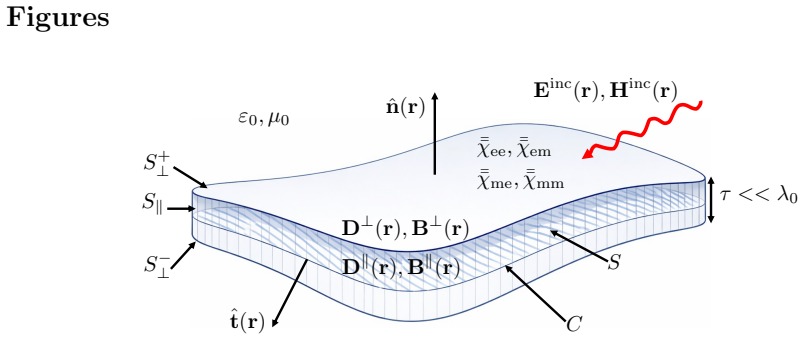
The paper presents a thin-sheet volume integral equation formulation that incorporates generalized sheet transition conditions for three-dimensional bianisotropic metasurfaces. The metasurface is treated as an equivalent thin sheet with constitutive tensors derived from the GSTC susceptibility tensors. This reduces the volume integral equations to surface integral equations where tangential and normal flux density components are handled as separate unknowns using appropriate basis functions. The approach enforces the bianisotropic GSTCs fully, including normal field effects, while maintaining the flux-based nature of the volume integral equation formulation.
What carries the argument
The thin-sheet approximation applied to the volume integral equation, which derives constitutive tensors from GSTC susceptibility tensors and discretizes tangential and normal flux densities separately with Rao-Wilton-Glisson and pulse basis functions to enforce the transition conditions.
If this is right
- Enables simulation of polarization rotation and perfect reflection in bianisotropic metasurfaces.
- Supports accurate modeling of multi-directional attenuation and oblique phase-shift transformations.
- Preserves the computational character of flux-based volume integral equations while adding surface reduction.
- Allows treatment of both tangential and normal field interactions within a single consistent framework.
Where Pith is reading between the lines
- The formulation could be paired with existing integral-equation codes to handle metasurfaces embedded in larger three-dimensional structures.
- It points toward efficiency gains when normal-component effects dominate, such as in dense arrays at oblique angles.
- Similar thin-sheet reductions might apply to time-varying or nonlinear metasurface problems if the susceptibility tensors can be updated dynamically.
Load-bearing premise
The metasurface thickness is negligible compared to the wavelength so the thin-sheet approximation accurately captures the structure through equivalent constitutive parameters without thickness-related errors.
What would settle it
Direct numerical comparison of the solver outputs against a full three-dimensional volume integral equation discretization or laboratory measurements on a metasurface with strong normal electric and magnetic field couplings would test the accuracy of the reduced formulation.
Figures


read the original abstract
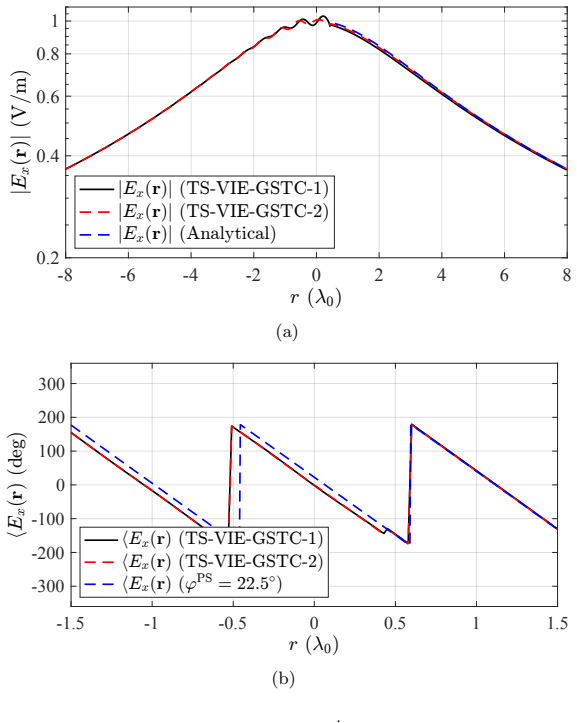
A thin-sheet (TS) volume integral equation (VIE) formulation incorporating generalized sheet transition conditions (GSTCs) is presented for the simulation of three-dimensional (3D) bianisotropic metasurfaces. The metasurface is represented as an equivalent TS, with its constitutive tensors derived from the GSTC susceptibility tensors. Invoking the TS approximation, the governing VIEs are reduced to surface integral equations (SIEs), in which tangential and normal flux density components are treated as distinct sets of unknowns and discretized using Rao-Wilton-Glisson and pulse basis functions, respectively. In contrast to conventional GSTC approaches based on conventional SIEs, which represent only tangential fields, the proposed framework rigorously enforces the bianisotropic GSTCs, including normal field interactions, while retaining the flux-based VIE character of the formulation. Numerical examples demonstrate the accuracy and robustness of the proposed TS-VIE-GSTC solver for polarization rotation, perfect reflection, multi-directional attenuation, and oblique phase-shift transformation.
Editorial analysis
A structured set of objections, weighed in public.
Referee Report
Summary. The paper presents a thin-sheet (TS) volume integral equation (VIE) formulation for 3D bianisotropic metasurfaces that incorporates generalized sheet transition conditions (GSTCs). The metasurface is modeled as an equivalent thin sheet whose constitutive tensors are derived from GSTC susceptibility tensors. The governing VIEs are reduced to surface integral equations (SIEs) under the TS approximation, with tangential flux densities discretized via Rao-Wilton-Glisson (RWG) basis functions and normal components via pulse basis functions. This is claimed to rigorously enforce the full bianisotropic GSTCs, including normal-field interactions, while preserving the flux-based VIE character. Numerical examples illustrate performance on polarization rotation, perfect reflection, multi-directional attenuation, and oblique phase-shift transformation.
Significance. If the central reduction is shown to be rigorous, the method would provide a flux-based SIE framework that includes normal-component coupling in bianisotropic GSTCs, addressing a limitation of conventional tangential-only SIE-GSTC approaches. This could improve accuracy for metasurfaces where normal fields contribute meaningfully to the jump conditions. The retention of VIE flux character and use of standard RWG/pulse bases are practical strengths, but the overall significance hinges on explicit validation that the zero-thickness limit and discretization commute with the GSTC operator.
major comments (2)
- [§3] §3 (formulation and thin-sheet reduction): The claim that the TS-VIE reduction to SIE 'rigorously enforces the bianisotropic GSTCs, including normal field interactions' requires an explicit interchange-of-limits argument. The pulse-basis discretization of normal D/B fluxes does not automatically guarantee that the distributional singular behavior in the zero-thickness limit reproduces the full GSTC jump conditions (including normal-component coupling). Conventional tangential SIE-GSTC methods avoid this by construction; the added normal unknowns constitute the novel step whose correctness is not demonstrated.
- [Numerical examples] Numerical examples section: Accuracy is asserted via polarization-rotation and phase-shift cases, but no quantitative error norms, convergence rates with respect to mesh density, or comparisons against either full 3D VIE or analytical GSTC solutions are reported. Without these, it is impossible to confirm that the thin-sheet approximation and normal-component discretization do not introduce uncontrolled errors for the claimed applications.
minor comments (2)
- [§2] The definitions of the equivalent constitutive tensors (derived from GSTC susceptibilities) should be stated explicitly with component-wise expressions rather than left as 'derived from'.
- [Numerical examples] Figure captions and axis labels in the numerical results should include the specific discretization parameters (number of RWG/pulse unknowns) used for each example to allow reproducibility.
Simulated Author's Rebuttal
We thank the referee for the detailed and constructive review of our manuscript. Below we respond point by point to the major comments, indicating the revisions we will incorporate.
read point-by-point responses
-
Referee: [§3] §3 (formulation and thin-sheet reduction): The claim that the TS-VIE reduction to SIE 'rigorously enforces the bianisotropic GSTCs, including normal field interactions' requires an explicit interchange-of-limits argument. The pulse-basis discretization of normal D/B fluxes does not automatically guarantee that the distributional singular behavior in the zero-thickness limit reproduces the full GSTC jump conditions (including normal-component coupling). Conventional tangential SIE-GSTC methods avoid this by construction; the added normal unknowns constitute the novel step whose correctness is not demonstrated.
Authors: We appreciate the referee highlighting the need for greater explicitness in the limiting argument. The derivation in §3 integrates the VIEs across the vanishing thickness while substituting the GSTC jump relations (derived from the susceptibility tensors) for both tangential and normal components; this substitution directly encodes the full bianisotropic conditions, including normal-flux coupling, before discretization. The pulse bases are selected precisely because they are constant across the infinitesimal thickness, preserving the distributional character of the jumps. Nevertheless, we agree that an explicit interchange-of-limits paragraph would strengthen the presentation. In the revised manuscript we will insert a short subsection after Eq. (12) that (i) states the sequence of operations (integrate first, then take thickness to zero, then discretize), (ii) shows that the normal-component unknowns remain bounded and the singular kernels reduce to the GSTC surface terms, and (iii) notes that the RWG/pulse choice is consistent with the same limiting process used in the tangential-only literature. This addition addresses the concern without altering the underlying formulation. revision: partial
-
Referee: [Numerical examples] Numerical examples section: Accuracy is asserted via polarization-rotation and phase-shift cases, but no quantitative error norms, convergence rates with respect to mesh density, or comparisons against either full 3D VIE or analytical GSTC solutions are reported. Without these, it is impossible to confirm that the thin-sheet approximation and normal-component discretization do not introduce uncontrolled errors for the claimed applications.
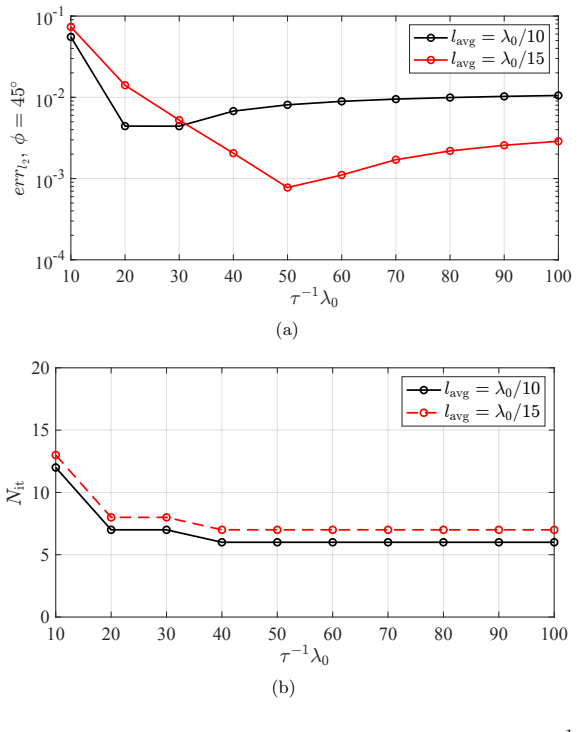
Authors: We concur that quantitative validation metrics are essential. In the revised Numerical Examples section we will add: (a) L2-norm error curves versus mesh density (number of RWG and pulse elements) for the polarization-rotation and oblique phase-shift examples; (b) direct comparison, where closed-form GSTC solutions exist, between the computed surface fields and the analytical jumps; and (c) for the perfect-reflection case, a side-by-side comparison of the TS-VIE-GSTC results against a reference full 3D VIE simulation performed with the same constitutive parameters but finite (yet small) thickness. These additions will be presented in new figures and tables, allowing the reader to assess both the convergence rate and the magnitude of the thin-sheet approximation error. revision: yes
Circularity Check
No significant circularity; derivation is self-contained from standard VIE and GSTC starting points
full rationale
The paper starts from established volume integral equations for bianisotropic media and the generalized sheet transition conditions, then applies the thin-sheet approximation to collapse the VIEs into SIEs while retaining flux densities as unknowns. Tangential and normal components are discretized separately with standard RWG and pulse bases as a direct consequence of the flux-based character. No load-bearing step reduces a prediction to a fitted input, renames a known result, or relies on a self-citation chain whose validity is presupposed by the present work; the claim of enforcing full bianisotropic GSTCs including normal interactions follows from the retained formulation without self-referential definition or interchange-of-limits assumptions that collapse to the inputs.
Axiom & Free-Parameter Ledger
axioms (2)
- standard math Maxwell's equations govern the electromagnetic fields in the volume and on the equivalent thin sheet.
- domain assumption The metasurface thickness is negligible compared to wavelength, justifying the thin-sheet reduction from VIE to SIE.
Reference graph
Works this paper leans on
-
[1]
A low-profile high-gain and wideband filtering antenna with metasurface,
Y. M. Pan, P. F. Hu, X. Y. Zhang, and S. Y. Zheng, “A low-profile high-gain and wideband filtering antenna with metasurface,”IEEE Trans. Antennas Propag., vol. 64, no. 5, pp. 2010– 2016, 2016
2010
-
[2]
Multibeam by metasurface antennas,
D. Gonz´ alez-Ovejero, G. Minatti, G. Chattopadhyay, and S. Maci, “Multibeam by metasurface antennas,”IEEE Trans. Antennas Propag., vol. 65, no. 6, pp. 2923–2930, 2017
2017
-
[3]
A new wireless communication paradigm through software-controlled metasurfaces,
C. Liaskos, S. Nie, A. Tsioliaridou, A. Pitsillides, S. Ioannidis, and I. Akyildiz, “A new wireless communication paradigm through software-controlled metasurfaces,”IEEE Commun. Mag., vol. 56, no. 9, pp. 162–169, 2018. 27
2018
-
[4]
Wireless com- munication based on information metasurfaces,
J. Y. Dai, W. Tang, M. Z. Chen, C. H. Chan, Q. Cheng, S. Jin, and T. J. Cui, “Wireless com- munication based on information metasurfaces,”IEEE Trans. Microw. Theory Tech., vol. 69, no. 3, pp. 1493–1510, 2021
2021
-
[5]
Theory and simulation of metasurface lenses for extending the angular scan range of phased arrays,
G. A. Egorov and G. V. Eleftheriades, “Theory and simulation of metasurface lenses for extending the angular scan range of phased arrays,”IEEE Trans. Antennas Propag., vol. 68, no. 5, pp. 3705–3717, 2020
2020
-
[6]
Thin planar metasurface lens for millimeter-wave MIMO applications,
Z. Wani, M. P. Abegaonkar, and S. K. Koul, “Thin planar metasurface lens for millimeter-wave MIMO applications,”IEEE Trans. Antennas Propag., vol. 70, no. 1, pp. 692–696, 2022
2022
-
[7]
Fully analytical design of dual-wire PCB metagratings for beam steering and splitting,
Z. Tan, J. Yi, X. Chen, M. Lin, Z. H. Jiang, D. H. Werner, and S. N. Burokur, “Fully analytical design of dual-wire PCB metagratings for beam steering and splitting,”IEEE Trans. Antennas Propag., vol. 71, no. 6, pp. 5452–5456, 2023
2023
-
[8]
Surface susceptibility synthesis of metasurface holograms for creating electromagnetic illusions,
T. J. Smy, S. A. Stewart, and S. Gupta, “Surface susceptibility synthesis of metasurface holograms for creating electromagnetic illusions,”IEEE Access, vol. 8, pp. 93 408–93 425, 2020
2020
-
[9]
New class of RCS-reduction metasurfaces based on scattering cancellation using array theory,
A. Y. Modi, C. A. Balanis, C. R. Birtcher, and H. N. Shaman, “New class of RCS-reduction metasurfaces based on scattering cancellation using array theory,”IEEE Trans. Antennas Propag., vol. 67, no. 1, pp. 298–308, 2019
2019
-
[10]
Metasurfaces for stealth appli- cations: A comprehensive review,
V. Joy, A. Dileep, P. V. Abhilash, R. U. Nair, and H. Singh, “Metasurfaces for stealth appli- cations: A comprehensive review,”J. Electron. Mater., vol. 50, no. 6, pp. 3129–3148, 2021
2021
-
[11]
Anti-radar based on metasurface,
Z. Sun, L. Zhang, X. Q. Chen, H. Xu, G. Xiao, Y. N. Zheng, Y. Wu, Z. Liu, H. Fu, X. Zhou, Z. Chen, H. Chen, Y. Quan, and T. J. Cui, “Anti-radar based on metasurface,”Nat. Commun., vol. 16, no. 1, p. 7258, 2025
2025
-
[12]
Metasurfaces: physics and applications in wireless communications,
V. G. Ataloglou, S. Taravati, and G. V. Eleftheriades, “Metasurfaces: physics and applications in wireless communications,”Natl. Sci. Rev., vol. 10, no. 8, p. nwad164, 2023
2023
-
[13]
Achouri and C
K. Achouri and C. Caloz,Electromagnetic Metasurfaces: Theory and Applications. IEEE Press Wiley, 2021. 28
2021
-
[14]
M. M. Idemen,Discontinuities in the Electromagnetic Field. Wiley-IEEE Press, 2011
2011
-
[15]
Averaged transition conditions for electromagnetic fields at a metafilm,
E. Kuester, M. Mohamed, M. Piket-May, and C. Holloway, “Averaged transition conditions for electromagnetic fields at a metafilm,”IEEE Trans. Antennas Propag., vol. 51, no. 10, pp. 2641–2651, 2003
2003
-
[16]
Computational analysis of meta- surfaces,
Y. Vahabzadeh, N. Chamanara, K. Achouri, and C. Caloz, “Computational analysis of meta- surfaces,”IEEE J. Multiscale Multiphys. Comput. Tech., vol. 3, pp. 37–49, 2018
2018
-
[17]
Finite-element modeling of metasurfaces with generalized sheet transition conditions,
S. Sandeep, J.-M. Jin, and C. Caloz, “Finite-element modeling of metasurfaces with generalized sheet transition conditions,”IEEE Trans. Antennas Propag., vol. 65, no. 5, pp. 2413–2420, 2017
2017
-
[18]
Fast nonuniform metasurface analysis in FDTD using surface susceptibility model,
X. Jia, F. Yang, X. Liu, M. Li, and S. Xu, “Fast nonuniform metasurface analysis in FDTD using surface susceptibility model,”IEEE Trans. Antennas Propag., vol. 68, no. 10, pp. 7121– 7130, 2020
2020
-
[19]
Generalized sheet transition condition FDTD simulation of metasurface,
Y. Vahabzadeh, N. Chamanara, and C. Caloz, “Generalized sheet transition condition FDTD simulation of metasurface,”IEEE Trans. Antennas Propag., vol. 66, no. 1, pp. 271–280, 2018
2018
-
[20]
Modelling of free-form conformal metasur- faces,
K. Wu, P. Coquet, Q. J. Wang, and P. Genevet, “Modelling of free-form conformal metasur- faces,”Nat. Commun., vol. 9, no. 1, p. 3494, 2018
2018
-
[21]
Modeling of metasurfaces using discontinuous Galerkin time- domain method based on generalized sheet transition conditions,
S. Tian, K. Wu, and Q. Ren, “Modeling of metasurfaces using discontinuous Galerkin time- domain method based on generalized sheet transition conditions,”IEEE Trans. Antennas Propag., vol. 70, no. 8, pp. 6905–6917, 2022
2022
-
[22]
A locally-implicit discontinuous Galerkin time-domain method to simulate metasurfaces using generalized sheet transition conditions,
L. Chen, M. B. Ozakin, R. Zhao, and H. Bagci, “A locally-implicit discontinuous Galerkin time-domain method to simulate metasurfaces using generalized sheet transition conditions,” IEEE Trans. Antennas Propag., vol. 71, no. 1, pp. 869–881, 2023
2023
-
[23]
Jin,Theory and Computation of Electromagnetic Fields
J.-M. Jin,Theory and Computation of Electromagnetic Fields. Hoboken, NJ, USA: John Wiley & Sons, 2015. 29
2015
-
[24]
Rigorous and efficient time-domain modeling of electro- magnetic wave propagation and fading statistics in indoor wireless channels,
A. Alighanbari and C. D. Sarris, “Rigorous and efficient time-domain modeling of electro- magnetic wave propagation and fading statistics in indoor wireless channels,”IEEE Trans. Antennas Propag., vol. 55, no. 8, pp. 2373–2381, 2007
2007
-
[25]
Parallel time-domain full-wave analysis and system-level modeling of ultrawideband indoor communication systems,
——, “Parallel time-domain full-wave analysis and system-level modeling of ultrawideband indoor communication systems,”IEEE Trans. Antennas Propag., vol. 57, no. 1, pp. 231–240, 2009
2009
-
[26]
Numerical modeling of indoor propagation using FDTD method with spatial averaging,
S. S. Zhekov, O. Franek, and G. F. Pedersen, “Numerical modeling of indoor propagation using FDTD method with spatial averaging,”IEEE Trans. Veh. Technol., vol. 67, no. 9, pp. 7984–7993, 2018
2018
-
[27]
An integral equation approach to the prediction of indoor wave propagation,
B. De Backer, F. Olyslager, and D. De Zutter, “An integral equation approach to the prediction of indoor wave propagation,”Radio Sci., vol. 32, no. 5, pp. 1833–1850, 1997
1997
-
[28]
Validation of a volume integral equation method for indoor propagation modelling,
I. Kavanagh and C. Brennan, “Validation of a volume integral equation method for indoor propagation modelling,”IET Microw. Antennas Propag., vol. 13, no. 6, pp. 705–713, 2019
2019
-
[29]
Indoor radio-wave propagation modeling by multilevel fast multipole algorithm,
C. C. Lu, “Indoor radio-wave propagation modeling by multilevel fast multipole algorithm,” Microw. Opt. Technol. Lett., vol. 29, no. 3, pp. 168–175, 2001
2001
-
[30]
Physics-informed neural networks for path loss esti- mation by solving electromagnetic integral equations,
F. Jiang, T. Li, X. Lv, H. Rui, and D. Jin, “Physics-informed neural networks for path loss esti- mation by solving electromagnetic integral equations,”IEEE Trans. Wirel. Commun., vol. 23, no. 10, pp. 15 380–15 393, 2024
2024
-
[31]
IE-GSTC metasurface field solver using surface susceptibility tensors with normal polarizabilities,
T. J. Smy, V. Tiukuvaara, and S. Gupta, “IE-GSTC metasurface field solver using surface susceptibility tensors with normal polarizabilities,”IEEE Trans. Antennas Propag., vol. 70, no. 6, pp. 4752–4765, 2022
2022
-
[32]
Simulation of circular cylindrical metasurfaces using GSTC- MoM,
S. Sandeep and S. Y. Huang, “Simulation of circular cylindrical metasurfaces using GSTC- MoM,”IEEE J. Multiscale Multiphys. Comput. Tech., vol. 3, pp. 185–192, 2018. 30
2018
-
[33]
Spatially dispersive metasur- faces—Part II: IE-GSTC-SD field solver with extended GSTCs,
T. J. Smy, J. G. N. Rahmeier, J. Dugan, and S. Gupta, “Spatially dispersive metasur- faces—Part II: IE-GSTC-SD field solver with extended GSTCs,”IEEE Trans. Antennas Propag., vol. 71, no. 7, pp. 5920–5934, 2023
2023
-
[34]
Simulation of two-dimensional propagation problems involving metasurfaces using a surface integral equation solver,
S. C. Sierra, R. Zhao, R. Chen, and H. Bagci, “Simulation of two-dimensional propagation problems involving metasurfaces using a surface integral equation solver,” inProc. Int. Appl. Comput. Electromagn. Soc. Symp., 2023, pp. 1–2
2023
-
[35]
An SIE-GSTC solver for simulation of monoanisotropic metasurfaces,
——, “An SIE-GSTC solver for simulation of monoanisotropic metasurfaces,” inProc. IEEE Int. Symp. Antennas Propag., 2023, pp. 553–554
2023
-
[36]
A surface integral equation solver with full form of generalized sheet transition conditions to simulate metasurfaces,
S. C. Sierra, R. Zhao, and H. Bagci, “A surface integral equation solver with full form of generalized sheet transition conditions to simulate metasurfaces,” inProc. IEEE ITNC-USNC- URSI Radio Sci. Meet., 2024
2024
-
[37]
An SIE-GSTC formulation for 3D composite metasurface analysis,
J. Budhu and S. Xu, “An SIE-GSTC formulation for 3D composite metasurface analysis,” in Proc. IEEE Int. Symp. Antennas Propag., 2024, pp. 1505–1506
2024
-
[38]
Three-dimensional integral equation-based GSTC method for composite structure with arbitrary-shaped nonpenetrating metasurface,
I. Kim, Y. Noh, H.-R. Im, I.-P. Hong, H. Lee, and J.-G. Yook, “Three-dimensional integral equation-based GSTC method for composite structure with arbitrary-shaped nonpenetrating metasurface,”IET Microw. Antennas Propag., vol. 19, p. e70012, 2025
2025
-
[39]
A surface integral equation solver for simu- lation of metasurfaces described by monoanisotropic generalized sheet transition conditions,
S. Celis Sierra, R. Zhao, R. Chen, and H. Bagci, “A surface integral equation solver for simu- lation of metasurfaces described by monoanisotropic generalized sheet transition conditions,” IEEE Trans. Antennas Propag., vol. 74, no. 1, pp. 801–816, 2026
2026
-
[40]
Angular scattering properties of metasurfaces,
K. Achouri and O. J. F. Martin, “Angular scattering properties of metasurfaces,”IEEE Trans. Antennas Propag., vol. 68, no. 1, pp. 432–442, 2020
2020
-
[41]
Thin dielectric sheet simulation by surface integral equation using modified RWG and pulse bases,
I.-T. Chiang and W. C. Chew, “Thin dielectric sheet simulation by surface integral equation using modified RWG and pulse bases,”IEEE Trans. Antennas Propag., vol. 54, no. 7, pp. 1927–1934, 2006. 31
1927
-
[42]
Simulating bianisotropic metasurfaces: A thin dielectric sheet approach,
S. C. Sierra, R. Zhao, and H. Bagci, “Simulating bianisotropic metasurfaces: A thin dielectric sheet approach,” inProc. IEEE ITNC-USNC-URSI Radio Sci. Meet., 2024
2024
-
[43]
An anisotropic thin dielectric sheet method for analysis of magnetized graphene,
L. Guan, S. Tao, Y. Zhao, and R. Chen, “An anisotropic thin dielectric sheet method for analysis of magnetized graphene,”IEEE Antennas Wireless Propag. Lett., vol. 18, no. 2, pp. 279–282, 2019
2019
-
[44]
A thin dielectric approximation for cal- culation of electromagnetic scattering from 3-D homogeneous chiral bodies,
X. Deng, Y. Tian, J. Wang, C. Gu, and Y. Zhou, “A thin dielectric approximation for cal- culation of electromagnetic scattering from 3-D homogeneous chiral bodies,”Appl. Comput. Electromagn. Soc., pp. 1213–1221, 2013
2013
-
[45]
A tetrahedral modeling method for electromagnetic scattering by arbitrarily shaped inhomogeneous dielectric bodies,
D. Schaubert, D. Wilton, and A. Glisson, “A tetrahedral modeling method for electromagnetic scattering by arbitrarily shaped inhomogeneous dielectric bodies,”IEEE Trans. Antennas Propag., vol. 32, no. 1, pp. 77–85, 1984
1984
-
[46]
A well-conditioned integral equation for electromagnetic scattering from composite inhomogeneous bi-anisotropic material and closed perfect electric conductor objects,
J. Liu, J. Yuan, Z. Li, and J. Song, “A well-conditioned integral equation for electromagnetic scattering from composite inhomogeneous bi-anisotropic material and closed perfect electric conductor objects,”IET Microw. Antennas Propag, vol. 15, no. 4, pp. 404–414, 2021
2021
-
[47]
Discretization of volume integral equation for- mulations for extremely anisotropic materials,
J. Markkanen, P. Yla-Oijala, and A. Sihvola, “Discretization of volume integral equation for- mulations for extremely anisotropic materials,”IEEE Trans. Antennas Propag., vol. 60, no. 11, pp. 5195–5202, 2012
2012
-
[48]
Current-based volume integral equation for- mulation for bianisotropic materials,
P. Yl¨ a-Oijala, J. Markkanen, and S. J¨ arvenp¨ a¨ a, “Current-based volume integral equation for- mulation for bianisotropic materials,”IEEE Trans. Antennas Propag., vol. 64, no. 8, pp. 3470–3477, 2016
2016
-
[49]
General metasurface synthesis based on susceptibility tensors,
K. Achouri, M. A. Salem, and C. Caloz, “General metasurface synthesis based on susceptibility tensors,”IEEE Trans. Antennas Propag., vol. 63, no. 7, pp. 2977–2991, 2015
2015
-
[50]
Synthesis of spherical metasurfaces based on susceptibility tensor GSTCs,
X. Jia, Y. Vahabzadeh, C. Caloz, and F. Yang, “Synthesis of spherical metasurfaces based on susceptibility tensor GSTCs,”IEEE Trans. Antennas Propag., vol. 67, no. 4, pp. 2542–2554, 2019. 32
2019
-
[51]
A multitrace surface integral equation solver to simulate graphene-based devices,
R. Zhao, L. Chen, P. Li, J. Hu, and H. Bagci, “A multitrace surface integral equation solver to simulate graphene-based devices,”IEEE Trans. Antennas Propag., vol. 70, no. 9, pp. 8648– 8653, 2022
2022
-
[52]
Accurate simulation of thin dielectric sheet by higher order surface integral equation,
Y. Ren, S. W. Zhao, H. S. Zhang, W. Huang, Y. H. Liu, K. D. Xu, and J. H. Li, “Accurate simulation of thin dielectric sheet by higher order surface integral equation,”Electromagnetics, vol. 37, no. 6, pp. 369–376, 2017
2017
-
[53]
Electromagnetic scattering by surfaces of arbitrary shape,
S. Rao, D. Wilton, and A. Glisson, “Electromagnetic scattering by surfaces of arbitrary shape,” IEEE Trans. Antennas Propag., vol. 30, no. 3, pp. 409–418, 1982
1982
-
[54]
GMRES: A generalized minimal residual algorithm for solving nonsymmetric linear systems,
Y. Saad and M. H. Schultz, “GMRES: A generalized minimal residual algorithm for solving nonsymmetric linear systems,”SIAM J. Sci. Comput., vol. 7, no. 3, pp. 856–869, 1986
1986
-
[55]
Design, concepts, and applications of electromagnetic metasur- faces,
K. Achouri and C. Caloz, “Design, concepts, and applications of electromagnetic metasur- faces,”Nanophotonics, vol. 7, no. 6, pp. 1095–1116, 2018
2018
-
[56]
Simulation of photonic metasurfaces using a surface integral equation solver with generalized sheet transition conditions,
S. C. Sierra, P. Mondal, R. Zhao, and H. Bagci, “Simulation of photonic metasurfaces using a surface integral equation solver with generalized sheet transition conditions,” inProc. IEEE Latin Amer. Conf. Antennas Propag. (LACAP), 2024, pp. 1–2
2024
-
[57]
Potential integrals for uniform and linear source distributions on polygonal and polyhedral domains,
D. Wilton, S. Rao, A. Glisson, D. Schaubert, O. Al-Bundak, and C. Butler, “Potential integrals for uniform and linear source distributions on polygonal and polyhedral domains,”IEEE Trans. Antennas Propag., vol. 32, no. 3, pp. 276–281, 1984
1984
-
[58]
On the numerical integration of the linear shape functions times the 3-D Green’s function or its gradient on a plane triangle,
R. Graglia, “On the numerical integration of the linear shape functions times the 3-D Green’s function or its gradient on a plane triangle,”IEEE Trans. Antennas Propag., vol. 41, no. 10, pp. 1448–1455, 1993
1993
-
[59]
Calculation of CFIE impedance matrix elements with RWG andn×RWG functions,
P. Yla-Oijala and M. Taskinen, “Calculation of CFIE impedance matrix elements with RWG andn×RWG functions,”IEEE Trans. Antennas Propag., vol. 51, no. 8, pp. 1837–1846, 2003
2003
-
[60]
The evaluation of MFIE integrals with the use of vector triangle basis functions,
R. E. Hodges and Y. Rahmat-Samii, “The evaluation of MFIE integrals with the use of vector triangle basis functions,”Microw. Opt. Technol. Lett., vol. 14, no. 1, pp. 9–14, 1997. 33 Figures <latexit sha1_base64="lNr4U052kuGCMnu6JrWRNnZ7cdM=">AAACLnicdVBbS8MwGE29znmr+uhLcAgTZLRDpo/DC/g4wV1gnSPN0i0sTUuSCqP0F/niX9EHQUV89WeYbh3opgcCh3POR77vuCGjUlnWq7GwuLS8sppb...
1997
discussion (0)
Sign in with ORCID, Apple, or X to comment. Anyone can read and Pith papers without signing in.