Recognition: unknown
Suppressing the Erasure Error of Fusion Operation in Photonic Quantum Computing
Pith reviewed 2026-05-09 22:22 UTC · model grok-4.3
The pith
Tree-encoded fusion with spin qubit memory suppresses erasure errors during photonic graph-state generation.
A machine-rendered reading of the paper's core claim, the machinery that carries it, and where it could break.
Core claim
The central claim is that tree-encoded fusion, an encoding strategy built on spin qubit quantum memory, suppresses erasure errors induced by photon loss when generating graph states for MBQC. Integrated into a compiler with overhead-reduction algorithms, the method delivers better robustness than alternative encodings and exponential improvement over the prior OneAdapt compiler across representative quantum algorithm benchmarks at multiple scales, with a proof-of-concept validation on real photonic hardware.
What carries the argument
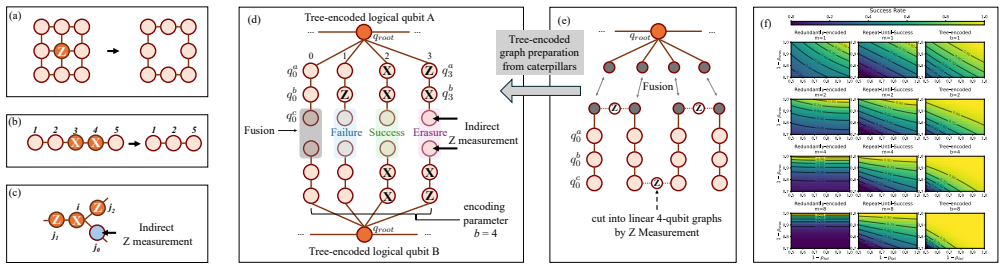
tree-encoded fusion, an encoding strategy that uses spin qubit quantum memory to structure fusion operations in a tree pattern protecting against photon-loss erasures in graph-state construction.
If this is right
- Tree-encoded fusion achieves better robustness against erasures than alternative fusion-encoding strategies in realistic simulations.
- The compiler framework reduces execution overhead by an exponential factor relative to OneAdapt on the tested benchmarks.
- Quantum algorithms can be compiled and run with explicit accounting for both fusion failure and erasure mechanisms.
- A hardware proof-of-concept confirms the basic feasibility of the spin-memory integration for this purpose.
Where Pith is reading between the lines
- Hybrid photonic-matter systems may offer a route to larger-scale MBQC by using matter qubits specifically for erasure protection during fusion steps.
- The tree-encoding principle could extend to suppressing loss in other probabilistic photonic operations such as entanglement swapping.
- Optimizing tree depth and branching for particular program graphs might yield further overhead reductions beyond the current compiler.
Load-bearing premise
Spin qubit quantum memory can be integrated into photonic architectures to encode fusions without introducing loss, decoherence, or interfacing overheads that would cancel the erasure-suppression benefit.
What would settle it
Direct measurement of successful graph-state generation rates on a photonic platform with spin memories, comparing tree-encoded fusion against standard fusion under controlled photon-loss levels to check for the predicted reduction in erasure errors.
Figures


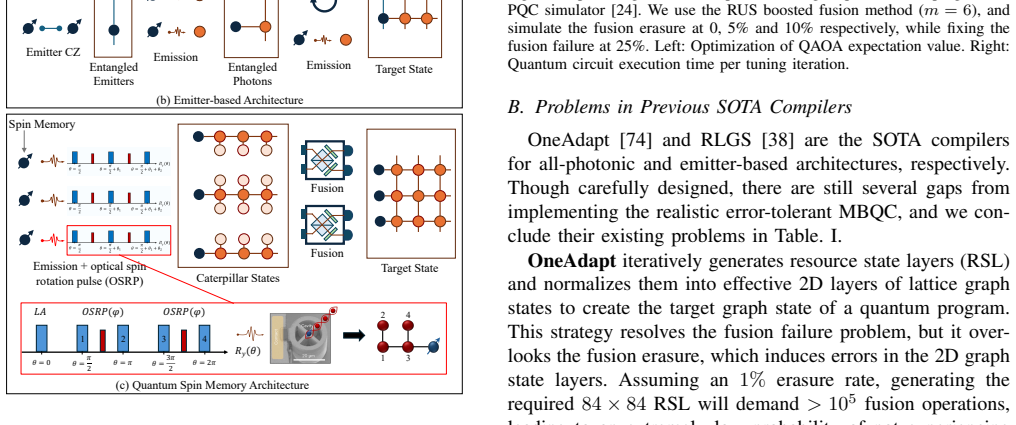


read the original abstract
Photonic quantum computing provides a promising route toward quantum computation by naturally supporting the measurement-based quantum computation (MBQC) model. In MBQC, programs are executed through measurements on a pre-generated graph state, whose construction largely depends on probabilistic fusion operations. However, fusion operations in PQC are vulnerable to two major error sources: fusion failure and fusion erasure. As a result, MBQC compilation must account for both error mechanisms to generate reliable and efficient photonic executions. Prior state-of-the-art MBQC compilation, represented by OneAdapt, is designed for all-photonic architectures and mainly focuses on handling fusion failures. Nevertheless, it does not explicitly model fusion erasures induced by photon loss, which can be substantially more damaging than fusion failures. To mitigate fusion erasure errors, we introduce a new MBQC compilation scheme built upon the spin qubit quantum memory. We propose tree-encoded fusion, an encoding strategy that suppresses erasure errors during graph-state generation. We further incorporate this scheme into a compiler framework with algorithms that reduce the execution overhead of quantum programs. We evaluate the proposed framework using a realistic PQC simulator on six representative quantum algorithm benchmarks across multiple program scales. The results show that tree-encoded fusion achieves better robustness than alternative fusion-encoding strategies, and that our compiler provides exponential improvement over OneAdapt. In addition, we validate the feasibility of our approach through a proof-of-concept demonstration on real PQC hardware.
Editorial analysis
A structured set of objections, weighed in public.
Referee Report
Summary. The paper introduces a MBQC compilation framework for photonic quantum computing that incorporates spin-qubit quantum memories and a tree-encoded fusion strategy to suppress erasure errors arising from photon loss during graph-state generation. It augments this with overhead-reduction algorithms and reports simulator-based evaluations on six quantum algorithm benchmarks showing exponential improvement over OneAdapt, plus a proof-of-concept hardware demonstration.
Significance. If the spin-photon interface losses and decoherence can be shown to be small enough that the erasure suppression yields a net gain, the work would meaningfully extend prior all-photonic compilers by addressing a dominant error channel. The use of a realistic simulator and hardware validation are positive, but the absence of explicit interface-parameter modeling leaves the central net-benefit claim unverified.
major comments (2)
- [Abstract and Evaluation section] The abstract and evaluation claims assert exponential improvement over OneAdapt via tree-encoded fusion, yet no quantitative error model or parameter values are provided for the spin-photon interfacing losses, conversion inefficiency, or spin decoherence times. Without these, it is impossible to confirm that the modeled suppression is not offset by the added overheads (see skeptic concern on interface losses).
- [Proposed scheme and simulator evaluation] The central claim that tree-encoded fusion suppresses erasure errors during graph-state generation rests on the assumption that spin-qubit memories can be integrated without prohibitive new loss channels. The manuscript does not report the specific loss rates or decoherence times used in the simulator, making the robustness comparison to alternative encodings unverifiable.
minor comments (2)
- [Abstract] The abstract refers to 'six representative quantum algorithm benchmarks across multiple program scales' but does not name the benchmarks or scales; this should be stated explicitly for reproducibility.
- [Introduction] Notation for fusion failure versus erasure is introduced without a clear distinction in the opening paragraphs; a short definitions paragraph would improve clarity.
Simulated Author's Rebuttal
We thank the referee for the careful reading and constructive comments, which highlight the need for greater transparency on interface parameters to substantiate net gains. We agree that explicit reporting of these values strengthens the central claims and will revise the manuscript accordingly to include the simulator parameters, a quantitative error model, and sensitivity discussion while preserving the focus on the compilation framework and hardware validation.
read point-by-point responses
-
Referee: [Abstract and Evaluation section] The abstract and evaluation claims assert exponential improvement over OneAdapt via tree-encoded fusion, yet no quantitative error model or parameter values are provided for the spin-photon interfacing losses, conversion inefficiency, or spin decoherence times. Without these, it is impossible to confirm that the modeled suppression is not offset by the added overheads (see skeptic concern on interface losses).
Authors: We acknowledge that the abstract and evaluation sections present the exponential improvement without listing explicit numerical values for spin-photon interface losses, conversion inefficiency, or decoherence times. The reported gains reflect the reduction in effective erasure probability and resulting compiler overhead under the tree-encoded fusion model relative to OneAdapt (which does not address erasures). To address the concern, the revised manuscript will add a new subsection in the simulator evaluation section that specifies the loss rates, conversion inefficiencies, and decoherence times used in the model (drawn from representative experimental values for spin-photon interfaces), together with the quantitative error model and a brief sensitivity analysis showing net benefit within realistic parameter ranges. This addition will make the net-gain claim verifiable without altering the core results. revision: yes
-
Referee: [Proposed scheme and simulator evaluation] The central claim that tree-encoded fusion suppresses erasure errors during graph-state generation rests on the assumption that spin-qubit memories can be integrated without prohibitive new loss channels. The manuscript does not report the specific loss rates or decoherence times used in the simulator, making the robustness comparison to alternative encodings unverifiable.
Authors: The robustness comparison evaluates the erasure suppression achieved by tree-encoded fusion (enabled by spin-qubit memory for encoding and retry) against direct fusion and other encodings within the same simulator. We agree that the absence of the exact loss rates and decoherence times limits independent verification of the comparison. In the revision we will explicitly report these simulator parameters, describe how they enter the erasure probability model for each encoding strategy, and include the comparison data in a form that allows readers to reproduce the relative robustness. The hardware demonstration remains a proof-of-concept for integration feasibility and is not claimed to quantify net overhead. revision: yes
Circularity Check
No circularity: new encoding proposal evaluated on simulator benchmarks
full rationale
The paper proposes a new MBQC compilation scheme and tree-encoded fusion strategy built on spin-qubit memories to suppress erasure errors. Claims of exponential improvement over OneAdapt rest on simulator evaluations across benchmarks rather than any derivation chain. No equations, fitted parameters renamed as predictions, self-definitional steps, or load-bearing self-citations appear in the abstract or description. The approach is presented as an independent engineering proposal with hardware validation, keeping the result self-contained against external benchmarks.
Axiom & Free-Parameter Ledger
Reference graph
Works this paper leans on
-
[1]
Tree cluster-state code,
“Tree cluster-state code,” inThe Error Correction Zoo, V . V . Albert and P. Faist, Eds., 2024. [Online]. Available: https://errorcorrectionzoo. org/c/tree cluster
2024
-
[2]
High performance computing, artificial intelligence, and quantum computing convergence,
“High performance computing, artificial intelligence, and quantum computing convergence,” 2025. [On- line]. Available: https://www.quandela.com/wp-content/uploads/2025/ 10/202510-Quantum-HPC-Quandela-Whitepaper.pdf
2025
-
[3]
Scaling and networking a modular photonic quantum computer,
H. Aghaee Rad, T. Ainsworth, R. N. Alexander, B. Altieri, M. F. Askarani, R. Baby, L. Banchi, B. Q. Baragiola, J. E. Bourassa, R. S. Chadwick, I. Charania, H. Chen, M. J. Collins, P. Contu, N. D’Arcy, G. Dauphinais, R. De Prins, D. Deschenes, I. Di Luch, S. Duque, P. Edke, S. E. Fayer, S. Ferracin, H. Ferretti, J. Gefaell, S. Glancy, C. Gonz ´alez-Arcinie...
2025
-
[4]
Frozenqubits: Boosting fidelity of qaoa by skipping hotspot nodes,
R. Ayanzadeh, N. Alavisamani, P. Das, and M. Qureshi, “Frozenqubits: Boosting fidelity of qaoa by skipping hotspot nodes,” inProceedings of the 28th ACM International Conference on Architectural Support for Programming Languages and Operating Systems, Volume 2, 2023, pp. 311–324
2023
-
[5]
Fusion-based quantum computation,
S. Bartolucci, P. Birchall, H. Bombin, H. Cable, C. Dawson, M. Gimeno- Segovia, E. Johnston, K. Kieling, N. Nickerson, M. Pant, F. Pastawski, T. Rudolph, and C. Sparrow, “Fusion-based quantum computation,” Nature Communications, vol. 14, no. 1, p. 912, 2023
2023
-
[6]
Fusion-based quantum computation,
S. Bartolucci, P. Birchall, H. Bomb ´ın, H. Cable, C. Dawson, M. Gimeno-Segovia, E. Johnston, K. Kieling, N. Nickerson, M. Pant, F. Pastawski, T. Rudolph, and C. Sparrow, “Fusion-based quantum computation,”Nature Communications, vol. 14, no. 1, p. 912, Feb. 2023, publisher: Nature Publishing Group. [Online]. Available: https://www.nature.com/articles/s414...
2023
-
[7]
Optimizing Graph Codes for Measurement-Based Loss Tolerance,
T. J. Bell, L. A. Pettersson, and S. Paesani, “Optimizing Graph Codes for Measurement-Based Loss Tolerance,”PRX Quantum, vol. 4, no. 2, p. 020328, May 2023. [Online]. Available: https: //link.aps.org/doi/10.1103/PRXQuantum.4.020328
-
[8]
The xzzx surface code,
J. P. Bonilla Ataides, D. K. Tuckett, S. D. Bartlett, S. T. Flammia, and B. J. Brown, “The xzzx surface code,”Nature Communications, vol. 12, no. 1, p. 2172, 2021
2021
-
[9]
One-Way Quantum Repeater Based on Near-Deterministic Photon-Emitter Interfaces,
J. Borregaard, H. Pichler, T. Schr ¨oder, M. D. Lukin, P. Lodahl, and A. S. Sørensen, “One-Way Quantum Repeater Based on Near-Deterministic Photon-Emitter Interfaces,”Physical Review X, vol. 10, no. 2, p. 021071, Jun. 2020. [Online]. Available: https: //link.aps.org/doi/10.1103/PhysRevX.10.021071
-
[10]
Measurement-based quantum computation,
H. J. Briegel, D. E. Browne, W. D ¨ur, R. Raussendorf, and M. Van den Nest, “Measurement-based quantum computation,”Nature Physics, vol. 5, no. 1, pp. 19–26, 2009
2009
-
[11]
Resource-efficient linear optical quantum computation,
D. E. Browne and T. Rudolph, “Resource-efficient linear optical quantum computation,”Physical Review Letters, vol. 95, no. 1, p. 010501, 2005. [Online]. Available: https://journals.aps.org/prl/abstract/ 10.1103/PhysRevLett.95.010501
-
[12]
Tailoring fusion-based photonic quantum computing schemes to quantum emitters,
M. L. Chan, T. J. Bell, L. A. Pettersson, S. X. Chen, P. Yard, A. S. Sørensen, and S. Paesani, “Tailoring fusion-based photonic quantum computing schemes to quantum emitters,”PRX Quantum, vol. 6, no. 2, p. 020304, Apr. 2025, arXiv:2410.06784 [quant-ph]. [Online]. Available: http://arxiv.org/abs/2410.06784
-
[13]
Deterministic generation of indistinguishable photons in a cluster state,
D. Cogan, Z.-E. Su, O. Kenneth, and D. Gershoni, “Deterministic generation of indistinguishable photons in a cluster state,”Nature Photonics, vol. 17, no. 4, pp. 324–329, Apr. 2023, publisher: Nature Publishing Group. [Online]. Available: https://www.nature.com/articles/ s41566-022-01152-2
2023
-
[14]
Afs: Accurate, fast, and scalable error- decoding for fault-tolerant quantum computers,
P. Das, C. A. Pattison, S. Manne, D. M. Carmean, K. M. Svore, M. Qureshi, and N. Delfosse, “Afs: Accurate, fast, and scalable error- decoding for fault-tolerant quantum computers,” in2022 IEEE Interna- tional Symposium on High-Performance Computer Architecture (HPCA). IEEE, 2022, pp. 259–273
2022
-
[15]
A case for multi- programming quantum computers,
P. Das, S. S. Tannu, P. J. Nair, and M. Qureshi, “A case for multi- programming quantum computers,” inProceedings of the 52nd Annual IEEE/ACM International Symposium on Microarchitecture, 2019, pp. 291–303
2019
-
[16]
Systematic crosstalk mitigation for superconducting qubits via frequency-aware compilation,
Y . Ding, P. Gokhale, S. F. Lin, R. Rines, T. Propson, and F. T. Chong, “Systematic crosstalk mitigation for superconducting qubits via frequency-aware compilation,” in2020 53rd Annual IEEE/ACM International Symposium on Microarchitecture (MICRO). IEEE, 2020, pp. 201–214
2020
-
[17]
Optically generated 2- dimensional photonic cluster state from coupled quantum dots,
S. E. Economou, N. Lindner, and T. Rudolph, “Optically generated 2- dimensional photonic cluster state from coupled quantum dots,”Physical review letters, vol. 105, no. 9, p. 093601, 2010. [Online]. Available: https://journals.aps.org/prl/abstract/10.1103/PhysRevLett.105.093601
-
[18]
3/4-efficient bell measurement with passive linear optics and unentangled ancillae,
F. Ewert and P. van Loock, “3/4-efficient bell measurement with passive linear optics and unentangled ancillae,”Physical review letters, vol. 113, no. 14, p. 140403, 2014
2014
-
[19]
Deterministic Generation of Large-Scale Entan- gled Photonic Cluster State from Interacting Solid State Emitters,
M. Gimeno-Segovia, “Deterministic Generation of Large-Scale Entan- gled Photonic Cluster State from Interacting Solid State Emitters,” Physical Review Letters, vol. 123, no. 7, 2019
2019
-
[20]
M. Gimeno-Segovia, T. Rudolph, and S. E. Economou, “Deterministic generation of large-scale entangled photonic cluster state from interacting solid state emitters,”Physical review letters, vol. 123, no. 7, p. 070501, 2019. [Online]. Available: https://journals.aps.org/prl/ abstract/10.1103/PhysRevLett.123.070501
-
[21]
A Spin-Optical Quantum Computing Architecture,
G. d. Gliniasty, P. Hilaire, P.-E. Emeriau, S. C. Wein, A. Salavrakos, and S. Mansfield, “A Spin-Optical Quantum Computing Architecture,” Quantum, vol. 8, p. 1423, Jul. 2024, publisher: Verein zur F ¨orderung des Open Access Publizierens in den Quantenwissenschaften. [Online]. Available: https://quantum-journal.org/papers/q-2024-07-24-1423/
2024
-
[22]
Arbitrarily complete bell-state measurement using only linear optical elements,
W. P. Grice, “Arbitrarily complete bell-state measurement using only linear optical elements,”Physical Review A—Atomic, Molecular, and Optical Physics, vol. 84, no. 4, p. 042331, 2011
2011
-
[23]
Entanglement in Graph States and its Applications
M. Hein, W. D ¨ur, J. Eisert, R. Raussendorf, M. Nest, and H.- J. Briegel, “Entanglement in graph states and its applications,” arXiv preprint quant-ph/0602096, 2006. [Online]. Available: https: //arxiv.org/abs/quant-ph/0602096
work page Pith review arXiv 2006
-
[24]
Quantum7, 931 (2023) https: //doi.org/10.22331/q-2023-02-21-931
N. Heurtel, A. Fyrillas, G. d. Gliniasty, R. Le Bihan, S. Malherbe, M. Pailhas, E. Bertasi, B. Bourdoncle, P.-E. Emeriau, R. Mezher, L. Music, N. Belabas, B. Valiron, P. Senellart, S. Mansfield, and J. Senellart, “Perceval: A Software Platform for Discrete Variable Photonic Quantum Computing,”Quantum, vol. 7, p. 931, Feb. 2023. [Online]. Available: https:...
-
[25]
Near-deterministic hybrid generation of arbitrary photonic graph states using a single quantum emitter and linear optics,
P. Hilaire, L. Vidro, H. S. Eisenberg, and S. E. Economou, “Near-deterministic hybrid generation of arbitrary photonic graph states using a single quantum emitter and linear optics,”Quantum, vol. 7, p. 992, Apr. 2023, publisher: Verein zur F ¨orderung des Open Access Publizierens in den Quantenwissenschaften. [Online]. Available: https://quantum-journal.o...
2023
-
[26]
Near-deterministic hybrid generation of arbitrary photonic graph states using a single quantum emitter and linear optics,
——, “Near-deterministic hybrid generation of arbitrary photonic graph states using a single quantum emitter and linear optics,”Quantum, vol. 7, p. 992, 2023. [Online]. Available: https://quantum-journal.org/ papers/q-2023-04-27-992/
2023
-
[27]
Measurement of subpicosecond time intervals between two photons by interference,
C.-K. Hong, Z.-Y . Ou, and L. Mandel, “Measurement of subpicosecond time intervals between two photons by interference,”Physical review letters, vol. 59, no. 18, p. 2044, 1987
2044
-
[28]
Resources required for preparing graph states,
P. Høyer, M. Mhalla, and S. Perdrix, “Resources required for preparing graph states,” inInternational Symposium on Algorithms and Computation. Springer, 2006, pp. 638–649. [Online]. Available: https://link.springer.com/chapter/10.1007/11940128 64
-
[29]
Deterministic and reconfigurable graph state generation with a single solid-state quantum emitter,
H. Huet, P. R. Ramesh, S. C. Wein, N. Coste, P. Hilaire, N. Somaschi, M. Morassi, A. Lema ˆıtre, I. Sagnes, M. F. Doty, O. Krebs, L. Lanco, D. A. Fioretto, and P. Senellart, “Deterministic and reconfigurable graph state generation with a single solid-state quantum emitter,”Nature Communications, vol. 16, no. 1, p. 4337, May 2025, publisher: Nature Publish...
2025
-
[30]
Deterministic and reconfigurable graph state generation with a single solid-state quantum 14 emitter,
H. Huet, P. Ramesh, S. Wein, N. Coste, P. Hilaire, N. Somaschi, M. Morassi, A. Lema ˆıtre, I. Sagnes, M. Dotyet al., “Deterministic and reconfigurable graph state generation with a single solid-state quantum 14 emitter,”Nature communications, vol. 16, no. 1, p. 4337, 2025. [Online]. Available: https://www.nature.com/articles/s41467-025-59693-3
2025
-
[31]
Coherence of a dynamically decoupled quantum-dot hole spin,
L. Huthmacher, R. Stockill, E. Clarke, M. Hugues, C. Le Gall, and M. Atat ¨ure, “Coherence of a dynamically decoupled quantum-dot hole spin,”Physical Review B, vol. 97, no. 24, p. 241413, 2018
2018
-
[32]
Quantum computing with Qiskit,
A. Javadi-Abhari, M. Treinish, K. Krsulich, C. J. Wood, J. Lishman, J. Gacon, S. Martiel, P. D. Nation, L. S. Bishop, A. W. Cross, B. R. Johnson, and J. M. Gambetta, “Quantum computing with Qiskit,” 2024
2024
-
[33]
Resource-efficient loss-aware photonic graph state preparation using atomic emitters,
E. Kaur, A. Patil, and S. Guha, “Resource-efficient loss-aware photonic graph state preparation using atomic emitters,”arXiv preprint arXiv:2402.00731, 2024. [Online]. Available: https://arxiv.org/abs/2402. 00731
-
[34]
New high-intensity source of polarization-entangled photon pairs,
P. G. Kwiat, K. Mattle, H. Weinfurter, A. Zeilinger, A. V . Sergienko, and Y . Shih, “New high-intensity source of polarization-entangled photon pairs,”Physical Review Letters, vol. 75, no. 24, p. 4337,
-
[35]
Available: https://journals.aps.org/prl/abstract/10.1103/ PhysRevLett.75.4337
[Online]. Available: https://journals.aps.org/prl/abstract/10.1103/ PhysRevLett.75.4337
-
[36]
Graph-theoretical optimization of fusion-based graph state generation,
S.-H. Lee and H. Jeong, “Graph-theoretical optimization of fusion-based graph state generation,”Quantum, vol. 7, p. 1212, 2023. [Online]. Available: https://quantum-journal.org/papers/q-2023-12-20-1212/
2023
-
[37]
Photonic resource state generation from a minimal number of quantum emitters,
B. Li, S. E. Economou, and E. Barnes, “Photonic resource state generation from a minimal number of quantum emitters,”npj Quantum Information, vol. 8, no. 1, p. 11, 2022. [Online]. Available: https://www.nature.com/articles/s41534-022-00522-6
2022
-
[38]
Resource costs for fault-tolerant linear optical quantum computing,
Y . Li, P. C. Humphreys, G. J. Mendoza, and S. C. Benjamin, “Resource costs for fault-tolerant linear optical quantum computing,” Physical Review X, vol. 5, no. 4, p. 041007, 2015. [Online]. Available: https://journals.aps.org/prx/abstract/10.1103/PhysRevX.5.041007
-
[39]
Y . Li, Y . Dai, A. Pawar, R. Dong, J. Yang, Y . Zhang, and X. Tang, “Reinforcement Learning-Guided Graph State Generation in Photonic Quantum Computers,” inProceedings of the 52nd Annual International Symposium on Computer Architecture, ser. ISCA ’25. New York, NY , USA: Association for Computing Machinery, 2025, pp. 1598–1612. [Online]. Available: https...
-
[40]
Fmcc: Flexible measurement-based quantum computation over cluster state,
Y . Li, A. Pawar, Z. Mo, Y . Zhang, J. Yang, and X. Tang, “Fmcc: Flexible measurement-based quantum computation over cluster state,” in Proceedings of the 29th ACM International Conference on Architectural Support for Programming Languages and Operating Systems, Volume 4, 2024, pp. 111–126
2024
-
[41]
Repeat-Until-Success Linear Optics Distributed Quantum Computing,
Y . L. Lim, “Repeat-Until-Success Linear Optics Distributed Quantum Computing,”Physical Review Letters, vol. 95, no. 3, 2005. [Online]. Available: https://journals.aps.org/prl/abstract/10.1103/PhysRevLett.95. 030505
-
[42]
Proposal for pulsed on-demand sources of photonic cluster state strings,
N. H. Lindner and T. Rudolph, “Proposal for pulsed on-demand sources of photonic cluster state strings,”Physical review letters, vol. 103, no. 11, p. 113602, 2009. [Online]. Available: https: //journals.aps.org/prl/abstract/10.1103/PhysRevLett.103.113602
-
[43]
Reliability modeling of nisq-era quantum comput- ers,
J. Liu and H. Zhou, “Reliability modeling of nisq-era quantum comput- ers,” in2020 IEEE international symposium on workload characteriza- tion (IISWC). IEEE, 2020, pp. 94–105
2020
-
[44]
A versatile single-photon-based quantum computing platform,
N. Maring, A. Fyrillas, M. Pont, E. Ivanov, P. Stepanov, N. Margaria, W. Hease, A. Pishchagin, A. Lema ˆıtre, I. Sagnes, T. H. Au, S. Boissier, E. Bertasi, A. Baert, M. Valdivia, M. Billard, O. Acar, A. Brieussel, R. Mezher, S. C. Wein, A. Salavrakos, P. Sinnott, D. A. Fioretto, P.-E. Emeriau, N. Belabas, S. Mansfield, P. Senellart, J. Senellart, and N. S...
2024
-
[45]
Detecting single infrared photons with 93% system efficiency,
F. Marsili, V . B. Verma, J. A. Stern, S. Harrington, A. E. Lita, T. Gerrits, I. Vayshenker, B. Baek, M. D. Shaw, R. P. Mirinet al., “Detecting single infrared photons with 93% system efficiency,”Nature Photonics, vol. 7, no. 3, pp. 210–214, 2013
2013
-
[46]
Compaqt: Compressed waveform memory architecture for scalable qubit control,
S. Maurya and S. Tannu, “Compaqt: Compressed waveform memory architecture for scalable qubit control,” in2022 55th IEEE/ACM Inter- national Symposium on Microarchitecture (MICRO). IEEE, 2022, pp. 1059–1077
2022
-
[47]
Fcm: A fusion-aware wire cutting approach for measurement-based quantum computing,
Z. Mo, Y . Li, A. Pawar, X. Tang, J. Yang, and Y . Zhang, “Fcm: A fusion-aware wire cutting approach for measurement-based quantum computing,” inProceedings of the 61st ACM/IEEE Design Automation Conference, 2024, pp. 1–6
2024
-
[48]
Noise-adaptive compiler mappings for noisy intermediate-scale quan- tum computers,
P. Murali, J. M. Baker, A. Javadi-Abhari, F. T. Chong, and M. Martonosi, “Noise-adaptive compiler mappings for noisy intermediate-scale quan- tum computers,” inProceedings of the twenty-fourth international conference on architectural support for programming languages and operating systems, 2019, pp. 1015–1029
2019
-
[49]
Photonic quantum technologies,
J. L. O’brien, A. Furusawa, and J. Vu ˇckovi´c, “Photonic quantum technologies,”Nature photonics, vol. 3, no. 12, pp. 687–695, 2009
2009
-
[50]
Ancilla-assisted linear optical bell mea- surements and their optimality,
A. Olivo and F. Grosshans, “Ancilla-assisted linear optical bell mea- surements and their optimality,”Physical Review A, vol. 98, no. 4, p. 042323, 2018
2018
-
[51]
Veritas: accurately estimating the correct output on noisy intermediate-scale quantum computers,
T. Patel and D. Tiwari, “Veritas: accurately estimating the correct output on noisy intermediate-scale quantum computers,” inSC20: International Conference for High Performance Computing, Networking, Storage and Analysis. IEEE, 2020, pp. 1–16
2020
-
[52]
Deterministic Generation of Concatenated Graph Codes from Quantum Emitters,
L. A. Pettersson, A. S. Sørensen, and S. Paesani, “Deterministic Generation of Concatenated Graph Codes from Quantum Emitters,” PRX Quantum, vol. 6, no. 1, p. 010305, Jan. 2025. [Online]. Available: https://link.aps.org/doi/10.1103/PRXQuantum.6.010305
-
[53]
A manufacturable platform for photonic quantum computing,
PsiQuantum team, K. Alexander, A. Benyamini, D. Black, D. Bonneau, S. Burgos, B. Burridge, H. Cable, G. Campbell, G. Catalano, A. Ceballos, C.-M. Chang, S. S. Choudhury, C. J. Chung, F. Danesh, T. Dauer, M. Davis, E. Dudley, P. Er-Xuan, J. Fargas, A. Farsi, C. Fenrich, J. Frazer, M. Fukami, Y . Ganesan, G. Gibson, M. Gimeno- Segovia, S. Goeldi, P. Goley, ...
2025
-
[54]
R. Raussendorf and H. J. Briegel, “A one-way quantum computer,” Physical review letters, vol. 86, no. 22, p. 5188, 2001. [Online]. Available: https://journals.aps.org/prl/abstract/10.1103/PhysRevLett.86. 5188
-
[55]
A scalable and robust compilation framework for emitter-photonic graph state,
X. Ren, Y . Huang, Z. Liang, and A. Barbalace, “A scalable and robust compilation framework for emitter-photonic graph state,” arXiv preprint arXiv:2503.16346, 2025. [Online]. Available: https: //arxiv.org/abs/2503.16346
-
[56]
A scalable and robust compilation framework for emitter- photonic graph state,
——, “A scalable and robust compilation framework for emitter- photonic graph state,” in2025 62nd ACM/IEEE Design Automation Conference (DAC), 2025, pp. 1–7
2025
-
[57]
Why I am optimistic about the silicon-photonic route to quantum computing,
T. Rudolph, “Why I am optimistic about the silicon-photonic route to quantum computing,”APL Photonics, vol. 2, no. 3, p. 030901, Mar
-
[58]
Available: https://pubs.aip.org/app/article/2/3/030901/ 122954/Why-I-am-optimistic-about-the-silicon-photonic
[Online]. Available: https://pubs.aip.org/app/article/2/3/030901/ 122954/Why-I-am-optimistic-about-the-silicon-photonic
-
[59]
Photonic graph state generation from quantum dots and color centers for quantum communications,
A. Russo, E. Barnes, and S. E. Economou, “Photonic graph state generation from quantum dots and color centers for quantum communications,”Physical Review B, vol. 98, no. 8, p. 085303, Aug. 2018, arXiv:1801.02754 [cond-mat]. [Online]. Available: http: //arxiv.org/abs/1801.02754
-
[60]
Sequential generation of entangled multiqubit states,
C. Sch ¨on, E. Solano, F. Verstraete, J. I. Cirac, and M. M. Wolf, “Sequential generation of entangled multiqubit states,”Physical review letters, vol. 95, no. 11, p. 110503, 2005. [Online]. Available: https://journals.aps.org/prl/abstract/10.1103/PhysRevLett.95.110503
-
[61]
Deterministic generation of a cluster state of entangled photons,
I. Schwartz, D. Cogan, E. R. Schmidgall, Y . Don, L. Gantz, O. Kenneth, N. H. Lindner, and D. Gershoni, “Deterministic generation of a cluster state of entangled photons,”Science, vol. 354, no. 6311, pp. 434–437,
-
[62]
Available: https://doi.org/10.1126/science.aah4758
[Online]. Available: https://doi.org/10.1126/science.aah4758
-
[63]
Optimized compilation of aggregated instructions for realistic quantum computers,
Y . Shi, N. Leung, P. Gokhale, Z. Rossi, D. I. Schuster, H. Hoffmann, and F. T. Chong, “Optimized compilation of aggregated instructions for realistic quantum computers,” inProceedings of the Twenty-Fourth International Conference on Architectural Support for Programming Languages and Operating Systems, 2019, pp. 1031–1044
2019
-
[64]
Hetec: Architectures for heterogeneous quantum error correction codes,
S. Stein, S. Xu, A. W. Cross, T. J. Yoder, A. Javadi-Abhari, C. Liu, K. Liu, Z. Zhou, C. Guinn, Y . Dinget al., “Hetec: Architectures for heterogeneous quantum error correction codes,” inProceedings of the 30th ACM International Conference on Architectural Support for 15 Programming Languages and Operating Systems, Volume 2, 2025, pp. 515–528
2025
-
[65]
Ensemble of diverse mappings: Improving reliability of quantum computers by orchestrating dissimilar mistakes,
S. S. Tannu and M. Qureshi, “Ensemble of diverse mappings: Improving reliability of quantum computers by orchestrating dissimilar mistakes,” inProceedings of the 52nd Annual IEEE/ACM International Symposium on Microarchitecture, 2019, pp. 253–265
2019
-
[66]
A case for variability-aware policies for nisq-era quantum computers,
S. S. Tannu and M. K. Qureshi, “A case for variability-aware policies for nisq-era quantum computers,”arXiv preprint arXiv:1805.10224, 2018
-
[67]
Not all qubits are created equal: A case for variability-aware policies for nisq-era quantum computers,
——, “Not all qubits are created equal: A case for variability-aware policies for nisq-era quantum computers,” inProceedings of the twenty- fourth international conference on architectural support for program- ming languages and operating systems, 2019, pp. 987–999
2019
-
[68]
Dual-rail encoding with superconducting cavities,
J. D. Teoh, P. Winkel, H. K. Babla, B. J. Chapman, J. Claes, S. J. de Graaf, J. W. O. Garmon, W. D. Kalfus, Y . Lu, A. Maiti, K. Sahay, N. Thakur, T. Tsunoda, S. H. Xue, L. Frunzio, S. M. Girvin, S. Puri, and R. J. Schoelkopf, “Dual-rail encoding with superconducting cavities,” Proceedings of the National Academy of Sciences, vol. 120, no. 22, p. e2221736...
2023
-
[69]
Fusion of deterministically generated photonic graph states,
P. Thomas, L. Ruscio, O. Morin, and G. Rempe, “Fusion of deterministically generated photonic graph states,”Nature, vol. 629, no. 8012, pp. 567–572, 2024. [Online]. Available: https: //www.nature.com/articles/s41586-024-07357-5
2024
-
[70]
Supermarq: A scalable quantum benchmark suite,
T. Tomesh, P. Gokhale, V . Omole, G. S. Ravi, K. N. Smith, J. Viszlai, X.- C. Wu, N. Hardavellas, M. R. Martonosi, and F. T. Chong, “Supermarq: A scalable quantum benchmark suite,” in2022 IEEE International Sym- posium on High-Performance Computer Architecture (HPCA). IEEE, 2022, pp. 587–603
2022
-
[71]
Loss Tolerance in One-Way Quantum Computation via Counterfactual Error Correction,
M. Varnava, D. E. Browne, and T. Rudolph, “Loss Tolerance in One-Way Quantum Computation via Counterfactual Error Correction,” Physical Review Letters, vol. 97, no. 12, p. 120501, Sep. 2006. [Online]. Available: https://link.aps.org/doi/10.1103/PhysRevLett.97.120501
-
[72]
Astrea: Accurate quantum error- decoding via practical minimum-weight perfect-matching,
S. Vittal, P. Das, and M. Qureshi, “Astrea: Accurate quantum error- decoding via practical minimum-weight perfect-matching,” inProceed- ings of the 50th Annual International Symposium on Computer Archi- tecture, 2023, pp. 1–16
2023
-
[73]
Systems architecture for quantum random access memory,
S. Xu, C. T. Hann, B. Foxman, S. M. Girvin, and Y . Ding, “Systems architecture for quantum random access memory,” inProceedings of the 56th Annual IEEE/ACM International Symposium on Microarchitecture, 2023, pp. 526–538
2023
-
[74]
Performance analysis of quantum repeaters enabled by deterministically generated photonic graph states,
Y . Zhan, P. Hilaire, E. Barnes, S. E. Economou, and S. Sun, “Performance analysis of quantum repeaters enabled by deterministically generated photonic graph states,”Quantum, vol. 7, p. 924, Feb. 2023, publisher: Verein zur F ¨orderung des Open Access Publizierens in den Quantenwissenschaften. [Online]. Available: https://quantum-journal. org/papers/q-202...
2023
-
[75]
Dtc-spmm: Bridging the gap in accelerating general sparse matrix multiplication with tensor cores,
H. Zhang, J. Ruan, H. Shapourian, R. R. Kompella, and Y . Ding, “OnePerc: A Randomness-aware Compiler for Photonic Quantum Computing,” inProceedings of the 29th ACM International Conference on Architectural Support for Programming Languages and Operating Systems, Volume 3, ser. ASPLOS ’24, vol. 3. New York, NY , USA: Association for Computing Machinery, 2...
-
[76]
Oneperc: A randomness-aware compiler for photonic quantum computing,
——, “Oneperc: A randomness-aware compiler for photonic quantum computing,” inProceedings of the 29th ACM International Conference on Architectural Support for Programming Languages and Operating Systems, Volume 3, 2024, pp. 738–754
2024
-
[77]
H. Zhang, J. Ruan, D. Tullsen, Y . Ding, A. Li, and T. Humble, “Oneadapt: Resource-adaptive compilation of measurement-based quantum computing for photonic hardware,” inProceedings of the 58th IEEE/ACM International Symposium on Microarchitecture, ser. MICRO ’25. New York, NY , USA: Association for Computing Machinery, 2025, p. 733–748. [Online]. Availabl...
-
[78]
Inter-layer scheduling space definition and exploration for tiled accelerators,
H. Zhang, A. Wu, Y . Wang, G. Li, H. Shapourian, A. Shabani, and Y . Ding, “Oneq: A compilation framework for photonic one-way quantum computation,” inProceedings of the 50th Annual International Symposium on Computer Architecture, ser. ISCA ’23. New York, NY , USA: Association for Computing Machinery, 2023. [Online]. Available: https://doi.org/10.1145/35...
-
[79]
Oneq: A compilation framework for photonic one-way quantum computation,
——, “Oneq: A compilation framework for photonic one-way quantum computation,” inProceedings of the 50th Annual International Sympo- sium on Computer Architecture, 2023, pp. 1–14
2023
-
[80]
Bosehedral: Com- piler optimization for bosonic quantum computing,
J. Zhou, Y . Liu, Y . Shi, A. Javadi-Abhari, and G. Li, “Bosehedral: Com- piler optimization for bosonic quantum computing,” in2024 ACM/IEEE 51st Annual International Symposium on Computer Architecture (ISCA). IEEE, 2024, pp. 261–276
2024
discussion (0)
Sign in with ORCID, Apple, or X to comment. Anyone can read and Pith papers without signing in.