Recognition: unknown
SPURS: Bursty Star Formation in an Extremely Luminous Weak Emission Line Galaxy at z=9.3
Pith reviewed 2026-05-09 21:02 UTC · model grok-4.3
The pith
The weak emission lines in this z=9.3 super-luminous galaxy result from a recent downturn in star formation after a 10-20 Myr burst.
A machine-rendered reading of the paper's core claim, the machinery that carries it, and where it could break.
Core claim
The combination of the Balmer break, weak emission lines, stellar wind features, and interstellar absorption lines showing outflows at approximately 161 km/s with large neutral gas covering fraction constrains the star formation history to a burst lasting 10-20 Myr followed by a downturn over the last 10 Myr. This history explains the observed properties, and the observations suggest that z greater than or equal to 9 weak emission line galaxies can be accounted for by stochastic star formation provided the downturns occur recently, less than 10 Myr before observation. The smooth Lyman-alpha break further indicates the galaxy sits in a small ionized bubble of radius 0.29 pMpc amid a mostly I-
What carries the argument
The star formation history constrained by the simultaneous fit to the Balmer break strength, emission-line equivalent widths, stellar wind lines, and absorption-line profiles from outflows.
If this is right
- Weak-emission-line galaxies at z greater than or equal to 9 are often post-burst systems rather than old or highly leaking galaxies.
- Stochastic star formation with short-timescale variability is required to reproduce the diversity of spectra seen in the earliest galaxies.
- The source resides inside a small ionized bubble, consistent with the high neutral hydrogen fraction inferred from the IGM damping wing.
- Ultra-deep grating spectra can separate local absorption effects from the IGM damping wing in individual sources.
Where Pith is reading between the lines
- If recent downturns prove common, the assembled stellar mass in z greater than 9 galaxies may have built up in shorter, more intense episodes than steady models predict.
- Future observations of larger samples could measure how often such 10-Myr downturns occur and whether they correlate with galaxy luminosity or environment.
- Galaxy formation simulations must resolve star-formation variability on timescales shorter than 10 Myr to match the observed fraction of weak-line sources.
Load-bearing premise
The weak emission lines are not produced by a large escape fraction of ionizing photons, because the interstellar absorption lines indicate outflows with high neutral gas covering fraction.
What would settle it
Finding strong emission lines or absorption lines with low neutral gas covering fraction in similar z greater than 9 galaxies would contradict the recent-downturn interpretation.
Figures


read the original abstract
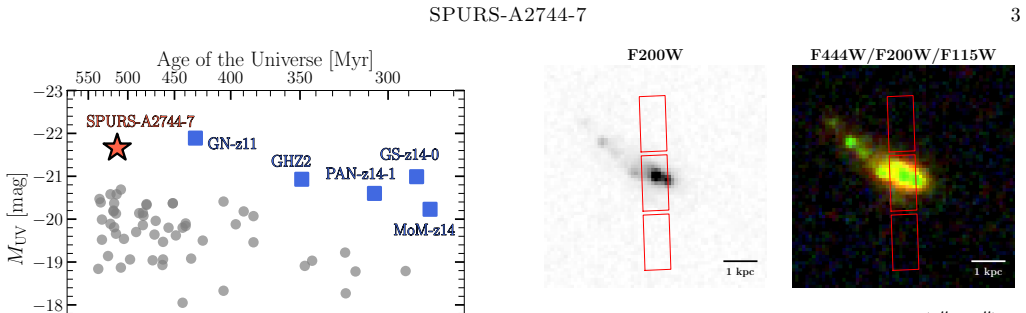
JWST has revealed a population of super-luminous early galaxies with a volume density in excess of most expectations. The spectra reveal diverse properties: while some reveal strong emission lines characteristic of galaxies in the midst of strong bursts, others show weak emission lines that could reflect old stellar populations, large escape fractions, or post-burst star formation histories. Through the JWST Cycle 4 large program SPURS, we have obtained ultra-deep (29 hr) rest-frame UV spectroscopy of a z=9.3 super-luminous ($M_{\rm UV}=-21.66$) galaxy with large assembled stellar mass (1.6$\times$10$^9$ $M_\odot$) and extremely weak emission lines (H$\beta$ EW $\approx25$~\AA). The strong stellar wind features and rest-optical line ratios suggest the galaxy is already significantly enriched, with a metallicity of 0.4--0.7~Z$_\odot$. The interstellar absorption lines reveal outflows ($v\simeq -161$~km~s$^{-1}$) with a large neutral gas covering fraction, suggesting that the weak emission lines are not due to large escape fractions. The combination of the Balmer break, weak emission lines, and stellar wind features constrains the star formation history, indicating a recent burst of star formation lasting 10--20 Myr followed by a downturn over the last 10~Myr. The observations suggest that $z\gtrsim 9$ weak emission line galaxies such as this source can be explained by stochastic star formation, provided that the downturns in star formation are recent (i.e., <10 Myr prior to observation). The ultra-deep grating spectrum enables the IGM damping wing to be characterized, decoupling the effects of local absorption. The smooth Ly$\alpha$ break indicates that this source, one of the most massive galaxies known at z>9, is likely situated in a small ionized bubble ($0.29_{-0.09}^{+0.11}$~pMpc), as is common at large neutral hydrogen fractions ($\bar{x}_{\rm HI}=0.81_{-0.21}^{+0.14}$).
Editorial analysis
A structured set of objections, weighed in public.
Referee Report
Summary. The manuscript presents JWST Cycle 4 SPURS ultra-deep (29 hr) rest-frame UV spectroscopy of a super-luminous (M_UV=-21.66) weak-emission-line galaxy at z=9.3 with assembled stellar mass 1.6e9 M_sun. It reports Hβ EW≈25 Å, strong stellar wind features, metallicity 0.4-0.7 Z_⊙, outflows at v≈-161 km s^{-1} with large neutral gas covering fraction from interstellar absorption lines, and a Balmer break. These are interpreted as a 10-20 Myr star-formation burst followed by a <10 Myr downturn, rather than high Lyman-continuum escape fraction. The observations are used to argue that z≳9 weak-line galaxies arise from stochastic star formation with recent downturns, and the IGM damping wing is characterized to infer a small ionized bubble (0.29 pMpc) at high neutral fraction.
Significance. If the central SFH interpretation holds, the result provides concrete observational support for bursty, stochastic star formation as the origin of the weak-line population among the most massive z>9 galaxies, directly addressing the diversity of JWST spectra. The ultra-deep grating data enabling separation of local absorption from the IGM damping wing is a clear strength, yielding a falsifiable prediction for the bubble size at x_HI≈0.81. The multi-feature constraints (winds, absorption, Balmer break) add robustness beyond single-line diagnostics.
major comments (1)
- [Abstract and the section on interstellar absorption lines and escape fraction] Abstract and the section on interstellar absorption lines and escape fraction: the claim that outflows with 'large neutral gas covering fraction' rule out large f_esc (thereby preferring the post-burst downturn over ongoing star formation plus leakage) is load-bearing for the stochastic-SFH conclusion. The covering fraction is not shown to be unity, nor is the geometry or ionization structure modeled to exclude ionized channels; if f_esc remains viable, the same spectral features (weak Hβ, Balmer break, winds) are compatible with continuous SF, undermining the preference for a recent <10 Myr downturn.
minor comments (1)
- [The quantitative SFH modeling section] The quantitative SFH modeling section: the assumptions on stellar population synthesis models, IMF, dust attenuation law, and metallicity priors used to derive the 10-20 Myr burst + downturn solution are not fully specified, limiting reproducibility of the claimed SFH constraints.
Simulated Author's Rebuttal
We thank the referee for their constructive and detailed review of our manuscript. The primary concern regarding the strength of the evidence from the interstellar absorption lines for ruling out high escape fractions, and the implications for the star-formation history interpretation, is addressed point by point below. We propose targeted revisions to qualify our claims while maintaining that the ensemble of spectral features supports the post-burst scenario.
read point-by-point responses
-
Referee: Abstract and the section on interstellar absorption lines and escape fraction: the claim that outflows with 'large neutral gas covering fraction' rule out large f_esc (thereby preferring the post-burst downturn over ongoing star formation plus leakage) is load-bearing for the stochastic-SFH conclusion. The covering fraction is not shown to be unity, nor is the geometry or ionization structure modeled to exclude ionized channels; if f_esc remains viable, the same spectral features (weak Hβ, Balmer break, winds) are compatible with continuous SF, undermining the preference for a recent <10 Myr downturn.
Authors: We agree that the neutral gas covering fraction is not demonstrated to be exactly unity and that we have not performed detailed radiative transfer or ionization modeling to exclude the possibility of ionized channels permitting some escape. The absorption line depths indicate a high but not total covering fraction, which we interpret as making a large f_esc unlikely. This is reinforced by the Balmer break (indicating an older stellar population inconsistent with ongoing continuous star formation at the observed strength) and the strong stellar wind features (consistent with a recent burst). While high f_esc cannot be entirely excluded without further modeling, the combination of features favors the recent downturn interpretation over continuous SF plus leakage. We will revise the abstract and the relevant section to use more cautious phrasing (e.g., 'suggesting that the weak emission lines are unlikely to result from large escape fractions') and add a short paragraph discussing the limitations of the covering fraction estimate and the value of future modeling. This constitutes a partial revision, as we do not alter the core conclusion but strengthen the presentation of uncertainties. revision: partial
Circularity Check
No circularity: conclusions rest on direct JWST spectroscopic measurements
full rationale
The paper derives its SFH interpretation (10-20 Myr burst followed by <10 Myr downturn) from observed quantities: Hβ EW≈25 Å, Balmer break strength, stellar wind features, outflow velocity v≈−161 km s⁻¹, and neutral gas covering fraction inferred from interstellar absorption lines. These are independent data products from the ultra-deep grating spectrum. The claim that weak lines are not due to high f_esc follows from the measured covering fraction and is presented as an inference, not a self-definition or fitted prediction. No equations reduce the target result to its inputs by construction, no parameters are fitted to a subset and then called a prediction of a related quantity, and no load-bearing uniqueness theorems or ansatzes are imported via self-citation. The analysis is self-contained against the external JWST dataset.
Axiom & Free-Parameter Ledger
free parameters (2)
- star formation burst duration =
10-20 Myr
- metallicity =
0.4-0.7 Z_sun
axioms (1)
- domain assumption Standard stellar population synthesis models apply to high-redshift galaxies
Reference graph
Works this paper leans on
-
[1]
Excitation and Ionization Properties of Star-forming Galaxies at z = 2.0-9.3 with JWST/NIRSpec. , keywords =. doi:10.3847/1538-4357/acedad , archivePrefix =. 2301.06696 , primaryClass =
-
[2]
Ly Radiative Transfer in Cosmological Simulations and Application to a z -0.5ex = 8 Ly Emitter. , keywords =. doi:10.1086/504460 , archivePrefix =. astro-ph/0510347 , primaryClass =
-
[3]
The Lyman Alpha Reference Sample. V. The Impact of Neutral ISM Kinematics and Geometry on Ly Escape. , keywords =. doi:10.1088/0004-637X/805/1/14 , archivePrefix =. 1503.01157 , primaryClass =
-
[4]
JWST/NIRSpec spectroscopy of z = 7-9 star-forming galaxies with CEERS: new insight into bright Ly emitters in ionized bubbles. , keywords =. doi:10.1093/mnras/stad2763 , archivePrefix =. 2301.07072 , primaryClass =
- [5]
-
[6]
The All-Wavelength Extended Groth Strip International Survey (AEGIS) Data Sets. , keywords =. doi:10.1086/517931 , archivePrefix =. astro-ph/0607355 , primaryClass =
-
[7]
CANDELS: The Cosmic Assembly Near-infrared Deep Extragalactic Legacy Survey. , keywords =. doi:10.1088/0067-0049/197/2/35 , archivePrefix =. 1105.3753 , primaryClass =
-
[8]
M., et al., 2011, @doi [ ] 10.1088/0067-0049/197/2/36 , 197, 36
CANDELS: The Cosmic Assembly Near-infrared Deep Extragalactic Legacy Survey The Hubble Space Telescope Observations, Imaging Data Products, and Mosaics. , keywords =. doi:10.1088/0067-0049/197/2/36 , archivePrefix =. 1105.3754 , primaryClass =
-
[9]
The Cosmic Evolution Early Release Science (CEERS) Survey
-
[10]
Photometry of a complete sample of faint galaxies. , keywords =. doi:10.1086/190669 , adsurl =
-
[11]
Larry Bradley and Brigitta Sipőcz and Thomas Robitaille and Erik Tollerud and Zé Vinícius and Christoph Deil and Kyle Barbary and Tom J Wilson and Ivo Busko and Axel Donath and Hans Moritz Günther and Mihai Cara and P. L. Lim and Sebastian Meßlinger and Simon Conseil and Azalee Bostroem and Michael Droettboom and E. M. Bray and Lars Andersen Bratholm and ...
-
[12]
2016, MNRAS, 462, 1415, doi: 10.1093/mnras/stw1756
Modelling and interpreting spectral energy distributions of galaxies with BEAGLE. , keywords =. doi:10.1093/mnras/stw1756 , archivePrefix =. 1603.03037 , primaryClass =
-
[13]
Modelling the nebular emission from primeval to present-day star-forming galaxies. , keywords =. doi:10.1093/mnras/stw1716 , archivePrefix =. 1607.06086 , primaryClass =
-
[14]
Stellar population synthesis at the resolution of 2003. , keywords =. doi:10.1046/j.1365-8711.2003.06897.x , archivePrefix =. astro-ph/0309134 , primaryClass =
-
[15]
, keywords =
The 2013 Release of Cloudy. , keywords =
2013
-
[16]
Galactic Stellar and Substellar Initial Mass Function. , keywords =. doi:10.1086/376392 , archivePrefix =. astro-ph/0304382 , primaryClass =
work page internal anchor Pith review Pith/arXiv arXiv doi:10.1086/376392
-
[17]
2015, MNRAS, 452, 1068, doi: 10.1093/mnras/stv1281
PARSEC evolutionary tracks of massive stars up to 350 M _ at metallicities 0.0001 Z 0.04. , keywords =. doi:10.1093/mnras/stv1281 , archivePrefix =. 1506.01681 , primaryClass =
-
[18]
PARSEC: stellar tracks and isochrones with the PAdova and TRieste Stellar Evolution Code. , keywords =. doi:10.1111/j.1365-2966.2012.21948.x , archivePrefix =. 1208.4498 , primaryClass =
-
[19]
An updated analytic model for attenuation by the intergalactic medium. , keywords =. doi:10.1093/mnras/stu936 , archivePrefix =. 1402.0677 , primaryClass =
-
[20]
Interstellar Dust from the Milky Way to the Magellanic Clouds. , keywords =. doi:10.1086/171637 , adsurl =
-
[21]
2024, arXiv e-prints, arXiv:2404.09015, doi: 10.48550/arXiv.2404.09015
On the universal validity of Case B recombination theory. arXiv e-prints , keywords =. doi:10.48550/arXiv.2404.09015 , archivePrefix =. 2404.09015 , primaryClass =
-
[22]
The density-bounded twilight of starbursts in the early Universe. arXiv e-prints , keywords =. doi:10.48550/arXiv.2405.15859 , archivePrefix =. 2405.15859 , primaryClass =
-
[23]
The Near-Infrared Spectrograph (NIRSpec) on the James Webb Space Telescope. II. Multi-object spectroscopy (MOS). , keywords =. doi:10.1051/0004-6361/202142673 , archivePrefix =. 2202.03306 , primaryClass =
-
[24]
The James Webb Space Telescope Mission. arXiv e-prints , keywords =. doi:10.48550/arXiv.2304.04869 , archivePrefix =. 2304.04869 , primaryClass =
-
[25]
Science opportunities with the near-IR camera (NIRCam) on the James Webb Space Telescope (JWST). Space Telescopes and Instrumentation 2012: Optical, Infrared, and Millimeter Wave , year = 2012, editor =. doi:10.1117/12.925447 , adsurl =
-
[26]
IR Space Telescopes and Instruments , year = 2003, editor =
NGST NIRCam Scientific Program and Design Concept. IR Space Telescopes and Instruments , year = 2003, editor =. doi:10.1117/12.489103 , adsurl =
-
[27]
Cryogenic Optical Systems and Instruments XI , year = 2005, editor =
Overview of James Webb Space Telescope and NIRCam's Role. Cryogenic Optical Systems and Instruments XI , year = 2005, editor =. doi:10.1117/12.615554 , adsurl =
-
[28]
Performance of NIRCam on JWST in Flight. , keywords =. doi:10.1088/1538-3873/acac53 , archivePrefix =. 2212.12069 , primaryClass =
-
[29]
The Near-Infrared Spectrograph (NIRSpec) on the James Webb Space Telescope. I. Overview of the instrument and its capabilities. , keywords =. doi:10.1051/0004-6361/202142663 , archivePrefix =. 2202.03305 , primaryClass =
work page internal anchor Pith review doi:10.1051/0004-6361/202142663
-
[30]
In-orbit Performance of the Near-infrared Spectrograph NIRSpec on the James Webb Space Telescope. , keywords =. doi:10.1088/1538-3873/acb846 , archivePrefix =. 2301.13766 , primaryClass =
-
[31]
D., Sivaramakrishnan, A., Lajoie, C.-P., et al
Updated point spread function simulations for JWST with WebbPSF. Space Telescopes and Instrumentation 2014: Optical, Infrared, and Millimeter Wave , year = 2014, editor =. doi:10.1117/12.2056689 , adsurl =
-
[32]
Ionised gas kinematics and dynamical masses of z 6 galaxies from JADES/NIRSpec high-resolution spectroscopy. , keywords =. doi:10.1051/0004-6361/202347755 , archivePrefix =. 2308.09742 , primaryClass =
-
[33]
JADES NIRSpec initial data release for the Hubble Ultra Deep Field: Redshifts and line fluxes of distant galaxies from the deepest JWST Cycle 1 NIRSpec multi-object spectroscopy. , keywords =. doi:10.1051/0004-6361/202347094 , archivePrefix =. 2306.02467 , primaryClass =
-
[34]
The JADES Origins Field: A New JWST Deep Field in the JADES Second NIRCam Data Release. arXiv e-prints , keywords =. doi:10.48550/arXiv.2310.12340 , archivePrefix =. 2310.12340 , primaryClass =
-
[35]
J., Willott, C., Alberts, S., et al
Overview of the JWST Advanced Deep Extragalactic Survey (JADES). arXiv e-prints , keywords =. doi:10.48550/arXiv.2306.02465 , archivePrefix =. 2306.02465 , primaryClass =
-
[36]
JADES Data Release 3 -- NIRSpec/MSA spectroscopy for 4,000 galaxies in the GOODS fields. arXiv e-prints , keywords =. doi:10.48550/arXiv.2404.06531 , archivePrefix =. 2404.06531 , primaryClass =
-
[37]
The GLASS-JWST Early Release Science Program. I. Survey Design and Release Plans. , keywords =. doi:10.3847/1538-4357/ac8158 , archivePrefix =. 2206.07978 , primaryClass =
-
[38]
The Complete CEERS Early Universe Galaxy Sample: A Surprisingly Slow Evolution of the Space Density of Bright Galaxies at z 8.5 14.5. , keywords =. doi:10.3847/2041-8213/ad4495 , archivePrefix =. 2311.04279 , primaryClass =
-
[39]
The Cosmic Evolution Early Release Science Survey (CEERS). arXiv e-prints , keywords =. doi:10.48550/arXiv.2501.04085 , archivePrefix =. 2501.04085 , primaryClass =
-
[40]
The JWST UNCOVER Treasury Survey: Ultradeep NIRSpec and NIRCam Observations before the Epoch of Reionization. , keywords =. doi:10.3847/1538-4357/ad66cf , archivePrefix =. 2212.04026 , primaryClass =
-
[41]
UNCOVERing the extended strong lensing structures of Abell 2744 with the deepest JWST imaging. , keywords =. doi:10.1093/mnras/stad1627 , archivePrefix =. 2212.04381 , primaryClass =
-
[42]
The NIRSpec Wide GTO Survey. , keywords =. doi:10.1051/0004-6361/202449914 , archivePrefix =. 2403.05506 , primaryClass =
-
[43]
Confirmation and refutation of very luminous galaxies in the early Universe. , keywords =. doi:10.1038/s41586-023-06521-7 , archivePrefix =. 2303.15431 , primaryClass =
-
[44]
Spectroscopic Confirmation of CEERS NIRCam-selected Galaxies at z ≃ 8-10. , keywords =. doi:10.3847/2041-8213/acdd54 , archivePrefix =. 2304.05378 , primaryClass =
-
[45]
JWST NIRSpec/NIRCam Follow-Up of the High-Redshift Transients Discovered in the GOODS-S JADES-Deep Field
-
[46]
The CANDELS-Area Prism Epoch of Reionization Survey (CAPERS)
-
[47]
doi:10.5281/zenodo.14153298 , version =
JWST Calibration Pipeline. doi:10.5281/zenodo.14153298 , version =
-
[48]
Metal-poor star formation at z > 6 with JWST: new insight into hard radiation fields and nitrogen enrichment on 20 pc scales. , keywords =. doi:10.1093/mnras/stae682 , archivePrefix =. 2401.08764 , primaryClass =
-
[49]
Data release of 263 spectra from 245 unique sources
The GLASS-JWST Early Release Science Program: IV. Data release of 263 spectra from 245 unique sources. , keywords =. doi:10.1051/0004-6361/202450493 , archivePrefix =. 2408.16675 , primaryClass =
-
[50]
Data from the JWST advanced deep extragalactic survey ( JADES )
Rieke, Marcia and Robertson, Brant and Tacchella, Sandro and Willmer, Christopher and Johnson, Ben and Carniani, Stefano and Bunker, Andy and Willott, Chris. Data from the JWST advanced deep extragalactic survey ( JADES )
-
[51]
Data from the cosmic evolution early release science survey ( CEERS )
Finkelstein, Steven and Bagley, Micaela and Yang, Guang. Data from the cosmic evolution early release science survey ( CEERS )
-
[52]
High-level science products produced by the GLASS-JWST team, as described in Paris, et al
Treu, Tommaso and Paris, Diego. High-level science products produced by the GLASS-JWST team, as described in Paris, et al. 2024 ( ADS bibcode: 2023ApJ...952...20P) , and in Mascia, et al. 2024 ( ADS bibcode: 2024A&A...690A...2M )
2024
-
[53]
Gas outflows in two recently quenched galaxies at z = 4 and 7. , keywords =. doi:10.1051/0004-6361/202553908 , archivePrefix =. 2503.01990 , primaryClass =
-
[54]
Spectroscopic confirmation of two luminous galaxies at a redshift of 14. , keywords =. doi:10.1038/s41586-024-07860-9 , archivePrefix =. 2405.18485 , primaryClass =
-
[55]
P., Matthee, J., Kramarenko, I., et al
All the Little Things in Abell 2744: > 1000 Gravitationally Lensed Dwarf Galaxies at z=0-9 from JWST NIRCam Grism Spectroscopy. arXiv e-prints , keywords =. doi:10.48550/arXiv.2410.01874 , archivePrefix =. 2410.01874 , primaryClass =
-
[56]
An H view of galaxy buildup in the first 2 Gyr: Luminosity functions at z 4‑6.5 from NIRCam/grism spectroscopy. , keywords =. doi:10.1051/0004-6361/202452363 , archivePrefix =. 2409.17241 , primaryClass =
-
[57]
The JWST FRESCO survey: legacy NIRCam/grism spectroscopy and imaging in the two GOODS fields. , keywords =. doi:10.1093/mnras/stad2411 , archivePrefix =. 2304.02026 , primaryClass =
-
[58]
The VIMOS Ultra-Deep Survey: -0.5ex 10 000 galaxies with spectroscopic redshifts to study galaxy assembly at early epochs 2 < z ≃ 6. , keywords =. doi:10.1051/0004-6361/201423829 , archivePrefix =. 1403.3938 , primaryClass =
-
[59]
J., et al., 2018, @doi [ ] 10.1093/mnras/sty1213 , http://adsabs.harvard.edu/abs/2018MNRAS.tmp.1192M
The VANDELS ESO public spectroscopic survey. , keywords =. doi:10.1093/mnras/sty1213 , archivePrefix =. 1803.07414 , primaryClass =
-
[60]
The VANDELS ESO public spectroscopic survey: The spectroscopic measurements catalogue. , keywords =. doi:10.1051/0004-6361/202346293 , archivePrefix =. 2309.14436 , primaryClass =
-
[61]
VLT/FORS2 spectroscopy in the GOODS-South Field: Part II
The great observatories origins deep survey. VLT/FORS2 spectroscopy in the GOODS-South Field: Part II. , keywords =. doi:10.1051/0004-6361:20054796 , archivePrefix =. astro-ph/0601367 , primaryClass =
-
[62]
VLT/FORS2 spectroscopy in the GOODS-South Field
The Great Observatories Origins Deep Survey. VLT/FORS2 spectroscopy in the GOODS-South Field. , keywords =. doi:10.1051/0004-6361:20041532 , archivePrefix =. astro-ph/0406591 , primaryClass =
-
[63]
VLT/FORS2 spectroscopy in the GOODS-South field: Part III
The great observatories origins deep survey. VLT/FORS2 spectroscopy in the GOODS-South field: Part III. , keywords =. doi:10.1051/0004-6361:20078332 , archivePrefix =. 0711.0850 , primaryClass =
-
[64]
The MUSE-Wide survey: A first catalogue of 831 emission line galaxies. , keywords =. doi:10.1051/0004-6361/201731055 , archivePrefix =. 1705.08215 , primaryClass =
-
[65]
2019, A&A, 624, A141, doi: 10.1051/0004-6361/201834656
The MUSE-Wide Survey: survey description and first data release. , keywords =. doi:10.1051/0004-6361/201834656 , archivePrefix =. 1811.06549 , primaryClass =
-
[66]
The MUSE Hubble Ultra Deep Field Survey. I. Survey description, data reduction, and source detection. , keywords =. doi:10.1051/0004-6361/201730833 , archivePrefix =. 1710.03002 , primaryClass =
-
[67]
2023, A&A, 670, A4, doi: 10.1051/0004-6361/202244187
The MUSE Hubble Ultra Deep Field surveys: Data release II. , keywords =. doi:10.1051/0004-6361/202244187 , archivePrefix =. 2211.08493 , primaryClass =
-
[68]
The MUSE Hubble Ultra Deep Field Survey. II. Spectroscopic redshifts and comparisons to color selections of high-redshift galaxies. , keywords =. doi:10.1051/0004-6361/201731195 , archivePrefix =. 1710.03773 , primaryClass =
-
[69]
The MUSE second-generation VLT instrument. Ground-based and Airborne Instrumentation for Astronomy III , year = 2010, editor =. doi:10.1117/12.856027 , archivePrefix =. 2211.16795 , primaryClass =
-
[70]
The MUSE Hubble Ultra Deep Field Survey. XIV. Evolution of the Ly emitter fraction from z = 3 to z = 6. , keywords =. doi:10.1051/0004-6361/201937340 , archivePrefix =. 2003.12083 , primaryClass =
-
[71]
The MUSE-Wide survey: a measurement of the Ly emitting fraction among z > 3 galaxies. , keywords =. doi:10.1093/mnras/stx2307 , archivePrefix =. 1709.00991 , primaryClass =
-
[72]
Evolution of the Lyman- -emitting fraction and UV properties of lensed star-forming galaxies in the range 2.9 < z < 6.7. , keywords =. doi:10.1051/0004-6361/202347110 , archivePrefix =. 2307.15559 , primaryClass =
-
[73]
MUSE observations towards the lensing cluster A2744: Intersection between the LBG and LAE populations at z 3-7. , keywords =. doi:10.1051/0004-6361/202037651 , archivePrefix =. 2009.12824 , primaryClass =
-
[74]
A simultaneous search for high-z LAEs and LBGs in the SHARDS survey. , keywords =. doi:10.1093/mnras/sty1106 , adsurl =
-
[75]
Reionization of the Intergalactic Medium and the Damping Wing of the Gunn-Peterson Trough. , keywords =. doi:10.1086/305799 , archivePrefix =. astro-ph/9708253 , primaryClass =
-
[76]
The distribution of bubble sizes during reionization. , keywords =. doi:10.1093/mnras/stw1542 , archivePrefix =. 1511.01506 , primaryClass =
-
[77]
Dark-ages reionization and galaxy formation simulation V: morphology and statistical signatures of reionization. , keywords =. doi:10.1093/mnras/stw1718 , archivePrefix =. 1512.00564 , primaryClass =
-
[78]
Can the intergalactic medium cause a rapid drop in Ly emission at z > 6?. , keywords =. doi:10.1093/mnras/stu2089 , archivePrefix =. 1406.6373 , primaryClass =
-
[79]
The Evolution Of 21 cm Structure (EOS): public, large-scale simulations of Cosmic Dawn and reionization. , keywords =. doi:10.1093/mnras/stw831 , archivePrefix =. 1602.07711 , primaryClass =
-
[80]
Inhomogeneous recombinations during cosmic reionization. , keywords =. doi:10.1093/mnras/stu377 , archivePrefix =. 1402.2298 , primaryClass =
discussion (0)
Sign in with ORCID, Apple, or X to comment. Anyone can read and Pith papers without signing in.