Recognition: unknown
On a class of constrained particle filters for continuous-discrete state space models
Pith reviewed 2026-05-08 12:49 UTC · model grok-4.3
The pith
Constrained particle filters enforce compact state support at each observation by acting directly on the dynamics rather than the likelihood.
A machine-rendered reading of the paper's core claim, the machinery that carries it, and where it could break.
Core claim
By constraining the particle dynamics to enforce compact support on the state at each discrete observation instant, the filter converges to the true posterior distribution, admits uniform-in-time error estimates, and remains valid when the underlying SDE is replaced by a numerical discretisation.
What carries the argument
The constrained particle dynamics that restrict trajectories between observations so that the state lies in a compact set at every observation time, implemented for example with barrier functions.
Load-bearing premise
The convergence and uniform error results rest on standard regularity assumptions for the SDE coefficients and observation model.
What would settle it
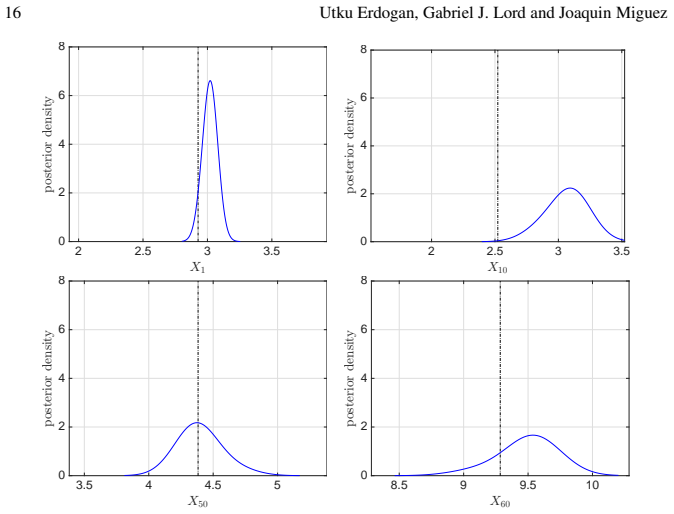
Run the constrained filter on the Lorenz-96 system for many observation steps with a growing number of particles and verify that the empirical error stays bounded uniformly in time, while an unconstrained version diverges or becomes unstable.
Figures

read the original abstract
Particle filters (PFs) are recursive Monte Carlo algorithms for Bayesian tracking and prediction in state space models. This paper addresses continuous-discrete filtering problems, where the hidden state evolves as an It\^o stochastic differential equation (SDE) and observations arrive at discrete times. We propose a novel class of constrained PFs that enforce compact support on the state at each observation instant, thereby limiting exploration to plausible regions of the state space. Unlike earlier approaches that truncate the likelihood, the proposed method constrains the dynamics directly, yielding improved numerical stability. Under standard regularity assumptions, we prove convergence of the constrained filter, derive uniform-in-time error estimates, and extend the analysis to account for discretisation errors arising from numerical SDE solvers. A numerical study on a stochastic Lorenz-96 system demonstrates the practical application of the methodology when the constraint is implemented via barrier functions.
Editorial analysis
A structured set of objections, weighed in public.
Referee Report
Summary. The paper proposes a novel class of constrained particle filters for continuous-discrete state-space models. The hidden state evolves according to an Itô SDE but is forced to have compact support at each discrete observation time by directly modifying the dynamics (rather than truncating the likelihood). Under standard regularity assumptions the authors prove convergence of the constrained filter, derive uniform-in-time error bounds, and extend the analysis to discretization errors from numerical SDE solvers. The constraint is implemented via barrier functions in a numerical study on a stochastic Lorenz-96 system.
Significance. If the theoretical guarantees apply to the implemented algorithm, the work offers a principled way to improve numerical stability of particle filters in systems with known physical constraints. The uniform-in-time error estimates and the explicit treatment of discretization error are potentially valuable contributions to the continuous-discrete filtering literature.
major comments (2)
- [§3] §3 (Convergence and error analysis): The proofs assume a hard compact-support constraint enforced directly on the state process at observation instants. The numerical implementation (§5) uses barrier functions that add a repulsive drift term but do not enforce a hard boundary; trajectories can exit the intended set with positive probability. No quantitative bound (e.g., total-variation distance) is given between the hard-constrained law and the barrier-regularized law, so it is unclear whether the proved uniform error estimates carry over to the algorithm that is actually run.
- [§4] §4 (Regularity assumptions): The convergence and well-posedness arguments invoke “standard regularity assumptions” on the constrained SDE. When the barrier is made steep enough to approximate a hard constraint, the resulting drift term may violate the Lipschitz or linear-growth conditions typically required for existence/uniqueness and for the particle-filter convergence arguments. The manuscript does not verify that these conditions continue to hold for the barrier-modified coefficients used in the experiments.
minor comments (2)
- [Abstract] The abstract claims “improved numerical stability” but the numerical section does not report quantitative stability metrics (e.g., effective sample size or variance of the filter) against an unconstrained baseline.
- [§2–§5] Notation for the constrained process and the barrier function should be introduced once and used consistently; several symbols appear to be redefined between the theoretical and numerical sections.
Simulated Author's Rebuttal
We thank the referee for their careful reading and constructive comments, which have helped us identify areas where the manuscript can be strengthened. We address each major comment below and indicate the corresponding revisions.
read point-by-point responses
-
Referee: [§3] §3 (Convergence and error analysis): The proofs assume a hard compact-support constraint enforced directly on the state process at observation instants. The numerical implementation (§5) uses barrier functions that add a repulsive drift term but do not enforce a hard boundary; trajectories can exit the intended set with positive probability. No quantitative bound (e.g., total-variation distance) is given between the hard-constrained law and the barrier-regularized law, so it is unclear whether the proved uniform error estimates carry over to the algorithm that is actually run.
Authors: We appreciate the referee for identifying this distinction between the theoretical setting and the numerical implementation. The convergence proofs and uniform error bounds in §3 are derived under the idealized hard compact-support constraint. The barrier-function approach in §5 serves as a practical soft approximation that adds a repulsive drift to discourage boundary violations. We agree that the absence of a quantitative distance (such as total variation) between the two laws leaves open the question of how directly the error estimates apply to the implemented algorithm. In the revised manuscript we will insert a clarifying remark in §3 (and a cross-reference in §5) stating that the barrier-regularized process converges to the hard-constrained process as the barrier parameter tends to infinity, citing relevant results on barrier approximations for SDEs. We will also note the conditions under which the proved bounds remain approximately valid. A full quantitative bound is not derived in the present work, but the approximation link will be made explicit. revision: partial
-
Referee: [§4] §4 (Regularity assumptions): The convergence and well-posedness arguments invoke “standard regularity assumptions” on the constrained SDE. When the barrier is made steep enough to approximate a hard constraint, the resulting drift term may violate the Lipschitz or linear-growth conditions typically required for existence/uniqueness and for the particle-filter convergence arguments. The manuscript does not verify that these conditions continue to hold for the barrier-modified coefficients used in the experiments.
Authors: The referee correctly observes that steep barrier terms can threaten global Lipschitz continuity and linear growth. The “standard regularity assumptions” invoked in the paper are those guaranteeing unique strong solutions to the SDE and the applicability of the particle-filter convergence theorems. For the specific smooth, localized barrier functions employed in the stochastic Lorenz-96 experiments, the modified drift remains globally Lipschitz and satisfies linear growth for the barrier strengths used. Nevertheless, this verification is not explicitly documented. In the revision we will add a short appendix subsection that confirms the Lipschitz and growth constants for the exact coefficients appearing in §5. Should steeper barriers be considered in future work, we will note that local Lipschitz conditions together with the compact-support constraint suffice for the existence and convergence arguments. revision: yes
Circularity Check
No circularity; claims rest on independent convergence analysis under standard assumptions
full rationale
The paper introduces a constrained particle filter by directly modifying SDE dynamics to enforce compact support at observation times, then states convergence and uniform error bounds under 'standard regularity assumptions' for the resulting process. No self-definitional loops, fitted parameters renamed as predictions, or load-bearing self-citations appear in the derivation chain. The numerical implementation via barrier functions is presented as one concrete realization, but the theoretical results are not reduced to or forced by that choice. The analysis is therefore self-contained against external benchmarks.
Axiom & Free-Parameter Ledger
axioms (1)
- domain assumption standard regularity assumptions
Reference graph
Works this paper leans on
-
[1]
SIAM Journal on Numerical Analysis 62(2), 946–973 (2024)
Akyildiz, D., Crisan, D., Miguez, J.: Sequential discret isation schemes for a class of stochastic differential equations and their application to Bayesian fi ltering. SIAM Journal on Numerical Analysis 62(2), 946–973 (2024)
2024
-
[2]
IEEE Signal Processing Letters 24(6), 858–862 (2017)
Amor, N., Bouaynaya, N.C., Shterenberg, R., Chebbi, S.: O n the convergence of constrained particle filters. IEEE Signal Processing Letters 24(6), 858–862 (2017)
2017
-
[3]
Engle wood Cliffs (1979)
Anderson, B.D.O., Moore, J.B.: Optimal Filtering. Engle wood Cliffs (1979)
1979
-
[4]
Springer (2008)
Bain, A., Crisan, D.: Fundamentals of Stochastic Filteri ng. Springer (2008)
2008
-
[5]
Probability and statistics: Es say in honour of David A
Bengtsson, T., Bickel, P ., Li, B.: Curse of dimensionalit y revisited: Collapse of particle filter in very large scale systems. Probability and statistics: Es say in honour of David A. Freedman 2, 316–334 (2008)
2008
-
[6]
Proceedings of the IEEE 95(5), 899–924 (2007)
Capp´ e, O., Godsill, S.J., Moulines, E.: An overview of ex isting methods and recent advances in sequential Monte Carlo. Proceedings of the IEEE 95(5), 899–924 (2007)
2007
-
[7]
Chopin, N., Papaspiliopoulos, O.: An introduction to seq uential Monte Carlo, vol. 4. Springer (2020)
2020
-
[8]
Tech- nical Report Cambridge University (CUED/FINFENG/TR381) ( 2000)
Crisan, D., Doucet, A.: Convergence of sequential Monte C arlo methods. Tech- nical Report Cambridge University (CUED/FINFENG/TR381) ( 2000). URL citeseer.ist.psu.edu/crisan00convergence.html
2000
-
[9]
SIAM/ASA Journal on Uncertainty Quantification 8(1), 483–509 (2020)
Crisan, D., L´ opez-Y ela, A., Miguez, J.: Stable approxim ation schemes for optimal filters. SIAM/ASA Journal on Uncertainty Quantification 8(1), 483–509 (2020)
2020
-
[10]
Bernoulli 20(4), 1879–1929 (2014)
Crisan, D., Miguez, J.: Particle-kernel estimation of t he filter density in state-space models. Bernoulli 20(4), 1879–1929 (2014)
1929
-
[11]
Springer (2004) 24 Utku Erdogan, Gabriel J
Del Moral, P .: Feynman-Kac Formulae: Genealogical and I nteracting Particle Systems with Applications. Springer (2004) 24 Utku Erdogan, Gabriel J. Lord and Joaquin Miguez
2004
-
[12]
Annales de l’Institut Hen ri Poincar´ e (B) Probability and Statistics 37(2), 155–194 (2001)
Del Moral, P ., Guionnet, A.: On the stability of interact ing processes with applications to filtering and genetic algorithms. Annales de l’Institut Hen ri Poincar´ e (B) Probability and Statistics 37(2), 155–194 (2001)
2001
-
[13]
Approximations of Feynman-Kac formulae with applications to non-linear fil tering
Del Moral, P ., Miclo, L.: Branching and interacting part icle systems. Approximations of Feynman-Kac formulae with applications to non-linear fil tering. Lecture Notes in Mathematics pp. 1–145 (2000)
2000
-
[14]
IEEE Signal Processing Magazine 20(5), 19–38 (2003)
Djuri´ c, P .M., Kotecha, J.H., Zhang, J., Huang, Y ., Ghir mai, T., Bugallo, M.F., M´ ıguez, J.: Particle filtering. IEEE Signal Processing Magazine 20(5), 19–38 (2003)
2003
-
[15]
Statistics and Computing 10(3), 197–208 (2000)
Doucet, A., Godsill, S., Andrieu, C.: On sequential Mont e Carlo Sampling methods for Bayesian filtering. Statistics and Computing 10(3), 197–208 (2000)
2000
-
[16]
Erdogan, U., Lord, G.J., Miguez, J.: On a class of constra ined bayesian filters and their numerical implementation in high-dimensional state-space markov models. arXiv:2512.11012 (2025)
-
[17]
Ocean dynamics 53(4), 343–367 (2003)
Evensen, G.: The ensemble Kalman filter: Theoretical for mulation and practical implementa- tion. Ocean dynamics 53(4), 343–367 (2003)
2003
-
[18]
Journal of Computati onal and Graphical Statistics 32(3), 793–804 (2023)
Frazier, D.T., Loaiza-Maya, R., Martin, G.M.: V ariatio nal Bayes in state space models: Inferential and predictive accuracy. Journal of Computati onal and Graphical Statistics 32(3), 793–804 (2023)
2023
-
[19]
IEEE Transactions on Signal Processing 60(7), 3372–3386 (2012)
Garcia-Fernandez, A.F., Morelande, M.R., Grajal, J.: T runcated unscented Kalman filtering. IEEE Transactions on Signal Processing 60(7), 3372–3386 (2012)
2012
-
[20]
IEEE Transactions on Automatic Control 58(10), 2481–2494 (2013)
Georgiou, T.T., Lindquist, A.: The separation principl e in stochastic control, redux. IEEE Transactions on Automatic Control 58(10), 2481–2494 (2013)
2013
-
[21]
IEE Proceedings-F 140(2), 107–113 (1993)
Gordon, N., Salmond, D., Smith, A.F.M.: Novel approach t o nonlinear and non-Gaussian Bayesian state estimation. IEE Proceedings-F 140(2), 107–113 (1993)
1993
-
[22]
Geoscientific Model Development 13(4), 1903–1924 (2020)
Grudzien, C., Bocquet, M., Carrassi, A.: On the numerica l integration of the Lorenz-96 model, with scalar additive noise, for benchmark twin exper iments. Geoscientific Model Development 13(4), 1903–1924 (2020)
1903
-
[23]
Advances in Applied Probability 40(4), 979–1001 (2008)
Heine, K., Crisan, D.: Uniform approximations of discre te-time filters. Advances in Applied Probability 40(4), 979–1001 (2008)
2008
-
[24]
Proceedings of the IEEE 92(2), 401–422 (2004)
Julier, S.J., Uhlmann, J.: Unscented filtering and nonli near estimation. Proceedings of the IEEE 92(2), 401–422 (2004)
2004
-
[25]
Journal of Basic Engineering 82, 35–45 (1960)
Kalman, R.E.: A new approach to linear filtering and predi ction problems. Journal of Basic Engineering 82, 35–45 (1960)
1960
-
[26]
Kalman, R.E., Bucy, R.S.: New results in linear filtering and prediction theory (1961)
1961
-
[27]
Kitagawa, G.: Monte Carlo filter and smoother for non-Gau ssian nonlinear state-space models. J. Comput. Graph. Statist. 1, 1–25 (1996)
1996
-
[28]
Springer (1995)
Kloeden, P .E., Platen, E.: Numerical solution of stocha stic differential equations. Springer (1995)
1995
-
[29]
The Annals of Statistics 33(5), 1983–2021 (2005)
K¨ unsch, H.R.: Recursive Monte Carlo filters: Algorithm s and theoretical bounds. The Annals of Statistics 33(5), 1983–2021 (2005)
1983
-
[30]
S pringer (2015)
Law, K., Stuart, A., Zygalakis, K.: Data Assimilation. S pringer (2015)
2015
-
[31]
Journal of the American Statistical Association 93(443), 1032–1044 (1998)
Liu, J.S., Chen, R.: Sequential Monte Carlo methods for d ynamic systems. Journal of the American Statistical Association 93(443), 1032–1044 (1998)
1998
-
[32]
Statistics and Computing 23(1), 91–107 (2013)
M´ ıguez, J., Crisan, D., Djuri´ c, P .M.: On the convergen ce of two sequential Monte Carlo methods for maximum a posteriori sequence estimation and st ochastic global optimization. Statistics and Computing 23(1), 91–107 (2013)
2013
-
[33]
IEEE Control Systems Magazine 16(3), 67–76 (2002)
Mitter, S.K.: Filtering and stochastic control: A histo rical perspective. IEEE Control Systems Magazine 16(3), 67–76 (2002)
2002
-
[34]
P . E. Kloeden, E.P ., Schurz, H.: Numerical solution of SD E through computer experiments. Springer Science & Business Media (2012)
2012
-
[35]
Physica l Review E 98(6), 063,305 (2018)
P´ erez-Vieites, S., Mari˜ no, I.P ., Miguez, J.: Probabilistic scheme for joint parameter estimation and state prediction in complex dynamical systems. Physica l Review E 98(6), 063,305 (2018)
2018
-
[36]
Pieper-Sethmacher, T., Avitabile, D., van der Meulen, F .: Guided filtering and smoothing for infinite-dimensional diffusions (2025) Constrained particle filters for continuous-discrete stat e space models 25
2025
-
[37]
Pitt, M.K., Shephard, N.: Auxiliary variable based part icle filters. In: A. Doucet, N. de Freitas, N. Gordon (eds.) Sequential Monte Carlo Methods in Practice , chap. 13, pp. 273–293. Springer (2001)
2001
-
[38]
Cambridge University Press (2015)
Reich, S., Cotter, C.: Probabilistic forecasting and Ba yesian data assimilation. Cambridge University Press (2015)
2015
-
[39]
Artech House, Boston (2004)
Ristic, B., Arulampalam, S., Gordon, N.: Beyond the Kalm an Filter: Particle Filters for Tracking Applications. Artech House, Boston (2004)
2004
-
[40]
S¨ arkk¨ a, S.: Bayesian filtering and smoothing. 3. Cambridge university press (2013)
2013
-
[41]
IE EE Transactions on Signal Processing 56(10), 5020–5030 (2008)
Smidl, V ., Quinn, A.: V ariational bayesian filtering. IE EE Transactions on Signal Processing 56(10), 5020–5030 (2008)
2008
-
[42]
Monthly Weather Review 136(12), 4629–4640 (2008)
Snyder, C., Bengtsson, T., Bickel, P ., Anderson, J.: Obs tacles to high-dimensional particle filtering. Monthly Weather Review 136(12), 4629–4640 (2008)
2008
-
[43]
Artech House (2013)
Stone, L.D., Streit, R.L., Corwin, T.L., Bell, K.L.: Bay esian multiple target tracking. Artech House (2013)
2013
-
[44]
Annals of Applied Probability 23(6), 2500–2537 (2013)
Whiteley, N.P .: Stability properties of some particle fi lters. Annals of Applied Probability 23(6), 2500–2537 (2013)
2013
discussion (0)
Sign in with ORCID, Apple, or X to comment. Anyone can read and Pith papers without signing in.