Recognition: unknown
Positivity-Preserving and Entropy-Stable Oscillation-Eliminating DGSEM for the Compressible Euler Equations on Curvilinear Meshes with Adaptive Mesh Refinement
Pith reviewed 2026-05-09 21:21 UTC · model grok-4.3
The pith
Entropy-stable fluxes for nonconforming interfaces enable positivity-preserving DGSEM on curvilinear AMR grids.
A machine-rendered reading of the paper's core claim, the machinery that carries it, and where it could break.
Core claim
The authors construct an entropy-stable flux for nonconforming interfaces that ensures global conservation and a semi-discrete entropy inequality. For polynomial degrees two and higher, they introduce a mortar-based flux that interpolates at the solution level to preserve high-order accuracy at the expense of losing the entropy stability proof. They extend the Zhang-Shu positivity-preserving framework to curvilinear AMR meshes, proving that under forward Euler time stepping and a suitable CFL condition the scheme with either flux preserves positivity of cell-average density and pressure, and with the limiter all nodal points stay admissible.
What carries the argument
The entropy-stable numerical flux at hanging-node interfaces together with the mortar-based flux that evaluates standard two-point fluxes on fine-side mortars.
If this is right
- The entropy-stable flux guarantees global conservation and a semi-discrete entropy inequality.
- Cell-average density and pressure remain positive under forward Euler stepping with appropriate CFL condition.
- The mortar-based flux maintains formal high-order accuracy on AMR grids.
- Combining the flux with the Zhang-Shu limiter keeps all nodal density and pressure positive.
- Shock-indicator-driven AMR with conservative data transfer produces a robust simulation algorithm.
Where Pith is reading between the lines
- Similar flux designs might apply to other discontinuous Galerkin methods on adaptive meshes for hyperbolic problems.
- Long-term simulations of complex flows could benefit from the guaranteed positivity to avoid crashes.
- Extending the approach to three dimensions would require generalizing the interface handling for hanging faces.
- Comparing the entropy evolution in the two flux variants on test problems could guide future hybrid methods.
Load-bearing premise
The positivity preservation proof assumes forward Euler time stepping together with a suitable CFL condition on the curvilinear AMR meshes.
What would settle it
Running the scheme on a curvilinear AMR grid for the Euler equations and observing a negative cell-average density or pressure when the CFL condition is met and the limiter is applied would disprove the positivity claim.
Figures




read the original abstract
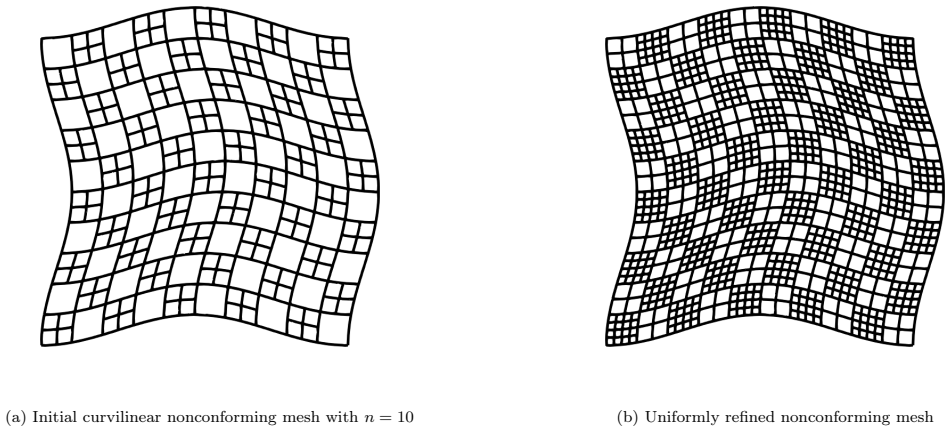
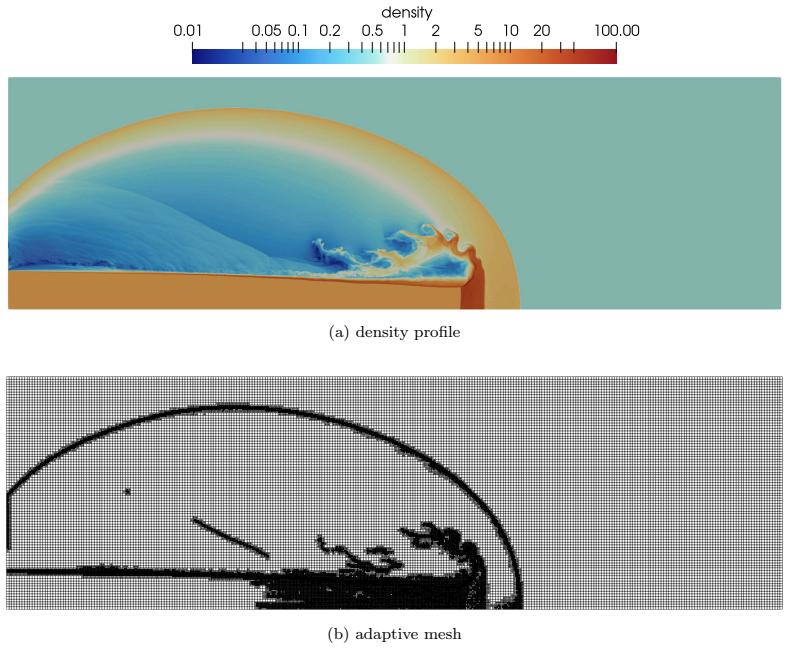
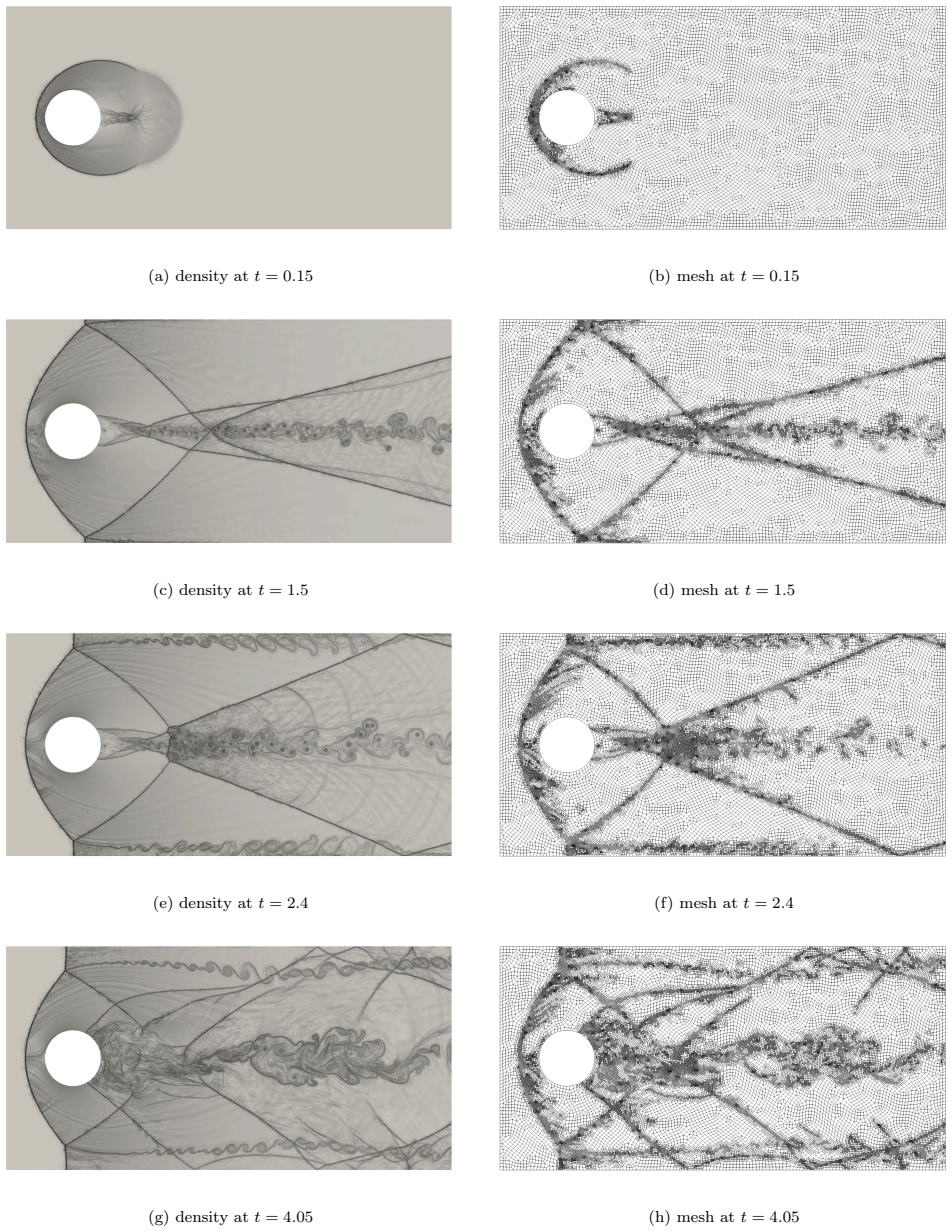
We extend the entropy-stable oscillation-eliminating discontinuous Galerkin spectral element method (ES-OEDG) on curvilinear meshes to adaptive mesh refinement (AMR) grids with nonconforming interfaces. The formulation targets two-dimensional curvilinear quadrilateral meshes under a 2:1 refinement constraint, allowing a single level of hanging nodes. Elementwise volume discretization and geometric mapping are retained, while oscillation elimination and interface coupling are adapted for nonconforming interfaces. A central contribution is the design and analysis of numerical fluxes for such interfaces. We construct an entropy-stable flux that ensures global conservation and a semi-discrete entropy inequality. However, for polynomial degree N >= 2, negative entries in nonconforming interpolation operators lead to loss of formal high-order consistency. To address this, we propose a mortar-based flux that preserves high-order accuracy by interpolating at the solution level and evaluating standard two-point fluxes on fine-side mortars, at the cost of losing provable entropy stability. We also extend the Zhang--Shu positivity-preserving framework to curvilinear AMR meshes. Under forward Euler time stepping and a suitable CFL condition, the scheme using either flux preserves positivity of cell-average density and pressure. Combined with the Zhang--Shu limiter, this yields a fully discrete scheme maintaining admissibility at all nodal points. We further incorporate shock-indicator-based AMR and a conservative, positivity-preserving data transfer procedure between successive meshes, resulting in a robust and efficient algorithm. Numerical experiments on Cartesian and curvilinear AMR grids confirm high-order accuracy and robustness.
Editorial analysis
A structured set of objections, weighed in public.
Referee Report
Summary. The manuscript extends the entropy-stable oscillation-eliminating discontinuous Galerkin spectral element method (ES-OEDG) to two-dimensional curvilinear quadrilateral meshes with adaptive mesh refinement under a 2:1 refinement constraint. Key contributions include the design of an entropy-stable numerical flux for nonconforming interfaces that ensures global conservation and a semi-discrete entropy inequality, a mortar-based alternative flux that preserves high-order accuracy but loses the entropy stability guarantee due to negative entries in interpolation operators for N >= 2, an extension of the Zhang-Shu positivity-preserving limiter to curvilinear AMR meshes ensuring positivity of cell averages under forward Euler time stepping with suitable CFL, shock-indicator-based AMR, and conservative positivity-preserving data transfer. Numerical experiments confirm high-order accuracy and robustness on Cartesian and curvilinear AMR grids.
Significance. If the results hold, this provides a practical and theoretically grounded approach for high-order simulations of the compressible Euler equations on adaptive curvilinear meshes, addressing challenges in conservation, entropy stability, positivity, and oscillation control. The explicit acknowledgment of the trade-off between entropy stability and high-order accuracy for higher polynomial degrees on nonconforming interfaces is a strength, as is the numerical validation. This could be impactful for applications in aerodynamics and other fields requiring local mesh refinement.
major comments (2)
- Abstract: The entropy-stable flux for 2:1 nonconforming interfaces ensures conservation and semi-discrete entropy inequality but loses formal high-order consistency for N >= 2 due to negative entries in the nonconforming interpolation operators. This is load-bearing for the high-order accuracy claim on AMR meshes, since the mortar-based alternative explicitly relinquishes the entropy-stability proof. The manuscript should quantify the actual order of the entropy-stable flux on nonconforming interfaces or provide evidence that the consistency loss does not undermine the advertised high-order property in practice.
- The positivity preservation under forward Euler with CFL is asserted for both fluxes via the extended Zhang-Shu framework on curvilinear AMR meshes. However, because the entropy-stability proof applies only to one flux, the manuscript must clarify whether the positivity argument is independent of the entropy-stable structure or if it requires additional justification for the mortar flux.
minor comments (1)
- Abstract: The description of how oscillation elimination is adapted for nonconforming interfaces could be expanded for clarity, as it is mentioned but not detailed in the summary of contributions.
Simulated Author's Rebuttal
We thank the referee for the thorough review and valuable comments. We address each major comment below and have made revisions to the manuscript to improve clarity and address the concerns raised.
read point-by-point responses
-
Referee: [—] Abstract: The entropy-stable flux for 2:1 nonconforming interfaces ensures conservation and semi-discrete entropy inequality but loses formal high-order consistency for N >= 2 due to negative entries in the nonconforming interpolation operators. This is load-bearing for the high-order accuracy claim on AMR meshes, since the mortar-based alternative explicitly relinquishes the entropy-stability proof. The manuscript should quantify the actual order of the entropy-stable flux on nonconforming interfaces or provide evidence that the consistency loss does not undermine the advertised high-order property in practice.
Authors: We agree that the entropy-stable flux loses formal high-order consistency for N >= 2 due to negative entries in the interpolation operators. To address this concern, we have added numerical convergence studies specifically for the entropy-stable flux on 2:1 nonconforming interfaces. These tests, performed on both Cartesian and curvilinear AMR meshes with smooth solutions, show that the observed orders remain close to the design order (typically within 0.5 of the expected rate for N=2,3). We have included a new table and discussion in the revised manuscript demonstrating that the consistency loss does not undermine practical high-order accuracy for the tested regimes. We have also clarified in the abstract and Section 3 that the mortar-based flux is available when strict high-order consistency is prioritized, while the entropy-stable flux offers a robust alternative with near-optimal observed accuracy. revision: yes
-
Referee: [—] The positivity preservation under forward Euler with CFL is asserted for both fluxes via the extended Zhang-Shu framework on curvilinear AMR meshes. However, because the entropy-stability proof applies only to one flux, the manuscript must clarify whether the positivity argument is independent of the entropy-stable structure or if it requires additional justification for the mortar flux.
Authors: The positivity preservation argument is independent of the entropy-stability property. The extended Zhang-Shu framework requires only that the numerical flux is consistent with the physical flux and that the cell-average update satisfies a positivity condition under a suitable CFL restriction; both the entropy-stable and mortar-based fluxes meet these requirements. Entropy stability is an additional structural property used only for the first flux and is not invoked in the positivity analysis. We have revised the relevant sections (particularly the positivity theorem statement and its proof sketch) to explicitly note this independence and to provide a uniform justification that applies to both fluxes without reference to entropy stability. revision: yes
Circularity Check
No significant circularity; derivations rely on explicit constructions and external priors
full rationale
The paper extends its prior ES-OEDG framework to AMR by explicitly constructing an entropy-stable interface flux to enforce global conservation and a semi-discrete entropy inequality, then defines a mortar-based alternative by direct interpolation of the solution followed by standard two-point fluxes on fine-side mortars. Positivity preservation is obtained by extending the Zhang-Shu limiter under forward Euler time stepping and a stated CFL condition, without any parameter fitting, self-referential equations, or reduction of the target properties to the inputs by construction. The paper openly notes the loss of high-order consistency for N >= 2 in the entropy-stable version and the loss of the entropy proof in the mortar version, confirming that the central claims do not collapse into self-definition or load-bearing self-citation chains. All steps remain independent of the results they derive.
Axiom & Free-Parameter Ledger
free parameters (1)
- CFL condition
axioms (2)
- domain assumption The compressible Euler equations admit an entropy function and entropy variables that allow construction of entropy-stable two-point fluxes.
- domain assumption Forward Euler time stepping with a CFL restriction preserves positivity when combined with the Zhang-Shu limiter.
Reference graph
Works this paper leans on
- [1]
-
[2]
T. C. Fisher, High-order L2 stable multi-domain finite difference method for compressible flows, Ph.D. thesis, Purdue University (2012)
2012
-
[3]
Carpenter, T
M. Carpenter, T. Fisher, E. Nielsen, M. Parsani, M. Svärd, N. Yamaleev, Entropy sta- ble summation-by-parts formulations for compressible computational fluid dynamics, in: Handbook of Numerical Analysis, Vol. 17, Elsevier, 2016, pp. 495–524
2016
-
[4]
Crean, J
J. Crean, J. E. Hicken, D. C. D. R. Fernández, D. W. Zingg, M. H. Carpenter, Entropy- stable summation-by-parts discretization of the Euler equations on general curved elements, Journal of Computational Physics 356 (2018) 410–438
2018
-
[5]
J. Chan, L. C. Wilcox, On discretely entropy stable weight-adjusted discontinuous Galerkin methods: curvilinear meshes, Journal of Computational Physics 378 (2019) 366–393
2019
-
[6]
L. Friedrich, A. R. Winters, D. C. Del Rey Fernández, G. J. Gassner, M. Parsani, M. H. Carpenter, An entropy stableh/pNon-Conforming Discontinuous Galerkin Method with the Summation-by-Parts Property, Journal of Scientific Computing 77 (2) (2018) 689–725. doi:10.1007/s10915-018-0733-7
-
[7]
D. C. Del Rey Fernández, M. H. Carpenter, L. Dalcin, S. Zampini, M. Parsani, Entropy stable h/p-nonconforming discretization with the summation-by-parts property for the com- pressible euler and navier–stokes equations, SN Partial Differential Equations and Applica- tions 1 (9) (2020) 1–54.doi:10.1007/s42985-020-00009-z
-
[8]
J. Chan, M. J. Bencomo, D. C. Del Rey Fernández, Mortar-based Entropy-Stable Discontin- uous Galerkin Methods on Non-conforming Quadrilateral and Hexahedral Meshes, Journal of Scientific Computing 89 (2021) 51.doi:10.1007/s10915-021-01652-3
-
[9]
D. A. Kopriva, Metric identities and the discontinuous spectral element method on curvi- linear meshes, Journal of Scientific Computing 26 (3) (2006) 301–327.doi:10.1007/ s10915-005-9070-8
2006
-
[10]
P. Chandrashekar, Kinetic energy preserving and entropy stable finite volume schemes for compressible euler and navier-stokes equations, Communications in Computational Physics 14 (5) (2013) 1252–1286
2013
-
[11]
Guermond, B
J.-L. Guermond, B. Popov, Fast estimation from above of the maximum wave speed in the Riemann problem for the Euler equations, J. Comput. Phys. 321 (2016) 908–926
2016
-
[12]
Zhang, C.-W
X. Zhang, C.-W. Shu, On positivity-preserving high order discontinuous galerkin schemes for compressible euler equations on rectangular meshes, Journal of Computational Physics 229 (23) (2010) 8918–8934
2010
-
[13]
D. A. Kopriva, S. L. Woodruff, M. Y. Hussaini, Computation of electromagnetic scattering with a non-conforming discontinuous spectral element method, International Journal for Numerical Methods in Engineering 53 (1) (2002) 105–122.doi:10.1002/nme.394
-
[14]
M. Peng, Z. Sun, K. Wu, OEDG: Oscillation-eliminating discontinuous galerkin method for hyperbolic conservation laws, Mathematics of Computation 94 (353) (2025) 1147–1198. 34
2025
-
[15]
Anderson, J
R. Anderson, J. Andrej, A. Barker, J. Bramwell, J.-S. Camier, J. Cerveny, V. Dobrev, Y. Dudouit, A. Fisher, T. Kolev, et al., Mfem: A modular finite element methods library, Computers & Mathematics with Applications 81 (2021) 42–74
2021
-
[16]
Andrej, N
J. Andrej, N. Atallah, J.-P. Bäcker, J.-S. Camier, D. Copeland, V. Dobrev, Y. Dudouit, T. Duswald, B. Keith, D. Kim, et al., High-performance finite elements with mfem, The International Journal of High Performance Computing Applications 38 (5) (2024) 447–467
2024
-
[17]
P.E.Vincent, P.Castonguay, A.Jameson, Insightsfromvonneumannanalysisofhigh-order flux reconstruction schemes, Journal of Computational Physics 230 (22) (2011) 8134–8154
2011
-
[18]
C.-W. Shu, Essentially non-oscillatory and weighted essentially non-oscillatory schemes for hyperbolic conservation laws, in: Advanced Numerical Approximation of Nonlinear Hyper- bolic Equations: Lectures given at the 2nd Session of the Centro Internazionale Matematico Estivo (CIME) held in Cetraro, Italy, June 23–28, 1997, Springer, 2006, pp. 325–432
1997
-
[19]
P.Woodward, P.Colella, Thenumericalsimulationoftwo-dimensionalfluidflowwithstrong shocks, Journal of computational physics 54 (1) (1984) 115–173
1984
-
[20]
C.-W. Shu, High-order finite difference and finite volume weno schemes and discontinuous galerkin methods for cfd, International Journal of Computational fluid dynamics 17 (2) (2003) 107–118
2003
-
[21]
Zhang, On positivity-preserving high order discontinuous galerkin schemes for compress- ible navier–stokes equations, Journal of Computational Physics 328 (2017) 301–343
X. Zhang, On positivity-preserving high order discontinuous galerkin schemes for compress- ible navier–stokes equations, Journal of Computational Physics 328 (2017) 301–343
2017
-
[22]
D. S. Balsara, Self-adjusting, positivity preserving high order schemes for hydrodynamics and magnetohydrodynamics, Journal of Computational Physics 231 (22) (2012) 7504–7517
2012
-
[23]
Dzanic, F
T. Dzanic, F. D. Witherden, Positivity-preserving entropy-based adaptive filtering for dis- continuous spectral element methods, Journal of Computational Physics 468 (2022) 111501
2022
-
[24]
C. Liu, G. T. Buzzard, X. Zhang, An optimization based limiter for enforcing positivity in a semi-implicit discontinuous galerkin scheme for compressible navier–stokes equations, Journal of Computational Physics 519 (2024) 113440
2024
-
[25]
J.-L.Guermond, M.Nazarov, B.Popov, I.Tomas, Second-orderinvariantdomainpreserving approximation of the euler equations using convex limiting, SIAM Journal on Scientific Computing 40 (5) (2018) A3211–A3239
2018
-
[26]
Deng, A new open-source library based on novel high-resolution structure-preserving convection schemes, Journal of Computational Science 74 (2023) 102150
X. Deng, A new open-source library based on novel high-resolution structure-preserving convection schemes, Journal of Computational Science 74 (2023) 102150
2023
-
[27]
Nazarov, A
M. Nazarov, A. Larcher, Numerical investigation of a viscous regularization of the euler equations by entropy viscosity, Computer Methods in Applied Mechanics and Engineering 317 (2017) 128–152
2017
-
[28]
Z. Chen, K. Chen, High-order positivity-preserving and dissipation-adaptive computational framework with sharp-interface immersed boundaries for high-mach-number shock-obstacle interactions, Aerospace Science and Technology (2025) 111073
2025
-
[29]
Geuzaine, J.-F
C. Geuzaine, J.-F. Remacle, Gmsh: A 3-d finite element mesh generator with built-in pre- and post-processing facilities, International journal for numerical methods in engineering 79 (11) (2009) 1309–1331. 35
2009
-
[30]
Remacle, J
J.-F. Remacle, J. Lambrechts, B. Seny, E. Marchandise, A. Johnen, C. Geuzainet, Blossom- quad: A non-uniform quadrilateral mesh generator using a minimum-cost perfect-matching algorithm, International journal for numerical methods in engineering 89 (9) (2012) 1102– 1119. 36
2012
discussion (0)
Sign in with ORCID, Apple, or X to comment. Anyone can read and Pith papers without signing in.