Recognition: unknown
The Representation Type of the Descent Algebras
Pith reviewed 2026-05-08 13:11 UTC · model grok-4.3
The pith
The representation types of descent algebras are now classified for all types except E8 over any field.
A machine-rendered reading of the paper's core claim, the machinery that carries it, and where it could break.
Core claim
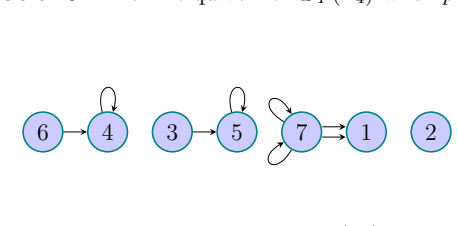
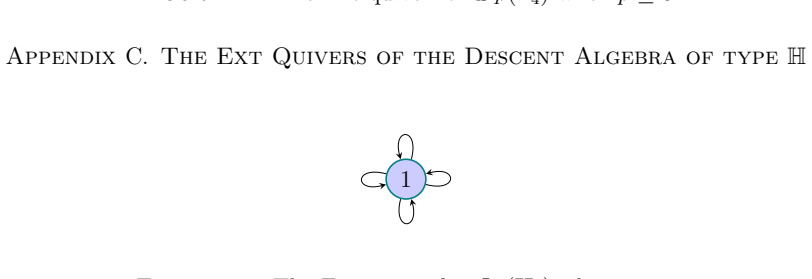
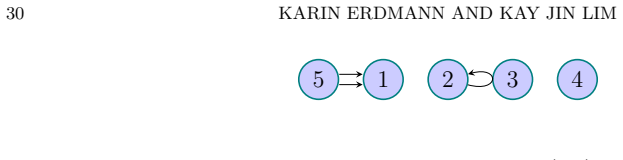
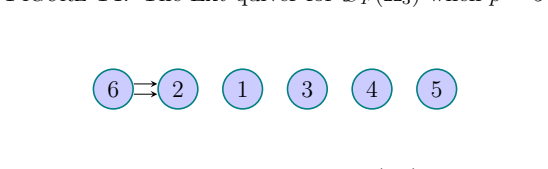
The paper establishes the representation type of the descent algebra for every finite Coxeter type except E8. The proof for type B is entirely theoretical. For the remaining small cases in type D and the exceptional types, the Ext-quivers are computed to determine whether the algebra is of finite, tame, or wild representation type.
What carries the argument
The Ext-quiver of the descent algebra, whose structure decides the representation type in the small-rank cases.
If this is right
- The classification of representation type is now complete for types A, B, D, F4, E6 and E7.
- Type B requires no computer assistance.
- The small cases of type D and the exceptional series are settled once the Ext-quiver computations are accepted.
- Only the descent algebra of type E8 remains unclassified.
Where Pith is reading between the lines
- The same computational strategy used for the small exceptional cases could in principle be tried on E8 if sufficient resources are available.
- The uniform patterns across the classified types may indicate that representation type is governed by rank or by the presence of certain subdiagrams in the Coxeter diagram.
- These results supply a complete list of examples against which any future general theory of descent-algebra representation type can be tested.
Load-bearing premise
The computer calculations that determine the Ext-quivers for the small cases in types D and the exceptional types are both correct and exhaustive.
What would settle it
An independent check that finds a different number of indecomposable modules or a different Ext-quiver for any one of the small cases whose type was computed.
Figures












read the original abstract
Schocker classified the representation type of the descent algebra of type $\mathbb{A}$ over any field of characteristic zero. In an earlier paper, the authors extended this classification for type $\mathbb{A}$ to fields of positive characteristic. In this paper, we complete the classification for all other types except for $\mathbb{E}_8$. The proof for type $\mathbb{B}$ is entirely theoretical, while some small cases in type $\mathbb{D}$ and the exceptional types require computer computation to determine their Ext-quivers.
Editorial analysis
A structured set of objections, weighed in public.
Referee Report
Summary. The manuscript completes the classification of the representation type of descent algebras for all Dynkin types except E8. Building on Schocker's classification for type A in characteristic zero and the authors' prior extension to positive characteristic, the paper gives a fully theoretical proof for type B and determines the representation type for small cases in type D and the exceptional types via computer-assisted computations of the Ext-quivers.
Significance. If the computational results are correct and exhaustive, this work supplies a near-complete classification of representation types for descent algebras, a meaningful advance in the representation theory of algebras attached to Coxeter groups and finite reflection groups. The entirely theoretical argument for type B is a clear strength, as it supplies an independent, non-computational derivation that can be checked analytically. The paper builds directly on prior classifications while adding new arguments and computations for the remaining types.
major comments (1)
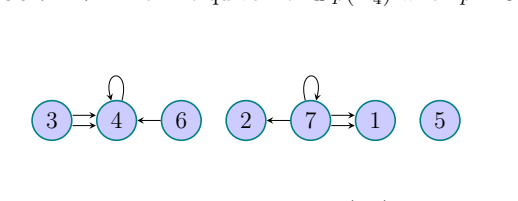
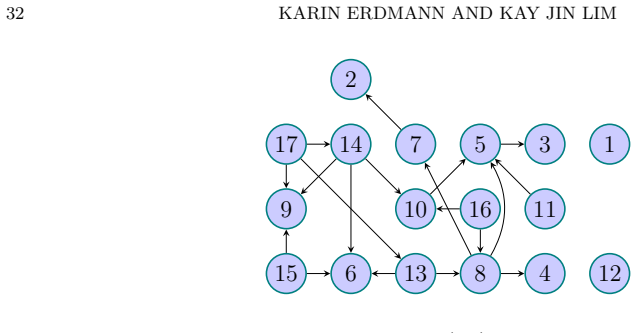
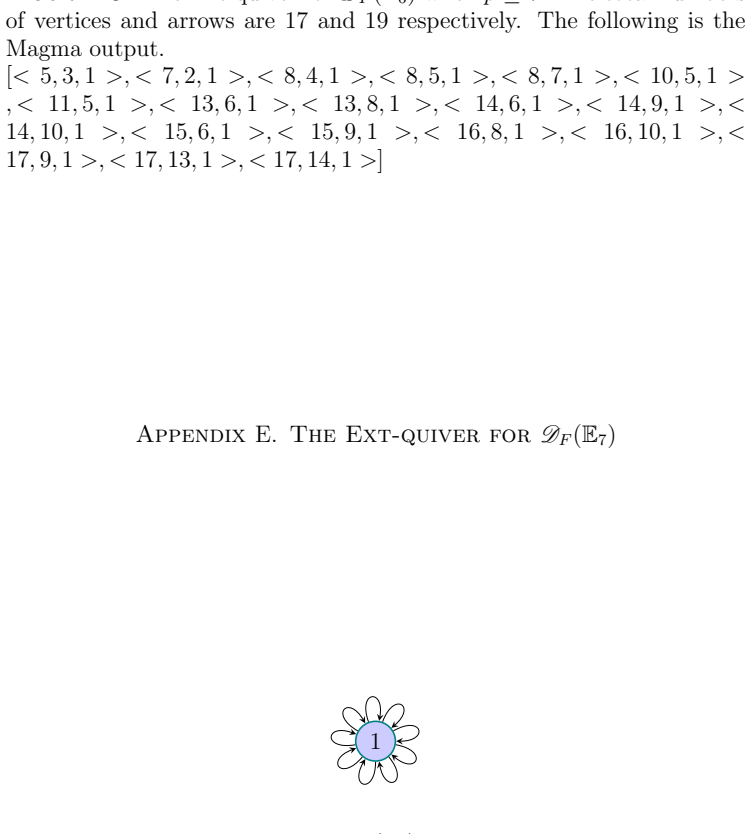
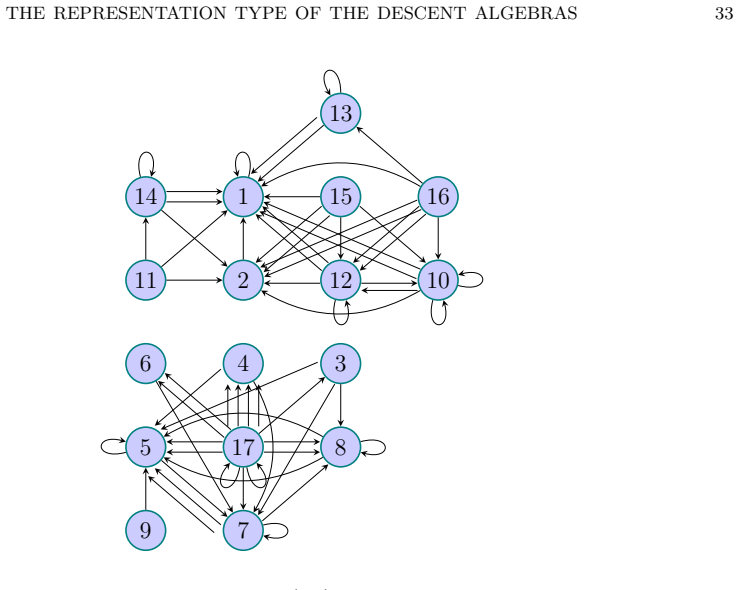
- [Abstract and sections describing the computer-assisted cases for type D and exceptional types] The classification claim for types D and the exceptional types rests on the computer determination of Ext-quivers for the small cases (as stated in the abstract). No details are supplied on the algebra software, the precise input (basis, structure constants, or modules), the field characteristic, or the raw output matrices/quivers. This prevents independent verification or spot-checking of these load-bearing computations.
Simulated Author's Rebuttal
We thank the referee for their careful reading of the manuscript and for the positive overall assessment of the classification results, particularly the theoretical treatment of type B. We address the major comment below and will make the requested revisions to enhance the verifiability of the computational portions.
read point-by-point responses
-
Referee: [Abstract and sections describing the computer-assisted cases for type D and exceptional types] The classification claim for types D and the exceptional types rests on the computer determination of Ext-quivers for the small cases (as stated in the abstract). No details are supplied on the algebra software, the precise input (basis, structure constants, or modules), the field characteristic, or the raw output matrices/quivers. This prevents independent verification or spot-checking of these load-bearing computations.
Authors: We agree that the manuscript currently provides insufficient detail on the computer-assisted determination of the Ext-quivers for the small cases in types D and the exceptional types, which limits independent verification. In the revised version we will insert a new subsection (in the section treating the computational cases) that supplies the missing information: the algebra software and packages used, the explicit construction of the descent algebra basis together with the structure constants, the precise field characteristic for each computation, the modules employed in the Ext calculations, and the resulting quivers (including adjacency matrices or relation presentations for the smallest cases). These additions will make the computations reproducible and allow spot-checking without altering the overall length or focus of the paper. revision: yes
Circularity Check
No circularity: classification extends prior work via independent theoretical proofs and explicit computations
full rationale
The paper completes the representation-type classification for descent algebras by supplying a fully theoretical proof for type B and computer-assisted Ext-quiver determinations for small cases in types D and the exceptionals. These steps are presented as new, non-reductive arguments that determine the quivers and hence the representation type; they do not reduce by construction to fitted parameters, self-definitions, or prior results. Self-citations are confined to the foundational type-A classification (Schocker and the authors' earlier paper) and are not invoked to justify the new claims for other types. No equations or derivations in the provided text equate a claimed result to its own inputs.
Axiom & Free-Parameter Ledger
Reference graph
Works this paper leans on
-
[1]
Aguiar, N
M. Aguiar, N. Bergeron and K. Nyman, The peak algebra and the descent algebras of typesB andD, Trans. Amer. Math. Soc. 356 (2004), no.7, 2781–2824
2004
-
[2]
M. D. Atkinson, G. Pfeiffer and S. J. van Willigenburg, Thep-modular descent algebras, Algebr. Represent. Theory 5 (2002), no. 1, 101–113
2002
-
[3]
M. D. Atkinson and S. J. van Willigenburg, Thep-modular descent algebra of the symmetric group, Bull. London Math. Soc. 29 (1997), no. 4, 407–414
1997
-
[4]
Auslander, I
M. Auslander, I. Reiten and S. O. Smalø, Representation Theory of Artin Algebras, Cambridge Stud. Adv. Math., 36, Cambridge University Press, Cambridge, 1995
1995
-
[5]
D. J. Benson, Representations and Cohomology I: Basic Representation Theory of Finite Groups and Associative Algebras, Cambridge Studies in Advanced Mathematics, vol. 30, Cambridge University Press, 1991, reprinted in paperback, 1998
1991
-
[6]
D. J. Benson and K. J. Lim, Projective modules and cohomology for integral basic algebras, Int. Math. Res. Not. IMRN 2025, no. 9, Paper No. rnaf105, 23 pp
2025
-
[7]
Bergeron and N
F. Bergeron and N. Bergeron, A decomposition of the descent algebra of the hyperoctahedral group, I, J. Algebra 148 (1992), no. 1, 86–97
1992
-
[8]
Bergeron, N
F. Bergeron, N. Bergeron, R. B. Howlett and D. E. Taylor, A decomposition of the descent algebra of a finite Coxeter group, J. Algebraic Combin. 1 (1992), no. 1, 23–44
1992
-
[9]
Bergeron, A
F. Bergeron, A. Garsia, and C. Reutenauer, Homomorphisms between Solomon’s descent alge- bras, J. Algebra 150 (1992), no. 2, 503–519
1992
-
[10]
Bergeron and S
N. Bergeron and S. J. van Willigenburg, A multiplication rule for the descent algebra of typeD, J. Algebra 206 (1998), no.2, 699–705
1998
-
[11]
Blessenohl and H
D. Blessenohl and H. Laue, On the descending Loewy series of Solomon’s descent algebra, J. Algebra 180 (1996), no. 3, 698–724
1996
-
[12]
Blessenohl and H
D. Blessenohl and H. Laue, The module structure of Solomon’s descent algebra. J. Aust. Math. Soc. 72 (2002), no. 3, 317–333
2002
-
[13]
Bosma, J
W. Bosma, J. Cannon and C. Playoust, The Magma algebra system. I. The user language, J. Symbolic Comput., 24 (1997), 235–265
1997
-
[14]
Cline, B
E. Cline, B. Parshall and L. Scott, Stratifying Endomorphism Algebras, Mem. Amer. Math. Soc. 124 (1996), no. 591
1996
-
[15]
Crawley-Boevey, On tame algebras and bocses
W. Crawley-Boevey, On tame algebras and bocses. Proc. London Math. Soc.(3) 56 (1988), no.3, 451–483
1988
-
[16]
Dlab and C
V. Dlab and C. M. Ringel, Indecomposable representations of graphs and algebras, Mem. Amer. Math. Soc. 6 (1976), no. 173
1976
-
[17]
Donovan and M
P. Donovan and M. R. Freislich, The Representation Theory of Finite Graphs and Associated Algebras, Carleton Mathematical Lecture Notes, No. 5. Carleton University, Ottawa, ON, 1973. iii+83 pp
1973
-
[18]
Ju. A. Drozd, Tame and wild matrix problems, Representation Theory, II (Proc. Second Internat. Conf., Carleton Univ., Ottawa, Ont., 1979), pp. 242–258, Lecture Notes in Math., 832, Springer, Berlin, 1980
1979
-
[19]
Erdmann, Blocks of Tame Representation Type and Related Algebras, Lecture Notes in Mathematics, vol
K. Erdmann, Blocks of Tame Representation Type and Related Algebras, Lecture Notes in Mathematics, vol. 1428, Springer-Verlag, Berlin, 1990
1990
-
[20]
Erdmann, T
K. Erdmann, T. Holm, O. Iyama and J. Schr¨ oer, Radical embeddings and representation dimen- sion, Adv. Math. 185 (2004), no. 1, 159–177
2004
-
[21]
Erdmann and K
K. Erdmann and K. J. Lim, The representation type of the descent algebras of typeA, Sci. China Math. 68 (2025), no. 12, 2827–2846
2025
-
[22]
Gabriel, Unzerlegbare Darstellungen
P. Gabriel, Unzerlegbare Darstellungen. I. Manuscripta Math 6, 71–103 (1972). correction, ibid. 6 (1972), 309
1972
-
[23]
Gabriel, Auslander-Reiten sequences and representation-finite algebras
P. Gabriel, Auslander-Reiten sequences and representation-finite algebras. Representation theory I (Proc. Workshop, Carleton Univ., Ottawa, Ont., 1979), pp. 1–71. Lecture Notes in Math., 831, Springer, Berlin, 1980. THE REPRESENTATION TYPE OF THE DESCENT ALGEBRAS 25
1979
-
[24]
A. M. Garsia and C. Reutenauer, A decomposition of Solomon’s descent algebra, Adv. Math. 77 (1989), no. 2, 189–262
1989
-
[25]
Geck and G
M. Geck and G. Pfeiffer, Characters of Finite Coxeter Groups and Iwahori–Hecke Algebras, London Math. Soc. Monographs, vol. 21, Oxford University Press, 2000
2000
-
[26]
J. E. Humphreys, Reflection Groups and Coxeter Groups, Cambridge Stud. Adv. Math., 29 Cambridge University Press, Cambridge, 1990
1990
-
[27]
Krause, Stable equivalence preserves representation type, Comment
H. Krause, Stable equivalence preserves representation type, Comment. Math. Helv. 72 (1997), no. 2, 266–284
1997
-
[28]
K. J. Lim, Modular idempotents for the descent algebras of typeAand higher Lie powers and modules, J. Algebra, 628 (2023), 98–162
2023
-
[29]
C. M. Ringel, The Representation Type of Local Algebras, Lecture Notes in Mathematics, vol. 488, Springer, Berlin, 1975
1975
-
[30]
F. V. Saliola, On the quiver of the descent algebra, J. Algebra 320 (2008), 3866–3894
2008
-
[31]
M. Schocker, The descent algebra of the symmetric group, in: Representations of Finite Dimen- sional Algebras and Related Topics in Lie Theory and Geometry, Fields Institute Communica- tions, 40 (American Mathematical Society, Providence, RI, 2004), 145–161
2004
-
[32]
Solomon, A Mackey formula in the group ring of a Coxeter group, J
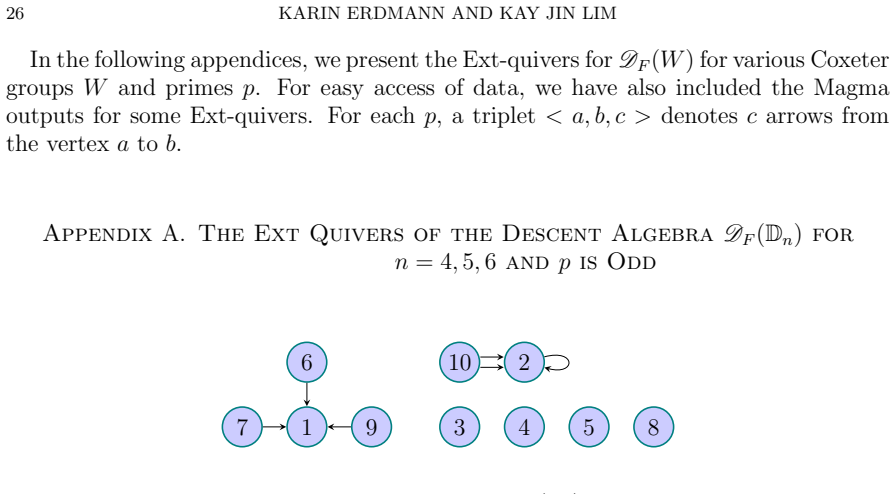
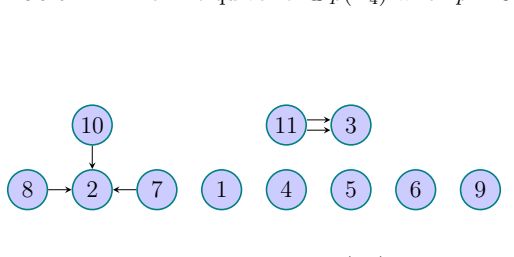
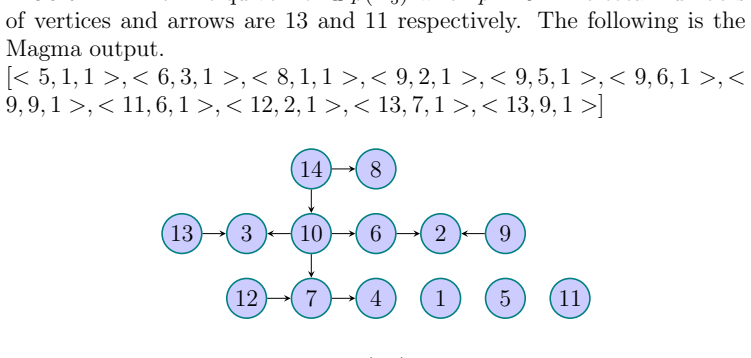
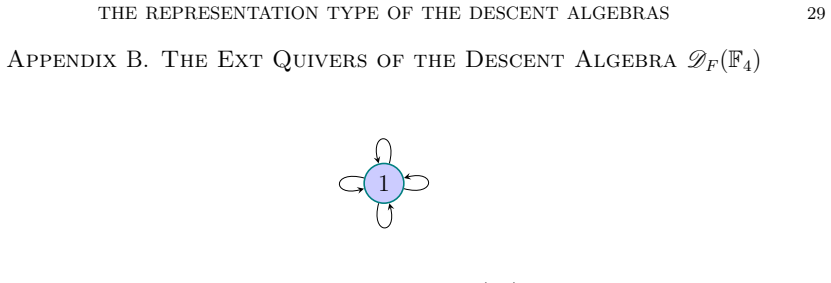
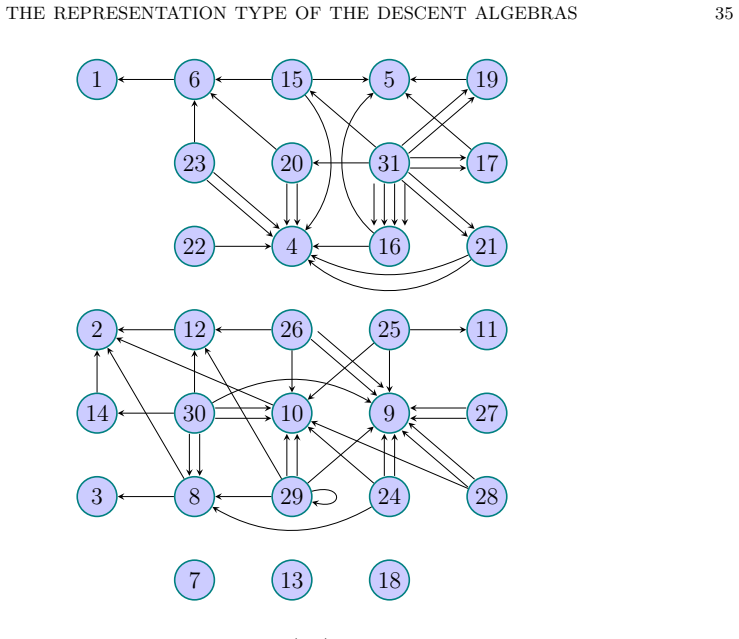
L. Solomon, A Mackey formula in the group ring of a Coxeter group, J. Algebra 41 (1976) 255–268. 26 KARIN ERDMANN AND KAY JIN LIM In the following appendices, we present the Ext-quivers forDF (W) for various Coxeter groupsWand primesp. For easy access of data, we have also included the Magma outputs for some Ext-quivers. For eachp, a triplet< a, b, c >den...
1976
discussion (0)
Sign in with ORCID, Apple, or X to comment. Anyone can read and Pith papers without signing in.