Multi-wavelength study of EP250416a / GRB 250416C: An Optically Dark Long GRB with a Late Jet Break
Pith reviewed 2026-05-09 21:04 UTC · model grok-4.3
The pith
EP250416a shows a jet break at 1.5 million seconds after trigger, yielding a jet half-opening angle of 10.6 degrees, while host-galaxy dust with A_V = 5.5 mag accounts for its optical darkness.
A machine-rendered reading of the paper's core claim, the machinery that carries it, and where it could break.
Core claim
EP250416a is a long GRB at z = 0.963 whose X-ray afterglow exhibits a jet break at t approximately 1.5 times 10 to the 6 seconds that corresponds to a jet half-opening angle of 10.6 degrees; the burst is optically dark because of A_V host equal to 5.5 magnitudes of extinction, while its prompt emission energies align with the Amati relation for long GRBs and its fluence ratio marks it as X-ray rich.
What carries the argument
The late break in the X-ray afterglow light curve interpreted as the jet-break time, together with an extinction-curve model that reproduces the observed optical-to-X-ray spectral index from host-galaxy dust.
If this is right
- The derived jet opening angle of 10.6 degrees implies that the true energy release is lower than the isotropic value by a factor set by the solid angle of the jet.
- Events with such late jet breaks are consistent with wider jets that remain detectable for longer times in X-rays.
- High host extinction can hide the optical afterglow even when the X-ray signal remains observable, increasing the fraction of dark GRBs in flux-limited samples.
- The classification as an X-ray rich GRB with energies on the Amati relation supports the idea that this burst belongs to the standard long-GRB population despite its optical properties.
Where Pith is reading between the lines
- If many optically dark GRBs turn out to have similarly late jet breaks, the average jet opening angle distribution would shift toward wider values.
- Multi-wavelength campaigns that include late-time X-ray monitoring could systematically recover jet angles for bursts missed in optical surveys.
- The required host extinction of 5.5 magnitudes suggests that dust-rich environments may be common among GRB hosts at moderate redshift, testable with future infrared observations.
Load-bearing premise
The observed X-ray break at 1.5 million seconds is produced by the jet edge becoming visible to the observer, and the optical faintness is caused entirely by dust extinction in the host galaxy rather than by intrinsically weak emission or other effects.
What would settle it
Detection of an optical afterglow significantly brighter than predicted by the 5.5-mag extinction model, or an X-ray light curve that fails to steepen after 1.5 million seconds in a manner consistent with post-jet-break evolution.
Figures



read the original abstract
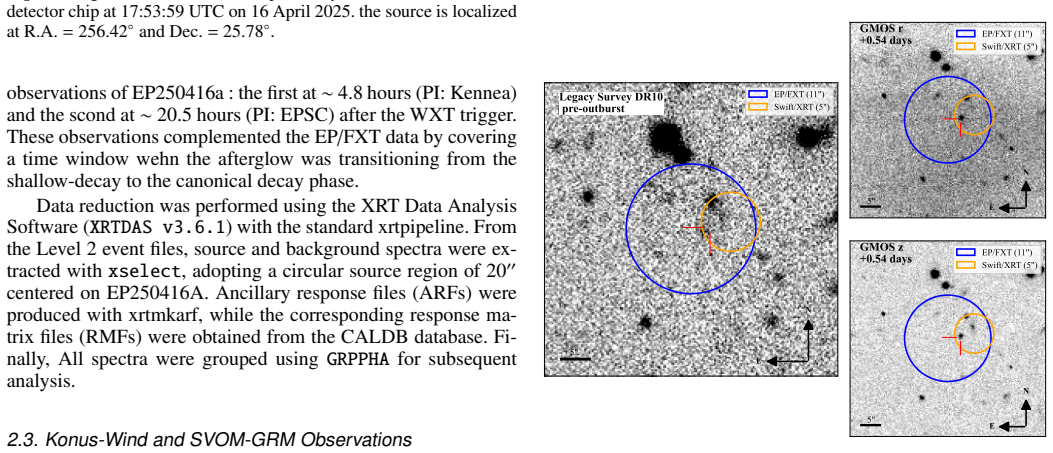
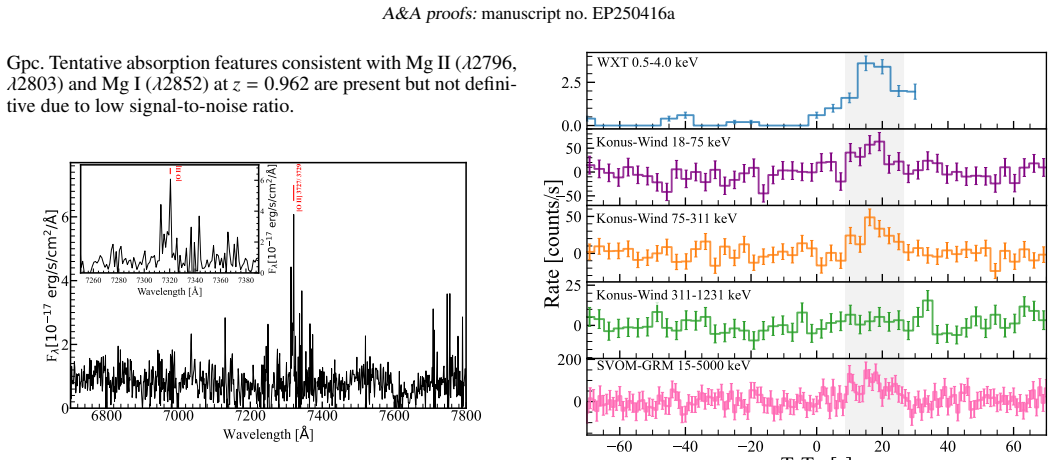
We present multi-wavelength study of the $\gamma$/X-ray transient EP250416a (also designated GRB 250416C), triggered by the Einstein Probe (EP) Wide-field X-ray Telescope and also by SVOM and Konus-Wind. Observations spanning the gamma-ray, X-ray, and optical bands facilitated detailed analysis of the burst's prompt emission, afterglow evolution, and physical origin. EP250416a exhibits a burst duration of 30 s in X-ray and 17.7 s in gamma-rays, with joint spectral fitting of 0.5-5000 keV data gives $E\rm_{peak}=342_{-232}^{+90}$ keV. Optical spectroscopy of the afterglow, acquired with the Gemini Multi-Object Spectrograph (GMOS) on Gemini South, yielded a redshift of $z=0.963$. Accounting for the measured redshift, the isotropic energies are $E\rm_{X,iso}=2.7_{-0.5}^{+0.9}\times10^{50}$ erg and $E\rm_{\gamma,iso}=7.34_{-2.1}^{+5.1}\times10^{51}$ erg, aligning with the Amati relation for long GRBs. The fluence ratio $\rm S(25-50~keV)/S(50-100~keV)=0.78_{-0.15}^{+0.1}$ classifies EP250416a as an X-ray rich (XRR) GRB. The X-ray afterglow shows an initial shallow decay ($\alpha \approx -0.5$) transitioning to a canonical decay phase ($\alpha \approx -1$), with a very late jet break at $t\sim 1.5\times 10^6$ s, corresponding to a jet half-opening angle of $\theta _j=10.6_{-1.8}^{+1.9}$ degrees. EP250416a is optically dark, as it shows only a faint $r$-band detection ($r=24.16$ mag) from Gemini South-GMOS and a low optical-to-X-ray spectral index $\beta_{\rm OX} = 0.3$. This may be attributed to significant host-galaxy extinction, with a required $A_V^{\text{host}}=5.5\ \text{mag}$ derived from the extinction curve model.
Editorial analysis
A structured set of objections, weighed in public.
Referee Report
Summary. The manuscript reports multi-wavelength observations of the long GRB EP250416a/GRB 250416C, including prompt emission with E_peak = 342 keV, redshift z = 0.963 from Gemini spectroscopy, isotropic energies consistent with the Amati relation, an X-ray afterglow with shallow-to-canonical decay and a break at t ~ 1.5e6 s interpreted as a jet break giving theta_j = 10.6 deg, and optical darkness (single r = 24.16 mag detection, beta_OX = 0.3) attributed to A_V^host = 5.5 mag extinction.
Significance. If the jet-break and extinction interpretations are confirmed, the result adds a well-observed example of a very late jet break and an optically dark GRB with high host extinction, helping constrain jet opening-angle distributions and the demographics of dark bursts. The prompt-emission classification as X-ray rich and the use of Einstein Probe data provide timely multi-instrument coverage.
major comments (2)
- [X-ray afterglow analysis] The X-ray afterglow section (as summarized in the abstract) identifies the break at t ~ 1.5e6 s as a jet break yielding theta_j = 10.6 deg via the standard t_j formula, but reports neither the post-break temporal index nor any test for achromaticity with the optical band. Without these, the steepening cannot be verified to match the expected post-jet-break slope (alpha ~ -p or -p-1), weakening the opening-angle claim.
- [Optical and extinction analysis] The optical extinction analysis derives A_V^host = 5.5 mag from the single r-band point and beta_OX = 0.3 alone. The manuscript must detail the joint X-ray/optical SED fit, the specific extinction law assumed, and explicit checks that rule out an intrinsically faint afterglow or alternative spectral components before attributing the entire optical suppression to host extinction.
minor comments (2)
- Add a table listing all X-ray and optical photometric points with uncertainties, fit parameters, and reduced chi-squared values to support the light-curve modeling and extinction derivation.
- Clarify the exact functional form and any free parameters used in the extinction-curve model that produces A_V^host = 5.5 mag.
Simulated Author's Rebuttal
We thank the referee for the constructive and detailed comments, which help clarify the presentation of our results on EP250416a. We address each major comment below and indicate the revisions planned for the manuscript.
read point-by-point responses
-
Referee: [X-ray afterglow analysis] The X-ray afterglow section (as summarized in the abstract) identifies the break at t ~ 1.5e6 s as a jet break yielding theta_j = 10.6 deg via the standard t_j formula, but reports neither the post-break temporal index nor any test for achromaticity with the optical band. Without these, the steepening cannot be verified to match the expected post-jet-break slope (alpha ~ -p or -p-1), weakening the opening-angle claim.
Authors: We agree that explicit reporting of the post-break temporal index and discussion of achromaticity would strengthen the jet-break interpretation. The X-ray light curve is modeled with a broken power law, and the post-break index is steeper than the pre-break canonical phase, consistent with expectations for a jet break. However, no optical observations exist after t ~ 1.5e6 s, precluding a direct achromaticity test. We will revise the X-ray afterglow section to state the fitted post-break index explicitly and note the limitation on achromaticity due to the absence of late-time optical data. revision: yes
-
Referee: [Optical and extinction analysis] The optical extinction analysis derives A_V^host = 5.5 mag from the single r-band point and beta_OX = 0.3 alone. The manuscript must detail the joint X-ray/optical SED fit, the specific extinction law assumed, and explicit checks that rule out an intrinsically faint afterglow or alternative spectral components before attributing the entire optical suppression to host extinction.
Authors: We acknowledge the need for greater detail on the extinction analysis. The manuscript performs a joint X-ray/optical SED fit at the epoch of the optical detection using the measured beta_OX = 0.3 and assumes the SMC extinction law, which is standard for GRB host environments and yields A_V^host = 5.5 mag. We will expand the relevant section to describe the SED fitting procedure, specify the SMC curve, and add a short discussion ruling out alternatives such as an intrinsically faint afterglow (inconsistent with the observed X-ray flux and prompt energetics) or an additional spectral component. revision: yes
Circularity Check
No circularity: standard formulas applied to new observations
full rationale
The paper derives isotropic energies directly from measured fluences, redshift, and luminosity distance using the standard cosmological conversion E_iso = 4π d_L^2 S / (1+z). The jet half-opening angle follows from the observed X-ray break time via the canonical afterglow jet-break formula (involving E_iso and an assumed circumburst density), which is an independent calculation rather than a redefinition. Host extinction A_V is obtained by applying an extinction curve model to match the single optical detection against the X-ray spectral extrapolation; this is a forward fit to data, not a quantity defined in terms of itself. No self-citation is load-bearing for the central claims, no fitted parameter is relabeled as a prediction, and no ansatz is smuggled via prior work. The derivation chain remains self-contained against external benchmarks.
Axiom & Free-Parameter Ledger
free parameters (3)
- E_peak =
342 keV
- theta_j =
10.6 degrees
- A_V^host =
5.5 mag
axioms (2)
- standard math Standard flat Lambda-CDM cosmology for luminosity distance and isotropic energy conversion
- domain assumption Late X-ray break is produced by the edge of a relativistic jet becoming visible
Reference graph
Works this paper leans on
- [1]
-
[2]
Aptekar, R. L., Frederiks, D. D., Golenetskii, S. V ., et al. 1995, Space Sci. Rev., 71, 265
work page 1995
- [3]
-
[4]
Blandford, R. D. & Znajek, R. L. 1977, MNRAS, 179, 433
work page 1977
-
[5]
Burrows, D. N. & Swift XRT Team. 2004, in AAS/High Energy Astrophysics
work page 2004
- [6]
-
[7]
2025, Experimental Astronomy, 60, 15
Cheng, H., Zhang, C., Ling, Z., et al. 2025, Experimental Astronomy, 60, 15
work page 2025
- [8]
-
[9]
Djorgovski, S. G., Frail, D. A., Kulkarni, S. R., et al. 2001, ApJ, 562, 654
work page 2001
-
[10]
1975, ApJ, 198, 95 Götz, D., Paul, J., Basa, S., et al
Gorenstein, P. 1975, ApJ, 198, 95 Götz, D., Paul, J., Basa, S., et al. 2009, in American Institute of Physics Confer- ence Series, V ol. 1133, Gamma-ray Burst: Sixth Huntsville Symposium, ed. C. Meegan, C. Kouveliotou, & N. Gehrels, 25–30
work page 1975
- [11]
-
[12]
Higgins, A. B., van der Horst, A. J., Starling, R. L. C., et al. 2019, MNRAS, 484, 5245
work page 2019
- [13]
-
[14]
T., Sbarufatti, B., Shen, R., et al
Holland, S. T., Sbarufatti, B., Shen, R., et al. 2010, ApJ, 717, 223
work page 2010
- [15]
-
[16]
Jakobsson, P., Hjorth, J., Fynbo, J. P. U., et al. 2004, ApJ, 617, L21
work page 2004
- [17]
-
[18]
A., Klose, S., Zhang, B., et al
Kann, D. A., Klose, S., Zhang, B., et al. 2011, ApJ, 734, 96
work page 2011
-
[19]
A., Klose, S., Zhang, B., et al
Kann, D. A., Klose, S., Zhang, B., et al. 2010, ApJ, 720, 1513
work page 2010
- [20]
-
[21]
Kouveliotou, C., Meegan, C. A., Fishman, G. J., et al. 1993, ApJ, 413, L101
work page 1993
- [22]
- [23]
- [24]
-
[25]
2025a, arXiv e-prints, arXiv:2512.15162
Li, R.-Z., Mao, J., Yang, Y .-P., et al. 2025a, arXiv e-prints, arXiv:2512.15162
- [26]
- [27]
-
[28]
2025, GRB Coordinates Network, 40156, 1
Lipunov, V ., Gorbovskoy, E., Tiurina, N., et al. 2025, GRB Coordinates Network, 40156, 1
work page 2025
-
[29]
Lloyd-Ronning, N. M. & Zhang, B. 2004, ApJ, 613, 477
work page 2004
-
[30]
Lu, R.-J., Wei, J.-J., Qin, S.-F., & Liang, E.-W. 2012, ApJ, 745, 168
work page 2012
- [31]
-
[32]
Minaev, P. Y . & Pozanenko, A. S. 2020, MNRAS, 492, 1919 Article number, page 11 of 12 A&A proofs:manuscript no. EP250416a
work page 2020
-
[33]
Norris, J. P., Nemiroff, R. J., Bonnell, J. T., et al. 1996, ApJ, 459, 393
work page 1996
-
[34]
Piro, L., Frail, D. A., Gorosabel, J., et al. 2002, ApJ, 577, 680
work page 2002
- [35]
-
[36]
Rees, M. J. & Meszaros, P. 1992, MNRAS, 258, 41
work page 1992
-
[37]
Rees, M. J. & Meszaros, P. 1994, ApJ, 430, L93
work page 1994
-
[38]
Rol, E., van der Horst, A., Wiersema, K., et al. 2007, ApJ, 669, 1098
work page 2007
- [39]
-
[40]
Sakamoto, T., Barthelmy, S. D., Barbier, L., et al. 2008, ApJS, 175, 179
work page 2008
- [41]
-
[42]
Sari, R., Piran, T., & Halpern, J. P. 1999, ApJ, 519, L17
work page 1999
-
[43]
2025, GRB Coordinates Network, 40166, 1
Sbarrato, T., Brivio, R., Salvaggio, C., et al. 2025, GRB Coordinates Network, 40166, 1
work page 2025
-
[44]
2010, arXiv e-prints, arXiv:1005.5008
Schanne, S., Paul, J., Wei, J., et al. 2010, arXiv e-prints, arXiv:1005.5008
-
[45]
2025, GRB Coordinates Network, 40167, 1 SVOM/GRM Team, Wang, C.-W., Huang, Y ., et al
Svinkin, D., Frederiks, D., Lysenko, A., et al. 2025, GRB Coordinates Network, 40167, 1 SVOM/GRM Team, Wang, C.-W., Huang, Y ., et al. 2025, GRB Coordinates Net- work, 40184, 1
work page 2025
-
[46]
2007, PASJ, 59, L29 van der Horst, A
Urata, Y ., Huang, K.-Y ., Kuo, P.-H., et al. 2007, PASJ, 59, L29 van der Horst, A. J., Kouveliotou, C., Gehrels, N., et al. 2009, ApJ, 699, 1087
work page 2007
- [47]
- [48]
-
[49]
Wei, J.-J., Zhang, B.-B., Shao, L., Wu, X.-F., & Mészáros, P. 2017, ApJ, 834, L13
work page 2017
-
[50]
2022, in Handbook of X-ray and Gamma-ray Astrophysics, ed
Yuan, W., Zhang, C., Chen, Y ., & Ling, Z. 2022, in Handbook of X-ray and Gamma-ray Astrophysics, ed. C. Bambi & A. Sangangelo, 86
work page 2022
- [51]
-
[52]
2018, The Physics of Gamma-Ray Bursts
Zhang, B. 2018, The Physics of Gamma-Ray Bursts
work page 2018
- [53]
- [54]
-
[55]
Zhang, B. & Mészáros, P. 2004, International Journal of Modern Physics A, 19, 2385
work page 2004
- [56]
-
[57]
Zhang, Z.-B., Deng, J.-G., Lu, R.-J., & Gao, H.-F. 2006, Chinese J. Astron. As- trophys., 6, 312
work page 2006
-
[58]
Zhao, G. Y ., Zhou, C., Chen, X. L., et al. 2025, GRB Coordinates Network, 40154, 1
work page 2025
- [59]
-
[60]
Zhou, H., Zhao, G. Y ., Zhou, C., et al. 2025, GRB Coordinates Network, 40165, 1
work page 2025
-
[61]
Zhou, R., Newman, J. A., Mao, Y .-Y ., et al. 2021, MNRAS, 501, 3309
work page 2021
-
[62]
Zhu, Z.-P., Xu, D., Fynbo, J. P. U., et al. 2023, ApJ, 948, 30 Article number, page 12 of 12
work page 2023
discussion (0)
Sign in with ORCID, Apple, or X to comment. Anyone can read and Pith papers without signing in.