Recognition: unknown
DCMorph: Face Morphing via Dual-Stream Cross-Attention Diffusion
Pith reviewed 2026-05-09 22:14 UTC · model grok-4.3
The pith
DCMorph generates face morphs via dual-stream cross-attention diffusion that achieve higher attack success rates on four state-of-the-art recognition systems than prior methods while evading current detectors.
A machine-rendered reading of the paper's core claim, the machinery that carries it, and where it could break.
Core claim
DCMorph operates simultaneously at the identity-conditioning level through decoupled cross-attention interpolation and at the latent-space level through DDIM inversion followed by spherical interpolation, producing morphs that yield the highest attack success rates across four face recognition systems at operational thresholds and prove difficult for current morphing attack detection solutions to identify.
What carries the argument
Decoupled cross-attention interpolation that injects identity-specific features from both source faces into the denoising process, combined with DDIM inversion and spherical interpolation to supply a geometrically consistent initial latent.
If this is right
- Face recognition systems exhibit greater vulnerability to morphing attacks when evaluated against DCMorph outputs than against outputs from earlier techniques.
- Current morphing attack detection solutions fail to reliably identify DCMorph-generated samples.
- Diffusion models with dual conditioning can overcome the reconstruction and artifact limitations seen in image-level blending and GAN-based morphing.
Where Pith is reading between the lines
- Similar dual-stream conditioning could be tested for generating consistent composites in other domains such as medical image fusion or multi-object scene synthesis.
- Recognition systems may require training regimes that specifically target diffusion-generated morphs rather than only traditional ones.
- The method's reliance on pre-trained identity-conditioned diffusion models raises the question of how performance changes when those base models are updated or replaced.
Load-bearing premise
The decoupled cross-attention and spherical latent interpolation actually produce explicit dual-identity conditioning and consistent structures that improve attack performance without creating new detectable artifacts or relying on uneven test conditions.
What would settle it
Re-running the vulnerability analysis on the same four face recognition systems with identical protocols and finding that DCMorph does not produce the highest attack success rates, or that standard morphing attack detectors flag most of its outputs at high rates.
Figures

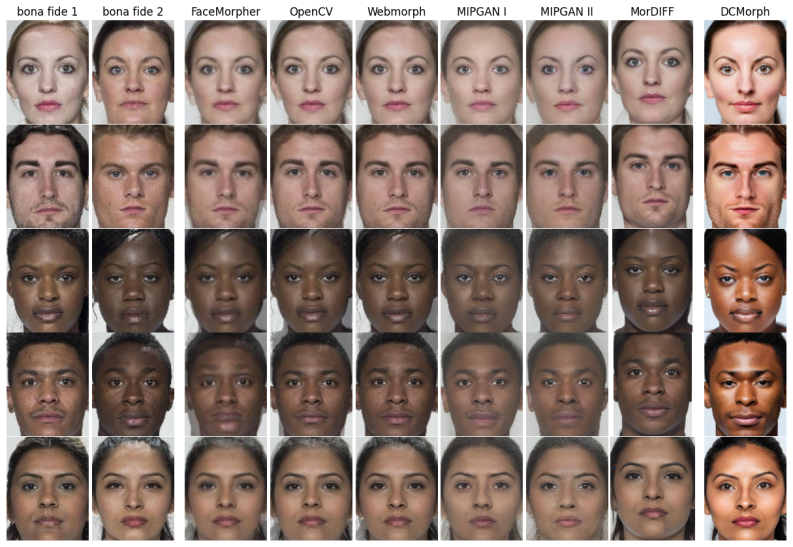
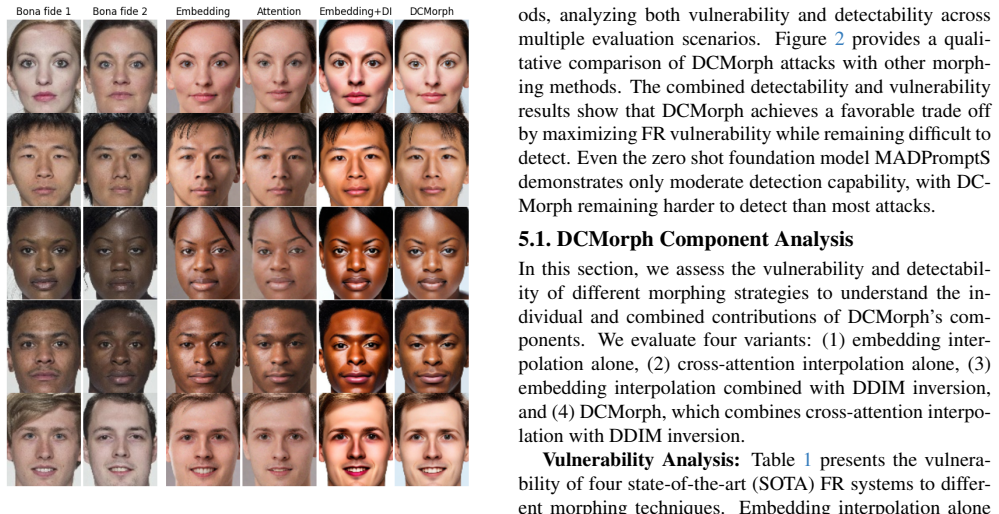
read the original abstract
Advancing face morphing attack techniques is crucial to anticipate evolving threats and develop robust defensive mechanisms for identity verification systems. This work introduces DCMorph, a dual-stream diffusion-based morphing framework that simultaneously operates at both identity conditioning and latent space levels. Unlike image-level methods suffering from blending artifacts or GAN-based approaches with limited reconstruction fidelity, DCMorph leverages identity-conditioned latent diffusion models through two mechanisms: (1) decoupled cross-attention interpolation that injects identity-specific features from both source faces into the denoising process, enabling explicit dual-identity conditioning absent in existing diffusion-based methods, and (2) DDIM inversion with spherical interpolation between inverted latent representations from both source faces, providing geometrically consistent initial latent representation that preserves structural attributes. Vulnerability analyses across four state-of-the-art face recognition systems demonstrate that DCMorph achieves the highest attack success rates compared to existing methods at both operational thresholds, while remaining challenging to detect by current morphing attack detection solutions.
Editorial analysis
A structured set of objections, weighed in public.
Referee Report
Summary. The paper introduces DCMorph, a dual-stream diffusion-based face morphing framework that operates via decoupled cross-attention interpolation for explicit dual-identity conditioning during denoising and DDIM inversion with spherical interpolation to obtain geometrically consistent initial latents from two source faces. It claims this yields the highest attack success rates against four state-of-the-art face recognition systems at operational thresholds while evading current morphing attack detection methods, addressing limitations of image-level blending and GAN-based approaches.
Significance. If the empirical claims are substantiated with rigorous evidence, the work would be significant for biometric security research by demonstrating how diffusion models can be extended to produce high-quality morphing attacks that outperform prior techniques. The dual-stream design offers a concrete way to inject multiple identities without blending artifacts, which could inform both attack generation and the development of more robust defenses against diffusion-based threats.
major comments (4)
- [Abstract] Abstract: the central claim of 'highest attack success rates' and 'challenging to detect' is asserted without any numerical values, specific baselines, dataset details, operational thresholds, or error analysis, leaving the superiority of the dual-stream design unsupported by visible evidence.
- [§3.2] §3.2: the decoupled cross-attention interpolation is claimed to provide explicit dual-identity conditioning absent from existing diffusion morphers, but no ablations isolate its contribution versus standard cross-attention or single-stream variants, so it is unclear whether this mechanism drives the reported ASR gains or if they stem from model capacity or training differences.
- [§3.3] §3.3: DDIM inversion with spherical interpolation is presented as delivering geometrically consistent latents that preserve structure better than alternatives, yet the manuscript supplies no quantitative metrics (e.g., reconstruction fidelity, perceptual similarity, or artifact analysis) comparing it to linear interpolation to confirm the link to superior attack performance without new detectable artifacts.
- [Results section] Results section: the vulnerability analyses across four FR systems are described as demonstrating the headline result, but without details on the systems, datasets (subject counts, morph pair generation), thresholds, or statistical significance, the claim cannot be assessed for fairness or reproducibility.
minor comments (2)
- [Abstract] The abstract would benefit from a concise statement of the number of experiments or datasets to contextualize the claims.
- [§3] Notation for the interpolation operations and cross-attention decoupling should be formalized with equations to improve clarity and reproducibility.
Simulated Author's Rebuttal
We thank the referee for their thorough review and constructive suggestions. We will address each major comment by providing additional details and analyses in the revised manuscript.
read point-by-point responses
-
Referee: [Abstract] Abstract: the central claim of 'highest attack success rates' and 'challenging to detect' is asserted without any numerical values, specific baselines, dataset details, operational thresholds, or error analysis, leaving the superiority of the dual-stream design unsupported by visible evidence.
Authors: We agree with this observation. The revised abstract will incorporate specific numerical values for attack success rates, comparisons to baselines, dataset information, operational thresholds, and error analysis to substantiate the claims regarding the dual-stream design's superiority. revision: yes
-
Referee: [§3.2] §3.2: the decoupled cross-attention interpolation is claimed to provide explicit dual-identity conditioning absent from existing diffusion morphers, but no ablations isolate its contribution versus standard cross-attention or single-stream variants, so it is unclear whether this mechanism drives the reported ASR gains or if they stem from model capacity or training differences.
Authors: We recognize the importance of isolating the contribution of the decoupled cross-attention. In the revision, we will include ablation studies that compare the proposed dual-stream cross-attention interpolation against standard cross-attention and single-stream variants, while controlling for model capacity and training differences to confirm its role in the ASR improvements. revision: yes
-
Referee: [§3.3] §3.3: DDIM inversion with spherical interpolation is presented as delivering geometrically consistent latents that preserve structure better than alternatives, yet the manuscript supplies no quantitative metrics (e.g., reconstruction fidelity, perceptual similarity, or artifact analysis) comparing it to linear interpolation to confirm the link to superior attack performance without new detectable artifacts.
Authors: We concur that quantitative validation is needed. The revised manuscript will add comparisons using metrics such as reconstruction fidelity (e.g., MSE or PSNR), perceptual similarity (LPIPS), and artifact analysis between spherical and linear interpolation in DDIM inversion, linking these to the improved attack performance. revision: yes
-
Referee: [Results section] Results section: the vulnerability analyses across four FR systems are described as demonstrating the headline result, but without details on the systems, datasets (subject counts, morph pair generation), thresholds, or statistical significance, the claim cannot be assessed for fairness or reproducibility.
Authors: We will revise the results section to include comprehensive details on the four face recognition systems, the datasets with subject counts and morph pair generation procedures, the operational thresholds, and statistical significance of the results. This will enhance reproducibility and allow for proper assessment of the claims. revision: yes
Circularity Check
No circularity: empirical architecture combining existing diffusion components
full rationale
The paper presents DCMorph as a novel dual-stream diffusion framework for face morphing, relying on decoupled cross-attention interpolation for dual-identity conditioning and DDIM inversion with spherical interpolation for consistent latents. These are described as extensions of standard diffusion techniques (identity-conditioned LDMs, cross-attention, DDIM) rather than derived from fitted parameters or self-referential definitions. The headline results are empirical attack success rates on four FR systems, obtained via standard vulnerability analysis, with no equations or predictions that reduce by construction to the inputs. No self-citation chains, uniqueness theorems, or ansatz smuggling appear in the abstract or described claims. The derivation chain is self-contained as an engineering combination evaluated experimentally.
Axiom & Free-Parameter Ledger
Reference graph
Works this paper leans on
-
[1]
Understanding the impact of negative prompts: When and how do they take effect? In European Conference on Computer Vision, pages 190–206
Yuanhao Ban, Ruochen Wang, Tianyi Zhou, Minhao Cheng, Boqing Gong, and Cho-Jui Hsieh. Understanding the impact of negative prompts: When and how do they take effect? In European Conference on Computer Vision, pages 190–206. Springer, 2024. 3
2024
-
[2]
Leveraging diffusion for strong and high quality face morphing attacks.IEEE Trans
Zander Blasingame and Chen Liu. Leveraging diffusion for strong and high quality face morphing attacks.IEEE Trans. Biom. Behav. Identity Sci., 6(1):118–131, 2024. 1, 2
2024
-
[3]
Automated artifact retouching in morphed im- ages with attention maps.IEEE Access, 9:136561–136579,
Guido Borghi, Annalisa Franco, Gabriele Graffieti, and Da- vide Maltoni. Automated artifact retouching in morphed im- ages with attention maps.IEEE Access, 9:136561–136579,
-
[4]
Mixfacenets: Extremely effi- cient face recognition networks
Fadi Boutros, Naser Damer, Meiling Fang, Florian Kirch- buchner, and Arjan Kuijper. Mixfacenets: Extremely effi- cient face recognition networks. InIJCB, pages 1–8. IEEE,
-
[5]
Elasticface: Elastic margin loss for deep face recognition
Fadi Boutros, Naser Damer, Florian Kirchbuchner, and Ar- jan Kuijper. Elasticface: Elastic margin loss for deep face recognition. InCVPR Workshops, pages 1577–1586. IEEE,
-
[6]
Idiff-face: Synthetic-based face recognition through fizzy identity-conditioned diffusion models
Fadi Boutros, Jonas Henry Grebe, Arjan Kuijper, and Naser Damer. Idiff-face: Synthetic-based face recognition through fizzy identity-conditioned diffusion models. InIEEE/CVF International Conference on Computer Vision, ICCV 2023, Paris, France, October 1-6, 2023, pages 19593–19604. IEEE, 2023. 1, 2, 3
2023
-
[7]
Eduarda Caldeira, Fadi Boutros, and Naser Damer. Mad- prompts: Unlocking zero-shot morphing attack detection with multiple prompt aggregation.CoRR, abs/2508.08939,
-
[8]
Neg- facediff: The power of negative context in identity- conditioned diffusion for synthetic face generation
Eduarda Caldeira, Naser Damer, and Fadi Boutros. Neg- facediff: The power of negative context in identity- conditioned diffusion for synthetic face generation. In Proceedings of the IEEE/CVF International Conference on Computer Vision, pages 5914–5924, 2025. 2
2025
-
[9]
De- tecting face morphing attacks by analyzing the directed dis- tances of facial landmarks shifts
Naser Damer, Viola Boller, Yaza Wainakh, Fadi Boutros, Philipp Terh ¨orst, Andreas Braun, and Arjan Kuijper. De- tecting face morphing attacks by analyzing the directed dis- tances of facial landmarks shifts. InGCPR, pages 518–534. Springer, 2018. 2
2018
-
[10]
Morgan: Recognition vulnerability and attack detectability of face morphing attacks created by gen- erative adversarial network
Naser Damer, Alexandra Mosegui Saladie, Andreas Braun, and Arjan Kuijper. Morgan: Recognition vulnerability and attack detectability of face morphing attacks created by gen- erative adversarial network. In9th IEEE International Con- ference on Biometrics Theory, Applications and Systems, BTAS 2018, Redondo Beach, CA, USA, October 22-25, 2018, pages 1–10. ...
2018
-
[11]
Realistic dreams: Cascaded enhancement of gan-generated images with an ex- ample in face morphing attacks
Naser Damer, Fadi Boutros, Alexandra Mosegui Saladie, Florian Kirchbuchner, and Arjan Kuijper. Realistic dreams: Cascaded enhancement of gan-generated images with an ex- ample in face morphing attacks. In10th IEEE International Conference on Biometrics Theory, Applications and Systems, BTAS 2019, Tampa, FL, USA, September 23-26, 2019, pages 1–10. IEEE, 2019. 2
2019
-
[12]
Raja, Marius S ¨ußmilch, Sushma Venkatesh, Fadi Boutros, Meiling Fang, Florian Kirchbuch- ner, Raghavendra Ramachandra, and Arjan Kuijper
Naser Damer, Kiran B. Raja, Marius S ¨ußmilch, Sushma Venkatesh, Fadi Boutros, Meiling Fang, Florian Kirchbuch- ner, Raghavendra Ramachandra, and Arjan Kuijper. Regen- morph: Visibly realistic GAN generated face morphing at- tacks by attack re-generation. InISVC (1), pages 251–264. Springer, 2021. 2
2021
-
[13]
Privacy-friendly synthetic data for the development of face morphing attack detectors
Naser Damer, C ´esar Augusto Fontanillo L ´opez, Meiling Fang, No ´emie Spiller, Minh Vu Pham, and Fadi Boutros. Privacy-friendly synthetic data for the development of face morphing attack detectors. InProceedings of the IEEE/CVF Conference on Computer Vision and Pattern Recognition, pages 1606–1617, 2022. 5, 7, 8
2022
-
[14]
Mordiff: Recognition vul- nerability and attack detectability of face morphing attacks created by diffusion autoencoders
Naser Damer, Meiling Fang, Patrick Siebke, Jan Niklas Kolf, Marco Huber, and Fadi Boutros. Mordiff: Recognition vul- nerability and attack detectability of face morphing attacks created by diffusion autoencoders. InIWBF, pages 1–6. IEEE, 2023. 1, 2, 5
2023
-
[15]
Face Research Lab Lon- don Set
Lisa DeBruine and Benedict Jones. Face Research Lab Lon- don Set. 2021. 5
2021
-
[16]
Arcface: Additive angular margin loss for deep face recognition
Jiankang Deng, Jia Guo, Niannan Xue, and Stefanos Zafeiriou. Arcface: Additive angular margin loss for deep face recognition. InCVPR, pages 4690–4699. Computer Vi- sion Foundation / IEEE, 2019. 5, 6, 7, 8
2019
-
[17]
Face restoration for morphed images re- touching
Nicol `o Di Domenico, Guido Borghi, Annalisa Franco, and Davide Maltoni. Face restoration for morphed images re- touching. In12th International Workshop on Biometrics and Forensics, IWBF 2024, Enschede, The Netherlands, April 11-12, 2024, pages 1–6. IEEE, 2024. 2
2024
-
[18]
Unsuper- vised face morphing attack detection via self-paced anomaly detection
Meiling Fang, Fadi Boutros, and Naser Damer. Unsuper- vised face morphing attack detection via self-paced anomaly detection. InIJCB, pages 1–11, 2022. 5, 7, 8
2022
-
[19]
The magic passport
Matteo Ferrara, Annalisa Franco, and Davide Maltoni. The magic passport. InIJCB, pages 1–7. IEEE, 2014. 1, 2
2014
-
[20]
Face demorphing.IEEE Trans
Matteo Ferrara, Annalisa Franco, and Davide Maltoni. Face demorphing.IEEE Trans. Inf. Forensics Secur., 13(4):1008– 1017, 2018. 1, 2
2018
-
[21]
Classifier-Free Diffusion Guidance
Jonathan Ho and Tim Salimans. Classifier-free diffusion guidance.CoRR, abs/2207.12598, 2022. 3
work page internal anchor Pith review arXiv 2022
-
[22]
Denoising dif- fusion probabilistic models
Jonathan Ho, Ajay Jain, and Pieter Abbeel. Denoising dif- fusion probabilistic models. InAdvances in Neural Informa- tion Processing Systems 33: Annual Conference on Neural Information Processing Systems 2020, NeurIPS 2020, De- cember 6-12, 2020, virtual, 2020. 2
2020
-
[23]
Huang, Marwan Mattar, Tamara Berg, and Eric Learned-Miller
Gary B. Huang, Marwan Mattar, Tamara Berg, and Eric Learned-Miller. Labeled Faces in the Wild: A Database forStudying Face Recognition in Unconstrained Environ- ments. InWorkshop on Faces in ’Real-Life’ Images: Detec- tion, Alignment, and Recognition, Marseille, France, 2008. Erik Learned-Miller and Andras Ferencz and Fr´ed´eric Jurie. 5
2008
-
[24]
Curricularface: Adaptive curriculum learning loss for deep face recognition
Yuge Huang, Yuhan Wang, Ying Tai, Xiaoming Liu, Pengcheng Shen, Shaoxin Li, Jilin Li, and Feiyue Huang. Curricularface: Adaptive curriculum learning loss for deep face recognition. InCVPR, pages 5900–5909. Computer Vi- sion Foundation / IEEE, 2020. 5, 7, 8
2020
-
[25]
Raja, Raghavendra Ramachandra, Naser Damer, Pedro C
Marco Huber, Fadi Boutros, Anh Thi Luu, Kiran B. Raja, Raghavendra Ramachandra, Naser Damer, Pedro C. Neto, Tiago Gonc ¸alves, Ana F. Sequeira, Jaime S. Cardoso, Jo˜ao Tremoc ¸o, Miguel Lourenc ¸o, Sergio Serra, Eduardo Cerme˜no, Marija Ivanovska, Borut Batagelj, Andrej Kro- novsek, Peter Peer, and Vitomir Struc. SYN-MAD 2022: Competition on face morphing...
2022
-
[26]
ISO/IEC DIS 30107-3:2016 Information Technology – Biometric Presen- tation Attack Detection – Part 3: Testing and Reporting
International Organization for Standardization. ISO/IEC DIS 30107-3:2016 Information Technology – Biometric Presen- tation Attack Detection – Part 3: Testing and Reporting. International Standard ISO/IEC 30107-3:2016, ISO/IEC,
2016
-
[27]
Spherical linear interpolation and text- anchoring for zero-shot composed image retrieval
Young Kyun Jang, Dat Huynh, Ashish Shah, Wen-Kai Chen, and Ser-Nam Lim. Spherical linear interpolation and text- anchoring for zero-shot composed image retrieval. InCom- puter Vision - ECCV 2024 - 18th European Conference, Mi- lan, Italy, September 29-October 4, 2024, Proceedings, Part XIX, pages 239–254. Springer, 2024. 4
2024
-
[28]
Jain, and Xiaoming Liu
Minchul Kim, Anil K. Jain, and Xiaoming Liu. Adaface: Quality adaptive margin for face recognition. InCVPR, pages 18729–18738. IEEE, 2022. 5, 7, 8
2022
-
[29]
Jain, and Xiaoming Liu
Minchul Kim, Feng Liu, Anil K. Jain, and Xiaoming Liu. Dcface: Synthetic face generation with dual condition dif- fusion model. InIEEE/CVF Conference on Computer Vi- sion and Pattern Recognition, CVPR 2023, Vancouver, BC, Canada, June 17-24, 2023, pages 12715–12725. IEEE,
2023
-
[30]
Uiface: Unleashing inherent model capabilities to enhance intra-class diversity in syn- thetic face recognition
Xiao Lin, Yuge Huang, Jianqing Xu, Yuxi Mi, Shuigeng Zhou, and Shouhong Ding. Uiface: Unleashing inherent model capabilities to enhance intra-class diversity in syn- thetic face recognition. InICLR. OpenReview.net, 2025. 1, 2, 3
2025
-
[31]
Face morph using opencv — c++ / python
Satya Mallick. Face morph using opencv — c++ / python. LearnOpenCV, 1(1), 2016. 5
2016
-
[32]
N., Raghavendra Ramachandra, Krotha- palli Sreenivasa Rao, and Pabitra Mitra
Aravinda Reddy P. N., Raghavendra Ramachandra, Krotha- palli Sreenivasa Rao, and Pabitra Mitra. Morcode: Face morphing attack generation using generative codebooks. In 35th British Machine Vision Conference Workshop Proceed- ings, BMVC 2024 Workshops, Glasgow, UK, November 25- 28, 2024. BMV A Press, 2024. 2
2024
-
[33]
SDXL: Improving Latent Diffusion Models for High-Resolution Image Synthesis
Dustin Podell, Zion English, Kyle Lacey, Andreas Blattmann, Tim Dockhorn, Jonas M ¨uller, Joe Penna, and Robin Rombach. SDXL: improving latent diffusion models for high-resolution image synthesis.CoRR, abs/2307.01952,
work page internal anchor Pith review arXiv
-
[34]
Diffusion autoen- coders: Toward a meaningful and decodable representation
Konpat Preechakul, Nattanat Chatthee, Suttisak Wizad- wongsa, and Supasorn Suwajanakorn. Diffusion autoen- coders: Toward a meaningful and decodable representation. InIEEE/CVF Conference on Computer Vision and Pattern Recognition, CVPR 2022, New Orleans, LA, USA, June 18- 24, 2022, pages 10609–10619. IEEE, 2022. 2
2022
-
[35]
Low visual distortion and robust morphing attacks based on partial face image manipulation.IEEE Trans
Le Qin, Fei Peng, Sushma Venkatesh, Raghavendra Ra- machandra, Min Long, and Christoph Busch. Low visual distortion and robust morphing attacks based on partial face image manipulation.IEEE Trans. Biom. Behav. Identity Sci., 3(1):72–88, 2021. 2
2021
-
[36]
Raja, Sushma Venkatesh, and Christoph Busch
Ramachandra Raghavendra, Kiran B. Raja, Sushma Venkatesh, and Christoph Busch. Face morphing versus face averaging: Vulnerability and detection. InIJCB, pages 555–
-
[37]
Blattmann, Dominik Lorenz, Patrick Esser, and Bj ¨orn Ommer
Robin Rombach, A. Blattmann, Dominik Lorenz, Patrick Esser, and Bj ¨orn Ommer. High-resolution image synthesis with latent diffusion models.2022 IEEE/CVF Conference on Computer Vision and Pattern Recognition (CVPR), pages 10674–10685, 2021. 2, 3, 5
2022
-
[38]
Norm-guided latent space exploration for text-to-image generation
Dvir Samuel, Rami Ben-Ari, Nir Darshan, Haggai Maron, and Gal Chechik. Norm-guided latent space exploration for text-to-image generation. InNeurIPS, 2023. 4
2023
-
[39]
Ulrich Scherhag, Andreas Nautsch, Christian Rathgeb, Marta Gomez-Barrero, Raymond N. J. Veldhuis, Luuk J. Spreeuwers, Maikel Schils, Davide Maltoni, Patrick Grother, S´ebastien Marcel, Ralph Breithaupt, Ramachandra Raghavendra, and Christoph Busch. Biometric systems un- der morphing attacks: Assessment of morphing techniques and vulnerability reporting. I...
2017
-
[40]
Face morph detection for unknown morph- ing algorithms and image sources: a multi-scale block local binary pattern fusion approach.IET Biom., 9(6):278–289,
Ulrich Scherhag, Jonas Kunze, Christian Rathgeb, and Christoph Busch. Face morph detection for unknown morph- ing algorithms and image sources: a multi-scale block local binary pattern fusion approach.IET Biom., 9(6):278–289,
-
[41]
Facial demorphing via iden- tity preserving image decomposition
Nitish Shukla and Arun Ross. Facial demorphing via iden- tity preserving image decomposition. InIEEE International Joint Conference on Biometrics, IJCB 2024, Buffalo, NY, USA, September 15-18, 2024, pages 1–10. IEEE, 2024. 2
2024
-
[42]
dc-gan: Dual-conditioned GAN for face demorphing from a single morph
Nitish Shukla and Arun Ross. dc-gan: Dual-conditioned GAN for face demorphing from a single morph. In19th IEEE International Conference on Automatic Face and Ges- ture Recognition, FG 2025, Tampa/Clearwater, FL, USA, May 26-30, 2025, pages 1–9. IEEE, 2025. 2
2025
-
[43]
3d face morphing attack generation using non-rigid registration
Jag Mohan Singh and Raghavendra Ramachandra. 3d face morphing attack generation using non-rigid registration. In 18th IEEE International Conference on Automatic Face and Gesture Recognition, FG 2024, Istanbul, Turkey, May 27-31, 2024, pages 1–5. IEEE, 2024. 2
2024
-
[44]
3-d face morphing attacks: Generation, vulnerability and detection
Jag Mohan Singh and Raghavendra Ramachandra. 3-d face morphing attacks: Generation, vulnerability and detection. IEEE Trans. Biom. Behav. Identity Sci., 6(1):103–117, 2024. 2
2024
-
[45]
Weiss, Niru Mah- eswaranathan, and Surya Ganguli
Jascha Sohl-Dickstein, Eric A. Weiss, Niru Mah- eswaranathan, and Surya Ganguli. Deep unsupervised learning using nonequilibrium thermodynamics. InPro- ceedings of the 32nd International Conference on Machine Learning, ICML 2015, Lille, France, 6-11 July 2015, pages 2256–2265. JMLR.org, 2015. 2
2015
-
[46]
Denois- ing diffusion implicit models
Jiaming Song, Chenlin Meng, and Stefano Ermon. Denois- ing diffusion implicit models. InICLR. OpenReview.net,
-
[47]
Raja, Naser Damer, and Christoph Busch
Sushma Venkatesh, Haoyu Zhang, Raghavendra Ramachan- dra, Kiran B. Raja, Naser Damer, and Christoph Busch. Can GAN generated morphs threaten face recognition systems equally as landmark based morphs? - vulnerability and de- tection. In8th International Workshop on Biometrics and Forensics, IWBF 2020, Porto, Portugal, April 29-30, 2020, pages 1–6. IEEE, 2020. 2
2020
-
[48]
On discrete prompt optimization for diffusion models
Ruochen Wang, Ting Liu, Cho-Jui Hsieh, and Boqing Gong. On discrete prompt optimization for diffusion models. In ICML. OpenReview.net, 2024. 3
2024
-
[49]
Id 3: Identity-preserving- yet-diversified diffusion models for synthetic face recogni- tion
Jianqing Xu, Shen Li, Jiaying Wu, Miao Xiong, Ailin Deng, Jiazhen Ji, Yuge Huang, Guodong Mu, Wenjie Feng, Shouhong Ding, and Bryan Hooi. Id 3: Identity-preserving- yet-diversified diffusion models for synthetic face recogni- tion. InNeurIPS, 2024. 2, 3
2024
-
[50]
Ip- adapter: Text compatible image prompt adapter for text-to- image diffusion models
Hu Ye, Jun Zhang, Sibo Liu, Xiao Han, and Wei Yang. Ip- adapter: Text compatible image prompt adapter for text-to- image diffusion models. 2023. 5
2023
-
[51]
MIPGAN - generating strong and high quality mor- phing attacks using identity prior driven GAN.IEEE Trans
Haoyu Zhang, Sushma Venkatesh, Raghavendra Ramachan- dra, Kiran Bylappa Raja, Naser Damer, and Christoph Busch. MIPGAN - generating strong and high quality mor- phing attacks using identity prior driven GAN.IEEE Trans. Biom. Behav. Identity Sci., 3(3):365–383, 2021. 1, 2, 5
2021
discussion (0)
Sign in with ORCID, Apple, or X to comment. Anyone can read and Pith papers without signing in.