Recognition: unknown
Constraining dark matter self-interaction from kinetic heating in neutron stars
Pith reviewed 2026-05-09 21:41 UTC · model grok-4.3
The pith
A neutron star at 1000-1200 K could constrain asymmetric dark matter self-interactions two orders of magnitude better than the bullet cluster.
A machine-rendered reading of the paper's core claim, the machinery that carries it, and where it could break.
Core claim
In the optically thin limit, dark matter self-interactions assist the capture and thermalization of dark matter within neutron stars, imparting kinetic heating that alters surface temperatures. A detected neutron star with surface temperatures of approximately 1000 to 1200 K would improve constraints on the asymmetric dark matter self-interaction cross-section by about two orders of magnitude relative to the bullet cluster.
What carries the argument
The optically thin limit for dark matter capture in neutron stars, where self-interactions enable efficient thermalization and kinetic heating that raises observable surface temperatures.
If this is right
- Upcoming telescopes could detect the faint radiation emitted by kinetically heated neutron stars.
- Upper limits on the asymmetric dark matter self-interaction cross-section would become two orders of magnitude stronger than bullet cluster bounds.
- Combined with direct detection results, such observations could provide a smoking-gun signature for self-interacting dark matter.
- The method would require accounting for local dark matter halo properties around individual neutron stars.
Where Pith is reading between the lines
- The temperature-based approach could be adapted to other compact objects such as white dwarfs to probe similar dark matter properties.
- Refinements in neutron star cooling models would be needed to isolate the dark matter contribution from intrinsic cooling effects.
- Targeted searches for cold neutron stars in regions of known high dark matter density could maximize the constraining power of this technique.
Load-bearing premise
Dark matter self-interactions dominate capture and thermalization inside neutron stars without being overwhelmed by other heating or cooling processes or by uncertainties in neutron star structure and dark matter halo properties.
What would settle it
Detection of a neutron star whose surface temperature lies well outside the 1000-1200 K range in an optically thin environment, or absence of the expected temperature shift correlated with dark matter density, would falsify the predicted self-interaction heating effect.
Figures


read the original abstract
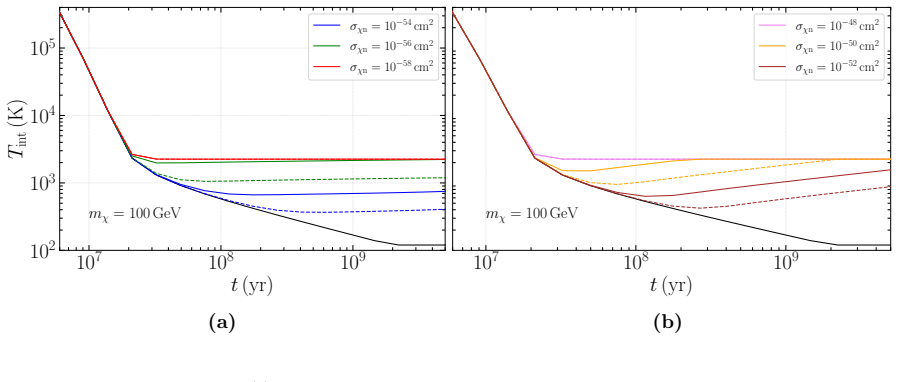
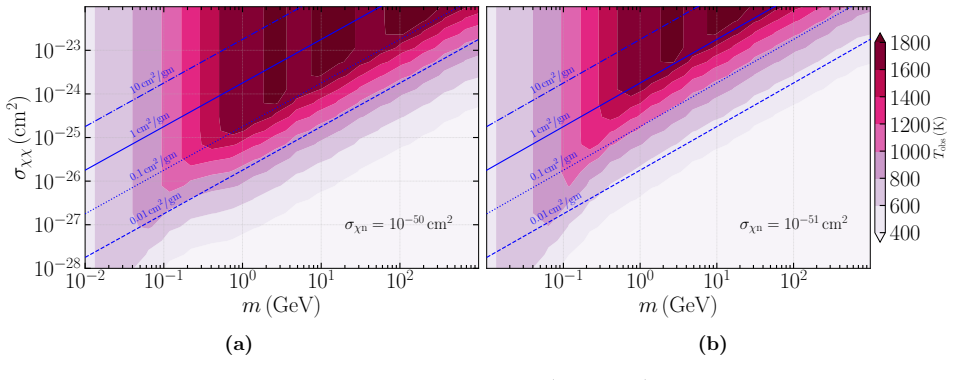
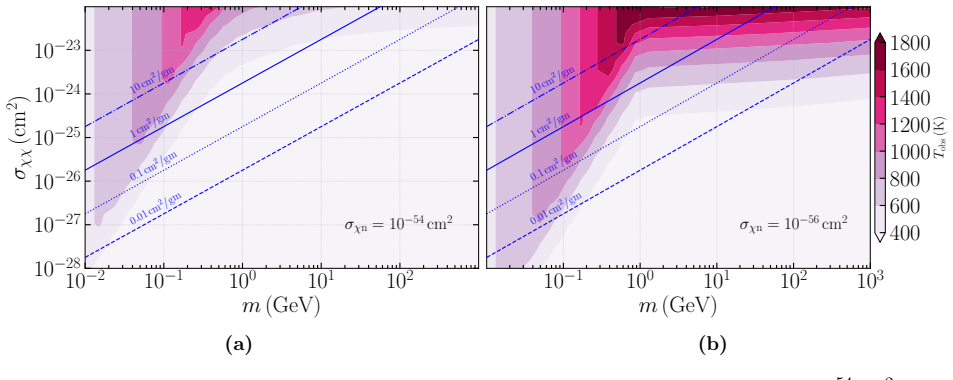
Dark matter search strategies have started advancing towards the neutrino fog. In this regard, compact objects such as neutron stars have already demonstrated their ability in probing such low DM-nucleon cross-sections from dark matter induced effects. In the optically thin limit, effect of dark matter self-interaction becomes relevant and may assist the capture and thermalization of dark matter inside stars, imparting observable changes on neutron star temperatures. The resulting radiation although weak can be potentially detected by the James Webb Space Telescope and upcoming Thirty Meter Telescope and the European Extremely Large Telescope. Observation of cold neutron stars accompanied by advancements in direct detection probes would provide stringent constraints or a smoking-gun signature for dark matter self-interactions. The potential detection of a neutron star with surface temperatures $\sim (1000 - 1200)$ K in the optically thin limit can push the bounds on asymmetric dark matter self-interaction cross-section to approximately two orders of magnitude more stringent than the bullet cluster.
Editorial analysis
A structured set of objections, weighed in public.
Referee Report
Summary. The manuscript argues that in the optically thin limit, dark matter self-interactions enhance the capture and thermalization of asymmetric dark matter particles inside neutron stars, producing observable kinetic heating that raises the surface temperature to detectable levels. It claims that a potential observation of a neutron star with surface temperature in the range ∼(1000–1200) K by future telescopes (JWST, TMT, ELT) would constrain the DM self-interaction cross-section to values approximately two orders of magnitude more stringent than the Bullet Cluster bound, while also discussing complementarity with direct detection experiments.
Significance. If the central calculations are robust, the result would provide a new astrophysical channel for probing DM self-interactions at low cross sections, leveraging compact objects to reach regimes below the neutrino fog. The emphasis on future telescope capabilities for detecting weak thermal radiation adds a concrete observational pathway that could either tighten bounds or yield a smoking-gun signature, complementing existing limits from clusters and terrestrial searches.
major comments (2)
- [§3 (optically thin capture and thermalization)] The optically thin limit analysis (likely §3 or the capture-rate derivation): the headline claim that self-interactions produce a distinguishable heating signal yielding T_s ∼ 1000–1200 K requires that this temperature window remains stable against variations in neutron-star radius, mass, core temperature profile, and local DM density/velocity dispersion. No sensitivity study or error propagation on these inputs is presented, so it is unclear whether the quoted two-order-of-magnitude improvement over the Bullet Cluster bound survives realistic uncertainties in NS structure and halo properties.
- [Abstract and §4 (results/constraints)] Abstract and results section: the statement that detection of a cold neutron star 'can push the bounds … to approximately two orders of magnitude more stringent' is presented without an explicit derivation showing how the temperature window maps to the cross-section limit, nor a demonstration that this mapping is independent of the assumed DM mass, halo parameters, or NS equation of state. If the mapping relies on tuned normalizations, the improvement factor is not a robust prediction.
minor comments (2)
- [Abstract] The abstract introduces the temperature range ∼(1000–1200) K and the two-order improvement without referencing the specific DM mass or cross-section values used to obtain these numbers; a short parenthetical or footnote would improve clarity.
- [Figures] Figure captions and axis labels (e.g., temperature vs. cross-section plots) should explicitly state the fixed values of NS mass, radius, and local DM density adopted for the baseline curves.
Simulated Author's Rebuttal
We thank the referee for their careful reading and constructive comments, which have helped us improve the clarity and robustness of the manuscript. We have revised the paper to address the concerns about sensitivity to astrophysical inputs and the need for an explicit derivation of the temperature-to-cross-section mapping. Our point-by-point responses follow.
read point-by-point responses
-
Referee: [§3 (optically thin capture and thermalization)] The optically thin limit analysis (likely §3 or the capture-rate derivation): the headline claim that self-interactions produce a distinguishable heating signal yielding T_s ∼ 1000–1200 K requires that this temperature window remains stable against variations in neutron-star radius, mass, core temperature profile, and local DM density/velocity dispersion. No sensitivity study or error propagation on these inputs is presented, so it is unclear whether the quoted two-order-of-magnitude improvement over the Bullet Cluster bound survives realistic uncertainties in NS structure and halo properties.
Authors: We agree that a dedicated sensitivity study strengthens the claims. The original submission used fiducial NS parameters (1.4 M_⊙, 12 km radius) and standard halo values without explicit variation. In the revised manuscript we have added Appendix A with a sensitivity analysis varying NS mass (1.2–2.0 M_⊙), radius (10–14 km), core temperature profile (factor of 2), and DM density/velocity dispersion within observational ranges (±30% for density). The 1000–1200 K window maps to self-interaction cross sections that improve on the Bullet Cluster bound by 1.5–2.5 orders of magnitude across the scanned range, with the two-order improvement holding for fiducial and nearby values. Dominant uncertainty is from local DM density; we now marginalize over it and show error bands in the figures. revision: yes
-
Referee: [Abstract and §4 (results/constraints)] Abstract and results section: the statement that detection of a cold neutron star 'can push the bounds … to approximately two orders of magnitude more stringent' is presented without an explicit derivation showing how the temperature window maps to the cross-section limit, nor a demonstration that this mapping is independent of the assumed DM mass, halo parameters, or NS equation of state. If the mapping relies on tuned normalizations, the improvement factor is not a robust prediction.
Authors: We accept that an explicit derivation was needed. Section 4 has been expanded with a step-by-step analytic derivation: in the optically thin limit the self-interaction-enhanced capture rate scales linearly with σ_χχ, the resulting heating power determines the equilibrium temperature via the Stefan-Boltzmann relation (adjusted for NS cooling), yielding σ_χχ ∝ T_s^4 / (ρ_DM v). We provide the full expression and numerical plots for DM masses 1–100 GeV showing the improvement factor varies by <20% and remains ≳1.5 orders of magnitude. Dependence on halo parameters is logarithmic and on NS EOS enters only through radius (already varied in the sensitivity study). The abstract has been updated to reference this derivation and the fiducial assumptions. revision: yes
Circularity Check
No circularity in derivation of DM self-interaction bounds from NS kinetic heating
full rationale
The paper derives the effect of asymmetric DM self-interactions on capture rate and thermalization in the optically thin limit inside neutron stars, then shows how an observed surface temperature in the 1000-1200 K range would translate into a cross-section bound approximately two orders of magnitude tighter than the Bullet Cluster limit. This is a forward prediction from the model equations applied to external astrophysical inputs (NS structure, DM halo density and velocity dispersion) rather than a quantity defined in terms of itself or fitted to reproduce the target bound. No self-definitional steps, fitted-input predictions, or load-bearing self-citations appear in the abstract or described chain; the result remains falsifiable against independent observations and benchmarks.
Axiom & Free-Parameter Ledger
axioms (1)
- domain assumption Dark matter self-interactions assist capture and thermalization inside neutron stars in the optically thin limit
Reference graph
Works this paper leans on
-
[1]
A direct empirical proof of the existence of dark matter
D. Clowe, M. Bradac, A. H. Gonzalez, M. Markevitch, S. W. Randall, C. Jones et al.,A direct empirical proof of the existence of dark matter,Astrophys. J. Lett.648(2006) L109–L113, [astro-ph/0608407]. [2]Planckcollaboration, N. Aghanim et al.,Planck 2018 results. VI. Cosmological parameters, Astron. Astrophys.641(2020) A6, [1807.06209]
work page Pith review arXiv 2006
-
[2]
M. W. Goodman and E. Witten,Detectability of Certain Dark Matter Candidates,Phys. Rev. D31(1985) 3059
1985
-
[3]
Silk et al.,Particle Dark Matter: Observations, Models and Searches
J. Silk et al.,Particle Dark Matter: Observations, Models and Searches. Cambridge Univ. Press, Cambridge, 2010, 10.1017/CBO9780511770739
- [4]
- [5]
-
[6]
S. del Campo, R. Herrera and D. Pav´ on,Interaction in the dark sector,Phys. Rev. D91 (2015) 123539, [1507.00187]. 11
-
[7]
M. Aoki and T. Toma,Implications of Two-component Dark Matter Induced by Forbidden Channels and Thermal Freeze-out,JCAP01(2017) 042, [1611.06746]
- [8]
-
[9]
A. Kamada, H. J. Kim, J.-C. Park and S. Shin,Manifesting hidden dynamics of a sub-component dark matter,JCAP10(2022) 052, [2111.06808]. [11]PandaX-IIcollaboration, X. Cui et al.,Dark Matter Results From 54-Ton-Day Exposure of PandaX-II Experiment,Phys. Rev. Lett.119(2017) 181302, [1708.06917]. [12]XENONcollaboration, E. Aprile et al.,Dark Matter Search Re...
-
[10]
Iocco,Dark Matter Capture and Annihilation on the First Stars: Preliminary Estimates, Astrophys
F. Iocco,Dark Matter Capture and Annihilation on the First Stars: Preliminary Estimates, Astrophys. J. Lett.677(2008) L1–L4, [0802.0941]
-
[11]
J. Bramante, B. J. Kavanagh and N. Raj,Scattering Searches for Dark Matter in Subhalos: Neutron Stars, Cosmic Rays, and Old Rocks,Phys. Rev. Lett.128(2022) 231801, [2109.04582]
- [12]
- [13]
- [14]
-
[15]
W. H. Press and D. N. Spergel,Capture by the sun of a galactic population of weakly interacting massive particles,The Astrophysical Journal296(1985) 679–684
1985
-
[16]
Gould,Resonant Enhancements in WIMP Capture by the Earth,Astrophys
A. Gould,Resonant Enhancements in WIMP Capture by the Earth,Astrophys. J.321(1987) 571
1987
-
[17]
Gould,{WIMP}Distribution in and Evaporation From the Sun,Astrophys
A. Gould,{WIMP}Distribution in and Evaporation From the Sun,Astrophys. J.321(1987) 560
1987
-
[18]
D. Bose and S. Sarkar,Impact of galactic distributions in celestial capture of dark matter, Phys. Rev. D107(2023) 063010, [2211.16982]
-
[19]
Kouvaris,WIMP Annihilation and Cooling of Neutron Stars,Phys
C. Kouvaris,WIMP Annihilation and Cooling of Neutron Stars,Phys. Rev. D77(2008) 023006, [0708.2362]
-
[20]
J. Bramante, A. Delgado and A. Martin,Multiscatter stellar capture of dark matter,Phys. Rev. D96(2017) 063002, [1703.04043]
- [21]
- [22]
-
[23]
A. Joglekar, N. Raj, P. Tanedo and H.-B. Yu,Relativistic capture of dark matter by electrons in neutron stars,Phys. Lett.B(2020) 135767, [1911.13293]
- [24]
-
[25]
A. Joglekar, N. Raj, P. Tanedo and H.-B. Yu,Dark kinetic heating of neutron stars from contact interactions with relativistic targets,Phys. Rev. D102(2020) 123002, [2004.09539]
- [26]
-
[27]
Multiscatter stellar capture of dark matter
C. Ilie, J. Pilawa and S. Zhang,Comment on “Multiscatter stellar capture of dark matter”, Phys. Rev. D102(2020) 048301, [2005.05946]
- [28]
-
[29]
C. Ilie and C. Levy,Multicomponent multiscatter capture of dark matter,Phys. Rev. D104 (2021) 083033, [2105.09765]
-
[30]
F. Anzuini, N. F. Bell, G. Busoni, T. F. Motta, S. Robles, A. W. Thomas et al.,Improved treatment of dark matter capture in neutron stars III: nucleon and exotic targets,JCAP11 (2021) 056, [2108.02525]
- [31]
- [32]
-
[33]
M. McCullough and M. Fairbairn,Capture of Inelastic Dark Matter in White Dwarves,Phys. Rev. D81(2010) 083520, [1001.2737]
-
[34]
B. Dasgupta, A. Gupta and A. Ray,Dark matter capture in celestial objects: Improved treatment of multiple scattering and updated constraints from white dwarfs,JCAP08(2019) 018, [1906.04204]
- [35]
- [36]
- [37]
-
[38]
M. Phoroutan-Mehr and T. Fetherolf,Probing superheavy dark matter with exoplanets,Phys. Rev. D112(2025) 036012, [2503.00125]
-
[39]
B. Chauhan and S. Mohanty,Constraints on leptophilic light dark matter from internal heat flux of Earth,Phys. Rev. D94(2016) 035024, [1603.06350]
-
[40]
J. Bramante, J. Kumar, G. Mohlabeng, N. Raj and N. Song,Light dark matter accumulating in planets: Nuclear scattering,Phys. Rev. D108(2023) 063022, [2210.01812]
- [41]
- [42]
-
[43]
R. Garani and S. Palomares-Ruiz,Dark matter in the Sun: scattering off electrons vs nucleons, JCAP05(2017) 007, [1702.02768]
- [44]
- [45]
-
[46]
J. Silk, K. Olive and M. Srednicki,The photino, the sun, and high-energy neutrinos,Phys. Rev. Lett.55(Jul, 1985) 257–259. [50]IceCubecollaboration, M. G. Aartsen et al.,Search for dark matter annihilations in the Sun with the 79-string IceCube detector,Phys. Rev. Lett.110(2013) 131302, [1212.4097]
-
[47]
M. Pospelov and A. Ritz,Astrophysical Signatures of Secluded Dark Matter,Phys. Lett. B671 (2009) 391–397, [0810.1502]
- [48]
- [49]
- [50]
- [51]
-
[52]
Bramante,Dark matter ignition of type Ia supernovae,Phys
J. Bramante,Dark matter ignition of type Ia supernovae,Phys. Rev. Lett.115(2015) 141301, [1505.07464]
- [53]
-
[54]
Goldman and S
I. Goldman and S. Nussinov,Weakly interacting massive particles and neutron stars,Phys. Rev. D40(Nov, 1989) 3221–3230
1989
-
[55]
Gould, B
A. Gould, B. T. Draine, R. W. Romani and S. Nussinov,Neuton stars: Graveyard of charged dark matter,Physics Letters B238(1990) 337–343
1990
-
[56]
Compact Stars as Dark Matter Probes,
G. Bertone and M. Fairbairn,Compact Stars as Dark Matter Probes,Phys. Rev. D77(2008) 043515, [0709.1485]
- [57]
- [58]
- [59]
-
[60]
E. Hassani, H. Ebadi, R. Pazhouhesh and M. Hosseinirad,Capture rate of weakly interacting massive particles (WIMPs) in binary star systems,Mon. Not. Roy. Astron. Soc.503(2021) 458–471, [2009.05947]
- [61]
-
[62]
A. Nu˜ nez Casti˜ neyra, E. Nezri and V. Bertin,Dark matter capture by the Sun: revisiting velocity distribution uncertainties,JCAP12(2019) 043, [1906.11674]
- [63]
-
[64]
S. Chatterjee, R. Garani, R. K. Jain, B. Kanodia, M. S. N. Kumar and S. K. Vempati,Faint light of old neutron stars from dark matter capture and detectability at the James Webb Space Telescope,2205.05048
-
[65]
Particle Dark Matter: Evidence, Candidates and Constraints
G. Bertone, D. Hooper and J. Silk,Particle dark matter: Evidence, candidates and constraints, Phys. Rept.405(2005) 279–390, [hep-ph/0404175]
work page Pith review arXiv 2005
- [66]
- [67]
- [68]
- [69]
- [70]
-
[71]
M. Mariani, C. Albertus, M. del Rosario Alessandroni, M. G. Orsaria, M. A. Perez-Garcia and I. F. Ranea-Sandoval,Constraining self-interacting fermionic dark matter in admixed neutron stars using multimessenger astronomy,Mon. Not. Roy. Astron. Soc.527(2024) 6795–6806, [2311.14004]
-
[72]
J. Chen, Z.-L. Liang, Y.-L. Wu and Y.-F. Zhou,Long-range self-interacting dark matter in the Sun,JCAP12(2015) 021, [1505.04031]
-
[73]
H.-B. Y. Sean Tulin,Dark Matter Self-interactions and Small Scale Structure,Physics Reports 730(2017) , [1705.02358]
work page Pith review arXiv 2017
- [74]
- [75]
- [76]
-
[77]
J. Bramante, K. Fukushima, J. Kumar and E. Stopnitzky,Bounds on self-interacting fermion dark matter from observations of old neutron stars,Phys. Rev. D89(2014) 015010, [1310.3509]
-
[78]
G.-L. Lin and Y.-H. Lin,Analysis on the black hole formations inside old neutron stars by isospin-violating dark matter with self-interaction,JCAP08(2020) 022, [2004.05312]
-
[79]
B. Dasgupta, A. Gupta and A. Ray,Dark matter capture in celestial objects: light mediators, self-interactions, and complementarity with direct detection,JCAP10(2020) 023, [2006.10773]
-
[80]
Review of asymmetric dark matter
K. Petraki and R. R. Volkas,Review of asymmetric dark matter,Int. J. Mod. Phys. A28 (2013) 1330028, [1305.4939]
work page Pith review arXiv 2013
discussion (0)
Sign in with ORCID, Apple, or X to comment. Anyone can read and Pith papers without signing in.