Recognition: unknown
Saturation Mechanisms in the Interacting Dark Sector
Pith reviewed 2026-05-08 14:07 UTC · model grok-4.3
The pith
Bayesian tests favor a nonzero sparseness scale in two dark-sector interaction models.
A machine-rendered reading of the paper's core claim, the machinery that carries it, and where it could break.
Core claim
The authors construct nonlinear interaction terms for the dark sector that incorporate a sparseness scale inspired by saturation in ecology. Phase-space analysis identifies the fixed points and their stability, demonstrating that the scale alters the asymptotic behavior. When confronted with observational datasets including DESI DR2 measurements, the Bayesian inference disfavors the limit where the sparseness scale vanishes for two of the three models at more than 95 percent confidence, supporting the presence of a characteristic saturation scale in the interaction.
What carries the argument
the sparseness scale, introduced as a half-saturation constant in the interaction rate between dark matter and dark energy to bound the energy transfer and control dynamical evolution
If this is right
- The sparseness scale can prevent the dark energy equation of state from crossing the phantom divide.
- Stationary points in the phase space change stability properties depending on the value of the sparseness scale.
- For two models, the data prefer the nonlinear saturated interaction over the linear limit.
- The models remain consistent with current acceleration of the universe while fitting growth rate data.
Where Pith is reading between the lines
- Similar saturation mechanisms might apply to other cosmological interactions or modified gravity models.
- Future high-precision measurements of the dark energy equation of state could directly test the saturation bound.
- The approach opens a way to link ecological concepts of limited resources to cosmic energy densities.
Load-bearing premise
The three specific nonlinear interaction forms chosen are representative of the actual dark sector physics.
What would settle it
Future observations that force the sparseness parameter to be consistent with zero at high confidence, or detect phantom crossing in the dark energy equation of state without saturation effects, would challenge the models' viability.
Figures





read the original abstract
We introduce a family of phenomenological cosmological models featuring an interacting dark sector modulated by a sparseness scale parameter, in order to describe the late-time accelerated expansion of the universe. The sparseness scale, inspired by well-established saturation mechanisms in ecology and biology, is introduced in the interaction as a half-saturation constant that bounds the energy exchange between dark matter and dark energy, controls the dynamical behaviour of the physical variables and can prevent the phantom crossing. We consider three nonlinear interacting models, where two of them recover the linear interacting scenarios when the sparsity parameter vanishes. We examine the phase-space of the cosmological field equations by using the Hubble normalization approach. We determine the stationary points and their stability properties in order to reconstruct the asymptotics behaviour of the field equations. Such an analysis allows us to demonstrate the effects of the sparseness scale on the background dynamics. We test the interacting models with observational data. Specifically, we employ Supernovae catalogues, cosmic chronometers, Baryon Acoustic Oscillation measurements from DESI DR2, and redshift-space distortion measurements of the growth of large-scale structure through the $f$ and $f\sigma_8$ observables. The Bayesian analysis suggests that, for two of the three models, a vanishing sparsity parameter is disfavoured at more than the 95\% confidence interval, providing observational support for a nonzero sparseness scale in the dark sector interaction.
Editorial analysis
A structured set of objections, weighed in public.
Referee Report
Summary. The manuscript introduces three phenomenological nonlinear interacting dark-sector models modulated by a sparseness scale parameter (inspired by ecological saturation mechanisms) that bounds energy exchange between dark matter and dark energy. Two of the models recover linear interactions when the sparseness parameter vanishes. Phase-space analysis via Hubble normalization identifies stationary points and stability properties to reconstruct asymptotic behavior and demonstrate the scale's dynamical effects. Bayesian fits to SN catalogues, cosmic chronometers, DESI DR2 BAO, and RSD f/fσ8 data indicate that, for two of the three models, a vanishing sparseness parameter is disfavoured at >95% CI.
Significance. If the central result holds, the work supplies a concrete saturation-inspired mechanism for controlling late-time acceleration and avoiding phantom crossing in interacting DE-DM cosmologies, with the phase-space analysis providing model-independent dynamical insight. The inclusion of recent DESI DR2 BAO data alongside growth-rate measurements strengthens the observational constraints on the interaction parameters relative to earlier linear-interaction studies.
major comments (2)
- [Abstract] Abstract: the assertion that the Bayesian analysis 'provides observational support for a nonzero sparseness scale in the dark sector interaction' is conditional on the specific choice of the three phenomenological Q(ρ_dm, ρ_de, H) forms. The manuscript does not demonstrate that other saturating functions (e.g., exponential cutoffs or alternative density-ratio dependencies) would produce posteriors excluding zero at 95% CI; this model dependence should be explicitly qualified in the abstract and conclusion.
- [Bayesian analysis section] Bayesian analysis section: the reported >95% disfavoring of vanishing sparseness for two models is tied to the exact functional shape of the nonlinear interaction terms (two of which reduce to linear at zero sparseness). Without robustness checks against alternative saturating mechanisms, the claim that the data support a nonzero scale in the dark sector does not generalize beyond the selected family.
minor comments (2)
- The Hubble-normalization variables and the explicit definitions of the three interaction functions should be collected in a single table or appendix for easier reference during the phase-space discussion.
- Clarify whether the priors on the sparseness scale and interaction strengths are chosen independently of the data or informed by the phase-space fixed-point analysis.
Simulated Author's Rebuttal
We thank the referee for the constructive comments and careful assessment of our manuscript. We address the major comments below regarding model dependence and have revised the abstract and relevant sections to qualify our claims accordingly.
read point-by-point responses
-
Referee: [Abstract] Abstract: the assertion that the Bayesian analysis 'provides observational support for a nonzero sparseness scale in the dark sector interaction' is conditional on the specific choice of the three phenomenological Q(ρ_dm, ρ_de, H) forms. The manuscript does not demonstrate that other saturating functions (e.g., exponential cutoffs or alternative density-ratio dependencies) would produce posteriors excluding zero at 95% CI; this model dependence should be explicitly qualified in the abstract and conclusion.
Authors: We agree that the observational preference for nonzero sparseness is specific to the three phenomenological interaction forms introduced. These were selected as representative saturating mechanisms (with two recovering linear interactions at vanishing sparseness) inspired by ecological half-saturation. While we did not test alternatives such as exponential cutoffs, the consistency of results across two of the three models provides internal support within this class. We have revised the abstract and conclusion to explicitly qualify that the support applies to the models studied here and does not claim generality beyond this family. revision: yes
-
Referee: [Bayesian analysis section] Bayesian analysis section: the reported >95% disfavoring of vanishing sparseness for two models is tied to the exact functional shape of the nonlinear interaction terms (two of which reduce to linear at zero sparseness). Without robustness checks against alternative saturating mechanisms, the claim that the data support a nonzero scale in the dark sector does not generalize beyond the selected family.
Authors: We acknowledge that the >95% CI disfavoring of zero sparseness depends on the precise nonlinear functional forms chosen. The analysis is confined to these three cases, and no robustness checks against other saturating mechanisms (e.g., exponential or different density-ratio dependencies) were performed, as the study focused on this specific family. We have added clarifying text in the Bayesian analysis section noting the model-specific character of the results and recommending future exploration of alternative forms for broader applicability. revision: yes
Circularity Check
No significant circularity; derivation and data fit are independent
full rationale
The paper defines three phenomenological interaction forms Q(ρ_dm, ρ_de, H) that incorporate a free sparseness scale parameter, derives the autonomous system and stationary points directly from the Friedmann and continuity equations using Hubble normalization, and then performs a separate Bayesian fit of all free parameters (including the sparseness scale) to external datasets (SN, cosmic chronometers, DESI DR2 BAO, f and fσ8 RSD). No claimed result is obtained by renaming a fitted quantity as a prediction, no load-bearing premise reduces to a self-citation, and the phase-space analysis contains no data-dependent inputs. The reported posterior intervals therefore constitute an ordinary model comparison against independent observations rather than an internal tautology.
Axiom & Free-Parameter Ledger
free parameters (2)
- sparseness scale parameter
- interaction strength parameters
axioms (2)
- standard math The universe is described by a flat FLRW metric with standard matter and radiation components.
- domain assumption The interaction between dark matter and dark energy can be written as a phenomenological function of their densities modulated by the sparseness scale.
Forward citations
Cited by 2 Pith papers
-
Alleviating the Hubble Tension Using $\Lambda$sCDM Model: A Coupled Dark Energy - Dark Matter Interaction
The ΛsCDM model with coupled dark sectors reduces the Hubble tension to 1.2σ via late-time expansion changes while keeping the early-universe sound horizon nearly unchanged.
-
Alleviating the Hubble Tension Using $\Lambda$sCDM Model: A Coupled Dark Energy - Dark Matter Interaction
The ΛsCDM interacting dark sector model reduces the Hubble tension to 1.2σ via late-time energy transfer from dark matter to dark energy while leaving the sound horizon nearly unchanged.
Reference graph
Works this paper leans on
-
[1]
Saturation Mechanisms in the Interacting Dark Sector
INTRODUCTION Cosmological models that describe energy transfer between the fluids composing the dark sector have attracted considerable interest, since they offer a dynamical framework for dark energy [1–7] which can explain the recent cosmological observations and alleviate cosmological tensions [8–16]. Nonzero Interacting terms can be naturally introduc...
work page internal anchor Pith review Pith/arXiv arXiv 2026
-
[2]
sparseness scale
INTERACTING DARK SECTOR WITH A SPARSENESS SCALE In the standard cosmological scenario, dark matter and dark energy are assumed to evolve independently and to interact only gravitationally. Within the framework of a spatially flat and FLRW geometry with line element ds2 =−dt 2 +a 2 (t) dx2 +dy 2 +dz 2 ,(1) the cosmological field equations are 1 3H2 =ρ m +ρ...
-
[3]
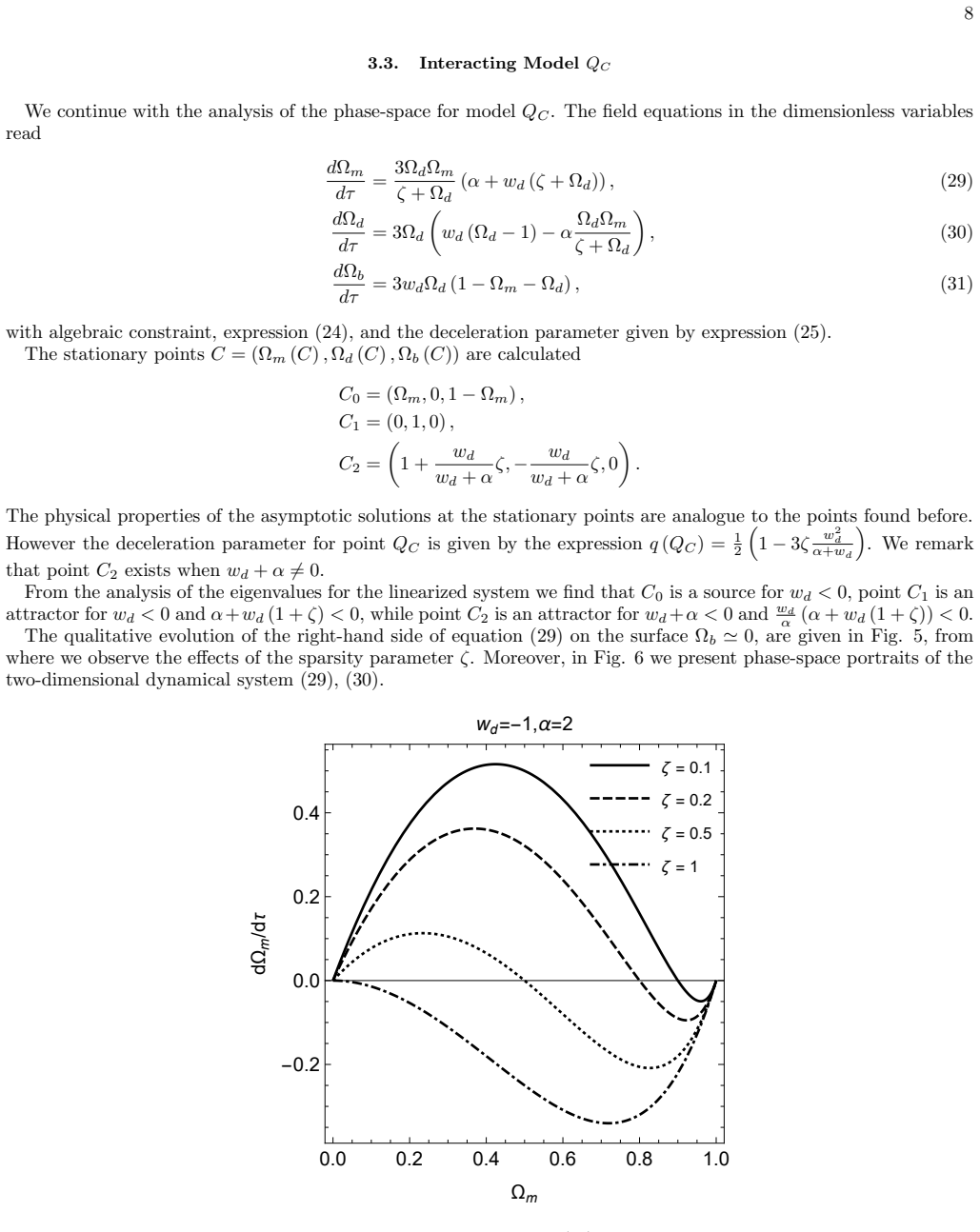
PHASE-SPACE ANALYSIS Within the framework of the Hubble normalization we introduce new dimensionless dependent variables Ωm = ρm 3H2 ,Ω d = ρd 3H2 ,Ω b = ρb 3H2 ,(20) and a new independent variableτ= lna. 3.1. Interacting ModelQ A The cosmological field equations for the interacting modelQ A are expressed into the equivalent form dΩm dτ = 3ΩdΩm ζ+ Ω d (α+...
-
[4]
In order to avoid the appearance of ghosts, we introduce the constraint 0≤ − α wd +ζ ≤1. The pointA 2 is governed by the sparsity parameterζand is the point which describes the change of sign of the evolution equation for Ω m, as described before and demonstrated in Fig. 1. Using the constraint (24), we eliminate Ωb and reduce the system to the two-dimens...
-
[5]
For the sampling algorithm, we employ the PolyChord nested sampler [92, 93], which makes a direct derivation of the Bayesian evidence lnZ
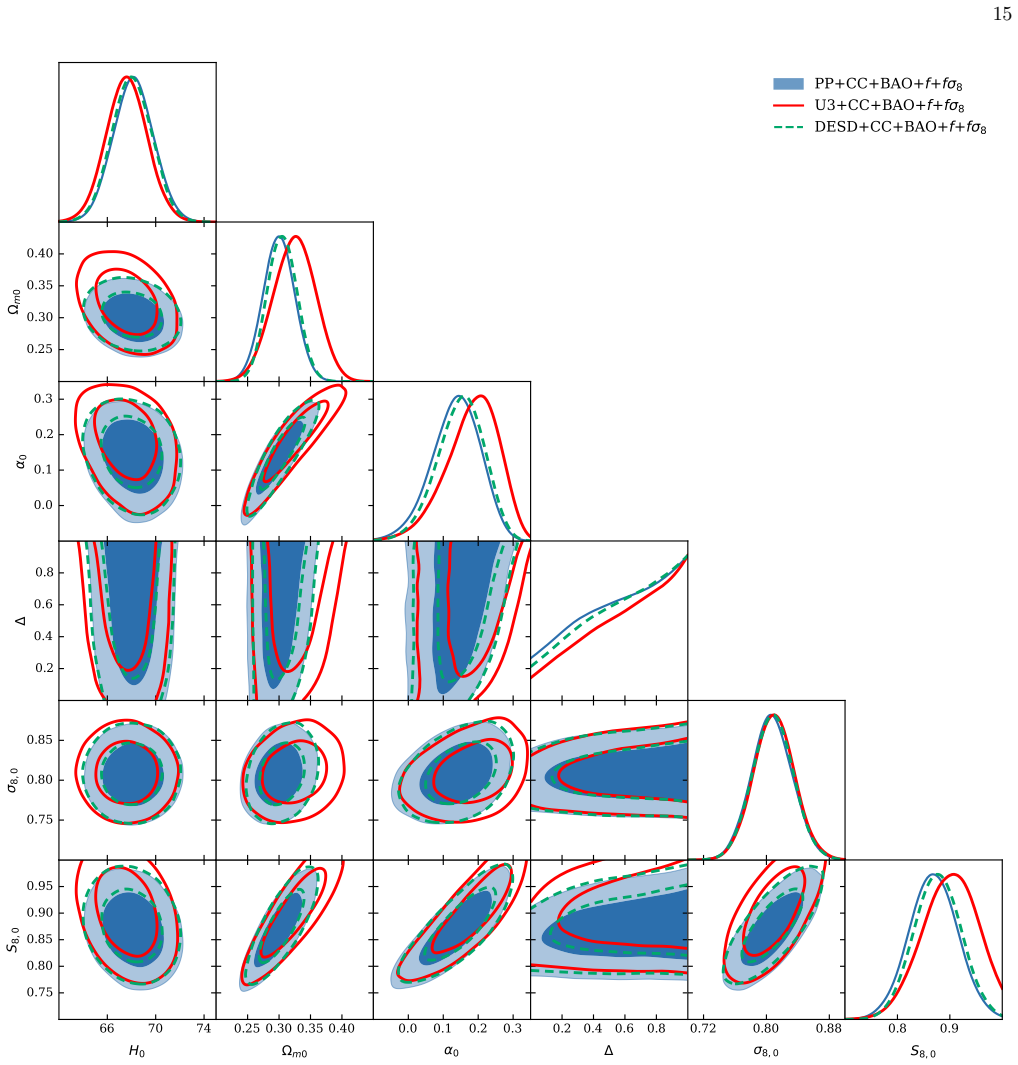
OBSERVATIONAL CONSTRAINTS For our analysis and the comparison of the theoretical predictions with the cosmological data, we make use of the Bayesian inference framework Cobaya2 [90, 91], with a custom theory for the derivation of the theoretical observables. For the sampling algorithm, we employ the PolyChord nested sampler [92, 93], which makes a direct ...
2018
-
[6]
Specifically, we introduced three nonlinear interacting models, namelyQ A,Q B andQ C which depend on the new sparseness scale parameterζ
CONCLUSIONS In this work we introduced cosmological models which describe an interacting dark sector with a saturation mech- anism, which controls the energy exchange between dark matter and dark energy. Specifically, we introduced three nonlinear interacting models, namelyQ A,Q B andQ C which depend on the new sparseness scale parameterζ. In the limit wh...
2018
-
[7]
Amendola, Phys
L. Amendola, Phys. Rev. D62, 043511 (2000)
2000
-
[8]
Cai and A
R.-G. Cai and A. Wang, JCAP03, 002 (2005)
2005
-
[9]
Amendola, G
L. Amendola, G. C. Campos, and R. Rosenfeld, Phys. Rev. D75, 083506 (2007)
2007
-
[10]
N. Cruz, S. Lepe, and F. Pena, Phys. Lett. B663, 338 (2008)
2008
- [11]
-
[12]
S. del Campo, R. Herrera, and D. Pavon, JCAP01, 020 (2009), 0812.2210
- [13]
-
[14]
Gao, S.-S
L.-Y. Gao, S.-S. Xue, and X. Zhang, Chinese Phys. C48, 051001 (2024)
2024
-
[15]
B. Wang, E. Abdalla, F. Atrio-Barandela, and D. Pavon, Reports on Progress in Physics87, 036901 (2024)
2024
-
[16]
Giare, Phys
W. Giare, Phys. Rev. D109, 123545 (2024)
2024
-
[17]
G. Montani, N. Carlevaro, L. A. Escamilla, and E. Di Valentino,Kinetic model for dark energy - dark matter interaction: Scenario for the hubble tension(2024), 2404.15977
-
[18]
Pan and W
S. Pan and W. Yang, inThe Hubble Constant Tension, edited by E. Di Valentino and D. Brout (Springer, Singapore, 2024), Springer Series in Astrophysics and Cosmology
2024
-
[19]
E. Di Valentino, A. Melchiorri, and O. Mena, Phys. Rev. D96, 043503 (2017), 1704.08342
-
[20]
E. Di Valentino, A. Melchiorri, O. Mena, and S. Vagnozzi, Phys. Dark Univ.30, 100666 (2020), 1908.04281
- [21]
- [22]
-
[23]
Brans and R
C. Brans and R. H. Dicke, Phys. Rev.124, 925 (1961)
1961
-
[24]
C. H. Brans, Phys. Rev.125, 2194 (1962)
1962
- [25]
-
[26]
G. Kofinas and M. Tsoukalas, Eur. Phys. J. C76, 686 (2016), 1512.04786
-
[27]
M. Postma and M. Volponi, Phys. Rev. D90, 103516 (2014), 1407.6874
- [28]
-
[29]
M. Tsamparlis, A. Paliathanasis, S. Basilakos, and S. Capozziello, Gen. Rel. Grav.45, 2003 (2013), 1307.6694
- [30]
-
[31]
J. M. Salim and S. L. Sautu, Classical and Quantum Gravity13, 353 (1996)
1996
-
[32]
M. Y. Konstantinov and V. N. Melnikov, International Journal of Modern Physics D4, 339 (1995)
1995
-
[33]
Romero, J
C. Romero, J. B. Fonseca-Neto, and M. L. Pucheu, Classical and Quantum Gravity29, 155015 (2012)
2012
-
[34]
Novello and H
M. Novello and H. Heintzmann, Physics Letters A98, 10 (1983)
1983
-
[35]
New insights on the matter-gravity coupling paradigm
T. Delsate and J. Steinhoff, Phys. Rev. Lett.109, 021101 (2012), 1201.4989
work page Pith review arXiv 2012
- [36]
- [37]
-
[38]
A. Sutiono, A. Suroso, and F. P. Zen, Int. J. Theor. Phys.63, 187 (2024), 2407.21380
-
[39]
Paliathanasis, Annals Phys.468, 169724 (2024), 2407.05042
A. Paliathanasis, Annals Phys.468, 169724 (2024), 2407.05042
- [40]
-
[41]
M. Bojowald and E. I. Duque, Phys. Rev. D109, 084006 (2024), 2311.10693
- [42]
-
[43]
A. Paliathanasis, Class. Quant. Grav.37, 195014 (2020), 2003.05342
-
[44]
I. V. Fomin, J. Phys. Conf. Ser.918, 012009 (2017)
2017
- [45]
-
[46]
Paliathanasis, Gen
A. Paliathanasis, Gen. Rel. Grav.56, 84 (2024)
2024
-
[47]
M. K. Dutta and B. Modak, Int. J. Theor. Phys.54, 2591 (2015)
2015
-
[48]
Sheikhahmadi, A
H. Sheikhahmadi, A. Mohammadi, A. Aghamohammadi, T. Harko, R. Herrera, C. Corda, A. Abebe, and K. Saaidi, Eur. Phys. J. C79, 1038 (2019)
2019
-
[49]
Khoury and A
J. Khoury and A. Weltman, Phys. Rev. Lett.93, 171104 (2004)
2004
-
[50]
Khoury and A
J. Khoury and A. Weltman, Phys. Rev. D69, 044026 (2004)
2004
- [51]
-
[52]
G.-W. Yuan, A.-C. Davis, M. Giannotti, S. Vagnozzi, L. Visinelli, and J. K. Vogel (2025), 2511.01655
-
[53]
C. Negrelli, L. Kraiselburd, S. J. Landau, and M. Salgado, Phys. Rev. D101, 064005 (2020), 2002.12073
-
[54]
Burrage and J
C. Burrage and J. Sakstein, Living Reviews in Relativity21, 1 (2018)
2018
-
[55]
M. van der Westhuizen, A. Abebe, and E. Di Valentino,I. Linear Interacting Dark Energy: Analytical Solutions and Theoretical Pathologies(2025), 2509.04495
-
[56]
M. van der Westhuizen, A. Abebe, and E. Di Valentino,II. Non-Linear Interacting Dark Energy: Analytical Solutions and Theoretical Pathologies(2025), 2509.04494
-
[57]
M. van der Westhuizen, A. Abebe, and E. Di Valentino,III. Interacting Dark Energy: Summary of Models, Pathologies, and Constraints(2025), 2509.04496
-
[58]
J. Valiviita, R. Maartens, and E. Majerotto, Mon. Not. Roy. Astron. Soc.402, 2355 (2010), 0907.4987
- [59]
-
[60]
J. Valiviita, E. Majerotto, and R. Maartens, JCAP07, 020 (2008), 0804.0232
- [62]
-
[63]
Y.-M. Zhang, T.-N. Li, G.-H. Du, S.-H. Zhou, L.-Y. Gao, J.-F. Zhang, and X. Zhang (2025), 2510.12627
- [64]
- [65]
- [66]
-
[67]
Cosmic sign-reversal: non-parametric reconstruction of interacting dark en- ergy with DESI DR2,
Y.-H. Li and X. Zhang (2025), 2506.18477
- [68]
-
[69]
E. Silva, M. A. Sabogal, M. Scherer, R. C. Nunes, E. Di Valentino, and S. Kumar, Phys. Rev. D111, 123511 (2025), 2503.23225
- [70]
-
[71]
A. Paliathanasis, Phys. Dark Univ.52, 102306 (2026), 2601.02789
- [72]
-
[73]
M. van der Westhuizen, D. Figueruelo, R. Thubisi, S. Sahlu, A. Abebe, and A. Paliathanasis, Phys. Dark Univ.50, 102107 (2025), 2505.23306
- [74]
- [75]
-
[76]
D. Benisty, S. Pan, D. Staicova, E. Di Valentino, and R. C. Nunes, Astron. Astrophys.688, A156 (2024), 2403.00056
- [77]
-
[78]
A. Bonilla, S. Kumar, R. C. Nunes, and S. Pan, Mon. Not. Roy. Astron. Soc.512, 4231 (2022), 2102.06149
-
[79]
Cosmology of Inelastic Self-Interacting Dark Matter: Linear Evolution and Observational Constraints
X.-C. Duan, Y.-L. S. Tsai, and Z. Wang (2026), 2604.15006
work page internal anchor Pith review Pith/arXiv arXiv 2026
-
[80]
M. Califano, I. De Martino, and R. Lazkoz, Phys. Rev. D110, 083519 (2024), 2410.06152
-
[81]
W. Giar` e, Y. Zhai, S. Pan, E. Di Valentino, R. C. Nunes, and C. van de Bruck, Phys. Rev. D110, 063527 (2024), 2404.02110
discussion (0)
Sign in with ORCID, Apple, or X to comment. Anyone can read and Pith papers without signing in.