Recognition: unknown
PHOTON: Non-Invasive Optical Tracking of Key-Lever Motion in Historical Keyboard Instruments
Pith reviewed 2026-05-08 13:11 UTC · model grok-4.3
The pith
Reflective optical sensors track the full vertical motion of keys in historical keyboard instruments without mechanical contact or alteration.
A machine-rendered reading of the paper's core claim, the machinery that carries it, and where it could break.
Core claim
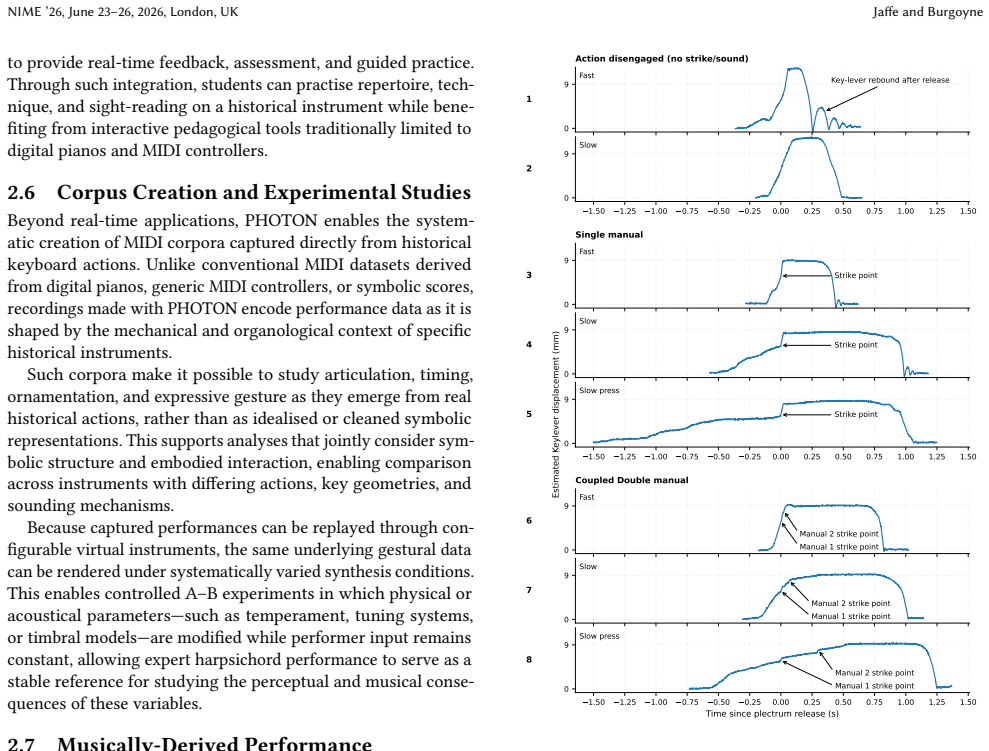
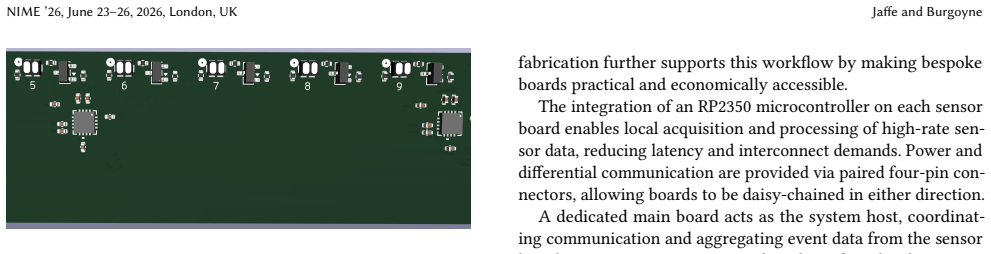
PHOTON tracks the vertical displacement of the key lever itself, capturing motion shaped by both performer input and the instrument's mechanically imposed, time-varying load. Reflective optical sensors mounted beneath the distal end of each lever provide continuous displacement, timing, and articulation data without interfering with the action. The modular, low-profile architecture accommodates the diverse geometries, limited clearances, and non-standard layouts of harpsichords, clavichords, and early fortepianos while enabling high-resolution, low-latency sensing across multiple manuals and variable key counts, with real-time MIDI output and open-source release for replication.
What carries the argument
Reflective optical sensors placed beneath the distal end of each key lever, which measure vertical displacement to produce continuous profiles of motion under combined player and instrument loads.
If this is right
- Real-time MIDI output becomes available directly from unaltered historical instruments.
- Empirical studies of expressive gesture and human-instrument interaction can draw on authentic mechanical responses.
- Instrument-specific MIDI corpora can be constructed from real historical mechanisms rather than modern approximations.
- The open-source hardware and software lower the barrier for replication and further development by other researchers.
Where Pith is reading between the lines
- The motion data could improve digital models that simulate the dynamic response of historical actions inside virtual instruments.
- Comparative studies of performance practice across eras could use consistent measurements taken from preserved instruments.
- Combining the optical tracks with other non-contact sensors might allow reconstruction of the full internal action chain in one session.
- The system could support training tools that give players immediate visual or auditory feedback on timing and touch when learning historical techniques.
Load-bearing premise
Reflective optical sensors mounted under the keys can deliver high-resolution, low-latency displacement data across varied instrument sizes and layouts without mechanical interference or calibration changes that affect playability.
What would settle it
Mounting and operating the sensors on an actual historical instrument and observing either altered key travel distance, increased resistance, delayed response, or data that fails to resolve fine timing and articulation differences during normal playing.
Figures





read the original abstract
This paper introduces PHOTON (PHysical Optical Tracking of Notes), a non-invasive optical sensing system for measuring key-lever motion in historical keyboard instruments. PHOTON tracks the vertical displacement of the key lever itself, capturing motion shaped by both performer input and the instrument's mechanically imposed, time-varying load. Reflective optical sensors mounted beneath the distal end of each lever provide continuous displacement, timing, and articulation data without interfering with the action. Unlike existing optical systems designed for modern pianos, PHOTON accommodates the diverse geometries, limited clearances, and non-standard layouts of harpsichords, clavichords, and early fortepianos. Its modular, low-profile architecture enables high-resolution, low-latency sensing across multiple manuals and variable key counts. Beyond performance capture, PHOTON provides real-time MIDI output and supports empirical study of expressive gesture, human-instrument interaction, and the construction of instrument-specific MIDI corpora using real historical mechanisms. The complete system is released as open-source hardware and software, from schematics and PCB layouts developed in KiCad to firmware written in CircuitPython, lowering the barrier to adoption, replication, and extension.
Editorial analysis
A structured set of objections, weighed in public.
Referee Report
Summary. The manuscript introduces PHOTON, a non-invasive optical sensing system for tracking vertical key-lever displacement in historical keyboard instruments (harpsichords, clavichords, early fortepianos). Reflective optical sensors mounted beneath the distal end of each lever capture continuous displacement, timing, and articulation data shaped by performer input and the instrument's time-varying mechanical load. The modular, low-profile design accommodates diverse geometries, limited clearances, non-standard layouts, and multiple manuals without mechanical interference, provides real-time MIDI output, and supports studies of expressive gesture and human-instrument interaction. The full hardware (KiCad schematics and PCB layouts) and software (CircuitPython firmware) stack is released as open source.
Significance. If the performance claims are substantiated, PHOTON would fill a clear gap by enabling non-invasive, high-fidelity capture of expressive articulation on period instruments whose actions cannot be modified. The explicit open-source release of complete hardware and firmware is a concrete strength that directly lowers barriers to replication and extension, potentially supporting the construction of instrument-specific MIDI corpora grounded in real historical mechanisms.
major comments (1)
- [Abstract] Abstract and system description: the central claims of 'high-resolution, low-latency sensing' and reliable operation 'across multiple manuals and variable key counts' are presented without any quantitative performance data, error analysis, resolution measurements, latency benchmarks, or validation experiments against ground truth. This absence is load-bearing because the weakest assumption (that low-profile reflective sensors can deliver the stated performance without instrument-specific calibration or playability changes) cannot be evaluated from the design description alone.
minor comments (1)
- The abstract and introduction would benefit from a short table or bullet list summarizing key specifications (e.g., sensor model, nominal resolution, maximum key count per manual) to allow readers to assess feasibility immediately.
Simulated Author's Rebuttal
We thank the referee for their constructive feedback and for acknowledging PHOTON's potential to enable non-invasive capture of expressive articulation on historical instruments. We address the single major comment below and have revised the manuscript accordingly.
read point-by-point responses
-
Referee: [Abstract] Abstract and system description: the central claims of 'high-resolution, low-latency sensing' and reliable operation 'across multiple manuals and variable key counts' are presented without any quantitative performance data, error analysis, resolution measurements, latency benchmarks, or validation experiments against ground truth. This absence is load-bearing because the weakest assumption (that low-profile reflective sensors can deliver the stated performance without instrument-specific calibration or playability changes) cannot be evaluated from the design description alone.
Authors: We agree that the abstract and system description would be strengthened by quantitative evidence. The submitted manuscript prioritizes the novel low-profile, modular design and complete open-source release (KiCad hardware and CircuitPython firmware) to lower barriers for replication on diverse historical instruments. To directly address the concern, the revised version will add a new 'System Characterization' section containing: resolution and accuracy measurements using a calibrated linear displacement stage as ground truth; end-to-end latency benchmarks from sensor output to MIDI event; error analysis across key velocities, multiple manuals, and variable key counts; and confirmation via performer testing that mounting produces no measurable change in playability or action feel. We will also document the minimal calibration procedure and its instrument independence. These additions will allow readers to evaluate the performance claims objectively. revision: yes
Circularity Check
No significant circularity
full rationale
The paper is a pure engineering system description of a modular optical sensing architecture for historical keyboards. It contains no mathematical derivations, equations, predictions, fitted parameters, or uniqueness theorems. The central claims follow directly from the stated non-contact, low-profile design choices and are supported by the open-source release rather than any internal reduction to inputs. No self-citation chains or ansatzes are invoked to justify core results.
Axiom & Free-Parameter Ledger
axioms (1)
- domain assumption Reflective optical sensors can provide accurate continuous displacement measurements of key levers without mechanical contact or interference.
Reference graph
Works this paper leans on
-
[1]
Alf Gabrielsson. 2003. Music Performance Research at the Millennium.Psychol- ogy of Music31, 3 (2003), 221–272. https://doi.org/10.1177/03057356030313003
-
[2]
Bruno Gingras, Pierre-Yves Asselin, Meghan Goodchild, and Stephen McAdams. 2009. Communicating Voice Emphasis in Harpsichord Perfor- mance. InProceedings of the 7th Triennial Conference of the European Society for the Cognitive Sciences of Music (ESCOM 2009), Jukka Louhivuori, Tuo- mas Eerola, Suvi Saarikallio, Tommi Himberg, and Päivi-Sisko Eerola (Eds.)...
2009
-
[3]
Bruno Gingras, Pierre-Yves Asselin, and Stephen McAdams. 2013. Individuality in Harpsichord Performance: Disentangling Performer- and Piece-specific Influences on Interpretive Choices.Frontiers in Psychology4 (2013), 895. https://doi.org/10.3389/fpsyg.2013.00895
-
[4]
Matthew Hamilton, Michele Ducceschi, Roberto Livi, Catalina Vicens, and An- drew McPherson. 2025. Augmentation of a Historical Harpsichord Keyboard Replica for Haptic-Enabled Interaction in Museum Exhibitions. InProceedings of the 2025 International Conference on New Interfaces for Musical Expression (NIME). https://nime.org/proceedings/2025/nime2025_61.pdf
2025
-
[5]
Randall Harlow, Mattias Petersson, Robert Ek, Federico Visi, and Stefan Öster- sjö. 2021. Global Hyperorgan: A Platform for Telematic Musicking and Re- search. InProceedings of the International Conference on New Interfaces for Musical Expression (NIME). https://doi.org/10.21428/92fbeb44.d4146b2d Pub- lished Apr 29, 2021
-
[6]
Kaori Kuromiya, Yuya Kobayashi, Masato Hirano, and Shinichi Furuya. 2025. Motor Origins of Timbre in Piano Performance.Proceedings of the National Academy of Sciences122, e2425073122 (2025). https://doi.org/10.1073/pnas. 2425073122
- [7]
-
[8]
Jennifer MacRitchie and Giulia Nuti. 2015. Using Historical Accounts of Harpsichord Touch to Empirically Investigate the Production and Perception of Dynamics on the 1788 Taskin.Frontiers in Psychology6 (2015), 183. https: //doi.org/10.3389/fpsyg.2015.00183
-
[9]
McPherson
Andrew P. McPherson. 2013. Portable Measurement and Mapping of Con- tinuous Piano Gesture. InProceedings of the International Conference on New Interfaces for Musical Expression (NIME 2013). Daejeon, South Korea, 152–157
2013
-
[10]
Andrew P. McPherson and Youngmoo E. Kim. 2011. Multidimensional Gesture Sensing at the Piano Keyboard. InProceedings of the SIGCHI Conference on Human Factors in Computing Systems (CHI). Vancouver, Canada, 2789–2798. https://doi.org/10.1145/1978942.1979355
-
[11]
Will Mowat. 2005. Bob Moog Piano Bar.Sound on Sound(2005). https: //www.soundonsound.com/reviews/bob-moog-piano-bar Online review
2005
-
[12]
Takanori Oku and Shinichi Furuya. 2022. Noncontact and High-Precision Sensing System for Piano Keys Identified Fingerprints of Virtuosity.Sensors 22 (2022). https://doi.org/10.3390/s22134891
-
[13]
Henri Penttinen. 2006. On the Dynamics of the Harpsichord and Its Syn- thesis. InProceedings of the 9th International Conference on Digital Audio Effects (DAFx). Montreal, Canada. https://aaltodoc.aalto.fi/server/api/core/ bitstreams/df2646b3-5b94-4e0d-9719-01a19f941c8a/content
2006
-
[14]
QRS Music Technologies. 2024. Roll with the Punches: The Story of QRS Music. http://www.qrsmusic.com/assets/pdf/BKS24.pdf Company self-publication on the history of QRS and player piano technology
2024
-
[15]
Adam Schmidt, Jeffrey Snyder, Gian Torrano Jacobs, Joseph Gascho, Joyce Chen, and Andrew McPherson. 2025. The Sparksichord: Practical Implemen- tation of a Lorentz Force Electromagnetic Actuation and Feedback System. In Proceedings of the 2025 International Conference on New Interfaces for Musical Expression (NIME). Canberra, Australia. https://nime.org/p...
2025
- [16]
-
[17]
Adam Štefunko, Suhit Chiruthapudi, Jan Hajic, and Carlos Eduardo Cancino- Chacón. 2025. Basso Continuo Goes Digital: Collecting and Aligning a Sym- bolic Dataset of Continuo Performance. InProceedings of the 6th Conference on AI Music Creativity (AIMC). Brussels, Belgium
2025
discussion (0)
Sign in with ORCID, Apple, or X to comment. Anyone can read and Pith papers without signing in.