Recognition: unknown
Gradual Voluntary Participation: A Framework for Participatory AI Governance in Journalism
Pith reviewed 2026-05-09 20:55 UTC · model grok-4.3
The pith
Journalists trust AI tools more when they perceive they can gradually and voluntarily influence how those tools are used in the newsroom.
A machine-rendered reading of the paper's core claim, the machinery that carries it, and where it could break.
Core claim
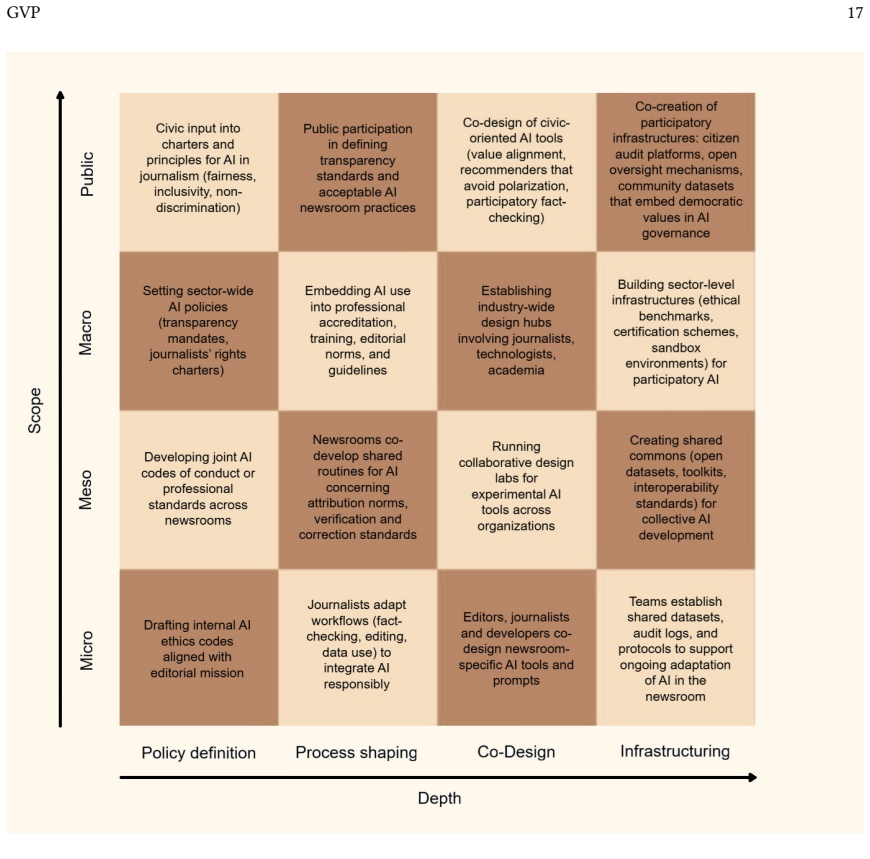
Through interviews with 10 journalists, the paper identifies a perception gap showing that trust in AI depends on perceived agency within workplace participatory workflows. Informed by these findings, it introduces the Gradual Voluntary Participation (GVP) framework and its five core principles, reconceptualizing participation as a gradual and voluntary process that can be operationalized at the newsroom level beyond fixed workshops or one-time preference-elicitation campaigns. The framework addresses epistemic burdens, participatory ceilings, and performative consultations by treating gradualism and voluntariness as design dimensions that shape perception, legitimacy, and ownership, and by,
What carries the argument
The Gradual Voluntary Participation (GVP) framework, which maps stakeholders on a bidimensional matrix of participation depth and scope while treating gradualism and voluntariness as adjustable design dimensions to build agency and legitimacy.
If this is right
- Participation becomes a continuous, optional process rather than one-time events, allowing operationalization directly in newsrooms.
- The bidimensional matrix replaces unidimensional ladders to better capture varying depths and scopes of stakeholder involvement.
- Gradualism and voluntariness function as design dimensions that directly affect perceptions of legitimacy and ownership.
- The approach balances technological transformation with empowerment by addressing performative consultations and participatory ceilings.
- Local participatory AI governance becomes feasible in hybrid workplaces without requiring full stakeholder control over opaque systems.
Where Pith is reading between the lines
- The framework could be adapted and tested in other high-stakes professional settings where AI is introduced into expert workflows.
- Implementing the matrix structure might surface new practical challenges around measuring and adjusting participation depth over time.
- If the perception gap closes under GVP, newsrooms might see faster and more sustained adoption of AI tools with less internal resistance.
Load-bearing premise
That insights from interviews with a small sample of ten journalists are sufficient to identify generalizable issues like epistemic burdens and participatory ceilings and to develop a framework that can be operationalized across diverse newsroom settings.
What would settle it
A follow-up study that applies the GVP principles in multiple real newsrooms and measures whether journalists report higher perceived agency, lower epistemic burdens, and increased trust in AI compared to standard participatory approaches.
Figures

read the original abstract
The integration of AI into journalism challenges participatory design (PD), particularly with respect to stakeholder influence, workplace perceptions, and organizational dynamics. Traditional PD assumes that users can shape technologies, yet AI systems resist influence due to opaque data, fixed architectures, and inaccessible objectives. Through interviews with 10 journalists, we identify the perception gap, showing that trust in AI depends on perceived agency within workplace participatory workflows. Informed by these findings, we introduce the Gradual Voluntary Participation (GVP) framework in journalism and its five core principles, reconceptualizing participation as a gradual and voluntary process that can be operationalized at the newsroom level, beyond fixed workshops or one-time preference-elicitation campaigns. Addressing epistemic burdens, participatory ceilings, and performative consultations, GVP treats gradualism and voluntariness as design dimensions that shape perception, legitimacy, and ownership. Moving beyond unidimensional ladder metaphors and adopting a bidimensional matrix structure, the framework maps stakeholders across depth and scope, offering a new model for local participatory AI governance that balances technological transformation with stakeholder empowerment in rapidly evolving hybrid workplaces.
Editorial analysis
A structured set of objections, weighed in public.
Referee Report
Summary. The paper claims that interviews with 10 journalists reveal a perception gap in which trust in AI depends on perceived agency within workplace participatory workflows. Informed by these findings, it introduces the Gradual Voluntary Participation (GVP) framework and its five core principles, which reconceptualize participation as a gradual and voluntary process operationalizable at the newsroom level via a bidimensional matrix that maps stakeholders along depth and scope dimensions, addressing epistemic burdens, participatory ceilings, and performative consultations beyond traditional PD approaches.
Significance. If the framework's generalizability holds, it would offer a practical, bidimensional alternative to unidimensional ladder models of participation, enabling newsrooms to design AI governance processes that better balance technological opacity with stakeholder empowerment and ownership. The qualitative identification of the perception gap and the emphasis on gradualism/voluntariness as design dimensions could inform empirical studies and local implementations in hybrid journalism workplaces.
major comments (2)
- [Methods] Methods section: No details are provided on the interview protocol, sampling strategy (e.g., selection criteria, diversity across newsroom size, ownership, or AI maturity), data analysis approach, or saturation criteria. This directly affects the central claim that the perception gap and five GVP principles were identified from the interviews and can be generalized to operationalize participation across diverse newsroom settings.
- [Findings and Framework] Findings and Framework sections: The derivation of the five core principles and the bidimensional matrix from the n=10 sample is presented without discussion of limitations, variation in participant experiences, or evidence that the insights address performative consultations beyond the specific cases studied. This load-bearing step for the framework's claimed utility requires stronger justification or additional data.
minor comments (2)
- [Abstract] Abstract: The claim that GVP 'can be operationalized at the newsroom level' would benefit from a brief example of how the matrix applies to a concrete AI tool (e.g., content recommendation system) to clarify the transition from principles to practice.
- [Related Work] The manuscript would be strengthened by explicit comparison of the GVP matrix to existing PD frameworks (e.g., Arnstein's ladder or later HCI adaptations) in a dedicated related-work subsection.
Simulated Author's Rebuttal
We are grateful to the referee for the constructive and detailed feedback, which identifies key areas where the manuscript can be strengthened. We address the major comments point by point below and will revise the paper accordingly to improve methodological transparency and the grounding of the GVP framework.
read point-by-point responses
-
Referee: [Methods] Methods section: No details are provided on the interview protocol, sampling strategy (e.g., selection criteria, diversity across newsroom size, ownership, or AI maturity), data analysis approach, or saturation criteria. This directly affects the central claim that the perception gap and five GVP principles were identified from the interviews and can be generalized to operationalize participation across diverse newsroom settings.
Authors: We agree that the current Methods section lacks necessary detail, which limits the ability to evaluate the robustness of the findings. In the revised manuscript, we will expand the Methods section to provide a complete account of the semi-structured interview protocol (including key questions), the purposive sampling strategy with explicit selection criteria and efforts to capture diversity in newsroom size, ownership, and AI maturity, the thematic analysis process, and the criteria used to determine saturation. These additions will directly support the claims regarding the perception gap and GVP principles while clarifying the exploratory scope of the study. revision: yes
-
Referee: [Findings and Framework] Findings and Framework sections: The derivation of the five core principles and the bidimensional matrix from the n=10 sample is presented without discussion of limitations, variation in participant experiences, or evidence that the insights address performative consultations beyond the specific cases studied. This load-bearing step for the framework's claimed utility requires stronger justification or additional data.
Authors: We acknowledge that the manuscript would be improved by explicitly addressing limitations and variations in the derivation of the principles and matrix. In the revision, we will add a dedicated discussion subsection that covers the constraints of the n=10 sample, observed variations in participant experiences (e.g., differences tied to newsroom context or AI exposure), and specific evidence from the interviews on how the framework targets performative consultations. We will clarify that the GVP framework is a conceptual model informed by the qualitative data rather than a direct empirical generalization, and we will note the need for future validation studies. This provides stronger justification for the framework's utility at the newsroom level. revision: yes
Circularity Check
No circularity: GVP framework derived from independent interview data without self-referential reduction
full rationale
The paper's derivation chain proceeds from qualitative interviews with 10 journalists to identification of a perception gap, then to introduction of the GVP framework and its five principles as informed by those findings. No equations, fitted parameters, or self-citations are present in the provided text. The framework is not defined in terms of itself, nor are any 'predictions' or principles shown to reduce by construction to the interview inputs. This is a standard empirical-to-conceptual move in participatory design research and remains self-contained; generalizability concerns are evidentiary rather than circular.
Axiom & Free-Parameter Ledger
axioms (1)
- domain assumption Participatory design approaches can be meaningfully adapted to opaque AI systems in journalism despite fixed architectures and inaccessible objectives.
invented entities (1)
-
Gradual Voluntary Participation (GVP) framework
no independent evidence
Reference graph
Works this paper leans on
-
[1]
Penelope Muse Abernathy. 2020. Will local news survive?News deserts and ghost newspapers(2020)
2020
-
[2]
Iban Albizu-Rivas, Sonia Parratt-Fernández, and Montse Mera-Fernández. 2024. Artificial Intelligence in Slow Journalism: Journalists’ Uses, Perceptions, and Attitudes.Journalism and Media5, 4 (Dec. 2024), 1836–1850. doi:10.3390/journalmedia5040111 Publisher: Multidisciplinary Digital Publishing Institute. Manuscript submitted to ACM GVP 21
-
[3]
In Proceedings of the 2019 CHI Conference on Human Factors in Computing Systems
Saleema Amershi, Dan Weld, Mihaela Vorvoreanu, Adam Fourney, Besmira Nushi, Penny Collisson, Jina Suh, Shamsi Iqbal, Paul N. Bennett, Kori Inkpen, Jaime Teevan, Ruth Kikin-Gil, and Eric Horvitz. 2019. Guidelines for Human-AI Interaction. InProceedings of the 2019 CHI Conference on Human Factors in Computing Systems(Glasgow, Scotland Uk)(CHI ’19). Associat...
-
[4]
Arnstein
Sherry R. Arnstein. 1969. A Ladder Of Citizen Participation.Journal of the American Institute of Planners35, 4 (July 1969), 216–224. doi:10.1080/ 01944366908977225
1969
-
[5]
Liam Bannon, Jeffrey Bardzell, and Susanne Bødker. 2018. Reimagining participatory design.Interactions26, 1 (Dec. 2018), 26–32. doi:10.1145/3292015
-
[6]
2021.Participatory AI for humanitarian innovation
Aleks Berditchevskaia, Erini Malliaraki, and Kathy Peach. 2021.Participatory AI for humanitarian innovation. Technical Report. Nesta. https: //media.nesta.org.uk/documents/Nesta_Participatory_AI_for_humanitarian_innovation_Final.pdf
2021
-
[7]
Arngeir Berge, Frode Guribye, Siri-Linn Schmidt Fotland, Gro Fonnes, Ingrid H Johansen, and Christoph Trattner. 2023. Designing for control in nurse-ai collaboration during emergency medical calls. InProceedings of the 2023 ACM Designing Interactive Systems Conference. 1339–1352
2023
-
[8]
Abeba Birhane, William Isaac, Vinodkumar Prabhakaran, Mark Diaz, Madeleine Clare Elish, Iason Gabriel, and Shakir Mohamed. 2022. Power to the People? Opportunities and Challenges for Participatory AI. InProceedings of the 2nd ACM Conference on Equity and Access in Algorithms, Mechanisms, and Optimization(Arlington, VA, USA)(EAAMO ’22). Association for Com...
-
[9]
Claus Bossen, Christian Dindler, and Ole Sejer Iversen. 2010. User gains and PD aims: assessment from a participatory design project. InProceedings of the 11th Biennial Participatory Design Conference(Sydney, Australia)(PDC ’10). Association for Computing Machinery, New York, NY, USA, 141–150. doi:10.1145/1900441.1900461
-
[10]
Tone Bratteteig and Guri Verne. 2018. Does AI make PD obsolete? exploring challenges from artificial intelligence to participatory design. In Proceedings of the 15th Participatory Design Conference: Short Papers, Situated Actions, Workshops and Tutorial - Volume 2 (PDC ’18). Association for Computing Machinery, New York, NY, USA, 1–5. doi:10.1145/3210604.3210646
-
[11]
Tone Bratteteig and Ina Wagner. 2012. Disentangling power and decision-making in participatory design. InProceedings of the 12th Participatory Design Conference: Research Papers - Volume 1 (PDC ’12). Association for Computing Machinery, New York, NY, USA, 41–50. doi:10.1145/2347635.2347642
-
[12]
Tone Bratteteig and Ina Wagner. 2016. What is a participatory design result?. InProceedings of the 14th Participatory Design Conference: Full papers - Volume 1 (PDC ’16). Association for Computing Machinery, New York, NY, USA, 141–150. doi:10.1145/2940299.2940316
-
[13]
Warren Breed. 1955. Social Control in the Newsroom: A Functional Analysis.Social Forces33, 4 (May 1955), 326–335. doi:10.2307/2573002 Number: 4
-
[14]
Zana Buçinca, Maja Barbara Malaya, and Krzysztof Z. Gajos. 2021. To Trust or to Think: Cognitive Forcing Functions Can Reduce Overreliance on AI in AI-assisted Decision-making.Proc. ACM Hum.-Comput. Interact.5, CSCW1, Article 188, 21 pages. doi:10.1145/3449287
-
[15]
Parmit K. Chilana, Amy J. Ko, and Jacob O. Wobbrock. 2012. LemonAid: selection-based crowdsourced contextual help for web applications. In Proceedings of the SIGCHI Conference on Human Factors in Computing Systems(Austin, Texas, USA)(CHI ’12). Association for Computing Machinery, New York, NY, USA, 1549–1558. doi:10.1145/2207676.2208620
-
[16]
John Joon Young Chung, Shiqing He, and Eytan Adar. 2022. Artist Support Networks: Implications for Future Creativity Support Tools. InProceedings of the 2022 ACM Designing Interactive Systems Conference(Virtual Event, Australia)(DIS ’22). Association for Computing Machinery, New York, NY, USA, 232–246. doi:10.1145/3532106.3533505
-
[17]
Stewart Clegg, Torgeir Skyttermoen, and Anne Live Vaagaasar. 2024. Project leadership and representation: powering purposive social value. International Journal of Managing Projects in Business(Dec. 2024). doi:10.1108/IJMPB-05-2024-0119
-
[18]
Hannes Cools and Michael Koliska. 2024. News Automation and Algorithmic Transparency in the Newsroom: The Case of the Washington Post. Journalism Studies25, 6 (April 2024), 662–680. doi:10.1080/1461670X.2024.2326636
-
[19]
Ned Cooper, Tiffanie Horne, Gillian R Hayes, Courtney Heldreth, Michal Lahav, Jess Holbrook, and Lauren Wilcox. 2022. A Systematic Review and Thematic Analysis of Community-Collaborative Approaches to Computing Research. InProceedings of the 2022 CHI Conference on Human Factors in Computing Systems(New Orleans, LA, USA)(CHI ’22). Association for Computing...
-
[20]
Ned Cooper and Alexandra Zafiroglu. 2024. From Fitting Participation to Forging Relationships: The Art of Participatory ML. InProceedings of the 2024 CHI Conference on Human Factors in Computing Systems(Honolulu, HI, USA)(CHI ’24). Association for Computing Machinery, New York, NY, USA, Article 746, 9 pages. doi:10.1145/3613904.3642775
-
[21]
Eric Corbett, Remi Denton, and Sheena Erete. 2023. Power and Public Participation in AI. InProceedings of the 3rd ACM Conference on Equity and Access in Algorithms, Mechanisms, and Optimization(Boston, MA, USA)(EAAMO ’23). Association for Computing Machinery, New York, NY, USA, Article 8, 13 pages. doi:10.1145/3617694.3623228
-
[22]
Robert A. Dahl. 1957. The concept of power.Behavioral Science2, 3 (1957), 201–215. doi:10.1002/bs.3830020303
-
[23]
Edward L Deci and Richard M Ryan. 2012. Self-determination theory.Handbook of theories of social psychology1, 20 (2012), 416–436
2012
-
[24]
Fernando Delgado, Stephen Yang, Michael Madaio, and Qian Yang. 2023. The Participatory Turn in AI Design: Theoretical Foundations and the Current State of Practice. InProceedings of the 3rd ACM Conference on Equity and Access in Algorithms, Mechanisms, and Optimization(Boston, MA, USA)(EAAMO ’23). Association for Computing Machinery, New York, NY, USA, Ar...
-
[25]
Shipi Dhanorkar, Christine T Wolf, Kun Qian, Anbang Xu, Lucian Popa, and Yunyao Li. 2021. Who needs to know what, when?: Broadening the Explainable AI (XAI) Design Space by Looking at Explanations Across the AI Lifecycle. InProceedings of the 2021 ACM Designing Interactive Systems Manuscript submitted to ACM 22 Stefano Sorrentino, Matilde Barbini, and Dan...
2021
-
[26]
Nicholas Diakopoulos and Michael Koliska. 2017. Algorithmic transparency in the news media.Digital journalism5, 7 (2017), 809–828
2017
-
[27]
Tom Djajadiningrat, Kees Overbeeke, and Stephan Wensveen. 2002. But how, Donald, tell us how? On the creation of meaning in interaction design through feedforward and inherent feedback. InProceedings of the 4th conference on Designing interactive systems: processes, practices, methods, and techniques. 285–291
2002
-
[28]
Tomás Dodds, Astrid Vandendaele, Felix M Simon, Natali Helberger, Valeria Resendez, and Wang Ngai Yeung. 2024. The Impact of Knowledge Silos on Responsible AI Practices in Journalism. (2024). doi:10.48550/arXiv.2410.01138
-
[29]
Konstantin Nicholas Dörr and Katharina Hollnbuchner. 2017. Ethical challenges of algorithmic journalism.Digital journalism5, 4 (2017), 404–419
2017
-
[30]
Paul Dourish. 2001. Process descriptions as organisational accounting devices: the dual use of workflow technologies. InProceedings of the 2001 ACM International Conference on Supporting Group Work. 52–60
2001
-
[31]
2001.Where the action is: the foundations of embodied interaction
Paul Dourish. 2001.Where the action is: the foundations of embodied interaction. MIT press
2001
-
[32]
M. Z. van Drunen and D. Fechner and. 2023. Safeguarding Editorial Independence in an Automated Media System: The Relationship Between Law and Journalistic Perspectives.Digital Journalism11, 9 (2023), 1723–1750. doi:10.1080/21670811.2022.2108868
-
[33]
Tony Dundon, Miguel Martinez Lucio, Debra Howcroft, Emma Hughes, Arjan Keizer, and Roger Walden. 2017. Power dynamics in work and employment relationships: The capacity for employee influence. (2017). https://www.cipd.org/globalassets/media/knowledge/knowledge- hub/reports/power-dynamics-in-work-and-employment-relationships_2017-the-capacity-for-employee-...
2017
-
[34]
Pelle Ehn. 2017. Scandinavian design: On participation and skill. InParticipatory design. CRC press, 41–77
2017
-
[35]
Thomas Erickson and Wendy A Kellogg. 2000. Social translucence: an approach to designing systems that support social processes.ACM transactions on computer-human interaction (TOCHI)7, 1 (2000), 59–83
2000
-
[36]
Hansen et al. 2023. Initial white paper on the social, economic, and political impact of media AI technologies (D2.2). https://www.ai4media.eu/ reports/initial-white-paper-on-the-social-economic-and-political-impact-of-media-ai-technologies-2/
2023
-
[37]
2020.Google, the media patron: How the digital giant ensnares journalism
Alexander Fanta and Ingo Dachwitz. 2020.Google, the media patron: How the digital giant ensnares journalism. OBS-Arbeitsheft 103. Otto Brenner Foundation (OBS), Frankfurt am Main. https://www.otto-brenner-stiftung.de/fileadmin/user_data/stiftung/02_Wissenschaftsportal/03_ Publikationen/AH103_Google_EN.pdf
2020
-
[38]
Michael Feffer, Michael Skirpan, Zachary Lipton, and Hoda Heidari. 2023. From Preference Elicitation to Participatory ML: A Critical Survey & Guidelines for Future Research. InProceedings of the 2023 AAAI/ACM Conference on AI, Ethics, and Society. ACM, Montréal QC Canada, 38–48. doi:10.1145/3600211.3604661
-
[39]
Gerhard Fischer. 2011. Understanding, fostering, and supporting cultures of participation.Interactions18, 3 (May 2011), 42–53. doi:10.1145/1962438. 1962450
-
[40]
Bent Flyvbjerg. 2006. Five misunderstandings about case-study research.Qualitative inquiry12, 2 (2006), 219–245
2006
-
[41]
Robert Schuman Centre for Advanced Studies. 2020.Monitoring media pluralism in the digital era – Application of the media pluralism monitor in the European Union, Albania and Turkey in the years 2018-2019 – Report 2020. European University Institute. doi:doi/10.2870/21728
-
[42]
José Alberto García Avilés, León , Bienvenido, Sanders , Karen, , and Jackie Harrison. 2004. Journalists at digital television newsrooms in Britain and Spain: workflow and multi-skilling in a competitive environment.Journalism Studies5, 1 (Feb. 2004), 87–100. doi:10.1080/1461670032000174765
-
[43]
Anne Gerdes. 2022. A participatory data-centric approach to AI Ethics by Design.Applied Artificial Intelligence36, 1 (2022). doi:10.1080/08839514. 2021.2009222
-
[44]
MIT Press, Cambridge, MA (2021), https://mitpress.mit.edu/9780262044776
Lisa Gitelman. 2013.Raw data is an oxymoron. MIT press. https://mitpress.mit.edu/9780262518284/raw-data-is-an-oxymoron/
-
[45]
Judith Gregory. 2003. Scandinavian Approaches to Participatory Design.International Journal of Engineering Education19, 1 (2003), 62–74
2003
-
[46]
Tovi Grossman and George Fitzmaurice. 2010. ToolClips: an investigation of contextual video assistance for functionality understanding. In Proceedings of the SIGCHI Conference on Human Factors in Computing Systems(Atlanta, Georgia, USA)(CHI ’10). Association for Computing Machinery, New York, NY, USA, 1515–1524. doi:10.1145/1753326.1753552
-
[47]
Lara Groves, Aidan Peppin, Andrew Strait, and Jenny Brennan. 2023. Going public: the role of public participation approaches in commercial AI labs. InProceedings of the 2023 ACM Conference on Fairness, Accountability, and Transparency (FAccT ’23). Association for Computing Machinery, New York, NY, USA, 1162–1173. doi:10.1145/3593013.3594071
-
[48]
Gillian R. Hayes. 2014. Knowing by Doing: Action Research as an Approach to HCI. InWays of Knowing in HCI, Judith S. Olson and Wendy A. Kellogg (Eds.). Springer, New York, NY, 49–68. doi:10.1007/978-1-4939-0378-8_3
-
[49]
Naja Holten Møller, Gina Neff, Jakob Grue Simonsen, Jonas Christoffer Villumsen, and Pernille Bjørn. 2021. Can workplace tracking ever empower? Collective sensemaking for the responsible use of sensor data at work.Proceedings of the ACM on human-computer interaction5, GROUP (2021), 1–21
2021
-
[50]
Md Naimul Hoque, Ayman A Mahfuz, Mayukha Sridhatri Kindi, and Naeemul Hassan. 2024. Towards Designing a Question-Answering Chatbot for Online News: Understanding Questions and Perspectives. InProceedings of the 2024 CHI Conference on Human Factors in Computing Systems (Honolulu, HI, USA)(CHI ’24). Association for Computing Machinery, New York, NY, USA, Ar...
-
[51]
Eric Horvitz. 1999. Principles of mixed-initiative user interfaces. InProceedings of the SIGCHI conference on Human Factors in Computing Systems. 159–166
1999
-
[52]
Andreas Jungherr, Oliver Posegga, and Jisun An. 2019. Discursive Power in Contemporary Media Systems: A Comparative Framework.The International Journal of Press/Politics24, 4 (2019), 404–425. doi:10.1177/1940161219841543 Manuscript submitted to ACM GVP 23
-
[53]
Christopher M. Kelty. 2017. The Participatory Development Toolkit.Limn9 (Nov. 2017), 110–110. https://limn.press/article/the-participatory- development-toolkit/ Publisher: Limn Press
2017
- [54]
-
[55]
Philip Kraft and Jørgen Bansler. 1994. The collective resource approach: the Scandinavian experience.Scandinavian Journal of Information Systems 6, 1 (Jan. 1994). https://aisel.aisnet.org/sjis/vol6/iss1/4
1994
-
[56]
2013.Media Innovations: A Multidisciplinary Study of Change (2013)
Arne Krumsvik, Tanja Storsul, Lucy Kung, Leyla Dogruel, Gunnar Liestøl, Sabine Baumann, Eli Skogerbø, Gillian Doyle, Sven Lindmark, Heritiana Ranaivoson, Karen Donders, Pieter Ballon, Stine Lomborg, Rasmus Helles, Piet Bakker, Charles Davis, Iris Jennes, Jo Pierson, and Kjartan Müller. 2013.Media Innovations: A Multidisciplinary Study of Change (2013). do...
-
[57]
Kalle Kusk and Claus Bossen. 2022. Working with Wolt: an ethnographic study of lenient algorithmic management on a food delivery platform. Proceedings of the ACM on Human-Computer Interaction6, GROUP (2022), 1–22
2022
-
[58]
1991.Situated Learning: Legitimate Peripheral Participation
Jean Lave and Etienne Wenger. 1991.Situated Learning: Legitimate Peripheral Participation. Cambridge University Press
1991
-
[59]
Leo Leppänen, Myriam Munezero, Mark Granroth-Wilding, and Hannu Toivonen. 2017. Data-Driven News Generation for Automated Journalism. In Proceedings of the 10th International Conference on Natural Language Generation, Jose M. Alonso, Alberto Bugarín, and Ehud Reiter (Eds.). Association for Computational Linguistics, Santiago de Compostela, Spain, 188–197....
-
[60]
1985.Naturalistic inquiry
Yvonna S Lincoln and Egon G Guba. 1985.Naturalistic inquiry. sage
1985
-
[61]
Juliane A Lischka, Nadja Schaetz, and Anna-Lena Oltersdorf. 2023. Editorial technologists as engineers of journalism’s future: exploring the professional community of computational journalism.Digital Journalism11, 6 (2023), 1026–1044. doi:10.1080/21670811.2021.1995456
-
[62]
Airong Luo, Margaret Ann Murphy, and Ted Hanss. 2012. Human infrastructure as process and effect: its impact on individual scientists’ participation in international collaboration. InProceedings of the 2012 ACM International Conference on Supporting Group Work. 45–54
2012
-
[63]
Caitlin Lustig, Maya A Kaneko, Meghna Gupta, Kavita Dattani, Audrey Desjardins, and Daniela Rosner. 2024. Porous by Design: How Childcare Platforms Impact Worker Personhood, Safety, and Connection. InProceedings of the 2024 ACM Designing Interactive Systems Conference(Copenhagen, Denmark)(DIS ’24). Association for Computing Machinery, New York, NY, USA, 1...
-
[64]
Gloria Mark and Steven Poltrock. 2003. Shaping technology across social worlds: groupware adoption in a distributed organization. InProceedings of the 2003 ACM International Conference on Supporting Group Work. 284–293
2003
-
[65]
Philip M Napoli, Sarah Stonbely, Kathleen McCollough, and Bryce Renninger. 2017. Local journalism and the information needs of local communities: Toward a scalable assessment approach.Journalism Practice11, 4 (2017), 373–395
2017
-
[66]
Roberto Navigli, Simone Conia, and Björn Ross. 2023. Biases in Large Language Models: Origins, Inventory, and Discussion.Journal of Data and Information Quality15, 2 (June 2023), 1–21. doi:10.1145/3597307 Number: 2
-
[67]
Elie Neghawi, Zerui Wang, Jun Huang, and Yan Liu. 2023. Linking Team-level and Organization-level Governance in Machine Learning Operations through Explainable AI and Responsible AI Connector. In2023 IEEE 47th Annual Computers, Software, and Applications Conference (COMPSAC). 1223–1230. doi:10.1109/COMPSAC57700.2023.00185
-
[68]
Anna Neumann, Elisabeth Kirsten, Muhammad Bilal Zafar, and Jatinder Singh. 2025. Position is Power: System Prompts as a Mechanism of Bias in Large Language Models (LLMs). InProceedings of the 2025 ACM Conference on Fairness, Accountability, and Transparency (FAccT ’25). Association for Computing Machinery, New York, NY, USA, 573–598. doi:10.1145/3715275.3732038
-
[69]
Karin Niemantsverdriet, Harm van Essen, Minna Pakanen, and Berry Eggen. 2019. Designing for Awareness in Interactions with Shared Systems: The DASS Framework.ACM Transactions on Computer-Human Interaction26 (11 2019), 1–41. doi:10.1145/3338845
-
[70]
Sejin Paik. 2023. Journalism Ethics for the Algorithmic Era.Digital Journalism13, 4 (April 2023), 696–722. doi:10.1080/21670811.2023.2200195
-
[71]
Charis Papaevangelou. 2024. Funding Intermediaries: Google and Facebook’s Strategy to Capture Journalism.Digital Journalism12, 2 (Feb. 2024), 234–255. doi:10.1080/21670811.2022.2155206
-
[72]
John Pavlik. 2000. The Impact of Technology on Journalism.Journalism Studies1, 2 (May 2000), 229–237. doi:10.1080/14616700050028226
-
[73]
Marianne Aubin Le Quéré and Maurice Jakesch. 2022. Trust in AI in Under-resourced Environments: Lessons from Local Journalism. InCHI’22: Workshop on Trust and Reliance in AI-Human Teams
2022
-
[74]
Damian Radcliffe and Christopher Ali. 2017. Local news in a digital world: Small-market newspapers in the digital age.Damian Radcliffe, Christopher Ali(2017)
2017
-
[75]
Lauge Baungaard Rasmussen. 2004. Action research—Scandinavian experiences.AI & SOCIETY18, 1 (Jan. 2004), 21–43. doi:10.1007/s00146-003-0269-7
-
[76]
Robert W Reeder, Lujo Bauer, Lorrie Faith Cranor, Michael K Reiter, Kelli Bacon, Keisha How, and Heather Strong. 2008. Expandable grids for visualizing and authoring computer security policies. InProceedings of the SIGCHI Conference on Human Factors in Computing Systems. 1473–1482
2008
-
[77]
Felix M. Simon. 2022. Uneasy Bedfellows: AI in the News, Platform Companies and the Issue of Journalistic Autonomy.Digital Journalism10, 10 (Nov. 2022), 1832–1854. doi:10.1080/21670811.2022.2063150
-
[78]
Felix M. Simon. 2024.Artificial Intelligence in the News: How AI Retools, Rationalizes, and Reshapes Journalism and the Public Arena. Technical Report. Tow Center for Digital Journalism, Columbia University. doi:10.7916/ncm5-3v06
-
[79]
Felix M. Simon. 2024. Escape Me If You Can: How AI Reshapes News Organisations’ Dependency on Platform Companies.Digital Journalism12, 2 (Feb. 2024), 149–170. doi:10.1080/21670811.2023.2287464
-
[80]
Jesper Simonsen, Connie Svabo, Sara Malou Strandvad, Kristine Samson, Morten Hertzum, and Ole Erik Hansen. 2014. Situated methods in design. Situated design methods(2014), 1–21. Manuscript submitted to ACM 24 Stefano Sorrentino, Matilde Barbini, and Daniel Gatica-Perez
2014
discussion (0)
Sign in with ORCID, Apple, or X to comment. Anyone can read and Pith papers without signing in.