Recognition: unknown
Hydrodynamics and Energy Correlators
Pith reviewed 2026-05-09 21:07 UTC · model grok-4.3
The pith
Energy-energy correlators in heavy-ion collisions follow collective flow scaling at large angles before crossing to hydrodynamic mode control at smaller angles.
A machine-rendered reading of the paper's core claim, the machinery that carries it, and where it could break.
Core claim
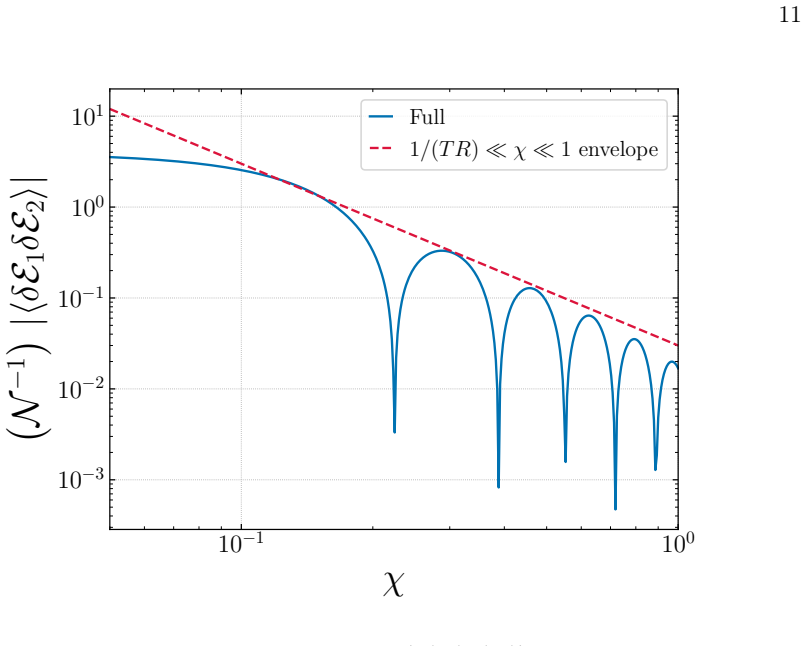
In the collinear limit the energy-energy correlator of hadrons from a boost-invariant Gubser hydrodynamic medium is dominated at the largest angles by a disconnected piece whose angular dependence is fixed analytically by the collective flow velocity field; at smaller angles the connected piece becomes important and the correlator is controlled by collective hydrodynamic modes whose angular behavior matches that found in heavy and large-charge states of conformal field theories.
What carries the argument
Energy-energy correlator angular distribution in the collinear limit, decomposed into disconnected contributions fixed by Gubser flow and connected contributions governed by collective hydrodynamic modes.
If this is right
- An explicit analytic formula for the angular dependence of the EEC arising from boost-invariant Gubser flow.
- Azimuthal perturbations to the flow produce measurable modulations in the EEC that can be used to constrain initial-state anisotropies.
- The intermediate-angle regime of the EEC is predicted to exhibit the same angular scaling previously identified in heavy and large-charge CFT states.
- A continuous crossover from the hydrodynamic-mode regime to the light-ray OPE structure occurs at still smaller angles before the correlator finally matches the dilute hadronic limit.
Where Pith is reading between the lines
- The same hydrodynamic-mode regime may appear in other high-multiplicity hadronic collisions if collective flow develops.
- Energy-energy correlators could serve as a new experimental handle on the shear viscosity and other transport coefficients of the quark-gluon plasma.
- The sequence of regimes provides a template for testing whether hydrodynamic descriptions remain valid down to the smallest resolved angles in current collider data.
Load-bearing premise
The assumption that at smaller angular separations the energy-energy correlator is controlled by collective hydrodynamic modes whose angular dependence matches the pattern seen in conformal field theory states.
What would settle it
A precision measurement of the angular shape of the energy-energy correlator in heavy-ion data that deviates from the analytic form derived for Gubser flow at the largest angles inside the collinear regime.
Figures



read the original abstract
We study energy-energy correlators (EECs) in many-body quantum states, focusing on the matter produced in the aftermath of heavy-ion collisions. We analyze the angular structure of EECs in the collinear limit and identify a sequence of dynamical regimes. At the largest angular separations within the small-angle regime, the observable is dominated by disconnected contributions, leading to a classical scaling determined by the collective flow of the medium. We explicitly construct this contribution for hadrons produced from a hydrodynamic medium described by boost-invariant Gubser flow, obtaining the angular dependence of the EEC analytically. We further consider azimuthal perturbations to this flow, illustrating how EECs can be used to probe anisotropies in the initial state. At smaller angular separations, connected contributions become increasingly important. We argue that in this regime the EEC is controlled by collective hydrodynamic modes. The resulting angular behavior is similar to the one identified in the EECs of heavy and large-charge states of conformal field theories. At even smaller angles, this regime is expected to match onto the structure determined by the light-ray operator product expansion, before eventually crossing over to the smallest-angle behavior characteristic of dilute hadronic matter. Altogether, these results provide a unified picture of the angular structure of EECs in many-body QCD states and suggest new observables sensitive to the properties of matter in heavy-ion collisions.
Editorial analysis
A structured set of objections, weighed in public.
Referee Report
Summary. The manuscript examines energy-energy correlators (EECs) in many-body states relevant to heavy-ion collisions. It identifies a sequence of dynamical regimes in the collinear limit: at large angles within the small-angle regime, disconnected contributions dominate with classical scaling from collective flow, explicitly constructed for boost-invariant Gubser hydrodynamic flow; at intermediate angles, connected contributions are argued to be controlled by collective hydrodynamic modes with angular scaling akin to that in conformal field theory heavy and large-charge states; at smaller angles, it transitions to light-ray OPE behavior before crossing to dilute hadronic matter. The work proposes EECs as new observables for probing matter properties in heavy-ion collisions, including sensitivity to initial-state anisotropies via azimuthal perturbations.
Significance. If the results hold, the paper offers a unified description of the angular structure of EECs in QCD many-body states and highlights their potential as probes for hydrodynamic properties and initial conditions in heavy-ion collisions. A notable strength is the analytic construction of the disconnected contribution for Gubser flow, which provides explicit angular dependence. This could open avenues for using EECs to study collective effects beyond traditional flow observables.
major comments (1)
- [Abstract and intermediate-regime discussion] The claim that at smaller angular separations the connected EEC is controlled by collective hydrodynamic modes whose angular behavior matches the CFT heavy/large-charge result is asserted by analogy rather than derived via explicit mode decomposition, linearization of the hydrodynamic equations around the Gubser background, or direct computation of the connected stress-tensor correlators. This is load-bearing for the central unified picture of three sequential regimes (Abstract).
Simulated Author's Rebuttal
We thank the referee for their careful reading and constructive comments on our manuscript. We appreciate the positive assessment of the work's significance, particularly the analytic construction for Gubser flow. We address the major comment below.
read point-by-point responses
-
Referee: [Abstract and intermediate-regime discussion] The claim that at smaller angular separations the connected EEC is controlled by collective hydrodynamic modes whose angular behavior matches the CFT heavy/large-charge result is asserted by analogy rather than derived via explicit mode decomposition, linearization of the hydrodynamic equations around the Gubser background, or direct computation of the connected stress-tensor correlators. This is load-bearing for the central unified picture of three sequential regimes (Abstract).
Authors: We agree that the intermediate-regime discussion relies on an argument by analogy rather than an explicit derivation. The manuscript already phrases this as 'We argue that in this regime the EEC is controlled by collective hydrodynamic modes. The resulting angular behavior is similar to the one identified in the EECs of heavy and large-charge states of conformal field theories,' reflecting that both the heavy-ion hydrodynamic medium and CFT heavy/large-charge states are governed by the same long-wavelength hydrodynamic effective theory, yielding comparable angular scaling from collective modes. We do not perform mode decomposition or linearization around the Gubser background in this work, as the focus is on the explicit disconnected contribution and identifying the overall sequence of regimes. We acknowledge that a direct computation would strengthen the claim and will revise the abstract and relevant sections to emphasize more clearly that this part of the unified picture is supported by scaling arguments and analogy to known hydrodynamic and CFT results, rather than a complete derivation. We will also note the value of future explicit calculations in this direction. revision: partial
Circularity Check
No significant circularity; explicit constructions and arguments by analogy remain independent of target results
full rationale
The paper explicitly constructs the disconnected large-angle EEC contribution from boost-invariant Gubser hydrodynamic flow and derives its angular dependence analytically without reference to the EEC data itself. The intermediate-angle regime is introduced via an argument that the connected piece is controlled by collective modes whose scaling resembles prior CFT results, rather than through a fitted parameter, self-definition, or derivation that reduces to the observable by construction. No load-bearing self-citations, uniqueness theorems imported from the authors' prior work, or ansatze smuggled via citation are required for the central claims. The overall sequence of regimes combines established hydrodynamic models with reasoned extensions and is therefore self-contained against external benchmarks.
Axiom & Free-Parameter Ledger
axioms (1)
- domain assumption The medium produced in heavy-ion collisions can be described by boost-invariant Gubser flow for constructing the disconnected contribution
Reference graph
Works this paper leans on
-
[1]
Heavy Ion Collisions: The Big Picture, and the Big Questions
W. Busza, K. Rajagopal and W. van der Schee,Heavy Ion Collisions: The Big Picture, and the Big Questions,Ann. Rev. Nucl. Part. Sci.68(2018) 339 [arXiv:1802.04801 [hep-ph]]
work page Pith review arXiv 2018
-
[2]
Arslandoket al., Hot QCD White Paper, (2023), arXiv:2303.17254 [nucl-ex]
M. Arslandoket. al.,Hot QCD White Paper,arXiv:2303.17254 [nucl-ex]
-
[3]
C. Shen and L. Yan,Recent development of hydrodynamic modeling in heavy-ion collisions,Nucl. Sci. Tech.31(10, 2020) 122 [arXiv:2010.12377 [nucl-th]]
-
[4]
Hydrodynamic Description of the Quark-Gluon Plasma
U. Heinz and B. Schenke 12, 2024.arXiv:2412.19393 [nucl-th]
-
[5]
QCD thermalization: Ab initio approaches and interdisciplinary connections
J. Berges, M. P. Heller, A. Mazeliauskas and R. Venugopalan,QCD thermalization: Ab initio approaches and interdisciplinary connections,Rev. Mod. Phys.93(2021) no. 3 035003 [arXiv:2005.12299 [hep-th]]
- [6]
- [7]
- [8]
-
[9]
I. Moult and H. X. Zhu,Energy Correlators: A Journey From Theory to Experiment, arXiv:2506.09119 [hep-ph]
-
[10]
C. L. Basham, L. S. Brown, S. D. Ellis and S. T. Love,Energy Correlations in electron - Positron Annihilation: Testing QCD,Phys. Rev. Lett.41(1978) 1585
1978
-
[11]
C. L. Basham, L. S. Brown, S. D. Ellis and S. T. Love,Energy Correlations in Perturbative Quantum Chromodynamics: A Conjecture for All Orders,Phys. Lett. B85 (1979) 297. 25
1979
- [12]
- [13]
- [14]
-
[15]
H. Chen, M.-X. Luo, I. Moult, T.-Z. Yang, X. Zhang and H. X. Zhu,Three point energy correlators in the collinear limit: symmetries, dualities and analytic results,JHEP08 (2020) no. 08 028 [arXiv:1912.11050 [hep-ph]]
- [16]
-
[17]
J. Holguin, I. Moult, A. Pathak and M. Procura,New paradigm for precision top physics: Weighing the top with energy correlators,Phys. Rev. D107(2023) no. 11 114002 [arXiv:2201.08393 [hep-ph]]
-
[18]
K. Devereaux, W. Fan, W. Ke, K. Lee and I. Moult,Probing cold nuclear matter with energy correlators,Phys. Rev. C112(2025) no. 3 035202 [arXiv:2303.08143 [hep-ph]]
- [19]
- [20]
-
[21]
D. Chicherin, I. Moult, E. Sokatchev, K. Yan and Y. Zhu,Collinear limit of the four-point energy correlator in N=4 supersymmetric Yang-Mills theory,Phys. Rev. D 110(2024) no. 9 L091901 [arXiv:2401.06463 [hep-th]]
-
[22]
Chen,QCD factorization from light-ray OPE,JHEP01(2024) 035 [arXiv:2311.00350 [hep-ph]]
H. Chen,QCD factorization from light-ray OPE,JHEP01(2024) 035 [arXiv:2311.00350 [hep-ph]]
- [23]
- [24]
-
[25]
K.-B. Chen, J.-P. Ma and X.-B. Tong,The connection between nucleon energy correlators and fracture functions,JHEP08(2024) 227 [arXiv:2406.08559 [hep-ph]]
- [26]
- [27]
-
[28]
A. Budhraja, H. Chen and W. J. Waalewijn,ν-point energy correletors with FastEEC: Small-x physics from LHC jets,Phys. Lett. B861(2025) 139239 [arXiv:2409.12235 [hep-ph]]. 26
- [29]
-
[30]
S. Alipour-fard, A. Budhraja, J. Thaler and W. J. Waalewijn,New Angles on Energy Correlators,arXiv:2410.16368 [hep-ph]
-
[31]
J. Barata, Z.-B. Kang, X. Mayo López and J. Penttala,Energy-Energy Correlator for jet production inppandpAcollisions,arXiv:2411.11782 [hep-ph]
-
[32]
H. Mäntysaari, Y. Tawabutr and X.-B. Tong,Nucleon energy correlators for the odderon, Phys. Rev. D112(2025) no. 11 114027 [arXiv:2503.20157 [hep-ph]]
-
[33]
S. Alipour-fard and W. J. Waalewijn,Energy correlators beyond angles,JHEP07(2025) 043 [arXiv:2501.17218 [hep-ph]]
- [34]
- [35]
- [36]
- [37]
- [38]
-
[39]
A. Budhraja, I. Pels and W. J. Waalewijn,Higher-point Energy Correlators: Factorization in the Back-to-Back Limit & Non-perturbative Effects,arXiv:2603.16996 [hep-ph]
-
[40]
M. Riembau and M. Son,Flow between Extremal One-Point Energy Correlators in QCD, Phys. Rev. Lett.136(2026) no. 10 101901 [arXiv:2509.02669 [hep-ph]]
-
[41]
M. Riembau and M. Son,Energy Correlators of Spinning Sources,arXiv:2512.16985 [hep-ph]
- [42]
- [43]
-
[44]
J. Holguin, I. Moult, A. Pathak, M. Procura and S. Sule,High precision heavy-boson-jet substructure with energy correlators,arXiv:2601.20923 [hep-ph]
-
[45]
M. Jaarsma, Y. Li, I. Moult, W. J. Waalewijn and H. X. Zhu,From DGLAP to Sudakov: Precision Predictions for Energy-Energy Correlators,arXiv:2512.11950 [hep-ph]
- [46]
-
[47]
M. Jaarsma, Y. Li, I. Moult, W. J. Waalewijn and H. X. Zhu,Energy correlators on tracks: resummation and non-perturbative effects,JHEP12(2023) 087 [arXiv:2307.15739 [hep-ph]]
-
[48]
W. Chen, J. Gao, Y. Li, Z. Xu, X. Zhang and H. X. Zhu,NNLL resummation for projected three-point energy correlator,JHEP05(2024) 043 [arXiv:2307.07510 [hep-ph]]. [49]Electron-Positron Alliancecollaboration, H. Bossiet. al.,Energy Correlators from Partons to Hadrons: Unveiling the Dynamics of the Strong Interactions with Archival ALEPH Data,arXiv:2511.00149...
-
[49]
Operator structure of power corrections and anomalous scaling in energy correlators
H. Chen and Y. Li,Operator structure of power corrections and anomalous scaling in energy correlators,arXiv:2604.11967 [hep-ph]
work page internal anchor Pith review Pith/arXiv arXiv
-
[50]
D. Chicherin, G. P. Korchemsky, E. Sokatchev and A. Zhiboedov,Energy correlations in heavy states,JHEP11(2023) 134 [arXiv:2306.14330 [hep-th]]
- [51]
-
[52]
J. M. Deutsch,Quantum statistical mechanics in a closed system,Phys. Rev. A43 (1991) no. 4 2046
1991
-
[53]
Srednicki,Chaos and Quantum Thermalization,Phys
M. Srednicki,Chaos and Quantum Thermalization,Phys. Rev. E50(3, 1994) [arXiv:cond-mat/9403051]
-
[54]
J. M. Deutsch,Eigenstate thermalization hypothesis,Rept. Prog. Phys.81(2018) no. 8 082001 [arXiv:1805.01616 [quant-ph]]
work page Pith review arXiv 2018
- [55]
- [56]
-
[57]
A. Krasnitz and R. Venugopalan,Nonperturbative computation of gluon minijet production in nuclear collisions at very high-energies,Nucl. Phys. B557(1999) 237 [arXiv:hep-ph/9809433]
- [58]
- [59]
- [60]
- [61]
-
[62]
B. Singh and V. Vaidya,Factorization for energy-energy correlator in heavy ion collision, arXiv:2408.02753 [hep-ph]
- [63]
- [64]
- [65]
- [66]
-
[67]
L. Apolinário, R. Kunnawalkam Elayavalli, N. O. Madureira, J.-X. Sheng, X.-N. Wang and Z. Yang,Flavor dependence of Energy-energy correlators,arXiv:2502.11406 [hep-ph]
- [68]
- [69]
-
[70]
A. Budhraja and B. Singh,Exploitingν-dependence of projected energy correlators in HICs,arXiv:2503.20019 [hep-ph]
-
[71]
L. Apolinário, D. Costa and A. Soto-Ontoso,Bottom-up approach to describe groomed jet data in heavy-ion collisions,arXiv:2601.13310 [hep-ph]
- [72]
- [73]
-
[74]
J. Casalderrey-Solana, D. Gulhan, G. Milhano, D. Pablos and K. Rajagopal,Angular Structure of Jet Quenching Within a Hybrid Strong/Weak Coupling Model,JHEP03 (2017) 135 [arXiv:1609.05842 [hep-ph]]
-
[75]
J. Casalderrey-Solana, D. C. Gulhan, J. G. Milhano, D. Pablos and K. Rajagopal,A Hybrid Strong/Weak Coupling Approach to Jet Quenching,JHEP10(2014) 019 [arXiv:1405.3864 [hep-ph]]. [Erratum: JHEP 09, 175 (2015)]. 29
- [76]
- [77]
- [78]
- [79]
- [80]
discussion (0)
Sign in with ORCID, Apple, or X to comment. Anyone can read and Pith papers without signing in.