Recognition: unknown
Cosmic-Ray Signatures of Annihilating and Semi-Annihilating Dark Matter via One-Step Cascades
Pith reviewed 2026-05-09 20:54 UTC · model grok-4.3
The pith
Dark matter models including semi-annihilation produce distinctive cosmic-ray signals
A machine-rendered reading of the paper's core claim, the machinery that carries it, and where it could break.
Core claim
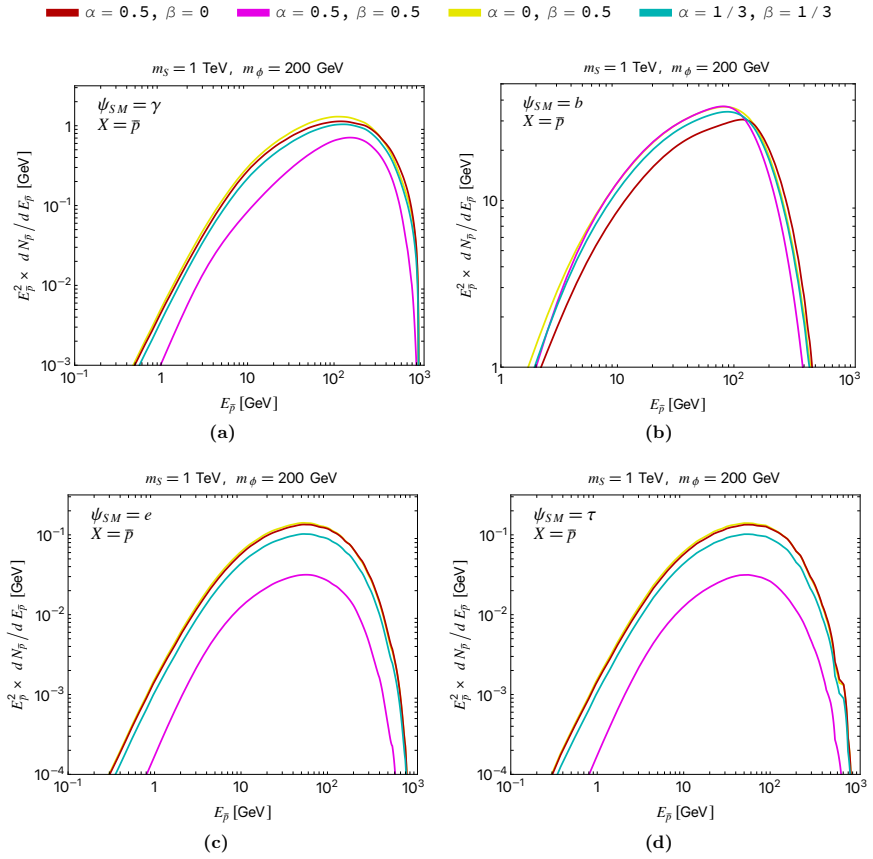
We present a framework in which three classes of dark matter number-changing processes affect both the relic abundance via thermal freeze-out and the generation of indirect cosmic-ray signals today, with semi-annihilation included systematically alongside annihilations. For benchmarks of mediator decays, the injection spectra vary with the relative importance of the processes, and this is applied to gamma-ray fluxes from dwarf spheroidal galaxies, with explicit models showing the interplay.
What carries the argument
Systematic inclusion of semi-annihilation processes with a dark matter particle and metastable mediator in the final state, in addition to direct annihilations and annihilations into mediators.
If this is right
- The injection spectra for gamma rays, neutrinos, and cosmic-ray antimatter depend on the mix of the three processes.
- Observable gamma-ray fluxes from dwarf spheroidal galaxies vary accordingly in the GeV-TeV range.
- Explicit model realizations illustrate how multiple processes together determine the signatures.
- A consistent link is established between early-universe dynamics and present-day observables.
Where Pith is reading between the lines
- Observers could use spectral shapes to infer the presence of semi-annihilation in addition to standard annihilation.
- The framework suggests searching for signals that only appear when semi-annihilation contributes significantly.
- It may help explain why some models fit data better when mixed processes are allowed.
Load-bearing premise
The setup assumes the presence of these processes with unsuppressed s-wave contributions and treats their relative importance as free parameters that can be varied independently.
What would settle it
Precise measurements of gamma-ray fluxes from dwarf galaxies that fail to match any combination of the predicted spectra for varying process weights would falsify the applicability of this framework.
Figures








read the original abstract
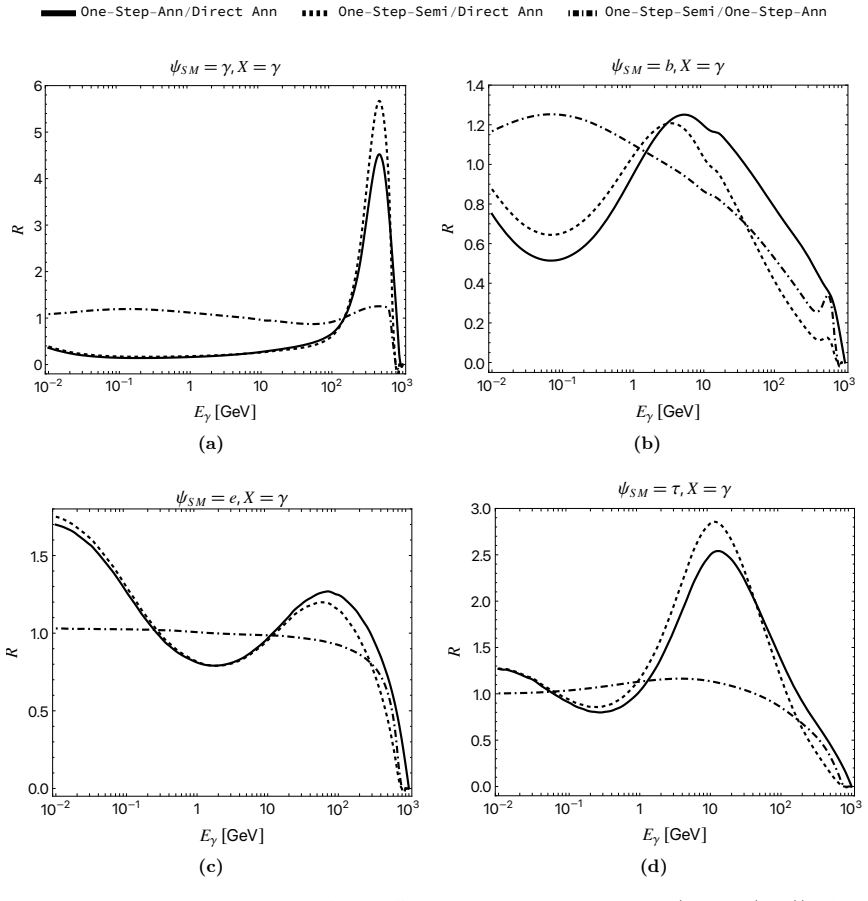
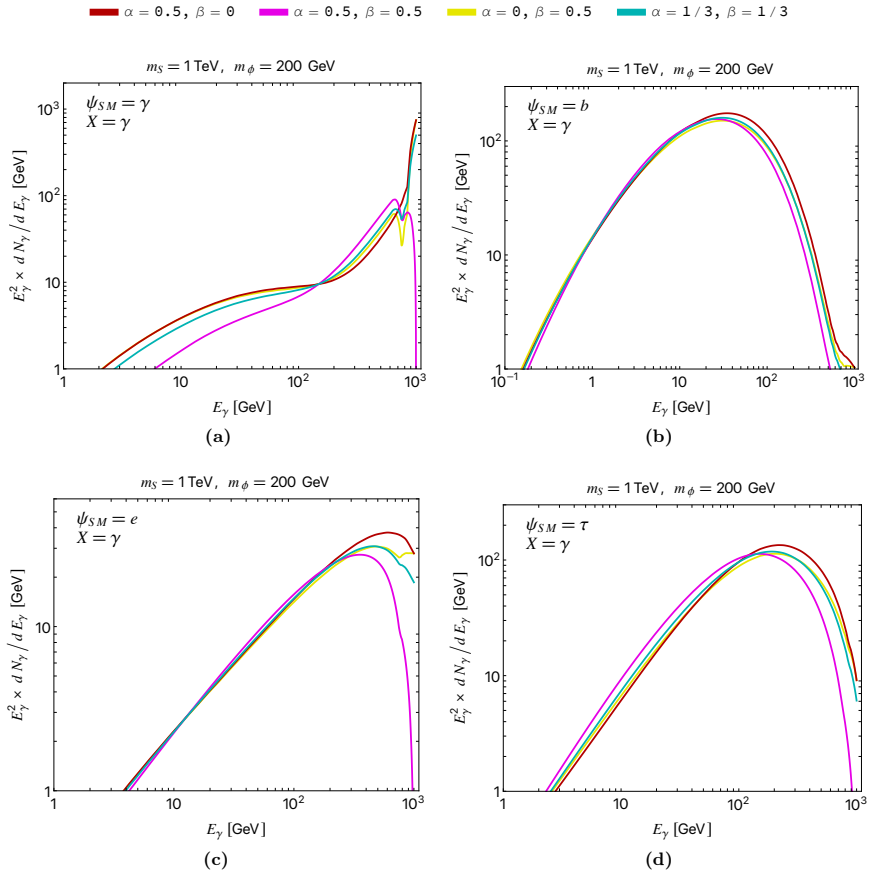
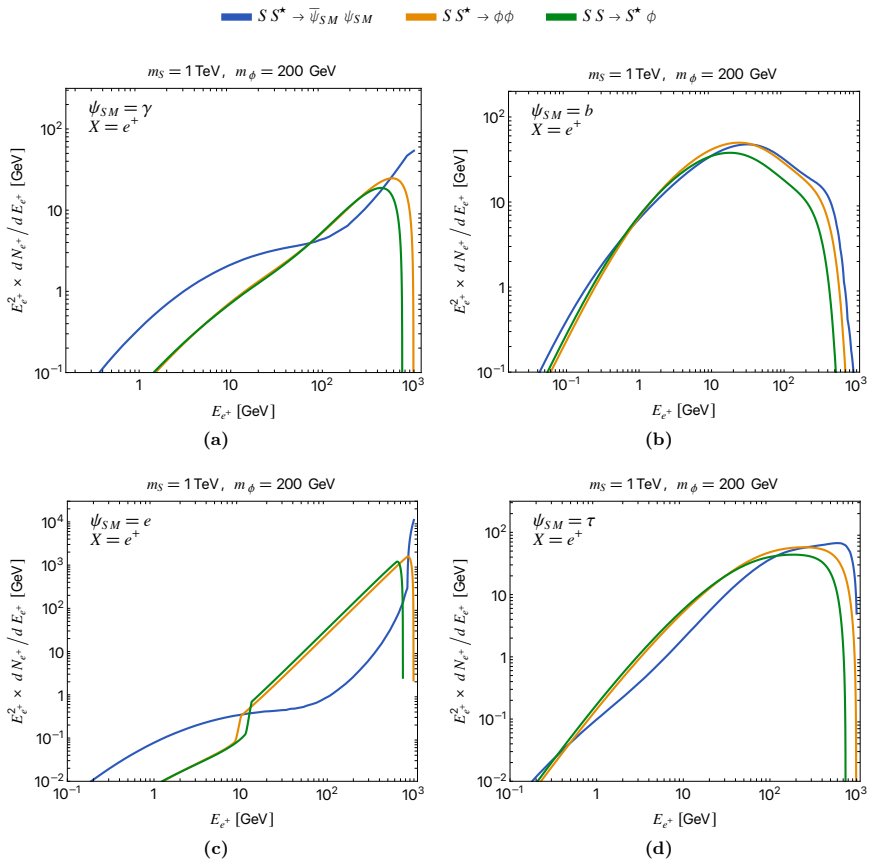
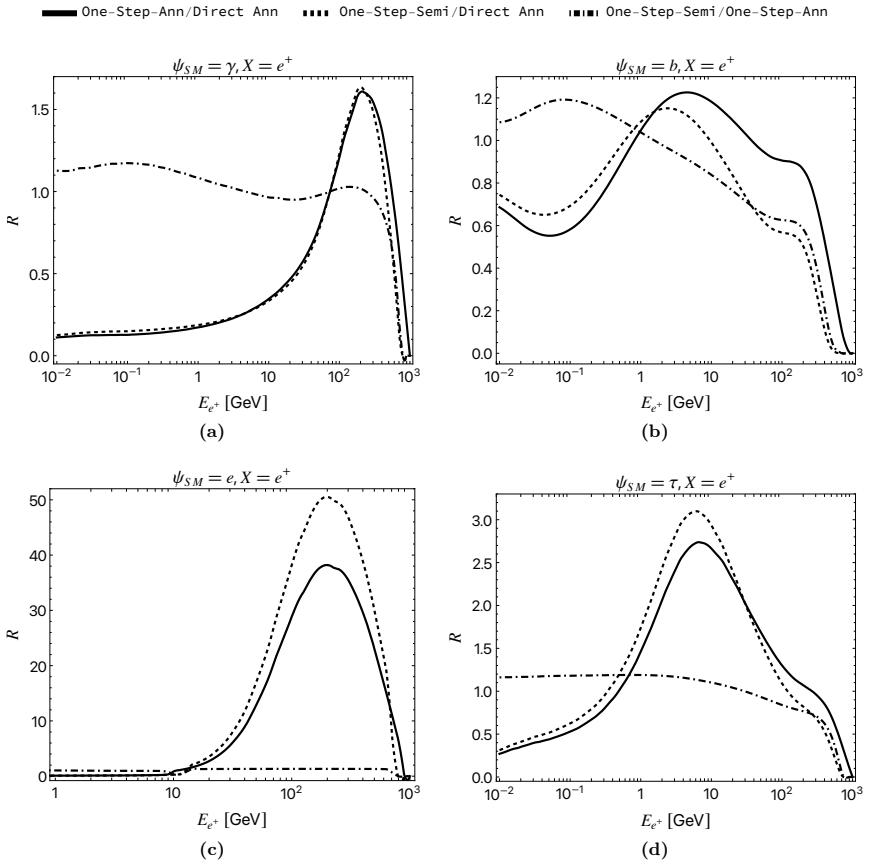
We present a framework in which three classes of dark matter number-changing processes can affect both the relic abundance via thermal freeze-out in the early universe and the generation of indirect cosmic-ray signals today. These processes are: (i) direct annihilations into Standard Model final states; (ii) annihilations into metastable on-shell mediators that subsequently decay into Standard Model particles; (iii) semi-annihilation processes featuring a dark matter particle in the final state, accompanied by a metastable mediator. A central element of our analysis is the systematic inclusion of semi-annihilation alongside the more commonly considered channels. This setup is largely model-independent, as we only assume the presence of one or more of these processes with unsuppressed $s$-wave contributions. We analyze representative benchmarks for the dominant decay modes of the mediator and show how the resulting injection spectra for $\gamma$ rays, neutrinos, and cosmic-ray antimatter vary with the relative importance of the three classes of processes. As an application, we evaluate the observable $\gamma$-ray fluxes from dwarf spheroidal galaxies in the GeV-TeV window. Finally, we provide explicit model realizations in which multiple processes coexist, and discuss how their interplay shapes indirect detection signatures. Our results provide a consistent connection between early-universe dynamics and present-day observables, revealing distinctive features that arise when multiple dark matter processes contribute simultaneously.
Editorial analysis
A structured set of objections, weighed in public.
Referee Report
Summary. The manuscript presents a largely model-independent framework in which three classes of dark matter number-changing processes—direct annihilation to SM states, annihilation to on-shell metastable mediators that decay to SM particles, and semi-annihilation (with a DM particle in the final state plus mediator)—simultaneously determine the thermal relic abundance via freeze-out and generate present-day injection spectra for gamma rays, neutrinos, and antimatter through one-step cascades. Representative benchmarks are analyzed for different mediator decay modes, gamma-ray fluxes from dwarf spheroidals are computed in the GeV-TeV range, and explicit UV-complete models are constructed in which the three channels coexist with calculable relative strengths.
Significance. If the central mapping holds, the work supplies a practical bridge between early-universe dynamics and indirect-detection observables, with the systematic inclusion of semi-annihilation and the demonstration of distinctive multi-channel spectral features offering a useful tool for interpreting cosmic-ray data. The provision of explicit UV realizations and benchmark spectra adds concrete value for model-building and data analysis in dark-matter phenomenology.
major comments (2)
- [Boltzmann equation section] § on the Boltzmann equation and effective cross section: the relic-density calculation must incorporate the semi-annihilation term (which does not deplete the DM number density in the same way as pure annihilation); the manuscript should explicitly display the modified Boltzmann equation and confirm that the same s-wave rates used for freeze-out are directly propagated to the injection spectra without additional assumptions.
- [Benchmarks section] Benchmarks and spectra section: the relative weights of the three process classes are varied as independent free parameters; while this is stated as model-independent, the paper must show that these variations remain compatible with the observed relic density for each benchmark point, or clarify whether the relic-density constraint is imposed after the fact.
minor comments (2)
- [Notation] Notation for the mediator decay branching ratios should be defined once in a dedicated table or equation block rather than repeated inline.
- [Application to dwarfs] The dwarf-galaxy flux plots would benefit from an overlay of current experimental limits (e.g., Fermi-LAT or CTA) to make the phenomenological impact immediate.
Simulated Author's Rebuttal
We thank the referee for the careful reading of our manuscript and the positive recommendation for minor revision. We address each major comment below and have incorporated the requested clarifications and additions into the revised version.
read point-by-point responses
-
Referee: [Boltzmann equation section] § on the Boltzmann equation and effective cross section: the relic-density calculation must incorporate the semi-annihilation term (which does not deplete the DM number density in the same way as pure annihilation); the manuscript should explicitly display the modified Boltzmann equation and confirm that the same s-wave rates used for freeze-out are directly propagated to the injection spectra without additional assumptions.
Authors: We agree that an explicit display of the Boltzmann equation is helpful. In the revised manuscript we now present the full form of the equation governing the DM number density, which includes the semi-annihilation term (proportional to the DM density squared but not depleting the total DM number in the same way as annihilation). We explicitly confirm that the s-wave rates entering the freeze-out calculation are identical to those used for the present-day injection spectra, with no additional assumptions beyond the model-independent framework of the paper. revision: yes
-
Referee: [Benchmarks section] Benchmarks and spectra section: the relative weights of the three process classes are varied as independent free parameters; while this is stated as model-independent, the paper must show that these variations remain compatible with the observed relic density for each benchmark point, or clarify whether the relic-density constraint is imposed after the fact.
Authors: We have clarified this point in the revised manuscript. The relative weights of the three process classes are indeed treated as free parameters within the model-independent setup, but for each benchmark the overall normalization is fixed by solving the Boltzmann equation so that the observed relic density is reproduced. We have added a short paragraph and an accompanying table that explicitly lists the effective cross-section scale required for each benchmark to match the Planck value, confirming that all points remain compatible with thermal freeze-out. revision: yes
Circularity Check
No significant circularity identified
full rationale
The paper defines a phenomenological framework in which the relative rates of three DM processes (direct annihilation, mediator annihilation, semi-annihilation) are introduced as independent free parameters with unsuppressed s-wave contributions. These parameters enter the Boltzmann equation for the relic abundance and are then reused to compute injection spectra for gamma rays, neutrinos, and antimatter. This is an explicit parametric mapping rather than a derivation that reduces to its own inputs. No self-definitional relations, fitted quantities presented as predictions, load-bearing self-citations, or smuggled ansatze appear. Explicit UV model realizations are provided as illustrations, not as the source of the central results. The analysis is self-contained against external benchmarks and does not exhibit any of the enumerated circularity patterns.
Axiom & Free-Parameter Ledger
free parameters (1)
- relative importance of the three process classes
axioms (2)
- domain assumption Unsuppressed s-wave contributions for the processes
- standard math Standard thermal freeze-out in the early universe
invented entities (1)
-
metastable on-shell mediator
no independent evidence
Reference graph
Works this paper leans on
-
[1]
Particle Dark Matter: Evidence, Candidates and Constraints
G. Bertone, D. Hooper and J. Silk,Particle dark matter: Evidence, candidates and constraints,Phys. Rept.405(2005) 279 [hep-ph/0404175]
work page Pith review arXiv 2005
-
[2]
Feng,Dark Matter Candidates from Particle Physics and Methods of Detection,Ann
J.L. Feng,Dark Matter Candidates from Particle Physics and Methods of Detection,Ann. Rev. Astron. Astrophys.48(2010) 495 [1003.0904]
-
[3]
M. Cirelli, A. Strumia and J. Zupan,Dark Matter,2406.01705
work page internal anchor Pith review arXiv
-
[4]
N. Bozorgnia, J. Bramante, J.M. Cline, D. Curtin, D. McKeen, D.E. Morrissey et al.,Dark matter candidates and searches,Can. J. Phys.103(2025) 671 [2410.23454]
-
[5]
Lee and S
B.W. Lee and S. Weinberg,Cosmological Lower Bound on Heavy Neutrino Masses,Phys. Rev. Lett.39(1977) 165
1977
-
[6]
Gondolo and G
P. Gondolo and G. Gelmini,Cosmic abundances of stable particles: Improved analysis,Nucl. Phys. B360(1991) 145
1991
-
[7]
M. Cirelli, N. Fornengo and A. Strumia,Minimal dark matter,Nucl. Phys. B753(2006) 178 [hep-ph/0512090]. [8]Planckcollaboration,Planck 2018 results. VI. Cosmological parameters,Astron. Astrophys. 641(2020) A6 [1807.06209]
-
[8]
Goldberg,Constraint on the Photino Mass from Cosmology,Phys
H. Goldberg,Constraint on the Photino Mass from Cosmology,Phys. Rev. Lett.50(1983) 1419
1983
-
[9]
Ellis, J.S
J.R. Ellis, J.S. Hagelin, D.V. Nanopoulos, K.A. Olive and M. Srednicki,Supersymmetric Relics from the Big Bang,Nucl. Phys. B238(1984) 453
1984
-
[10]
Scherrer and M.S
R.J. Scherrer and M.S. Turner,On the Relic, Cosmic Abundance of Stable Weakly Interacting Massive Particles,Phys. Rev. D33(1986) 1585. – 50 –
1986
-
[11]
Srednicki, R
M. Srednicki, R. Watkins and K.A. Olive,Calculations of Relic Densities in the Early Universe,Nucl. Phys. B310(1988) 693
1988
-
[12]
M. Di Mauro and Y. Wang,WIMP Shadows: Phenomenology of Secluded Dark Matter in Three Minimal BSM Scenarios,2510.23771
-
[13]
D. Hooper, R.K. Leane, Y.-D. Tsai, S. Wegsman and S.J. Witte,A systematic study of hidden sector dark matter:application to the gamma-ray and antiproton excesses,JHEP07(2020) 163 [1912.08821]
- [14]
- [15]
- [16]
- [17]
- [18]
-
[19]
L. Bergström, G. Bertone, T. Bringmann, J. Edsjö and M. Taoso,Gamma-ray and Radio Constraints of High Positron Rate Dark Matter Models Annihilating into New Light Particles, Phys. Rev. D79(2009) 081303 [0812.3895]
- [20]
- [21]
-
[22]
Hambye,Hidden vector dark matter,JHEP01(2009) 028 [0811.0172]
T. Hambye,Hidden vector dark matter,JHEP01(2009) 028 [0811.0172]
-
[23]
Confined hidden vector dark matter
T. Hambye and M.H.G. Tytgat,Confined hidden vector dark matter,Phys. Lett. B683 (2010) 39 [0907.1007]
work page Pith review arXiv 2010
- [24]
-
[25]
F. D’Eramo and J. Thaler,Semi-annihilation of Dark Matter,JHEP06(2010) 109 [1003.5912]
-
[26]
F. D’Eramo, M. McCullough and J. Thaler,Multiple Gamma Lines from Semi-Annihilation, JCAP04(2013) 030 [1210.7817]
-
[27]
Queiroz and C
F.S. Queiroz and C. Siqueira,Search for semi-annihilating dark matter with fermi-lat, h.e.s.s., planck, and the cherenkov telescope array,Journal of Cosmology and Astroparticle Physics 2019(2019) 048–048
2019
- [28]
- [29]
-
[30]
G. Arcadi, F.S. Queiroz and C. Siqueira,The Semi-Hooperon: Gamma-ray and anti-proton excesses in the Galactic Center,Phys. Lett. B775(2017) 196 [1706.02336]. – 51 –
-
[31]
J. Bernstein,KINETIC THEORY IN THE EXPANDING UNIVERSE, Cambridge Monographs on Mathematical Physics, Cambridge University Press, Cambridge, U.K. (1988), 10.1017/CBO9780511564185
-
[32]
G. Jungman, M. Kamionkowski and K. Griest,Supersymmetric dark matter,Phys. Rept.267 (1996) 195 [hep-ph/9506380]
-
[33]
F. D’Eramo, N. Fernandez and S. Profumo,Dark Matter Freeze-in Production in Fast-Expanding Universes,JCAP02(2018) 046 [1712.07453]
-
[34]
F. D’Eramo and T. Sassi,Axion portal to scalar Dark Matter: unveiling stabilizing symmetry footprints,JHEP07(2025) 031 [2502.19491]
-
[35]
F. D’Eramo and A. Lenoci,Lower mass bounds on FIMP dark matter produced via freeze-in, JCAP10(2021) 045 [2012.01446]. [37]Particle Data Groupcollaboration,Review of particle physics,Phys. Rev. D110(2024) 030001
- [36]
- [37]
- [38]
-
[39]
G.F. Giudice, D. Kim, J.-C. Park and S. Shin,Inelastic Boosted Dark Matter at Direct Detection Experiments,Phys. Lett. B780(2018) 543 [1712.07126]
-
[40]
M. Cirelli, G. Corcella, A. Hektor, G. Hutsi, M. Kadastik, P. Panci et al.,PPPC 4 DM ID: A Poor Particle Physicist Cookbook for Dark Matter Indirect Detection,JCAP03(2011) 051 [1012.4515]
- [41]
- [42]
-
[43]
The Large Area Telescope on the Fermi Gamma-ray Space Telescope Mission
W.B. Atwood, A.A. Abdo, M. Ackermann, W. Althouse, B. Anderson et al.,The Large Area Telescope on the Fermi Gamma-Ray Space Telescope Mission,Astrophys. J.697(2009) 1071 [0902.1089]
work page Pith review arXiv 2009
-
[44]
A. McDaniel, M. Ajello, C.M. Karwin, M. Di Mauro, A. Drlica-Wagner and M.A. Sánchez-Conde,Legacy analysis of dark matter annihilation from the Milky Way dwarf spheroidal galaxies with 14 years of Fermi-LAT data,Phys. Rev. D109(2024) 063024 [2311.04982]. [47]H.E.S.S.collaboration,The Status of the H.E.S.S. project,New Astron. Rev.48(2004) 331 [astro-ph/040...
- [45]
-
[46]
B. Díaz Sáez, P. Escalona, S. Norero and A.R. Zerwekh,Fermion singlet dark matter in a pseudoscalar dark matter portal,JHEP10(2021) 233 [2105.04255]
-
[47]
P. De La Torre Luque, J. Smirnov and T. Linden,Gamma-ray lines in 15 years of Fermi-LAT data: New constraints on Higgs portal dark matter,Phys. Rev. D109(2024) L041301 [2309.03281]. [54]CTAOcollaboration,Dark matter line searches with the Cherenkov Telescope Array,JCAP 07(2024) 047 [2403.04857]
- [48]
-
[49]
S. Profumo, F.S. Queiroz, J. Silk and C. Siqueira,Searching for Secluded Dark Matter with H.E.S.S., Fermi-LAT, and Planck,JCAP03(2018) 010 [1711.03133]
- [50]
-
[51]
C.A. Argüelles, A. Diaz, A. Kheirandish, A. Olivares-Del-Campo, I. Safa and A.C. Vincent, Dark matter annihilation to neutrinos,Rev. Mod. Phys.93(2021) 035007 [1912.09486]
-
[52]
S. Kanemura, S.-P. Li and D. Nanda,Bounds and detection of MeV-scale dark matter annihilation to neutrinos,Phys. Rev. D112(2025) L031702 [2506.04568]. [60]ANTAREScollaboration,Limits on Dark Matter Annihilation in the Sun using the ANTARES Neutrino Telescope,Phys. Lett. B759(2016) 69 [1603.02228]. [61]ANTAREScollaboration,Search for dark matter towards th...
- [53]
-
[54]
V.V. Mikhailov et al.,Galactic Cosmic Ray Electrons and Positrons over a Decade of Observations in the PAMELA Experiment,Bull. Russ. Acad. Sci. Phys.83(2019) 974. [69]H.E.S.S.collaboration,High-Statistics Measurement of the Cosmic-Ray Electron Spectrum with H.E.S.S.,Phys. Rev. Lett.133(2024) 221001 [2411.08189]. [70]AMScollaboration,Towards Understanding ...
-
[55]
Chang et al.,An excess of cosmic ray electrons at energies of 300-800 GeV,Nature456 (2008) 362
J. Chang et al.,An excess of cosmic ray electrons at energies of 300-800 GeV,Nature456 (2008) 362
2008
- [56]
-
[57]
S. Manconi, M. Di Mauro and F. Donato,Contribution of pulsars to cosmic-ray positrons in light of recent observation of inverse-Compton halos,Phys. Rev. D102(2020) 023015 [2001.09985]
- [58]
- [59]
- [60]
-
[61]
M. Aguilar et al.,The Alpha Magnetic Spectrometer (AMS) on the international space station: Part II - Results from the first seven years,Phys. Rep.894(2021) 1. [80]PAMELAcollaboration,PAMELA results on the cosmic-ray antiproton flux from 60 MeV to 180 GeV in kinetic energy,Phys. Rev. Lett.105(2010) 121101 [1007.0821]
-
[62]
M. Boudaud, Y. Génolini, L. Derome, J. Lavalle, D. Maurin, P. Salati et al.,AMS-02 antiprotons’ consistency with a secondary astrophysical origin,Phys. Rev. Res.2(2020) 023022 [1906.07119]
- [63]
- [64]
- [65]
-
[66]
Antideuterons as a Signature of Supersymmetric Dark Matter
F. Donato, N. Fornengo and P. Salati,Anti-deuterons as a signature of supersymmetric dark matter,Phys. Rev. D62(2000) 043003 [hep-ph/9904481]
work page Pith review arXiv 2000
-
[67]
L. Šerkšnyt˙ e et al.,Reevaluation of the cosmic antideuteron flux from cosmic-ray interactions and from exotic sources,Phys. Rev. D105(2022) 083021 [2201.00925]. [87]AMScollaboration,Properties of Cosmic Deuterons Measured by the Alpha Magnetic Spectrometer,Phys. Rev. Lett.132(2024) 261001. [88]BESScollaboration,Search for Antideuterons of Cosmic Origin ...
-
[68]
M. Di Mauro, N. Fornengo, A. Jueid, R.R. de Austri and F. Bellini,Nailing Down the Theoretical Uncertainties of D¯Spectrum Produced from Dark Matter,Phys. Rev. Lett.135 (2025) 131002 [2411.04815]
-
[69]
M. Di Mauro, A. Jueid, J. Koechler and R.R. de Austri,Robust determination of antinuclei production from dark matter via weakly decaying beauty hadrons,Phys. Rev. D112(2025) 083017 [2504.07172]
- [70]
-
[71]
S. Schael et al.,AMS-100: The next generation magnetic spectrometer in space – An international science platform for physics and astrophysics at Lagrange point 2,Nucl. Instrum. Meth. A944(2019) 162561 [1907.04168]. [94]CTAOcollaboration,Prospects for dark matter observations in dwarf spheroidal galaxies with the Cherenkov Telescope Array Observatory,2508.19120
-
[72]
A.B. Pace and L.E. Strigari,Scaling Relations for Dark Matter Annihilation and Decay Profiles in Dwarf Spheroidal Galaxies,Mon. Not. Roy. Astron. Soc.482(2019) 3480 [1802.06811]
- [73]
-
[74]
N. Hiroshima, M. Hayashida and K. Kohri,Dependence of accessible dark matter annihilation cross-sections on the density profiles of dwarf spheroidal galaxies with the Cherenkov Telescope Array,Phys. Rev. D99(2019) 123017 [1905.12940]
- [75]
- [76]
-
[77]
T. Hambye, M.H.G. Tytgat, J. Vandecasteele and L. Vanderheyden,Dark matter from dark photons: a taxonomy of dark matter production,Phys. Rev. D100(2019) 095018 [1908.09864]
-
[78]
H. Beauchesne and C.-W. Chiang,Dark matter semi-annihilation for inert scalar multiplets, JHEP06(2024) 164 [2403.01729]
-
[79]
H. Beauchesne and C.-W. Chiang,Indirect detection constraints on semi-annihilation of inert scalar multiplets,2407.01096. – 55 –
discussion (0)
Sign in with ORCID, Apple, or X to comment. Anyone can read and Pith papers without signing in.