Recognition: unknown
An Extended Parametric Model for Self-interacting Dark Matter Halos
Pith reviewed 2026-05-09 20:33 UTC · model grok-4.3
The pith
An extended parametric model for SIDM halos incorporates mass accretion to reduce overpredictions of V_max at z=0.
A machine-rendered reading of the paper's core claim, the machinery that carries it, and where it could break.
Core claim
We improve upon the parametric model for the evolution of the density profiles of self-interacting dark matter (SIDM) halos introduced in Yang et al. (2024b), by considering the effects of mass accretion on a SIDM halo's gravothermal evolution. The original parametric model accurately predicts parameters V_max and R_max, but with a tendency to overpredict V_max at z=0 for a subset of field halos. This discrepancy results from the parametric model predicting a faster rate of gravothermal evolution for these field halos compared to that measured in cosmological zoom-in simulations. We propose that the effects of mass accretion on the evolution of SIDM halos are not fully captured by the orignl
What carries the argument
The assumption that smooth mass accretion delays core-collapse by driving the SIDM halo density profile back toward a Navarro-Frenk-White (NFW) shape.
If this is right
- The model yields smaller residuals in V_max for field halos at z=0 while retaining analytic simplicity.
- Predicted halo density profiles remain close to those measured in simulations across a broader range of accretion rates.
- The framework can be inserted into semi-analytic galaxy-formation codes without requiring full N-body runs for each halo.
- Core-collapse timescales become longer for halos that continue to accrete mass, altering the expected abundance of dense SIDM cores today.
Where Pith is reading between the lines
- The same accretion-reset logic might be applied to other parametric SIDM models to improve their agreement with simulations at earlier redshifts.
- If the reset assumption holds, observed samples of field dwarf galaxies could be used to place tighter limits on the SIDM cross section by comparing their measured V_max values to the extended model's predictions.
- The approach suggests a concrete test: halos with recent major mergers should show less core collapse than isolated halos of similar mass and age.
Load-bearing premise
Smooth mass accretion on SIDM halos can be modeled as resetting their profiles toward NFW shapes and thereby delaying core collapse.
What would settle it
Comparing the extended model's V_max predictions against an independent suite of zoom-in simulations that span a wide range of mass-accretion histories would show whether the reduction in error persists or disappears.
Figures




read the original abstract
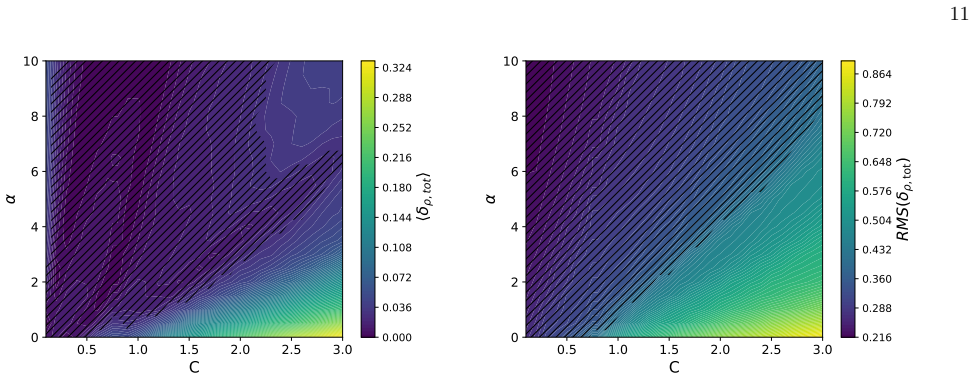
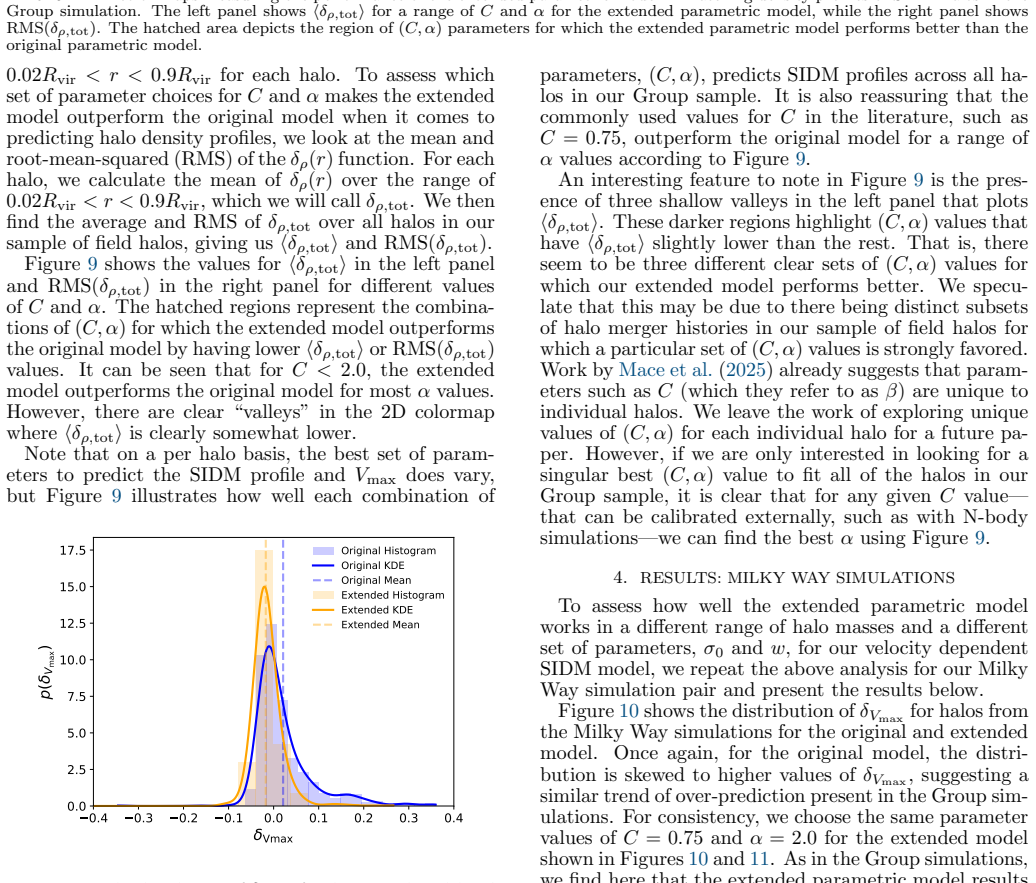
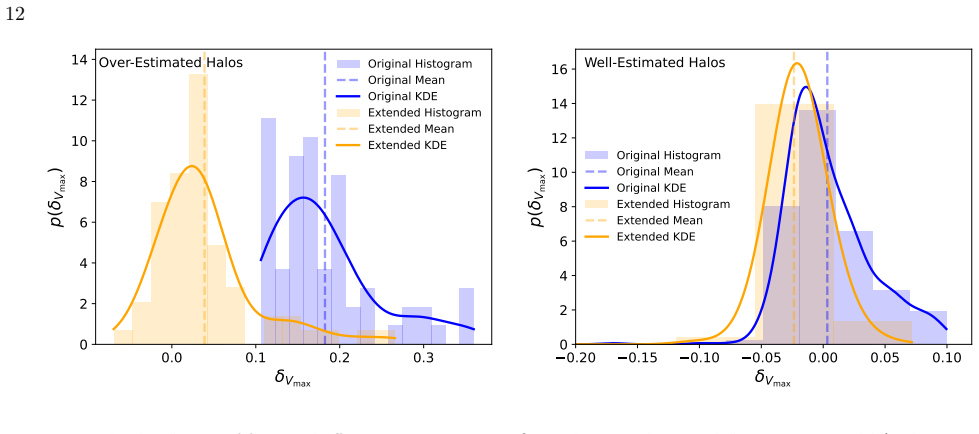
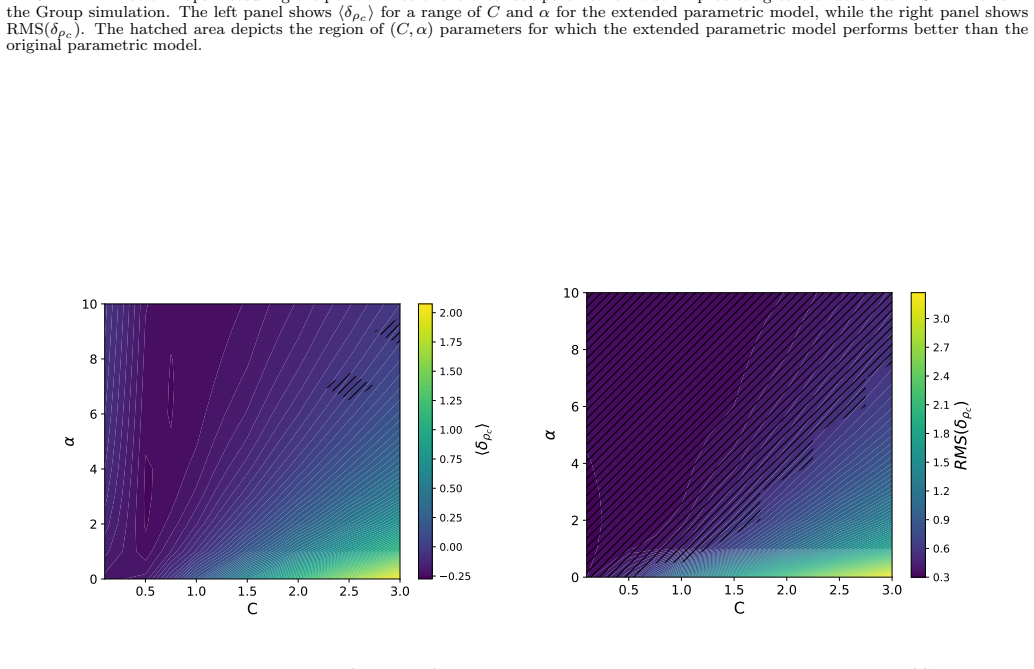
We improve upon the parametric model for the evolution of the density profiles of self-interacting dark matter (SIDM) halos introduced in Yang et al. (2024b), by considering the effects of mass accretion on a SIDM halo's gravothermal evolution. The original parametric model accurately predicts parameters $V_{\max}$ and $R_{\max}$, but with a tendency to overpredict $V_{\max}$ at $z=0$ for a subset of field halos. This discrepancy results from the parametric model predicting a faster rate of gravothermal evolution for these field halos compared to that measured in cosmological zoom-in simulations. We propose that the effects of mass accretion on the evolution of SIDM halos are not fully captured by the original parametric model. Our extended parametric model assumes that smooth mass accretion delays core-collapse by driving the SIDM halo back toward a Navarro-Frenk-White (NFW) profile (as it would have in the case of cold dark matter). We find that this extended model is able to substantially reduce the error in predicted $V_{\max}$ for halos compared to the original model, providing a more accurate model of SIDM halo evolution.
Editorial analysis
A structured set of objections, weighed in public.
Referee Report
Summary. The paper extends the parametric model of Yang et al. (2024b) for the gravothermal evolution of SIDM halo density profiles by incorporating smooth mass accretion. The extension assumes that accretion delays core collapse by restoring the halo toward an NFW profile (as in CDM), and the authors report that this substantially reduces the overprediction of V_max at z=0 for a subset of field halos relative to the original model.
Significance. If the reported error reduction is robust, the extended model would provide a practical, computationally efficient improvement for predicting SIDM halo properties in cosmological contexts, particularly for matching zoom-in simulation results without full gravothermal integration. This could strengthen the use of parametric SIDM models in interpreting dwarf galaxy kinematics or other observables. The phenomenological calibration, however, limits its generality beyond the tuned simulation suite.
major comments (2)
- [Abstract] Abstract and central assumption: the claim that smooth mass accretion 'drives the SIDM halo back toward a Navarro-Frenk-White (NFW) profile' is introduced phenomenologically without derivation from the underlying gravothermal fluid equations or Boltzmann equation under continuous mass growth. No section demonstrates that the assumed instantaneous NFW reset is consistent with the coupled accretion+self-interaction dynamics; the reported V_max error reduction therefore rests on a functional form calibrated to the same zoom-in runs the model aims to reproduce.
- [Abstract] The abstract states that the extended model 'substantially reduce[s] the error in predicted V_max' but supplies no quantitative metrics (e.g., mean fractional error, RMS, or per-halo comparisons before/after the extension). Without these numbers or the corresponding simulation validation plots, the magnitude and statistical significance of the improvement cannot be assessed, undermining evaluation of the central claim.
minor comments (1)
- Notation for the accretion delay parameters should be defined explicitly with symbols and ranges when first introduced, rather than left implicit in the description of the extension.
Simulated Author's Rebuttal
We thank the referee for the constructive and detailed review of our manuscript. We address each major comment below in a point-by-point manner. We agree that the central assumption is phenomenological and will revise the text to clarify this while preserving the model's practical utility. We will also add quantitative metrics to the abstract.
read point-by-point responses
-
Referee: [Abstract] Abstract and central assumption: the claim that smooth mass accretion 'drives the SIDM halo back toward a Navarro-Frenk-White (NFW) profile' is introduced phenomenologically without derivation from the underlying gravothermal fluid equations or Boltzmann equation under continuous mass growth. No section demonstrates that the assumed instantaneous NFW reset is consistent with the coupled accretion+self-interaction dynamics; the reported V_max error reduction therefore rests on a functional form calibrated to the same zoom-in runs the model aims to reproduce.
Authors: We acknowledge that the assumption is introduced phenomenologically rather than derived directly from the gravothermal fluid or Boltzmann equations. The motivation arises from the well-established behavior in CDM, where smooth accretion maintains an NFW-like profile; we posit an analogous restoring effect in SIDM that delays core collapse. The original Yang et al. (2024b) model is itself a calibrated parametric fit, and our extension follows the same philosophy to achieve computational efficiency while improving agreement with the zoom-in suite. We will revise the manuscript to explicitly label the assumption as phenomenological, expand the discussion of its physical motivation and limitations, and note that full consistency with the coupled dynamics would require more expensive fluid simulations beyond the scope of this work. revision: partial
-
Referee: [Abstract] The abstract states that the extended model 'substantially reduce[s] the error in predicted V_max' but supplies no quantitative metrics (e.g., mean fractional error, RMS, or per-halo comparisons before/after the extension). Without these numbers or the corresponding simulation validation plots, the magnitude and statistical significance of the improvement cannot be assessed, undermining evaluation of the central claim.
Authors: We agree that the abstract would be strengthened by including explicit quantitative metrics. The full manuscript already contains per-halo comparisons, error reductions, and validation plots against the zoom-in simulations (see Figures 3–5 and associated tables). In the revised version we will update the abstract to report specific measures, such as the reduction in mean fractional error in V_max at z=0 and the RMS improvement relative to the original model, together with references to the relevant figures. revision: yes
Circularity Check
No significant circularity in the extended parametric SIDM model derivation
full rationale
The paper extends the existing parametric model of Yang et al. (2024b) by introducing an explicit phenomenological assumption that smooth mass accretion drives SIDM halos back toward NFW profiles, thereby delaying core collapse. This assumption is presented as a modeling choice to address an observed discrepancy between the original model's gravothermal evolution rate and measurements from cosmological zoom-in simulations. The improvement in V_max accuracy is then demonstrated via direct comparison to those same external simulations. No quoted step reduces a claimed prediction or first-principles result to its own inputs by construction, nor does any load-bearing premise rest solely on overlapping-author self-citation. The derivation chain remains self-contained against the external simulation benchmarks, with the extension functioning as an added degree of freedom rather than a tautological redefinition or fitted renaming.
Axiom & Free-Parameter Ledger
free parameters (1)
- model parameters controlling accretion delay
axioms (1)
- domain assumption Smooth mass accretion drives SIDM halos back toward NFW profiles and thereby delays core collapse
Reference graph
Works this paper leans on
-
[1]
The Astrophysical Journal , volume=
Strong dark matter self-interactions diversify halo populations within and surrounding the milky way , author=. The Astrophysical Journal , volume=. 2023 , publisher=
2023
-
[2]
The Astrophysical Journal Letters , volume=
A Self-interacting Dark Matter Solution to the Extreme Diversity of Low-mass Halo Properties , author=. The Astrophysical Journal Letters , volume=. 2023 , publisher=
2023
-
[3]
Journal of Cosmology and Astroparticle Physics , volume=
Gravothermal evolution of dark matter halos with differential elastic scattering , author=. Journal of Cosmology and Astroparticle Physics , volume=. 2022 , publisher=
2022
-
[4]
Monthly Notices of the Royal Astronomical Society , volume =
Turner, Hannah C and Lovell, Mark R and Zavala, Jesús and Vogelsberger, Mark , title =. Monthly Notices of the Royal Astronomical Society , volume =. 2021 , month =. doi:10.1093/mnras/stab1725 , url =
-
[5]
The Astrophysical Journal , volume=
Statistical properties of x-ray clusters: Analytic and numerical comparisons , author=. The Astrophysical Journal , volume=. 1998 , publisher=
1998
-
[6]
Annual Review of Astronomy and Astrophysics , volume=
Streams, substructures, and the early history of the Milky Way , author=. Annual Review of Astronomy and Astrophysics , volume=. 2020 , publisher=
2020
-
[7]
Distinguishing dark matter annihilation enhancement scenarios via halo shapes , journal =
Masahiro Ibe and Hai-Bo Yu , keywords =. Distinguishing dark matter annihilation enhancement scenarios via halo shapes , journal =. 2010 , issn =. doi:https://doi.org/10.1016/j.physletb.2010.07.026 , url =
-
[8]
arXiv preprint arXiv:2406.10753 , year=
Testing the parametric model for self-interacting dark matter using matched halos in cosmological simulations , author=. arXiv preprint arXiv:2406.10753 , year=
-
[9]
and Yu, Hai-Bo and Zhong, Yi-Ming , year=
Yang, Daneng and Nadler, Ethan O. and Yu, Hai-Bo and Zhong, Yi-Ming , year=. A parametric model for self-interacting dark matter halos , volume=. Journal of Cosmology and Astroparticle Physics , publisher=. doi:10.1088/1475-7516/2024/02/032 , number=
-
[10]
Boylan-Kolchin, Michael and Bullock, James S. and Kaplinghat, Manoj , title =. Monthly Notices of the Royal Astronomical Society: Letters , volume =. 2011 , month =. doi:10.1111/j.1745-3933.2011.01074.x , url =
-
[11]
Klypin, Anatoly and Kravtsov, Andrey V. and Valenzuela, Octavio and Prada, Francisco , title =. The Astrophysical Journal , abstract =. 1999 , month =. doi:10.1086/307643 , url =
-
[12]
Ludlow, Aaron D. and Navarro, Julio F. and Boylan-Kolchin, Michael and Bett, Philip E. and Angulo, Raúl E. and Li, Ming and White, Simon D. M. and Frenk, Carlos and Springel, Volker , year=. The mass profile and accretion history of cold dark matter haloes , volume=. Monthly Notices of the Royal Astronomical Society , publisher=. doi:10.1093/mnras/stt526 ...
-
[13]
Observational Evidence for Self-Interacting Cold Dark Matter , author =. Phys. Rev. Lett. , volume =. 2000 , month =. doi:10.1103/PhysRevLett.84.3760 , url =
-
[14]
Nature , volume=
Evidence against dissipation-less dark matter from observations of galaxy haloes , author=. Nature , volume=. 1994 , publisher=
1994
-
[15]
The Astrophysical Journal , volume=
Self-interacting dark matter halos and the gravothermal catastrophe , author=. The Astrophysical Journal , volume=. 2002 , publisher=
2002
-
[16]
Monthly Notices of the Royal Astronomical Society , volume=
Simulations of X-ray clusters , author=. Monthly Notices of the Royal Astronomical Society , volume=. 1995 , publisher=
1995
-
[17]
, year = 1997, month = dec, volume = 490, pages =
Navarro, Julio F. and Frenk, Carlos S. and White, Simon D. M. , year=. A Universal Density Profile from Hierarchical Clustering , volume=. The Astrophysical Journal , publisher=. doi:10.1086/304888 , number=
-
[18]
Oman, Kyle A. and Navarro, Julio F. and Fattahi, Azadeh and Frenk, Carlos S. and Sawala, Till and White, Simon D. M. and Bower, Richard and Crain, Robert A. and Furlong, Michelle and Schaller, Matthieu and Schaye, Joop and Theuns, Tom , year=. The unexpected diversity of dwarf galaxy rotation curves , volume=. Monthly Notices of the Royal Astronomical Soc...
-
[19]
The Astrophysical Journal , volume=
A universal mass profile for dwarf spheroidal galaxies? , author=. The Astrophysical Journal , volume=. 2009 , publisher=
2009
-
[20]
Behroozi, Peter S. and Wechsler, Risa H. and Wu, Hao-Yi and Busha, Michael T. and Klypin, Anatoly A. and Primack, Joel R. , year=. GRAVITATIONALLY CONSISTENT HALO CATALOGS AND MERGER TREES FOR PRECISION COSMOLOGY , volume=. The Astrophysical Journal , publisher=. doi:10.1088/0004-637x/763/1/18 , number=
-
[21]
Behroozi, Peter S. and Wechsler, Risa H. and Wu, Hao-Yi , year=. THE ROCKSTAR PHASE-SPACE TEMPORAL HALO FINDER AND THE VELOCITY OFFSETS OF CLUSTER CORES , volume=. The Astrophysical Journal , publisher=. doi:10.1088/0004-637x/762/2/109 , number=
-
[22]
Velocity-dependent self-interacting dark matter from groups and clusters of galaxies , volume=
Sagunski, Laura and Gad-Nasr, Sophia and Colquhoun, Brian and Robertson, Andrew and Tulin, Sean , year=. Velocity-dependent self-interacting dark matter from groups and clusters of galaxies , volume=. Journal of Cosmology and Astroparticle Physics , publisher=. doi:10.1088/1475-7516/2021/01/024 , number=
-
[23]
Outmezguine, Nadav Joseph and Boddy, Kimberly K and Gad-Nasr, Sophia and Kaplinghat, Manoj and Sagunski, Laura , year=. Universal gravothermal evolution of isolated self-interacting dark matter halos for velocity-dependent cross-sections , volume=. Monthly Notices of the Royal Astronomical Society , publisher=. doi:10.1093/mnras/stad1705 , number=
-
[24]
and Yu, Hai-Bo and Zhong, Yi-Ming , year=
Essig, Rouven and McDermott, Samuel D. and Yu, Hai-Bo and Zhong, Yi-Ming , year=. Constraining Dissipative Dark Matter Self-Interactions , volume=. Physical Review Letters , publisher=. doi:10.1103/physrevlett.123.121102 , number=
-
[25]
Theevolutionofbinaryfractionsinglobularclusters,
Springel, Volker , title =. Monthly Notices of the Royal Astronomical Society , volume =. 2005 , month =. doi:10.1111/j.1365-2966.2005.09655.x , url =
-
[26]
Nadler, Ethan O. and Mansfield, Philip and Wang, Yunchong and Du, Xiaolong and Adhikari, Susmita and Banerjee, Arka and Benson, Andrew and Darragh-Ford, Elise and Mao, Yao-Yuan and Wagner-Carena, Sebastian and Wechsler, Risa H. and Wu, Hao-Yi , year=. Symphony: Cosmological Zoom-in Simulation Suites over Four Decades of Host Halo Mass , volume=. The Astro...
-
[27]
Zavala, Jesús and Vogelsberger, Mark and Walker, Matthew G. , title =. Monthly Notices of the Royal Astronomical Society: Letters , volume =. 2013 , month =. doi:10.1093/mnrasl/sls053 , url =
-
[28]
Dark Matter Halos as Particle Colliders: Unified Solution to Small-Scale Structure Puzzles from Dwarfs to Clusters , author =. Phys. Rev. Lett. , volume =. 2016 , month =. doi:10.1103/PhysRevLett.116.041302 , url =
-
[29]
Comprehensiveanalyticformulaeforstellarevolutionasafunctionofmassandmetallicity,
Hierarchical galaxy formation. , keywords =. doi:10.1046/j.1365-8711.2000.03879.x , archivePrefix =. astro-ph/0007281 , primaryClass =
-
[30]
The physical origin of the universal function
Correa, Camila A. and Wyithe, J. Stuart B. and Schaye, Joop and Duffy, Alan R. , title =. Monthly Notices of the Royal Astronomical Society , volume =. 2015 , month =. doi:10.1093/mnras/stv689 , url =
-
[31]
Baryonic solutions and challenges for cosmological models of dwarf galaxies , author=. Nature Astronomy , volume=. 2022 , publisher=. doi:10.1038/s41550-022-01689-w , number=
-
[32]
Mao, Yao-Yuan and Williamson, Marc and Wechsler, Risa H. , year=. THE DEPENDENCE OF SUBHALO ABUNDANCE ON HALO CONCENTRATION , volume=. The Astrophysical Journal , publisher=. doi:10.1088/0004-637x/810/1/21 , number=
-
[33]
Nishikawa, Hiroya and Boddy, Kimberly K. and Kaplinghat, Manoj , year=. Accelerated core collapse in tidally stripped self-interacting dark matter halos , volume=. Physical Review D , publisher=. doi:10.1103/physrevd.101.063009 , number=
-
[34]
2025 , eprint=
Calibrating the SIDM Gravothermal Catastrophe with N-body Simulations , author=. 2025 , eprint=
2025
-
[35]
Bullock, James S. and Boylan-Kolchin, Michael , year=. Small-Scale Challenges to the ΛCDM Paradigm , volume=. Annual Review of Astronomy and Astrophysics , publisher=. doi:10.1146/annurev-astro-091916-055313 , number=
-
[36]
Collins, Michelle L. M. and Read, Justin I. , year=. Observational constraints on stellar feedback in dwarf galaxies , volume=. Nature Astronomy , publisher=. doi:10.1038/s41550-022-01657-4 , number=
-
[37]
Baryonic clues to the puzzling diversity of dwarf galaxy rotation curves , volume=
Santos-Santos, Isabel M E and Navarro, Julio F and Robertson, Andrew and Benítez-Llambay, Alejandro and Oman, Kyle A and Lovell, Mark R and Frenk, Carlos S and Ludlow, Aaron D and Fattahi, Azadeh and Ritz, Adam , year=. Baryonic clues to the puzzling diversity of dwarf galaxy rotation curves , volume=. Monthly Notices of the Royal Astronomical Society , p...
-
[38]
Wetzel, Andrew R. and Hopkins, Philip F. and Kim, Ji-hoon and Faucher-Giguère, Claude-André and Kereš, Dušan and Quataert, Eliot , year=. RECONCILING DWARF GALAXIES WITH ΛCDM COSMOLOGY: SIMULATING A REALISTIC POPULATION OF SATELLITES AROUND A MILKY WAY–MASS GALAXY , volume=. The Astrophysical Journal Letters , publisher=. doi:10.3847/2041-8205/827/2/l23 , number=
-
[39]
Garrison-Kimmel, Shea and Hopkins, Philip F and Wetzel, Andrew and Bullock, James S and Boylan-Kolchin, Michael and Kereš, Dušan and Faucher-Giguère, Claude-André and El-Badry, Kareem and Lamberts, Astrid and Quataert, Eliot and Sanderson, Robyn , year=. The Local Group on FIRE: dwarf galaxy populations across a suite of hydrodynamic simulations , volume=...
-
[40]
and Kong, Demao and Yang, Daneng and Yu, Hai-Bo , year=
Nadler, Ethan O. and Kong, Demao and Yang, Daneng and Yu, Hai-Bo , year=. SIDM Concerto: Compilation and Data Release of Self-interacting Dark Matter Zoom-in Simulations , volume=. The Astrophysical Journal , publisher=. doi:10.3847/1538-4357/adf553 , number=
-
[41]
Ren, Tao and Kwa, Anna and Kaplinghat, Manoj and Yu, Hai-Bo , year=. Reconciling the Diversity and Uniformity of Galactic Rotation Curves with Self-Interacting Dark Matter , volume=. Physical Review X , publisher=. doi:10.1103/physrevx.9.031020 , number=
-
[42]
Monthly Notices of the Royal Astronomical Society , volume =
Silverman, Maya and Bullock, James S and Kaplinghat, Manoj and Robles, Victor H and Valli, Mauro , title =. Monthly Notices of the Royal Astronomical Society , volume =. 2022 , month =. doi:10.1093/mnras/stac3232 , url =
-
[43]
Escalating core formation with dark matter self-heating , author =. Phys. Rev. D , volume =. 2020 , month =. doi:10.1103/PhysRevD.102.043009 , url =
-
[44]
Vegetti, S. and Koopmans, L. V. E. and Bolton, A. and Treu, T. and Gavazzi, R. , year=. Detection of a dark substructure through gravitational imaging: Detection of a dark substructure , volume=. Monthly Notices of the Royal Astronomical Society , publisher=. doi:10.1111/j.1365-2966.2010.16865.x , number=
-
[45]
Minor, Quinn and Gad-Nasr, Sophia and Kaplinghat, Manoj and Vegetti, Simona , year=. An unexpected high concentration for the dark substructure in the gravitational lens SDSSJ0946+1006 , volume=. Monthly Notices of the Royal Astronomical Society , publisher=. doi:10.1093/mnras/stab2247 , number=
-
[46]
Despali, Giulia and Heinze, Felix M. and Fassnacht, Christopher D. and Vegetti, Simona and Spingola, Cristiana and Klessen, Ralf and Tajalli, Maryam , year=. Detecting low-mass haloes with strong gravitational lensing: II. Constraints on the density profiles of two detected subhaloes , volume=. doi:10.1051/0004-6361/202451546 , journal=
-
[47]
Tajalli, M and Vegetti, S and O’Riordan, C M and White, S D M and Fassnacht, C D and Powell, D M and McKean, J P and Despali, G , year=. SHARP–IX. The dense, low-mass perturbers in B1938+666 and J0946+1006: implications for cold and self-interacting dark matter , volume=. Monthly Notices of the Royal Astronomical Society , publisher=. doi:10.1093/mnras/st...
-
[48]
Monthly Notices of the Royal Astronomical Society , volume=
The overconcentrated dark halo in the strong lens SDSS J0946+ 1006 is a subhalo: evidence for self-interacting dark matter? , author=. Monthly Notices of the Royal Astronomical Society , volume=. 2025 , publisher=. doi:10.1093/mnras/staf697 , number=
-
[49]
The Astrophysical Journal , volume=
The Spur and the Gap in GD-1: Dynamical evidence for a dark substructure in the Milky Way halo , author=. The Astrophysical Journal , volume=. 2019 , publisher=
2019
-
[50]
2025 , eprint=
Strong Lensing Perturbers from the SIDM Concerto Suite , author=. 2025 , eprint=
2025
-
[51]
2025 , eprint=
Measurement of Dark Matter Substructure from the Kinematics of the GD-1 Stellar Stream , author=. 2025 , eprint=
2025
-
[52]
2026 , eprint=
MARVELously Dark: the gravothermal evolution of dwarf halos in velocity-dependent SIDM , author=. 2026 , eprint=
2026
-
[53]
and An, Rui and Yang, Daneng and Yu, Hai-Bo and Benson, Andrew and Gluscevic, Vera , year=
Nadler, Ethan O. and An, Rui and Yang, Daneng and Yu, Hai-Bo and Benson, Andrew and Gluscevic, Vera , year=. COZMIC. III. Cosmological Zoom-in Simulations of Self-interacting Dark Matter with Suppressed Initial Conditions , volume=. The Astrophysical Journal , publisher=. doi:10.3847/1538-4357/adce82 , number=
-
[54]
Grant and Kaplinghat, Manoj and Valli, Mauro and Yu, Hai-Bo , year=
Roberts, M. Grant and Kaplinghat, Manoj and Valli, Mauro and Yu, Hai-Bo , year=. Gravothermal collapse and the diversity of galactic rotation curves , volume=. Physical Review D , publisher=. doi:10.1103/physrevd.111.103041 , number=
-
[55]
Tulin, Sean and Yu, Hai-Bo , year=. Dark matter self-interactions and small scale structure , volume=. doi:10.1016/j.physrep.2017.11.004 , journal=
-
[56]
Zhang, Xingyu and Yu, Hai-Bo and Yang, Daneng and Nadler, Ethan O. , title =. The Astrophysical Journal Letters , abstract =. 2025 , month =. doi:10.3847/2041-8213/ada02b , url =
-
[57]
2025 , eprint=
Three Birds with One Stone: Core-Collapsed SIDM Halos as the Common Origin of Dense Perturbers in Lenses, Streams, and Satellites , author=. 2025 , eprint=
2025
discussion (0)
Sign in with ORCID, Apple, or X to comment. Anyone can read and Pith papers without signing in.