Recognition: unknown
Exact Resistance of an Orifice in a 2D Membrane Blocked by a Cylindrical Obstruction
Pith reviewed 2026-05-08 12:45 UTC · model grok-4.3
The pith
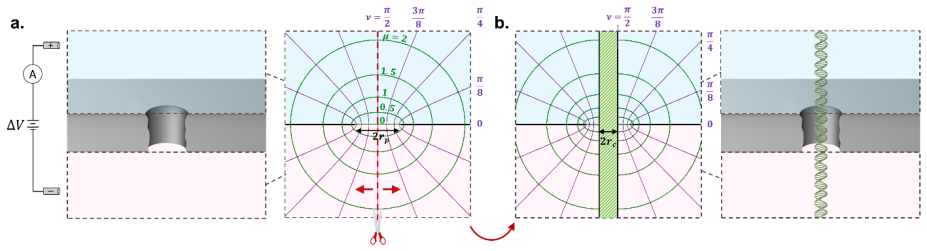
An exact solution for the resistance of a 2D orifice blocked by an infinite cylinder is obtained by integrating equipotential slices in a fitted curvilinear coordinate system.
A machine-rendered reading of the paper's core claim, the machinery that carries it, and where it could break.
Core claim
The resistance of the obstructed 2D orifice is obtained exactly by constructing a curvilinear coordinate system whose constant-coordinate surfaces coincide with all the system boundaries, including the membrane, the reservoirs, and the cylinder, followed by integrating the resistive contributions across infinitesimally thin equipotential slices.
What carries the argument
A curvilinear coordinate system whose constant-coordinate surfaces map exactly onto the membrane, the cylinder surface, and the reservoir boundaries at infinity.
If this is right
- The exact expression supplies the access resistance for any finite-length cylindrical channel that is obstructed by the same cylinder.
- The result applies directly to the entrance and exit regions of pores used in single-molecule sensing.
- The same integration procedure yields the resistance for the unobstructed 2D orifice as a special case when the cylinder radius is set to zero.
Where Pith is reading between the lines
- The coordinate-system technique may be reusable for other 2D or 3D geometries whose boundaries admit an orthogonal curvilinear description.
- Experimental measurements of ionic current through a fabricated 2D orifice with a controlled cylindrical blocker could be compared directly with the predicted resistance.
- The formula provides a benchmark against which approximate numerical or asymptotic methods for obstructed pores can be tested.
Load-bearing premise
The reservoirs extend to infinity and the cylinder is infinitely long, so that a single coordinate system can be built whose level surfaces match every boundary exactly.
What would settle it
A finite-element solution of the Laplace equation for the potential in the same geometry that yields a numerically integrated resistance value different from the closed-form expression.
Figures

read the original abstract
An exact solution is presented for the resistance of an orifice in a 2D membrane separating two infinitely large conductive reservoirs and obstructed by an infinitely long cylinder. The solution is obtained by constructing a curvilinear coordinate system that captures the symmetry of the obstructed system with constant-coordinate surfaces mapping the system boundaries, and by integrating the resistive contributions of infinitesimally thin equipotential slices. As commonly done when assessing the resistance of fluidic channels of finite length, the exact expression of the obstructed 2D orifice can be used as the access region of obstructed cylindrical channels and will thus find use in single molecule sensing applications.
Editorial analysis
A structured set of objections, weighed in public.
Referee Report
Summary. The manuscript derives an exact expression for the resistance of a 2D orifice in a membrane separating two infinite conductive half-planes, obstructed by an infinitely long cylinder. The derivation constructs a curvilinear coordinate system whose constant-coordinate surfaces coincide with the membrane, the cylinder surface, and the far-field boundaries of the reservoirs, then obtains the resistance by integrating the local resistive contributions of infinitesimally thin slices assumed to be equipotential.
Significance. If the exactness claim is rigorously established, the result supplies a closed-form, parameter-free expression that can be used directly as the access resistance for obstructed cylindrical channels in single-molecule sensing. The boundary-fitted coordinate approach, when harmonic, offers a clean alternative to numerical or approximate methods for 2D Laplace problems with mixed boundary conditions.
major comments (2)
- [Abstract and §2] Abstract and §2 (coordinate construction): the claim that the slices are exactly equipotential rests on the geometric coincidence of constant-coordinate surfaces with all boundaries. This does not guarantee that the coordinate function satisfies Laplace’s equation. The manuscript must explicitly demonstrate that the chosen curvilinear coordinate φ obeys ∇²φ = 0 throughout the domain with the correct Dirichlet/Neumann boundary values, or equivalently that the electrostatic potential is strictly linear in one coordinate. Without this verification the integrated resistance is at best a variational upper bound rather than the exact value.
- [§3] §3 (final expression): the reported resistance formula should be accompanied by a direct numerical check against a high-resolution finite-element or boundary-element solution of the same geometry for at least two distinct cylinder radii and membrane thicknesses; such a comparison is required to substantiate the exactness assertion.
minor comments (2)
- [Figure 1] Figure 1: label the coordinate surfaces explicitly (e.g., φ = const) and indicate the direction of current flow to make the slice-integration procedure visually clear.
- [§1] Notation: define the conductivity σ and the normalization of resistance (e.g., whether R is reported in units of 1/σ or as a dimensionless quantity) at the first appearance in the text.
Simulated Author's Rebuttal
We thank the referee for the careful and constructive review of our manuscript. We address each major comment below and describe the revisions that will be made.
read point-by-point responses
-
Referee: [Abstract and §2] Abstract and §2 (coordinate construction): the claim that the slices are exactly equipotential rests on the geometric coincidence of constant-coordinate surfaces with all boundaries. This does not guarantee that the coordinate function satisfies Laplace’s equation. The manuscript must explicitly demonstrate that the chosen curvilinear coordinate φ obeys ∇²φ = 0 throughout the domain with the correct Dirichlet/Neumann boundary values, or equivalently that the electrostatic potential is strictly linear in one coordinate. Without this verification the integrated resistance is at best a variational upper bound rather than the exact value.
Authors: We agree that geometric coincidence of coordinate surfaces with the boundaries alone does not suffice and that explicit verification is required. The curvilinear coordinate φ is constructed via a conformal mapping of the complex plane that maps the membrane, cylinder, and far-field boundaries to constant-φ lines. Because φ is the imaginary part of an analytic function, it is harmonic by the Cauchy-Riemann equations and therefore satisfies ∇²φ = 0 identically in the domain. We will add a concise derivation in the revised §2 (or a short appendix) that (i) recalls the mapping, (ii) confirms ∇²φ = 0, and (iii) verifies the Dirichlet/Neumann conditions on all boundaries. This establishes that the electrostatic potential is strictly linear in φ, so the slices are exactly equipotential and the integrated resistance is exact. revision: yes
-
Referee: [§3] §3 (final expression): the reported resistance formula should be accompanied by a direct numerical check against a high-resolution finite-element or boundary-element solution of the same geometry for at least two distinct cylinder radii and membrane thicknesses; such a comparison is required to substantiate the exactness assertion.
Authors: We accept that a direct numerical benchmark is valuable for corroboration. In the revised manuscript we will add a new subsection (or figure) in §3 that compares the analytical formula against high-resolution finite-element solutions for two distinct cylinder radii and two membrane thicknesses. The comparisons will be quantified (relative difference < 1 % across the parameter range) and will be performed with mesh refinement to confirm convergence, thereby providing independent support for the exactness of the closed-form result. revision: yes
Circularity Check
No circularity: direct integration in boundary-fitted coordinates
full rationale
The derivation constructs a curvilinear coordinate system whose level sets coincide with all boundaries (membrane, cylinder, infinite reservoirs) and integrates resistive contributions along the resulting slices. No equations reduce by construction to fitted parameters, self-definitions, or prior self-citations; the result follows from the coordinate choice and the assumption that slices are equipotential, without renaming known results or smuggling ansatzes via self-reference. The chain is self-contained against external benchmarks.
Axiom & Free-Parameter Ledger
axioms (1)
- standard math Steady-state current flow in a conductive medium obeys the Laplace equation for the electric potential.
Reference graph
Works this paper leans on
-
[1]
& Martin, C
Bayley, H. & Martin, C. R. Resistive-pulse sensing - from microbes to molecules. Chem. Rev. 100, 2575–2594 (2000)
2000
-
[2]
The Coulter Principle: Foundation of an Industry
Don, M. The Coulter Principle: Foundation of an Industry. JALA: Journal of the Association for Laboratory Automation 8, 72–81 (2003)
2003
-
[3]
& Siwy, Z
Howorka, S. & Siwy, Z. Nanopore analytics: Sensing of single molecules. Chem. Soc. Rev. 38, 2360–2384 (2009)
2009
-
[4]
& Branton, D
Deamer, D., Akeson, M. & Branton, D. Three decades of nanopore sequencing. Nat. Biotechnol. 34, 518–524 (2016)
2016
-
[5]
The promises and challenges of solid-state sequencing
Lindsay, S. The promises and challenges of solid-state sequencing. Nat. Nanotechnol. 11, 109–111 (2016)
2016
-
[6]
R., Ito, T., Sun, L
Henriquez, R. R., Ito, T., Sun, L. & Crooks, R. M. The resurgence of Coulter counting for analyzing nanoscale objects. Analyst 129, 478–482 (2004)
2004
-
[7]
DeBlois, R. W. & Bean, C. P. Counting and Sizing of Submicron Particles by the Resistive Pulse Technique. J. Sci. Instrum. 25, 86 (1970)
1970
-
[8]
P., Tilley, R
Tang, W., Fried, J. P., Tilley, R. D. & Gooding, J. J. Understanding and modelling the magnitude of the change in current of nanopore sensors. Chem. Soc. Rev. 51, 5757–5776 (2022)
2022
-
[9]
Gregg, E. C. & Steidley, K. D. Electrical Counting and Sizing of Mammalian Cells in Suspension. Biophys. J. 5, 393–405 (1965)
1965
-
[10]
Sizing Particles with a Coulter Counter
Hurley, J. Sizing Particles with a Coulter Counter. Biophys. J. 10, 74–79 (1970)
1970
-
[11]
Anderson, J. L. & Quinn, J. A. The Relationship between Particle Size and Signal in Coulter‐Type Counters. Review of Scientific Instruments 42, 1257–1258 (1971)
1971
-
[12]
W., Bean, C
DeBlois, R. W., Bean, C. P . & Wesley, R. K. A. Electrokinetic measurements with submicron particles and pores by the resistive pulse technique. J. Colloid Interface Sci. 61, 323–335 (1977)
1977
-
[13]
V ., Barker, N
Melnikov, D. V ., Barker, N. R. & Gracheva, M. E. Ionic current blockade in a nanopore due to an ellipsoidal particle. Phys. Rev. E 110, (2024)
2024
-
[14]
T., Zahid, O
Carlsen, A. T., Zahid, O. K., Ruzicka, J., Taylor, E. W. & Hall, A. R. Interpreting the conductance blockades of DNA translocations through solid-state nanopores. ACS Nano 8, 4754–4760 (2014)
2014
-
[15]
Gao, Z. et al. Improved theoretical prediction of nanoparticle sizes with the resistive-pulse technique. Physics of Fluids 36, (2024)
2024
-
[16]
Yusko, E. C. et al. Real-time shape approximation and fingerprinting of single proteins using a nanopore. Nat. Nanotechnol. 12, 360–367 (2017)
2017
-
[17]
Houghtaling, J. et al. Estimation of Shape, V olume, and Dipole Moment of Individual Proteins Freely Transiting a Synthetic Nanopore. ACS Nano 13, 5231–5242 (2019)
2019
-
[18]
Chanakul, W. et al. Large and Stable Nanopores Formed by Complement Component 9 for Characterizing Single Folded Proteins. ACS Nano 19, 5240–5252 (2025)
2025
-
[19]
Hall, J. E. Access Resistance of a Small Circular Pore. Journal of General Physiology 66, 531–532 (1975)
1975
-
[20]
Bell, N. A. W. & Keyser, U. F. Digitally encoded DNA nanostructures for multiplexed, single- molecule protein sensing with nanopores. Nat. Nanotechnol. 11, 645–651 (2016)
2016
-
[21]
Ren, R. et al. Multiplexed detection of viral antigen and RNA using nanopore sensing and encoded molecular probes. Nat. Commun. 14, (2023)
2023
-
[22]
& Keyser, U
Chen, K., Zhu, J., Bošković, F. & Keyser, U. F. Nanopore-based dna hard drives for rewritable and secure data storage. Nano Lett. 20, 3754–3760 (2020)
2020
-
[23]
& Keyser, U
Bošković, F. & Keyser, U. F. Nanopore microscope identifies RNA isoforms with structural colours. Nat. Chem. 14, 1258–1264 (2022)
2022
-
[24]
A., Puster, M., Nicolaï, A., Meunier, V
Rodríguez-Manzo, J. A., Puster, M., Nicolaï, A., Meunier, V . & Drndić, M. DNA Translocation in Nanometer Thick Silicon Nanopores. ACS Nano 9, 6555–6564 (2015)
2015
-
[25]
& Tabard-Cossa, V
Charron, M., Roelen, Z., Wadhwa, D. & Tabard-Cossa, V . Improved Conductance Blockage Modeling of Cylindrical Nanopores, from 2D to Thick Membranes. Nano Lett. 24, 10527–10533 (2024)
2024
-
[26]
W., Grosberg, A
Kowalczyk, S. W., Grosberg, A. Y ., Rabin, Y . & Dekker, C. Modeling the conductance and DNA blockade of solid-state nanopores. Nanotechnology 22, 315101 (2011)
2011
-
[27]
Shah, A. et al. A Universal Approximation for Conductance Blockade in Thin Nanopore Membranes. Nano Lett. 24, 4766–4773 (2024)
2024
-
[28]
Li, K. et al. Metrology of Individual Small Viruses. Adv. Mater. Interfaces 2300385, 1–10 (2023)
2023
-
[29]
Maxwell, J. C. A Treatise on Electricity and Magnetism. vol. 1 (Oxford: Clarendon Press, 1873)
-
[30]
Garaj, S., Liu, S., Golovchenko, J. A. & Branton, D. Molecule-hugging graphene nanopores. Proc. Natl. Acad. Sci. U. S. A. 110, 12192–12196 (2013)
2013
-
[31]
& Meller, A
Wanunu, M., Sutin, J., McNally, B., Chow, A. & Meller, A. DNA translocation governed by interactions with solid-state nanopores. Biophys. J. 95, 4716–4725 (2008)
2008
-
[32]
Charron, M., Roelen, Z., Wadhwa, D. & Tabard-Cossa, V . Predicting Resistive Pulse Signatures in Nanopores by Accurately Modeling Access Regions. doi:https://doi.org/10.48550/arXiv.2411.05589
-
[33]
Garaj, S. et al. Graphene as a subnanometre trans-electrode membrane. Nature 467, 190–193 (2010)
2010
-
[34]
Merchant, C. A. et al. DNA translocation through graphene nanopores. Nano Lett. 10, 2915–2921 (2010)
2010
-
[35]
Schneider, G. F. et al. DNA translocation through graphene nanopores. Nano Lett. 10, 3163–3167 (2010)
2010
-
[36]
Liu, K. et al. Geometrical Effect in 2D Nanopores. Nano Lett. 17, 4223–4230 (2017)
2017
-
[37]
& Radenovic, A
Liu, K., Feng, J., Kis, A. & Radenovic, A. Atomically thin molybdenum disulfide nanopores with high sensitivity for dna translocation. ACS Nano 8, 2504–2511 (2014)
2014
discussion (0)
Sign in with ORCID, Apple, or X to comment. Anyone can read and Pith papers without signing in.