Recognition: unknown
Dynamic solutions of next generation neural field models with delays
Pith reviewed 2026-05-08 12:36 UTC · model grok-4.3
The pith
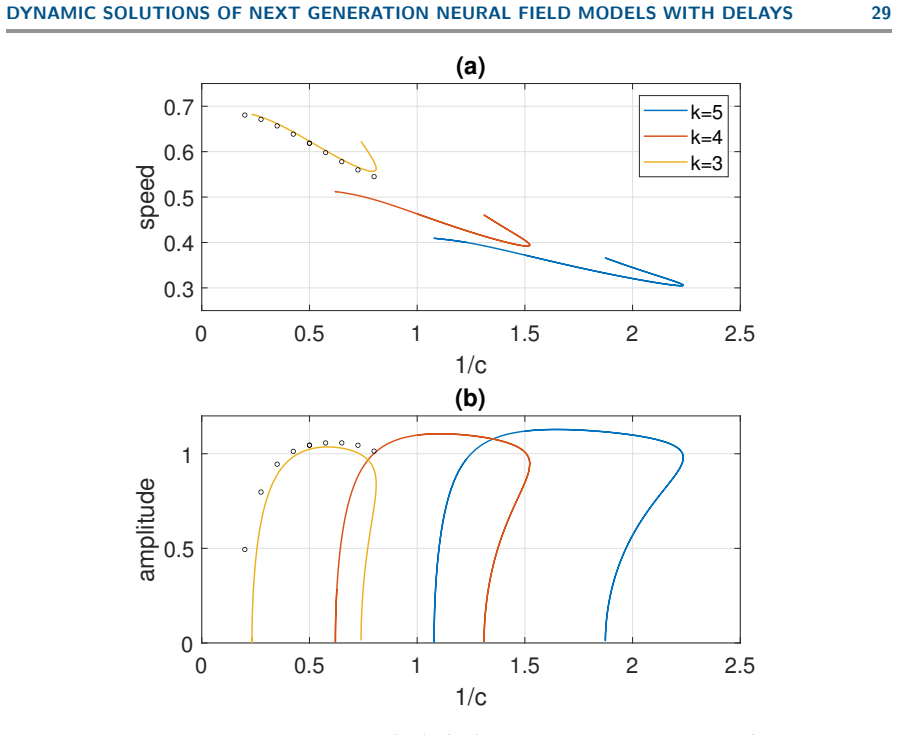
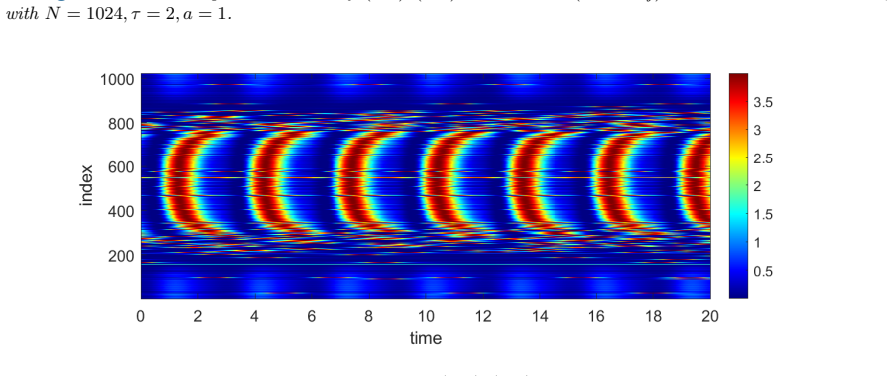
Hopf bifurcations from delays in theta neuron rings generate traveling waves and breathing bumps
A machine-rendered reading of the paper's core claim, the machinery that carries it, and where it could break.
Core claim
Networks of theta neurons on a ring with distributed and conduction delays are considered. In the continuum limit these are described by next generation neural field models with delays. Uniform and bump states are shown to undergo Hopf bifurcations as delay parameters vary, creating traveling waves and breathing bump solutions. These dynamic solutions satisfy self-consistency equations, which are solved efficiently to follow the solutions across parameter space and map the effects of delays on pattern formation.
What carries the argument
Self-consistency equations for traveling waves and periodic breathing solutions derived from the delayed next generation neural field models
If this is right
- Traveling waves arise from the Hopf bifurcations in the delayed models.
- Breathing bump solutions with periodic time dependence are generated similarly.
- Efficient numerical methods for the self-consistency equations enable continuation of these solutions with parameters.
- The global picture shows distinct influences of finite-support distributed delays, infinite-support delays, and conduction delays on the patterns.
Where Pith is reading between the lines
- Extensions to two-dimensional domains or heterogeneous networks could reveal more complex delay-driven patterns.
- The efficient solving technique might apply to other neural field models with delays for faster computation.
- These results suggest delays as a control parameter for desired spatiotemporal activity in neural systems.
Load-bearing premise
The continuum limit provides an accurate description of the dynamics in the finite ring network of theta neurons with the modeled delays.
What would settle it
Numerical simulations of large but finite rings of theta neurons incorporating the delays should reproduce the predicted traveling waves and breathing bumps if the continuum approximation holds.
Figures






read the original abstract
We study networks of theta neurons arranged on a ring with delayed interactions. In the continuum limit the systems are described by next generation neural field models with delays. We consider distributed delays with both finite and infinite support, and conduction delays. The stability of spatially uniform and localized bump states is determined, and we find that they undergo Hopf bifurcations as parameters related to the delays are varied. These bifurcations create traveling waves and ``breathing'' bump solutions. These dynamic solutions satisfy self-consistency equations and we show how to efficiently solve these equations. Following traveling waves and periodic solutions as parameters are varied provides a global picture of the influence of different delays on pattern formation processes in spatially extended networks of theta neurons.
Editorial analysis
A structured set of objections, weighed in public.
Referee Report
Summary. The paper examines networks of theta neurons on a ring with delayed interactions. In the continuum limit, these yield next-generation neural field models incorporating distributed delays (finite and infinite support) and conduction delays. Stability of spatially uniform states and localized bumps is analyzed, revealing Hopf bifurcations as delay-related parameters vary. These bifurcations produce traveling waves and breathing bump solutions, which satisfy self-consistency equations that the authors solve efficiently. Parameter continuation of the dynamic solutions is used to map the global influence of different delay types on pattern formation.
Significance. If the derivations and reductions hold, the work provides a useful framework for tracking delay-induced spatiotemporal patterns in neural fields via self-consistency equations and continuation methods. This offers an efficient route to a global view of how distributed versus conduction delays shape traveling waves and oscillatory bumps, which is a clear methodological strength for exploring parameter dependence in spatially extended systems.
major comments (1)
- [model derivation and stability analysis] The central claims about Hopf bifurcations to traveling waves and breathing bumps rest on the N→∞ continuum limit commuting with the incorporation of distributed and conduction delays. The manuscript provides no finite-N simulations, error bounds, or analysis of finite-size corrections to the stability boundaries, which is load-bearing for the reported dynamic solutions (see the model derivation and stability sections).
Simulated Author's Rebuttal
We thank the referee for their thoughtful summary and for recognizing the methodological value of using self-consistency equations and continuation to explore delay-induced patterns. We address the single major comment below.
read point-by-point responses
-
Referee: [model derivation and stability analysis] The central claims about Hopf bifurcations to traveling waves and breathing bumps rest on the N→∞ continuum limit commuting with the incorporation of distributed and conduction delays. The manuscript provides no finite-N simulations, error bounds, or analysis of finite-size corrections to the stability boundaries, which is load-bearing for the reported dynamic solutions (see the model derivation and stability sections).
Authors: We agree that direct numerical validation of the continuum limit in the presence of delays would strengthen the central claims. In the manuscript the delays are introduced at the level of the finite-N theta-neuron network on a ring; the Ott–Antonsen reduction is then applied to obtain the next-generation neural field equations, so that the N→∞ limit is taken after the delays have been incorporated. This ordering is standard for mean-field reductions of delayed pulse-coupled networks and ensures that the resulting continuum model inherits the delayed interactions. Nevertheless, the absence of finite-N benchmarks is a legitimate gap. In the revised version we will add a new subsection (or appendix) containing direct simulations of the finite-N system for representative values of the distributed-delay and conduction-delay parameters. These simulations will be used to compare the onset of Hopf bifurcations, the stability boundaries of uniform and bump states, and the existence of traveling-wave and breathing solutions against the continuum predictions. A short discussion of observed finite-size corrections will also be included. revision: yes
Circularity Check
No significant circularity; derivation is self-contained
full rationale
The paper derives next-generation neural field equations from the continuum limit of a finite ring of theta neurons with distributed and conduction delays, performs linear stability analysis on uniform and bump states to locate Hopf bifurcations, and then solves the resulting self-consistency equations for traveling waves and breathing solutions. These steps are standard mathematical reductions from the model equations; the self-consistency relations are obtained directly from the field equations rather than being fitted to data or smuggled in via self-citation. No load-bearing premise reduces to a prior result by the same authors, and the continuum limit is treated as an independent modeling assumption whose validity is not claimed to be proven within the paper itself.
Axiom & Free-Parameter Ledger
axioms (1)
- domain assumption Continuum limit of finite theta-neuron ring network yields a well-posed neural field equation
Reference graph
Works this paper leans on
-
[1]
Abrams, R
[1]D. Abrams, R. Mirollo, S. Strogatz, and D. Wiley,Solvable model for chimera states of coupled oscillators, Phys. Rev. Lett., 101 (2008), p. 084103. [2]I. Al-Darabsah, S. A. Campbell, and B. Rahman,Distributed delay and desynchronization in a neural mass model, SIAM Journal on Applied Dynamical Systems, 23 (2024), pp. 3013–3051. [3]S.-i. Amari,Dynamics ...
2008
-
[2]
[5]J. T. Ariaratnam and S. H. Strogatz,Phase diagram for the winfree model of coupled nonlinear oscillators, Physical Review Letters, 86 (2001), p
2001
-
[3]
[6]F. M. Atay and A. Hutt,Stability and bifurcations in neural fields with finite propagation speed and general connectivity, SIAM Journal on Applied Mathematics, 65 (2005), pp. 644–666. [7]F. M. Atay and A. Hutt,Neural fields with distributed transmission speeds and long-range feedback delays, SIAM Journal on Applied Dynamical Systems, 5 (2006), pp. 670–...
2005
-
[4]
Byrne, R
´A. Byrne, R. D. O’Dea, M. Forrester, J. Ross, and S. Coombes,Next-generation neural mass and field modeling, Journal of neurophysiology, (2020). [13]S. A. Campbell,Time delays in neural systems, in Handbook of brain connectivity, Springer, 2007, pp. 65–90. [14]S. Coombes,Waves, bumps, and patterns in neural field theories, Biol. Cybern., 93 (2005), pp. 9...
2020
-
[5]
[18]S. Coombes and C. Laing,Delays in activity-based neural networks, Philosophical Transactions of the Royal Society A: Mathematical, Physical and Engineering Sciences, 367 (2009), pp. 1117–1129. [19]S. Coombes and H. Meijer,Synchrony in firing rate neural networks with multiple delays: A harmonic balance approach, arXiv preprint arXiv:2509.22495, (2025)...
-
[6]
Ermentrout,Type I membranes, phase resetting curves, and synchrony, Neural computation, 8 (1996), pp
[24]B. Ermentrout,Type I membranes, phase resetting curves, and synchrony, Neural computation, 8 (1996), pp. 979–1001. [25]B. Ermentrout,Neural networks as spatio-temporal pattern-forming systems, Rep. Prog. Phys., 61 (1998), pp. 353–430. [26]G. B. Ermentrout and N. Kopell,Parabolic bursting in an excitable system coupled with a slow oscillation, SIAM Jou...
1996
-
[7]
Hartung, T
[31]F. Hartung, T. Krisztin, H.-O. Walther, and J. Wu,Functional differential equations with state- dependent delays: theory and applications, Handbook of differential equations: ordinary differential equations, 3 (2006), pp. 435–545. [32]Z. Huang, Y. Zhang, P. Zou, X. Zong, and Q. Zhang,Myelin dysfunction in aging and brain disorders: mechanisms and ther...
2006
-
[8]
[33]P. J. Hurtado and A. S. Kirosingh,Generalizations of the ‘linear chain trick’: incorporating more flexible dwell time distributions into mean field ode models, Journal of mathematical biology, 79 (2019), pp. 1831–1883. [34]J.-S. Kang, Y.-H. An, R.-S. Kim, and C.-U. Choe,Periodic external driving of transmission-delay- coupled phase oscillator system: ...
2019
-
[9]
Laing and C
[36]C. Laing and C. Chow,Stationary bumps in networks of spiking neurons, Neural Comput., 13 (2001), pp. 1473–1494. [37]C. R. Laing,The dynamics of chimera states in heterogeneous Kuramoto networks, Physica D, 238 (2009), pp. 1569–1588. [38]C. R. Laing,Derivation of a neural field model from a network of theta neurons, Physical Review E, 90 (2014), p. 010...
2001
-
[10]
[40]C. R. Laing,Exact neural fields incorporating gap junctions, SIAM Journal on Applied Dynamical Systems, 14 (2015), pp. 1899–1929. [41]C. R. Laing and B. Krauskopf,Periodic solutions for a pair of delay-coupled excitable theta neurons, Proceedings of the Royal Society A: Mathematical, Physical and Engineering Sciences, 481 (2025), p. 20240897. [42]C. R...
2015
-
[11]
[49]O. E. Omel’chenko,Periodic orbits in the Ott–Antonsen manifold, Nonlinearity, 36 (2023), pp. 845–861. [50]O. E. Omel’chenko and C. R. Laing,Activity patterns in ring networks of quadratic integrate-and-fire neurons with synaptic and gap junction coupling, Physical Review E, 110 (2024), p. 034411. [51]E. Ott and T. M. Antonsen,Low dimensional behavior ...
2023
-
[12]
Paz ´o and E
[54]D. Paz ´o and E. Montbri´o,Low-dimensional dynamics of populations of pulse-coupled oscillators, Phys- ical Review X, 4 (2014), p. 011009. [55]M. R. Qubbaj and V. K. Jirsa,Neural field dynamics under variation of local and global connectivity and finite transmission speed, Physica D, 238 (2009), pp. 2331–2346. [56]B. Rahman, K. B. Blyuss, and Y. N. Ky...
2014
-
[13]
[69]S. A. van Gils, S. G. Janssens, Y. A. Kuznetsov, and S. Visser,On local bifurcations in neural field models with transmission delays, Journal of mathematical biology, 66 (2013), pp. 837–887. [70]R. Veltz,Interplay between synaptic delays and propagation delays in neural field equations, SIAM Journal on Applied Dynamical Systems, 12 (2013), pp. 1566–16...
2013
-
[14]
[72]N. A. Venkov, S. Coombes, and P. C. Matthews,Dynamic instabilities in scalar neural field equations with space-dependent delays, Physica D, 232 (2007), pp. 1–15. [73]S. Visser, R. Nicks, O. Faugeras, and S. Coombes,Standing and travelling waves in a spherical brain model: the nunez model revisited, Physica D, 349 (2017), pp. 27–45. [74]H. R. Wilson an...
2007
-
[15]
Zhang,Representation of spatial orientation by the intrinsic dynamics of the head-direction cell ensemble: a theory, The journal of neuroscience, 16 (1996), pp
[78]K. Zhang,Representation of spatial orientation by the intrinsic dynamics of the head-direction cell ensemble: a theory, The journal of neuroscience, 16 (1996), pp. 2112–2126
1996
discussion (0)
Sign in with ORCID, Apple, or X to comment. Anyone can read and Pith papers without signing in.