Recognition: unknown
Resting-State EEG Biomarkers of Tinnitus Robust to Cross-Subject and Cross-Platform Variation
Pith reviewed 2026-05-08 12:54 UTC · model grok-4.3
The pith
Koopman features from resting-state EEG identify tinnitus through stable oscillation decay rates that generalize across datasets.
A machine-rendered reading of the paper's core claim, the machinery that carries it, and where it could break.
Core claim
Applying the Koopman operator through dynamic mode decomposition to PCA-reduced resting-state EEG yields features that classify tinnitus more accurately in cross-dataset tests than microstate-derived transition probabilities or durations. Eigenvalue magnitude, which encodes oscillation stability, maintains consistency across the two datasets while eigenvalue phase, which encodes frequency, does not. The analysis therefore identifies altered oscillatory decay rates as the more robust tinnitus biomarker.
What carries the argument
Koopman operator analysis via dynamic mode decomposition applied to PCA-reduced EEG signals, where eigenvalues capture the stability and frequency of underlying oscillatory modes.
If this is right
- PCA-based Koopman features achieve the highest discrimination metrics when classifiers are trained on one dataset and tested on the other.
- Koopman eigenvalue magnitude shows average consistency of 0.685 across datasets under Wasserstein-distance analysis.
- Koopman eigenvalue phase shows poorer consistency of 1.583 and does not generalize as well.
- Microstate transition and duration features are outperformed by Koopman features in the cross-dataset setting.
- Altered oscillatory decay rates rather than frequency shifts constitute the more reliable biomarker.
Where Pith is reading between the lines
- These stability-focused features could be tested for their ability to track changes in tinnitus severity over time within the same individuals.
- The same Koopman pipeline might be applied to other conditions involving disrupted brain rhythms to check whether decay-rate alterations appear more generally.
- Combining the single-window Koopman features with multi-window or spatial filtering steps could further improve cross-platform performance in future recordings.
Load-bearing premise
The two resting-state EEG datasets share enough similarity in subject demographics, recording conditions, and preprocessing that cross-dataset performance differences reflect true biomarker properties rather than unrelated dataset artifacts.
What would settle it
Recording a new independent EEG dataset on a third platform from both tinnitus patients and matched controls and finding that PCA-based Koopman magnitude features no longer discriminate the groups at similar accuracy would falsify the robustness claim.
Figures



read the original abstract
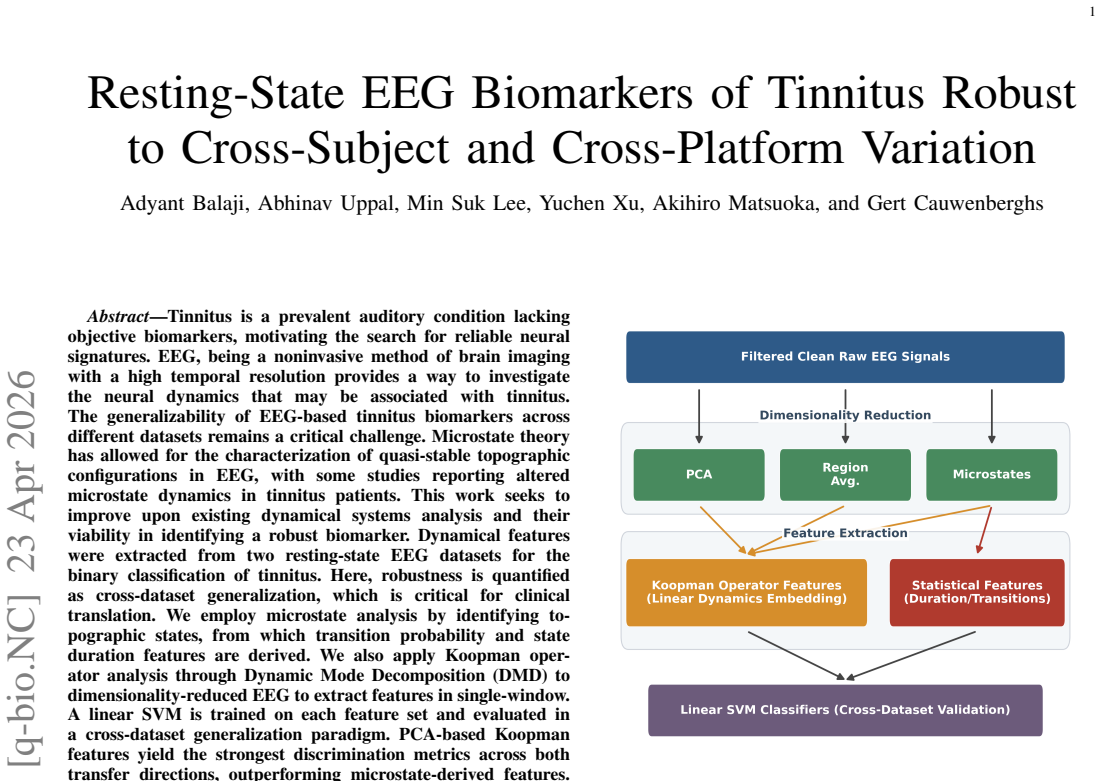
Tinnitus is a prevalent auditory condition lacking objective biomarkers, motivating the search for reliable neural signatures. EEG, being a noninvasive method of brain imaging with a high temporal resolution provides a way to investigate the neural dynamics that may be associated with tinnitus. The generalizability of EEG-based tinnitus biomarkers across different datasets remains a critical challenge. Microstate theory has allowed for the characterization of quasi-stable topographic configurations in EEG, with some studies reporting altered microstate dynamics in tinnitus patients. This work seeks to improve upon existing dynamical systems analysis and their viability in identifying a robust biomarker. Dynamical features were extracted from two resting-state EEG datasets for the binary classification of tinnitus. Here, robustness is quantified as cross-dataset generalization, which is critical for clinical translation. We employ microstate analysis by identifying topographic states, from which transition probability and state duration features are derived. We also apply Koopman operator analysis through Dynamic Mode Decomposition (DMD) to dimensionality-reduced EEG to extract features in single-window. A linear SVM is trained on each feature set and evaluated in a cross-dataset generalization paradigm. PCA-based Koopman features yield the strongest discrimination metrics across both transfer directions, outperforming microstate-derived features. A Wasserstein-distance consistency analysis further reveals that Koopman eigenvalue \emph{magnitude}, encoding oscillation stability, generalizes across datasets ($\bar{\rho} = 0.685$), whereas eigenvalue \emph{phase}, encoding oscillation frequency, does not ($\bar{\rho} = 1.583$), providing interpretable evidence that altered oscillatory decay rates, rather than frequency shifts, constitute the more robust tinnitus biomarker.
Editorial analysis
A structured set of objections, weighed in public.
Referee Report
Summary. The paper claims that PCA-based Koopman features extracted via DMD from resting-state EEG yield the strongest cross-dataset generalization for binary tinnitus classification using linear SVM, outperforming microstate transition and duration features. A Wasserstein-distance analysis on Koopman eigenvalues further indicates that eigenvalue magnitude (encoding oscillation stability/decay rates) generalizes across the two datasets (average ρ̄ = 0.685) while phase (encoding frequency) does not (ρ̄ = 1.583), positioning altered oscillatory decay as the more robust tinnitus biomarker.
Significance. If the central claims hold after addressing missing details, the work would provide interpretable, cross-platform evidence favoring dynamical stability metrics over frequency shifts or microstate features as tinnitus biomarkers. The combination of Koopman operator analysis, explicit cross-dataset transfer evaluation, and Wasserstein consistency testing on eigenvalues represents a constructive step toward generalizable EEG signatures, though the current lack of statistical grounding limits immediate impact.
major comments (3)
- [Abstract/Methods] Abstract and Methods: the reported cross-dataset SVM performance and Wasserstein consistency metrics (ρ̄ = 0.685 vs 1.583) are presented without sample sizes, statistical tests, error bars, confidence intervals, or any preprocessing pipeline details (filtering, artifact rejection, normalization, montage). These omissions make it impossible to assess whether the claimed generalization is statistically reliable or driven by tinnitus-specific dynamics.
- [Results/Discussion] Results/Discussion: the interpretation that magnitude generalizes better than phase because it encodes 'altered oscillatory decay rates' rather than frequency shifts assumes the two datasets are matched on tinnitus definition, demographics, hardware, sampling rate, and preprocessing. No verification or table comparing these dataset properties is provided, so superior transfer of magnitude features could reflect shared confounds (e.g., filter settings affecting apparent stability) instead of the claimed dynamical distinction.
- [Methods] Methods: the number of microstates, PCA dimensionality, DMD rank/window parameters, and exact feature construction for the SVM are listed as free parameters without reporting how they were chosen or whether cross-validation was performed within each dataset before transfer. This leaves open whether the reported outperformance of PCA-Koopman features is robust to reasonable hyperparameter variation.
minor comments (1)
- [Abstract] The abstract uses 'ρ̄' for the Wasserstein-derived consistency metric without defining the symbol or the exact averaging procedure over eigenvalues or subjects.
Simulated Author's Rebuttal
We thank the referee for their thoughtful review and constructive comments. We address each major comment below and will revise the manuscript accordingly to improve clarity and statistical rigor.
read point-by-point responses
-
Referee: [Abstract/Methods] Abstract and Methods: the reported cross-dataset SVM performance and Wasserstein consistency metrics (ρ̄ = 0.685 vs 1.583) are presented without sample sizes, statistical tests, error bars, confidence intervals, or any preprocessing pipeline details (filtering, artifact rejection, normalization, montage). These omissions make it impossible to assess whether the claimed generalization is statistically reliable or driven by tinnitus-specific dynamics.
Authors: We agree that providing these details is essential for evaluating the reliability of our results. In the revised manuscript, we will add the sample sizes for each dataset, include statistical tests (e.g., permutation tests or t-tests with p-values) for the performance metrics and Wasserstein distances, report error bars or confidence intervals, and expand the Methods section to fully describe the preprocessing pipeline including filtering, artifact rejection, normalization, and montage used. revision: yes
-
Referee: [Results/Discussion] Results/Discussion: the interpretation that magnitude generalizes better than phase because it encodes 'altered oscillatory decay rates' rather than frequency shifts assumes the two datasets are matched on tinnitus definition, demographics, hardware, sampling rate, and preprocessing. No verification or table comparing these dataset properties is provided, so superior transfer of magnitude features could reflect shared confounds (e.g., filter settings affecting apparent stability) instead of the claimed dynamical distinction.
Authors: We appreciate this point and recognize the importance of dataset comparability. We will add a supplementary table comparing the key properties of the two datasets, including tinnitus diagnostic criteria, participant demographics, recording hardware, sampling rates, and preprocessing steps. While the datasets are not perfectly matched, as they originate from independent studies, the cross-dataset generalization still provides evidence for robustness. We will also discuss potential confounds more explicitly in the revised Discussion. revision: yes
-
Referee: [Methods] Methods: the number of microstates, PCA dimensionality, DMD rank/window parameters, and exact feature construction for the SVM are listed as free parameters without reporting how they were chosen or whether cross-validation was performed within each dataset before transfer. This leaves open whether the reported outperformance of PCA-Koopman features is robust to reasonable hyperparameter variation.
Authors: We acknowledge that the hyperparameter selection process requires clarification. In the original analysis, the number of microstates was determined using standard criteria from the literature (e.g., cross-validation or elbow method), PCA dimensionality was set to retain 95% variance, and DMD parameters were chosen based on prior work on EEG dynamics. We will add a section detailing these choices and confirm that within-dataset cross-validation was used to select optimal parameters before evaluating cross-dataset transfer. Additionally, we will report sensitivity analyses to demonstrate robustness to reasonable variations in these parameters. revision: yes
Circularity Check
No significant circularity in derivation chain
full rationale
The paper extracts PCA-Koopman (DMD) and microstate features from two separate resting-state EEG datasets, trains linear SVMs on each feature set, and reports cross-dataset transfer performance as the robustness metric. The subsequent Wasserstein-distance analysis compares eigenvalue magnitude and phase distributions across the same datasets independently of the classifier training. Neither the generalization accuracies nor the ρ̄ consistency values (0.685 vs 1.583) are obtained by fitting a parameter to the target quantity or by re-using a self-cited uniqueness result; the pipeline remains externally falsifiable through held-out dataset transfer and does not reduce any reported claim to its own inputs by construction.
Axiom & Free-Parameter Ledger
free parameters (3)
- Number of microstates
- PCA dimensionality
- DMD rank or window parameters
axioms (2)
- domain assumption EEG can be meaningfully segmented into quasi-stable topographic microstates
- standard math DMD provides a linear approximation to the Koopman operator on the reduced EEG space
Reference graph
Works this paper leans on
-
[1]
Prevalence, Severity, Exposures, and Treatment Patterns of Tinnitus in the United States,
J. M. Bhatt, H. W. Linet al., “Prevalence, Severity, Exposures, and Treatment Patterns of Tinnitus in the United States,”JAMA Otolaryn- gology–Head & Neck Surgery, vol. 142, no. 10, pp. 959–965, Oct. 2016
2016
-
[2]
Clinical Practice Guideline: Tinnitus,
D. E. Tunkel, C. A. Baueret al., “Clinical Practice Guideline: Tinnitus,”Otolaryngology–Head and Neck Surgery, vol. 151, no. S2, pp. S1–S40, 2014, eprint: https://aao- hnsfjournals.onlinelibrary.wiley.com/doi/pdf/10.1177/0194599814545325
-
[3]
Tinnitus Intensity Dependent Gamma Oscillations of the Contralateral Auditory Cortex,
E. Van Der Loo, S. Gaiset al., “Tinnitus Intensity Dependent Gamma Oscillations of the Contralateral Auditory Cortex,”PLoS ONE, vol. 4, no. 10, p. e7396, Oct. 2009
2009
-
[4]
Tinnitus Perception and Distress Is Related to Abnormal Spontaneous Brain Activity as Measured by Magnetoen- cephalography,
N. Weisz, S. Morattiet al., “Tinnitus Perception and Distress Is Related to Abnormal Spontaneous Brain Activity as Measured by Magnetoen- cephalography,”PLoS Medicine, vol. 2, no. 6, p. e153, Jun. 2005
2005
-
[5]
Thalamocortical dysrhythmia: A neu- rological and neuropsychiatric syndrome characterized by magnetoen- cephalography,
R. R. Llin ´as, U. Ribaryet al., “Thalamocortical dysrhythmia: A neu- rological and neuropsychiatric syndrome characterized by magnetoen- cephalography,”Proceedings of the National Academy of Sciences, vol. 96, no. 26, pp. 15 222–15 227, Dec. 1999
1999
-
[6]
Phantom percepts: Tinnitus and pain as persisting aversive memory networks,
D. De Ridder, A. B. Elgoyhenet al., “Phantom percepts: Tinnitus and pain as persisting aversive memory networks,”Proceedings of the National Academy of Sciences, vol. 108, no. 20, pp. 8075–8080, May 2011
2011
-
[7]
Tinnitus: perspectives from human neuroimaging,
A. B. Elgoyhen, B. Langguthet al., “Tinnitus: perspectives from human neuroimaging,”Nature Reviews Neuroscience, vol. 16, no. 10, pp. 632– 642, Oct. 2015
2015
-
[8]
An integrative model of tinnitus based on a central gain controlling neural sensitivity,
A. J. Nore ˜na, “An integrative model of tinnitus based on a central gain controlling neural sensitivity,”Neuroscience & Biobehavioral Reviews, vol. 35, no. 5, pp. 1089–1109, Apr. 2011
2011
-
[9]
Nidal and A
K. Nidal and A. S. Malik,EEG/ERP Analysis: Methods and Applica- tions. CRC Press, Oct. 2014, google-Books-ID: SpXaBAAAQBAJ
2014
-
[10]
Systematic review and meta-analysis of late auditory evoked potentials as a candidate biomarker in the assessment of tinnitus,
E. Cardon, I. Joossenet al., “Systematic review and meta-analysis of late auditory evoked potentials as a candidate biomarker in the assessment of tinnitus,”PLOS ONE, vol. 15, no. 12, p. e0243785, Dec. 2020
2020
-
[11]
EEG alpha map series: brain micro-states by space-oriented adaptive segmentation,
D. Lehmann, H. Ozakiet al., “EEG alpha map series: brain micro-states by space-oriented adaptive segmentation,”Electroencephalography and Clinical Neurophysiology, vol. 67, no. 3, pp. 271–288, Sep. 1987
1987
-
[12]
EEG microstates as a tool for studying the temporal dynamics of whole-brain neuronal networks: A review,
C. M. Michel and T. Koenig, “EEG microstates as a tool for studying the temporal dynamics of whole-brain neuronal networks: A review,” NeuroImage, vol. 180, pp. 577–593, Oct. 2018
2018
-
[13]
Altered Resting-State EEG Microstate in Idiopathic Sudden Sensorineural Hearing Loss Patients With Tinnitus,
Y . Cai, S. Chenet al., “Altered Resting-State EEG Microstate in Idiopathic Sudden Sensorineural Hearing Loss Patients With Tinnitus,” Frontiers in Neuroscience, vol. 13, May 2019
2019
-
[14]
Enhanced classification of tinnitus patients using EEG microstates and deep learning techniques,
Z. Raeisi, A. Sodagartojgiet al., “Enhanced classification of tinnitus patients using EEG microstates and deep learning techniques,”Scientific Reports, vol. 15, no. 1, p. 15959, May 2025
2025
-
[15]
Hamiltonian Systems and Transformation in Hilbert Space,
B. O. Koopman, “Hamiltonian Systems and Transformation in Hilbert Space,”Proceedings of the National Academy of Sciences, vol. 17, no. 5, pp. 315–318, May 1931
1931
-
[16]
Spectral Properties of Dynamical Systems, Model Reduction and Decompositions,
I. Mezi ´c, “Spectral Properties of Dynamical Systems, Model Reduction and Decompositions,”Nonlinear Dynamics, vol. 41, no. 1, pp. 309–325, Aug. 2005
2005
-
[17]
Applied Koopmanisma),
M. Budi ˇsi´c, R. Mohret al., “Applied Koopmanisma),”Chaos: An Interdisciplinary Journal of Nonlinear Science, vol. 22, no. 4, p. 047510, Dec. 2012
2012
-
[18]
Robust Approximation of the Stochastic Koopman Operator,
M. Wanner and I. Mezi ´c, “Robust Approximation of the Stochastic Koopman Operator,”SIAM Journal on Applied Dynamical Systems, vol. 21, no. 3, pp. 1930–1951, Sep. 2022
1930
-
[19]
A Koopman-operator-theoretical approach for anomaly recognition and detection of multi-variate EEG system,
S. Qian and C.-A. Chou, “A Koopman-operator-theoretical approach for anomaly recognition and detection of multi-variate EEG system,” Biomedical Signal Processing and Control, vol. 69, p. 102911, Aug. 2021
2021
-
[20]
Data-driven Koopman operator approach for computational neuroscience,
N. Marrouch, J. Slawinskaet al., “Data-driven Koopman operator approach for computational neuroscience,”Annals of Mathematics and Artificial Intelligence, vol. 88, no. 11, pp. 1155–1173, Dec. 2020
2020
-
[21]
Cross-Subject Tinnitus Diagnosis Based on Multi-Band EEG Contrastive Representation Learning,
C.-D. Wang, X.-R. Zhuet al., “Cross-Subject Tinnitus Diagnosis Based on Multi-Band EEG Contrastive Representation Learning,”IEEE Jour- nal of Biomedical and Health Informatics, vol. 27, no. 7, pp. 3187–3197, Jul. 2023
2023
-
[22]
An Electroencephalography-based Database for studying the Effects of Acoustic Therapies for Tinnitus Treatment,
A. R. Cuevas-Romero, L. M. Alonso-Valerdiet al., “An Electroencephalography-based Database for studying the Effects of Acoustic Therapies for Tinnitus Treatment,”Scientific Data, vol. 9, no. 1, p. 500, Aug. 2022
2022
-
[23]
A tutorial on generalized eigendecomposition for de- noising, contrast enhancement, and dimension reduction in multichannel electrophysiology,
M. X. Cohen, “A tutorial on generalized eigendecomposition for de- noising, contrast enhancement, and dimension reduction in multichannel electrophysiology,”NeuroImage, vol. 247, p. 118809, Feb. 2022
2022
-
[24]
Detecting strange attractors in turbulence,
F. Takens, “Detecting strange attractors in turbulence,” inDynamical Systems and Turbulence, Warwick 1980, D. Rand and L.-S. Young, Eds. Berlin, Heidelberg: Springer, 1981, pp. 366–381
1980
-
[25]
Ergodic Theory, Dynamic Mode Decomposi- tion, and Computation of Spectral Properties of the Koopman Operator,
H. Arbabi and I. Mezi ´c, “Ergodic Theory, Dynamic Mode Decomposi- tion, and Computation of Spectral Properties of the Koopman Operator,” SIAM Journal on Applied Dynamical Systems, vol. 16, no. 4, pp. 2096– 2126, Jan. 2017
2096
discussion (0)
Sign in with ORCID, Apple, or X to comment. Anyone can read and Pith papers without signing in.