Recognition: unknown
Extended Haldane Model in The Dice Lattice: Multiple Flat-Band-Induced topological Transitions Revealed
Pith reviewed 2026-05-08 08:52 UTC · model grok-4.3
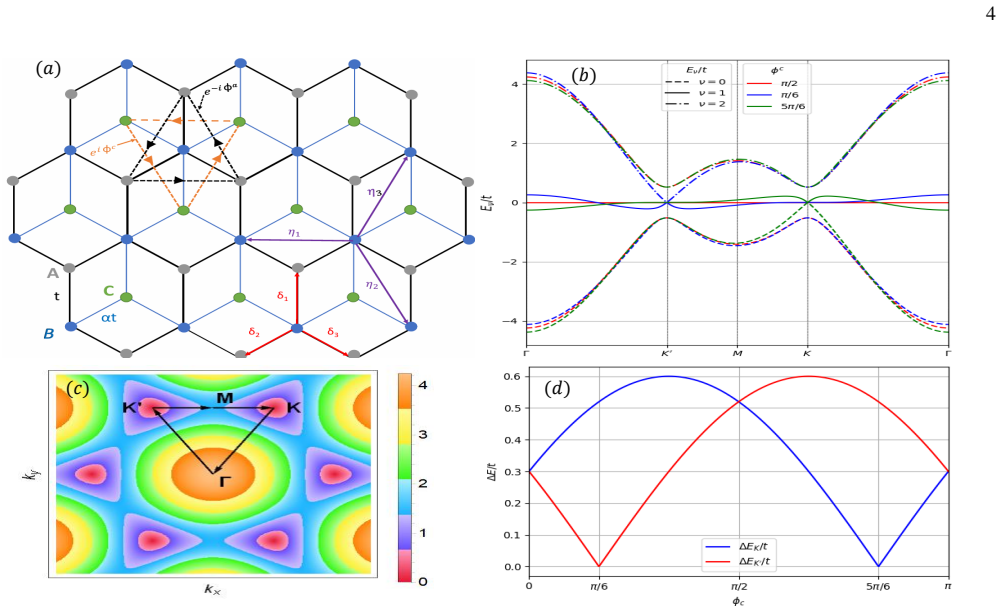
The pith
Modifying next-nearest-neighbor flows in the extended Haldane dice lattice causes topological transitions at specific fluxes that change Chern numbers of every band.
A machine-rendered reading of the paper's core claim, the machinery that carries it, and where it could break.
Core claim
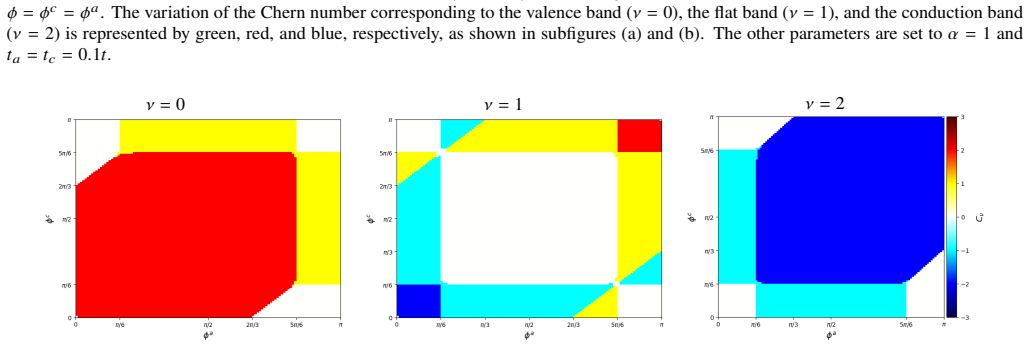
The authors demonstrate point-charge particle symmetries at the critical fluxes φ^c=π/6 and 5π/6 and derive analytical quasi-energies. Gap closure at these points induces topological transitions confirmed by Berry curvature and orbital magnetic moment calculations. The Chern numbers switch as (C0, C1, C2) = (2, -2, 0) or (0, 2, -2) when φ^c equals φ^a, or to (-1, -1) and (1, 1) when they differ, affecting all bands. This produces an anomalous Hall conductivity with a quantized plateau of 2σ0 and an unquantized tilted plateau from 1.50σ0 to 1.25σ0.
What carries the argument
The flux parameters φ^a and φ^c applied to next-nearest-neighbor hoppings, which break inversion and time-reversal symmetries and enable the computation of Chern numbers and Hall conductivity via Berry curvature.
If this is right
- Flux control can be used to engineer topological transitions in the dice lattice.
- All three bands, including the flat band, undergo changes in their topological invariants at the critical points.
- The anomalous Hall conductivity shows both quantized and tilted plateaus that evolve with the transitions.
- Quantum transport can be optimized for low dissipation and robustness by tuning the fluxes.
Where Pith is reading between the lines
- Similar flux engineering might induce flat-band topology in other two-dimensional lattices with degenerate bands.
- These transitions could be tested in cold-atom or photonic realizations of the dice lattice where fluxes are directly tunable.
- The analytical expressions for quasi-energies open the door to studying interaction effects on the topological phases.
- Changes in orbital magnetic moment near the critical fluxes provide an additional experimental signature of the transitions.
Load-bearing premise
The assumption that the tight-binding model with only nearest- and next-nearest-neighbor terms sufficiently captures the physics without higher-order corrections or many-body interactions.
What would settle it
If experiments or exact calculations show that the Hall conductivity does not exhibit the predicted quantized plateau of 2σ0 or the tilt at the specified flux values, the topological transition claim would be falsified.
Figures



read the original abstract
In this study, we examine the introduction of the Haldane model into the dice lattice by altering the flow between the next-nearest-neighbour sites. This breaks the lattice's inversion and time-reversal symmetries. We demonstrate the presence of point-charge particle symmetries at $\phi^c=\pi/6$ and $5\pi/6$ and derive the analytical expression for quasi-energies. We demonstrate that a gap closure occurs at these critical points, inducing a topological transition. This is confirmed by calculating the Berry curvature and orbital magnetic moment. A topological analysis shows that the Chern numbers of the valence band $(\nu=0)$, the flat band $(\nu=1)$ and the conduction band $(\nu=2)$ depend strongly on the relationship between the fluxes $\phi^a $ and $\phi^c$. When $\phi^c = \phi^a$, the Chern numbers are $(C_0, C_1, C_2) = (2, -2, 0)$ in the region $\phi^c \in [0, \pi/6[$, and (0, 2, -2) in the region $\phi^c\in ]5\pi/6, \pi]$. Conversely, when $\phi^c \neq \phi^a$, the topological invariants become $ (C_1, C_2) = (-1, -1)$ for $\phi^c \in [0, \pi/6[$, and $(C_0, C_1, )= (1, 1)$ for $\phi^c\in ]5\pi/6, \pi]$. These variations reflect topological phase transitions at the critical points $\phi^c=\pi/6$ and $5\pi/6$, affecting all of the system's bands. Furthermore, the anomalous Hall conductivity exhibits a quantized plateau of 2$\sigma_{0}$, as well as an unquantized tilted plateau evolving from 1.50$\sigma_{0}$ to 1.25$\sigma_{0}$ at the same transition points. Controlling the flux allows topological transitions to be engineered and quantum transport in the dice lattice to be optimised, offering promising prospects for reconfigurable topological devices with low dissipation and robust quantum transport.
Editorial analysis
A structured set of objections, weighed in public.
Referee Report
Summary. This paper studies an extended version of the Haldane model on the dice lattice, where next-nearest-neighbor hoppings are modified by two independent fluxes φ^a and φ^c to break inversion and time-reversal symmetries. The authors derive analytical expressions for the quasi-energies, identify special points at φ^c = π/6 and 5π/6 where particle symmetries lead to gap closures, and perform topological analysis via Berry curvature and Chern numbers. They report that the Chern numbers of the valence, flat, and conduction bands change at these critical points, with different patterns when φ^c = φ^a versus when they differ, and that the anomalous Hall conductivity shows a quantized plateau of 2σ0 and a tilted plateau varying from 1.50σ0 to 1.25σ0.
Significance. Should the analytical results and the minimal model's predictions prove accurate, the work is significant as it reveals a tunable mechanism for inducing multiple topological phase transitions in a system with flat bands. This could facilitate the design of reconfigurable topological devices with optimized quantum transport and low dissipation, providing specific flux values for transitions and conductivity features that can be tested experimentally. The analytical quasi-energy expressions constitute a clear strength.
major comments (2)
- [Model construction] The two-parameter tight-binding model is used to derive exact gap closures at φ^c=π/6 and 5π/6. However, there is no discussion or calculation addressing whether neglected longer-range hoppings (common in dice lattice materials) would shift these critical points or modify the Chern numbers. This is load-bearing for the central claims of exact transitions and specific conductivity plateaus.
- [Topological analysis] The listed Chern numbers for φ^c ≠ φ^a are incomplete: the expression for the region φ^c ∈ ]5π/6, π] is written as (C0, C1, ) = (1, 1), omitting C2. This makes it difficult to assess the full topological characterization and the claim that transitions affect all bands.
minor comments (3)
- [Abstract] The phrase 'point-charge particle symmetries' is unclear and non-standard in the literature; please define or rephrase it (e.g., if it refers to a particle-hole symmetry or a symmetry at high-symmetry points).
- [Abstract] The definition of σ0 (the conductivity quantum) should be stated explicitly, as it is used in the reported plateaus.
- [Abstract] Ensure consistent notation for the fluxes and bands; some expressions in the abstract appear truncated.
Simulated Author's Rebuttal
We thank the referee for their careful reading of our manuscript and for the constructive comments. We address each of the major comments in detail below.
read point-by-point responses
-
Referee: [Model construction] The two-parameter tight-binding model is used to derive exact gap closures at φ^c=π/6 and 5π/6. However, there is no discussion or calculation addressing whether neglected longer-range hoppings (common in dice lattice materials) would shift these critical points or modify the Chern numbers. This is load-bearing for the central claims of exact transitions and specific conductivity plateaus.
Authors: We thank the referee for this observation. The present work is devoted to the minimal tight-binding model with the two independent fluxes, which enables the derivation of exact quasi-energy expressions and the precise location of the gap-closing points at φ^c = π/6 and 5π/6 due to the underlying particle symmetries. This approach follows the spirit of the original Haldane model. We recognize that real dice-lattice materials may include longer-range hoppings that could in principle alter the critical fluxes and Chern numbers. Since our focus is the minimal model, we have added a short paragraph in the conclusions discussing this limitation and emphasizing that the reported transitions and plateaus are exact within the model considered. Further numerical studies including additional hoppings would be valuable but lie beyond the current scope. revision: partial
-
Referee: [Topological analysis] The listed Chern numbers for φ^c ≠ φ^a are incomplete: the expression for the region φ^c ∈ ]5π/6, π] is written as (C0, C1, ) = (1, 1), omitting C2. This makes it difficult to assess the full topological characterization and the claim that transitions affect all bands.
Authors: We are grateful to the referee for identifying this incompleteness in our presentation. The omission was unintentional. The full Chern numbers in the case φ^c ≠ φ^a are: (C_0, C_1, C_2) = (2, -1, -1) for φ^c ∈ [0, π/6[ and (C_0, C_1, C_2) = (1, 1, -2) for φ^c ∈ ]5π/6, π]. These assignments are consistent with the sum of Chern numbers being zero and demonstrate that the topological transitions at the critical points involve changes in all three bands. We have corrected the manuscript text, the abstract, and the relevant figures' captions accordingly. revision: yes
Circularity Check
No circularity: derivation proceeds from explicit Hamiltonian to analytical spectrum and invariants
full rationale
The paper defines a two-parameter tight-binding Hamiltonian on the dice lattice by adding flux-dependent phases to next-nearest-neighbor hoppings, then derives the quasi-energy eigenvalues in closed form, locates gap closures by setting the determinant or eigenvalues to zero at φ^c = π/6 and 5π/6, and evaluates Chern numbers from direct integration of the Berry curvature over the Brillouin zone. All reported transitions, plateaus in anomalous Hall conductivity, and changes in (C0, C1, C2) follow as algebraic consequences of this model without any fitted parameters being relabeled as predictions, without self-citation chains, and without ansätze imported from prior work by the same authors. The calculation is therefore self-contained within the stated minimal model.
Axiom & Free-Parameter Ledger
free parameters (2)
- φ^a
- φ^c
axioms (2)
- domain assumption The dice lattice can be modeled using a tight-binding Hamiltonian with next-nearest neighbor hoppings modified by phases.
- domain assumption Symmetry breaking by the flux terms leads to non-zero Chern numbers and topological transitions.
Reference graph
Works this paper leans on
-
[1]
Asimilartransitionhasalsobeenobservedat 𝛼=1/ √ 2in an 𝛼−𝑇 3bilayersubjectedtooff-resonancecircularpolarisation [8]
In the semi- Dirac limit, however, the system becomes topologically trivial [3]. Asimilartransitionhasalsobeenobservedat 𝛼=1/ √ 2in an 𝛼−𝑇 3bilayersubjectedtooff-resonancecircularpolarisation [8]. Furthermore, in a cyclic𝛼−𝑇 3 bilayer, the Haldanemodel can produce a Chern number as high as𝐶=5 , with an anomalous Hall conductivity of up to𝜎(𝑥𝑦)=6𝑒 2/ℎ [60]...
-
[2]
We intend to study this transition in the following sections
Consequently, from this symmetry and equation (15), we can deduce the following relationships: 𝐸0 (𝒌, 𝜙 𝑎, 𝜙𝑐 1)=−𝐸 2 (−𝒌, 𝜙 𝑎, 𝜙𝑐 2),(7) 𝐸1 (𝒌, 𝜙 𝑎, 𝜙𝑐 1)=−𝐸 1 (−𝒌, 𝜙 𝑎, 𝜙𝑐 2).(8) From these symmetries, we can predict the existence of a topological phase transition. We intend to study this transition in the following sections. III. QUASI-ENERGY AND BAND ...
-
[3]
and 𝐸1(𝒌, 𝜙 𝑎, 𝜙𝑐 1)=−𝐸 1(−𝒌, 𝜙 𝑎, 𝜙𝑐 2). To determine whether a topological phase transition is occurring, as illustrated in Fig.1(b), we examine two distinct gapssituatedclosetotheDiracpoints 𝑲′ and 𝑲,corresponding to the values𝜙𝑐 1 =𝜋/6 and 𝜙𝑐 2 =5𝜋/6 , respectively. These gaps are evaluated based on the function of the parameter 𝜙𝑐, which makes it pos...
-
[4]
Therefore, we expect a phase transition at𝜙𝑐 1 and 𝜙𝑐
At these values, the gap closes. Therefore, we expect a phase transition at𝜙𝑐 1 and 𝜙𝑐
-
[5]
This will allow us to confirm or refute the existence of a topological transition using a topological invariant: the Chern number
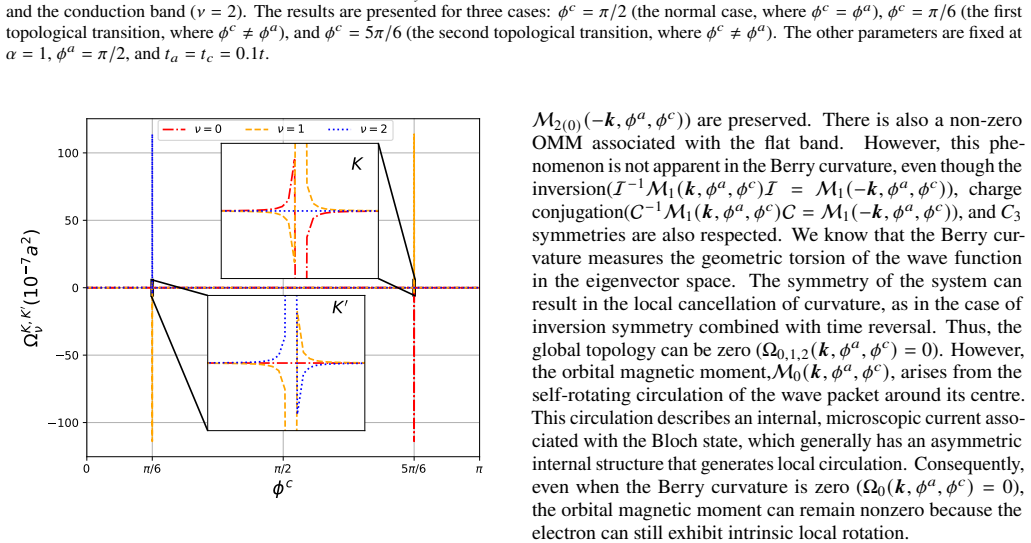
To investigate this, we will study the Berry curvature and the magnetic orbital moment to determine if a phase transition or topological properties are present. This will allow us to confirm or refute the existence of a topological transition using a topological invariant: the Chern number. IV. TOPOLOGICAL SIGNATURES The aim of this section is to study th...
-
[6]
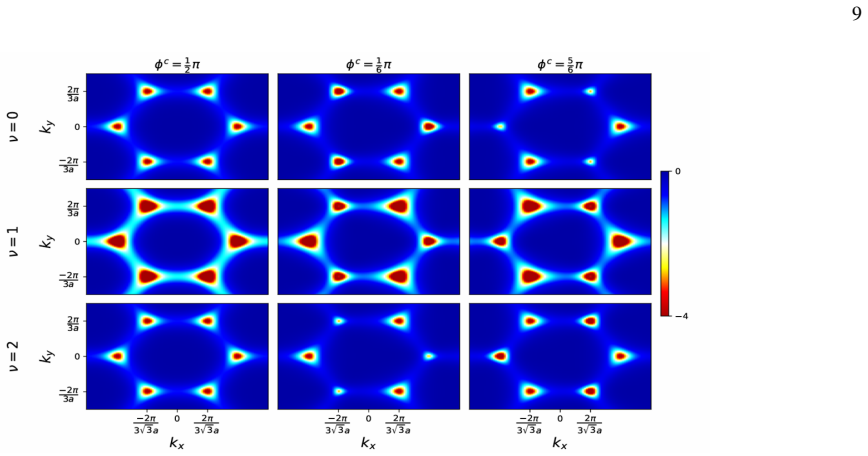
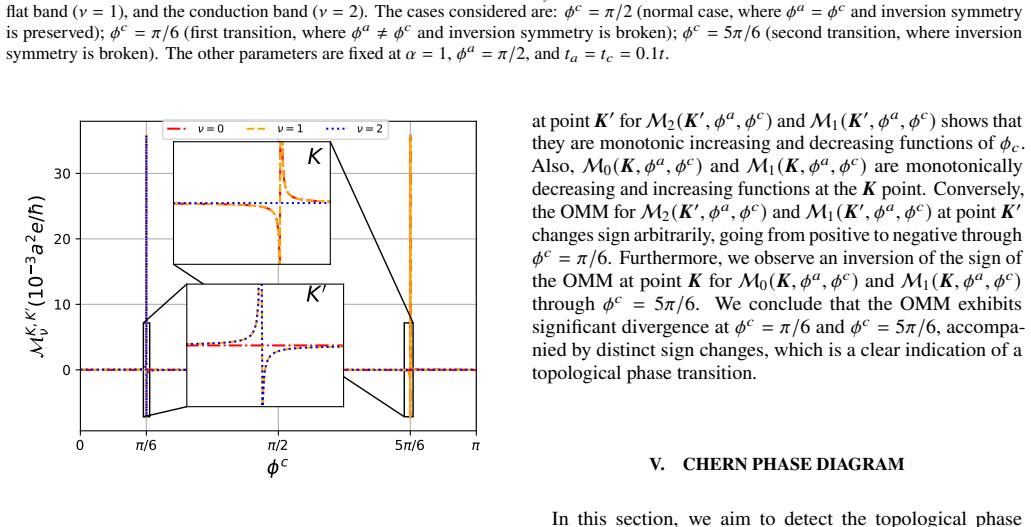
and C −1M1 (𝒌, 𝜙 𝑎, 𝜙𝑐 1)C=M 1 (−𝒌, 𝜙 𝑎, 𝜙𝑐 2). Breaking the inver- sionsymmetryinducesachangeintheOMMvaluesassociated with the conduction and flat bands at the Dirac point𝑲′ for 𝜙𝑐 =𝜋/6 , as well as in the valence and flat bands at the𝑲 point for 𝜙𝑐 =5𝜋/6 . These values were indeed not chosen arbitrarily. They are related by the transformation𝜙𝑐 2 =𝜋−𝜙 𝑐...
-
[7]
<i>Colloquium</i> : Quantum anomalous Hall effect
C. Z. Chang, C. X. Liu, and A. H. MacDonald, "Colloquium: Quantum anomalous Hall effect,"Re- views of Modern Physics95, no. 1 (2023): 011002. https://doi.org/10.1103/RevModPhys.95.011002
-
[8]
Giant anomalous Hall effect in a ferromagnetic kagome-lattice semimetal,
E. Liu, Y. Sun, N. Kumar, et al., "Giant anomalous Hall effect in a ferromagnetic kagome-lattice semimetal,"Nature Physics14, no. 11 (2018): 1125-1131. https://doi.org/10.1038/s41567-018- 0234-5
-
[9]
Opti- cally controlled topological phases in the deformed 𝛼– T3 lattice,
O. Benhaida, E. H. Saidi, and L. B. Drissi, "Opti- cally controlled topological phases in the deformed 𝛼– T3 lattice,"Annals of Physics482 (2025): 170203. https://doi.org/10.1016/j.aop.2025.170203
-
[10]
Confinement-induced chiral edge channel interaction in quantum anomalous Hall insulators,
L. J. Zhou, R. Mei, Y. F. Zhao, et al., "Confinement-induced chiral edge channel interaction in quantum anomalous Hall insulators,"Physical Review Letters130, no. 8 (2023): 086201. https://doi.org/10.1103/PhysRevLett.130.086201
-
[11]
Zero magnetic field plateauphasetransitioninhigherChernnumberquantumanoma- lousHallinsulators,
Y. F. Zhao, R. Zhang, L. J. Zhou, et al., "Zero magnetic field plateauphasetransitioninhigherChernnumberquantumanoma- lousHallinsulators,"PhysicalReviewLetters128,no.21(2022): 216801. https://doi.org/10.1103/PhysRevLett.128.216801
-
[12]
Exploring topological phases in superconducting transition metal (Sc, Ti, V)-carbides,
A. Elbahri, M. Ragragui, L. B. Drissi, and E. H. Saidi, "Exploring topological phases in superconducting transition metal (Sc, Ti, V)-carbides,"Materials Sci- ence in Semiconductor Processing186 (2025): 108993. https://doi.org/10.1016/j.mssp.2024.108993
-
[13]
Chern insula- tors at integer and fractional filling in moiré pentalayer graphene,
D. Waters, A. Okounkova, R. Su, et al., "Chern insula- tors at integer and fractional filling in moiré pentalayer graphene,"Physical Review X15, no. 1 (2025): 011045. https://doi.org/10.1103/PhysRevX.15.011045
-
[14]
TopologicalPropertiesofBilayer 𝛼−𝑇3LatticeInducedbyPolar- izedLight,
O. Benhaida, E. H. Saidi, L. B. Drissi, and R. Ahl Laamara, "TopologicalPropertiesofBilayer 𝛼−𝑇3LatticeInducedbyPolar- izedLight,"AdvancedQuantumTechnologies(2025): e2500064. https://doi.org/10.1002/qute.202500064
-
[15]
Tunable moiré materials for probing Berry physics and topol- ogy,
P. C. Adak, S. Sinha, A. Agarwal, and M. M. Deshmukh, "Tunable moiré materials for probing Berry physics and topol- ogy,"Nature Reviews Materials9, no. 7 (2024): 481-498. https://doi.org/10.1038/s41578-024-00671-4
-
[16]
Engineering Topological Transitions in Multi-Orbital Buck- led Honeycomb Lattices,
J. Benkaida, O. Benhaida, L. B. Drissi, and E. H. Saidi, "Engineering Topological Transitions in Multi-Orbital Buck- led Honeycomb Lattices,"Physics Letters A(2025): 130954. https://doi.org/10.1016/j.physleta.2025.130954
-
[17]
Second order topology in a band en- gineered Chern insulator,
S. Lahiri and S. Basu, "Second order topology in a band en- gineered Chern insulator,"Scientific Reports14, no. 1 (2024):
2024
-
[18]
https://doi.org/10.1038/s41598-024-52321-y
-
[19]
Domain Walls in Topological Tri-hinge Matter,
L. B. Drissi and E. H. Saidi, "Domain Walls in Topological Tri-hinge Matter,"European Physical Journal Plus136 (2021):
2021
-
[20]
https://doi.org/10.1140/epjp/s13360-020-01037-9
-
[21]
Anomalous bilayer quantum Hall effect,
G. Sethi, D. N. Sheng, and F. Liu, "Anomalous bilayer quantum Hall effect,"Physical Review B108, no. 16 (2023): L161112. https://doi.org/10.1103/PhysRevB.108.L161112
-
[22]
Higherordertopological matter and fractional chiral states,
L.B.Drissi,S.Lounis,andE.H.Saidi,"Higherordertopological matter and fractional chiral states,"The European Physical Jour- nal Plus137 (2022): 796. https://doi.org/10.1140/epjp/s13360- 022-02975-2
-
[23]
F. D. M. Haldane, "Model for a Quantum Hall Effect without Landau Levels: Condensed-Matter Realization of the ’Parity Anomaly’,"Physical Review Letters61 (1988): 2015–2018. https://doi.org/10.1103/PhysRevLett.61.2015
-
[24]
C.-Z. Chang, J. Zhang, X. Feng, et al., "Experimental Ob- servation of the Quantum Anomalous Hall Effect in a Mag- netic Topological Insulator,"Science340 (2013): 167–170. https://doi.org/10.1126/science.1234414
-
[25]
Topo- logical field theory of time-reversal invariant insula- tors,
X. L. Qi, T. L. Hughes, and S. C. Zhang, "Topo- logical field theory of time-reversal invariant insula- tors,"Physical Review B78, no. 19 (2008): 195424. https://doi.org/10.1103/PhysRevB.78.195424
-
[26]
Quantized Hall conductance in a two-dimensional peri- odic potential,
D. J. Thouless, M. Kohmoto, M. P. Nightingale, and M. den Nijs, "Quantized Hall conductance in a two-dimensional peri- odic potential,"Physical Review Letters49, no. 6 (1982): 405. https://doi.org/10.1103/PhysRevLett.49.405
-
[27]
H. Weng, R. Yu, X. Hu, X. Dai, and Z. Fang, "Quan- tum anomalous Hall effect and related topological electronic states,"Advances in Physics64, no. 3 (2015): 227-282. https://doi.org/10.1080/00018732.2015.1068524
-
[28]
Quantum anomalous Hall effect with higher plateaus,
J. Wang, B. Lian, H. Zhang, Y. Xu, and S. C. Zhang, "Quantum anomalous Hall effect with higher plateaus," Physical Review Letters111, no. 13 (2013): 136801. https://doi.org/10.1103/PhysRevLett.111.136801
-
[29]
Large-Chern- number quantum anomalous Hall effect in thin-film topological crystallineinsulators,
C. Fang, M. J. Gilbert, and B. A. Bernevig, "Large-Chern- number quantum anomalous Hall effect in thin-film topological crystallineinsulators,"PhysicalReviewLetters112,no.4(2014): 046801. https://doi.org/10.1103/PhysRevLett.112.046801
-
[30]
Tuning the Chern number in quantum anomalous Hall insulators,
Y. F. Zhao, R. Zhang, R. Mei, et al., "Tuning the Chern number in quantum anomalous Hall insulators,"Nature588, no. 7838 (2020): 419-423. https://doi.org/10.1038/s41586-020-3020-3
-
[31]
High-Chern-number Quan- tum anomalous Hall insulators in mixing-stacked𝑀𝑛𝐵𝑖 2𝑇 𝑒4 thin films,
J. Li, Q. Wu, and H. Weng, "High-Chern-number Quan- tum anomalous Hall insulators in mixing-stacked𝑀𝑛𝐵𝑖 2𝑇 𝑒4 thin films,"npj Quantum Materials10, no. 1 (2025): 53. https://doi.org/10.1038/s41535-025-00775-2
-
[32]
Y. Cao, V. Fatemi, S. Fang, et al., "Unconventional superconduc- tivity in magic-angle graphene superlattices,"Nature556, no. 7699 (2018): 43-50. https://doi.org/10.1038/nature26160
-
[33]
Screening two- dimensional materials with topological flat bands,
H. Liu, S. Meng, and F. Liu, "Screening two- dimensional materials with topological flat bands,"Phys- ical Review Materials5, no. 8 (2021): 084203. https://doi.org/10.1103/PhysRevMaterials.5.084203
-
[34]
Topological flat bands without magic angles in massive twisted bilayer graphenes,
S. Javvaji, J. H. Sun, and J. Jung, "Topological flat bands without magic angles in massive twisted bilayer graphenes,"Physical Review B101, no. 12 (2020): 125411. https://doi.org/10.1103/PhysRevB.101.125411
-
[35]
Y. Park, Y. Kim, B. L. Chittari, and J. Jung, "Topo- logical flat bands in rhombohedral tetralayer and multi- layer graphene on hexagonal boron nitride moiré superlat- tices,"Physical Review B108, no. 15 (2023): 155406. https://doi.org/10.1103/PhysRevB.108.155406
-
[36]
Gate- tunable topological flat bands in trilayer graphene boron-nitride moiré superlattices,
B. L. Chittari, G. Chen, Y. Zhang, F. Wang, and J. Jung, "Gate- tunable topological flat bands in trilayer graphene boron-nitride moiré superlattices,"Physical Review Letters122, no. 1 (2019): 016401. https://doi.org/10.1103/PhysRevLett.122.016401
-
[37]
BCS theory on a flat band lattice,
S. Miyahara, S. Kusuta, and N. Furukawa, "BCS theory on a flat band lattice,"Physica C: Superconductivity460 (2007): 1145-1146. https://doi.org/10.1016/j.physc.2007.03.393
-
[38]
Designer flat bands: Topology and enhancement of superconduc- tivity,
S. M. Chan, B. Grémaud, and G. G. Batrouni, "Designer flat bands: Topology and enhancement of superconduc- tivity,"Physical Review B106, no. 10 (2022): 104514. https://doi.org/10.1103/PhysRevB.106.104514 15
-
[39]
High-temperaturefractional quantumHallstates,
E.Tang,J.W.Mei,andX.G.Wen,"High-temperaturefractional quantumHallstates,"PhysicalReviewLetters106,no.23(2011): 236802. https://doi.org/10.1103/PhysRevLett.106.236802
-
[40]
Fractional quantum Hall states at zero magnetic field,
T. Neupert, L. Santos, C. Chamon, and C. Mudry, "Fractional quantum Hall states at zero magnetic field," Physical Review Letters106, no. 23 (2011): 236804. https://doi.org/10.1103/PhysRevLett.106.236804
-
[41]
Y. Zhou, G. Sethi, H. Liu, Z. Wang, and F. Liu, "Excited quantum anomalous and spin Hall effect: dissociation of flat- bands-enabled excitonic insulator state,"Nanotechnology33, no. 41 (2022): 415001. https://doi.org/10.1088/1361-6528/ac7a4b
-
[42]
Topological flat bands and higher- order topology in square-octagon lattice,
A. Mukherjee and B. Singh, "Topological flat bands and higher- order topology in square-octagon lattice,"arXiv preprint(2024): arXiv:2410.04515. https://doi.org/10.48550/arXiv.2410.04515
-
[43]
K. Ohgushi, S. Murakami, and N. Nagaosa, "Spin anisotropy and quantum Hall effect in the kagomé lattice: Chiral spin state based on a ferromagnet,"Physical Review B62, no. 10 (2000): R6065. https://doi.org/10.1103/PhysRevB.62.R6065
-
[44]
Quantum states and intertwining phases in kagome ma- terials,
Y. Wang, H. Wu, G. T. McCandless, J. Y. Chan, and M. N. Ali, "Quantum states and intertwining phases in kagome ma- terials,"Nature Reviews Physics5, no. 11 (2023): 635-658. https://doi.org/10.1038/s42254-023-00635-7
-
[45]
Topological band evolution between Lieb and kagome lattices,
W. Jiang, M. Kang, H. Huang, H. Xu, T. Low, and F. Liu, "Topological band evolution between Lieb and kagome lattices,"Physical Review B99, no. 12 (2019): 125131. https://doi.org/10.1103/PhysRevB.99.125131
-
[46]
Localization of electronic wave functions due to local topology,
B. Sutherland, "Localization of electronic wave functions due to local topology,"Physical Review B34, no. 8 (1986): 5208. https://doi.org/10.1103/PhysRevB.34.5208
-
[47]
Magnonsonadicelattice: Topological featuresandtransportproperties,
S.DebnathandS.Basu,"Magnonsonadicelattice: Topological featuresandtransportproperties,"PhysicalReviewB111,no.15 (2025): 155418. https://doi.org/10.1103/PhysRevB.111.155418
-
[48]
Unconventionalphases inaHaldanemodelofdicelattice,
B.Dey,P.Kapri,O.Pal,andT.K.Ghosh,"Unconventionalphases inaHaldanemodelofdicelattice,"PhysicalReviewB101,no.23 (2020): 235406. https://doi.org/10.1103/PhysRevB.101.235406
-
[49]
A. Raoux, M. Morigi, J. N. Fuchs, F. Piéchon, and G. Mon- tambaux, "From dia-to paramagnetic orbital susceptibility of massless fermions,"Physical Review Letters112, no. 2 (2014): 026402. https://doi.org/10.1103/PhysRevLett.112.026402
-
[50]
E. Illes, J. P. Carbotte, and E. J. Nicol, "Hall quantization and optical conductivity evolution with variable Berry phase in the 𝛼−𝑇 3 model,"Physical Review B92, no. 24 (2015): 245410. https://doi.org/10.1103/PhysRevB.92.245410
-
[51]
Klein tunneling and Fabry-Perot resonances in the𝛼−𝑇 3 bilayer with aligned stacking,
O.Benhaida,L.B.Drissi,E.H.Saidi,andR.A.Laamara,"Klein tunneling and Fabry-Perot resonances in the𝛼−𝑇 3 bilayer with aligned stacking,"Physica Scripta99, no. 8 (2024): 085958. https://doi.org/10.1088/1402-4896/ad5f5c
-
[52]
Aharonov-Bohm cages in two-dimensional structures,
J. Vidal, R. Mosseri, and B. Douçot, "Aharonov-Bohm cages in two-dimensional structures,"Physical Review Letters81, no. 26 (1998): 5888. https://doi.org/10.1103/PhysRevLett.81.5888
-
[53]
Massless Dirac-Weyl fermions in a 𝑇3 optical lat- tice,
D. Bercioux, D. F. Urban, H. Grabert, and W. Häusler, "Massless Dirac-Weyl fermions in a 𝑇3 optical lat- tice,"Physical Review A80, no. 6 (2009): 063603. https://doi.org/10.1103/PhysRevA.80.063603
-
[54]
Magneto-optics of mass- less Kane fermions: Role of the flat band and unusual Berry phase,
J. D. Malcolm and E. J. Nicol, "Magneto-optics of mass- less Kane fermions: Role of the flat band and unusual Berry phase,"Physical Review B92, no. 3 (2015): 035118. https://doi.org/10.1103/PhysRevB.92.035118
-
[55]
Atomistic spin model simulations of magnetic nanomaterials,
T. Biswas and T. K. Ghosh, "Magnetotransport properties of the 𝛼−𝑇 3 model,"Journal of Physics: Condensed Mat- ter28, no. 49 (2016): 495302. https://doi.org/10.1088/0953- 8984/28/49/495302
-
[56]
S. Mondal and S. Basu, "Topological features of the Hal- dane model on a dice lattice: Flat-band effect on transport properties,"Physical Review B107, no. 3 (2023): 035421. https://doi.org/10.1103/PhysRevB.107.035421
-
[57]
Chi- ral states induced by symmetry breaking terms in 𝛼−𝑇 3 lattices,
J. P. G. Nascimento, S. M. Cunha, M. L. A. Paz, et al., "Chi- ral states induced by symmetry breaking terms in 𝛼−𝑇 3 lattices,"Physical Review B112, no. 12 (2025): 125410. https://doi.org/10.1103/b4tj-5rky
-
[58]
Electron-phonon coupling induced topological phase transition in an𝛼−𝑇 3 Haldane-Holstein model,
M. Islam, K. Bhattacharyya, and S. Basu, "Electron-phonon coupling induced topological phase transition in an𝛼−𝑇 3 Haldane-Holstein model,"Physical Review B110, no. 4 (2024): 045426. https://doi.org/10.1103/PhysRevB.110.045426
-
[59]
K. Bhattacharyya, S. Lahiri, M. Islam, and S. Basu, "Holstein polaron in a pseudospin-1 quantum spin Hall system: First-and second-order topological phase transi- tions,"Physical Review B110, no. 23 (2024): 235432. https://doi.org/10.1103/PhysRevB.110.235432
-
[60]
P. Parui and B. L. Chittari, "Valley-polarized quantum anoma- lous Hall and topological metal phase in a Rashba-induced pseudospin-1 lattice,"Physical Review B112, no. 7 (2025): 075133. https://doi.org/10.1103/4sq5-x2jy
-
[61]
A novel single-crystal & single-pass source for polarisation- and colour-entangled photon pairs,
F.Li,Q.Zhang,andK.S.Chan,"Noveltransportpropertiesofthe 𝛼−𝑇3latticewithuniformelectricandmagneticfields,"Scientific Reports12,no.1(2022): 12987.https://doi.org/10.1038/s41598- 022-17288-8
-
[62]
Band-gap formation and morphing in 𝛼−𝑇 3 superlattices,
S.M.Cunha,D.R.DaCosta,J.M.PereiraJr,R.C.Filho,B.Van Duppen, and F. M. Peeters, "Band-gap formation and morphing in 𝛼−𝑇 3 superlattices,"Physical Review B104, no. 11 (2021): 115409. https://doi.org/10.1103/PhysRevB.104.115409
-
[63]
Topological phases of a semi- Dirac Chern insulator in the presence of extended range hopping,
S. Mondal and S. Basu, "Topological phases of a semi- Dirac Chern insulator in the presence of extended range hopping,"Physical Review B105, no. 23 (2022): 235441. https://doi.org/10.1103/PhysRevB.105.235441
-
[64]
K. W. Lee, P. H. Fu, and Y. S. Ang, "Interplay between Haldane and modified Haldane models in𝛼−𝑇 3 lattice: Band structures, phase diagrams, and edge states,"Physical Review B109, no. 23 (2024): 235105. https://doi.org/10.1103/PhysRevB.109.235105
-
[65]
Orbital magnetization senses the topological phase transition in a spin-orbit coupled 𝛼−𝑇 3 system,
L. Tamang, S. Verma, and T. Biswas, "Orbital magnetization senses the topological phase transition in a spin-orbit coupled 𝛼−𝑇 3 system,"Physical Review B110, no. 16 (2024): 165426. https://doi.org/10.1103/PhysRevB.110.165426
-
[66]
Floquetengineeringoftopologicalphasetransitionsin aquantumspinHall 𝛼−𝑇 3 system,
K.W.Lee,M.J.A.Calderon,X.L.Yu,C.H.Lee,Y.S.Ang,and P.H.Fu,"Floquetengineeringoftopologicalphasetransitionsin aquantumspinHall 𝛼−𝑇 3 system,"PhysicalReviewB111,no.4 (2025): 045406. https://doi.org/10.1103/PhysRevB.111.045406
-
[67]
Floquettopologicalphasetransitionin the 𝛼−𝑇 3 lattice,
B.DeyandT.K.Ghosh, "Floquettopologicalphasetransitionin the 𝛼−𝑇 3 lattice,"PhysicalReviewB99,no.20(2019): 205429. https://doi.org/10.1103/PhysRevB.99.205429
-
[68]
Topological properties of nearly flat bands in bilayer 𝛼−𝑇 3 lat- tice,
P. Parui, S. Ghosh, and B. L. Chittari, "Topological properties of nearly flat bands in bilayer 𝛼−𝑇 3 lat- tice,"Physical Review B109, no. 16 (2024): 165118. https://doi.org/10.1103/PhysRevB.109.165118
-
[69]
Quantized Anomalous Hall Effect in Two-Dimensional Ferromagnets: Quantum Hall Effect in Metals,
M. Onoda and N. Nagaosa, "Quantized Anomalous Hall Effect in Two-Dimensional Ferromagnets: Quantum Hall Effect in Metals,"Physical Review Letters90, no. 20 (2003): 206601. https://doi.org/10.1103/PhysRevLett.90.206601
-
[70]
Elec- tronic states of pseudospin-1 fermions in dice lattice ribbon,
D. O. Oriekhov, E. V. Gorbar, and V. P. Gusynin, "Elec- tronic states of pseudospin-1 fermions in dice lattice ribbon," Low Temperature Physics44, no. 12 (2018): 1313-1324. https://doi.org/10.1063/1.5078627
-
[71]
Probing topological signatures in an optically driven𝛼−𝑇 3 lattice,
L. Tamang and T. Biswas, "Probing topological signatures in an optically driven𝛼−𝑇 3 lattice,"Physical Review B107, no. 8 (2023): 085408. https://doi.org/10.1103/PhysRevB.107.085408
-
[72]
D. Xiao, M.-C. Chang, and Q. Niu, "Berry phase effects on elec- tronic properties,"Reviews of Modern Physics82, no. 3 (2010): 1959-2007. https://doi.org/10.1103/RevModPhys.82.1959 16
-
[73]
Role of Berry cur- vature in the generation of spin currents in Rashba sys- tems,
P. Kapri, B. Dey, and T. K. Ghosh, "Role of Berry cur- vature in the generation of spin currents in Rashba sys- tems,"Physical Review B103, no. 16 (2021): 165401. https://doi.org/10.1103/PhysRevB.103.165401
-
[74]
W. Ning and Z. Mao, "Recent advancements in the study of intrinsic magnetic topological insulators and magnetic Weyl semimetals,"APL Materials8, no. 9 (2020): 090701. https://doi.org/10.1063/5.0015328
-
[75]
M. C. Chang and Q. Niu, "Berry phase, hyperorbits, and the Hofstadter spectrum: Semiclassical dynamics in magnetic Bloch bands,"Physical Review B53, no. 11 (1996): 7010. https://doi.org/10.1103/PhysRevB.53.7010
-
[76]
Theory of orbital magnetization in solids,
T. Thonhauser, "Theory of orbital magnetization in solids," International Journal of Modern Physics B25, no. 11 (2011): 1429-1458. https://doi.org/10.1142/S0217979211058912
-
[77]
Physical Review Letters99(23), 236809 (2007) https://doi.org/10.1103/PhysRevLett.99.236809
D. Xiao, W. Yao, and Q. Niu, "Valley-Contrasting Physics in Graphene: Magnetic Moment and Topolog- ical Transport,"Phys. Rev. Lett.99 (2007): 236809. https://doi.org/10.1103/PhysRevLett.99.236809
-
[78]
Intrinsic hall conductivities induced by the orbital magnetic moment,
K. Das and A. Agarwal, "Intrinsic hall conductivities induced by the orbital magnetic moment,"Physical Review B103, no. 12 (2021): 125432. https://doi.org/10.1103/PhysRevB.103.125432
-
[79]
Topologi- cal–chiral magnetic interactions driven by emergent orbital magnetism,
S. Grytsiuk, J. P. Hanke, M. Hoffmann, et al., "Topologi- cal–chiral magnetic interactions driven by emergent orbital magnetism,"Nature Communications11, no. 1 (2020): 511. https://doi.org/10.1038/s41467-019-14030-3
-
[80]
Nonlinearity-inducedtopologicalphasetransitioncharacterized bythenonlinearChernnumber,
K. Sone, M. Ezawa, Y. Ashida, N. Yoshioka, and T. Sagawa, "Nonlinearity-inducedtopologicalphasetransitioncharacterized bythenonlinearChernnumber,"NaturePhysics20,no.7(2024): 1164-1170. https://doi.org/10.1038/s41567-024-02451-x
discussion (0)
Sign in with ORCID, Apple, or X to comment. Anyone can read and Pith papers without signing in.