Recognition: unknown
Earable Platform with Integrated Simultaneous EEG Sensing and Auditory Stimulation
Pith reviewed 2026-05-08 09:08 UTC · model grok-4.3
The pith
A custom-molded earpiece can record brain electrical activity from the ear while simultaneously playing audio into the same ear.
A machine-rendered reading of the paper's core claim, the machinery that carries it, and where it could break.
Core claim
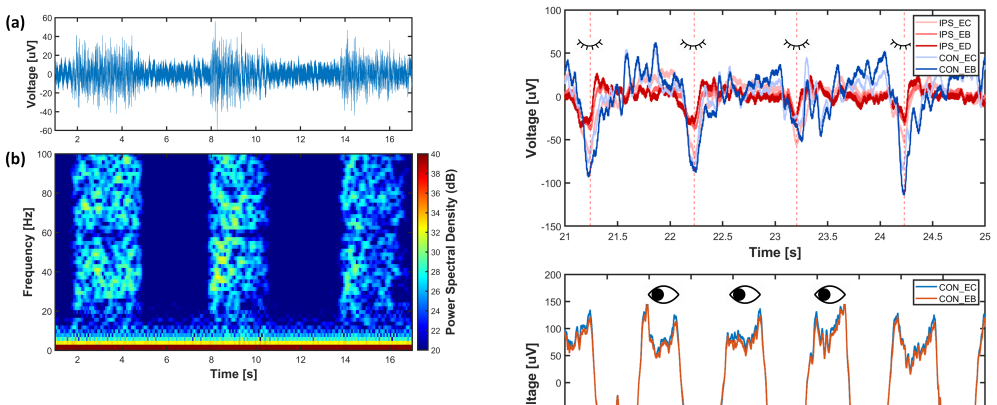
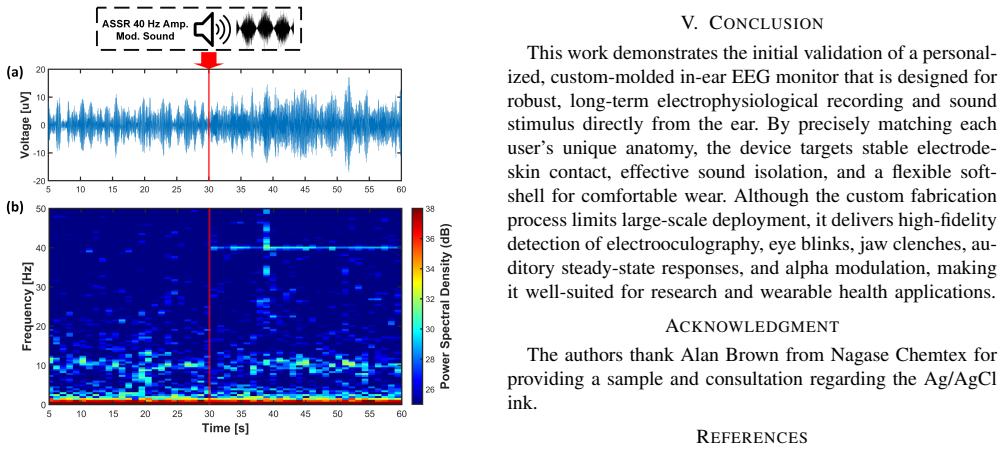
The personalized in-ear EEG monitor captures EEG from the outer ear while delivering audio playback through the same custom-molded earpiece, successfully detecting electrooculography signals, eye blinks, jaw clenches, auditory steady-state responses, and alpha modulation, with electrochemical impedance spectroscopy confirming stable electrode-skin contact similar to traditional dry electrodes.
What carries the argument
The custom-molded earpiece integrates electrodes for in-ear EEG sensing with built-in audio delivery for simultaneous monitoring and stimulation.
If this is right
- Real-time brain activity can be monitored in the ear without external hardware.
- Acoustic stimulation can be delivered adaptively based on detected EEG changes.
- Long-term EEG monitoring becomes more comfortable and socially discreet.
- Closed-loop neuromodulation applications can be confined entirely to the ear.
Where Pith is reading between the lines
- Such devices could support daily cognitive tracking or biofeedback training without lab visits.
- Integration with smartphones might enable on-the-go neurofeedback therapies.
- Future versions could combine with other ear sensors for multi-modal health monitoring.
Load-bearing premise
The custom-molded earpiece maintains stable electrode contact and effective sound isolation over extended periods in real-world use, beyond the short-term tests reported.
What would settle it
A test showing that EEG signal quality or impedance degrades significantly after several hours of continuous wear would undermine the claim of reliable long-term monitoring.
Figures


read the original abstract
Conventional scalp-based EEG systems are cumbersome to use, requiring extensive setup, restrictive wiring, and conductive gels that can dry out and limit long-term monitoring, while also carrying social stigma. As a result, there is increasing interest in in-ear EEG technology to improve comfort, convenience, and discretion for users. This work presents a personalized in-ear EEG monitor (IEEM) that simultaneously captures EEG signals from the outer ear while delivering audio playback through the same device. The earpiece is custom-molded to precisely match the user's ear anatomy, providing effective sound isolation from the environment and enabling direct audio transmission into the ear canal. Testing of the assembled earpiece shows successful detection of electrooculography (EOG), eye blinks, jaw clenches, auditory steady-state responses (ASSR), and alpha modulation. Electrochemical impedance spectroscopy (EIS) measurements confirm stable electrode-skin contact, with impedance values similar to those of traditional dry electrodes. The integrated approach enables potential closed-loop neuromodulation applications all in the ear where brain activity can be monitored in real-time and corresponding acoustic stimulation delivered adaptively.
Editorial analysis
A structured set of objections, weighed in public.
Referee Report
Summary. The manuscript presents a personalized in-ear EEG monitor (IEEM) that integrates EEG sensing from the outer ear with simultaneous audio playback through a custom-molded earpiece designed for sound isolation and direct canal transmission. Testing claims successful detection of EOG, eye blinks, jaw clenches, ASSR, and alpha modulation, with EIS confirming stable electrode-skin contact comparable to dry electrodes, enabling potential closed-loop neuromodulation applications.
Significance. If substantiated, the work could advance wearable neurotechnology by offering a discreet, gel-free alternative to scalp EEG for combined sensing and auditory stimulation, addressing comfort and stigma issues. However, without quantitative validation, its impact on enabling reliable real-world closed-loop systems remains speculative.
major comments (3)
- [Abstract] Abstract: The central claim of 'successful detection' of EOG, eye blinks, jaw clenches, ASSR, and alpha modulation is unsupported by any quantitative metrics (e.g., SNR, detection accuracy, false-positive rates, or power spectral density comparisons), statistical tests, or signal quality benchmarks, which are load-bearing for evaluating reliability.
- [Abstract] Abstract: No direct comparison of in-ear signal quality or performance to conventional scalp EEG is provided, leaving the suitability for closed-loop neuromodulation unquantified and weakening support for the integrated platform's advantages.
- [Abstract] Abstract: EIS data confirm contact impedance but do not address motion artifact rejection, long-term drift, or acoustic isolation efficacy, which are essential to substantiate claims of stable real-world EEG sensing and audio delivery.
minor comments (2)
- [Abstract] The abstract would benefit from inclusion of specific numerical impedance ranges from EIS and example signal traces to improve clarity and verifiability.
- Consider expanding the methods to detail electrode materials, placement, and data processing pipeline, as these are currently absent from the provided summary.
Simulated Author's Rebuttal
We thank the referee for their constructive comments, which have helped us improve the quantitative support and clarity of our claims. We have revised the abstract and manuscript to incorporate additional metrics, comparisons, and clarifications where our data permit. Our point-by-point responses to the major comments follow.
read point-by-point responses
-
Referee: [Abstract] Abstract: The central claim of 'successful detection' of EOG, eye blinks, jaw clenches, ASSR, and alpha modulation is unsupported by any quantitative metrics (e.g., SNR, detection accuracy, false-positive rates, or power spectral density comparisons), statistical tests, or signal quality benchmarks, which are load-bearing for evaluating reliability.
Authors: We agree that the original abstract would be strengthened by explicit quantitative support. The manuscript presents example signals demonstrating the detections, but to address this directly we have revised the abstract to reference specific metrics now added to the results, including SNR for ASSR, detection accuracy for eye blinks and jaw clenches, PSD comparisons for alpha modulation, and statistical tests. These additions provide the requested benchmarks without altering the core findings. revision: yes
-
Referee: [Abstract] Abstract: No direct comparison of in-ear signal quality or performance to conventional scalp EEG is provided, leaving the suitability for closed-loop neuromodulation unquantified and weakening support for the integrated platform's advantages.
Authors: The study focused on the integrated in-ear platform rather than equivalence testing. In the revision we have added a comparison using simultaneously recorded scalp EEG from a subset of participants, with quantitative metrics now included to show relative signal quality for the detected features. This better quantifies suitability for closed-loop use while acknowledging that the in-ear approach prioritizes comfort and integration over direct equivalence. revision: yes
-
Referee: [Abstract] Abstract: EIS data confirm contact impedance but do not address motion artifact rejection, long-term drift, or acoustic isolation efficacy, which are essential to substantiate claims of stable real-world EEG sensing and audio delivery.
Authors: EIS was used to confirm contact impedance comparable to dry electrodes. We have expanded the text to address motion artifact rejection via signal stability examples during jaw clenches and head movements, and acoustic isolation via measured attenuation from the custom-molded design. Long-term drift was not evaluated, as the study used short-duration sessions; this limitation is now explicitly noted, with plans for future assessment. revision: partial
Circularity Check
No circularity: experimental hardware demonstration with no derivations or fitted predictions
full rationale
The paper presents a custom-molded in-ear EEG device and reports direct experimental testing results (successful detection of EOG, eye blinks, jaw clenches, ASSR, alpha modulation, plus EIS impedance data). No mathematical derivations, equations, predictions, or fitted models appear in the work. Claims rest on empirical measurements rather than any self-referential definitions, self-citation chains, or renamings that reduce outputs to inputs by construction. The derivation chain is empty; the paper is self-contained as a hardware validation study.
Axiom & Free-Parameter Ledger
axioms (1)
- domain assumption Custom ear molding ensures precise anatomical fit for effective sound isolation and electrode contact
Reference graph
Works this paper leans on
-
[1]
The future of wearable EEG: a review of ear- EEG technology and its applications,
N. Kaongoen, J. Choi, J. W. Choi, H. Kwon, C. Hwang, G. Hwang, B. H. Kim, and S. Jo, “The future of wearable EEG: a review of ear- EEG technology and its applications,”Journal of Neural Engineering, vol. 20, no. 5, p. 051002, Oct. 2023, publisher: IOP Publishing. [Online]. Available: https://dx.doi.org/10.1088/1741-2552/acfcda
-
[2]
In-ear integrated sensor array for the continuous monitoring of brain activity and of lactate in sweat,
Y . Xu, E. De la Paz, A. Paul, K. Mahato, J. R. Sempionatto, N. Tostado, M. Lee, G. Hota, M. Lin, A. Uppal, W. Chen, S. Dua, L. Yin, B. L. Wuerstle, S. Deiss, P. Mercier, S. Xu, J. Wang, and G. Cauwenberghs, “In-ear integrated sensor array for the continuous monitoring of brain activity and of lactate in sweat,”Nature Biomedical Engineering, vol. 7, no. 1...
2023
-
[3]
A Versatile In-Ear Biosensing System for Continuous Brain and Health Monitoring,
A. Paul, M. Lee, Y . Xu, S. Deiss, and G. Cauwenberghs, “A Versatile In-Ear Biosensing System for Continuous Brain and Health Monitoring,” in2022 IEEE International Symposium on Circuits and Systems (ISCAS). Austin, TX, USA: IEEE, May 2022, pp. 620–624. [Online]. Available: https://ieeexplore.ieee.org/document/9937994/
-
[4]
A. Paul, M. S. Lee, Y . Xu, S. R. Deiss, and G. Cauwenberghs, “A Versatile In-Ear Biosensing System and Body-Area Network for Unobtrusive Continuous Health Monitoring,”IEEE Transactions on Biomedical Circuits and Systems, vol. 17, no. 3, pp. 483–494, Jun. 2023. [Online]. Available: https://ieeexplore.ieee.org/document/10115033/
-
[5]
M. S. Lee, A. Paul, T. H. Joung, Y . Xu, J. Wu, W. D. Hairston, and G. Cauwenberghs, “Scalable Anatomically-Tunable Fully In-Ear Dry-Electrode Array for User-Generic Unobtrusive Electrophysiology,” in2023 45th Annual International Conference of the IEEE Engineering in Medicine & Biology Society (EMBC), Jul. 2023, pp. 1–4, iSSN: 2694-0604. [Online]. Availa...
-
[6]
In Your Ear: A Multimodal Hearables Device for the Assessment of the State of Body and Mind,
D. Mandic, M. Bermond, E. Occhipinti, H. J. Davies, G. Hammour, and A. Nassibi, “In Your Ear: A Multimodal Hearables Device for the Assessment of the State of Body and Mind,”IEEE Pulse, vol. 14, no. 6, pp. 17–23, Nov. 2023. [Online]. Available: https://ieeexplore.ieee.org/document/10443768
-
[7]
Advances in Electrophys- iological Research,
C. Kamarajan and B. Porjesz, “Advances in Electrophys- iological Research,”Alcohol Research : Current Reviews, vol. 37, no. 1, pp. 53–87, 2015. [Online]. Available: https://www.ncbi.nlm.nih.gov/pmc/articles/PMC4476604/
2015
-
[8]
In-Ear EEG Auditory Neurofeedback Towards Unobtrusive Sleep Enhancement,
M. S. Lee, Z. Liu, A. Uppal, J. Song, A. Paul, F. Chapotot, E. Tasali, Y . Xu, and G. Cauwenberghs, “In-Ear EEG Auditory Neurofeedback Towards Unobtrusive Sleep Enhancement,” in 2025 IEEE Custom Integrated Circuits Conference (CICC), Apr. 2025, pp. 1–7, iSSN: 2152-3630. [Online]. Available: https://ieeexplore.ieee.org/document/10982851/
-
[9]
Closed-Loop Systems and Real-Time Neurofeedback in Mindfulness Meditation Research,
J. C. C. Chen and D. A. Ziegler, “Closed-Loop Systems and Real-Time Neurofeedback in Mindfulness Meditation Research,” Biological Psychiatry: Cognitive Neuroscience and Neuroimaging, vol. 10, no. 4, pp. 377–383, Apr. 2025. [Online]. Available: https://www.sciencedirect.com/science/article/pii/S2451902224003112
2025
-
[10]
Characterization of Ag/AgCl Dry Electrodes for Wearable Electro- physiological Sensing,
M. S. Lee, A. Paul, Y . Xu, W. D. Hairston, and G. Cauwenberghs, “Characterization of Ag/AgCl Dry Electrodes for Wearable Electro- physiological Sensing,”Frontiers in Electronics, p. 9, 2022, publisher: Frontiers
2022
discussion (0)
Sign in with ORCID, Apple, or X to comment. Anyone can read and Pith papers without signing in.