Recognition: unknown
Cold Nuclear Matter Effects on Inclusive J/psi Production in p+Au Collisions at sqrt{s_NN} = 200 GeV with the STAR Experiment
Pith reviewed 2026-05-08 08:53 UTC · model grok-4.3
The pith
The nuclear modification factor R_pAu for inclusive J/ψ production in p+Au collisions is consistent with unity.
A machine-rendered reading of the paper's core claim, the machinery that carries it, and where it could break.
Core claim
The R_pAu is consistent with unity, suggesting negligible modification of the yield by CNM effects in this kinematic region. Various model calculations agree with the R_pAu measurement, although they are less satisfactory in describing the individual invariant yields from p+p and p+Au collisions. The analysis improves the precision of the cross-section and invariant-yield measurements.
What carries the argument
The nuclear modification factor R_pAu, which is the ratio of the inclusive J/ψ yield in p+Au collisions to that in p+p collisions scaled by the average number of binary nucleon-nucleon collisions.
If this is right
- The measured R_pAu being consistent with unity implies that cold nuclear matter effects do not significantly alter J/ψ production in the covered kinematic range.
- Model calculations incorporating CNM effects match the observed R_pAu value.
- These models, however, provide a less accurate description of the absolute invariant yields in p+p and p+Au collisions.
- Improved precision is achieved in both the p+p cross section and the p+Au invariant yield measurements.
Where Pith is reading between the lines
- Any observed suppression of J/ψ in heavy-ion collisions at similar energies is likely dominated by hot medium effects rather than cold nuclear matter.
- The mismatch between model fits to R_pAu and to the raw yields suggests possible shortcomings in the models' handling of absolute production rates.
- Extending these measurements to lower pT or different rapidities could reveal where CNM effects become more prominent.
Load-bearing premise
The long-established presumption that the energy density and temperature in proton-nucleon collisions are too low to form quark-gluon plasma droplets, allowing R_pAu to be attributed solely to cold nuclear matter effects.
What would settle it
A precise measurement of R_pAu significantly deviating from unity in the same pT and y range, or independent evidence that quark-gluon plasma forms in p+Au collisions at this energy.
Figures


read the original abstract
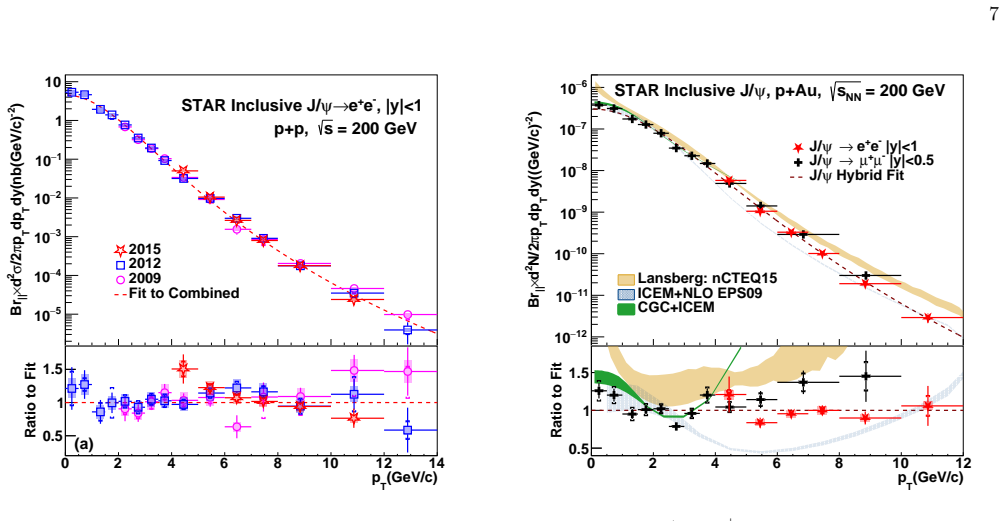
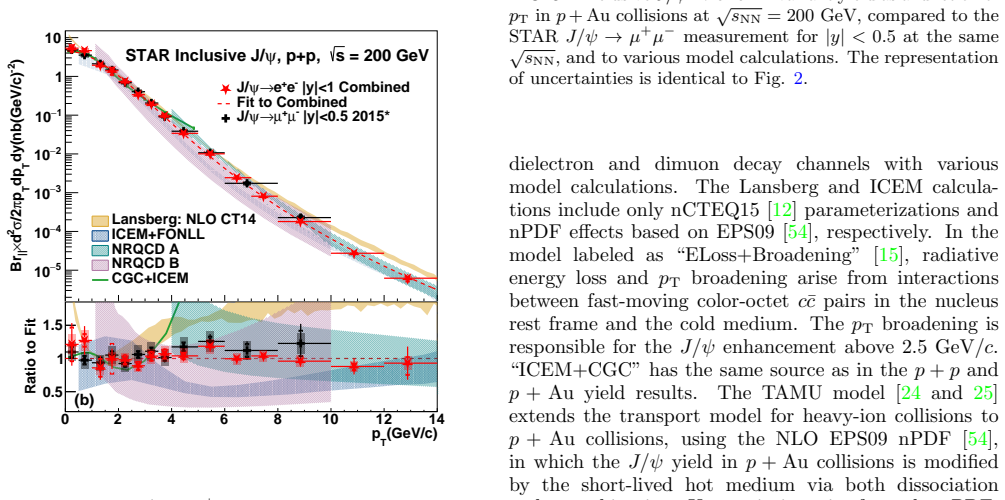
In this paper, a study of cold nuclear matter (CNM) effects is reported based on the new STAR measurement of inclusive $J/\psi$ production in $p+p$ and $p+\text{Au}$ collisions at $\sqrt{s_\text{NN}}$ = 200 GeV, and a combined $J/\psi\rightarrow e^{+}e^{-}$ cross section in $p+p$ collisions at $\sqrt{s}$ = 200 GeV is provided. Given the long-established presumption that the energy density and the temperature produced in proton-nucleon collisions are insufficient to form QGP droplets, CNM effects in $p+\text{Au}$ collisions are quantified by the nuclear modification factor ($R_{p\text{Au}}$), defined as the ratio of the yield of the inclusive $J/\psi$ in $p+\text{Au}$ collisions to that in $p+p$ collisions, scaled by the average number of binary nucleon-nucleon collisions. The $R_{p\text{Au}}$ is derived as a function of transverse momentum ($p_\text{T}$) in the range 4--12 GeV/$c$ and is averaged within the rapidity ($y$) and azimuthal angle ($\varphi$) coverage of $|y|<1$, $0 \leq \varphi < 2\pi$. The result is consistent with unity, suggesting negligible modification of the yield by CNM effects in this kinematic region. Various model calculations are in agreement with the $R_{p\text{Au}}$ measurement, yet the same calculations are less satisfactory in describing the individual invariant yields from $p+p$ and $p+\text{Au}$ collisions. In the covered kinematic region, this analysis has improved the precision of cross-section and invariant-yield measurements in $p+p$ and $p+\text{Au}$ collisions, respectively, and consequently the $R_{p\text{Au}}$.
Editorial analysis
A structured set of objections, weighed in public.
Referee Report
Summary. The manuscript reports a new STAR measurement of inclusive J/ψ production in p+p and p+Au collisions at √s_NN = 200 GeV. The nuclear modification factor R_pAu is extracted as a function of p_T (4–12 GeV/c) within |y| < 1 and found to be consistent with unity, implying negligible cold nuclear matter modification of the yield in this kinematic region. An updated combined p+p cross section is provided, and the data are compared to several model calculations that describe the ratio better than the absolute invariant yields.
Significance. If the central result holds, the work supplies a high-precision, data-driven constraint on CNM effects for charmonium at mid-rapidity and moderate p_T. The direct ratio measurement (scaled only by <N_coll>) and the reported improvement in p+p and p+Au precision constitute clear strengths that will be useful for future global analyses of nuclear PDFs and CNM mechanisms.
major comments (1)
- Abstract and Results section: the observation that the same models describe R_pAu well but fit the separate p+p and p+Au invariant yields less satisfactorily is noted but not quantified; a table or figure showing the χ² per degree of freedom for each observable would clarify whether this tension is statistically significant and whether it affects the interpretation of the R_pAu result.
minor comments (2)
- Figure captions and text should explicitly state the integrated luminosity and trigger conditions used for the p+Au data set to allow direct comparison with other experiments.
- The definition of the rapidity and azimuthal acceptance should be repeated in the Results section for readers who skip the experimental setup.
Simulated Author's Rebuttal
We thank the referee for the positive assessment of the work and for the constructive comment on model comparisons. We address the point below.
read point-by-point responses
-
Referee: [—] Abstract and Results section: the observation that the same models describe R_pAu well but fit the separate p+p and p+Au invariant yields less satisfactorily is noted but not quantified; a table or figure showing the χ² per degree of freedom for each observable would clarify whether this tension is statistically significant and whether it affects the interpretation of the R_pAu result.
Authors: We agree that a quantitative assessment of the model agreement strengthens the presentation. We have added a new table in the Results section that lists the χ² per degree of freedom for each model relative to the p+p invariant cross section, the p+Au invariant yield, and the R_pAu. The values confirm better agreement with the ratio than with the absolute yields and show no statistically significant tension that would change the conclusion of negligible CNM effects in the reported kinematic region. revision: yes
Circularity Check
Direct data ratio; no derivation reduces to inputs by construction
full rationale
The paper computes R_pAu directly from measured invariant yields in p+p and p+Au collisions, scaled by the independently determined <N_coll>. No parameter is fitted to a subset of the data and then re-used to 'predict' the same ratio. The interpretation as a pure CNM probe rests on the external, long-standing presumption that p+N collisions at 200 GeV do not produce QGP; this presumption is not derived inside the paper nor justified by self-citation. Model comparisons are presented as external checks, not as load-bearing steps. The central result is therefore an empirical ratio whose value is not forced by the paper's own equations or prior self-references.
Axiom & Free-Parameter Ledger
axioms (2)
- domain assumption Binary collision scaling defines the nuclear modification factor R_pAu
- domain assumption Proton-nucleon collisions do not produce QGP droplets
Reference graph
Works this paper leans on
-
[1]
The nominal se- lection onnσ e is−1.5< nσ e <2.5
PID by TPC withnσ e nσe is defined as: nσe = 1 σln( dE dx )e ×ln dE dx measured ⟨ dE dx e⟩ ,(3) where dE dx measured is the energy loss measured for a track; the expected energy loss⟨ dE dx e⟩is obtained based on the Bichsel formalism [36] with the measured mo- mentum when assuming such a track corresponds toe ±; σln( dE dx )e is the resolution of the nat...
-
[2]
normalization uncer- tainty
PID by BEMC with E/p The ratio (E/p) of the energy (E) deposited by a par- ticle in the BEMC to the magnitude of the particle’s momentum (p) measured in the TPC, is used to further selecte ±. It is expected to be roughly unity fore ±. The nominal selection onE/pis 0.5< E/p <2.5. B. Signal Extraction EachJ/ψcandidate is reconstructed from ane −e+ pair (the...
1926
-
[3]
CGC+ICEM
uses the CGC framework to obtain thec¯cpro- duction cross section and the ICEM model to describe hadronization. The charm mass is set to be 1.3 GeV/c 2, and the associated uncertainty is negligible. Both the “CGC+ICEM” and Lansberg calculations are tuned to the previous inclusiveJ/ψcross-section measurement at 200 GeV [53], allowing a direct comparison wi...
2015
-
[4]
Matsui and H
T. Matsui and H. Satz, Physics Letters B178, 416 (1986)
1986
-
[5]
X.-M. Xu, D. Kharzeev, H. Satz, and X.-N. Wang, Phys. Rev. C53, 3051 (1996)
1996
-
[6]
Sharma and I
R. Sharma and I. Vitev, Phys. Rev. C87, 044905 (2013)
2013
-
[7]
Andronic and et al., The European Physical Journal C76, 107 (2016)
A. Andronic and et al., The European Physical Journal C76, 107 (2016)
2016
-
[8]
M´ ocsy and P
A. M´ ocsy and P. Petreczky, Phys. Rev. Lett.99, 211602 (2007)
2007
-
[9]
Yao and B
X. Yao and B. M¨ uller, Phys. Rev. D100, 014008 (2019)
2019
-
[10]
Abreu and et al., Physics Letters B499, 85 (2001)
M. Abreu and et al., Physics Letters B499, 85 (2001)
2001
-
[11]
Adare and et al
A. Adare and et al. (PHENIX Collaboration), Phys. Rev. Lett.98, 232301 (2007)
2007
-
[12]
Aad and et al., Physics Letters B697, 294 (2011)
G. Aad and et al., Physics Letters B697, 294 (2011)
2011
-
[13]
Chatrchyan and et al
S. Chatrchyan and et al. (CMS Collaboration), Journal of High Energy Physics2012, 63 (2012)
2012
-
[14]
Abelev and et al
B. Abelev and et al. (ALICE Collaboration), Phys. Rev. Lett.109, 072301 (2012)
2012
-
[15]
Kovaˇ r´ ık, A
K. Kovaˇ r´ ık, A. Kusina, T. Jeˇ zo, D. B. Clark, C. Kep- pel, F. Lyonnet, J. G. Morf´ ın, F. I. Olness, J. F. Owens, I. Schienbein, and J. Y. Yu, Phys. Rev. D93, 085037 (2016)
2016
-
[16]
K. J. Eskola, P. Paakkinen, H. Paukkunen, and C. A. Sal- gado, The European Physical Journal C77, 163 (2017)
2017
-
[17]
Gelis, E
F. Gelis, E. Iancu, J. Jalilian-Marian, and R. Venu- gopalan, Annual Review of Nuclear and Particle Science 60, 463 (2010)
2010
-
[18]
Arleo, R
F. Arleo, R. Kolevatov, S. Peign´ e, and M. Rustamova, Journal of High Energy Physics2013, 155 (2013)
2013
-
[19]
Vogt, Physics Reports310, 197 (1999)
R. Vogt, Physics Reports310, 197 (1999)
1999
-
[20]
Ferreiro, Physics Letters B749, 98 (2015)
E. Ferreiro, Physics Letters B749, 98 (2015)
2015
-
[21]
Adare and et al
A. Adare and et al. (PHENIX Collaboration), Phys. Rev. C87, 034904 (2013)
2013
-
[22]
Acharya and et al
U. Acharya and et al. (PHENIX Collaboration), Phys. Rev. C102, 014902 (2020)
2020
-
[23]
Abdallah and et al
M. Abdallah and et al. (STAR Collaboration), Physics Letters B825, 136865 (2022)
2022
-
[24]
Acharya and et al
S. Acharya and et al. (ALICE Collaboration), Journal of High Energy Physics2018, 160 (2018)
2018
- [25]
-
[26]
Chekhovsky and et al
V. Chekhovsky and et al. (CMS Collaboration), Phys. Rev. Lett.135, 092301 (2025)
2025
-
[27]
Du and R
X. Du and R. Rapp, Nuclear Physics A943, 147 (2015)
2015
-
[28]
Du and R
X. Du and R. Rapp, Journal of High Energy Physics 2019, 15 (2019)
2019
-
[29]
G. C. Nayak, J.-W. Qiu, and G. Sterman, Phys. Rev. D 74, 074007 (2006)
2006
-
[30]
Adamczyk and et al
L. Adamczyk and et al. (STAR Collaboration), Physics Letters B722, 55 (2013)
2013
-
[31]
Adam and et al
J. Adam and et al. (STAR Collaboration), Physics Let- ters B786, 87 (2018)
2018
-
[32]
M. Anderson and et al., Nuclear Instruments and Meth- ods in Physics Research Section A: Accelerators, Spec- trometers, Detectors and Associated Equipment499, 659 (2003), the Relativistic Heavy Ion Collider Project: RHIC and its Detectors
2003
-
[33]
M. Beddo and et al., Nuclear Instruments and Methods in 10 Physics Research Section A: Accelerators, Spectrometers, Detectors and Associated Equipment499, 725 (2003), the Relativistic Heavy Ion Collider Project: RHIC and its Detectors
2003
-
[34]
C. A. Whitten (STAR Collaboration), AIP Conference Proceedings980, 390 (2008), https://pubs.aip.org/aip/acp/article- pdf/980/1/390/11985098/390 1 online.pdf
2008
-
[35]
Adams and et al
J. Adams and et al. (STAR Collaboration), Phys. Rev. Lett.91, 172302 (2003)
2003
-
[36]
D. J. Lange, Nuclear Instruments and Methods in Physics Research Section A: Accelerators, Spectrometers, De- tectors and Associated Equipment462, 152 (2001), bEAUTY2000, Proceedings of the 7th Int. Conf. on B- Physics at Hadron Machines
2001
-
[37]
Adamczyk and et al
L. Adamczyk and et al. (STAR Collaboration), Phys. Rev. D86, 072013 (2012)
2012
-
[38]
Smirnov, J
D. Smirnov, J. Lauret, V. Perevoztchikov, G. Van Buren, and J. Webb, Journal of Physics: Conference Series898, 042058 (2017)
2017
-
[39]
Bichsel, Nuclear Instruments and Methods in Physics Research Section A: Accelerators, Spectrometers, Detec- tors and Associated Equipment562, 154 (2006)
H. Bichsel, Nuclear Instruments and Methods in Physics Research Section A: Accelerators, Spectrometers, Detec- tors and Associated Equipment562, 154 (2006)
2006
-
[40]
T. Sj¨ ostrand, S. Mrenna, and P. Z. Skands, JHEP05, 026, arXiv:hep-ph/0603175
-
[41]
Sj¨ ostrand, S
T. Sj¨ ostrand, S. Mrenna, and P. Skands, Computer Physics Communications178, 852 (2008)
2008
-
[42]
Buckley, J
A. Buckley, J. Ferrando, S. Lloyd, K. Nordstr¨ om, B. Page, M. R¨ ufenacht, M. Sch¨ onherr, and G. Watt, The European Physical Journal C75, 132 (2015)
2015
-
[43]
Corke and T
R. Corke and T. Sj¨ ostrand, Journal of High Energy Physics2011, 9 (2011)
2011
-
[44]
Nisius, The European Physical Journal C74, 3004 (2014)
R. Nisius, The European Physical Journal C74, 3004 (2014)
2014
-
[45]
Ma and R
Y.-Q. Ma and R. Vogt, Phys. Rev. D94, 114029 (2016)
2016
-
[46]
Lansberg and H.-S
J.-P. Lansberg and H.-S. Shao, The European Physical Journal C77, 1 (2016)
2016
-
[47]
Kusina, J.-P
A. Kusina, J.-P. Lansberg, I. Schienbein, and H.-S. Shao, Phys. Rev. Lett.121, 052004 (2018)
2018
-
[48]
Shao, Computer Physics Communications184, 2562 (2013)
H.-S. Shao, Computer Physics Communications184, 2562 (2013)
2013
-
[49]
Shao, Computer Physics Communications198, 238 (2016)
H.-S. Shao, Computer Physics Communications198, 238 (2016)
2016
-
[50]
Dulat, T.-J
S. Dulat, T.-J. Hou, J. Gao, M. Guzzi, J. Huston, P. Nadolsky, J. Pumplin, C. Schmidt, D. Stump, and C.-P. Yuan, Phys. Rev. D93, 033006 (2016)
2016
-
[51]
Cacciari, M
M. Cacciari, M. Greco, and P. Nason, Journal of High Energy Physics1998, 007 (1998)
1998
-
[52]
Cacciari, S
M. Cacciari, S. Frixione, and P. Nason, Journal of High Energy Physics2001, 006 (2001)
2001
-
[53]
Y.-Q. Ma, K. Wang, and K.-T. Chao, Phys. Rev. D84, 114001 (2011)
2011
-
[54]
Butenschoen and B
M. Butenschoen and B. A. Kniehl, Phys. Rev. Lett.108, 172002 (2012)
2012
-
[55]
Y.-Q. Ma, R. Venugopalan, K. Watanabe, and H.-F. Zhang, Phys. Rev. C97, 014909 (2018)
2018
-
[56]
Adare and et al
A. Adare and et al. (PHENIX Collaboration), Phys. Rev. D85, 092004 (2012)
2012
-
[57]
Eskola, H
K. Eskola, H. Paukkunen, and C. Salgado, Journal of High Energy Physics2009, 065 (2009)
2009
-
[58]
Adam and et al., Physics Letters B797, 134917 (2019)
J. Adam and et al., Physics Letters B797, 134917 (2019)
2019
-
[59]
Adamczyk and et al
L. Adamczyk and et al. (STAR Collaboration), Phys. Rev. C93, 064904 (2016)
2016
discussion (0)
Sign in with ORCID, Apple, or X to comment. Anyone can read and Pith papers without signing in.