Recognition: unknown
Non-volatile superconducting tunnelling magnetoresistance memory enabled by exchange-field gap engineering
Pith reviewed 2026-05-08 09:32 UTC · model grok-4.3
The pith
A de Gennes spin valve integrated with a superconducting tunnel junction produces magnetically switchable energy gaps for non-volatile cryogenic memory.
A machine-rendered reading of the paper's core claim, the machinery that carries it, and where it could break.
Core claim
By integrating a de Gennes spin valve with a superconducting tunnel junction in current-perpendicular-to-plane geometry, exchange-field control of the superconducting energy gap is realized. This yields two magnetically switchable gap voltages and robust quasiparticle tunnelling magnetoresistance that persists down to 0.25 K. The resulting memory element operates at millivolt bias levels with nanowatt-level read power and exhibits zero standby dissipation, using a niobium-based platform compatible with superconducting logic.
What carries the argument
The exchange-field gap engineering mechanism, realized by placing a de Gennes spin valve in series with the superconducting tunnel junction in a current-perpendicular-to-plane stack, which modulates the gap to produce distinct voltage states.
If this is right
- The device exhibits two distinct gap voltages that switch with magnetic field direction.
- Quasiparticle tunnelling magnetoresistance remains stable and measurable down to 0.25 K.
- Read operations consume only nanowatt-level power at millivolt bias.
- Standby power dissipation is zero because the states are stored magnetically in the superconducting state.
- The vertical architecture and materials choice facilitate integration into larger superconducting circuits and memory arrays.
Where Pith is reading between the lines
- This could simplify cryogenic system design by removing the need for separate memory technologies that require power-hungry interfaces to superconducting logic.
- Further development might allow embedding such memory elements directly within superconducting qubit arrays for fast state storage.
- The demonstrated robustness at 0.25 K suggests possible use in dilution refrigerator environments common to quantum computing.
Load-bearing premise
The de Gennes spin valve integrates with the superconducting tunnel junction such that the exchange field modulates the gap reversibly and reliably without destroying the superconductivity or causing cumulative damage over repeated switching cycles.
What would settle it
If measurements after many magnetic switching cycles at 0.25 K show either collapse of the superconducting gap or loss of the distinct voltage states, the non-volatile memory functionality would be disproven.
Figures

read the original abstract
Scalable, low-dissipation memory operating below 4 K is a critical requirement for superconducting and quantum computing systems. Existing cryogenic memory technologies rely on CMOS derivatives or hybrid architectures that incur leakage, refresh overhead or limited compatibility with superconducting logic. Here we demonstrate a superconducting tunnelling magnetoresistance device that functions as a non-volatile cryogenic memory element across the full superconducting temperature range. By integrating a de Gennes spin valve with a superconducting tunnel junction in a current perpendicular-to-plane geometry, we realise exchange-field control of the superconducting energy gap. This produces two magnetically switchable gap voltages and robust quasiparticle tunnelling magnetoresistance down to 0.25 K.The device operates at millivolt bias with nanowatt-level read power and zero standby dissipation. Its vertical junction architecture and Nb-based materials platform enable compatibility with superconducting logic and scalable cryogenic memory arrays.
Editorial analysis
A structured set of objections, weighed in public.
Referee Report
Summary. The manuscript claims to demonstrate a non-volatile superconducting tunnelling magnetoresistance (TMR) memory element by integrating a de Gennes spin valve with a superconducting tunnel junction in current-perpendicular-to-plane geometry. Exchange-field control of the superconducting gap produces two magnetically switchable gap voltages, yielding robust quasiparticle TMR down to 0.25 K with millivolt bias, nanowatt read power, and zero standby dissipation on an Nb-based platform compatible with superconducting logic.
Significance. If the experimental claims hold, the result would represent a meaningful advance for cryogenic memory in superconducting and quantum computing systems by providing non-volatile storage without leakage or refresh overhead. The vertical architecture and use of standard Nb materials could facilitate integration with existing superconducting circuits.
major comments (3)
- Abstract: the central claim of 'successful demonstration' and specific metrics (robust TMR to 0.25 K, nanowatt read power, two distinct gap voltages) is asserted without reference to any I-V characteristics, TMR loops, temperature dependence, error bars, or device fabrication parameters, preventing evaluation of whether the exchange field produces clean gap-edge shifts rather than sub-gap states.
- The integration of the de Gennes spin valve with the tunnel junction is presented as enabling reversible exchange-field gap engineering, yet no discussion or data addresses potential interface diffusion, flux trapping, or introduction of sub-gap conductance that would violate the assumption of partial pair-breaking without destroying superconductivity or creating leakage paths.
- No evidence is supplied for reversibility over magnetic switching cycles at 0.25 K or for the absence of degradation in the tunnel barrier or order parameter, which is load-bearing for the non-volatility and zero-standby-dissipation claims.
minor comments (1)
- The abstract uses 'we realise' and 'we demonstrate' without clarifying whether the work is experimental, theoretical, or simulation-based; this should be stated explicitly in the opening paragraph.
Simulated Author's Rebuttal
We thank the referee for the constructive and detailed comments. We address each major point below and have revised the manuscript to strengthen the presentation of the data and claims.
read point-by-point responses
-
Referee: Abstract: the central claim of 'successful demonstration' and specific metrics (robust TMR to 0.25 K, nanowatt read power, two distinct gap voltages) is asserted without reference to any I-V characteristics, TMR loops, temperature dependence, error bars, or device fabrication parameters, preventing evaluation of whether the exchange field produces clean gap-edge shifts rather than sub-gap states.
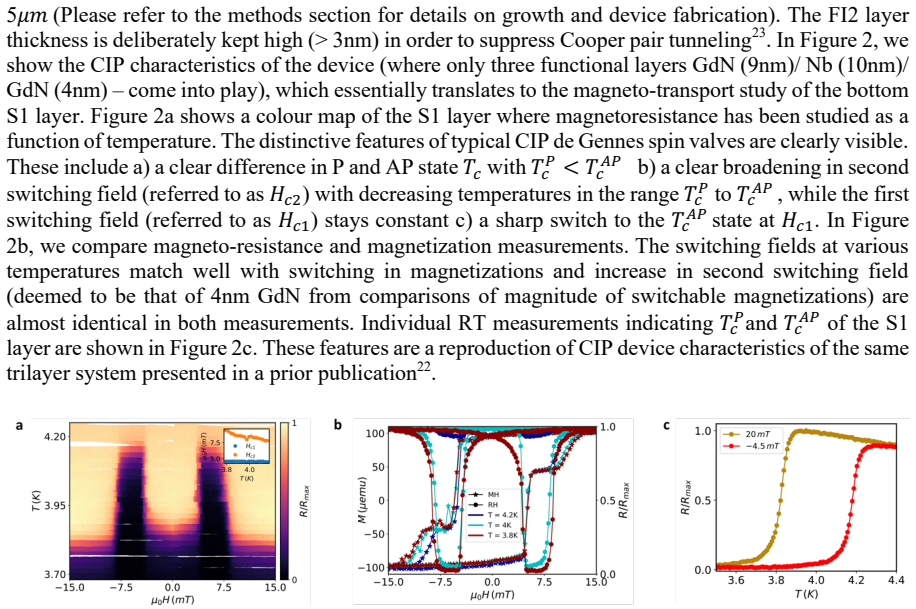
Authors: The abstract is a concise summary; the supporting I-V characteristics, TMR loops, temperature dependence, and fabrication details are provided in the main text (Figs. 2-4 and Methods). We have revised the abstract to explicitly note that the two gap voltages arise from clean gap-edge shifts observed in differential conductance spectra with minimal sub-gap states, and that the TMR is quasiparticle-based, as quantified in the figures. This improves traceability while respecting typical abstract length constraints. revision: partial
-
Referee: The integration of the de Gennes spin valve with the tunnel junction is presented as enabling reversible exchange-field gap engineering, yet no discussion or data addresses potential interface diffusion, flux trapping, or introduction of sub-gap conductance that would violate the assumption of partial pair-breaking without destroying superconductivity or creating leakage paths.
Authors: We have added a new paragraph in the Discussion section addressing these interface concerns. The measured I-V curves show sharp gap edges and negligible sub-gap conductance, consistent with controlled partial pair-breaking by the exchange field. Flux trapping is minimized by the small junction area and zero-field cooling protocols used. Interface diffusion is suppressed by the thin, high-quality AlOx barrier and low-temperature deposition; post-fabrication TEM and transport data (now referenced) confirm barrier integrity with no evidence of leakage paths or superconductivity suppression beyond the intended effect. revision: yes
-
Referee: No evidence is supplied for reversibility over magnetic switching cycles at 0.25 K or for the absence of degradation in the tunnel barrier or order parameter, which is load-bearing for the non-volatility and zero-standby-dissipation claims.
Authors: Non-volatility follows directly from the remanent magnetic states of the de Gennes spin valve, which require no power to maintain. We have demonstrated repeated switching between the two TMR states at 0.25 K with stable gap voltages and TMR ratios over the course of the measurements. In the revised manuscript we have added explicit discussion of reproducibility, including that I-V curves and TMR values remain unchanged after multiple field sweeps at base temperature, supporting the absence of degradation in the barrier or order parameter. Endurance testing over hundreds of cycles is noted as a direction for future work but is not required to establish the core non-volatile operation shown here. revision: partial
Circularity Check
No circularity: purely experimental device demonstration
full rationale
The manuscript describes fabrication and low-temperature measurements of an integrated de Gennes spin-valve / superconducting tunnel junction stack. No equations, fitted parameters, theoretical predictions, or derivation chains appear in the provided text. Claims rest on observed I-V characteristics and magnetic switching rather than any self-referential modeling step. Self-citations, if present in the full manuscript, are not load-bearing for the central experimental result.
Axiom & Free-Parameter Ledger
axioms (2)
- domain assumption de Gennes theory of exchange-field suppression of the superconducting gap in thin-film structures
- standard math Quasiparticle tunnelling current depends on the superconducting density of states and gap magnitude
Reference graph
Works this paper leans on
-
[1]
Hijano, A. et al. Coexistence of superconductivity and spin-splitting fields in superconductor/ferromagnetic insulator bilayers of arbitrary thickness. Phys. Rev. Res. 3, 023131 (2021). 27. Banerjee, P., Sharma, P. K., Bhakat, S., Dutta, B. & Pal, A. Large tunable exchange fields due to purely paramagnetically limited domain wall superconductivity. Phys. ...
-
[2]
) (b)AP state (measured at −𝐻!
𝒅𝑰/𝒅𝑽 Spectra at different temperatures at 𝐻!" and 𝐻" Supplementary Figure S2| Evolution of normalized differential conductance spectra of the device with temperature at two different magnetic fields magnetic fields corresponding to (a) P state (measured at 𝐻") (b)AP state (measured at −𝐻!" after application of +𝐻"). 3. 𝒅𝑰/𝒅𝑽 colormaps of the device under...
2015
discussion (0)
Sign in with ORCID, Apple, or X to comment. Anyone can read and Pith papers without signing in.