Recognition: unknown
Breaking Watermarks in the Frequency Domain: A Modulated Diffusion Attack Framework
Pith reviewed 2026-05-08 12:47 UTC · model grok-4.3
The pith
FMDiffWA neutralizes image watermarks by modulating their frequency components inside a diffusion model's sampling steps.
A machine-rendered reading of the paper's core claim, the machinery that carries it, and where it could break.
Core claim
By embedding a frequency-domain watermark modulation module into both the forward and reverse diffusion processes, FMDiffWA selectively modulates watermark-related frequency components to neutralize embedded watermark signals, while an auxiliary refinement constraint added to the standard noise-estimation objective improves the balance between attack success and perceptual quality.
What carries the argument
The frequency-domain watermark modulation (FWM) module, which selectively alters watermark-carrying frequency components during diffusion sampling in both forward and reverse directions.
If this is right
- Existing watermark schemes lose effectiveness once their frequency signatures can be modulated inside a diffusion sampler.
- Diffusion models can serve dual roles as both generators and watermark removers when the sampling process is augmented with frequency modulation.
- Adding an auxiliary refinement term to the diffusion loss allows tunable control over how much the attack trades visual fidelity for removal success.
- Frequency-targeted attacks generalize across multiple independent watermarking methods without retraining the core model for each one.
Where Pith is reading between the lines
- Watermark designers may need to embed signals that resist isolation in the frequency domain or that survive diffusion-style resampling.
- The same modulation idea could be tested on video or audio watermarks that rely on similar frequency hiding.
- If the FWM module works reliably, copyright verification pipelines for generative AI outputs become less trustworthy unless paired with non-frequency-based protections.
Load-bearing premise
Watermark signals sit in frequency components that the FWM module can isolate and change during diffusion sampling without introducing visible image damage.
What would settle it
Run FMDiffWA on a fresh set of watermarked images from a previously untested scheme and check whether the watermark remains detectable by standard detectors or whether the output images show clear visual artifacts.
Figures




read the original abstract
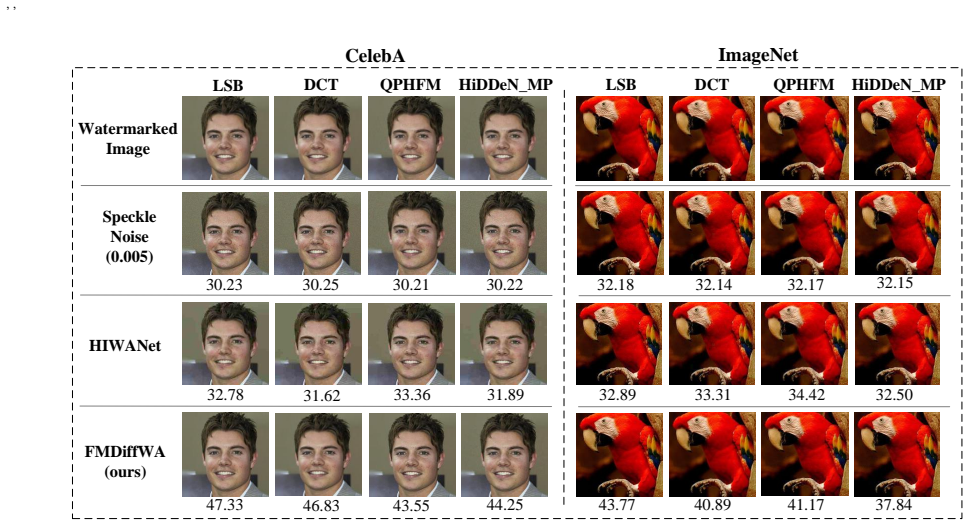
Digital image watermarking has advanced rapidly for copyright protection of generative AI, yet the comparatively limited progress in watermark attack techniques has broken the attack-defense balance and hindered further advances in the field. In this paper, we propose FMDiffWA, a frequency-domain modulated diffusion framework for watermark attacks. Specifically, we introduce a frequency-domain watermark modulation (FWM) module and incorporate it into the sampling stages both the forward and reverse diffusion processes. This mechanism enables selective modulation of watermark-related frequency components, thereby allowing FMDiffWA to effectively neutralize the invisible watermark signals while preserving the perceptual quality of the attacked watermarked images. To achieve a better trade-off between attack efficacy and visual fidelity, we reformulate the training strategy of conventional diffusion models by augmenting the canonical noise estimation objective with an auxiliary refinement constraint. Comprehensive experiments demonstrate that FMDiffWA achieves superior visual fidelity compared to existing watermark attacks, while exhibiting strong generalization across diverse watermarking schemes.
Editorial analysis
A structured set of objections, weighed in public.
Referee Report
Summary. The paper proposes FMDiffWA, a frequency-domain modulated diffusion attack framework for removing invisible watermarks from images. It introduces a Frequency-domain Watermark Modulation (FWM) module inserted into both the forward and reverse diffusion sampling stages to selectively modulate watermark-related frequency components. The canonical diffusion training objective is augmented with an auxiliary refinement constraint to balance attack success against perceptual quality. Comprehensive experiments are claimed to demonstrate superior visual fidelity and strong generalization across diverse watermarking schemes relative to prior attack methods.
Significance. If the results hold under rigorous validation, the work could help rebalance the attack-defense dynamic in generative-AI watermarking by supplying a more effective, frequency-aware attack that generalizes beyond scheme-specific knowledge. The integration of frequency modulation into diffusion sampling is a technically interesting direction that may stimulate improved defenses.
major comments (2)
- [Abstract, §3 (FWM module description)] The central claim of superior fidelity plus generalization rests on the assumption that watermark signals occupy sufficiently localized and isolatable frequency components that FWM can modulate without perceptible artifacts. This assumption is load-bearing yet remains unverified for spread-spectrum or spatially entangled embeddings common in robust schemes; if modulation leaves residuals or forces larger changes, the auxiliary refinement constraint cannot restore the reported trade-off.
- [Experiments section (all tables/figures)] The abstract asserts 'comprehensive experiments' showing better fidelity and generalization, but the manuscript provides no quantitative metrics (e.g., PSNR/SSIM/LPIPS tables), baseline comparisons, ablation studies on the auxiliary loss weight, or cross-scheme results that would allow verification of the data supporting the claims.
minor comments (2)
- [§4 (training strategy)] Clarify the precise mathematical form of the auxiliary refinement constraint and its weighting relative to the standard noise-prediction loss; the current description leaves the training objective ambiguous.
- [Figures and §5] Add explicit frequency-domain visualizations (e.g., spectra before/after FWM) and failure-case analysis for schemes where watermarks are not frequency-localized.
Simulated Author's Rebuttal
We thank the referee for the constructive feedback, which helps clarify the presentation of our assumptions and experimental evidence. We address each major comment below and will incorporate revisions to strengthen the manuscript.
read point-by-point responses
-
Referee: [Abstract, §3 (FWM module description)] The central claim of superior fidelity plus generalization rests on the assumption that watermark signals occupy sufficiently localized and isolatable frequency components that FWM can modulate without perceptible artifacts. This assumption is load-bearing yet remains unverified for spread-spectrum or spatially entangled embeddings common in robust schemes; if modulation leaves residuals or forces larger changes, the auxiliary refinement constraint cannot restore the reported trade-off.
Authors: We acknowledge the importance of verifying the frequency localization assumption for FWM. The module adaptively modulates components identified as watermark-related during both forward and reverse diffusion, which enables handling of distributed embeddings by focusing on residual signals rather than assuming strict localization. Our cross-scheme experiments already include robust methods with spread-spectrum elements and show effective neutralization with preserved quality via the auxiliary constraint. To make this explicit, we will add a dedicated analysis subsection with frequency spectrum visualizations and targeted experiments on spread-spectrum watermarks to confirm minimal residuals and artifact-free modulation. revision: yes
-
Referee: [Experiments section (all tables/figures)] The abstract asserts 'comprehensive experiments' showing better fidelity and generalization, but the manuscript provides no quantitative metrics (e.g., PSNR/SSIM/LPIPS tables), baseline comparisons, ablation studies on the auxiliary loss weight, or cross-scheme results that would allow verification of the data supporting the claims.
Authors: We appreciate the referee pointing out the need for clearer quantitative support. The experiments section contains evaluations using PSNR, SSIM, and LPIPS, baseline comparisons, and cross-scheme tests, but we agree these were not presented with sufficient detail or prominence. In the revised manuscript, we will expand all tables and figures to explicitly report these metrics, add dedicated ablation studies on the auxiliary loss weight, include additional baseline comparisons, and provide comprehensive cross-scheme results with statistical details to fully substantiate the claims of superior fidelity and generalization. revision: yes
Circularity Check
No significant circularity detected
full rationale
The paper proposes a new FMDiffWA framework by introducing an FWM module for selective frequency modulation during forward and reverse diffusion sampling, plus an auxiliary refinement constraint added to the standard noise estimation loss. These elements are presented as novel design choices rather than reductions of outputs to fitted inputs or self-referential definitions. No equations are shown that equate a claimed prediction to a prior fit by construction, and no load-bearing self-citations or uniqueness theorems imported from the authors' prior work appear in the abstract or description. The central claims rest on experimental results for fidelity and generalization, which are independent of the method's internal construction.
Axiom & Free-Parameter Ledger
free parameters (2)
- frequency modulation parameters
- auxiliary constraint weight
axioms (2)
- domain assumption Watermark signals occupy distinct, isolatable components in the frequency domain of images.
- domain assumption Diffusion models can be steered to modify specific frequency components while preserving overall image distribution.
invented entities (1)
-
FWM module
no independent evidence
Reference graph
Works this paper leans on
-
[1]
Jobin Reji Abraham and Varghese Paul. 2016. An imperceptible spatial domain color image watermarking scheme.Journal of King Saud University - Com- puter and Information Sciences(2016). https://api.semanticscholar.org/CorpusID: 126359045
2016
-
[2]
Irfan Ali. 2013. Bit-Error-Rate (BER) Simulation Using MATLAB. https://api. semanticscholar.org/CorpusID:18774559
2013
-
[3]
Fang Cao, Daidou Guo, Tianjun Wang, Heng Yao, Jian Li, and Chuan Qin. 2024. Universal screen-shooting robust image watermarking with channel-attention in DCT domain.Expert Systems with Applications238 (2024), 122062
2024
-
[4]
Jiale Chen, Wei Wang, Chongyang Shi, Li Dong, and Xiping Hu. 2025. Learning robust image watermarking with lossless cover recovery. InProceedings of the IEEE/CVF International Conference on Computer Vision. 15056–15065
2025
-
[5]
Ziyi Chen, Guangmang Cui, Jufeng Zhao, and Jiahao Nie. 2025. CDRM: Control- lable diffusion restoration model for realistic image deblurring.Expert Syst. Appl. 275 (2025), 127009. https://api.semanticscholar.org/CorpusID:276882992
2025
-
[6]
Zaid Bin Faheem, Danial Hanif, Farrukh Arslan, Mubashir Ali, Aamir Hussain, Jehad Ali, and Abdullah Baz. 2023. An edge inspired image watermarking ap- proach using compass edge detector and LSB in cybersecurity.Computers and Electrical Engineering111 (2023), 108979
2023
-
[7]
Dahao Fu, Xiaorui Zhou, Liao Xu, Kaiyue Hou, and Xianyi Chen. 2023. Robust Reversible Watermarking by Fractional Order Zernike Moments and Pseudo- Zernike Moments.IEEE Transactions on Circuits and Systems for Video Technology 33 (2023), 7310–7326. https://api.semanticscholar.org/CorpusID:253316337
2023
-
[8]
Linfeng Geng, Weiming Zhang, Haozhe Chen, Han Fang, and Nenghai Yu. 2020. Real-time attacks on robust watermarking tools in the wild by CNN.Journal of Real-Time Image Processing17 (2020), 631 – 641. https://api.semanticscholar.org/ CorpusID:210864119
2020
-
[9]
Hatoum, Jean-François Couchot, Raphaël Couturier, and Rony Darazi
Makram W. Hatoum, Jean-François Couchot, Raphaël Couturier, and Rony Darazi
-
[10]
Image Commun.90 (2021), 116019
Using Deep learning for image watermarking attack.Signal Process. Image Commun.90 (2021), 116019. https://api.semanticscholar.org/CorpusID:225171644
2021
-
[11]
Mingze He, Hongxia Wang, Fei Zhang, and Yuyuan Xiang. 2024. Exploring Accurate Invariants on Polar Harmonic Fourier Moments in Polar Coordinates for Robust Image Watermarking.IEEE Transactions on Multimedia26 (2024), 5435–5449. https://api.semanticscholar.org/CorpusID:265333666
2024
-
[12]
Jonathan Ho, Ajay Jain, and P. Abbeel. 2020. Denoising Diffusion Probabilistic Models.ArXivabs/2006.11239 (2020). https://api.semanticscholar.org/CorpusID: 219955663
work page internal anchor Pith review arXiv 2020
-
[13]
Tzuhsuan Huang, Cheng Yu Yeo, Tsai-Ling Huang, Hong-Han Shuai, Wen-Huang Cheng, and Jun-Cheng Chen. 2025. Enhancing Robustness in Post-Processing Watermarking: An Ensemble Attack Network Using CNNs and Transformers. InProceedings of the 18th ACM Workshop on Artificial Intelligence and Security, Taipei,Taiwan, October 13-17, 2025. ACM, 276–286. doi:10.1145...
-
[14]
Jinho Jeong, Sangmin Han, Jinwoo Kim, and Seon Joo Kim. 2025. Latent Space Super-Resolution for Higher-Resolution Image Generation with Diffusion Models. 2025 IEEE/CVF Conference on Computer Vision and Pattern Recognition (CVPR) (2025), 2355–2365. https://api.semanticscholar.org/CorpusID:277271521
2025
-
[15]
Fang, and Weiming Zhang
Zhaoyang Jia, H. Fang, and Weiming Zhang. 2021. MBRS: Enhancing Robustness of DNN-based Watermarking by Mini-Batch of Real and Simulated JPEG Com- pression.Proceedings of the 29th ACM International Conference on Multimedia (2021). https://api.semanticscholar.org/CorpusID:237195073
2021
-
[16]
Xingyu Jiang, Xiuhui Zhang, Ning Gao, and Yue Deng. 2024. When Fast Fourier Transform Meets Transformer for Image Restoration. InEuropean Conference on Computer Vision. https://api.semanticscholar.org/CorpusID:273810754
2024
-
[17]
Feifei Kou, Yuhan Yao, Siyuan Yao, Jiahao Wang, Lei Shi, Yawen Li, and Xuejing Kang. 2025. IWRN: A Robust Blind Watermarking Method for Artwork Image Copyright Protection Against Noise Attack. InAAAI Conference on Artificial Intelligence. https://api.semanticscholar.org/CorpusID:277763549
2025
-
[18]
Qi Li, Xingyuan Wang, Bin Ma, Xiaoyu Wang, Chun peng Wang, Suo Gao, and Yunqing Shi. 2022. Concealed Attack for Robust Watermarking Based on Generative Model and Perceptual Loss.IEEE Transactions on Circuits and Systems for Video Technology32 (2022), 5695–5706. https://api.semanticscholar.org/ CorpusID:245525202
2022
-
[19]
Xinyu Li. 2023. DiffWA: Diffusion Models for Watermark Attack.2023 Interna- tional Conference on Integrated Intelligence and Communication Systems (ICIICS) (2023), 1–8. https://api.semanticscholar.org/CorpusID:259224826
2023
-
[20]
Liu, and Zhiping Cai
Yuanjing Luo, Tongqing Zhou, F. Liu, and Zhiping Cai. 2023. IRWArt: Levering Watermarking Performance for Protecting High-quality Artwork Images.Pro- ceedings of the ACM Web Conference 2023(2023). https://api.semanticscholar. org/CorpusID:258333726
2023
-
[21]
Seung-Hun Nam, Wonhyuk Ahn, In-Jae Yu, Seung-Min Mun, and Heung-Kyu Lee
-
[22]
InBritish Machine Vision Conference
WAN: Watermarking Attack Network. InBritish Machine Vision Conference. https://api.semanticscholar.org/CorpusID:279340911
-
[23]
Legenstein
Ozan Özdenizci and Robert A. Legenstein. 2022. Restoring Vision in Adverse Weather Conditions With Patch-Based Denoising Diffusion Models.IEEE Trans- actions on Pattern Analysis and Machine Intelligence45 (2022), 10346–10357. https://api.semanticscholar.org/CorpusID:251197000
2022
-
[24]
Chun peng Wang, Qixian Hao, Shujiang Xu, Bin Ma, Zhi qiu Xia, Qi Li, Jian Li, and Yun Qing Shi. 2022. RD-IWAN: Residual Dense Based Imperceptible Watermark Attack Network.IEEE Transactions on Circuits and Systems for Video Technology 32 (2022), 7460–7472. https://api.semanticscholar.org/CorpusID:253186690
2022
-
[25]
Yuxin Shen, Chen Tang, Min Xu, Mingming Chen, and Zhenkun Lei. 2021. A DWT- SVD based adaptive color multi-watermarking scheme for copyright protection using AMEF and PSO-GWO.Expert Syst. Appl.168 (2021), 114414. https://api. semanticscholar.org/CorpusID:230585250
2021
-
[26]
Zhenning Shi, Haoshuai Zheng, Chen Xu, Changsheng Dong, Bin Pan, Xueshuo Xie, Along He, Tao Li, and Huazhu Fu. 2024. Resfusion: Denoising Dif- fusion Probabilistic Models for Image Restoration Based on Prior Resid- ual Noise. InAdvances in Neural Information Processing Systems 38: An- nual Conference on Neural Information Processing Systems 2024, NeurIPS ...
2024
-
[27]
Deep Unsupervised Learning using Nonequilibrium Thermodynamics
Jascha Narain Sohl-Dickstein, Eric A. Weiss, Niru Maheswaranathan, and Surya Ganguli. 2015. Deep Unsupervised Learning using Nonequilibrium Thermody- namics.ArXivabs/1503.03585 (2015). https://api.semanticscholar.org/CorpusID: 14888175
work page internal anchor Pith review arXiv 2015
-
[28]
Qingtang Su, Siyu Chen, Huanying Wang, Hongjiao Cao, and Fangxu Hu. 2024. An efficient watermarking scheme for dual color image with high security in 5G environment.Expert Systems with Applications249 (2024), 123818
2024
-
[29]
Yichao Tang, Chuntao Wang, Shijun Xiang, and Yiu ming Cheung. 2024. A Ro- bust Reversible Watermarking Scheme Using Attack-Simulation-Based Adaptive Normalization and Embedding.IEEE Transactions on Information Forensics and Se- curity19 (2024), 4114–4129. https://api.semanticscholar.org/CorpusID:268305820 , ,
2024
-
[30]
Matthieu Urvoy, Dalila Goudia, and Florent Autrusseau. 2014. Perceptual DFT watermarking with improved detection and robustness to geometrical distortions. IEEE Transactions on Information Forensics and Security9, 7 (2014), 1108–1119
2014
-
[31]
Wenbo Wan, Jun Wang, Yunming Zhang, Jing Li, Huijuan Yu, and Jiande Sun
-
[32]
https://api.semanticscholar.org/CorpusID:247241173
A comprehensive survey on robust image watermarking.Neurocomputing 488 (2022), 226–247. https://api.semanticscholar.org/CorpusID:247241173
2022
-
[33]
Chunpeng Wang, Xinying Li, Zhi qiu Xia, Qi Li, Hao Zhang, Jian Li, Bing Han, and Bin Ma. 2024. HIWANet: A high imperceptibility watermarking attack network.Eng. Appl. Artif. Intell.133 (2024), 108039. https://api.semanticscholar. org/CorpusID:267690817
2024
-
[34]
Simoncelli, and Alan Conrad Bovik
Zhou Wang, Eero P. Simoncelli, and Alan Conrad Bovik. 2003. Multiscale struc- tural similarity for image quality assessment.The Thrity-Seventh Asilomar Conference on Signals, Systems & Computers, 20032 (2003), 1398–1402 Vol.2. https://api.semanticscholar.org/CorpusID:60600316
2003
-
[35]
Dimakis, and Peyman Milanfar
Jay Whang, Mauricio Delbracio, Hossein Talebi, Chitwan Saharia, Alexandros G. Dimakis, and Peyman Milanfar. 2021. Deblurring via Stochastic Refinement.2022 IEEE/CVF Conference on Computer Vision and Pattern Recognition (CVPR)(2021), 16272–16282. https://api.semanticscholar.org/CorpusID:244908890
2021
-
[36]
Yanchao Yang and Stefano Soatto. 2020. FDA: Fourier Domain Adaptation for Semantic Segmentation.2020 IEEE/CVF Conference on Computer Vision and Pattern Recognition (CVPR)(2020), 4084–4094. https://api.semanticscholar.org/CorpusID: 215745272
2020
-
[37]
Wang Yuanji, Liu Jianhua, Lu Yi, Fu Yao, and Jiang Qinzhong. 2003. Image quality evaluation based on image weighted separating block peak signal to noise ratio.International Conference on Neural Networks and Signal Processing, 2003. Proceedings of the 20032 (2003), 994–997 Vol.2. https://api.semanticscholar.org/ CorpusID:18171431
2003
-
[38]
Hao Zhang, Zhen yu Li, Yongle Chen, Chenchen Lu, and Pengfei Yan. 2024. Fast image reconstruction method using radial harmonic Fourier moments and its application in digital watermarking.J. Frankl. Inst.362 (2024), 107391. https: //api.semanticscholar.org/CorpusID:274042742
2024
-
[39]
Leheng Zhang, Weiyi You, Kexuan Shi, and Shuhang Gu. 2025. Uncertainty- guided Perturbation for Image Super-Resolution Diffusion Model. InIEEE/CVF Conference on Computer Vision and Pattern Recognition, CVPR 2025, Nashville, TN, USA, June 11-15, 2025. Computer Vision Foundation / IEEE, 17980–17989. doi:10.1109/CVPR52734.2025.01675
-
[40]
Hang Zhao, Orazio Gallo, Iuri Frosio, and Jan Kautz. 2017. Loss Functions for Image Restoration With Neural Networks.IEEE Trans. Computational Imaging3, 1 (2017), 47–57. doi:10.1109/TCI.2016.2644865
-
[41]
Jiren Zhu, Russell Kaplan, Justin Johnson, and Li Fei-Fei. 2018. HiDDeN: Hiding Data With Deep Networks. InEuropean Conference on Computer Vision. https: //api.semanticscholar.org/CorpusID:50784854
2018
discussion (0)
Sign in with ORCID, Apple, or X to comment. Anyone can read and Pith papers without signing in.