Recognition: unknown
Beyond Chain-of-Thought: Rewrite as a Universal Interface for Generative Multimodal Embeddings
Pith reviewed 2026-05-08 12:43 UTC · model grok-4.3
The pith
Rewrite replaces chain-of-thought to create stronger generative multimodal embeddings.
A machine-rendered reading of the paper's core claim, the machinery that carries it, and where it could break.
Core claim
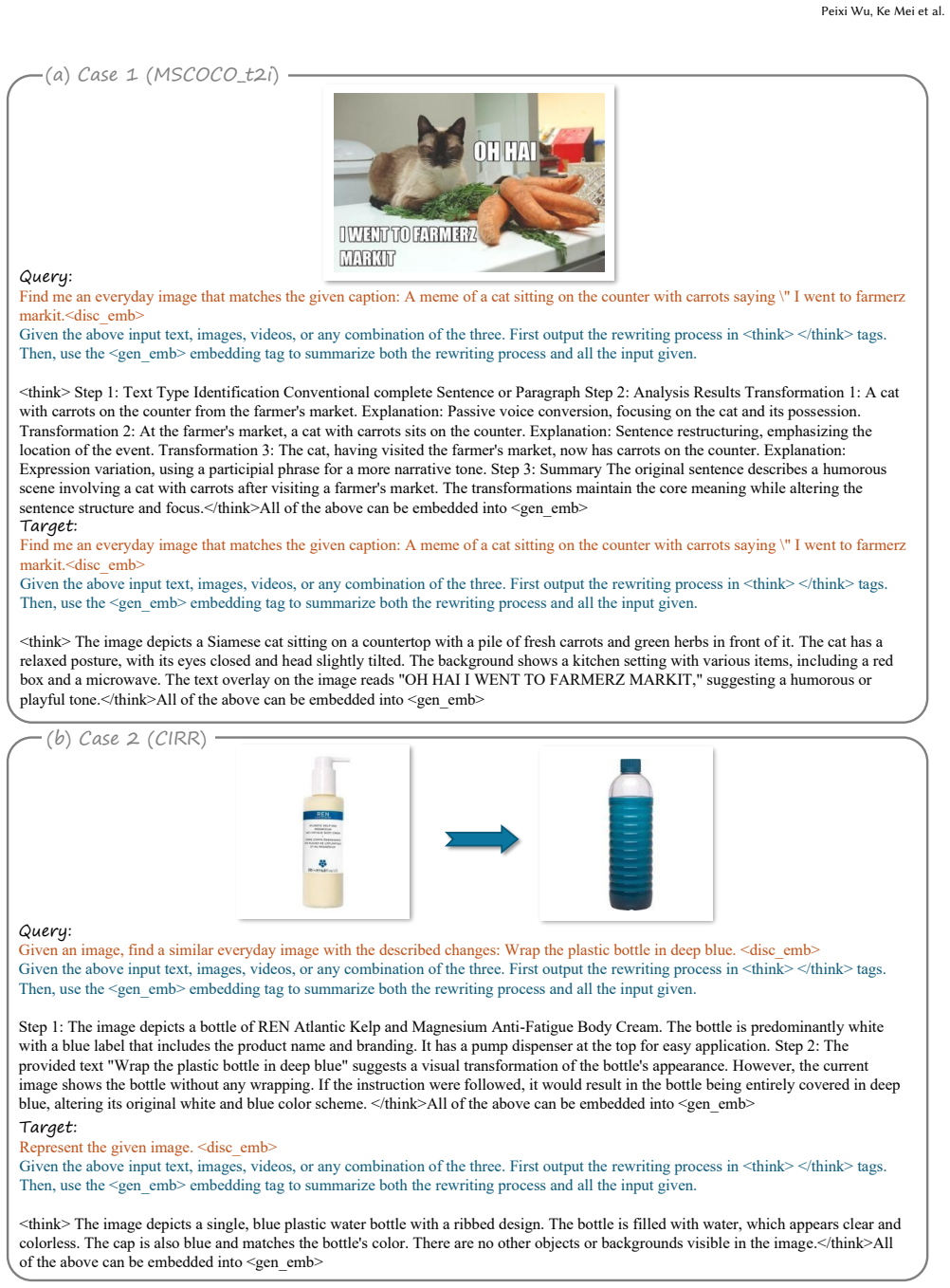
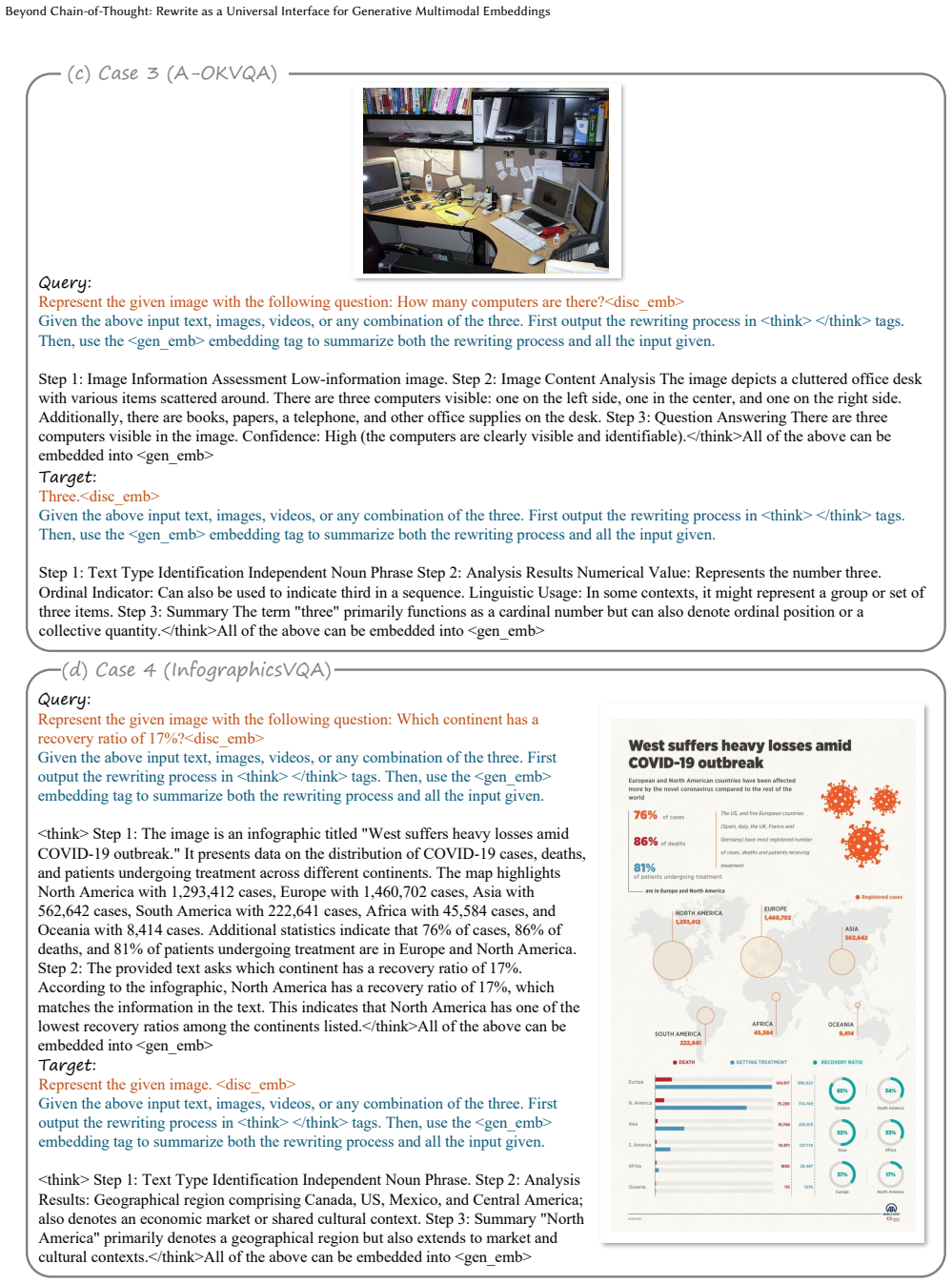
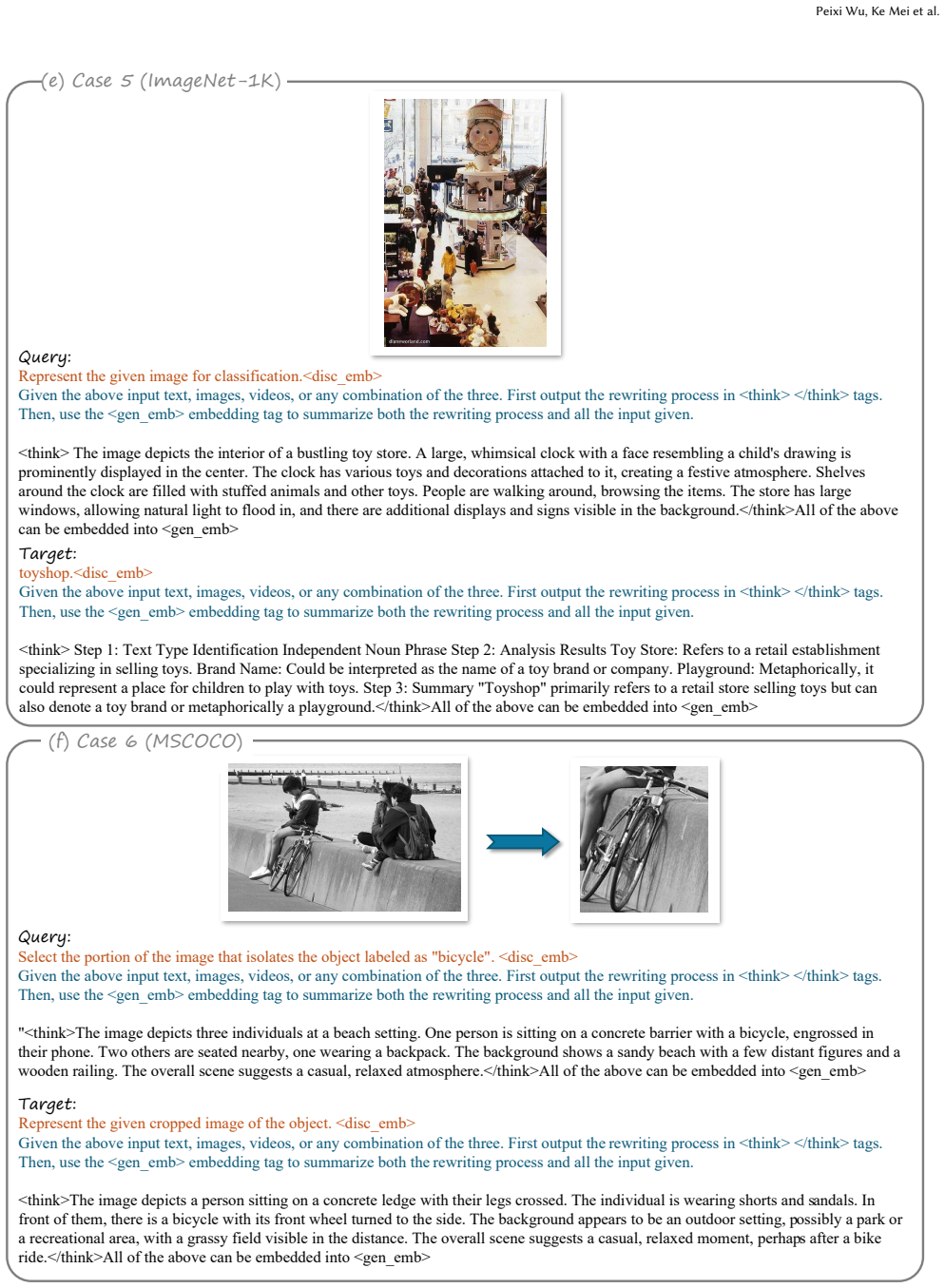
RIME is a unified framework that jointly optimizes generation and embedding through a retrieval-friendly rewrite, bridged by Cross-Mode Alignment for mutual retrieval between generative and discriminative spaces and guided by Refine-RL that anchors optimization to discriminative embeddings, resulting in substantial outperformance over prior generative models on MMEB-V2, MRMR, and UVRB while shortening the length of thinking.
What carries the argument
The retrieval-friendly rewrite step that acts as the central interface to jointly optimize generative and embedding objectives while preserving semantic content for downstream tasks.
If this is right
- Generative embeddings become usable in broader retrieval scenarios without introducing semantic ambiguity from long reasoning.
- Models gain the ability to trade off efficiency against accuracy through alignment of the two embedding spaces.
- Reinforcement learning for generation gains stability by treating discriminative embeddings as fixed semantic anchors.
- Shorter reasoning traces lower computational cost while sustaining or increasing task accuracy on embedding benchmarks.
Where Pith is reading between the lines
- The rewrite interface might extend beyond embeddings to other generative multimodal tasks such as captioning or question answering.
- Further tests on zero-shot or cross-modal retrieval could show whether the gains hold when query distributions shift from the training benchmarks.
- Integrating the rewrite with additional length penalties might yield even more compact outputs without further performance loss.
Load-bearing premise
The rewrite step preserves necessary semantic information for downstream retrieval while remaining retrieval-friendly.
What would settle it
Compare retrieval accuracy on held-out multimodal queries using RIME rewrite outputs versus direct chain-of-thought outputs; a drop below prior generative baselines would falsify the performance claim.
Figures




read the original abstract
Multimodal Large Language Models (MLLMs) have emerged as a promising foundation for universal multimodal embeddings. Recent studies have shown that reasoning-driven generative multimodal embeddings can outperform discriminative embeddings on several embedding tasks. However, Chain-of-Thought (CoT) reasoning tends to generate redundant thinking steps and introduce semantic ambiguity in the summarized answers in broader retrieval scenarios. To address this limitation, we propose Rewrite-driven Multimodal Embedding (RIME), a unified framework that jointly optimizes generation and embedding through a retrieval-friendly rewrite. Meanwhile, we present the Cross-Mode Alignment (CMA) to bridge the generative and discriminative embedding spaces, enabling flexible mutual retrieval to trade off efficiency and accuracy. Based on this, we also introduce Refine Reinforcement Learning (Refine-RL) that treats discriminative embeddings as stable semantic anchors to guide the rewrite optimization. Extensive experiments on MMEB-V2, MRMR and UVRB demonstrate that RIME substantially outperforms prior generative embedding models while significantly reducing the length of thinking.
Editorial analysis
A structured set of objections, weighed in public.
Referee Report
Summary. The paper proposes Rewrite-driven Multimodal Embedding (RIME), a unified framework replacing Chain-of-Thought reasoning with a retrieval-friendly rewrite step for generative multimodal embeddings. It introduces Cross-Mode Alignment (CMA) to bridge generative and discriminative embedding spaces for flexible mutual retrieval and Refine Reinforcement Learning (Refine-RL) that anchors rewrite optimization to stable discriminative embeddings. Experiments on MMEB-V2, MRMR, and UVRB are reported to show substantial outperformance over prior generative embedding models while reducing thinking length.
Significance. If the empirical results and ablations hold, RIME could offer a more efficient interface for generative multimodal embeddings by mitigating CoT redundancy and ambiguity, with CMA enabling trade-offs between efficiency and accuracy. The joint optimization via Refine-RL provides a concrete mechanism for aligning generative outputs to retrieval-friendly semantics.
major comments (2)
- [Abstract] Abstract: the claim of substantial outperformance on MMEB-V2, MRMR, and UVRB supplies no quantitative results, baselines, error bars, or ablation details, preventing evaluation of the central empirical claim from the provided text.
- [Abstract / §4] Abstract / §4 (Experiments): the assertion that the rewrite step preserves task-relevant semantics while remaining retrieval-friendly is not isolated from CMA alignment or Refine-RL anchoring; no controlled ablation, information-theoretic argument, or formal derivation separates the rewrite's contribution, which is load-bearing for attributing observed gains to the proposed interface rather than auxiliary objectives.
minor comments (1)
- [Abstract] Abstract: 'significantly reducing the length of thinking' lacks specific metrics (e.g., token counts or step reductions versus CoT baselines) that would clarify the efficiency claim.
Simulated Author's Rebuttal
We thank the referee for their detailed and constructive feedback on our paper. We have carefully considered each comment and provide point-by-point responses below, along with planned revisions to strengthen the manuscript.
read point-by-point responses
-
Referee: [Abstract] Abstract: the claim of substantial outperformance on MMEB-V2, MRMR, and UVRB supplies no quantitative results, baselines, error bars, or ablation details, preventing evaluation of the central empirical claim from the provided text.
Authors: We agree with the referee that the abstract lacks specific quantitative details, which would help readers quickly assess the claims. In the revised manuscript, we will update the abstract to include key performance numbers (e.g., average improvements on MMEB-V2, MRMR, and UVRB), mention the main baselines, and note that results include error bars from multiple runs. This addresses the evaluation concern directly. revision: yes
-
Referee: [Abstract / §4] Abstract / §4 (Experiments): the assertion that the rewrite step preserves task-relevant semantics while remaining retrieval-friendly is not isolated from CMA alignment or Refine-RL anchoring; no controlled ablation, information-theoretic argument, or formal derivation separates the rewrite's contribution, which is load-bearing for attributing observed gains to the proposed interface rather than auxiliary objectives.
Authors: We appreciate this point regarding the isolation of the rewrite step's contribution. The current experiments in §4 include ablations for the overall framework, but to more precisely separate the rewrite's role from CMA and Refine-RL, we will add a dedicated controlled experiment in the revision. This will involve comparing the full RIME against a variant where the rewrite is replaced by standard generation while retaining the other components. We will also include a short discussion on the semantic preservation properties of the rewrite based on embedding similarity metrics. This will better attribute the gains to the proposed rewrite interface. revision: yes
Circularity Check
No circularity: empirical claims rest on benchmarks, not self-referential derivations
full rationale
The paper introduces RIME as a framework combining a retrieval-friendly rewrite interface, Cross-Mode Alignment (CMA), and Refine-RL, but supplies no equations, first-principles derivations, or parameter-fitting steps that reduce to their own inputs. Central performance claims are supported solely by empirical results on MMEB-V2, MRMR, and UVRB; the rewrite's semantic-preservation property is asserted as a design choice rather than derived from prior fitted quantities or self-citations. No load-bearing self-citation chains, ansatz smuggling, or uniqueness theorems appear in the provided text. The derivation chain is therefore self-contained and non-circular.
Axiom & Free-Parameter Ledger
Reference graph
Works this paper leans on
-
[1]
Billel Aklouche, Ibrahim Bounhas, and Yahya Slimani. 2023. A discriminative method for global query expansion and term reweighting using co-occurrence graphs.Journal of Information Science49, 1 (2023), 183–206
2023
-
[2]
Shuai Bai, Yuxuan Cai, Ruizhe Chen, Keqin Chen, Xionghui Chen, Zesen Cheng, Lianghao Deng, Wei Ding, Chang Gao, et al. 2025. Qwen3-VL Technical Report. arXiv preprint arXiv:2511.21631(2025)
work page internal anchor Pith review arXiv 2025
-
[3]
Shuai Bai, Keqin Chen, Xuejing Liu, Jialin Wang, Wenbin Ge, Sibo Song, Kai Dang, Peng Wang, Shijie Wang, Jun Tang, et al . 2025. Qwen2. 5-vl technical report.arXiv preprint arXiv:2502.13923(2025)
work page internal anchor Pith review arXiv 2025
-
[4]
Claudio Carpineto and Giovanni Romano. 2012. A survey of automatic query expansion in information retrieval.Acm Computing Surveys (CSUR)44, 1 (2012), 1–50
2012
- [5]
- [6]
- [7]
-
[8]
Jingcheng Deng, Zhongtao Jiang, Liang Pang, Zihao Wei, Liwei Chen, Kun Xu, Yang Song, Huawei Shen, and Xueqi Cheng. 2025. Following the autoregressive nature of llm embeddings via compression and alignment. InProceedings of the 2025 Conference on Empirical Methods in Natural Language Processing. 12672– 12688
2025
-
[9]
Manuel Faysse, Hugues Sibille, Tony Wu, Bilel Omrani, Gautier Viaud, Céline Hudelot, and Pierre Colombo. 2024. Colpali: Efficient document retrieval with vision language models.arXiv preprint arXiv:2407.01449(2024)
work page internal anchor Pith review arXiv 2024
-
[10]
Yifan Gao, Chenyan Xiong, Xinyu Gao, Bofan Jia, Zhuyun Dai, Haoyu Chen, Zhiyuan Liu, Yiqun Wang, and William Yang Wang. 2022. Query Expansion by Pseudo-Relevance Feedback with Conditional Generative Models. InProceedings of the 2022 Conference on Empirical Methods in Natural Language Processing. 5574–5585
2022
- [11]
-
[12]
Daya Guo, Dejian Yang, Haowei Zhang, Junxiao Song, Ruoyu Zhang, Runxin Xu, Qihao Zhu, Shirong Ma, Peiyi Wang, Xiao Bi, et al . 2025. Deepseek-r1: Incentivizing reasoning capability in llms via reinforcement learning.arXiv preprint arXiv:2501.12948(2025)
work page internal anchor Pith review arXiv 2025
- [13]
-
[14]
Chao Jia, Yinfei Yang, Ye Xia, Yi-Ting Chen, Zarana Parekh, Hieu Pham, Quoc Le, Yun-Hsuan Sung, Zhen Li, and Tom Duerig. 2021. Scaling up visual and vision- language representation learning with noisy text supervision. InInternational conference on machine learning. PMLR, 4904–4916
2021
- [15]
- [16]
- [17]
-
[18]
Takeshi Kojima, Shixiang Shane Gu, Machel Reid, Yutaka Matsuo, and Yusuke Iwasawa. 2022. Large language models are zero-shot reasoners.Advances in neural information processing systems35 (2022), 22199–22213
2022
- [19]
- [20]
- [21]
-
[22]
Bo Li, Yuanhan Zhang, Dong Guo, Renrui Zhang, Feng Li, Hao Zhang, Kaichen Zhang, Peiyuan Zhang, Yanwei Li, Ziwei Liu, et al. 2024. LLaVA-OneVision: Easy Visual Task Transfer.arXiv preprint arXiv:2408.03326(2024)
work page internal anchor Pith review arXiv 2024
-
[23]
Feng Li, Renrui Zhang, Hao Zhang, Yuanhan Zhang, Bo Li, Wei Li, Zejun Ma, and Chunyuan Li. 2024. LLaVA-Next-Interleave: Tackling Multi-Image, Video, and 3D in Large Multimodal Models.arXiv preprint arXiv:2407.07895(2024)
work page internal anchor Pith review arXiv 2024
-
[24]
Hang Li, Ahmed Mourad, Shengyao Zhuang, Bevan Koopman, and Guido Zuccon
-
[25]
Pseudo relevance feedback with deep language models and dense retrievers: Successes and pitfalls.ACM Transactions on Information Systems41, 3 (2023), 1–40
2023
-
[26]
Junnan Li, Dongxu Li, Silvio Savarese, and Steven Hoi. 2023. Blip-2: Bootstrapping language-image pre-training with frozen image encoders and large language models. InInternational conference on machine learning. PMLR, 19730–19742
2023
- [27]
- [28]
-
[29]
Yijie Lin, Guofeng Ding, Haochen Zhou, Haobin Li, Mouxing Yang, and Xi Peng
- [30]
-
[31]
Bangwei Liu, Yicheng Bao, Shaohui Lin, Xuhong Wang, Xin Tan, Yingchun Wang, Yuan Xie, and Chaochao Lu. 2025. Idmr: Towards instance-driven precise visual correspondence in multimodal retrieval. InProceedings of the IEEE/CVF International Conference on Computer Vision. 6320–6329
2025
- [32]
-
[33]
Haotian Liu, Chunyuan Li, Qingyang Wu, and Yong Jae Lee. 2023. Visual In- struction Tuning. InAdvances in Neural Information Processing Systems, Vol. 36. 34892–34916
2023
- [34]
-
[35]
Yikun Liu, Yajie Zhang, Jiayin Cai, Xiaolong Jiang, Yao Hu, Jiangchao Yao, Yan- feng Wang, and Weidi Xie. 2025. LamRA: Large Multimodal Model as Your Advanced Retrieval Assistant. InProceedings of the IEEE/CVF Conference on Computer Vision and Pattern Recognition. 4015–4025
2025
- [36]
- [37]
-
[38]
Aaron van den Oord, Yazhe Li, and Oriol Vinyals. 2018. Representation learning with contrastive predictive coding.arXiv preprint arXiv:1807.03748(2018)
work page internal anchor Pith review arXiv 2018
-
[39]
Alec Radford, Jong Wook Kim, Chris Hallacy, Aditya Ramesh, Gabriel Goh, Sand- hini Agarwal, Girish Sastry, Amanda Askell, Pamela Mishkin, Jack Clark, et al
-
[40]
In International conference on machine learning
Learning transferable visual models from natural language supervision. In International conference on machine learning. PmLR, 8748–8763
-
[41]
Omri Uzan, Asaf Yehudai, Eyal Shnarch, Ariel Gera, et al. 2025. Guided Query Refinement: Multimodal Hybrid Retrieval with Test-Time Optimization.arXiv preprint arXiv:2510.05038(2025)
work page internal anchor Pith review Pith/arXiv arXiv 2025
-
[42]
Peng Wang, Shuai Bai, Sinan Tan, Shijie Wang, Zhihao Fan, Jinze Bai, Keqin Chen, Xuejing Liu, Jialin Wang, Wenbin Ge, et al. 2024. Qwen2-vl: Enhancing vision-language model’s perception of the world at any resolution.arXiv preprint arXiv:2409.12191(2024)
work page internal anchor Pith review arXiv 2024
-
[43]
Xiao Wang, Craig Macdonald, Nicola Tonellotto, and Iadh Ounis. 2023. ColBERT- PRF: Semantic pseudo-relevance feedback for dense passage and document retrieval.ACM Transactions on the Web17, 1 (2023), 1–39
2023
- [44]
-
[45]
Jason Wei, Xuezhi Wang, Dale Schuurmans, Maarten Bosma, Fei Xia, Ed Chi, Quoc V Le, Denny Zhou, et al. 2022. Chain-of-thought prompting elicits reason- ing in large language models.Advances in neural information processing systems 35 (2022), 24824–24837
2022
- [46]
-
[47]
Yang Xu, Gareth JF Jones, and Bin Wang. 2009. Query dependent pseudo- relevance feedback based on wikipedia. InProceedings of the 32nd international ACM SIGIR conference on Research and development in information retrieval. 59– 66. Peixi Wu, Ke Mei et al
2009
- [48]
- [49]
-
[50]
Xiaohua Zhai, Basil Mustafa, Alexander Kolesnikov, and Lucas Beyer. 2023. Sigmoid loss for language image pre-training. InProceedings of the IEEE/CVF international conference on computer vision. 11975–11986
2023
-
[51]
Ruohong Zhang, Liangke Gui, Zhiqing Sun, Yihao Feng, Keyang Xu, Yuanhan Zhang, Di Fu, Chunyuan Li, Alexander G Hauptmann, Yonatan Bisk, et al. 2025. Direct preference optimization of video large multimodal models from language model reward. InProceedings of the 2025 Conference of the Nations of the Ameri- cas Chapter of the Association for Computational L...
2025
- [52]
-
[53]
Xin Zhang, Yanzhao Zhang, Wen Xie, Mingxin Li, Ziqi Dai, Dingkun Long, Pengjun Xie, Meishan Zhang, Wenjie Li, and Min Zhang. 2024. GME: im- proving universal multimodal retrieval by multimodal LLMs.arXiv preprint arXiv:2412.16855(2024)
work page internal anchor Pith review arXiv 2024
- [54]
-
[55]
Junjie Zhou, Yongping Xiong, Zheng Liu, Ze Liu, Shitao Xiao, Yueze Wang, Bo Zhao, Chen Jason Zhang, and Defu Lian. 2025. MegaPairs: Massive Data Synthesis for Universal Multimodal Retrieval. (2025), 19076–19095
2025
-
[56]
Lanyun Zhu, Deyi Ji, Tianrun Chen, Haiyang Wu, and Shiqi Wang. 2025. Retrv-R1: A Reasoning-Driven MLLM Framework for Universal and Efficient Multimodal Retrieval.arXiv preprint arXiv:2510.02745(2025). Beyond Chain-of-Thought: Rewrite as a Universal Interface for Generative Multimodal Embeddings Beyond Chain-of-Thought: Rewrite as a Universal Interface for...
-
[57]
Computer Science: A branch of computer science dedicated to simulating human intelligence through algorithms and computational power
-
[58]
Product & Business Context: Software or hardware products and services endowed with intelligent interaction capabilities
-
[59]
Artificial Intelligence
Everyday Usage: Sometimes broadly used to describe any system or phenomenon exhibiting a degree of autonomous decision-making. Step 3: Summary "Artificial Intelligence" is a cross-disciplinary concept spanning computer science, mathematics, and cognitive science, whose meaning varies with context and requires interpretation based on the specific scenario....
2022
discussion (0)
Sign in with ORCID, Apple, or X to comment. Anyone can read and Pith papers without signing in.