Recognition: unknown
STEM: Structure-Tracing Evidence Mining for Knowledge Graphs-Driven Retrieval-Augmented Generation
Pith reviewed 2026-05-08 11:56 UTC · model grok-4.3
The pith
STEM reframes multi-hop reasoning over knowledge graphs as schema-guided graph search to raise both accuracy and evidence completeness.
A machine-rendered reading of the paper's core claim, the machinery that carries it, and where it could break.
Core claim
STEM is a framework that treats multi-hop reasoning as schema-guided graph search. A Semantic-to-Structural Projection pipeline uses knowledge-graph structural priors to break queries into atomic relational assertions and form an adaptive query schema graph. Globally-aware node anchoring and subgraph retrieval then extract the final evidence graph, guided by a Triple-Dependent GNN that produces a Global Guidance Subgraph. The method raises accuracy and evidence completeness of multi-hop reasoning graph retrieval and reaches state-of-the-art results on multiple benchmarks.
What carries the argument
The Semantic-to-Structural Projection pipeline that decomposes queries into atomic relational assertions via knowledge-graph structural priors, together with the Triple-Dependent GNN that generates a Global Guidance Subgraph to steer evidence-graph construction.
If this is right
- Multi-hop queries receive more complete evidence subgraphs because global structural information is injected during construction.
- Semantic mismatch between query and graph is reduced by building an adaptive schema graph from the knowledge graph's own priors.
- State-of-the-art performance is reached on multiple established multi-hop knowledge-graph question-answering benchmarks.
- Downstream retrieval-augmented generation benefits from higher-quality reasoning graphs supplied by the retrieval stage.
Where Pith is reading between the lines
- The same projection-plus-guidance pattern could be tested on other graph-retrieval settings that currently suffer from query-graph mismatch.
- Pairing the retrieved guidance graphs with large language models might further raise factual grounding in generation steps.
- Scaling experiments on larger, noisier knowledge graphs would show whether the projection step remains stable when structural priors are less clean.
- The approach implies that early injection of global topology can substitute for later, more expensive path-enumeration steps.
Load-bearing premise
That the Semantic-to-Structural Projection pipeline can turn queries into atomic relational assertions using knowledge-graph structural priors without substantial loss of original intent or semantic mismatch.
What would settle it
Direct evaluation on a standard multi-hop benchmark such as ComplexWebQuestions showing that STEM's retrieval accuracy or evidence-completeness scores fall below the current best reported methods.
Figures


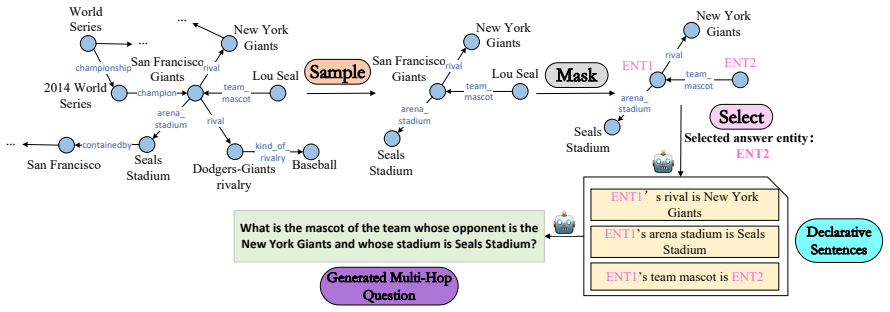


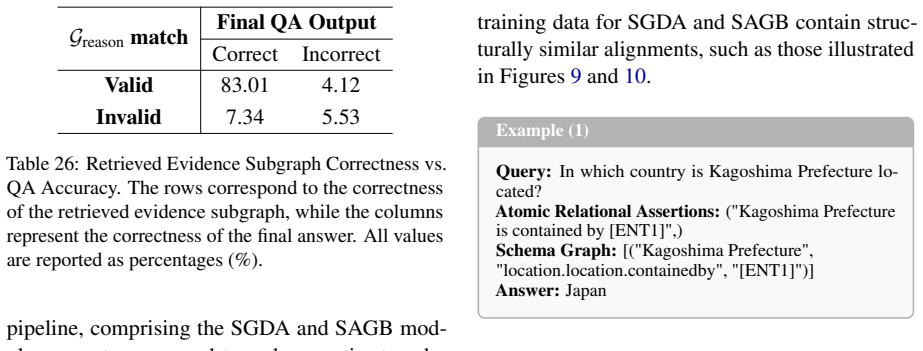
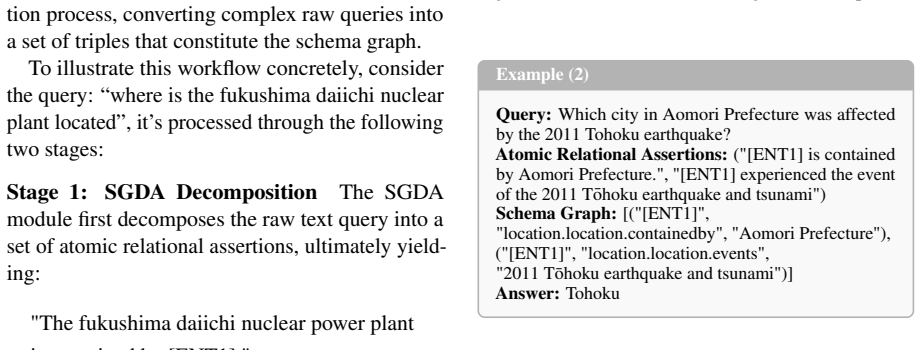
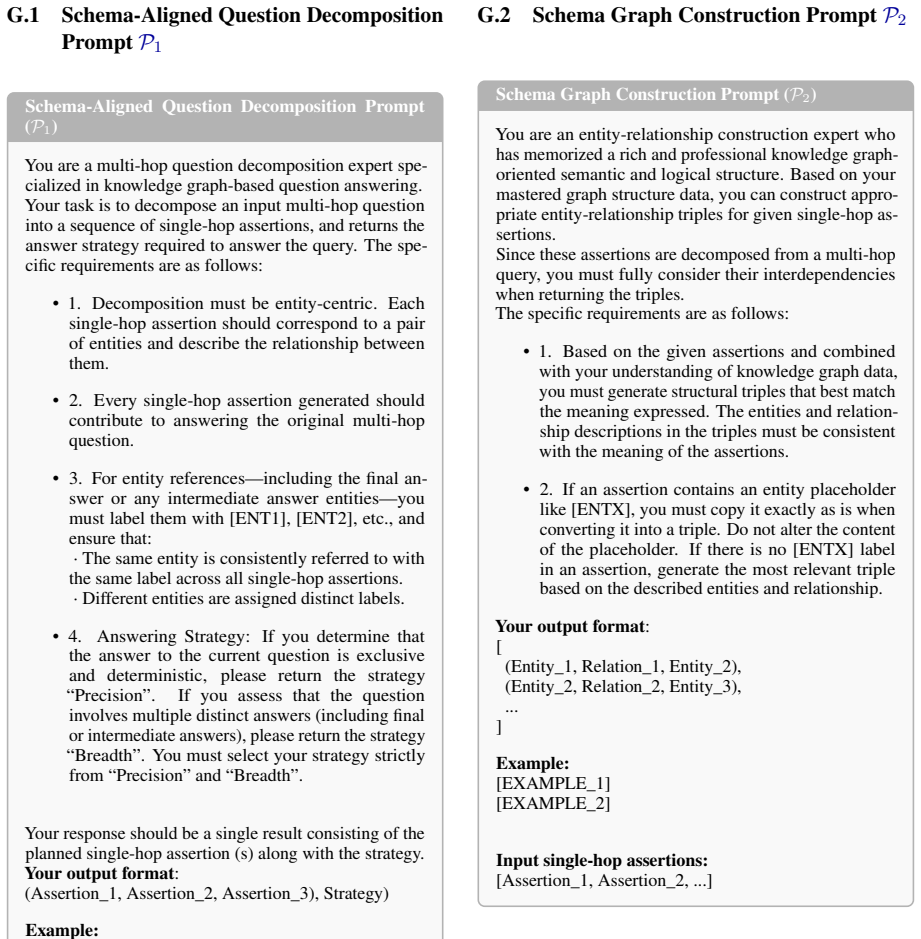



read the original abstract
Knowledge Graph-based Question Answering (KGQA) plays a pivotal role in complex reasoning tasks but remains constrained by two persistent challenges: the structural heterogeneity of Knowledge Graphs(KGs) often leads to semantic mismatch during retrieval, while existing reasoning path retrieval methods lack a global structural perspective. To address these issues, we propose Structure-Tracing Evidence Mining (STEM), a novel framework that reframes multi-hop reasoning as a schema-guided graph search task. First, we design a Semantic-to-Structural Projection pipeline that leverages KG structural priors to decompose queries into atomic relational assertions and construct an adaptive query schema graph. Subsequently, we execute globally-aware node anchoring and subgraph retrieval to obtain the final evidence reasoning graph from KG. To more effectively integrate global structural information during the graph construction process, we design a Triple-Dependent GNN (Triple-GNN) to generate a Global Guidance Subgraph (Guidance Graph) that guides the construction. STEM significantly improves both the accuracy and evidence completeness of multi-hop reasoning graph retrieval, and achieves State-of-the-Art performance on multiple multi-hop benchmarks.
Editorial analysis
A structured set of objections, weighed in public.
Referee Report
Summary. The paper proposes STEM, a framework for Knowledge Graph-based Question Answering that reframes multi-hop reasoning as a schema-guided graph search task. It introduces a Semantic-to-Structural Projection pipeline to decompose queries into atomic relational assertions and construct an adaptive query schema graph from KG structural priors, followed by globally-aware node anchoring and subgraph retrieval. A Triple-Dependent GNN (Triple-GNN) generates a Global Guidance Subgraph to integrate global structural information during construction. The central claim is that STEM significantly improves accuracy and evidence completeness of multi-hop reasoning graph retrieval and achieves SOTA performance on multiple multi-hop benchmarks.
Significance. If the empirical claims hold, the approach could advance KGQA by mitigating semantic mismatch from structural heterogeneity and providing a global structural perspective missing in prior retrieval methods. The Triple-GNN and guidance subgraph mechanism represent a potentially useful way to inject KG priors into subgraph construction for RAG.
major comments (1)
- Abstract: The manuscript asserts SOTA performance and improvements in accuracy and evidence completeness but provides no experimental details, baselines, metrics, error analysis, or data to evaluate whether results support the claims; this is a major gap for an empirical method paper.
Simulated Author's Rebuttal
We thank the referee for their review of our manuscript and for acknowledging the potential value of the Triple-GNN and guidance subgraph mechanisms. We address the single major comment below.
read point-by-point responses
-
Referee: Abstract: The manuscript asserts SOTA performance and improvements in accuracy and evidence completeness but provides no experimental details, baselines, metrics, error analysis, or data to evaluate whether results support the claims; this is a major gap for an empirical method paper.
Authors: We agree that the abstract, constrained by length, does not enumerate specific baselines, metrics, or error analysis. The full manuscript details these in Section 4 (Experiments), where we evaluate on standard multi-hop KGQA benchmarks including WebQSP, ComplexWebQuestions, and MetaQA, reporting Hits@1, F1, and evidence completeness against baselines such as PullNet, NSM, and others, with SOTA results and error analysis in Section 5. This follows conventional structure for empirical papers. To strengthen the abstract's support for the claims, we will partially revise it to include high-level references to the benchmarks and primary metrics while preserving conciseness. revision: partial
Circularity Check
No circularity in derivation chain
full rationale
The paper describes a procedural framework (Semantic-to-Structural Projection pipeline, Triple-GNN, subgraph retrieval) for KGQA without equations, fitted parameters, predictions, or first-principles derivations. No self-definitional steps, fitted inputs renamed as predictions, or load-bearing self-citations appear in the abstract or described method. Claims rest on empirical SOTA results on external benchmarks rather than internal reductions to inputs. This is a standard non-circular engineering contribution.
Axiom & Free-Parameter Ledger
axioms (1)
- domain assumption KG structural priors can be leveraged to decompose natural language queries into atomic relational assertions and construct an adaptive query schema graph
invented entities (2)
-
Triple-Dependent GNN (Triple-GNN)
no independent evidence
-
Global Guidance Subgraph (Guidance Graph)
no independent evidence
Reference graph
Works this paper leans on
-
[1]
A Study of BFLOAT16 for Deep Learning Training
A study of BFLOAT16 for deep learning train- ing.CoRR, abs/1905.12322. Vladimir Karpukhin, Barlas Oguz, Sewon Min, Patrick Lewis, Ledell Wu, Sergey Edunov, Danqi Chen, and Wen-tau Yih. 2020. Dense passage retrieval for open- domain question answering. InProceedings of the 2020 Conference on Empirical Methods in Natural Language Processing (EMNLP), pages 6...
work page Pith review arXiv 1905
-
[2]
Corrective Retrieval Augmented Generation
Corrective retrieval augmented generation. CoRR, abs/2401.15884. Bishan Yang, Wen-tau Yih, Xiaodong He, Jianfeng Gao, and Li Deng. 2015. Embedding entities and relations for learning and inference in knowledge bases. In 3rd International Conference on Learning Represen- tations, ICLR 2015. Shunyu Yao, Jeffrey Zhao, Dian Yu, Nan Du, Izhak Shafran, Karthik ...
work page internal anchor Pith review arXiv 2015
-
[3]
Qwen3 Embedding: Advancing Text Embedding and Reranking Through Foundation Models
DecAF: Joint decoding of answers and log- ical forms for question answering over knowledge bases. InThe Eleventh International Conference on Learning Representations, ICLR 2023. Wenhao Yu, Hongming Zhang, Xiaoman Pan, Peixin Cao, Kaixin Ma, Jian Li, Hongwei Wang, and Dong Yu. 2024. Chain-of-Note: Enhancing robustness in retrieval-augmented language models...
work page internal anchor Pith review arXiv 2023
-
[4]
B.2 Implementation Details STEM involves three LLM-based modules: SGDA, SAGB, and the LLM reasoning model
The distribution of answer counts in the dataset is presented in Table 9. B.2 Implementation Details STEM involves three LLM-based modules: SGDA, SAGB, and the LLM reasoning model. For the first two modules, we fine-tune Qwen3-8B9 respec- tively, and for reasoning model, we select Llama- 3.1-8B-Instruct10, Llama-3.1-70B-Instruct11, and GPT-4o12 (OpenAI, 2...
2024
-
[5]
optimizes subgraph retrieval complexity and employs both text view and graph view to enhance question comprehension, andLightProf(Ao et al.,
-
[6]
retrieves the reasoning path, then integrate KG factual and structural information into embed- dings for improved answering. With Prompting.We adopt the following ap- proaches as baselines for comparison:G-Ret(G- Retriever) (He et al., 2024) proposes a novel RAG framework that formulates subgraph retrieval as a Prize-Collecting Steiner Tree (PCST) problem...
2024
-
[7]
introduces a novel framework that enhances LLM reasoning by incorporating super-relations in knowledge graphs.MFC(Zhang et al., 2025a) transforms questions into knowledge graph triples using LLMs and quantifies question quality based on cognitive metrics.SubgraphRAG(Li et al.,
-
[8]
decouples the roles of knowledge graphs and LLMs in RAG systems.GNN-RAG(Mavromatis and Karypis, 2025) leverages lightweight GNNs for efficient graph retrieval.ProgRAG(Park et al.,
2025
-
[9]
[ENTX]” is used; (2) different entities are distinguished by different identifiers (“[ENTX]
introduces feedback-aware and evidence- aware mechanisms to progressively align LLM rea- soning with factual knowledge from graphs. C Training Setup C.1 Basic Training Configuration Our work involves the training of three modules: Schema-Grounded Decomposition Agent, Symbol- Aligned Graph Builder, and Triple-GNN15. We will sequentially introduce the data ...
2025
-
[10]
Due to the constraints of the controlled variable method, the value of τ is set to 0.2 for all experiments
End-to-End QA Performance:We integrated SGDA, SAGB, and Triple-GNN into the complete 1.2 1.5 1.8 2.1 2.4 2.740 50 60 70 80 67.15 70.18 70.3 70.54 70.12 70.35 52.71 54.22 54.16 53.19 54.1 53.98 Multiplicative factorλ F1 (%) WebQSP (sub) CWQ (sub) (a) Performance comparison with different λ. Due to the constraints of the controlled variable method, the valu...
-
[11]
schema hallucination
It is evident that incorporating the Daug data leads to significant improvements in schema gener- ation Precision, Recall, and F1 scores across both test sets. Notably, on WebQSP, the inclusion of Daug yields a Recall increase of approximately 15% and an F1 improvement exceeding 14%. Similarly, the CWQ dataset witnesses a marked 15% rise in Precision and ...
2025
-
[12]
the airport near rome is [ENT1]
("the airport near rome is [ENT1].",)
-
[13]
rome is served by a nearby airport, [ENT1]
("rome is served by a nearby airport, [ENT1].",)
-
[14]
[ENT1] is a nearby airport for rome
("[ENT1] is a nearby airport for rome.",) StrategyBreadth Schema Graphs1. [("rome", "location.location.nearby_airports", "[ENT1]")] Retrieved 1. [("Rome", "location.location.nearby_airports", "Ciampino–G. B. Pastine International Airport")]
-
[15]
Rome", "location.location.nearby_airports
[("Rome", "location.location.nearby_airports", "Leonardo da Vinci–Fiumicino Airport")] Ground Truth (2 items) Ciampino–G. B. Pastine International Airport, Leonardo da Vinci–Fiumicino Airport Output Answer Ciampino - G. B. Pastine International Airport and Leonardo da Vinci – Fiumicino Airport. Table 17: Case study C1: Interpretability analysis on the Web...
-
[16]
texarkana, arkansas is a country within [ENT1]
("texarkana, arkansas is a country within [ENT1].",)
-
[17]
texarkana arkansas is part of the country [ENT1]
("texarkana arkansas is part of the country [ENT1].",)
-
[18]
the country to which texarkana arkansas belongs is [ENT1]
("the country to which texarkana arkansas belongs is [ENT1].",) StrategyPrecision Schema Graphs1. [("texarkana arkansas", "location.location.containedby", "[ENT1]")]
-
[19]
texarkana arkansas
[("texarkana arkansas", "location.hud_county_place.county", "[ENT1]")]
-
[20]
texarkana arkansas
[("texarkana arkansas", "location.administrative_division", "[ENT1]")] Retrieved1. [("Beech Street Historic District", "location.location.containedby", "Texarkana, Arkansas")]
-
[21]
texarkana, arkansas
[("texarkana, arkansas", "location.hud_county_place.county", "Miller County")]
-
[22]
Arkansas
[("Arkansas","location.administrative_division.country","United States of America")] Ground TruthMiller County Output AnswerMiller County Table 18: Case study C2: Interpretability analysis on the WebQSP dataset. Questionwhat style of music did bessie smith perform Assertions1. ("bessie smith’s music genre is [ENT1]",)
-
[23]
the music genre of bessie smith is [ENT1]
("the music genre of bessie smith is [ENT1].",)
-
[24]
bessie smith’s genre of music is [ENT1]
("bessie smith’s genre of music is [ENT1].",)
-
[25]
[ENT1] is the music genre associated with bessie smith
("[ENT1] is the music genre associated with bessie smith.",) StrategyPrecision Schema Graphs1. [("bessie smith", "music.artist.genre", "[ENT1]")] Retrieved1. [("Bessie Smith", "music.artist.genre", "Jazz")] Ground TruthJazz Output AnswerJazz Table 19: Case study C3: Interpretability analysis on the WebQSP dataset. Question What educational institution wit...
-
[26]
The school sports team known as the Wisconsin Badgers belongs to [ENT1]
("The school sports team known as the Wisconsin Badgers belongs to [ENT1].", "The educational institution that Russell Wilson attended is [ENT1].")
-
[27]
[ENT1]’s official school sports team is called the Wisconsin Badgers
("[ENT1]’s official school sports team is called the Wisconsin Badgers.", "Russell Wilson’s educational institution is [ENT1].")
-
[28]
[ENT1] is the institution that fields the Wisconsin Badgers sports team
("[ENT1] is the institution that fields the Wisconsin Badgers sports team.", "Russell Wilson received his education at [ENT1].") StrategyPrecision Schema Graphs 1.[("Wisconsin Badgers", "sports.sports_league.teams", "[ENT1]"), ("Russell Wilson", "edu- cation.education.institution", "[ENT1]")] 2.[("Wisconsin Badgers", "sports.school_sports_team.team", "[EN...
-
[29]
Jenny’s father is a character in [ENT1]
("Jenny’s father is a character in [ENT1].", "[ENT2] appears as an actor in [ENT1].")
-
[30]
Jenny’s father is a character in movie [ENT1]
("Jenny’s father is a character in movie [ENT1].", "[ENT2] is a character in [ENT1].", "[ENT3] portrayed [ENT2] in the film.") StrategyPrecision Schema Graphs1.[("Jenny’s Father", "film.performance.character", "[ENT1]"), ("[ENT2]", "film.performance.actor", "[ENT1]")] 2.[("Jenny’s Father", "film.film_character.portrayed_in_films", "[ENT1]"), ("[ENT2]", "f...
-
[31]
Corfu is belong to [ENT1]
("Corfu is belong to [ENT1].", "[ENT1]’s official language is [ENT2].")
-
[32]
Corfu is an administrative division of [ENT1]
("Corfu is an administrative division of [ENT1].", "[ENT1]’s official language is [ENT2].") StrategyBreadth Schema Graphs1.[("Corfu", "location.country.official_language", "[ENT1]")] 2.[("Corfu", "location.location.containedby", "[ENT1]"), ("[ENT1]", "location.country.official_language", "[ENT2]")] 3.[("Corfu", "location.administrative_division.country", ...
-
[33]
The capital cities of [ENT1] are Brussels
("The capital cities of [ENT1] are Brussels.", "The European Union is composed of [ENT1].")
-
[34]
Brussels serves as the capital city for [ENT1]
("Brussels serves as the capital city for [ENT1].", "The member states of the European Union are [ENT1].")
-
[35]
Brussels is the capital city of [ENT1]
("Brussels is the capital city of [ENT1]", "European Union contains [ENT1].") StrategyPrecision Schema Graphs1. [("Brussels", "location.administrative_division.capital", "[ENT1]"]), ("[ENT1]", "location.location.containedby", "European Union")]
-
[36]
Brussels
[("Brussels", "location.location.containedby", "[ENT1]"]), ("[ENT1]", "location.location.containedby", "European Union")]
-
[37]
Brussels
[("Brussels", "location.administrative_division.capital", "[ENT1]"]), ("[ENT1]", "organization.membership_organization.members", "European Union")]
-
[38]
Brussels
[("Brussels", "location.administrative_division.capital", "[ENT1]"]), ("[ENT1]", "location.location.containedby", "European Union")] Retrieved1. [("European Union", "organization.organization.founders", "Belgium"), ("Brussels", "location.administrative_division.capital", "Belgium")]
-
[39]
European Union
[("European Union", "organization.membership_organization.members", "France"), ("Paris", "location.administrative_division.capital", "France")] Ground TruthBelgium Output AnswerBelgium Table 23: Case study C7: Interpretability analysis on the CWQ dataset. A critical factor influencing the execution ef- ficiency of STEM is the subgraph search mode, which i...
2011
discussion (0)
Sign in with ORCID, Apple, or X to comment. Anyone can read and Pith papers without signing in.