Recognition: unknown
Interplay of inertia and external forcing in Kuramoto model
Pith reviewed 2026-05-08 08:45 UTC · model grok-4.3
The pith
Competition between external forcing and bimodal frequencies suppresses standing wave states in inertial Kuramoto oscillators.
A machine-rendered reading of the paper's core claim, the machinery that carries it, and where it could break.
Core claim
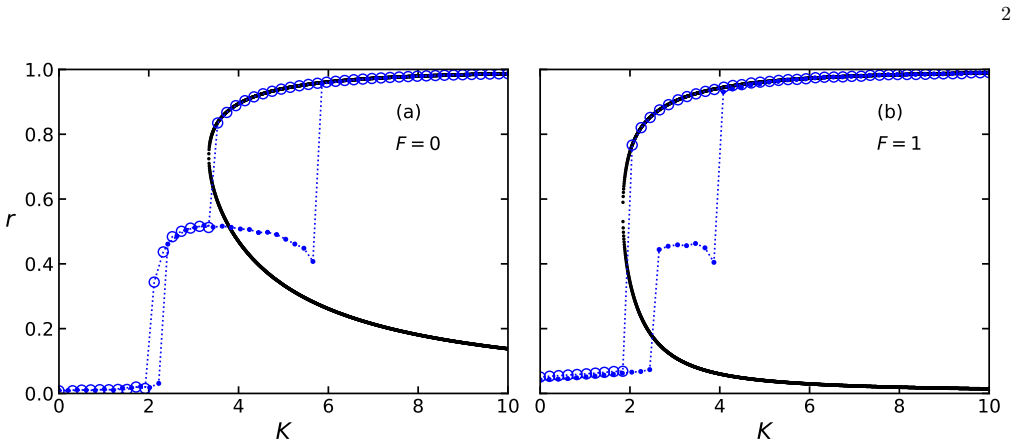
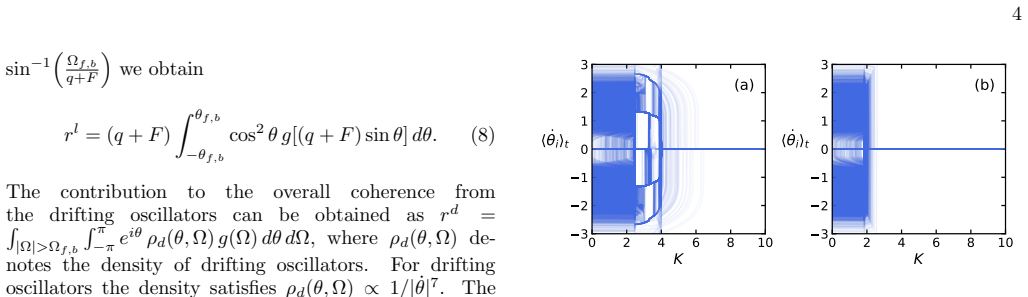
Using a self-consistent analytical framework, the study shows that external forcing competes with the intrinsic bimodality to suppress intermediate standing wave states by entraining oscillators to the forcing. For bimodal distributions, this forcing renders the backward synchronization transition discontinuous, unlike the continuous transition in the unimodal inertial case. For bi-delta distributions, a closed-form expression is obtained for the backward solution branch.
What carries the argument
Self-consistent analytical framework for the inertial Kuramoto model with external forcing and bimodal frequency distributions, which tracks entrainment and the resulting changes in synchronization transitions.
If this is right
- Standing wave states are eliminated in bimodal inertial Kuramoto models once external forcing exceeds a threshold set by the frequency separation.
- The backward transition from coherence to incoherence becomes discontinuous for any bimodal frequency distribution under forcing.
- An exact closed-form expression exists for the backward solution branch when the frequency distribution consists of two delta peaks.
- The same competition between forcing and bimodality shapes collective dynamics in systems such as photoreceptor and pacemaker cells.
Where Pith is reading between the lines
- The suppression mechanism may extend to frequency distributions with more than two modes if the forcing can still entrain the dominant clusters.
- Pinning-control strategies in multi-agent networks could exploit the discontinuous transition to achieve abrupt switches between states by tuning forcing amplitude.
- Direct comparison of the derived closed-form branch with numerical integration for bi-delta cases would provide a sharp test of the analytical framework.
Load-bearing premise
The self-consistent analytical framework captures the suppression of standing waves and the change in transition character without additional unstated restrictions on forcing strength or distribution parameters.
What would settle it
Numerical simulations or laboratory experiments that continue to observe persistent standing-wave states under strong external forcing in a bimodal inertial Kuramoto system would falsify the claimed suppression.
Figures



read the original abstract
The impact of external forcing is well studied in the Kuramoto model without inertia, but remains unclear for inertial Kuramoto oscillators (KMI) with bimodal intrinsic frequency distributions. This article fills that gap, showing that competition between external forcing and intrinsic bimodality can suppress the intermediate standing wave states of bimodal KMI by entraining oscillators to the external forcing. Using a self-consistent analytical framework, we show that, for a bimodal distribution, forcing makes the backward transition discontinuous, unlike the continuous transition in the unimodal case. Further, for a bi-delta distribution, we derive a closed form expression for the backward solution branch. These results clarify how intrinsic frequency structure shapes the effect of external forcing, with implications for biological systems (e.g., photoreceptor and pacemaker cells) and for pinning-control strategies in multi-agent networks.
Editorial analysis
A structured set of objections, weighed in public.
Referee Report
Summary. The paper examines the inertial Kuramoto model (KMI) with bimodal intrinsic frequency distributions subject to external forcing. Using a self-consistent analytical framework, it claims that forcing competes with bimodality to suppress intermediate standing-wave states, rendering the backward synchronization transition discontinuous (in contrast to the continuous transition for unimodal distributions). For the special case of a bi-delta frequency distribution, a closed-form expression is derived for the backward solution branch.
Significance. If the derivations are free of unstated restrictions on forcing strength, this clarifies how frequency structure modulates forcing effects in second-order oscillator networks, with direct relevance to biological synchronization (e.g., photoreceptors) and pinning control. The closed-form bi-delta result is a concrete strength that enables falsifiable predictions.
major comments (2)
- [§3.2, Eq. (12)] §3.2, Eq. (12): the self-consistent integral for the complex order parameter r assumes entrainment of both bimodal peaks; the derivation does not state the explicit threshold on forcing amplitude K_f relative to inertia m and peak separation 2Δω below which residual relative oscillations (standing waves) remain stable. This condition is load-bearing for the claimed suppression and discontinuity.
- [§4.1, Eq. (18)] §4.1, Eq. (18): the closed-form backward branch for the bi-delta case is obtained by solving the stationary measure, but the stability analysis of this branch against perturbations in the inertial term is not shown; without it the discontinuity claim rests on the forward branch only.
minor comments (2)
- [§2.1] The notation for the bimodal distribution (Gaussian vs. Lorentzian) should be stated explicitly in §2.1 rather than left to the reader to infer from the integrals.
- [Figure 3] Figure 3: the phase diagram axes labels omit the inertia value m used; adding a note on the fixed m would improve reproducibility.
Simulated Author's Rebuttal
We thank the referee for the careful reading and constructive comments on our manuscript. The feedback has helped us clarify the assumptions underlying our self-consistent framework and strengthen the presentation of the backward branch. We address each major comment below and have revised the manuscript to incorporate the suggested clarifications.
read point-by-point responses
-
Referee: [§3.2, Eq. (12)] the self-consistent integral for the complex order parameter r assumes entrainment of both bimodal peaks; the derivation does not state the explicit threshold on forcing amplitude K_f relative to inertia m and peak separation 2Δω below which residual relative oscillations (standing waves) remain stable. This condition is load-bearing for the claimed suppression and discontinuity.
Authors: We agree that an explicit entrainment threshold would improve clarity. In the revised manuscript we have added a short derivation immediately after Eq. (12) that obtains the condition for both peaks to be entrained by the external forcing. The threshold follows from requiring that the forcing term overcomes the inertial detuning in the self-consistent equation; it is expressed in terms of K_f, m and the peak separation. For the parameter regimes examined in the paper this threshold is satisfied, confirming suppression of standing waves and the discontinuous character of the backward transition. revision: yes
-
Referee: [§4.1, Eq. (18)] the closed-form backward branch for the bi-delta case is obtained by solving the stationary measure, but the stability analysis of this branch against perturbations in the inertial term is not shown; without it the discontinuity claim rests on the forward branch only.
Authors: We thank the referee for this observation. While the discontinuity is already visible from the hysteresis loop between forward and backward branches, we acknowledge that a direct linear stability analysis of the inertial perturbations around the closed-form backward solution was omitted. In the revised manuscript we have added this analysis (now included as a short appendix) by linearizing the second-order equations about the stationary measure and confirming that the resulting eigenvalues possess negative real parts along the backward branch for the relevant range of parameters. revision: yes
Circularity Check
No significant circularity detected in the derivation chain.
full rationale
The paper presents a self-consistent analytical framework applied to the inertial Kuramoto model with bimodal distributions and external forcing, deriving a closed-form expression for the backward solution branch in the bi-delta case. No load-bearing step is shown to reduce by construction to its own inputs, fitted parameters renamed as predictions, or self-citation chains that substitute for independent derivation. The abstract and context describe solving the model's phase equations and stationary measures directly, without evidence of self-definitional loops or ansatz smuggling. This is the most common honest finding for analytical work in the field when the equations are solved rather than assumed.
Axiom & Free-Parameter Ledger
Reference graph
Works this paper leans on
-
[1]
Peleˇ s, J
1S. Peleˇ s, J. L. Rogers, and K. Wiesenfeld, Phys. Rev. E73, 026212 (2006). 2J. Cosp, J. Madrenas, E. Alarc´ on, E. Vidal, and G. Villar, IEEE transactions on neural networks15, 1315 (2004). 3A. Pikovsky, M. Rosenblum, J. Kurths, and A. Synchronization, A universal concept in nonlinear sciences(Cambridge University Press, Princeton, 1985). 4Y. Kuramoto, ...
2006
-
[2]
5J. A. Acebr´ on, L. L. Bonilla, C. J. P´ erez Vicente, F. Ritort, and R. Spigler, Rev. Mod. Phys.77, 137 (2005). 6H.-A. Tanaka, A. J. Lichtenberg, and S. Oishi, Physica D: Non- linear Phenomena100, 279 (1997). 7H.-A. Tanaka, A. J. Lichtenberg, and S. Oishi, Phys. Rev. Lett. 78, 2104 (1997). 8B. Ermentrout, Journal of Mathematical Biology29, 571 (1991). 9...
2005
discussion (0)
Sign in with ORCID, Apple, or X to comment. Anyone can read and Pith papers without signing in.